Use the labels in the right column to find what you want. Or you can go thru them one by one, there are only 31,929 posts. Searching is done in the search box in upper left corner. I blog on anything to do with stroke. DO NOT DO ANYTHING SUGGESTED HERE AS I AM NOT MEDICALLY TRAINED, YOUR DOCTOR IS, LISTEN TO THEM. BUT I BET THEY DON'T KNOW HOW TO GET YOU 100% RECOVERED. I DON'T EITHER BUT HAVE PLENTY OF QUESTIONS FOR YOUR DOCTOR TO ANSWER.
Thursday, September 7, 2017
The readability of scientific texts is decreasing over time
All the more reason we need a great stroke association to create a database of all stroke protocols and stroke research with commentary. You don't expect your doctor to be the genius that can read, understand and implement interventions from research, Do you? A lot of what I read is total gobbledegook. https://elifesciences.org/articles/27725?utm_source=content_alert&
Clarity and accuracy of reporting are fundamental to the
scientific process. Readability formulas can estimate how difficult a
text is to read. Here, in a corpus consisting of 709,577 abstracts
published between 1881 and 2015 from 123 scientific journals, we show
that the readability of science is steadily decreasing. Our analyses
show that this trend is indicative of a growing use of general
scientific jargon. These results are concerning for scientists and for
the wider public, as they impact both the reproducibility and
accessibility of research findings. https://doi.org/10.7554/eLife.27725.001
Reporting science clearly and accurately is a fundamental part
of the scientific process, facilitating both the dissemination of
knowledge and the reproducibility of results. The clarity of written
language can be quantified using readability formulas, which estimate
how understandable written texts are (Flesch, 1948; Kincaid et al., 1975; Chall and Dale, 1995; Danielson, 1987; DuBay, 2004; Štajner et al., 2012).
Texts written at different times can vary in their readability: trends
towards simpler language have been observed in US presidential speeches (Lim, 2008), novels (Danielson et al., 1992; Jatowt and Tanaka, 2012) and news articles (Stevenson, 1964).
There are studies that have investigated linguistic trends within the
scientific literature. One study showed an increase in positive
sentiment (Vinkers et al., 2015),
finding that positive words such as 'novel' have increased dramatically
in scientific texts since the 1970s. A tentative increase in complexity
has been reported in scientific texts in a limited dataset (Hayes, 1992), but the extent of this phenomenon and any underlying reasons for such a trend remain unknown.
To investigate trends in scientific readability over time, we
downloaded 709,577 article abstracts from PubMed, from 123 highly cited
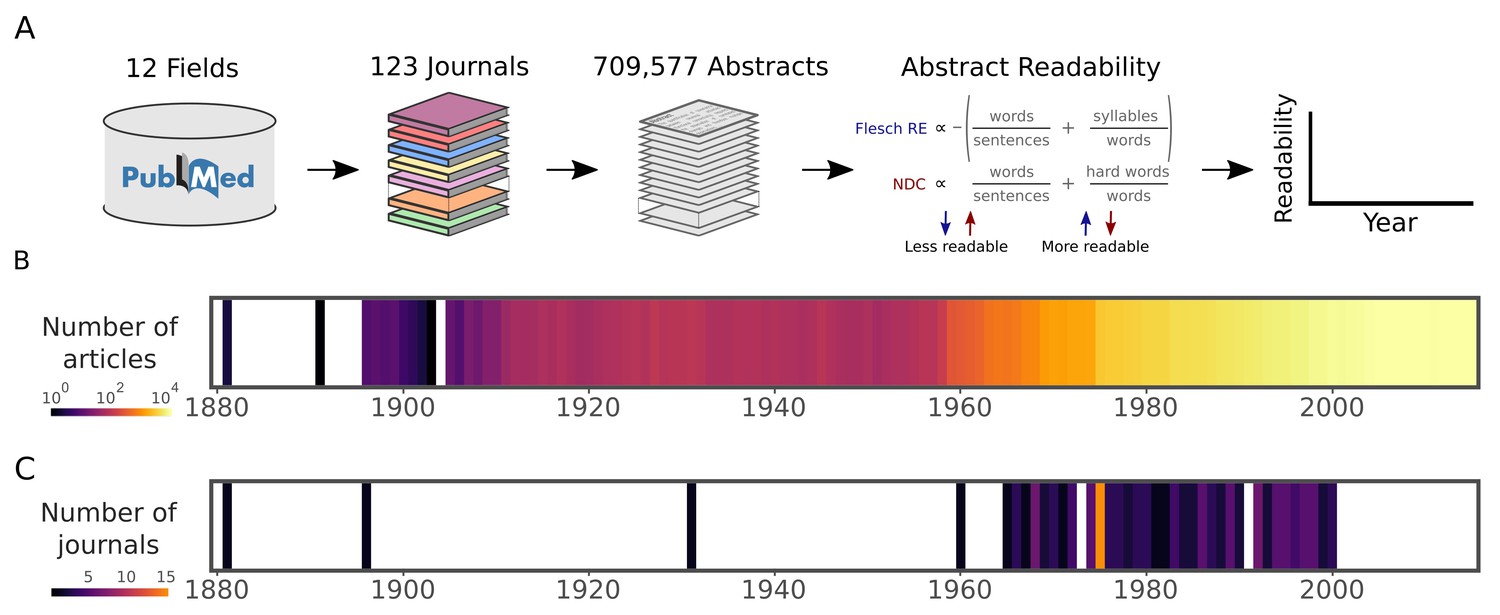
journals selected from 12 fields of research (Figure 1A–C).
These journals cover general, biomedical and life sciences. This
journal list included, among others, Nature, Science, NEJM, The Lancet,
PNAS and JAMA (see Materials and methods and Supplementary file 1)
and the publication dates ranged from 1881 to 2015. We quantified the
reading level of each abstract using two established measures of
readability: the Flesch Reading Ease (FRE; Flesch, 1948; Kincaid et al., 1975) and the New Dale-Chall Readability Formula (NDC; Chall and Dale, 1995).
The FRE is calculated using the number of syllables per word and the
number of words in each sentence. The NDC is calculated using the number
of words in each sentence and the percentage of 'difficult words'.
Difficult words are defined as those words which do not belong to a
predefined list of common words (see Materials and methods). Lower
readability is indicated by a low FRE score or a high NDC score (Figure 1A).
(A) Schematic
depicting the major steps in the abstract extraction and analysis
pipeline. Readability formulas are provided in full in
Materials and methods. (B) Number of articles in the corpus …


No comments:
Post a Comment