Now if we had ANY COMPETENCE IN STROKE AT ALL, the followup research would be the creation of protocols that fix the problems that were discovered!
Breakthrough Sensor Technology Tracks Stroke After Effects
| By HospiMedica International staff writers Posted on 06 Mar 2025 |
Stroke is a severe condition that occurs when blood vessels in the brain are either blocked or rupture, endangering life and potentially leading to long-lasting effects such as dysphagia (difficulty swallowing) and dysarthria (slurred or indistinct speech). As the second leading cause of death globally, stroke results in significant complications and has a high recurrence rate, even after treatment. Traditionally, stroke sequelae are assessed through direct examinations by healthcare professionals at hospitals, which makes it challenging to monitor changes continuously in patients' day-to-day lives. Now, an international team of researchers has developed a new method for managing stroke sequelae using a wearable sensor system to track these effects in real time.
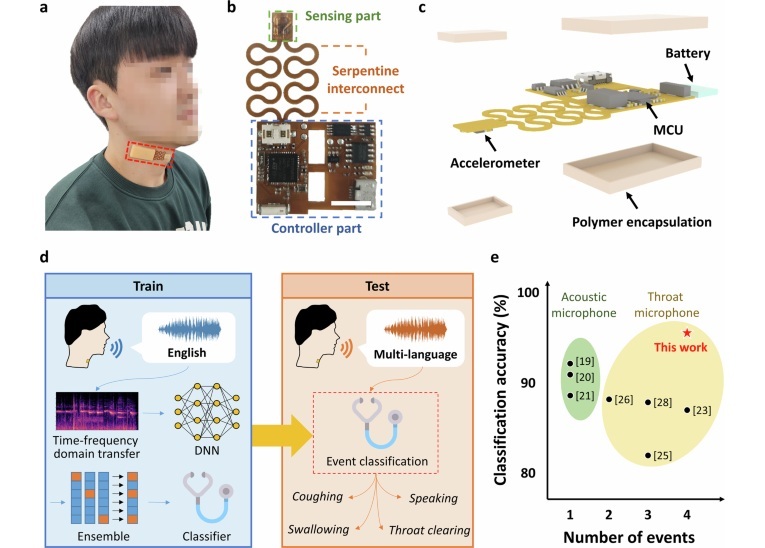
A research team from Pohang University of Science and Technology (POSTECH, Pohang, South Korea), in collaboration with the Lucerne Institute (Vitznau, Switzerland), has developed a skin-mounted sensor system capable of continuously monitoring stroke sequelae. The system features a flexible skin-mounted neck vibration sensor (STVS) that closely adheres to the skin, unaffected by surrounding noise, and accurately detects signals related to stroke effects, such as speaking, swallowing, and coughing in daily activities. The sensor incorporates a wavy structure, allowing it to naturally fit the skin and respond to movement. It remains securely attached during physical activities like walking or running, ensuring continuous data measurement. Experimental findings demonstrated that this sensor achieved more than three times the signal-to-noise ratio (SNR) improvement compared to existing wearable devices.
Moreover, the research team developed an 'ensemble classification model' based on artificial intelligence (AI) to automatically analyze the data collected by the sensor. This model allows for the precise measurement and differentiation of activities associated with stroke, such as swallowing, coughing, speaking, and throat clearing, without the need for specialized medical personnel. This feature enables a high-level medical evaluation. Clinical trials conducted at a Swiss stroke rehabilitation center, which included participants fluent in five languages—Korean, English, French, German, and Spanish—demonstrated that the sensor achieved over 96% accuracy in activity classification. These results were published in npj Digital Medicine.
"We have proposed a new paradigm for monitoring stroke sequelae in daily life through the integration of wearable sensors and AI technology," said POSTECH Professor Jeong Yoon-young. "This technology, which has proven its high accuracy and stability in various languages and environments, will significantly contribute to the diagnosis and customized treatment of various neurological disorders in the future."
Related Links:
POSTECH
Lucerne Institute


No comments:
Post a Comment