This is the whole problem in stroke enumerated in two words; 'care'; NOT RECOVERY! Guidelines; NOT PROTOCOLS!
If your hospital is touting 'care' it means they are a failure because they are delivering 'care'; NOT RECOVERY! I would never go to a failed hospital!
YOU have to get involved and change this failure mindset of 'care' to 100% RECOVERY! Survivors want RECOVERY, NOT 'CARE'!
I see nothing here that states going for 100% recovery! You need to create EXACT PROTOCOLS FOR THAT!
ASK SURVIVORS WHAT THEY WANT, THEY'LL NEVER RESPOND 'CARE'! This tyranny of low expectations has to be completely rooted out of any stroke conversation! I wouldn't go there because of such incompetency as not having 100% recovery protocols!
RECOVERY IS THE ONLY GOAL IN STROKE!
GET THERE!'
UC College of Medicine faculty help shape national guidelines for cardiovascular, stroke care
The University of Cincinnati College of Medicine is reaffirming its leadership in advancing cardiovascular and neurological health, with two faculty members contributing to newly released national guidelines from the American Heart Association (AHA), American College of Cardiology (ACC) and American Stroke Association (ASA). These groundbreaking publications are expected to shape clinical practice and improve outcomes for millions of patients across the country.
Mistry’s leadership in hypertension care
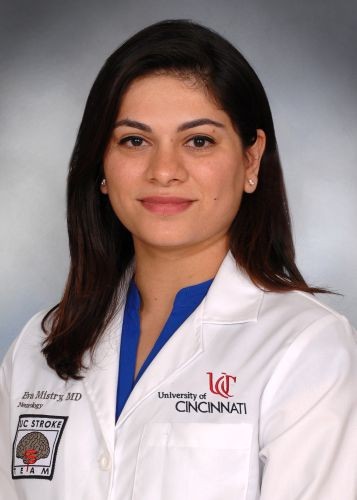
Eva A. Mistry, MBBS
Eva A. Mistry, MBBS, associate professor in the Department of Neurology & Rehabilitation Medicine, served as a co-author of the 2025 AHA/ACC Guideline for the Prevention, Detection, Evaluation and Management of High Blood Pressure in Adults. This comprehensive update to the 2017 guidelines provides evidence-based recommendations for clinicians across specialties and is poised to influence care for millions of patients living with or at risk for hypertension.
“This publication is one of the most important documents from a public health standpoint and is expected to drive care of millions of patients with high blood pressure, as well as healthy people who are at risk of developing high blood pressure. I am immensely honored to co-author this publication along with a highly accomplished, multi-disciplinary group of dedicated experts, who have all donated their time during the last two years towards this monumental effort,” Mistry shared. “There are many important updates in this guideline, such as first-line therapy, guidance on when to start treatment for blood pressure and how to prevent high blood pressure. I am hoping that this will help clinicians across the world, across specialties in detection, evaluation, management, and importantly, prevention of high blood pressure, which is one of the most important chronic diseases and leads to heart attacks, strokes, dementia and other pathologies. The most important work comes next, which is to implement these guidelines in clinical practice for the betterment of the health of all.”
Awosika’s advocacy for stroke survivors

Oluwole O. Awosika, MD
In a complementary effort, Oluwole O. Awosika, MD, associate professor of clinical in the Department of Neurology & Rehabilitation Medicine, co-authored the AHA/ASA Policy Statement for Improving Access to Stroke Rehabilitation and Recovery. This vital document addresses inequities in post-stroke care(NOT RECOVERY!) and calls for policies that ensure timely, equitable and effective rehabilitation services.
“We commonly talk about how critical time is in getting to the emergency room for life-saving treatment when symptoms of a stroke are first recognized (i.e. FAST). However, time is also of the essence with stroke recovery,” Awosika said. “While recovery is possible years after a stroke, by far, the most significant improvements occur in the days to weeks after a stroke. For this reason, every stroke survivor should be given the best chance at life by pursuing optimal recovery through timely access to quality post-acute services. It's an honor to be a voice for stroke survivors and their caregivers. My goal is to ensure they receive the highest quality of care(NOT RECOVERY!), helping to improve their outcomes and quality of life."
Excellence in academic medicine
Mistry and Awosika exemplify the College of Medicine’s commitment to advancing health through research, clinical excellence and academic service. Their leadership on national guidelines(NOT PROTOCOLS!) underscores the vital role UC physicians play in shaping the future of care(NOT RECOVERY!) — locally, nationally and globally.


No comments:
Post a Comment