With any competence at all in your stroke medical 'professionals', this would be turned into protocols and delivered to all 10 million yearly stroke survivors! But since there is NO leadership and NO strategy, NOTHING WILL OCCUR! That is how fucking incompetent your stroke medical 'professionals' are! Nothing here works for patients with spasticity.
Turning everyday objects into tools for recovery
When
people recover from a stroke, they often start by doing exercises in a
clinic. But once they go home, they need to keep exercising to keep
their hands and wrists functional. These exercises can feel boring and
hard to stick to. Many people skip the recommended 30 minutes of daily
exercises, which slows down or reverses their recovery. But what if
brushing your teeth or drinking your morning coffee could help you get
better?

At the University of Twente, researchers Juliet Haarman, Kostas Nizamis, Emiel Harmsen and Armağan Karahanoğlu have come up with a creative idea: use everyday objects as tools to help people recover. This transforms ordinary household objects into smart hand-training objects.
"We started in 2019 with a focus on wearable robotics," says Haarman, "but we quickly realised we could make it easier by using things people already have at home." This approach focuses on hand rehabilitation, particularly for stroke patients who need to maintain or regain wrist movement. The researchers partnered with Roessingh Research and Development, Roessingh Rehabilitation Centre, Hankamp Rehab, ZGT, and Saxion University to co-develop these tools with patients and physiotherapists.
From toothbrush to coffee cup
The team looked at everyday items like your toothbrush, a placemat or coffee cup to see how they could double as exercise tools. "We asked patients and experts what objects would be easiest to use," the researchers explained. The goal was to make tools that are helpful but not frustrating.
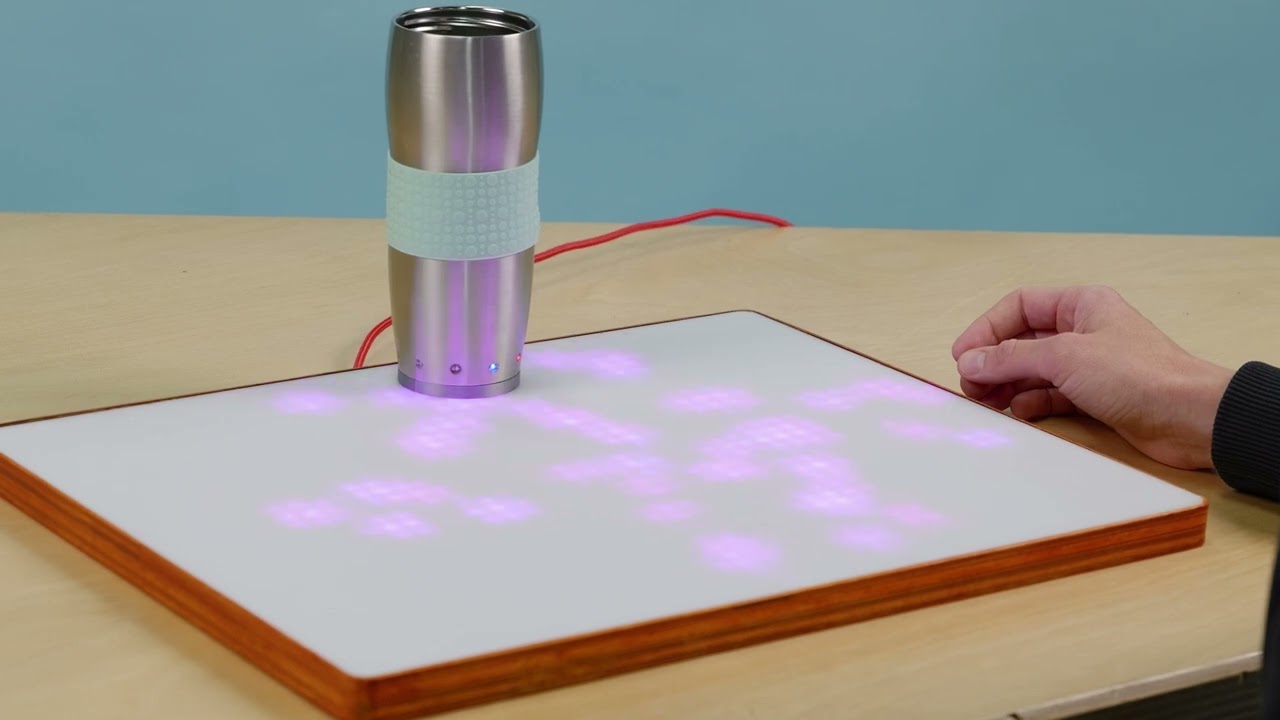
Take the toothbrush, for instance. To train wrist rotation, the team developed a brush that rotates while in use. "The toothbrush stimulates you to make a few wrist rotations, turning your brushing routine into a mini wrist workout. It is a form of training that facilitates the use of patients’ affected hand and wrist." Similarly, colourful LEDs in a placemat encourage patients to perform specific hand movements by dancing around like little fairies showing you exactly where to place your cup.
The toothbrush is way too small for my left hand fingers to get a grasp on.
Human-centred design
A previous version of the placemat which – a large wooden block with small LED screens – showed smiley faces when the cup was placed correctly. “But making it too much like a game had downsides. People got bored of the game after a while. Therefore, we redesigned it to be more subtle, so it doesn’t interrupt the drinking activity itself."
The coffee cup design evolved after initial feedback. Early versions required squeezing a glass cup with lights to give feedback, but users found it unnatural and worried the glass might break. "We switched to a stainless steel cup and made the gripping movements feel more natural." These changes show how important it is to listen to user feedback.
I can't get my fingers open enough without using my right hand to pull them open, and that would entail turning the cup sideways thus spilling the coffee! Doing it with an empty cup still wouldn't work, filling it after that would still spill since spasticity turns the wrist sideways.
Testing in real homes
The researchers soon start with small trials with stroke patients at home. Over a period of four weeks, they will track how often people use the tools and for how long. "Our first goal is to see if people actually use these objects. Once we know that, we can test if they work as well as traditional exercises."
The potential impact of these tools extends beyond the lab. The researchers hope to create a wide range of tools for different people. "For example, someone who cooks a lot might use a spatula for exercises, while a computer user might benefit from a special mouse.” By making recovery part of daily life, these tools could make it easier and more enjoyable for patients to stick to their routines.
You have a ways to go to get survivors with spasticity recovering
A new way to heal
So, what if your morning coffee or brushing your teeth could help you heal after a stroke? Thanks to these innovative researchers, it’s not just a possibility, it’s becoming a reality. These tools have the potential to transform rehabilitation, making it an intuitive and integral part of life, and bringing hope to countless patients worldwide.


No comments:
Post a Comment