Changing stroke rehab and research worldwide now.Time is Brain! trillions and trillions of neurons that DIE each day because there are NO effective hyperacute therapies besides tPA(only 12% effective). I have 523 posts on hyperacute therapy, enough for researchers to spend decades proving them out. These are my personal ideas and blog on stroke rehabilitation and stroke research. Do not attempt any of these without checking with your medical provider. Unless you join me in agitating, when you need these therapies they won't be there. Did your doctor somehow miss the recovery protocol that Pedro Bach-y-Rita used to recover fully back in 1958 with only a partial brain?

What this blog is for:

My blog is not to help survivors recover, it is to have the 10 million yearly stroke survivors light fires underneath their doctors, stroke hospitals and stroke researchers to get stroke solved. 100% recovery. The stroke medical world is completely failing at that goal, they don't even have it as a goal. Shortly after getting out of the hospital and getting NO information on the process or protocols of stroke rehabilitation and recovery I started searching on the internet and found that no other survivor received useful information. This is an attempt to cover all stroke rehabilitation information that should be readily available to survivors so they can talk with informed knowledge to their medical staff. It lays out what needs to be done to get stroke survivors closer to 100% recovery. It's quite disgusting that this information is not available from every stroke association and doctors group.

Showing posts with label reproducibility. Show all posts

Thursday, June 7, 2018

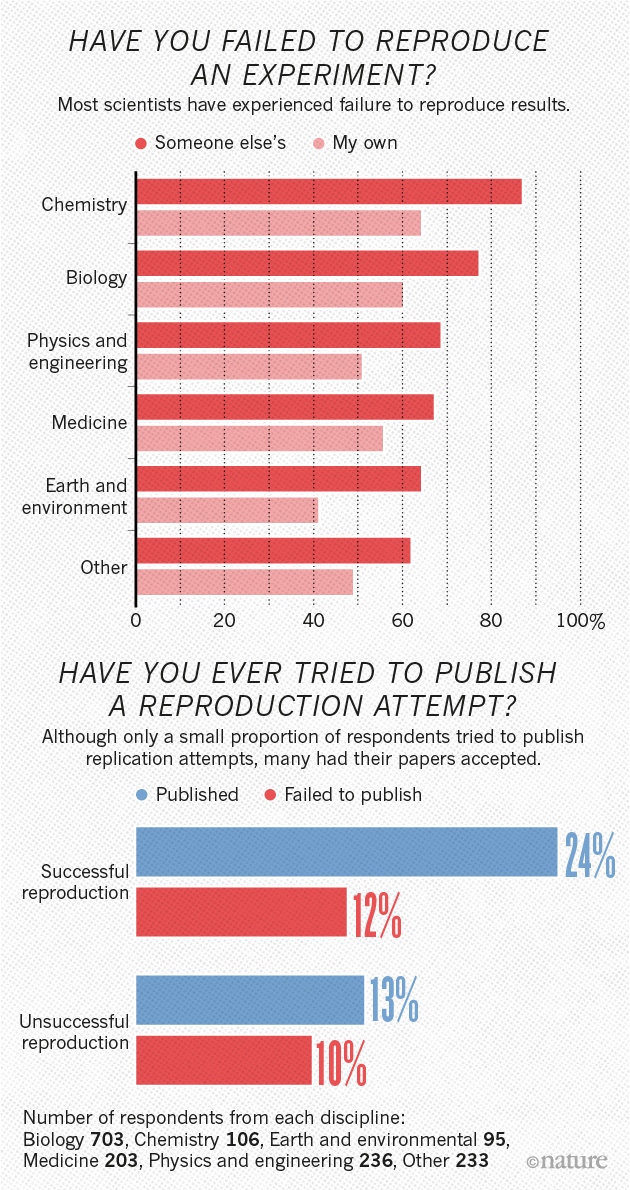
More than 70% of researchers have tried and failed to reproduce another scientist's experiments, and more than half have failed to reproduce their own experiments.

If there is not enough information to reproduce research there surely is not enough information to create a stroke protocol out of it. We're screwed, that great stroke association president should be reading the riot act to stroke researchers. 

More than 70% of researchers have tried and failed to reproduce another scientist's experiments, and more than half have failed to reproduce their own experiments.


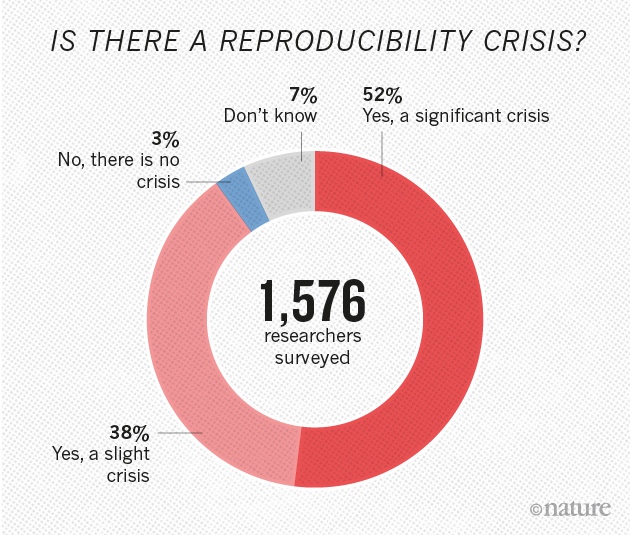
More than 70% of researchers have tried and failed to reproduce another scientist's experiments, and more than half have failed to reproduce their own experiments. Those are some of the telling figures that emerged from Nature's survey of 1,576 researchers who took a brief online questionnaire on reproducibility in research.
The data reveal sometimes-contradictory attitudes towards reproducibility. Although 52% of those surveyed agree that there is a significant 'crisis' of reproducibility, less than 31% think that failure to reproduce published results means that the result is probably wrong, and most say that they still trust the published literature.
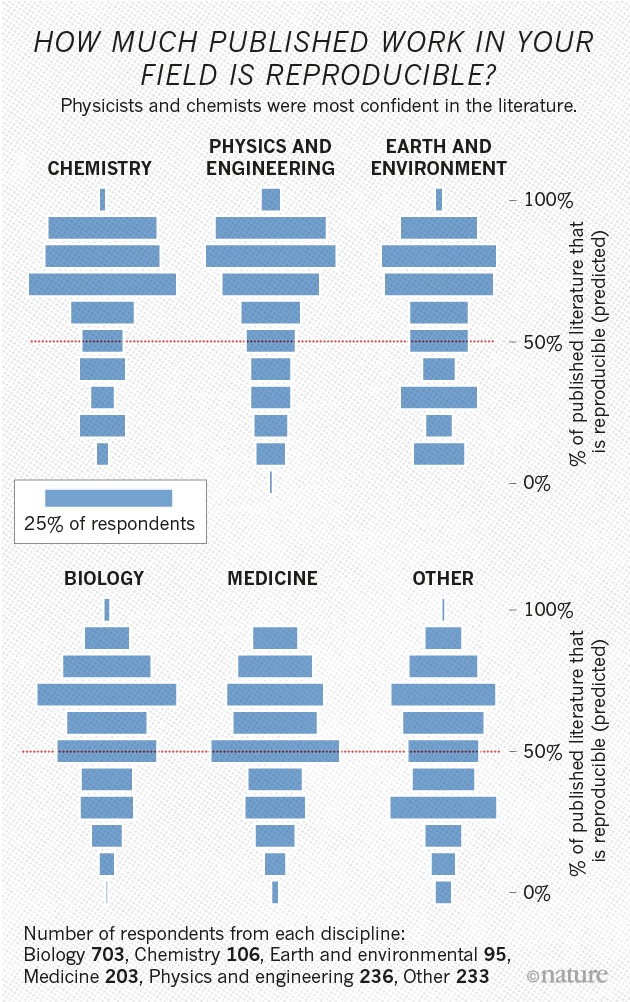
Data on how much of the scientific literature is reproducible are rare and generally bleak. The best-known analyses, from psychology1 and cancer biology2, found rates of around 40% and 10%, respectively. Our survey respondents were more optimistic: 73% said that they think that at least half of the papers in their field can be trusted, with physicists and chemists generally showing the most confidence.
The results capture a confusing snapshot of attitudes around these issues, says Arturo Casadevall, a microbiologist at the Johns Hopkins Bloomberg School of Public Health in Baltimore, Maryland. “At the current time there is no consensus on what reproducibility is or should be.” But just recognizing that is a step forward, he says. “The next step may be identifying what is the problem and to get a consensus.”
Failing to reproduce results is a rite of passage, says Marcus Munafo, a biological psychologist at the University of Bristol, UK, who has a long-standing interest in scientific reproducibility. When he was a student, he says, “I tried to replicate what looked simple from the literature, and wasn't able to. Then I had a crisis of confidence, and then I learned that my experience wasn't uncommon.”
The challenge is not to eliminate problems with reproducibility in published work. Being at the cutting edge of science means that sometimes results will not be robust, says Munafo. “We want to be discovering new things but not generating too many false leads.”

The scale of reproducibility

But sorting discoveries from false leads can be discomfiting. Although the vast majority of researchers in our survey had failed to reproduce an experiment, less than 20% of respondents said that they had ever been contacted by another researcher unable to reproduce their work. Our results are strikingly similar to another online survey of nearly 900 members of the American Society for Cell Biology (see go.nature.com/kbzs2b). That may be because such conversations are difficult. If experimenters reach out to the original researchers for help, they risk appearing incompetent or accusatory, or revealing too much about their own projects.
A minority of respondents reported ever having tried to publish a replication study. When work does not reproduce, researchers often assume there is a perfectly valid (and probably boring) reason. What's more, incentives to publish positive replications are low and journals can be reluctant to publish negative findings. In fact, several respondents who had published a failed replication said that editors and reviewers demanded that they play down comparisons with the original study.
Nevertheless, 24% said that they had been able to publish a successful replication and 13% had published a failed replication. Acceptance was more common than persistent rejection: only 12% reported being unable to publish successful attempts to reproduce others' work; 10% reported being unable to publish unsuccessful attempts.
Survey respondent Abraham Al-Ahmad at the Texas Tech University Health Sciences Center in Amarillo expected a “cold and dry rejection” when he submitted a manuscript explaining why a stem-cell technique had stopped working in his hands. He was pleasantly surprised when the paper was accepted3. The reason, he thinks, is because it offered a workaround for the problem.
Others place the ability to publish replication attempts down to a combination of luck, persistence and editors' inclinations. Survey respondent Michael Adams, a drug-development consultant, says that work showing severe flaws in an animal model of diabetes has been rejected six times, in part because it does not reveal a new drug target. By contrast, he says, work refuting the efficacy of a compound to treat Chagas disease was quickly accepted4.

The corrective measures

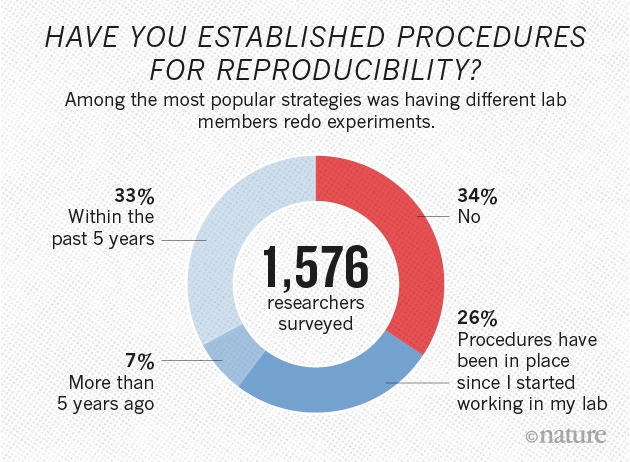
One-third of respondents said that their labs had taken concrete steps to improve reproducibility within the past five years. Rates ranged from a high of 41% in medicine to a low of 24% in physics and engineering. Free-text responses suggested that redoing the work or asking someone else within a lab to repeat the work is the most common practice. Also common are efforts to beef up the documentation and standardization of experimental methods.
Any of these can be a major undertaking. A biochemistry graduate student in the United Kingdom, who asked not to be named, says that efforts to reproduce work for her lab's projects doubles the time and materials used — in addition to the time taken to troubleshoot when some things invariably don't work. Although replication does boost confidence in results, she says, the costs mean that she performs checks only for innovative projects or unexpected results.
Consolidating methods is a project unto itself, says Laura Shankman, a postdoc studying smooth muscle cells at the University of Virginia, Charlottesville. After several postdocs and graduate students left her lab within a short time, remaining members had trouble getting consistent results in their experiments. The lab decided to take some time off from new questions to repeat published work, and this revealed that lab protocols had gradually diverged. She thinks that the lab saved money overall by getting synchronized instead of troubleshooting failed experiments piecemeal, but that it was a long-term investment.
Irakli Loladze, a mathematical biologist at Bryan College of Health Sciences in Lincoln, Nebraska, estimates that efforts to ensure reproducibility can increase the time spent on a project by 30%, even for his theoretical work. He checks that all steps from raw data to the final figure can be retraced. But those tasks quickly become just part of the job. “Reproducibility is like brushing your teeth,” he says. “It is good for you, but it takes time and effort. Once you learn it, it becomes a habit.”
One of the best-publicized approaches to boosting reproducibility is pre-registration, where scientists submit hypotheses and plans for data analysis to a third party before performing experiments, to prevent cherry-picking statistically significant results later. Fewer than a dozen people mentioned this strategy. One who did was Hanne Watkins, a graduate student studying moral decision-making at the University of Melbourne in Australia. Going back to her original questions after collecting data, she says, kept her from going down a rabbit hole. And the process, although time consuming, was no more arduous than getting ethical approval or formatting survey questions. “If it's built in right from the start,” she says, “it's just part of the routine of doing a study.”

The cause

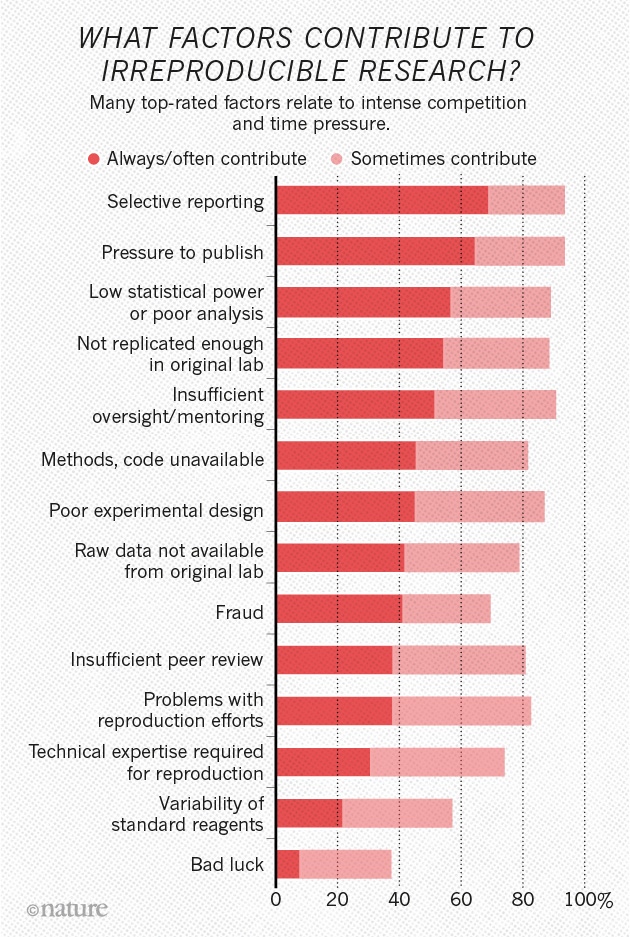
The survey asked scientists what led to problems in reproducibility. More than 60% of respondents said that each of two factors — pressure to publish and selective reporting — always or often contributed. More than half pointed to insufficient replication in the lab, poor oversight or low statistical power. A smaller proportion pointed to obstacles such as variability in reagents or the use of specialized techniques that are difficult to repeat.
But all these factors are exacerbated by common forces, says Judith Kimble, a developmental biologist at the University of Wisconsin–Madison: competition for grants and positions, and a growing burden of bureaucracy that takes away from time spent doing and designing research. “Everyone is stretched thinner these days,” she says. And the cost extends beyond any particular research project. If graduate students train in labs where senior members have little time for their juniors, they may go on to establish their own labs without having a model of how training and mentoring should work. “They will go off and make it worse,” Kimble says.
What can be done?

Respondents were asked to rate 11 different approaches to improving reproducibility in science, and all got ringing endorsements. Nearly 90% — more than 1,000 people — ticked “More robust experimental design” “better statistics” and “better mentorship”. Those ranked higher than the option of providing incentives (such as funding or credit towards tenure) for reproducibility-enhancing practices. But even the lowest-ranked item — journal checklists — won a whopping 69% endorsement.
The survey — which was e-mailed to Nature readers and advertised on affiliated websites and social-media outlets as being 'about reproducibility' — probably selected for respondents who are more receptive to and aware of concerns about reproducibility. Nevertheless, the results suggest that journals, funders and research institutions that advance policies to address the issue would probably find cooperation, says John Ioannidis, who studies scientific robustness at Stanford University in California. “People would probably welcome such initiatives.” About 80% of respondents thought that funders and publishers should do more to improve reproducibility.
“It's healthy that people are aware of the issues and open to a range of straightforward ways to improve them,” says Munafo. And given that these ideas are being widely discussed, even in mainstream media, tackling the initiative now may be crucial. “If we don't act on this, then the moment will pass, and people will get tired of being told that they need to do something.”
Download the full questionnaire used in the survey and the raw data in a spreadsheet (the data are also available as a tab-delimited file at Figshare).
Nature
533,
452–454
()
doi:10.1038/533452a

Wednesday, June 22, 2016

Complying With the National Institutes of Health Guidelines and Principles for Rigor and Reproducibility

Our fucking failures of stroke associations should have enough employees that can monitor that stroke research meets these guidelines. But they won't, it would be too much like hard work. They would have to keep track of all research and do a better job than I can. If they were my minions they would accomplish that with no questions asked.
http://atvb.ahajournals.org/content/36/7/1303.extract?etoc
  1. Christian Weber
+ Author Affiliations
  1. From the Saha Cardiovascular Research Center and Department of Physiology, University of Kentucky, Lexington (A.D.); Department of Medicine and Robarts Research Institute, Schulich School of Medicine and Dentistry, Western University, London, Ontario, Canada (R.A.H.); Department of Medicine, University of North Carolina at Chapel Hill (N.M.); Departments of Medicine and Department of Genetics, Perelman School of Medicine, University of Pennsylvania, Philadelphia (D.J.R.); Diabetes Research Program, Division of Endocrinology, Department of Medicine, New York University Langone Medical Center (A.M.S.); and Institute for Cardiovascular Prevention, and Department of Medicine, Ludwig-Maximilians-Universität (LMU) and German Centre for Cardiovascular Research (DZHK), partner site Munich Heart Alliance, Munich, Germany (C.W.).
  1. Correspondence to Alan Daugherty, University of Kentucky, Saha Cardiovascular Research Center, 741 S Limestone - BBSRB Room 243, Lexington, KY 40536. E-mail Alan.Daugherty@uky.edu

In 2014, the National Institutes of Health (NIH) delivered a document that described the principles and guidelines for reporting preclinical research (https://www.nih.gov/research-training/rigor-reproducibility/principles-guidelines-reporting-preclinical-research). These principles and guidelines were developed in a workshop that addressed the concern of reproducibility of preclinical research and were built on previous NIH recommendations for transparency in reporting data.1 A major driving force behind this effort stemmed from concerns voiced by the pharmaceutical industry that described their failure to replicate studies performed in academic laboratories2,3 These issues have also attracted attention through commentaries in both scientific journals4 and the lay press.5
As guardians of a large investment of public funds, the NIH aspires to promote confidence in science through enhanced reporting of protocols and data in journals, focusing in particular on reproducibility of results of similar experiments performed in different laboratories. A wide spectrum of scientific leaders, including many journal editors, attended the meeting at which this document was developed. The consequent report emphasized the need for journals to modify their editorial processes in several respects. These included requirement that authors document a detailed description of statistical analyses and data reporting with the aim of increasing transparency, sharing of data and materials, and establishing best practices for reagent verification. An additional requirement was for journals to establish a standard mechanism for the reporting of refutations of published work. All American Heart Association journals, including ATVB, have endorsed these NIH guidelines.
The NIH guidelines state specifically that “the journal assumes responsibility …

Wednesday, June 1, 2016

What does research reproducibility mean?

I'd be willing to bet that none of the clinical stroke research trials since forever are reproducible or replicable.  Because they don't have an objective starting point of exact description of the size and location of the dead/damaged areas.
Definitions from Retraction Watch
Here’s how the US National Science Foundation (NSF) defines “reproducibility,” according to the authors:
…reproducibility refers to the ability of a researcher to duplicate the results of a prior study using the same materials as were used by the original investigator. That is, a second researcher might use the same raw data to build the same analysis files and implement the same statistical analysis in an attempt to yield the same results…. Reproducibility is a minimum necessary condition for a finding to be believable and informative.
And here’s how the NSF defines “replicability,” the authors say:
…the ability of a researcher to duplicate the results of a prior study if the same procedures are followed but new data are collected.

What does research reproducibility mean?

Science Translational Medicine  01 Jun 2016:
Vol. 8, Issue 341, pp. 341ps12
DOI: 10.1126/scitranslmed.aaf5027
You are currently viewing the abstract.
View Full Text

Abstract

The language and conceptual framework of “research reproducibility” are nonstandard and unsettled across the sciences. In this Perspective, we review an array of explicit and implicit definitions of reproducibility and related terminology, and discuss how to avoid potential misunderstandings when these terms are used as a surrogate for “truth.”