Changing stroke rehab and research worldwide now.Time is Brain! trillions and trillions of neurons that DIE each day because there are NO effective hyperacute therapies besides tPA(only 12% effective). I have 523 posts on hyperacute therapy, enough for researchers to spend decades proving them out. These are my personal ideas and blog on stroke rehabilitation and stroke research. Do not attempt any of these without checking with your medical provider. Unless you join me in agitating, when you need these therapies they won't be there. Did your doctor somehow miss the recovery protocol that Pedro Bach-y-Rita used to recover fully back in 1958 with only a partial brain?

What this blog is for:

My blog is not to help survivors recover, it is to have the 10 million yearly stroke survivors light fires underneath their doctors, stroke hospitals and stroke researchers to get stroke solved. 100% recovery. The stroke medical world is completely failing at that goal, they don't even have it as a goal. Shortly after getting out of the hospital and getting NO information on the process or protocols of stroke rehabilitation and recovery I started searching on the internet and found that no other survivor received useful information. This is an attempt to cover all stroke rehabilitation information that should be readily available to survivors so they can talk with informed knowledge to their medical staff. It lays out what needs to be done to get stroke survivors closer to 100% recovery. It's quite disgusting that this information is not available from every stroke association and doctors group.

Showing posts with label Moterum I Stride device. Show all posts

Sunday, February 4, 2024

Stroke patients see progress with USF professor’s stroke therapy shoe

Well shit, hasn't your doctor been using this since March 2019? Or don't you have a functioning stroke doctor? Video at link.

YOUR HEALTH: How a new shoe could give the boot to a stroke victim’s limp

March 2019

The latest here:

Stroke patients see progress with USF professor’s stroke therapy shoe

A newly published study on a stroke therapy shoe shows that patients made great strides in relearning how to walk using the device, and a University of South Florida professor is behind the invention.

One of the patients was Maria Magdalena Valencia Juares of Mexico. Also known as Elena, she suffered a stroke in 2021 and could not leave her rural home in Guadalajara with more than 100 stairs.

"Since the stroke, she had nearly no mobility, like her ability to walk was extremely limited," said KC Hostetler, one of Elena’s daughters. "By the time I got to her, she'd been isolated for a year. She was just really, she was in a really bad place."

Her family went looking for help, coming across the I-Stride device, an invention by USF professor Kyle Reed.
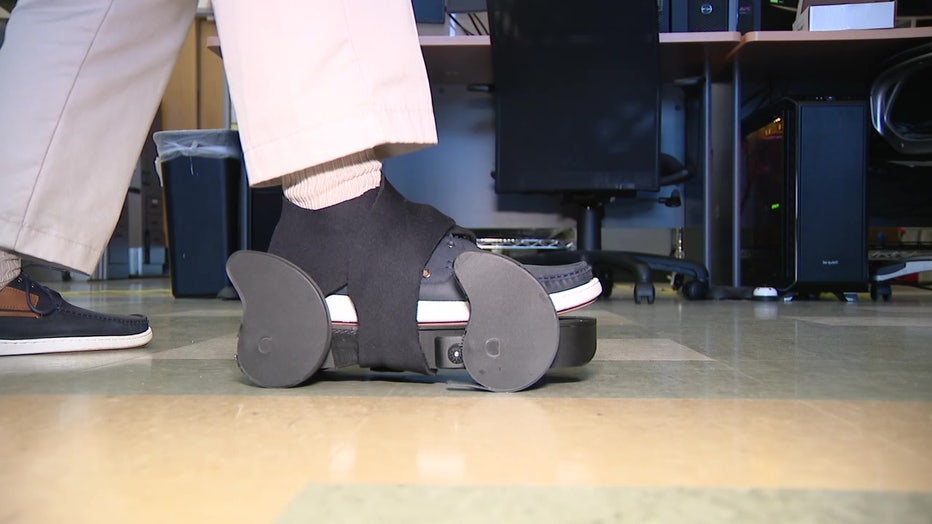
"This is the iStride device. It’s a device that’s worn by someone who’s had a stroke to help them learn to walk better," said Reed.

The stroke therapy shoe mimics walking on a treadmill, using strings.

"It actually destabilizes you, and so when you’re wearing it makes you not want to be on your healthy foot, which makes you want to go to your impaired side," said Reed.

READ: Go behind the scenes of Tampa General Hospital’s nationally recognized transplant center

Reed worked with Moterum Technologies on several studies with the shoe, the latest funded by the National Institutes of Health.

"We’ve actually had a paper published last month that looked at the one-year follow-up and found that even one year later, the people who went through the study are continuing to have good gait outcomes," said Reed, adding that he visited Elena while she was a part of the study.  "Moterum was actually running the study. So, when I got there, she had been on the shoe for about two weeks."

He saw the progression to get Elena back on her feet one step at a time.
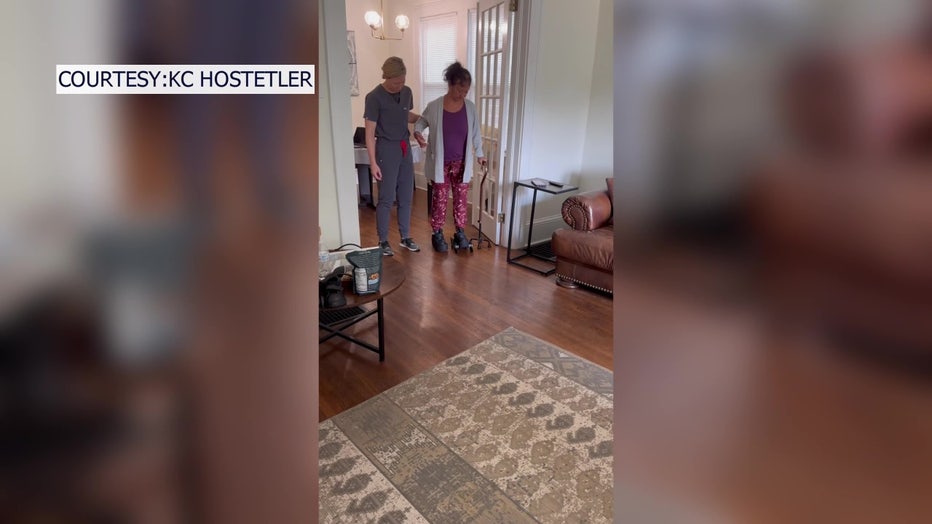
Elena does not speak English, so her daughter KC translated for her.

"Before she got there, she wasn't sure that she would ever walk again. So being able to walk and be around her family and her friends and being able to get down to the community and see them and be a part of that community has been wonderful. And she feels much better," translated Hostetler for Elena.

Stroke specialists said the way they treat stroke patients has changed.

READ: TampaWell Garden and Pharmacy opens

"Stroke in the old days had a negative connotation. Oh, you had a stroke, nothing can be done. There’s no treatment, there’s no rehab. That has fundamentally changed," said Dr. Karl Kasischke, the Comprehensive Stroke Center Medical director for AdventHealth Tampa.

Kasischke said reprogramming the affected side is important, and a shoe like the iStride can help.

"It will provide an incentive for the patients to actively work at home. It provides an incentive for the stroke and the research community," said Kasischke.
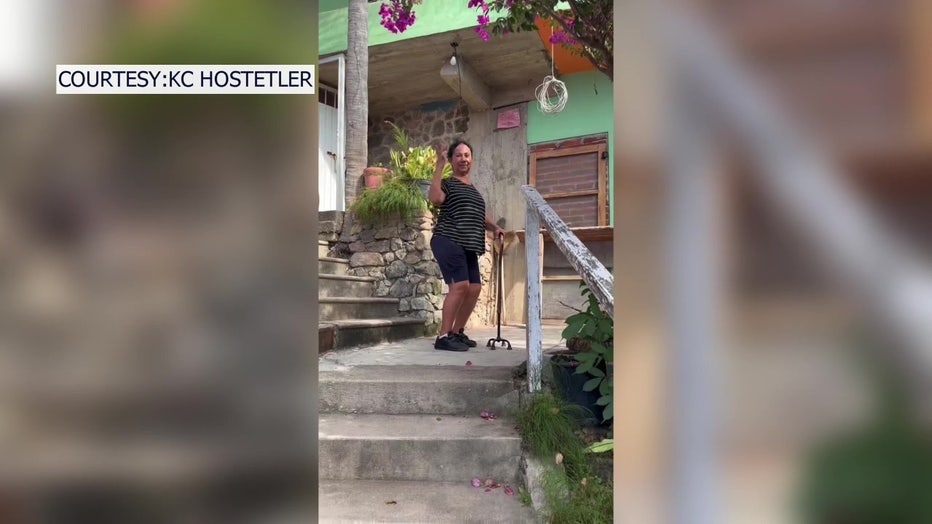
As Elena went through her rehab using the stroke therapy shoe, she stopped using her cane, walked up at 100-plus steps to her house in Mexico, and is dancing again.

"It’s been really nice to see it having impact and really helping people," said Reed.

Reed said he is working with Moterum Technologies to get the shoe mass-produced and into patients’ hands. The goal is for patients to use the shoe at home for about 30 minutes a day to help them walk, and he said they hope to roll it out later this year.

Thursday, January 18, 2024

Stroke therapy shoe empowers patients' recovery

 Didn't your competent? doctor start using this years ago? Oh, you don't have a functioning stroke doctor, do you?

Stroke therapy shoe empowers patients' recovery

Credit: Kyle Reed and Moterum Technologies Inc.

In a rural village near Guadalajara, Mexico, Maria Magdalena Valencia Juares, known as Elena, has to climb 120 stairs to get to her home on the top of a hill. It's a source of exercise for the 70-year-old and the connection to her longtime community below. But a stroke in 2021 left her isolated in her 1,000-square-foot home. Her feet, too unsteady for stairs; her state of mind, declining with the compounded loneliness caused by the COVID-19 pandemic.

Valencia Juares wasn't formally educated, so her world depends on social interaction. However, the caused by her stroke and the risk of falling made that difficult to obtain. Her family lives thousands of miles away, her daughter Noemi Armenta in Los Angeles, and her unofficially adopted daughter, KC Hostetler, in Alaska. They saw from afar the toll Valencia Juares's stroke was having on her mental health and started searching for solutions in the United States.

"I had not been able to get back to Mexico because of COVID, so it had been a while since I was able to see her," Hostetler said. "By the time I reached her, she was in a really tough spot mentally and she was in a depression. We talked about how we can fix this, and she said she needed something that could stabilize her leg."

"Before the iStride treatment, I was isolated. Every day was a struggle, and I became desperate and very sad," Valencia Juares said. "I taught myself to get around the best I could so that I could try to do chores. I felt like such a burden. It was very hard."

Hostetler found information online about the iStride device, invented and patented by Kyle Reed, associate professor of mechanical engineering at USF, and licensed by Moterum Technologies Inc. The iStride is a portable, lightweight device designed for that helps improve their walking ability. It straps over the patient's shoe on the good side of their body and the specially designed wheels generate a corrective motion during each step. Repeated use results in the stroke-impacted leg getting stronger and an improved once the shoe is removed.

After months of coordination, Hostetler and Armenta brought their mother to North Carolina to get therapy on the iStride device. They practiced what many take for granted—shifting from a sitting to standing position and walking. They walked up and down the halls over and over again on the iStride device, soon able to walk without a cane.

"The iStride gait device challenges the wearer by destabilizing the unimpaired leg, promoting increased use of the affected side," Reed said. "This changes the gait pattern so walking becomes easier after each session with an increased gait speed and reduction in gait asymmetry."

Credit: Molly Menchen, University Communications and Marketing

After about a month of therapy on the iStride, Valencia Juares returned home to Mexico, climbed all 120 stairs, and danced ecstatically when she got to the top.

"She was dancing. She hasn't danced in years, and being able to express that sense of joy since her incident has been really amazing," Hostetler said. "It's been amazing to see that transformation, she's much more like the person we knew before the stroke."

Valencia Juares's success story is far from anecdotal. Reed just published a study in the academic journal Frontiers in Neurology that examined the long-term impact of the iStride on gait speed in stroke survivors. The research team worked with 18 individuals who suffered a stroke, averaging within the last five years. Each patient received three, 30-minute therapy sessions a week for four weeks and had their gait checked several times over the course of the following year.

The results were rapid, with gait speed up an average of 50% within one month of starting therapy. What's even more remarkable, the improvements remained mostly unchanged one year after the iStride therapy sessions concluded. The average patient is now walking 0.21 meters per second faster than they were before the start of the study, averaging 0.74 meters per second. According to the National Institutes of Health, the walking speed of an average healthy adult ranges between 0.9 and 1.3 meters per second.

Reed says this is one of the greatest improvements ever recorded in an academic journal that's focused on enhancing gait speed in stroke survivors. He's published several related studies since he patented the iStride a few years ago—one dedicated to using the iStride at home—but this was by far the toughest paper to place.

"The paper was initially rejected because one of the early reviewers stated that the gait speed improvement was way beyond what had previously been reported in the literature," Reed said. "Showing the reviewers videos of the subjects walking before and after therapy helped them understand the dramatic difference."

"Moterum is shifting the paradigm of . Hope is a powerful tool," said Lauren S. Rashford, president of Moterum Technologies. "Providing personalized journeys and meeting each patient where they are at allows us to create a relationship that has been proven to instill and expand hope in each life."

More information: Brianne Darcy et al, One-year retention of gait speed improvement in stroke survivors after treatment with a wearable home-use gait device, Frontiers in Neurology (2024). DOI: 10.3389/fneur.2023.1089083

Journal information: Frontiers in Neurology

Explore further

Saturday, October 23, 2021

Wearable gait device for stroke gait rehabilitation at home

This has been out there for years, doesn't your stroke hospital already have it?Or are you OK with your hospital being incompetent?

Wearable gait device for stroke gait rehabilitation at home

Topics in Stroke Rehabilitation , Volume 28(6) , Pgs. 443-454.

NARIC Accession Number: J87256.  What's this?
ISSN: 1074-9357.
Author(s): Huizenga, David ; Rashford, Lauren ; Darcy, Brianne ; Lundin, Elizabeth ; Medas, Ryan ; Shultz, S. Tyler ; DuBose, Elizabeth ; Reed, Kyle B..
Publication Year: 2021.
Number of Pages: 12.

Abstract: 

 Study investigated whether using the iStride gait device within the home environment can provide safe and effective gait treatment for individuals with hemiparetic gait impairments caused by stroke. The device is worn over the shoe on the non-paretic foot during overground ambulation. Twelve 30-minute sessions of walking on the device were administered in each participant’s home environment. Twenty-one participants who were more than one-year post-stroke received the treatment. The Ten-Meter Walk Test, Timed Up and Go Test, Berg Balance Scale, Functional Gait Assessment, and Stroke Specific Quality of Life Scale were performed before and one week after treatment. Safety, treatment plan compliance, and subjective responses were also recorded during the study period. Results demonstrated significant improvement on all five outcome measures from before treatment to one week after the last treatment session using two-tailed paired t-tests. Seventy-six percent of participants improved beyond the small meaningful change or minimal detectable change on three or more outcome measures. Sixty-seven percent of participants improved clinically in gait speed and on at least one of the fall risk assessment inventories. Eighty-one percent of the participants were able to perform the treatment in their home without assistance before the end of week three. Findings suggest that the iStride gait device can facilitate effective, safe, and home-accessible gait treatment opportunities for individuals with hemiparesis from stroke.
Descriptor Terms: AMBULATION, DEVICES EVALUATION, HEMIPLEGIA, HOME BASED, MOBILITY AIDS, MOBILITY TRAINING, ORTHOTICS, REHABILITATION TECHNOLOGY, STROKE.


Can this document be ordered through NARIC's document delivery service*?: Y.

Citation: Huizenga, David , Rashford, Lauren , Darcy, Brianne , Lundin, Elizabeth , Medas, Ryan , Shultz, S. Tyler , DuBose, Elizabeth , Reed, Kyle B.. (2021). Wearable gait device for stroke gait rehabilitation at home.  Topics in Stroke Rehabilitation , 28(6), Pgs. 443-454. Retrieved 10/23/2021, from REHABDATA database.

Tuesday, November 26, 2019

Stroke patients relearning how to walk with peculiar shoe

What other shoes is your hospital using in your walking rehab?

Ask your stroke hospital which shoes they have already tested and which one of these they like. No testing, you have an incompetent stroke hospital doing nothing for stroke survivors. That should get me lots of angry replies.


Stroke patients relearning how to walk with peculiar shoe

A therapeutic shoe engineered to improve stroke recovery is proving successful and expected to hit the market by the end of the year. Clinical trials have been completed on the U.S. patented iStride device, which is licensed by Moterum LLC, a startup company located in the University of South Florida (USF) Research Park. Its results were just published in the Journal of NeuroEngineering and Rehabilitation.

Stroke sufferers experience muscle weakness or partial paralysis on one side of the body, which greatly impacts how they walk, known as gait. Gait asymmetry is associated with poor balance, a major cause of degenerative issues that make individuals more susceptible to falls and injuries.
The iStride device is strapped over the shoe of the good leg and generates a backwards motion, exaggerating the existing step, making it harder to walk while wearing the shoe. The awkward movement strengthens the stroke-impacted leg, allowing gait to become more symmetrical once the shoe is removed. The impaired foot wears a matching shoe that remains stationary.
"The backward motion of the shoe is generated passively by redirecting the wearer's downward force during stance phase. Since the motion is generated by the wearer's force, the person is in control, which allows easier adaptation to the motion," said developer Kyle Reed, PhD, associate professor of mechanical engineering at USF. "Unlike many of the existing gait rehabilitation devices, this device is passive, portable, wearable and does not require any external energy."
"The importance of over-ground gait training has been emphasized in previous studies," said Seok Hun Kim, PT, PhD, research collaborator and associate professor in the School of Physical Therapy and Rehabilitation Sciences in the USF Health Morsani College of Medicine. "However, the training options available after stroke are very limited. This novel device allows gait rehabilitation in the environment of daily activities."
The trial included six people between ages 57 and 74 who suffered a cerebral stroke at least one-year prior to the study. They all had asymmetry large enough to impact their walking ability. Each received twelve, 30-minute gait training sessions for four weeks. With guidance from a physical therapist, the patients' gait symmetry and functional walking were measured using the ProtoKinetics Zeno Walkway system in the Human Functional Performance Laboratory at USF.
All participants improved their gait's symmetry and speed. That includes how long it takes to stand up from a sitting position and walk, as well as how long it takes to walk to a specific location and distance traveled within six minutes. Four improved the percentage of time spent in a gait cycle with both feet simultaneously planted on the ground, known as double limb support. As far as the other two that didn't improve, one started the study with severe impairment, while the other was highly functional. It's also important to note that three participants joined the study limited to walking in their homes. Following the trial, two of them could successfully navigate public venues.
Reed and Kim compared their method to a previous study conducted on split-belt treadmill training (SBT), which is used to help stroke patients improve their gait. The equipment allows the legs to move at different speeds, forcing the patient to compensate in order to remain on the treadmill. While the SBT improves certain aspects of gait, unlike the iStride, it doesn't strengthen double limb support. That research concluded only about 60 percent of patients trained on the SBT corrected their gait when walking in a normal environment.
Walking is context dependent where visual cues impact how quickly one tries to move, and in what direction. The iStride allows patients to adjust accordingly. Movement on a treadmill is predictable and provides individuals a static scene.
Since patients are often disappointed in their progress after being discharged from rehabilitation, the iStride's portability allows patients to relearn to walk in a typical setting more often and for a longer duration. Reed and his collaborators are now working on a home-based clinical trial with 21 participants and expects to publish results within the next year. He recently received a Fulbright scholarship to conduct research at Hong Kong Polytechnic University. He's working in the rehabilitation sciences and biomedical engineering departments throughout the 2019-2020 academic year.


Story Source:
Materials provided by University of South Florida. Note: Content may be edited for style and length.


Journal Reference:
  1. Seok Hun Kim, David E. Huizenga, Ismet Handzic, Rebecca Edgeworth Ditwiler, Matthew Lazinski, Tyagi Ramakrishnan, Andrea Bozeman, David Z. Rose, Kyle B. Reed. Relearning functional and symmetric walking after stroke using a wearable device: a feasibility study. Journal of NeuroEngineering and Rehabilitation, 2019; 16 (1) DOI: 10.1186/s12984-019-0569-x

Thursday, March 28, 2019

YOUR HEALTH: How a new shoe could give the boot to a stroke victim’s limp

But will it work for my problems? 

Foot angles outward due to spasticity?  

Lower leg does not swing freely due to spasticity?

YOUR HEALTH: How a new shoe could give the boot to a stroke victim’s limp

 
Video at link.

TAMPA, Florida – In the United States every year close to 800,000 people suffer a stroke.
Many are left with a dragging foot.
But doctors are working on an inexpensive way to fix their footing.
"I used to walk three to five miles a day before my stroke and it would be nice if I could just walk a half a mile."
Well Diane Hintz is on the right track.  She's making strides with this patented portable shoe.
It's called the Moterum I Stride device.  It was invented at USF in Tampa.
These doctors have been working for years to get it just right.  And they're almost to the finish line.
"It took a lot of math," said mechanical engineer Kyle Reed.
"A lot of engineering and quite a few different prototypes to get it to work just right."
Many stroke patients are left with a limp because of damage to their central nervous system.  This shoe helps rewire the brain so they can correct their gait.
Doctors say it's more effective and cheaper than the typical split belt treadmill treatment(Does your stroke hospital have this AND the protocol to go with it?) and patients can even bring this home.
"The I-Stride device causes one foot to move backwards while they're walking and this helps to exaggerate one of the feet so it becomes more asymmetric especially when they take it off they have a corrected gait where it's more symmetric afterwards," explained Reed.
"Don't forget the patient is wearing the shoe on their good side," said University of Southern Florida Physical Therapy and Rehabilitation professor Seok Hun Kim.
The shoe is worn on the good side so it forces the bad side to compensate for the irregular walking pattern.
So far the study shows that within four weeks patients can feel a difference.
"The hope is that if you keep doing this every day you train you get a little more equalized in your step length and you're going to start walking faster," said Reed.
NEW TECHNOLOGY: Engineer Kyle Reed said the iStride device causes one foot to go backwards and this exaggerates your existing asymmetry so that you have to compensate for it.   And so you get a little bit less of asymmetry.   When you go back to walking without the iStride device then that little bit of asymmetry is gone because you've already started compensating for it so now you have a more symmetric walking pattern.
USF doctors say typical stroke rehabilitation uses a split belt treadmill.   It is expensive and has to be done in an office setting with trained staff to monitor sessions.
The I Stride could be available to the public in a year.

Wednesday, March 20, 2019

Health Beat: Stroke shoe retrains the brain

Interesting that this is put on the good foot, similar to this? This probably would do nothing for me, the spasticity turning my foot out and lack of a free swinging lower leg wouldn't be corrected  by this.

Exercising the good side to recover the 'bad' side.


Health Beat: Stroke shoe retrains the brain


"I used to walk three to five miles a day before my stroke. and it would be nice if I could just walk a half a mile," she said.
Hintz is making strides with a patented portable shoe. It's called the Moterum iStride device. It was invented at the University of South Florida in Tampa. Doctors have been working for years to get it just right, and they're almost to the finish line.
"It took a lot of math, a lot of engineering and quite a few different prototypes to get it to work just right," said Kyle Reed, an associate professor of mechanical engineering at USF.
Many stroke patients are left with a limp because of damage to their central nervous system. The shoe helps rewire the brain so they can correct their gait. Doctors said it's more effective and cheaper than the typical split belt treadmill treatment, and patients can even take it home.
"The iStride device causes one foot to move backwards while they're walking and this helps to exaggerate one of the feet so it becomes more asymmetric, especially when they take it off," Reed continued. "They have a corrected gait where it's more symmetric afterwards."
"Don't forget the patient is wearing the shoe on their good side," said Seok Hun Kim, an associate professor of physical therapy and rehabilitation sciences at USF.