Changing stroke rehab and research worldwide now.Time is Brain! trillions and trillions of neurons that DIE each day because there are NO effective hyperacute therapies besides tPA(only 12% effective). I have 523 posts on hyperacute therapy, enough for researchers to spend decades proving them out. These are my personal ideas and blog on stroke rehabilitation and stroke research. Do not attempt any of these without checking with your medical provider. Unless you join me in agitating, when you need these therapies they won't be there. Did your doctor somehow miss the recovery protocol that Pedro Bach-y-Rita used to recover fully back in 1958 with only a partial brain?

What this blog is for:

My blog is not to help survivors recover, it is to have the 10 million yearly stroke survivors light fires underneath their doctors, stroke hospitals and stroke researchers to get stroke solved. 100% recovery. The stroke medical world is completely failing at that goal, they don't even have it as a goal. Shortly after getting out of the hospital and getting NO information on the process or protocols of stroke rehabilitation and recovery I started searching on the internet and found that no other survivor received useful information. This is an attempt to cover all stroke rehabilitation information that should be readily available to survivors so they can talk with informed knowledge to their medical staff. It lays out what needs to be done to get stroke survivors closer to 100% recovery. It's quite disgusting that this information is not available from every stroke association and doctors group.

Showing posts with label job killer. Show all posts

Tuesday, December 11, 2018

Telestroke (stroke telemedicine)

The whole problem with telestroke is that it still depends on a subjective evaluation by a neurologist.  We need to get to these much faster and objective diagnosis tools, but that would be a neurologist job killer which means it will never occur even if better for patients.  

Hats off to Helmet of Hope - stroke diagnosis in 30 seconds

Microwave Imaging for Brain Stroke Detection and Monitoring using High Performance Computing in 94 seconds

New Device Quickly Assesses Brain Bleeding in Head Injuries - 5-10 minutes

The latest here:

Telestroke (stroke telemedicine)

Overview

In telestroke, also called stroke telemedicine, doctors who have advanced training in treating strokes can use technology to treat people who have had strokes in another location. These stroke experts work with the person's local emergency medicine doctors to recommend diagnosis and treatment that can be given in their own community.
Doctors and patients communicate using digital video cameras, internet telecommunications, robotic telepresence, smartphones, tablets and other technology.
Stroke telemedicine operates on a distant site-and-originating site system. A large urban medical center, generally certified as a primary or comprehensive stroke center, usually serves as the primary medical center (the distant site). Remote locations, often smaller regional hospitals, serve as the originating site.
In telestroke, many people work together as a team, including a program manager, a clinical coordinator, vascular neurologists, neurosurgeons and radiologists at the distant site, and emergency medicine doctors and other staff at the originating site. Radiology technicians, informational technology staff, researchers, nurses, nurse practitioners and other staff also are important members of the stroke telemedicine team.

Why it's done

In stroke telemedicine, your doctor and the doctor trained in treating strokes at the distant site work together to provide care in your home community and try to avoid the need for transfer to another medical center. This often allows you to receive quality stroke care in your community.
Many regional hospitals don't have neurologists on call to recommend the most appropriate stroke care. In stroke telemedicine, a stroke expert at the distant site consults with doctors and people who've had acute strokes at the originating remote site.
Getting a prompt diagnosis and an appropriate treatment recommendation increases the chances that clot-dissolving therapies (thrombolytics) can be delivered in time to reduce stroke-related disability.
To be effective,(Bullshit, you don't know how fast it needs to be delivered to effectively get 100% recovery.) intravenously delivered clot-dissolving therapies must be given within four and a half hours after you experience stroke symptoms. Procedures to dissolve clots may be considered within 24 hours of stroke symptoms, but these require transferring from the originating to the distant site.

What you can expect
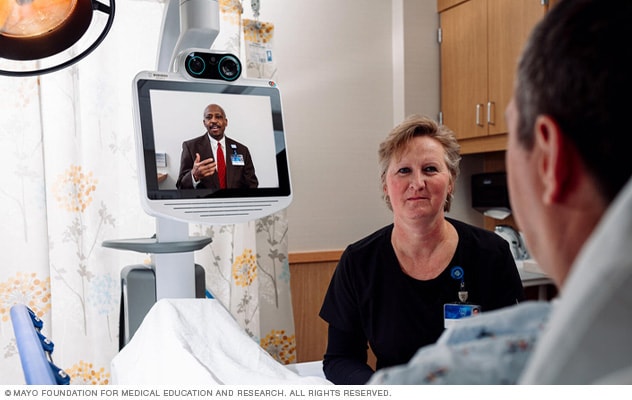
Photo showing telestroke consultation Telestroke consultation Your doctor performs a live, real-time consultation with video and sound with the doctor at the distant hospital.
In a stroke telemedicine consultation, an emergency medicine doctor at your regional hospital (the originating) will examine you. If your doctor suspects an acute stroke, he or she will activate the stroke telemedicine hotline at the distant hospital, which has a dedicated hotline and group paging system and stroke experts on call 24 hours a day, 365 days a year. The distant sites on-call doctor usually responds within five minutes.
After you have a CT scan at the originating hospital, the stroke expert at the distant site performs a live, real-time consultation with video and sound — so you can see, hear and speak with the doctor. The stroke specialist may discuss your medical history and review your test results.
The stroke specialist evaluates you, works with your doctor to determine the most appropriate treatment and sends the treatment recommendation electronically to the originating hospital.

Tuesday, September 12, 2017

Stroke ambulance piques interest of neurologists at Calgary medical conference

This will soon be disrupted by much better technologies and wasting the $1 million spent on it. But neurologists won't like the replacements since those are neurologist job killers.
But are these other fast stroke diagnosis tools good enough to roll out to the world? Do you even know about them?

Hats off to Helmet of Hope - stroke diagnosis in 30 seconds


Microwave Imaging for Brain Stroke Detection and Monitoring using High Performance Computing in 94 seconds


New Device Quickly Assesses Brain Bleeding in Head Injuries - 5-10 minutes


 Maybe these 17 diagnosis possibilities to find out which one is the best? Or maybe the Qualcomm Xprize for the tricorder?


http://www.cbc.ca/news/canada/calgary/canadian-stroke-congress-alberta-mobile-ambulance-1.4283420
A piece of equipment unique to Alberta garnered a lot of interest at a medical conference in Calgary over the weekend.
Neurologists from across the country were in town for the annual Canadian Stroke Congress, with many wanting to get a look at a specialized ambulance operating out of the University of Alberta Hospital in Edmonton.
Essentially a mobile CT scanner, the $1-million unit has the technology and staffing to treat patients suffering a stroke, especially those in rural areas who could lose their lives or suffer paralysis if they're too far from a hospital and can't be treated in time.
"To do it out on the road in the middle of winter in northern Alberta, I mean that's where technology's supposed to be, right?" said Albert Jin, an Ontario neurologist.
"It's supposed to be putting this sort of care and this sort of technology in the hard-to-reach places where people live. And it's just incredible. I really want to see this in my region."
The specialized ambulance is able to meet a regular ambulance carrying a patient and a scan is done on the side of the road, which can be assessed by specialists at the U of A, saving precious time.
It began operating in January as part of a three-year pilot program funded by the University Hospital Foundation and can travel up to 250 kilometers outside of Edmonton.
Another topic being discussed over the weekend was the requirement for physicians to report patients who have suffered a stroke and may no longer be well enough to drive.
stroke ambulance
Patients can be given a CT scan on the side of the road, which is assessed by specialists in Edmonton. (CBC)
Alberta is one of three provinces in the country where physicians are not required to do that, Dr. Hillel Finestone, the director of stroke rehabilitation at Elisabeth Bruyere Hospital in Ottawa, told Daybreak Alberta.
Finestone said some doctors have expressed being uncomfortable assessing whether someone is fit to drive after suffering a stroke while others had concerns around privacy when it comes to releasing information about patients.
"We're going to try to have some discussion because it's such a sensitive issue," he said Sunday morning.
"We know that driving is life for some people. In rural Alberta, driving is freedom, the ability to have social interaction with others. If you don't have that, it's terrible."
The current test for fitness involves looking at the patient's history, as well as having them perform a few simple tests and tasks, like drawing a clock with the 12 numbers.
Those who've suffered a stroke or other brain injury, said Finestone, will often draw it with the numbers only on one side.

Thursday, March 9, 2017

Microwave helmet yields fast and safe evaluation of head injuries

I bet it will take decades to get this into widespread use. Mainly because this would be a neurologist job-killer.
http://www.alphagalileo.org/ViewItem.aspx?ItemId=173247&CultureCode=en
Results from a clinical study demonstrates that microwave measurements can be used for a rapid detection of intracranial bleeding in traumatic brain injuries. A recently published scientific paper shows that health care professionals get vital information and can quickly decide on appropriate treatment if patients are examined using a microwave helmet.
The study demonstrates a new health care application for microwave measurements. Previously, microwave measurements have been used to distinguish stroke caused by bleeding in the brain from stroke caused by cloth.[sic]
The new study shows that the technology also applies to patients affected by traumatic brain injury, which is the most common cause of death and disability among young people. This type of injuries are often caused by traffic accidents, assaults or falls. An estimated 10 million people are affected annually by traumatic brain injuries.
The study compared 20 patients hospitalized for surgery of chronic subdural hematoma – a serious form of intracranial bleeding – with 20 healthy volunteers. The patients were examined with microwave measurements which were compared to traditional CT scans. The results show that microwave measurements have great potential to detect intracranial bleeding in this group of patients.
“The result is very promising even though the study is small and only focused on one type of head injury. The microwave helmet could improve the medical assessment of traumatic head injuries even before the patient arrives at the hospital”, says Johan Ljungqvist, specialist in neurosurgery at the Sahlgrenska University Hospital. “The result indicates that the microwave measurements can be useful in ambulances and in other care settings.”
Further studies of acute head injury patients are ongoing and planned in Sweden and abroad.
“Microwave technology has the potential to revolutionize medical diagnostics by enabling faster, more flexible and more cost-effective care”, says Mikael Persson, professor of biomedical engineering at Chalmers University of Technology. “In many parts of the world microwave measurements systems can become a complement to CT scans and other imaging systems, which are often missing or have long waiting lists.”
“It is challenging to develop a new clinical methodology, from early tests to a device for clinical use in a hyperacute clinical environment where routine care of patients cannot be delayed. It requires a close collaboration between technical and medical professionals which has been supported by MedTech West, a western Sweden based organization for med-tech research & development driven by clinical need”, says Mikael Elam, professor of clinical neurophysiology, Sahlgrenska Academy and University Hospital.
The Swedish Research Council programme for clinical research has been crucial for the project.
Facts about microwave measurements
A microwave helmet is placed on the patient's head and the brain tissue is examined with the aid of microwave radiation. The system consists of three parts: a helmet-like antenna system that is put on the patient's head, a microwave unit and a computer that is used to control the equipment, data acquisition and signal processing. Individual antennas in system transmit, in sequence, a weak microwave signals through the brain, while the other receiving antennas measure the reflected signals. Distinct structures and substances in the brain affect the microwave scattering and reflections in different ways and the received signals provides a complex pattern, as interpreted by using advanced algorithms.
http://www.chalmers.se/en/news/pressreleases/Pages/default.aspx