Use the labels in the right column to find what you want. Or you can go thru them one by one, there are only 34,483 posts. Searching is done in the search box in upper left corner. I blog on anything to do with stroke. DO NOT DO ANYTHING SUGGESTED HERE AS I AM NOT MEDICALLY TRAINED, YOUR DOCTOR IS, LISTEN TO THEM. BUT I BET THEY DON'T KNOW HOW TO GET YOU 100% RECOVERED. I DON'T EITHER BUT HAVE PLENTY OF QUESTIONS FOR YOUR DOCTOR TO ANSWER.
Changing stroke rehab and research worldwide now.Time is Brain!trillions and trillions of neuronsthatDIEeach day because there areNOeffective hyperacute therapies besides tPA(only 12% effective). I have 523 posts on hyperacute therapy, enough for researchers to spend decades proving them out. These are my personal ideas and blog on stroke rehabilitation and stroke research. Do not attempt any of these without checking with your medical provider. Unless you join me in agitating, when you need these therapies they won't be there. Did your doctor somehow miss the recovery protocol that Pedro Bach-y-Rita used to recover fully back in 1958 with only a partial brain?
What this blog is for:
My blog is not to help survivors recover, it is to have the 10 million yearly stroke survivors light fires underneath their doctors, stroke hospitals and stroke researchers to get stroke solved. 100% recovery. The stroke medical world is completely failing at that goal, they don't even have it as a goal. Shortly after getting out of the hospital and getting NO information on the process or protocols of stroke rehabilitation and recovery I started searching on the internet and found that no other survivor received useful information. This is an attempt to cover all stroke rehabilitation information that should be readily available to survivors so they can talk with informed knowledge to their medical staff. It lays out what needs to be done to get stroke survivors closer to 100% recovery. It's quite disgusting that this information is not available from every stroke association and doctors group.
Showing posts with label shit for brains. Show all posts
Showing posts with label shit for brains. Show all posts
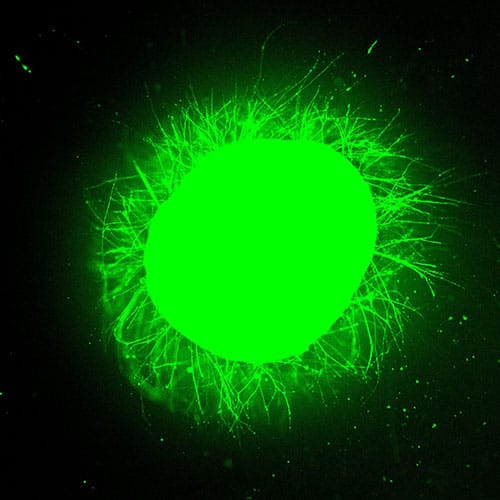
Under a fluorescence microscope at Northwestern University, a sphere of human spinal cord tissue — about 3 mm across, roughly the diameter of a mouse spinal cord — erupted with green light. It had been stained with a calcium-sensitive dye that lights up living neurons and their extending fibers. This green light provided unmistakable visual proof of neurites streaming outward from the tissue’s injured surface and into a synthetic gel, where they were growing in organized, parallel structures.
Fluorescence microscopy reveals axons (green) extending from an injured spinal cord organoid after treatment with the supramolecular therapy.
That sphere of spinal cord tissue was a spinal cord organoid — a three-dimensional, miniaturized tissue model grown in a dish from human induced pluripotent stem cells (iPSCs) to recapitulate key features of an actual organ. This one had been differentiated over 24 weeks into a range of spinal cord cell types: neurons, astrocytes, oligodendrocyte progenitor cells, and Schwann cells.
The Northwestern team also incorporated microglia — the brain and spinal cord’s resident immune cells — by coaxing iPSC-derived progenitors to infiltrate the organoid. The result was an immune-competent model capable of mounting an inflammatory response to injury.
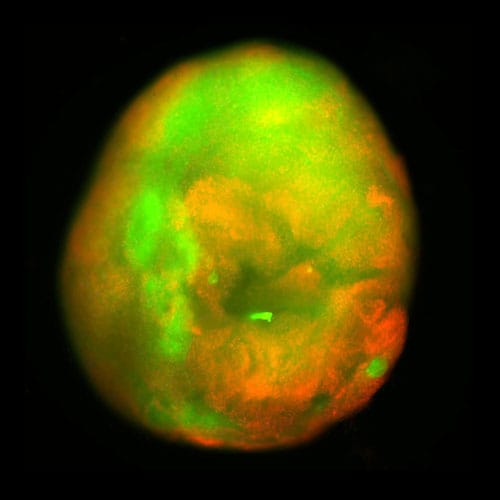
Contusion from a mechanical impactor produces diffuse cell death (red), simulating the blunt-force trauma behind real-world spinal cord injuries.
Then, to make the organoid useful, the team injured it — either slicing it with a scalpel to model surgical hemisection or crushing it with a mechanical impactor to deliver the kind of compressive contusion that causes most real-world spinal cord injuries.
If we had anything other than fucking failures of stroke associations, we could get quarterly updates on the progress towards 100% recovery. But since we have shit for brains in stroke leadership; NOTHING EVER GETS DONE FOR SURVIVORS! Until we get survivors in charge, we'll never solve stroke to 100% recovery! Hope you don't mind your children and grandchildren having the same shitty recovery you did!
It's been 16 years, what has your hospital and doctor done with this to get you recovered? NOTHING AT ALL? Then you have shit for brains in your hospital.
Mental
practice as an additional cognitive therapy is getting increased
attention in stroke rehabilitation. A systematic review shows some
evidence that several techniques in which movements are rehearsed
mentally might be effective but not enough to be certain. This trial
investigates whether mental practice can contribute to a quicker and/or
better recovery of stroke in two Dutch nursing homes. The objective is
to investigate the therapeutic potential of mental practice embedded in
daily therapy to improve individually chosen daily activities of adult
stroke patients compared to therapy as usual. In addition, we will
investigate prognostic variables and feasibility (process evaluation).
Methods
A
randomised, controlled, observer masked prospective trial will be
conducted with adult stroke patients in the (sub)acute phase of stroke
recovery. Over a six weeks intervention period the control group will
receive multi professional therapy as usual. Patients in the
experimental group will be instructed how to perform mental practice,
and will receive care as usual in which mental practice is embedded in
physical, occupation and speech therapy sessions. Outcome will be
assessed at six weeks and six months. The primary outcome measure is the
patient-perceived effect on performance of daily activities as assessed
by an 11-point Likert Scale. Secondary outcomes are: Motricity Index,
Nine Hole Peg Test, Barthel Index, Timed up and Go, 10 metres walking
test, Rivermead Mobility Index. A sample size of the patients group and
all therapists will be interviewed on their opinion of the experimental
program to assess feasibility. All patients are asked to keep a log to
determine unguided training intensity.
Discussion
Advantages and disadvantages of several aspects of the chosen design are discussed.
Stroke is a major health problem, which is likely to increase due to aging [1–3].
Patients are often confronted with disabilities on a physical,
cognitive, social and/or communicative level. Rehabilitation of stroke
patients is a time consuming process in which patients and caregivers
have to learn new skills. In the Netherlands about 5,3 billion Euro are
spend on rehabilitation of patients with cardiovascular diseases of
which 1,5 billion is spend in nursing homes each year [4].
While
it is reasonably established that the overall process of rehabilitation
is effective, there is little evidence to support many specific
rehabilitation therapeutic techniques [3, 5].
Currently it seems that task orientated practice (i.e. practising an
activity of relevance) is probably the most effective single therapeutic
technique [6].
This is not dissimilar to the situation in sport where practice is the
bedrock of improving skills. Indeed improving any skilled motor activity
seems to depend upon continuing practice. It is perhaps this similarity
that has lead to using mental practice, a technique from sports, in
neurological rehabilitation.
The use of mental practice or motor imagery is well established in sports [7–12].
The principle is simple: a person imagines himself undertaking a
skilled movement without actually doing the movement. It is a cognitive
ability which is often used (un)consciously by all of us. Many
therapists report that they use imagery in their therapy sessions
already, but not systematically. They just ask the patient to imagine
moving in a different way. Recently the use of mental practice has been
subject to systematic research in neurological rehabilitation [13].
Although many aspects of mental practice still remain unclear, it does
seem to be a promising addition to the therapy, based on best evidence.
Further research into mental practice is needed, particularly where it
is embedded into normal rehabilitation services.
In the
Netherlands, nursing homes provide a substantial amount of stroke care
although most research is restricted to academic hospitals and
rehabilitation centres [14]. Consequently, more stroke research should take place in nursing homes.
The overall aim
of the proposed research project is to investigate systematically the
therapeutic potential of mental practice embedded in daily
rehabilitation therapy on the improvement of daily activities of adult
stroke patients compared to therapy as usual.
The first additional research question is which prognostic variables or patient characteristics are associated with a positive outcome in the experimental subgroup.
The second additional research question investigates the feasibility of the mental practice-based therapy as judged by the patients and therapists.
This
paper reports on preliminary work, and explains the choices made in the
final study design, which has been approved by the medical ethical
committee of the Atrium Medical Centre & Maasland Hospital in
Heerlen, The Netherlands.
Background work
A full systematic review of previous evaluative research on mental practice was completed and has been published [13].
It showed some evidence suggesting that mental practice in stroke
rehabilitation might work. However, the evidence still is weak.
Furthermore, there is no consistency about or clarity on:
- the nature of the intervention itself (what was actually done?)
- the timing after stroke (when should patients be given mental practice?)
- control (what should be the control intervention?)
Consequently,
we felt it important to set up a larger study. The review also
highlighted several important issues to be considered in that:
- knowing what patients are doing during imagery [15],
- knowing whether patients are using mental practice [15],
- knowing what mental images of a movement the patient had [16],
- determining practicality in the commonest stroke rehabilitation setting (nursing homes in the Netherlands),
- determining what features predict success or failure.
These issues will be discussed also in this article.
A
multi-centre, prospective, parallel-group, randomized, controlled,
observer masked trial (RCT) will be conducted over a two year period
(mid 2007-mid 2009) involving clinically diagnosed adult stroke
patients, complying with all normal research governance procedures.
Methods/Design
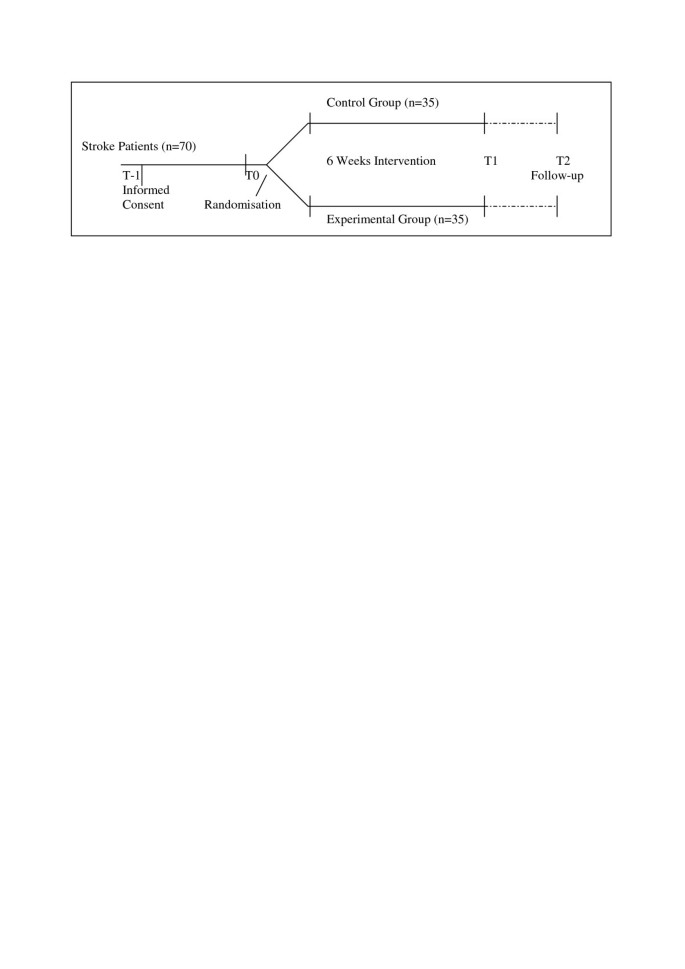
After
recruitment of participants, a baseline measurement will occur (T0)
followed by random assignment to either the control or experimental
group. Effects of the interventions will be measured directly after the
six weeks intervention period (T1) and six months after start of the
intervention period (T2). Outcome measures will cover activities. Brain
activity will be assessed with quantitative electroencephalography. An
outline of the study design is given in figure 1.
Figure 1
Outline of study design. T-1 = 1–4 days before baseline. T0 = baseline. T1 = 6 weeks. T2 = 6 months.
Seventy
stroke patients will be recruited in two nursing homes by the treating
physicians or other staff. There are no data available concerning
ability to benefit from mental practice, and so only practical factors
affect inclusion and exclusion – can the person give consent and
understand the instructions?
Patients entering the RCT have to meet following inclusion criteria:
a) Clinically diagnosed adult stroke patient. In nursing homes, most of the stroke patients will be elder (> 60 years old);
b)
Sufficient cognitive level and communication skills to engage in mental
practice; this is a clinical judgement. Patients need to be able to
follow simple instructions;
c) Between two and 10 weeks of stroke onset.
Exclusion criteria
d)
Severe additional impairments prior to stroke causing persistent
disability, like rheumatic diseases, orthopaedic problems after fall.
Sample size calculation
The
calculation of the sample size is based on the primary outcome measure,
perceived improvement of daily activities, like 'drinking out of a cup'
and 'walking', as assessed by an 11 point Likert scale. Although
arbitrary, the calculation of the sample size is based on following
expectations: For us a 20% difference between the two groups in this
outcome measure would be a reasonable change to aim for which means a
2.2 point change on the Numeric Rating Scale (μ1 = 2.2). There is no
literature available on the standard deviation in a stroke population
but in other populations the standard deviation on numerical rating
scales is somewhere between 1.5 and 3.0. In this sample size calculation
we will use a standard deviation of 2.25 (σ = 2.25). The power (the
ability to detect a true difference in outcome) of this study is set at
90% (β = 0.10). The level of significance (likelihood of detecting a
treatment effect when no effect exists) is set at 5% (α = 0.05). The
power and the level of significance are generally chosen by convention.
The sample size calculation formula used for measuring the difference between two unpaired samples is: N1 = N2 = (z1-β + z1-α/2)2 * ((σ12 + σ22)/(μ1 - μ2)2)
This
would mean that we would need to have 19 patients in each group
assuming a 50:50 random allocation. The goal of this study is to have 35
patients in each group to allow for drop-outs, loss to follow-up and
uncertainty in the power calculation. A sample size of n = 70 seems
realistically achievable over a 2 year period. Two nursing homes
participate in this study: Klevarie nursing home (Maastricht) assesses
about 200 new stroke patients each year. nursing home St. Camillus
(Roermond) treats another 70 patients each year. We estimate that 40% of
all treated stroke patients will be able to participate in the study,
but not all will want to. If an added value of the experimental
intervention can not be found in 70 patients the clinical relevance of a
mental practice-based therapy should be questioned.
Treatment of participants
All patients included in the study will receive six weeks of multi professional rehabilitation [2].
Patients in the experimental group will receive their usual therapy
extended with mental practice-techniques and principles embedded in
therapy sessions. Paramedical therapists will be instructed (in the
theory, in workshops and in training with their patients by an external
expert (SB, MK)) on how to treat the patients in the experimental group.
Patients allocated to the control group can be treated by any
therapist. To prevent/limit contamination in therapy of the instructed
therapists, an expert (also the trainer of mental practice for the
participating therapists (SB)) will monitor the contrast between the
experimental and control therapy by observing therapy randomly.
Experimental intervention
First,
we would like to make some general remarks on why we chose to embed
mental practice in therapy and not give mental practice as an additional
intervention outside of guided practice (f.i. with an audio tape).
There is some evidence that mental rehearsal should be combined
regularly with the overt movement to increase imagery vividness [17–20]. Next, improving skills seems to depend on continuous practice [2, 3, 5, 21].
Last, we believe that a higher training intensity will not only
increase skills but also consolidate the mental practice technique,
making the patient more confident that he/she is practicing correctly
and thereby increasing compliance and motivating patients to practice
unguided.
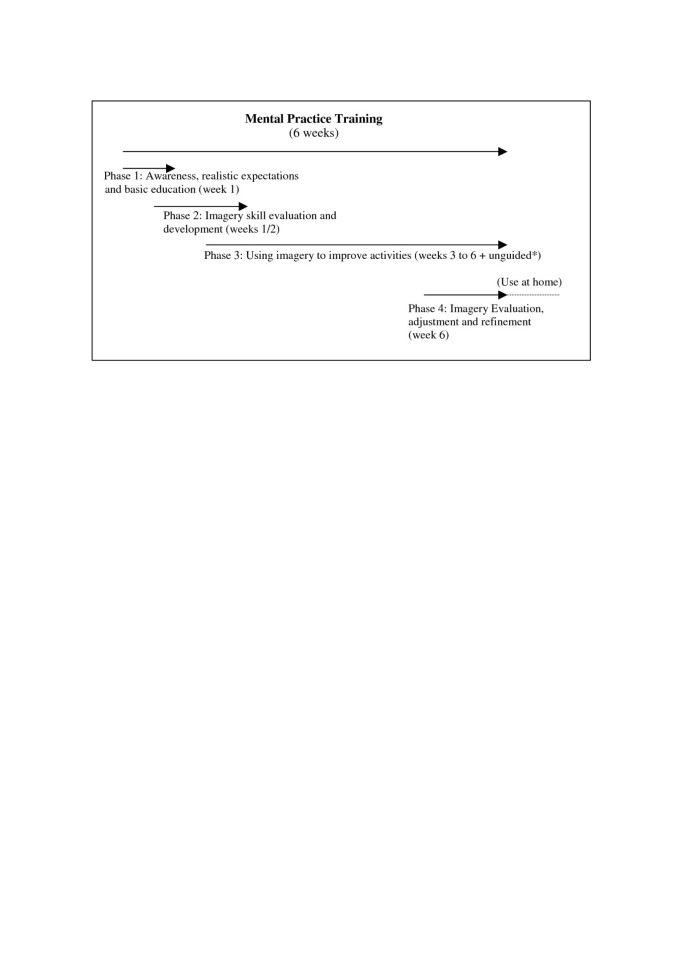
The experimental intervention period is divided into four phases (fig. 2).
In the first sessions, patients will first be familiarised with mental
practice-based therapy and educated by their treating therapists as to
basic imagery principles and the importance of imagery training on a
regular basis (phase 1). There is some evidence that patients
educated on and familiarised with the technique are more likely to
practice in general and to practice correctly by themselves [22–24].
Figure 2
Overview
of mental practice training phases and their aims. * at least 3 times
10 minutes a day. Preferably, mental practice is combined with physical
or occupational therapy or the overt movement at lunch time. Time spend
on mental practice unguided can be increased considerable due to
compliance/motivation of the patient to practice. Training data are
recorded in a personal log (diary) preferably by the patient or assisted
by a member of the family or therapist/nurse.
During the next one to two weeks, phase 2, they will be taught
by their treating therapist how to use the mental practice technique to
improve 'drinking from a cup' (occupation therapy) and/or 'walking –
with(out) walking aids' (physiotherapy), depending on what they want to
improve. The main reason that we chose these two activities is that
patients report these activities most frequently, as activities they
want to improve when starting rehabilitation. We also wanted two common
activities for all patients to practice so that we can standardize the
learning process and we will be able to compare results, at the end of
the study. Third, 'drinking from a cup' and 'walking' are different kind
of tasks; walking is repetitive with timing of different body segments
(arm swing, body rotation combined with leg swing), whereas drinking is a
'forward-back movement', where the different parts of the movement seem
to follow each other up in time. Perhaps these movements involve
different amounts of cortical information. This could imply that certain
movements are more suitable to practice mentally for they need more
cortical involvement (attention) for a successful performance. Within
the speech therapy, mental practice will be used to improve 'swallowing
problems' or motor problems due to facial pareses, like 'smiling'
symmetrically. We see no direct plausibility to improve aphasia with
mental practice and have found no evidence for it in literature.
We will use results from the Structural Dimensional Analysis of Motor Memory (SDA-M) [17, 18, 20]
to determine the basic architecture of specific goal-directed movements
and thus to guide the imagery given through identifying inappropriate
mental processes. It is for example used to identify weak spots in the
sequence of events that should lead to a certain motor performance in
sports.
We have investigated the reproducibility and feasibility
of the SDA-M in a nursing home stroke population for the motor action
'drinking out of a cup'. The measuring protocol was successfully
adjusted to the ability of the stroke population to process information.
The measure instrument seems useful in rehabilitation [16].
The SDA-M results will be performed and interpreted by an external
expert (SB) and used by the treating therapists to tailor the mental
practice intervention of individual patients in the experimental group.
The
vividness of imagery will be enhanced using videos of the tasks and
stimulating patients to recall all sensory information during imagery,
like sounds, smell, touch, pressure and taste.
The duration of the
first two phases can differ depending on how fast the patient catches
on to the technique. It will however not take longer than two weeks.
During the four weeks training period (phase 3),
patients will receive guided mental practice-based therapy in their
routine rehabilitation. Movement imagery will be alternated with overt
movement in short individually determined blocks (for example: three
times a mental rehearsal of the movement, three repetitions of the overt
movement). These blocks of imagery and motor action will be interrupted
by short breaks (one minute). The embedded imagery training will take
place in the first 10–15 minutes of 30 minutes treating time when
patients are still fresh and alert. Neural (coordination) training
should take place when the nervous system is fresh (participants should
not be tired due to physical exercise). Participants will be encouraged
to practice unguided as much as they want. The unguided training amount
is registered daily in a log. The logs are used to discuss progress in
unguided therapy at the beginning of a therapy session. In a log the
participants can record one week of unguided training, a new one is
handed over after every week.
Three refreshment sessions can be
held in which tasks are shown on a video or demonstrated. The SDA-M may
be repeated if the treating therapist thinks this is useful, for example
if significant change has occurred. The external expert (SB) will
perform the test and again the results will be used to adjust the
content of the mental practice intervention. Apart from optimizing the
mental practice of 'drinking from a cup' and/or 'walking' the aim of the
refreshment session is to add additional tasks (one more task per
profession). This way, additional activities the patients want to
improve are part of the protocol as well.
In the fourth phase,
a general evaluation will take place to see whether any adaptations,
advice or alterations are necessary in order for the patient to continue
mental practice at the nursing home or at home. This will take no
longer than two therapy sessions.
Control intervention
The control group will receive therapy as usual in accordance with the Dutch Guidelines for Stroke Rehabilitation [2, 3, 21].
To compensate for the unguided imagery training, patients in the
control group will be encouraged to do 'homework' as well, primarily
practicing tasks that they find difficult. Participants in the control
group will also be instructed to use logs.
Study parameters/endpoints
Measurement
dates are at entry in the study (T0 – baseline), after a six weeks
intervention period (T1) and six months after entry (T2). Additional
information during the course of rehabilitation will be collected, e.g.
recurrence of stroke, other intercurrent medical problems, amount of
therapy received, used medication. In addition, any deviation from the
treatment protocol and any co-intervention during the six months will be
recorded.
In the choice of measuring instruments following considerations were taken into account.
•
The measuring instruments should have sufficient methodological quality
and feasibility recorded in literature and/or be recommended by the
National (Dutch) stroke Guidelines;
• If possible, the measuring
instrument should be part of the standard assessment in the nursing
homes to restrict the additional load on the patient;
• If the
quality of a listed measuring instrument has not yet been established
the measuring instruments should have evidence from other studies on
their potential use in stroke rehabilitation;
• The feasibility
will be measured by using semi-structured interviews (process
evaluation), recording co-interventions, analysing logs and monitoring
therapy content in the experimental group.
The extra load for the participants due to additional clinical testing is approximately 20 minutes at each assessment point.
Demographics
Upon
the patient's entry (T0) into the study the full neurological status
and following patient characteristics will be recorded: age, gender,
brain lesion site (from status), extent of hemiplegia (the perceived
disability as categorised by the patient: no, mild, average and severe
disability), time post stroke, ability to imagine motor acts (as
perceived by the patient in four categories: no ability,
blurry/unfocussed, some/parts, vivid imagery), cognitive level (MMSE),
hand dominance prior to stroke. Additional information about highest
educational level and sports history (no history, leisure, competition,
profession) by asking the patient is recorded as well. Treating
therapists are asked to predict, based on their experience, whether
patients in the experimental group will benefit from a mental practice
based therapy.
We will then investigate whether the two groups are comparable and whether any of these data have prognostic value.
Main study parameter/endpoint
It is hypothesised that mental practice has the most effects on the movement that is actually mentally rehearsed [9, 18, 25, 26].
Improvement of these activities should therefore be assessed. To
measure if mental practice improves the performance of activities in the
experimental group more than in the control group, an 11-point Likert
scale will be used:
▪11 point Likert scale assesses the
performance of the activities 'drinking' and 'walking' ranging from 10
('excellent') to 0 ('poor') as perceived by the patient and the
therapist. The physiotherapist and the occupational therapist will each
score another task, which may be individually chosen and scored on the
11 point Likert scale. If the participant is treated for swallowing
problems and/or motor problems due to a facial paresis by a speech
therapist, he himself and the speech therapist will score motor actions
within these two domains on perceived performance.
Secondary study parameters/endpoints
• Motricity Index (MI – function (impairment) level)
The
Motricity Index evaluates voluntary movement activity and the maximum
muscle strength with a six point Scale in six limb movements.
Reliability and Validity are sufficient in stroke populations [27].
• Barthel Index (BI – activity level)
With the Barthel Index the degree of independent performance of daily activities is measured [28]. Several versions exist. In this study an assessment form with a 20 points scale will be used [28].
• Nine Hole Peg Test (NHPT – function (activity) level)
The
NHPT is a measuring instrument in which the speed of the fine hand
coordination is assessed. The patient has to take nine dowels from a
tray, one at a time, as fast as possible and place them in a pegboard.
The time needed to complete the attempt is recorded. Only the hand that
is being assessed (i.e. the affected hand) may be used. The reliability
and validity are sufficient [29–31].
• Rivermead Mobility Index (RMI – activity level)
This
is a staff-completed questionnaire to measure mobility disability after
head injury, MS, stroke and other conditions. It comprises of 14
questions (activities scored range from turning over in bed to running)
and 1 direct observation of standing for 10 seconds. Each answer is
scored 'Yes' (1) or 'No' (0). The minimum score is 0 and the maximum
score is 15. The higher the score is, the better the mobility.
• 10 meter walking test (TMW – activity level)
The
10-meter walking test can be used in patients able to walk
independently with or without walking aids and/or orthoses. Patients
should walk at a comfortable speed. The test is reliable, valid and
responsive [27].
Furthermore, a significant relation between the comfortable walking
speed during the TMW and the quality with which patients walk has been
established [32]. Codes for not able (yet) and independent in wheelchair are 0 resp. 1.
• Timed up and go (TUG – activity level)
The
TUG measures the time a patient needs to stand up from a chair, walk 3
meters at a comfortable speed, turn around, walk back and sit down. The
patient is allowed to use his/her own walking aids, but no physical
assistance may be given by the researcher or therapist. The test is
practical and simple. The internal consistency, reliability, validity
and responsiveness are sufficient [33–37].
EEG activity in stroke is primarily assessed in the acute phase of stroke recovery to reveal possible epileptic activity [38].
QEEG assessment in the acute and chronic phase of recovery is not a
generally performed procedure, although it might function as a reliable
marker for monitoring the recovery and predicting the clinical outcomes
after stroke [39, 40].
In numerous studies, brain electrical activity across the sensorimotor
cortex has been related to both execution and imagination of movements.
The mu rhythm (8–15 Hz) seems to be connected to movement in general and
is only to be found above the sensorimotor cortex [41].
In general, body movements block or suppress mu activity up to 60%, and
imagination of movements generates similar suppression. It is
hypothesised, that alterations in mu rhythm suppression during motor
imagery in stroke would reflect distorted information processing of the
sensorimotor cortex, thereby functioning as a possible marker for
decreased ability of imagination of movements [42].
In the RCT, we want to investigate if the QEEG can be used as a
biomarker to predict if patients are able to perform imagery and are
likely to benefit from a mental practice based intervention.
In
addition to the QEEG as a prognostic value, the mu suppression is used
as an evaluative measure to assess progress in imagery techniques during
the six weeks intervention period.
Suppression of the mu waves
can be interpreted as movement related information processing. Measures
of brain activity will be performed with a universal amplifier (MPAQ,
Maastricht Instruments, The Netherlands) and data acquisition software
(IDEEQ, Maastricht Instruments, The Netherlands). Eight sensors will be
placed above the sensorimotor cortex at both hemispheres according to a
standardized protocol. To ensure low skin impedance (< 5 kΩ), the
skin will be cleaned with a lotion and a non-allergic gel will be used
for better transmitting of the signal (Ten20 conductive gel). Results
will be expressed in % of suppression of mu activity. Patients may
refuse QEEG measures at T1 and T2 due to the additional load of 20
minutes per assessment. If necessary due to allergy, nickel-free
electrodes will be used.
Compliance, integrity check and feasibility of mental practice
During
the mental practice intervention period, therapy compliance of the
patient is monitored by using a log in which the time spent on practice
is recorded on a daily basis. The diary entries will be checked by
either the therapist or a member of the nursing staff. In the Dutch
guidelines the amount of therapy is considered of importance with regard
to effectiveness of any intervention to improve functions [2, 3, 21].
Furthermore,
a small sample of the participants will be interviewed by the
researcher on experiences and beliefs during mental practice in the
experimental group and on content of therapy as usual in the control
group (n = 10 in each group for both sites). These will be selected
arbitrarily, and limited to those agreeing.
The therapist will be
monitored as well. They will be asked to what extent they followed the
given instructions from the mental practice protocol. All therapists
will be interviewed on their opinion of the feasibility of the
experimental intervention in every day practice. To monitor the
intervention content an external expert will attend therapy sessions of
participants in the experimental group unannounced. Table 1 summarises the data collection.
No stratification will take place [43].
Randomisation will take place on the participant level. Based on a
computerized (block) randomisation schedule with random block size (4 or
6) seventy sequentially numbered envelopes will be prepared, with
equality being achieved after every four or six. Each participant
recruited will be registered and given the next sequential number, and
then the envelope will be opened to determine their allocation. The
randomisation procedure is the same for both sites.
Blinding
At
baseline, before randomisation the measurements will be performed by
the treating therapists and psychologist of the staff. The measurements
at T1 and T2 will be performed by an independent trained rater. The
patients are aware of the treatment they receive, so it is not possible
to blind them. The rater however will be blinded for the treatment
allocation: patients will be asked by the rater not to reveal the
treatment to which they were assigned. A blinding check will be
performed after each of the two measurement sessions (T1 and T2). A
process measure as to success of rater's blinding is the rater's opinion
about the group he thinks a patient belonged to.
Withdrawal of individual participants
Participants
can leave the study at any time for any reason if they wish to do so
without any consequences. If reasons are given they will be recorded.
The investigator can decide to withdraw a subject from the study for
urgent medical reasons. We allowed for a 20% drop out in the size
calculation.
Follow-up of participants withdrawn from treatment
The
statistical analyses will be performed according to the
'intention-to-treat' principle (patients will be analysed in the
treatment group to which they were randomly assigned). Patients who
withdraw from treatment but allow further data collection will have data
collected.
Statistical analysis
Descriptive statistics
All
data will be collected on paper and the records will be stored by
registration number in a secure cabinet. Anonymised data will be
transferred to a computer database and secured using a password. Entries
in the patients' diaries and results from the interviews will be
analysed qualitatively.
Multivariate analysis
The
baseline scores of the patient's demographic, primary and secondary
outcomes will be used to compare the two groups. If necessary,
adjustments for baseline variables will be made, using analysis of
covariance. Differences at baseline and differences between the two
groups on the various assessment times will be calculated. Data will be
analysed using MAN(C)OVA and Generalized Estimating Equations (GEE)
analyses to ascertain the effects of mental practice based therapy on
different levels of outcome and to follow improvements individually in
time. Regression analyses will be used to identify prognostic variables.
The statistical analysis concerned with comparing the two groups will
be performed according to the 'intention-to-treat' principle (patients
will be analysed in the treatment group to which they were randomly
assigned). Missing data will be replaced by a linear interpolation
method for missing measurements. A 'last measurement carried forward'
method is used to predict outcome in dropouts [44].
Ethical considerations
Measurement
instruments have been chosen as far as possible from the assessment
protocol of the nursing homes, thereby minimizing the additional testing
load during intake and testing for the individual patient. Table 2 gives an overview of the main ethical considerations.
The
method of recruitment should be fair, neither disadvantaging some
patients nor advantaging others. All patients will received full
information and will be given at least 48 hours to decide whether they
wish to participate in the research, and will be able to withdraw at any
time without affecting their other rehabilitation. Witnessed consent
will be obtained. Patients may contact an independent physician for
information and advice. The patient is free to refuse participation.
Benefits and risks assessment, group relatedness
As
there are no invasive interventions, nor any untested experimental
measurement instruments used, there is no additional risk associated
with the additional assessments or treatment of the patient.
There
will be a small extra burden potentially placed on patients. They will
spend more time seeing the researcher. They will be asked to answer
questions, fill in questionnaires, and sometimes to undertake activities
or tasks that might be timed. However none of this will be especially
uncomfortable or troublesome, and all can be undertaken by the patient
at their own pace.
The risks faced by patients are no greater than
those risks they face during routine rehabilitation practice. The only
potential exception to this is the QEEG. A QEEG in itself carries no
direct risks. Theoretically, a patient might be allergic to the
materials used, but each patient will be asked if they are allergic to
these materials (e.g. the metal involved in the electrode) and a
anti-allergic gel will be used to improve signal measures.
Discussion
This
study poses several interesting problems when considering its design.
When we started out deciding how the trial should be performed, we first
discussed the goals of our research. We thought it important that
mental practice should be applicable to as many stroke patients and
usable in as many settings as possible. This meant that the costs for
the program should be low, therapists should be instructed easily and
the content of mental practice should not be difficult to follow, so
that not too many exclusion criteria should be set. We then decided to
run the study in nursing homes, because they have a major role in stroke
rehabilitation in The Netherlands [14].
The choice for this setting has many implications for the content of
the experimental intervention and the recruitment of eligible
participants. Two important aspects of recruitment concern the selection
criteria and the best time to approach the patients. Our third main
concern was to define the control intervention and the outcome measures
in order to identify effects of mental practice on stroke recovery.
These aspects will be discussed below.
Strategy vs tactics: teach how to do mental practice in general, or teach only a specific task?
Although
all nursing homes work according to the best available evidence, there
are considerable differences in tasks and organisation of the nursing
homes, depending for instance if they are part of specific stroke
services or not. This reflects in variations in time post stroke at
submission, the neurological assessments, tasks of professionals and
routeing of the patient during the rehabilitation process and also in
the duration of the rehabilitation process. We wanted to create an
intervention protocol that could be used in any nursing home,
independent of the organisation form.
Second, we wanted therapists
of different disciplines to use mental practice in motor learning tasks
of the same patient, so that they could reinforce each other's therapy.
We
therefore made the explicit choice to only set a fixed theoretical
framework for using mental practice, but also leave room to tailor
therapy to the preferences and abilities of the patient, thereby giving
the professional space to use his/her experience (real practice) instead
of forcing patients into a fixed intervention program.
Incorporation into routine working practice
In
reported studies, sometimes the physiotherapist, the occupational
therapist or the psychologist instructed and guided the patients through
the mental practice and sometimes an audio tape was used for this
purpose [13].
There is no evidence that a certain caregiver is a better mental
practice coach than another. As stated before we chose to incorporate
mental practice into every paramedical therapy session. To ensure that
all treating therapists of the experimental group were informed of what
the other therapists were doing and to enhance and use imagery skills of
a patient, all physiotherapy, speech therapy and occupational therapy
sessions were recorded in one central log. If time does not allow the
therapists to discuss patients in person, they are still able to see
what others have done and use this information for their own sessions.
In
order to use their expertise for tailoring mental practice, a therapist
should have practical experience in teaching and monitoring it in daily
routine. Therapists need to be instructed thoroughly, not only
theoretically but especially with regard to 'hands on' skills.
Therefore, a great part of the instruction needs to consist of workshops
(showing and giving examples) and training on the job (guiding).
Sufficient time needs to be reserved for therapists to get familiar with
mental practice and teaching it confidently. We incorporated a
preliminary phase of about five months for the therapists to get
comfortable with mental practice, gaining experience and incorporating
it into routine working practice, before starting the trial.
Because
we randomised on the patient level (and not on f.i. institute or
therapist level) and because we trained all therapists involved in the
trial (giving both the experimental and control intervention), we faced a
challenge: avoiding possible contamination of mental practice into the
control content. We choose for randomisation on patient level because we
felt that real care of patients should come first (see: selecting patients).
We trained all therapists to maximize recruitment within the nursing
homes. Both therapists and patients can diminish the contrast between
the experimental and control intervention.
Caregivers who were
made enthusiastic about a new approach and have just spend a lot of time
learning how to use mental practice as an additional tool may be
tempted to use it as much as possible, whenever possible. This could
decrease the differences between the two compared interventions. There
is some evidence that altering professional behaviour is not very easy [45].
Therapists will probably need more effort to consciously implement
mental practice into their daily routines then copying them in the
control group. Nonetheless, therapists will undergo an integrity check
too, determining how well they were able to distinguish between the two
interventions in therapy. During an interview, therapists will be asked
to which extend they were able to stick to the intervention contents
(subjective opinion). Furthermore, the external expert will attend
therapy sessions of all therapists unannounced and at random throughout
the two year trial period. With these measures, we will try to maximize
the contrast between the compared interventions. In case contamination
does take place, we will report it as fair as possible.
From the
patient's point of view, we believe there is a big difference between
telling patients to imagine movements and actually teaching it. It is
more probable that patients that were taught will successfully use
mental practice on a regular basis. A big part of the effect will
probably come from the practice outside of therapy, unguided.
Selecting patients
Ethical
considerations in recruiting patients should always be taken in
account, especially if so little is known about effects and prognostic
values, as is the case in imagery research. Because we do not know
whether mental practice will lead to better and/or quicker recover in
this research the only 'ethical' design seems to be a randomised trial.
Data analysis with GEE will give us more ideas on improvements on an
individual basis.
Patients unable to learn imagery should not be
frustrated unnecessary, but we also do not want to withhold mental
practice from patients who might well benefit from mental practice.
Since we do not know who might benefit from mental practice we believe
it ethical to include anyone able and willing to participate in the
research. Within this study, the participation judgement is made based
on the extend of attention a patient has, as well as the amount of
working memory he/she has and the ability to perceive different
information. Participants need to be able to think practical but
analytical about a movement. Predictions of the treating therapists on
the ability of the patient to participate in the study will be discussed
during multi disciplinary meetings of the paramedical team and a
prediction of the patient's ability to participate in mental practice
will be made based on consensus.
We are aware that patients who
just have had a stroke are extremely vulnerable and should be given time
to cope with their new situation. So when should recruitment start? In
preliminary work, we found that about 25% of the acute stroke patients
(one to two weeks post stroke) in the nursing homes were willing to
participate in a pilot study. We decided to start recruitment within the
RCT at any time between two and ten weeks post stroke which should
maximise recruitment while maintaining the focus on patients in the
acute phase. Those patients who are recovering well and able to start
earlier will probably start at two-three weeks but patients who are
sicker or slower in recovering still have an opportunity to start up to
ten weeks. This approach should, oddly, reduce heterogeneity in the
population studied because each person will be recruited at a similar
stage in their own recovery trajectory.
Knowing if people are practicing
Two
aspects are important with regard to compliance of the patient to the
experimental intervention. 1. Are patients actually thinking about
movements during mental practice and 2. Are they reporting the unguided
therapy time correctly?
At this point, we do not know of any
measure that can measure thoughts. In different studies, the main way to
check if participants are imaging movements is the indirect way of
interviewing. Our experience is that one can get a good idea of what the
patient has been doing, just by asking. We therefore chose to use
semi-structured interviews in our trial to check on what patients are
doing during imagery. However, we also wanted a quantitative measure to
verify self-reports. The idea of using QEEG as a biomarker for imagery
came from a study Ramachandran performed with autistic children [46].
Mu wave suppression seems to be a key factor in determining whether a
participant is imagining movement or not. In the trial, we want to
assess if mu-wave suppression during imagery is trainable and whether it
can be used as a prognostic value in the nursing home stroke
population.
One of the benefits of mental practice is that it can
increase the therapy amount considerably; patients are not dependent on
time spend in the gym with therapists, but can exercise safely any time,
anywhere [22, 23, 47–56].
This results in giving the patient more autonomy over his
rehabilitation process, which might well motivate certain participants
to practice.
Therapy amount could well be a prognostic variable
for outcome. It is therefore important to register unguided therapy time
as detailed as possible. A log was developed for this purpose. In it,
the patient can describe on a daily basis, what activity he/she has
practiced mentally, for how long and how well it went. Additionally the
patient can score how he/she felt that day by marking one of three
smiley's (bad day, neutral day, good day). At the bottom of each page
(day), space is left open for comments and remarks, for instance to
report if anything unusual had happened. To encourage patients to use
the log, every session starts with looking at the log's entries and
discussing them with the patient. By involving family members and the
Nursing staff, we hope to come as near as possible to the actually
practiced time.
Control for mental practice training
By
embedding mental practice in the regular therapy sessions and therapy
time, we tried to minimize the additional training time in the
experimental group. About four to six additional hours are made during
the six weeks intervention time (one hour per week). The majority of
these six hours are spend on performing the SDA-M in the second phase of
the mental practice protocol (three-four hours) during regular therapy
time. The external expert will perform this assessment and discuss
outcome with the treating therapists. The other two to three hours are
used instructing participants on what mental practice is, tailoring the
intervention to the patient's abilities and preferences and explaining
the log as well as interviewing a part of the patient group.
We
decided to compare mental practice embedded in therapy with therapy as
usual (TAU) and compensate for extra time spend with patients and given
attention were possible. The SDA-M is not performed in the control
group. During these hours, participants from the control group will have
therapy as usual.
To compensate for attention, participants from
the control group will be instructed to keep a log on their homework
(movements) and then score the actual performance of these actions.
Within the control group an equally big sub group will be interviewed on
their perceptions and believes with regard to the control intervention.
Outcome measurement
There is little known about what specific aspect or combinations of aspects of mental practice lead to positive results [18, 19].
Outcome measures within neurological studies are often chosen to assess
physical improvement, but imagery can also have effects on motivation
and altering cognitions and feelings, like anxiety. Martin and
co-workers developed an applied model, based on models from cognitive
psychology, to provide a guiding framework that describes how an athlete
can use imagery to achieve a variety of cognitive, affective, and
behavioral changes across different sport situations [17].
It is very important that such a (for neurological rehabilitation)
adjusted model were applied in neurological rehabilitation as well, to
ensure future comparison of studies.
We specifically chose to use
mental practice to improve physical performance, trying to leave mental
practice content that has effects on other domains, out of the
intervention protocol. The measuring instruments were chosen with this
information in mind. We thought it very important for patients to be
able to choose the tasks they wanted to improve, for they should be
relevant for the client. Just as in athletes, patients then use mental
practice for specific motor actions. Exactly these movements should then
improve. The chosen tasks, apart from 'drinking from a cup' and/or
'walking', are likely to vary greatly, since they depend on the
patient's preferences. The 11 point Likert Scale was chosen as the
primary measure because it seems most plausible that effects of mental
practice should first and mainly be detectable on the rehearsed tasks.
Second, we wanted one measure that could be used for any kind of motor
action. Subjective changes in the performance of the task from both the
therapist's view as the patient's view seem equally important. The
secondary measures were chosen to reflect on as many tasks as possible.
Final remark
By
describing the design, we hope to contribute to the discussion on how
mental practice should be introduced in stroke rehabilitation. Results
from this study, might clarify some aspects of mental practice in stroke
rehabilitation and give further leads on how to do it, or how not to.