Changing stroke rehab and research worldwide now.Time is Brain! trillions and trillions of neurons that DIE each day because there are NO effective hyperacute therapies besides tPA(only 12% effective). I have 523 posts on hyperacute therapy, enough for researchers to spend decades proving them out. These are my personal ideas and blog on stroke rehabilitation and stroke research. Do not attempt any of these without checking with your medical provider. Unless you join me in agitating, when you need these therapies they won't be there.

What this blog is for:

My blog is not to help survivors recover, it is to have the 10 million yearly stroke survivors light fires underneath their doctors, stroke hospitals and stroke researchers to get stroke solved. 100% recovery. The stroke medical world is completely failing at that goal, they don't even have it as a goal. Shortly after getting out of the hospital and getting NO information on the process or protocols of stroke rehabilitation and recovery I started searching on the internet and found that no other survivor received useful information. This is an attempt to cover all stroke rehabilitation information that should be readily available to survivors so they can talk with informed knowledge to their medical staff. It lays out what needs to be done to get stroke survivors closer to 100% recovery. It's quite disgusting that this information is not available from every stroke association and doctors group.

Showing posts with label ESUS. Show all posts

Friday, April 22, 2022

Reclassification and risk stratification of embolic stroke of undetermined source by ASCOD phenotyping

 EXACTLY how is this going to get survivors 100% recovered? After this research what are the next steps to 100% recovery? Don't know or don't have that, then this was fucking useless research. Please explain how your mentors and senior researchers are so clueless about the only goal in stroke; 100% recovery.

Reclassification and risk stratification of embolic stroke of undetermined source by ASCOD phenotyping

First Published April 14, 2022 Research Article 

Background:

Vascular diseases underlying stroke, including atherosclerosis, small-vessel disease (SVD), and cardioembolic pathology, can be present in patients with embolic stroke of undetermined source (ESUS), although these are not direct causes of stroke.

Aims:

To describe the frequency and degree of the 3 major diseases using ASCOD phenotyping and to assess their prognostic implications in ESUS.

Methods:

In this prospective observational study, 221 patients with ESUS within 1 week of onset were consecutively enrolled and followed up for 1 year. Vascular diseases associated with stroke were assessed using the ASCOD classification. The primary outcome was a composite of major adverse cardiovascular events (MACEs).

Results:

Among 221 patients, 135 (61.1%), 102 (46.2%), and 107 (48.4%) had any grade of atherosclerosis (A2 or A3), SVD (S3), and cardiac pathology (C2 or C3), respectively. ESUS patients graded as A2 or A3 (i.e., ipsilateral atherosclerotic plaque, contralateral ≥50% stenosis, or aortic arch plaque) were at a significantly higher risk of MACE than those graded as A0 (i.e., no atherosclerotic disease) (adjusted hazard ratio [95% confidence interval], 2.40 [1.01–5.72]). No differences were observed in the event risk between patients with S3 (i.e., magnetic resonance imaging evidence of SVD) and S0 (i.e., no SVD) and between those with C2 or C3 (i.e., presence of any cardiac pathology) and C0 (i.e., no cardiac abnormalities).

Conclusions:

ASCOD grade A2 or A3 was predictive of MACE in ESUS patients. Reclassification of ESUS using ASCOD phenotyping provides important clues for risk prediction and may guide optimal management strategies.


Tuesday, July 6, 2021

It's Time to Say Goodbye to the ESUS Construct

Hope  your doctor doesn't give up on finding the cause of your stroke just like they have given up on getting you 100% recovered

It's Time to Say Goodbye to the ESUS Construct

  • 1Department of Neurology and Stroke Center, Hospital Universitario La Paz, Madrid, Spain
  • 2Department of Medicine, Universidad Autónoma de Madrid, Madrid, Spain

Cryptogenic stroke has been a challenge for years in clinical practice, given it can represent up to 40% of strokes, depending on the etiological classification used, which has different operative definitions for those patients in whom the complete diagnostic workup does not reveal a specific stroke etiology. In 2014, two opposing approaches to the challenge of cryptogenic stroke were proposed. On the one hand, Bang et al. proposed its assessment using advanced diagnostic techniques (such as advanced vascular imaging and cardiac monitoring, aortogenic, and paradoxical embolic source assessment, coagulopathy, and cancer screening tests) as a measure to reduce the proportion of cryptogenic strokes by increasing the diagnosis of atheroembolic disease, aortic embolic disease, branch occlusive disease, paroxysmal atrial fibrillation, paradoxical embolism, and cancer-related coagulopathy (1). On the other hand, the Cryptogenic Stroke/ESUS International Working Group proposed a new clinical construct that they named embolic stroke of undetermined source (ESUS) (2). The rationale behind the ESUS concept was the assumption that most cryptogenic strokes were thromboembolic and could benefit from non-vitamin K agonist oral anticoagulants (NOACs) that had already demonstrated their efficacy and safety in atrial fibrillation (AF), to reduce recurrent brain ischemia. This suggestion prompted the development of randomized clinical trials testing the safety and efficacy of rivaroxaban and dabigatran in patients with ESUS as well as the rapid dissemination of the ESUS concept to clinical practice due to the simplicity of the diagnostic workup, which required only the demonstration by neuroimaging procedures [computed tomography (CT) or magnetic resonance imaging (MRI)] of a non-lacunar infarction, the absence of extracranial or intracranial atherosclerosis causing ≥50% luminal stenosis in arteries supplying the ischemic area, no major-risk cardioembolic source of embolism and no other cause of stroke identified. The only diagnostic procedure assessments required were brain CT or MRI, 12-lead electrocardiogram (ECG), precordial echocardiography, cardiac monitoring for ≥24 h with automated rhythm detection and imaging of extracranial and intracranial arteries by either ultrasonography or MRI, CT, or catheter angiography.

However, the failure of the RESPECT-ESUS and NAVIGATE-ESUS trials (3, 4) in demonstrating any efficacy in the prevention of stroke recurrences in patients with ESUS has called into question the practical usefulness of this concept as, compared with the concept of cryptogenic stroke, the only difference is the exclusion of lacunar stroke (59). Therefore, ESUS remains a non-diagnosis similar to the classic cryptogenic stroke concept. Some of the most commonly used stroke classifications, such as the TOAST (10) and the ESUS criteria themselves (2), were developed for use in clinical trials; however, they have been incorporated in clinical practice without enough validation studies to truly evaluate their usefulness in clinical settings. Stroke physicians attend stroke patients daily in whom there is no clear evidence of the underlying etiology and must choose between two options. One is to make the diagnosis of ESUS (which is not actually associated with any specific therapeutic change), and the other is to make a greater effort to identify the ultimate cause of the stroke by the use of advanced diagnostic techniques (1). Choosing one or the other option is crucial for secondary stroke prevention, given the treatments can be different.

In this opinion article, we would like to highlight some of the arguments against the use of the ESUS concept in clinical practice:

• The rationale behind the ESUS concept, considering that many ESUSs would be due to covert paroxysmal AF, and therefore would benefit from the use of NOAC, has clearly failed, not only because of the neutral/negative results of the RESPECT-ESUS and NAVIGATE-ESUS trials (3, 4), but also because clinical trials with long-term ECG monitoring as well as observational studies have shown that covert AF represents only about 30% of ESUS (1113).

This low rate of AF detection during follow-up, the different phenotypes between patients with ESUS and patients with stroke with AF, and data from studies with implantable cardiac monitoring devices showing that the majority of embolic events do not occur proximal to episodes of AF have raised doubts regarding the causal association between covert AF and ESUS (14).

• The authors of the ESUS construct acknowledged that arteriogenic embolism due to non-stenotic plaques was possible in some patients with ESUS (2). However, grouping them into the same category as patients with other minor cardioembolic strokes, assuming that they would also benefit from anticoagulants, risks neglecting the atherothrombotic origin in patients with stroke with carotid atherosclerosis with stenosis lower than 50% or with aortic arch atheroma (AAA); these etiologies require a more tailored approach to atherosclerosis to prevent not only stroke recurrences, but also other vascular events such as myocardial infarction.

Several studies have reported a higher prevalence of ipsilateral carotid plaques than contralateral carotid plaques in some ESUS cohorts (15, 16), and the global prevalence of carotid non-stenotic plaques in the ESUS Global Registry is as high as 79% (17). Recently published data from the NAVIGATE trial have shown that up to 40% of the patients included in that trial had carotid plaques, this being clearly more frequent on the ipsilateral side to the qualifying stroke. Interestingly, the group of patients with carotid plaques showed a strong tendency to higher frequency of stroke recurrences compared with those without carotid plaques (18).

Similarly, AAA is a frequent finding in patients with ESUS (when screened), found in up to 28% in the ESUS Global registry (17) and in the 29% of patients who had transesophageal echocardiography (TEE) included in the NAVIGATE trial, and they showed a higher frequency of multiterritorial infarcts in neuroimaging (19). Therefore, for cases in which the stroke physician follows the ESUS criteria, which does not require TEE, many symptomatic AAA cases might be missed. Although clinical trials on the use of antithrombotic drugs in stroke prevention in AAA were inconclusive because of insufficient power calculation (1921), these patients carry a higher risk of stroke recurrences than patients with other possible causes of cryptogenic stroke (20) and have a high burden of vascular risk factors and of coronary artery disease (1921). Therefore, they should be instructed to strictly adhere to lifestyle modifications and risk factor interventions to reduce the overall vascular risk, instead of providing them with the uncertainty of an ESUS diagnosis.

• Patent foramen ovale (PFO) has also been included in the broad concept of ESUS (2), following the historical controversy on its pathogenic role in ischemic stroke. It has been reported to be present in up to 7.4% of patients with ESUS recruited in the NAVIGATE trial (22) and in 12.6% in the RESPECT-ESUS trial (3); however, actual rates could be underestimated, given TEE, or bubble transcranial Doppler were not required prior to inclusion in the trials. None of them showed NOAC to have any significant effect on reducing stroke recurrences. Moreover, given percutaneous PFO closure has been demonstrated to be safe and efficacious in the prevention of stroke recurrences in those patients with ischemic stroke related to large PFOs (especially when associated with atrial septal aneurysm) and no other cause of stroke (23, 24), they should be excluded from the ESUS category because the therapeutic approach is clearly different. Indeed, an update of current nomenclature and classifications systems has recently been proposed to include the specific category of PFO-associated stroke (25).

• Cancer-associated stroke is another possible underlying etiology in patients with ESUS (2) and data from the NAVIGATE trial reported a cancer diagnosis in up to 7.5% of the included patients. This value is probably an underestimate, given an exclusion criterion was a life expectancy of <6 months. A new cancer diagnosis at 11 months' follow-up was found in 1.7% (26). Patients with cancer had a higher risk of stroke recurrences than patients without cancer, without differences in ischemic stroke recurrences between the aspirin and rivaroxaban groups, although with a trend toward more major bleeds with rivaroxaban (26). Involved pathogenic mechanisms are non-bacterial thrombotic endocarditis, tumor emboli from occult cancer and a cancer-associated hypercoagulable state. Cancer-associated stroke has a very poor prognosis, with high mortality at follow-up (27, 28). Identifying and treating the underlying cancer is crucial in these patients. For this reason, following such a basic diagnostic approach as required for ESUS appears to be inappropriate for the detection of stroke-associated cancer and, in our opinion, further laboratory tests (such as D-dimer, which has been proposed as a helpful parameter for suspected covert cancer in stroke patients) (29) and cardiac examinations (such as TEE to rule out non-bacterial thrombotic endocarditis) should be performed.

• Finally, there are some other less recognized cardioembolic sources of stroke, such as atrial cardiopathy and left ventricular disease, including hypertrophy, decreased ejection fraction and valvular heart disease without AF, which merit identification in patients with stroke. The results of the ongoing ATTICUS and ARCADIA trials (30, 31) that are investigating the efficacy and safety of apixaban in patients with disease of unknown etiology and atrial cardiopathy or at least one risk factor suggestive of cardiac embolism should provide us with new insights into the role of atrial cardiopathy and the risk of stroke, whether mediated or not by covert AF. These trials are selecting cryptogenic stroke patients who present the following markers suggestive of atrial cardiopathy: left atrium enlargement >45 mm, spontaneous echo contrast in left atrial appendage (LAA), LAA flow velocity ≤ 0.2 m/sg, atrial high rate episodes, PFO and high CHADS2-VASc score (≥4) in the ATTICUS Trial; and the P-wave terminal force > 5,000 μV x ms in ECG lead V1, serum N-terminal pro-brain natriuretic peptide (NT-ProBNP) >250 pg/ml, and left atrial diameter index ≥3 cm/m2 in the ARCADIA Trial (30, 31).

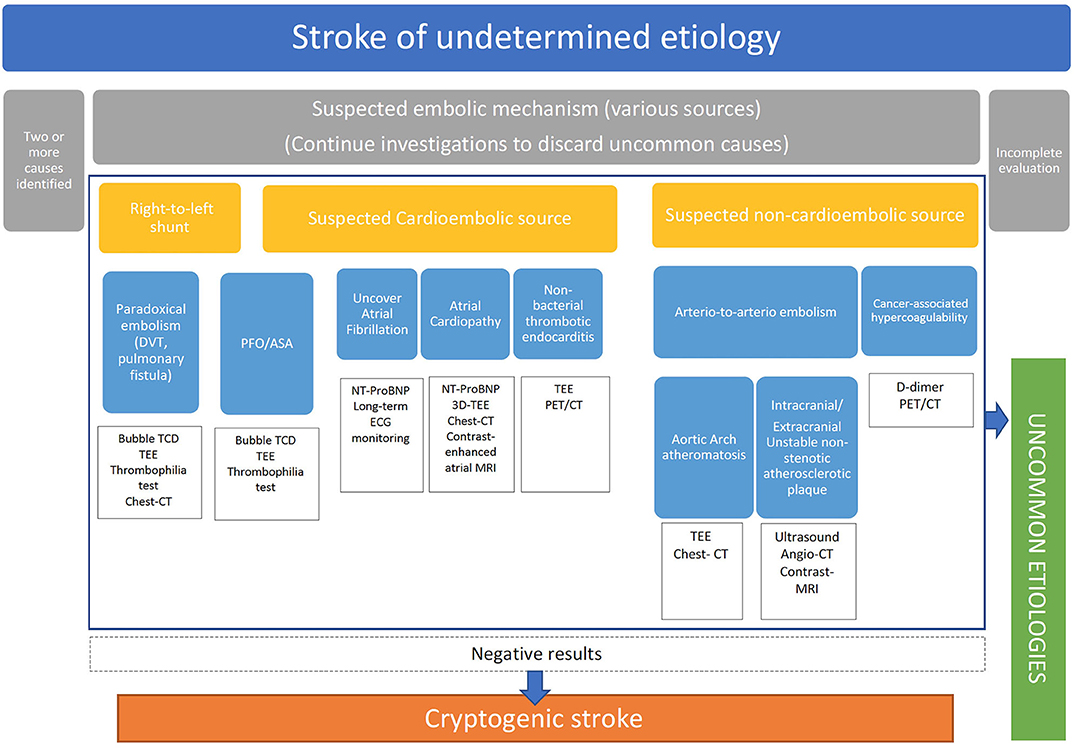
Therefore, in our opinion, the exclusion of ipsilateral non-stenotic carotid plaques, aortic arch atherosclerosis, PFO, and cancer-associated strokes should be a prerequisite before diagnosing a cryptogenic stroke in clinical practice (Figure 1), and patients with factors that have been identified as being associated with a higher risk of covert AF should undergo long-term cardiac monitoring. In this sense, the evaluation of serum (Nt-ProBNP) could help in the selection of patients for long-term cardiac monitoring since levels ≥505 pg/ml have recently shown to have a 86% sensitivity and 98% negative predictive value for AF in cryptogenic stroke (32).

FIGURE 1
www.frontiersin.org

Figure 1. A proposal for stroke of unknown etiology, cryptogenic stroke classification and diagnostic approach. CT, Computed Tomography; DVT, Deep Venous Thrombosis; ECG, Electrocardiogram; MRI, Magnetic Resonance Imaging; PET/CT, Positron Emission Tomography/Computed Tomography; TCD, Transcranial Doppler; TEE, Transesophageal Echocardiography.

In conclusion, our advice to stroke physicians is to forget ESUS and be smart in the search for underlying causes of ischemic stroke, optimizing advanced diagnostic procedures according to the patient's and stroke's characteristics, attempting to find the correct diagnosis for stroke patients and reducing rates of cryptogenic stroke diagnosis.


Saturday, May 29, 2021

d-dimer Level as a Predictor of Recurrent Stroke in Patients With Embolic Stroke of Undetermined Source

Useless. This prediction does absolutely no good without a protocol implemented that will alleviate this risk.  The reason for stroke research is to help stroke survivors or actually prevent strokes. This does neither.  What were the mentors and senior researchers thinking? 

d-dimer Level as a Predictor of Recurrent Stroke in Patients With Embolic Stroke of Undetermined Source

Originally publishedhttps://doi.org/10.1161/STROKEAHA.120.033217Stroke. ;0:STROKEAHA.120.033217

Background and Purpose:

This study aimed to investigate the value of d-dimer levels in predicting recurrent stroke in patients with embolic stroke of undetermined source. We also evaluated the underlying causes of recurrent stroke according to d-dimer levels.

Methods:

A total of 1431 patients with undetermined source were enrolled in this study and divided into quartiles according to their baseline plasma d-dimer levels. The primary outcome measure was the occurrence of recurrent stroke (ischemic or hemorrhagic) in the year following the stroke event.

Results:

The risk of recurrent stroke increased significantly with the increasing d-dimer quartile (log-rank P=0.001). Patients in the higher d-dimer quartiles had a higher probability of recurrent embolic stroke because of covert atrial fibrillation, hidden malignancy, or undetermined sources. Most recurrent strokes in Q3 and Q4 were embolic but not in Q1 or Q2. Multivariate analysis revealed that patients in Q3 and Q4 had a significantly increased risk of recurrent stroke compared with those in Q1 (hazard ratio, 3.12 [95% CI, 1.07−9.07], P=0.036; hazard ratio, 7.29 [95% CI, 2.59−20.52], P<0.001, respectively; Ptrend<0.001). Binary analyses showed a significant association between a high d-dimer level above normal range and the risk of recurrent stroke (hazard ratio, 2.48 [95% CI, 1.31−4.70], P=0.005). In subgroup analyses, a high d-dimer level was associated with a significantly higher risk of recurrent stroke in men than in women (P=0.039).

Conclusions:

Our findings suggest that d-dimer levels can be a useful risk assessment biomarker for predicting recurrent stroke, especially embolic ischemic stroke, in patients with undetermined source.


Tuesday, August 18, 2020

Machine Learning Prediction of Stroke Mechanism in Embolic Strokes of Undetermined Source

 Maybe I'm missing something but there seems to be nothing here that will help survivors recover. Mentions NOTHING on what should be done on recovery protocols for cardioembolic versus noncardioembolic cases.  

Machine Learning Prediction of Stroke Mechanism in Embolic Strokes of Undetermined Source

Originally publishedhttps://doi.org/10.1161/STROKEAHA.120.029305Stroke. ;0

Background and Purpose:

One-fifth of ischemic strokes are embolic strokes of undetermined source (ESUS). Their theoretical causes can be classified as cardioembolic versus noncardioembolic. This distinction has important implications, but the categories’ proportions are unknown.

Methods:

Using data from the Cornell Acute Stroke Academic Registry, we trained a machine-learning algorithm to distinguish cardioembolic versus non-cardioembolic strokes, then applied the algorithm to ESUS cases to determine the predicted proportion with an occult cardioembolic source. A panel of neurologists adjudicated stroke etiologies using standard criteria. We trained a machine learning classifier using data on demographics, comorbidities, vitals, laboratory results, and echocardiograms. An ensemble predictive method including L1 regularization, gradient-boosted decision tree ensemble (XGBoost), random forests, and multivariate adaptive splines was used. Random search and cross-validation were used to tune hyperparameters. Model performance was assessed using cross-validation among cases of known etiology. We applied the final algorithm to an independent set of ESUS cases to determine the predicted mechanism (cardioembolic or not). To assess our classifier’s validity, we correlated the predicted probability of a cardioembolic source with the eventual post-ESUS diagnosis of atrial fibrillation.

Results:

Among 1083 strokes with known etiologies, our classifier distinguished cardioembolic versus noncardioembolic cases with excellent accuracy (area under the curve, 0.85). Applied to 580 ESUS cases, the classifier predicted that 44% (95% credibility interval, 39%–49%) resulted from cardiac embolism. Individual ESUS patients’ predicted likelihood of cardiac embolism was associated with eventual atrial fibrillation detection (OR per 10% increase, 1.27 [95% CI, 1.03–1.57]; c-statistic, 0.68 [95% CI, 0.58–0.78]). ESUS patients with high predicted probability of cardiac embolism were older and had more coronary and peripheral vascular disease, lower ejection fractions, larger left atria, lower blood pressures, and higher creatinine levels.

Conclusions:

A machine learning estimator that distinguished known cardioembolic versus noncardioembolic strokes indirectly estimated that 44% of ESUS cases were cardioembolic.


Monday, May 27, 2019

Embolic strokes of undetermined source: theoretical construct or useful clinical tool?

Instead of being able to blithely state you had a cryptogenic stroke your doctor now has to do a complete vascular workup. It has only been out for 5 years, does your doctor and stroke hospital know about this?  Or is incompetence showing its ugly head once again?

Do you prefer your doctor, hospital and board of director's incompetence NOT KNOWING? OR NOT DOING?

Embolic strokes of undetermined source: theoretical construct or useful clinical tool?

First Published May 24, 2019 Review Article


In 2014, the definition of embolic strokes of undetermined source (ESUS) emerged as a new clinical construct to characterize cryptogenic stroke (CS) patients with complete vascular workup to determine nonlacunar, nonatherosclerotic strokes of presumable embolic origin. NAVIGATE ESUS, the first phase III randomized-controlled, clinical trial (RCT) comparing rivaroxaban (15 mg daily) with aspirin (100 mg daily), was prematurely terminated for lack of efficacy after enrollment of 7213 patients. Except for the lack of efficacy in the primary outcome, rivaroxaban was associated with increased risk of major bleeding and hemorrhagic stroke compared with aspirin. RE-SPECT ESUS was the second phase III RCT that compared the efficacy and safety of dabigatran (110 or 150 mg, twice daily) to aspirin (100 mg daily). The results of this trial have been recently presented and showed similar efficacy and safety outcomes between dabigatran and aspirin. Indirect analyses of these trials suggest similar efficacy on the risk of ischemic stroke (IS) prevention, but higher intracranial hemorrhage risk in ESUS patients receiving rivaroxaban compared to those receiving dabigatran (indirect HR = 6.63, 95% CI: 1.38–31.76). ESUS constitute a heterogeneous group of patients with embolic cerebral infarction. Occult AF represents the underlying mechanism of cerebral ischemia in the minority of ESUS patients. Other embolic mechanisms (paradoxical embolism via patent foramen ovale, aortic plaque, nonstenosing unstable carotid plaque, etc.) may represent alternative mechanisms of cerebral embolism in ESUS, and may mandate different management than oral anticoagulation. The potential clinical utility of ESUS may be challenged since the concept failed to identify patients who would benefit from anticoagulation therapy. Compared with the former diagnosis of CS, ESUS patients required thorough investigations; more comprehensive diagnostic work-up than is requested in current ESUS diagnostic criteria may assist clinicians in uncovering the source of brain embolism in CS patients and individualize treatment approaches.

Even though no etiopathogenic mechanism can be identified in more than one-third of all ischemic strokes (IS), the definition of cryptogenic cerebral ischemia still remains very vague, given that the characterization of a cerebral ischemic event as cryptogenic depends largely on the diagnostic investigations performed, the quality of these exams, and the subjective assessment of the treating physician.1,2 The most frequently used definition of cryptogenic stroke (CS) to date is based on the Trial of Org 10172 in Acute Stroke Treatment (TOAST) criteria, which were first published in 1993.3 TOAST criteria classify an IS as cryptogenic when no cause can be identified after baseline diagnostic work-up. However, IS with incomplete work-up or cerebral infarctions with two or more possible underlying causes are also characterized as cryptogenic. The lack of specified mandatory diagnostic testing and work-up algorithm imple-mentation of TOAST criteria results in huge variations in the reported prevalence of CS across hospital registries, as a consequence of poor agreement between physicians to classify a cerebral ischemic event as cryptogenic.4,5
In 2007, the Causative Classification of Stroke system proposed to subdivide strokes of undetermined cause further into cryptogenic embolism, other cryptogenic, incomplete evaluation, and unclassified groups.6 In 2014, the definition of embolic strokes of undetermined source (ESUS) emerged as a new clinical construct to characterize nonlacunar (>1.5 cm on CT or >2 cm on MRI), nonatherosclerotic (absence of significant ipsilateral vessel stenosis ⩾50%) strokes of an undetermined embolic source, in the absence of a high-risk for embolism cardiac disease or any other specific cause.4 ESUS working group investigators further proposed that the minimal stroke work-up should include brain neuroimaging with CT or MRI, 12-lead ECG, transthoracic echocardiography (TTE), 24 h Holter-ECG and imaging of both extracranial and intracranial vessels with any available imaging modality (DSA, MRA, CTA, or US). Transesophageal echocardiography (TEE) and long-term ECG monitoring were not included as mandatory investigations in the diagnostic work-up of ESUS patients. Approximately 9–25% of IS patients fulfil ESUS diagnostic criteria with any variance attributed to the characteristics of the patient population.7,8