Use the labels in the right column to find what you want. Or you can go thru them one by one, there are only 34,483 posts. Searching is done in the search box in upper left corner. I blog on anything to do with stroke. DO NOT DO ANYTHING SUGGESTED HERE AS I AM NOT MEDICALLY TRAINED, YOUR DOCTOR IS, LISTEN TO THEM. BUT I BET THEY DON'T KNOW HOW TO GET YOU 100% RECOVERED. I DON'T EITHER BUT HAVE PLENTY OF QUESTIONS FOR YOUR DOCTOR TO ANSWER.
What this blog is for:
My blog is not to help survivors recover, it is to have the 10 million yearly stroke survivors light fires underneath their doctors, stroke hospitals and stroke researchers to get stroke solved. 100% recovery. The stroke medical world is completely failing at that goal, they don't even have it as a goal. Shortly after getting out of the hospital and getting NO information on the process or protocols of stroke rehabilitation and recovery I started searching on the internet and found that no other survivor received useful information. This is an attempt to cover all stroke rehabilitation information that should be readily available to survivors so they can talk with informed knowledge to their medical staff. It lays out what needs to be done to get stroke survivors closer to 100% recovery. It's quite disgusting that this information is not available from every stroke association and doctors group.
Monday, April 13, 2026
Budget Impact Analysis of Kickstart Exoskeletal Technology for Stroke Rehabilitation within the Ontario Hospital System
Thursday, July 10, 2025
Effect of the Kickstart exoskeleton lower extremity walking system on improving lower extremity walking ability in subacute stroke patients: a randomized controlled trial
So you incompetently missed this research from April 2015. Just proving you should be fired!
kickstart
(8 posts to April 2015)
Effect of the Kickstart exoskeleton lower extremity walking system on improving lower extremity walking ability in subacute stroke patients: a randomized controlled trial
- Chengpan Liang,
- Chunli Wan,
- Jinyu Yang,
- Xiaowen Shen,
- Cui Yu,
- Yi Shao,
- Pei Che,
- Yuting Zhang &
- Yongqiang Li
Journal of NeuroEngineering and Rehabilitation volume 22, Article number: 155 (2025) Cite this article
Abstract
Background
Walking dysfunction is a primary cause of a reduced ability to perform activities of daily living and decreased quality of life in stroke patients. The Kickstart® Walk assist system is portable and easy to don and remove. There is a lack of high-quality, randomized controlled trials to validate its effectiveness. The aim of this study was to evaluate the effectiveness of the Kickstart® Walk Assist system in improving lower limb muscle strength and walking ability in stroke patients.
Methods
Forty-six patients were enrolled and randomly assigned to either a control group (n = 23) or a Kickstart group (n = 23). Both groups received conventional rehabilitation therapy. In addition, patients in the Kickstart group wore the Kickstart® Walk Assist system for 20 min, and patients in the control group received walking training for 20 min. The outcome measures included the Fugl-Meyer Assessment of Lower Extremity Motor Function (FMA-LE), gait parameters, the 10MWT, the Borg Subjective Fatigue Scale (Borg), and surface electromyography (sEMG).
Results
Compared with the control group, the Kickstart group showed more significant improvements in FMA-LE at 4 and 8 weeks (P = 0.025, P = 0.028), 10-MWT (P = 0.256), Borg at 8 weeks (P = 0.035), sEMG (P < 0.05), and gait parameters (P > 0.05). No adverse events were observed during or after the intervention.
Conclusion
The Kickstart® Walk assist system can increase stroke patients’ lower limb strength and motor function and improve their walking ability.
Trial registration
This study was registered in the Chinese Clinical Trial Registry (Unique Identifier ChiCTR2300067605) on January 13, 2023.
Saturday, September 14, 2024
Implementation of a unilateral hip flexion exosuit to aid paretic limb advancement during inpatient gait retraining for individuals post-stroke: A feasibility study
But is this better than Kickstart? Why doesn't your competent?doctor know that answer? And almost a decade in doing nothing I bet!
Do you prefer your doctor and hospital incompetence NOT KNOWING? OR NOT DOING?
kickstart (7 posts to April 2015)
Implementation of a unilateral hip flexion exosuit to aid paretic limb advancement during inpatient gait retraining for individuals post-stroke: A feasibility study
NARIC Accession Number: J94134. What's this?
Author(s): Chang, Chih-Kang, Lee, Christina, Nuckols, Richard W., Eckert-Erdheim, Asa, Orzel, Dorothy, Herman, Maxwell, Traines, Jennifer, Prokup, Sara, Jayaraman, Arun, Walsh, Conor J..
Publication Year: 2024.
Abstract: Study evaluated the feasibility of using a hip-flexion exosuit to aid paretic limb advancement during inpatient rehabilitation after a stroke. Fourteen post-stroke individuals received three to seven 1-hour walking sessions with the exosuit over one to two weeks in addition to standard care. The exosuit assistance was either triggered by physical therapists (PTs) or based on gait events detected by body-worn sensors. Clinical (distance, speed) and spatiotemporal (cadence, stride length, swing time symmetry) gait measures were assessed with and without exosuit assistance during the 2-Minute Walk Test (2MWT) and 10-Meter Walk Test (10MWT). Sessions were grouped by the assistance required from the PTs (limb advancement and balance support, balance support only, or none) without exosuit assistance. PTs successfully operated the exosuit in 97 percent of sessions, of which 70 percent assistance timing was PT-triggered to accommodate atypical gait. Exosuit assistance eliminated the need for manual limb advancement from PTs. In sessions with participants requiring limb advancement and balance support, the average distance and cadence during the 2MWT increased with exosuit assistance by 2.2 meters and 3.4 steps per minute, respectively. In sessions with participants requiring balance support only, the average speed during the 10MWT increased with the exosuit by 0.07 meters per second. Clinical and spatiotemporal measures of independent ambulators were similar with and without the exosuit. In this study, exosuit assistance removed the burden of manual limb advancement from the PTs and resulted in improved gait measures in some conditions.
Descriptor Terms: AMBULATION, ASSISTIVE TECHNOLOGY, FEASIBILITY STUDIES, JOINTS, LIMBS, MOBILITY TRAINING, PHYSICAL THERAPY, REHABILITATION, REHABILITATION TECHNOLOGY, ROBOTICS, STROKE.
Can this document be ordered through NARIC's document delivery service*?: Request Information.
Get this Document: https://jneuroengrehab.biomedcentral.com/articles/10.1186/s12984-024-01410-0(link is external).
Citation: Chang, Chih-Kang, Lee, Christina, Nuckols, Richard W., Eckert-Erdheim, Asa, Orzel, Dorothy, Herman, Maxwell, Traines, Jennifer, Prokup, Sara, Jayaraman, Arun, Walsh, Conor J.. (2024.) Implementation of a unilateral hip flexion exosuit to aid paretic limb advancement during inpatient gait retraining for individuals post-stroke: A feasibility study. Journal of NeuroEngineering and Rehabilitation., 21(121) Retrieved 9/14/2024, from REHABDATA database.
Wednesday, December 21, 2022
Effect of a passive hip exoskeleton on walking distance in neurological patients.
But is this better than Kickstart? Why doesn't your competent? doctor know that answer?
kickstart (7 posts to April 2015)
The latest here:
Effect of a passive hip exoskeleton on walking distance in neurological patients.
NARIC Accession Number: J90394. What's this?
ISSN: 1040-0435.
Author(s): Panizzolo, F. A.; Cimino, S.; Pettenello, E.; Belfiore, A.; Petrone, N.; Marcolin, G..
Publication Year: 2022.
Number of Pages: 6.
Abstract: Study investigated the effect of a passive (operating without actuators and batteries) exoskeleton assisting hip flexion on total walking distance and rate of perceived exertion during a 5-week training study in patients affected by neurological diseases. Severe neurodegenerative diseases such as Parkinson’s disease or multiple sclerosis and acute events like stroke, spinal cord injuries, or other related pathologies have been shown to negatively impact the central and peripheral nervous systems, thus causing severe impairments to mobility. The development and utilization of exoskeletons as rehabilitation devices have shown good potential for improving patients’ gait function. Ten older adults (mean age: 68.9 years) affected by neurological diseases impacting their gait function completed a 10-session gait training protocol where they walked for 10 minutes wearing a passive exoskeleton assisting hip flexion called Exoband. Results showed that participants walked a significantly longer distance in the last session of training compared to the first session (453.1 vs 392.4 meters, respectively). Findings suggest the potential of Exoband as an effective tool for gait rehabilitation in patients with neurological diseases. Wearable, lightweight, and low-cost devices such as the one involved in this study have the potential to improve walking distance in patients.
Descriptor Terms: AMBULATION, ASSISTIVE TECHNOLOGY, NEUROLOGICAL DISORDERS, REHABILITATION TECHNOLOGY, ROBOTICS.
Can this document be ordered through NARIC's document delivery service*?: Y.
Citation: Panizzolo, F. A., Cimino, S., Pettenello, E., Belfiore, A., Petrone, N., Marcolin, G.. (2022). Effect of a passive hip exoskeleton on walking distance in neurological patients . Assistive Technology , 34(5), Pgs. 527-532. Retrieved 12/21/2022, from REHABDATA database.
Sunday, April 25, 2021
The kickstart walk assist system for improving balance and walking function in stroke survivors: A feasibility study
And you managed not to have known about this earlier research?
kickstart (5 posts to April 2015)
The kickstart walk assist system for improving balance and walking function in stroke survivors: A feasibility study
NARIC Accession Number: J86003. What's this?
ISSN: 1743-0003.
Author(s): Yao, Jiajia ; Sado, Takashi ; Wang, Wenli ; Gao, Jiawen ; Zhao, Yichao ; Qi, Qi ; Mukherjee, Mukul.
Number of Pages: 12.
Abstract: Study evaluated the feasibility of using the Kickstart Walk Assist system in stroke survivors who were in the subacute and chronic stages of the disease and attending an inpatient rehabilitation center. Kickstart is a passive exoskeleton device with an exotendon that runs parallel to the lateral side of the leg and goes through pulleys over the hip, knee, and ankle joints. Thirty stroke survivors experienced walking with the Kickstart exoskeleton device that provided spring-loaded assistance during gait. After 5 days of wearing the exoskeleton, participants were evaluated wearing and not wearing the exoskeleton. Outcome measures included: (1) spatiotemporal gait measures, (2) balance measures and (3) exoskeleton-use feedback questionnaire. In comparison to not wearing the device, when participants wore the Kickstart walking system, weight bearing asymmetry was reduced. The time spent on the 10-Meter Walk Test was also reduced, but there was no difference in the Timed Up and Go test. Gait analysis data showed reduction in step time and double support time. Stroke survivors were positive about the Kickstart walking system’s ability to improve their balance, speed, and gait. In addition, their confidence level and willingness to use the device was positive. These findings show the feasibility of using the Kickstart walking system for improving walking performance in stroke survivors.
Descriptor Terms: AMBULATION, FEASIBILITY STUDIES, PHYSICAL THERAPY, REHABILITATION TECHNOLOGY, ROBOTICS, STROKE.
Can this document be ordered through NARIC's document delivery service*?: Y.
Get this Document: https://jneuroengrehab.biomedcentral.com/articles/10.1186/s12984-020-00795-y.
Citation: Yao, Jiajia , Sado, Takashi , Wang, Wenli , Gao, Jiawen , Zhao, Yichao , Qi, Qi , Mukherjee, Mukul. The kickstart walk assist system for improving balance and walking function in stroke survivors: A feasibility study. Journal of NeuroEngineering and Rehabilitation , 18(42) Retrieved 4/23/2021, from REHABDATA database.
Thursday, February 25, 2021
The Kickstart Walk Assist System for improving balance and walking function in stroke survivors: a feasibility study
The pictures show a Balance Master for testing your balance.
I was tested in one of these 4 weeks post-stroke. The force plates I was standing on could move side to side, front to back and tilt in various directions, all the while the three sides; front of you and each side were moving around. You were strapped into a harness to catch you when you fall. After it was all done my PT ran my scores thru the universe of results and at that time my age of 50 results were better than the average 50 year old male. I just told him I would really have enjoyed that testing challenge when I was healthy. It's like kneeling on a yoga ball for balance practice. This was all absolutely necessary for keeping upright in a squirrely whitewater canoe. My favorite was a Mad River Outrage. Ok, feeling sorry for myself again.
But is it better than this other spring loaded one? Your doctor has some comparisons to do.
This was known about 5 years ago,did your doctor bring one in to help stroke patients recover? OR IS THAT NOT HIS/HER JOB?
Spring-based wearable device could help those with certain neurological conditions walk again December 2015
Or maybe this Levitation brace from December 2015 also.
World’s first ‘bionic knee brace’ returns energy to your joints to boost leg strength
The latest here, why was this research done?
The Kickstart Walk Assist System for improving balance and walking function in stroke survivors: a feasibility study
Journal of NeuroEngineering and Rehabilitation volume 18, Article number: 42 (2021) Cite this article
-
1 Altmetric
Abstract
Background
Compared with traditional physical therapy for stroke patients, lower extremity exoskeletons can provide patients with greater endurance and more repeatable and controllable training, which can reduce the therapeutic burden of the therapist. However, most exoskeletons are expensive, heavy or require active power to be operated. Therefore, a lighter, easy to wear, easy to operate, low-cost technology for stroke rehabilitation would be a welcome opportunity for stroke survivors, caregivers and clinicians. One such device is the Kickstart Walk Assist system and the purpose of this study was to determine feasibility of using this unpowered exoskeleton device in a sample of stroke survivors.
Methods
Thirty stroke survivors were enrolled in the study and experienced walking with the Kickstart exoskeleton device that provided spring-loaded assistance during gait. After 5 days of wearing the exoskeleton, participants were evaluated in the two states of wearing and not wearing the exoskeleton. Outcome measures included: (a) spatio-temporal gait measures, (b) balance measures and (c) exoskeleton-use feedback questionnaire.
Results
In comparison to not wearing the device, when participants wore the Kickstart walking system, weight bearing asymmetry was reduced. The time spent on the 10-m walk test was also reduced, but there was no difference in the timed-up-and-go test (TUGT). Gait analysis data showed reduction in step time and double support time. Stroke survivors were positive about the Kickstart walking system’s ability to improve their balance, speed and gait. In addition, their confidence level and willingness to use the device was also positive.
Conclusions
These findings show the feasibility of using the Kickstart walking system for improving walking performance in stroke survivors. Our future goal is to perform a longer duration study with more comprehensive pre- and post-testing in a larger sample of stroke survivors.
Trial registration Chinese Clinical Trial Registry, ChiCTR2000032665. Registered 5 May 2020—Retrospectively registered, http://www.chictr.org.cn/showproj.aspx?proj=53288
Background
Nearly one-third of strokes occur in people over the age of 65, and most stroke survivors have associated ambulation problems [1, 2]. In this population, the reduction in muscle mass and muscle strength frequently reduces their daily activities, confines them to bed, and reduces the ability to move, thus accelerating the degradation of the neuromuscular system. Stroke can lead to major impairments related to functional mobility [3,4,5] that consequently impacts independence and reduces the quality of life. Conventional gait therapy for stroke survivors, that is provided by therapists, can improve gait speed and endurance [6], especially when performed in the sub-acute stage [7]. However, it is demanding and exhausting for therapists and outcomes depend on the skill of the therapist which may vary a lot depending on experience and expertise. Devices that reduce this burden like the body weight support system or robot-assisted gait training devices like the Lokomat have other issues such as being too expensive and bulky, and may require superior technical skills to operate and therefore may not suitable for wide usage [8]. Therefore, in recent years, light and easy-to-operate exoskeletons have become popular which can help stroke survivors who are unable to stand independently to regain their ability to stand and walk [9].
Exoskeletons have been in development since at least the 1890′s [10]. In the past several decades, many universities, research institutions and companies have made great progress in developing exoskeleton-assisted rehabilitation devices [11, 12]. Based on power source types, exoskeletons can be categorized as active (powered by the external sources) or passive (self-powered through elastic components) [13,14,15]. Currently, several lower extremity exoskeletons are in the market that can assist with gait training in stroke survivors, including treadmill-based Lokomat [16], LokoHelp [17] and ReoAmbulator [18], and wearable systems such as Ekso GT [19], HAL-5 [20] and ReWalk [21]. They are mainly used for elderly people or patients who have lost walking ability due to stroke or spinal cord injury, so that they can walk, sit up, and climb stairs, thus reducing the burden on the caregiver and improving the quality of life of the patients [22].
Exoskeletal devices target characteristic deficiencies observed after a stroke—insufficient forward propulsion, reduced range of motion, hyper-reflexia which lead to compensatory strategies such as hip hiking, circumductory gait and elevated metabolic cost [23,24,25,26,27]. Compared with traditional physical therapy, lower extremity exoskeletons can provide patients with more repeatable and controllable training, which can reduce the treatment burden of the therapist, so that the therapist can pay attention to other aspects of the patient’s treatment [28].
Based on a Cochrane review of electromechanical and robotic-assisted training for walking after stroke [29], an analysis of 36 different research studies that involved over 1400 participants, it was shown that the use of such devices in combination with physical therapy can improve walking after stroke. These devices were shown to be safe and acceptable to most participants. It was noted that the improvement was greatest for those who were not ambulatory. Additionally, best results were obtained for treatment in the acute/sub-acute phase within 3 months of the stroke episode. It is important to note that a reason for the Cochrane review of this field was to determine the justification for large equipment and human resource costs that are needed to implement electromechanical-assisted gait devices.
Although in the past 20 years, research and development of robotic exoskeletons has grown rapidly, and many robotic-assisted systems have been successfully used in scientific research and clinical applications, the adoption rate remains very low. According to a survey of 1326 rehabilitation therapists in the US, about 2% of them used some robot-assisted devices for upper and lower movement rehabilitation [30]. Primary barriers to adoption include the lack of scientific evidence of effectiveness, high economic costs and low user-friendliness, which greatly limit clinical usage of robotic exoskeletons [31, 32]. While active devices, like Lokomat, provide several functional benefits to a variety of patient populations, these are only available to well-funded clinical facilities and research settings. Moreover, it is unrealistic for patients to use an active device by themselves because of its size, weight, cost, and complexity of use. Therefore, there is a significant need for lighter-weight, easy to wear, user-friendly, and low-cost technologies for walking training in stroke survivors.
The Kickstart® Walk Assist system is such a rehabilitation device that consists of a belt, an external support structure and an Exotendon (Fig. 1). The effect of the Exotendon is similar to an artificial tendon, which stores energy during the stance phase and releases it during the swing phase of the gait cycle. The Exotendon mechanism is inspired by the anatomical features of the hind limbs of the horse: in the hind limbs of the horse, several long tendons span multiple joints, and during the stance phase, the tendons stretch and store energy, and this stored energy is then used to initiate gait swing and consequently, reduce muscle exertion [33, 34]. Compared to other robotic lower extremity exoskeleton systems, the Kickstart walking system is lighter in weight, easier to wear and take off, and is inexpensive. In a series of case studies (2 stroke survivors and one spinal cord injury patient), it was shown that the Kickstart walking system could increase wearers' walking speed and endurance [35]. Unlike more tightly controlled exoskeletal systems like the Lokomat, the lightweight, spring-loaded Kickstart walking system could allow easier interaction with the environment that would be more explorative.
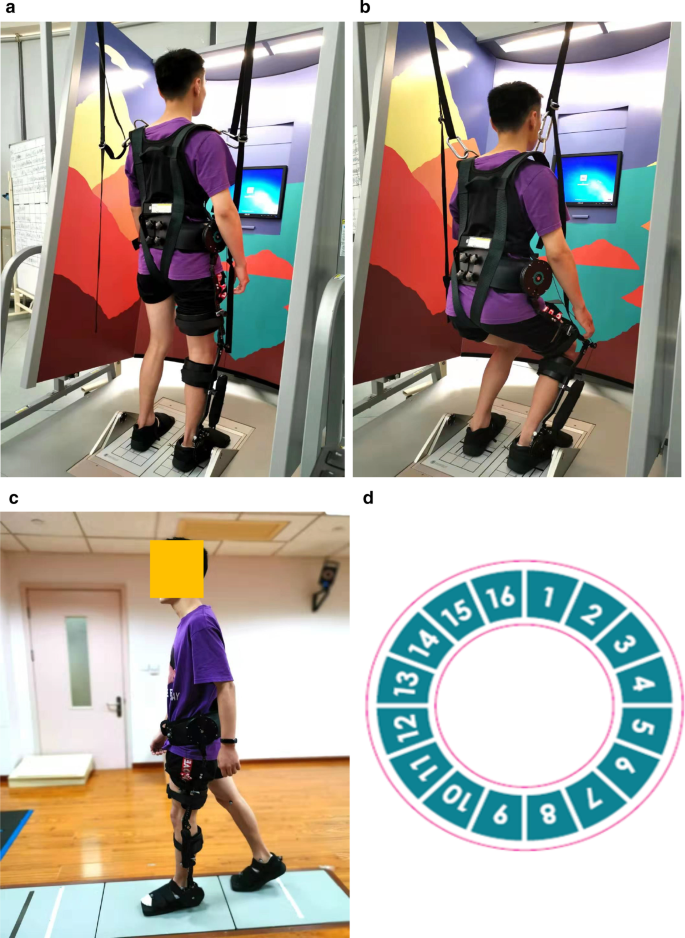
The figure shows the setup for the weight bearing squat test in the a upright position and b The squatting position with the exoskeleton device attached unilaterally. c Shows a non-study participant walking with exoskeletal assistance on a set of force platforms in the gait lab that has motion capture cameras on the walls. d Shows the dial sticker that was attached to the hip piece to note the movement of the ratchet for tightening the exotendon cable
The purpose of this study was to determine the feasibility of using the Kickstart walking system in a sample of stroke survivors who were in the subacute and chronic stages of the disease and attending an inpatient rehabilitation center. Study participants were tested for several measures with/without the device after experiencing walking with the exoskeleton over a period of 5 days. Outcome measures included: (a) gait measures, (b) balance measures and (c) exoskeleton-use feedback questionnaire. Results from this study will help us to explore if the technology can offer a new option for encouraging the recovery of walking ability of stroke patients, optimizing the rehabilitation treatment strategy, and providing some reference for subsequent related research.
Tuesday, July 21, 2020
Ankle–foot orthosis with dorsiflexion resistance using spring-cam mechanism increases knee flexion in the swing phase during walking in stroke patients with hemiplegia
A readable article on it here:
Putting Spring-cam Back Into Stroke Patients Steps
But is it better than either of these two? Your doctor has some comparisons to do.
Spring-based wearable device could help those with certain neurological conditions walk again - Kickstart
World’s first ‘bionic knee brace’ returns energy to your joints to boost leg strength
The research article here:
Ankle–foot orthosis with dorsiflexion resistance using spring-cam mechanism increases knee flexion in the swing phase during walking in stroke patients with hemiplegia
Highlights
- •
- Newly developed spring-cam mechanism (CAM) produces ankle dorsiflexion resistance.
- •
- CAM was added to AFO with plantarflexion resistance mechanism (AFO-P).
- •
- The AFO-P with CAM (AFO-PCAM) had dorsiflexion and plantarflexion resistance.
- •
- Effect of the AFO-PCAM on gait kinematics in hemiplegic patients was examined.
- •
- The AFO-PCAM increased knee flexion in swing during gait in hemiplegic patients.
Abstract
Background
Research question
Methods
Results
Significance
Thursday, March 3, 2016
Arizona veteran on the road to walk again with help from new device
Would this device even have been needed if our doctors and researchers had prevented the neuronal cascade of death? Don't people ever connect the dots and ask the correct questions on cause and effect?
Arizona veteran on the road to walk again with help from new device
After losing the ability to walk due to a stroke that occurred 10 years ago, one Arizona veteran took a major step on the road to walk again.
After some research, stroke survivor Intelligence Officer Mark Lazercheff stumbled across a device called Kickstart. The spring-based technology works by mimicking the tendons of a horse, enabling the user to properly walk.
Kickstart is currently being used in just a few therapy clinics across the country. It has been shown in clinical studies to help people with neurological disabilities, such as stroke, make dramatic gains in their recovery to walk again.
On Friday, Lazercheff was fitted with his very own Kickstart.
“Exercise helps with the pain. Anyone will tell you that,” said Lazercheff. “This will allow me to walk more and break up the tightness. It’s like rocks and rubber bands.”
Lazercheff said his goal is to be able to run a little before he retires next January.
Friday, December 11, 2015
Spring-based wearable device could help those with certain neurological conditions walk again
Have your therapist and doctor compare it to this:
World’s first ‘bionic knee brace’ returns energy to your joints to boost leg strength
Spring-based wearable device could help those with certain neurological conditions walk again
/ Dec 9, 2015 at 11:30 AM
For some patients who have suffered strokes, spinal cord injuries or other neurological conditions, walking again can be an immense challenge. Cadence Biomedical has created the Kickstart device, which uses spring-based technology to help those learning to walk again. It announced today the first peer-reviewed publication that indicates the promising effects of the device.
The study, published in Physical Medicine and Rehabilitation International, is the first indication that the Kickstart has had proven results and is a viable option for those in need of therapy.
The clinical case series demonstrated the outcomes of patients who had previously plateaued in their progress to walk and how use of the Kickstart both during physical therapy and at home increased their results.
According to a statement: “The study found that in each case, walking speed and endurance progressed for each patient, with improvement of walking distance ranging from 1.8 to five times farther as a result of using Kickstart. All patients were able to walk an average of two times faster than at baseline.”
“It’s immensely gratifying and encouraging to see clinicians using Kickstart to speed up improvement for their neurological clients, even up to 20 years after their injuries,” Cadence co-founder and COO Brian Glaister, said in the company’s statement. “This paper represents a critical dataset showing Kickstart’s efficacy as a therapeutic tool, which we hope will make a difference in the lives of many more stroke survivors and help to transform health outcomes.”
Friday, April 10, 2015
Kickstart Equips Stroke Rehab Facilities to Accelerate Walking Recovery
http://www.medgadget.com/2015/04/kickstart-equips-stroke-rehab-facilities-accelerate-walking-recovery.html