Use the labels in the right column to find what you want. Or you can go thru them one by one, there are only 33,563 posts. Searching is done in the search box in upper left corner. I blog on anything to do with stroke. DO NOT DO ANYTHING SUGGESTED HERE AS I AM NOT MEDICALLY TRAINED, YOUR DOCTOR IS, LISTEN TO THEM. BUT I BET THEY DON'T KNOW HOW TO GET YOU 100% RECOVERED. I DON'T EITHER BUT HAVE PLENTY OF QUESTIONS FOR YOUR DOCTOR TO ANSWER.
Changing stroke rehab and research worldwide now.Time is Brain!trillions and trillions of neuronsthatDIEeach day because there areNOeffective hyperacute therapies besides tPA(only 12% effective). I have 523 posts on hyperacute therapy, enough for researchers to spend decades proving them out. These are my personal ideas and blog on stroke rehabilitation and stroke research. Do not attempt any of these without checking with your medical provider. Unless you join me in agitating, when you need these therapies they won't be there.
What this blog is for:
My blog is not to help survivors recover, it is to have the 10 million yearly stroke survivors light fires underneath their doctors, stroke hospitals and stroke researchers to get stroke solved. 100% recovery. The stroke medical world is completely failing at that goal, they don't even have it as a goal. Shortly after getting out of the hospital and getting NO information on the process or protocols of stroke rehabilitation and recovery I started searching on the internet and found that no other survivor received useful information. This is an attempt to cover all stroke rehabilitation information that should be readily available to survivors so they can talk with informed knowledge to their medical staff. It lays out what needs to be done to get stroke survivors closer to 100% recovery. It's quite disgusting that this information is not available from every stroke association and doctors group.
Thursday, April 4, 2019
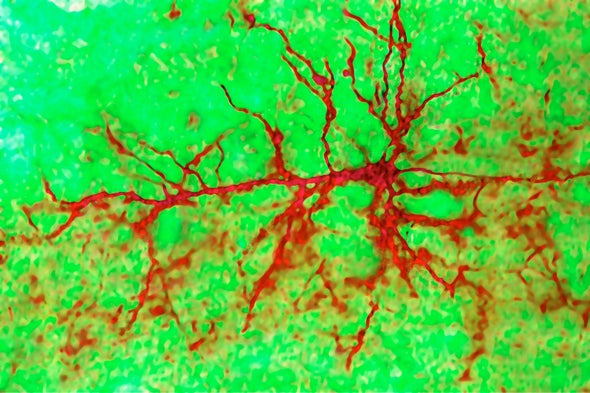
The Adult Brain Does Grow New Neurons After All, Study Says
Well then we need a protocol so we can do that on demand. AND we need a protocol to migrate them to the needed areas. Your doctor can read these and create a migration protocol for you.
If the memory center of the human
brain can grow new cells, it might help people recover from depression
and post-traumatic stress disorder (PTSD), delay the onset of
Alzheimer’s, deepen our understanding of epilepsy and offer new insights
into memory and learning. If not, well then, it’s just one other way
people are different from rodents and birds.
For decades, scientists have debated whether the birth of new
neurons—called neurogenesis—was possible in an area of the brain that is
responsible for learning, memory and mood regulation. A growing body of
research suggested they could, but then a Nature paper last year raised doubts.
Now, a new study published today in another of the Nature family of journals—Nature Medicine—tips
the balance back toward “yes.” In light of the new study, “I would say
that there is an overwhelming case for the neurogenesis throughout life
in humans,” Jonas Frisén, a professor at the Karolinska Institute in
Sweden, said in an e-mail. Frisén, who was not involved in the new
research, wrote a News and Views about the study in the current issue of
Nature Medicine.
Not everyone was convinced. Arturo Alvarez-Buylla was the senior author on last year’s Nature
paper, which questioned the existence of neurogenesis. Alvarez-Buylla, a
professor of neurological surgery at the University of California, San
Francisco, says he still doubts that new neurons develop in the brain’s
hippocampus after toddlerhood.
“I don’t think this at all settles things out,” he says. “I’ve been
studying adult neurogenesis all my life. I wish I could find a place [in
humans] where it does happen convincingly.”
For decades, some researchers
have thought that the brain circuits of primates—including humans—would
be too disrupted by the growth of substantial numbers of new neurons.
Alvarez-Buylla says he thinks the scientific debate over the existence
of neurogenesis should continue. “Basic knowledge is fundamental. Just
knowing whether adult neurons get replaced is a fascinating basic
problem,” he said.
New technologies that can locate cells in the living brain and
measure the cells’ individual activity, none of which were used in the Nature Medicine study, may eventually put to rest any lingering questions.
A number of researchers praised the new study as thoughtful and
carefully conducted. It’s a “technical tour de force,” and addresses the
concerns raised by last year’s paper, says Michael Bonaguidi, an
assistant professor at the University of Southern California Keck School
of Medicine.
The researchers, from Spain, tested a variety of methods of
preserving brain tissue from 58 newly deceased people. They found that
different methods of preservation led to different conclusions about
whether new neurons could develop in the adult and aging brain.
Brain tissue has to be preserved within a few hours after death, and
specific chemicals used to preserve the tissue, or the proteins that
identify newly developing cells will be destroyed, said Maria
Llorens-Martin, the paper’s senior author. Other researchers have missed
the presence of these cells, because their brain tissue was not as
precisely preserved, says Llorens-Martin, a neuroscientist at the
Autonomous University of Madrid in Spain.
Jenny Hsieh, a professor at the University of Texas San Antonio who
was not involved in the new research, said the study provides a lesson
for all scientists who rely on the generosity of brain donations. “If
and when we go and look at something in human postmortem, we have to be
very cautious about these technical issues.”
Llorens-Martin said she began carefully collecting and preserving
brain samples in 2010, when she realized that many brains stored in
brain banks were not adequately preserved for this kind of research. In
their study, she and her colleagues examined the brains of people who
died with their memories intact, and those who died at different stages
of Alzheimer’s disease. She found that the brains of people with
Alzheimer’s showed few if any signs of new neurons in the
hippocampus—with less signal the further along the people were in the
course of the disease. This suggests that the loss of new neurons—if it
could be detected in the living brain—would be an early indicator of the
onset of Alzheimer’s, and that promoting new neuronal growth could
delay or prevent the disease that now affects more than 5.5 million
Americans.
Rusty Gage, president of the Salk Institute for Biological Studies
and a neuroscientist and professor there, says he was impressed by the
researchers’ attention to detail. “Methodologically, it sets the bar for
future studies,” says Gage, who was not involved in the new research
but was the senior author in 1998 of a paper
that found the first evidence for neurogenesis. Gage says this new
study addresses the concerns raised by Alvarez-Buylla’s research. “From
my view, this puts to rest that one blip that occurred,” he says. “This
paper in a very nice way… systematically evaluates all the issues that
we all feel are very important.”
Neurogenesis in the hippocampus matters, Gage says, because evidence
in animals shows that it is essential for pattern separation, “allowing
an animal to distinguish between two events that are closely associated
with each other.” In people, Gage says, the inability to distinguish
between two similar events could explain why patients with PTSD keep
reliving the same experiences, even though their circumstances have
changed. Also, many deficits seen in the early stages of cognitive
decline are similar to those seen in animals whose neurogenesis has been
halted, he says.
In healthy animals, neurogenesis promotes resilience in stressful
situations, Gage says. Mood disorders, including depression, have also
been linked to neurogenesis.
Hsieh says her research on epilepsy has found that newborn neurons
get miswired, disrupting brain circuits and causing seizures and
potential memory loss. In rodents with epilepsy, if researchers prevent
the abnormal growth of new neurons, they prevent seizures, Hsieh says,
giving her hope that something similar could someday help human
patients. Epilepsy increases someone’s risk of Alzheimer’s as well as
depression and anxiety, she says. “So, it’s all connected somehow. We
believe that the new neurons play a vital role connecting all of these
pieces,” Hsieh says.
In mice and rats, researchers can stimulate the growth of new neurons
by getting the rodents to exercise more or by providing them with
environments that are more cognitively or socially stimulating,
Llorens-Martin says. “This could not be applied to advanced stages of
Alzheimer’s disease. But if we could act at earlier stages where
mobility is not yet compromised,” she says, “who knows, maybe we could
slow down or prevent some of the loss of plasticity [in the brain].”


No comments:
Post a Comment