Changing stroke rehab and research worldwide now.Time is Brain! trillions and trillions of neurons that DIE each day because there are NO effective hyperacute therapies besides tPA(only 12% effective). I have 523 posts on hyperacute therapy, enough for researchers to spend decades proving them out. These are my personal ideas and blog on stroke rehabilitation and stroke research. Do not attempt any of these without checking with your medical provider. Unless you join me in agitating, when you need these therapies they won't be there.

What this blog is for:

My blog is not to help survivors recover, it is to have the 10 million yearly stroke survivors light fires underneath their doctors, stroke hospitals and stroke researchers to get stroke solved. 100% recovery. The stroke medical world is completely failing at that goal, they don't even have it as a goal. Shortly after getting out of the hospital and getting NO information on the process or protocols of stroke rehabilitation and recovery I started searching on the internet and found that no other survivor received useful information. This is an attempt to cover all stroke rehabilitation information that should be readily available to survivors so they can talk with informed knowledge to their medical staff. It lays out what needs to be done to get stroke survivors closer to 100% recovery. It's quite disgusting that this information is not available from every stroke association and doctors group.

Showing posts with label too good to treat. Show all posts

Wednesday, April 3, 2024

Trends of Intravenous Thrombolysis and Thrombectomy for Low NIHSS Score (<6) Strokes in the United States: A National Inpatient Sample Study

 There are never stroke patients too good to treat. All patients should get to 100% recovery.

Trends of Intravenous Thrombolysis and Thrombectomy for Low NIHSS Score (<6) Strokes in the United States: A National Inpatient Sample Study

Originally publishedhttps://doi.org/10.1161/SVIN.123.001262Stroke: Vascular and Interventional Neurology. 2024;0:e001262

Stroke management has evolved significantly with the use of intravenous thrombolysis (IVT) and endovascular thrombectomy (EVT). However, low‐severity strokes, National Institutes of Health Stroke Scale (NIHSS) score <6, were mostly absent in the main trials that established the efficacy of EVT and IVT. As the indications for thrombectomy expand for larger and older strokes, there is still ambiguity surrounding its use in these low‐severity cases. This study aims to analyze the trends in IVT and EVT usage as well as functional outcome, inpatient death, and intracranial hemorrhage (ICH) among low‐severity strokes in the United States following the landmark 2015 EVT trials. 

METHODS

Anonymized data and materials have been made publicly available at the Healthcare Cost and Utilization Project National Inpatient Sample database and the data from 2016 to 2020 which were utilized can be accessed at www.hcup‐us.ahrq.gov/nisoverview.jsp.1 Our analysis can be made available upon reasonable request. The National Inpatient Sample is the United States’ largest inpatient database, with 7 million annual admissions. Managed by the Healthcare Cost and Utilization Project, it features deidentified hospitalization data based on billing and discharge records. Its discharge weights enable national statistical estimates. We analyzed the NIS database from 2016 to 2020 for patients with stroke with NIHSS score <6 on admission. Functional independence, which entails routine home discharge without assistance, was used as our primary outcome, as this has been shown to correlate with modified Rankin scale score ≤ 2 at 90 days.2 We also analyzed the rates of inpatient death and ICH. We used the ICH variable International Classification of Diseases, Tenth Revision (ICD‐10) code as opposed to ICH as a sequela of cerebrovascular disease. All annual proportions were compared using logistic regression models, with 2016 as the reference year. Statistical analyses were performed accounting for the sampling design of the National Inpatient Sample, with appropriate strata, weights, and clusters according to Healthcare Cost and Utilization Project guidelines.1

RESULTS

Baseline patient characteristics can be viewed in Table S1. Compared with 2016, IVT usage decreased significantly by 2020 (11.32% versus 14.88%; odds ratio [OR], 0.769 [95% CI, 0.676–0.874]; P<0.001), while EVT usage incrementally increased during this time and was significantly higher in 2020 (1.97% versus 1.35%; OR,1.466 [95% CI, 1.012–2.123]; P<0.05). Rates of combined IVT and EVT treatment were 0.37% in 2016 and, while slightly increasing, remained statistically unchanged during the period. There was a significant increase in functional independence in 2017 (49.02% versus 46.42%; OR, 1.110 [95% CI, 1.011–1.219]; P = 0.029), 2018 (48.81% versus 46.42%; OR, 1.101 [95% CI, 1.005–1.204]; P = 0.038), and 2019 (49.37 versus 46.42%; OR, 1.125 [95% CI, 1.030–1.230]; P = 0.009), compared with 2016, and a nearly significantly increase in 2020 (48.54% versus 46.42%; OR, 1.089 [95% CI, 0.996–1.190]; P = 0.06). ICH and inpatient death remained statistically unchanged. Trend lines can be visualized in the Figure and the table of outcomes in Table S2.

Thursday, July 20, 2023

The use of alteplase, although safe, does not offer clear clinical advantages when mild stroke is non-disabling

Did you ask your patients if your definition of non-disabling matches theirs?   I thought not.

There are NO strokes that are too good to treat. Do you ever talk to stroke survivors about leaving them disabled because you did NOTHING?

The use of alteplase, although safe, does not offer clear clinical advantages when mild stroke is non-disabling

Giovanni Merlino1,2*, Lorenzo Nesi2, Pietro Vergobbi2, Marco Domenico Scanni2, Sara Pez2, Alessandro Marziali2, Yan Tereshko2, Giuseppe Sportelli2, Simone Lorenzut1, Francesco Janes1,2, Gian Luigi Gigli3 and Mariarosaria Valente2,3
  • 1Stroke Unit, Department of Head-Neck and Neuroscience, Udine University Hospital, Udine, Italy
  • 2Clinical Neurology, Udine University Hospital, Udine, Italy
  • 3Dipartimento di Area Medica (DAME), University of Udine, Udine, Italy

Introduction: It is unknown whether alteplase is effective and safe in patients with mild acute ischemic stroke (AIS). Determining whether symptoms are “disabling” or not is a crucial factor in the management of these patients. This study aimed to investigate the efficacy and safety of alteplase in patients with mild, non-disabling AIS.

Methods: We included all consecutive patients admitted for AIS at our institution from January 2015 to May 2022 who presented a baseline NIHSS score of 0–5 and fit the criteria to receive intravenous thrombolysis. In order to select only subjects with non-disabling AIS, we excluded patients who scored more than 1 point in the following NIHSS single items: vision, language, neglect, and single limb. Patients who scored at least 1 point in the NIHSS consciousness item were excluded as well. This study is a retrospective analysis of a prospectively collected database.

Results: After the application of the exclusion criteria, we included 319 patients, stratified into patients receiving and not receiving alteplase based on non-disabling symptoms. The two groups were comparable regarding demographic and clinical data. Rates of a 3-month favorable outcome, defined as a 3-month mRS score of 0–1, were similar, being 82.3% and 86.1% in the treated and untreated patients, respectively. Hemorrhagic complications and mortality occurred infrequently and were not affected by alteplase treatment.

Discussion: This observational study suggests that the use of alteplase, although safe, is not associated with a better outcome in highly selected patients with non-disabling AIS.

Sunday, February 19, 2023

Thrombolysis Not Necessary in Mild Nondisabling Stroke: ARAMIS

But you say NOTHING on how you are getting them 100% recovered! There are NO strokes that are too good to treat. Do you ever talk to stroke survivors about leaving them disabled because you did NOTHING?

Thrombolysis Not Necessary in Mild Nondisabling Stroke: ARAMIS

Among Chinese patients with minor nondisabling stroke who presented within 4.5 hours of symptom onset, dual antiplatelet treatment was noninferior to thrombolysis with intravenous alteplase with regard to functional outcome at 90 days in the ARAMIS trial.

The trial was presented by Thanh Nguyen, MD, Boston Medical Center, on February 10 at the International Stroke Conference (ISC) 2023 in Dallas, Texas.

"Given the ease of administration, less intensive monitoring, low cost, and safety profile of dual antiplatelet therapy, the current findings support the use of dual antiplatelet in this population," Nguyen concluded.

Commenting on the ARAMIS trial for theheart.org | Medscape Cardiology, Pooja Khatri, MD, professor of neurology at the University of Cincinnati, Ohio, and lead investigator of the previous PRISMS study of tissue plasminogen activator (tPA) or alteplase in mild stroke, said the results reinforced the current recommendations of giving dual antiplatelet therapy but not alteplase to these patients.

Noting that the standard of care is now to give dual antiplatelet therapy to these patients, Khatri said: "These data reassure that this remains the right way to go."

She added that her take-home message from the study would be: "Keep giving dual antiplatelet therapy, and we may be doing more harm than good with alteplase in this patient population."

Introducing her presentation, Nguyen explained that mild ischemic stroke, defined as having a National Institutes of Health Stroke Scale (NIHSS) score of 5 or less, comprises half of ischemic stroke patients in the US. But the benefit of thrombolysis in patients with minor ischemic stroke that is not disabling is unknown.

A subgroup analysis of one of the major thrombolysis trials (IST-3) found that a higher proportion of patients with mild ischemic stroke that was treated within 3 hours of symptom onset were alive and independent at 6 months if they had been given thrombolysis (84%), compared to 65% in the control group who received standard medical treatment.

This led to the first randomized trial (PRISMS) dedicated to patients with mild nondisabling stroke, which found that alteplase given within 3 hours of symptom onset did not increase the likelihood of a good functional outcome at 90 days in comparison with single-agent aspirin. The study was unfortunately terminated early for administrative reasons, and no definitive conclusions could be drawn on the basis of these results, Nguyen reported.

In 2018, the American Heart Association/American Stroke Association guidelines indicated that for patients who present within 3 hours of symptom onset with mild ischemic stroke that was judged to be nondisabling, thrombolysis with intravenous alteplase could be considered, she noted.

In the meantime, dual antiplatelet therapy was shown to be safe and effective in the POINT and CHANCE trials in patients presenting with minor stroke within 12 or 24 hours, and the CHANCE trial also found a benefit in reducing recurrent stroke that was most effective in the first 2 weeks.

The current ARAMIS trial was therefore conducted to evaluate dual antiplatelet therapy in comparison with thrombolysis for patients with acute minor stroke (NIHSS 5 or less) who presented within 4.5 hours of symptom onset and were without clearly disabling deficit.

The trial was conducted in 38 hospitals in China and included 760 patients (median NIHSS score of 2) who were randomly assigned to receive intravenous alteplase at the standard dose of 0.9 mg/kg, followed by guideline-based antiplatelet treatment, or dual antiplatelet therapy (clopidogrel 300 mg plus 100 mg aspirin loading dose followed by 10 to 14 days of aspirin 100 mg and clopidogrel 75 mg).

The trial was designed to assess noninferiority of dual antiplatelet therapy to alteplase with noninferiority margin of -4.5%.

In the modified intention-to-treat analysis, which included 722 patients, the primary outcome (excellent functional outcome, defined as a Modified Rankin Scale score of 0 or 1 at 90 days) occurred in 93.8% of patients in the dual antiplatelet therapy group and in 91.4% of the alteplase group. This gave a difference of 2.4%, which fell within the limits for noninferiority (P = .0002 for noninferiority test).

"Therefore, this was a positive trial," Nguyen stated.

About 20% of patients crossed over from the dual antiplatelet group to the thrombolysis group, and about 16% of patients crossed over from the thrombolysis group to the dual antiplatelet group. But a per-protocol and an "as treated" analysis showed similar results to the main intention-to-treat analysis.

Secondary outcomes were largely similar between the two groups other than early neurologic deterioration, which was less common in the dual antiplatelet therapy group.

In terms of safety, symptomatic intracranial hemorrhage occurred in 0.3% (1/369) in the dual antiplatelet group and in 0.9% (3/350) in the alteplase group, a nonsignificant difference.

Events of "any bleeding" occurred in more patients in the thrombolysis group (5.4%) than in the dual antiplatelet therapy group (1.6%), and this difference was significant (P = .01).

Subgroup analysis showed a trend toward benefit of alteplase for patients with higher NIHSS score at baseline (NIHSS >3). Otherwise, the other subgroups looked similar to the main results.

Dual Antiplatelet Therapy Now Standard of Care

Nguyen pointed out one limitation of the study ― that dual antiplatelet therapy was updated to standard treatment in this target population in the 2019 AHA/ASA guidelines.

In her discussion of the study, Khatri suggested that the ARAMIS results were what might have been expected.

"Dual antiplatelet therapy is designed to prevent stroke. Even in the POINT trial, dual antiplatelet therapy showed no effect on 90-day functional outcome. It was really about prevention. The PRISMS trial suggested that alteplase was also unlikely to improve 90-day functional outcome in this population of patients with mild and not clearly disabling stroke. So, it is not surprising that dual antiplatelet therapy was noninferior to alteplase for 90-day functional outcome for both those reasons," she explained.

"That being said, while designed as a noninferiority study, it is interesting to note that alteplase again showed no evidence of treatment effect compared to antiplatelet therapy, affirming what was observed in the prematurely terminated PRISMS trial," Khatri added.

In a discussion of the study at an ISC 2023 highlights session, ISC program chair Tudor Jovin, MD, Cooper Neurological Institute, Cherry Hill, New Jersey, said: "This is very important data and it's actually the first completed trial that examines this question."

But, he added, "I think we need to refine our knowledge about what a nondisabling stroke actually is. You could argue that every stroke is disabling. I think we need more clarity on this definition, as in practice, many clinicians still give tPA on account of these mild strokes still being disabling."

The ARAMIS trial was funded by the National Key R&D Program of China and the Science and Technology Project Plan of Liao Ning Province. Nguyen reports research support from Medtronic that was not related to the current study.

International Stroke Conference (ISC) 2023: Abstract LB23. Presented February 10, 2023.

For more from the heart.org | Medscape Cardiology, follow us on Twitter and Facebook.


Friday, November 26, 2021

Acute Ischemic Stroke With Mild Symptoms–To Thrombolyse or Not to Thrombolyse?

Really? doing nothing is an option? Charge them $1000 a dead neuron, that will concentrate the mind. You're supposed to do no harm, dead neurons are considered harm, aren't they?

Acute Ischemic Stroke With Mild Symptoms–To Thrombolyse or Not to Thrombolyse?

 
Julia Ferrari1*, Audrey Reynolds2, Michael Knoflach3 and Marek Sykora1,4
  • 1Department of Neurology, St John's Hospital, Vienna, Austria
  • 2Department of Neurology, St Vincent's University Hospital, Dublin, Ireland
  • 3Department of Neurology, Medical University of Innsbruck, Innsbruck, Austria
  • 4Medical Faculty, Sigmund Freud University Vienna, Vienna, Austria

Management of stroke with minor symptoms may represent a therapeutical dilemma as the hemorrhage risk of acute thrombolytic therapy may eventually outweigh the stroke severity. However, around 30% of patients presenting with minor stroke symptoms are ultimately left with disability. The objective of this review is to evaluate the current literature and evidence regarding the management of minor stroke, with a particular emphasis on the role of IV thrombolysis. Definition of minor stroke, pre-hospital recognition of minor stroke and stroke of unknown onset are discussed together with neuroimaging aspects and existing evidence for IV thrombolysis in minor strokes. Though current guidelines advise against the use of thrombolysis in those without clearly disabling symptoms due to a paucity of evidence, advanced imaging techniques may be able to identify those likely to benefit. Further research on this topic is ongoing.

Introduction

A scenario known to every neurologist: a patient with acute onset mild stroke symptoms is admitted to the hospital. Imaging excludes an intracranial hemorrhage. Should intravenous thrombolysis be given? What are the risks and what are the benefits? It is frequently assumed that for those with mild stroke symptoms, risks of thrombolysis outweigh potential benefits. However, despite having “minor” symptoms, one-third of stroke patients were not functionally independent at 90 days when considered too mild to treat for intravenous thrombolysis (14). The purpose of this review is to provide an update on the acute treatment of patients with minor stroke with a special focus on intravenous thrombolysis.

Definition of Stroke With Mild Symptoms

The definition of a stroke with mild symptoms or minor stroke (MS) is not standardized. Definitions are often based on the National Institutes of Health Stroke Scale (NIHSS) requiring a score ≤ 1 on every item (5) or utilize certain limits, mostly NIHSS ≤ 6 (6). Other definitions include whether symptoms are disabling or non-disabling, e.g., isolated aphasia or a severe distal paresis of the arm will give a low NIHSS score but are very disabling symptoms.

Further questions arise in differentiating minor stroke from a transient ischemic attack (TIA). In the acute phase, it is not possible to tell whether symptoms will persist or resolve spontaneously. The definition of a TIA from the American Heart and the American Stroke Association from 2002, “a transient episode of neurological dysfunction caused by focal brain, spinal cord, or retinal ischemia, without acute infarction” (7) implies the use of an advanced imaging method to differentiate between TIA and minor stroke. This definition will build the basis for the 11th International Classification of Diseases (8). A majority of TIAs are of short duration, and once neurological deficits persist longer than 60 min they resolve in <15% within 24 h (9). Furthermore, only 2% of patients that received placebo in the National Institute of Neurological Disorders and Stroke rt-PA Stroke Study were free of symptoms 24 h later (10).

Those with rapidly improving symptoms are usually excluded from receiving thrombolysis therapy. Rapidly improving symptoms are those which improve spontaneously after presentation, but the definition is ambiguous. However, their outcomes are not predictable, with 30% of those with minor stroke or rapidly improving symptoms not fully functionally independent at hospital discharge (1).

Disabling or Non-Disabling Symptoms?

Determining whether symptoms are “disabling” or not is an important factor in the management of acute MS. A pooled metanalysis of nine trials could show that thrombolysis treatment resulted in a nearly 10% better chance of an excellent functional outcome after 3 months in patients with clearly disabling deficits such as aphasia or hemiparesis (11, 12).

For those with non-disabling symptoms, however, less evidence exists. Only one of these nine trials–the Third International Stroke Trial (IST-3) (13)–did not exclude patients with non-disabling symptoms.

IST-3 found evidence of benefit for thrombolysis for those presenting within 6 h of symptoms of stroke, however the benefit increased with increasing NIHSS and was less beneficial for those with minor stroke symptoms. Out of the 106 patients randomized with NIHSS ≤ 5, 60% showed a favorable outcome after 3 months.

Non-disabling symptoms include transient, fluctuating or persistent symptoms without unilateral motor weakness or language/speech disturbance (e.g., hemi-body sensory symptoms, monocular vision loss, binocular diplopia, hemifield vision loss, dysarthria, dysphagia, or ataxia). The PRISMS trial, a randomized controlled trial (RCT), showed that among patients with a low NIHSS and no disabling deficit, rtPA may not provide a benefit and might increase the risk of symptomatic intracranial hemorrhage (6). A clearly disabling deficit was operationally defined as a deficit that, if unchanged, would prevent the patient from performing basic activities of daily living (i.e., bathing, ambulating, toileting, hygiene, and eating) or returning to work. Judging how disabling a deficit will be in the future is challenging in the hyperacute stroke setting.

A further obstacle to thrombolysis treatment in minor stroke is that patients with minor stroke symptoms do not receive the priority of emergency medical services and in-hospital triage pathways leading to relevant time delays in onset-to-door and door-to-imaging times (14).

Prehospital Recognition of Minor Stroke

The presentation of those with mild symptoms is frequently delayed compared to major stroke as it may not be recognized in the acute phase, leading to undertreatment. Public knowledge of stroke symptoms according to the FAST campaign is only about 70%, with the highest rate found in females and in the older and white population (15). Additionally, the mode of arrival at the hospital plays an important role. Patterns of emergency medical services pre-notification vary across countries. Data from a cohort study in New York showed that patients with minor stroke have longer door to needle times if the mode of arrival was without pre-notification (16).

The clinical significance of posterior circulation symptoms is often not recognized and, therefore, mostly remain undertreated in the acute phase. As in the NIHSS symptoms of the posterior circulation are underrepresented (e.g., vertigo, imbalance of gait), strokes in this territory are more likely to be defined as “minor” if a cut-off NIHSS score is used.

Wake up Stroke and Stroke of Unknown Onset

Those who wake up with stroke were traditionally excluded from revascularization therapies, due to unknown time of onset. Due to circadian rhythms there is diurnal variation in stroke onset, with a higher number occurring in the morning, which may be related to a surge in blood pressure (17). This suggests that the stroke may have occurred shortly before awakening, though the true time of onset is unknown. Modern imaging technologies, such as MRI DWI and FLAIR mismatch and or perfusion imaging, can help identify those who may benefit from thrombolysis or thrombectomy (18). The WAKE-UP trial showed that those with strokes evident from sleep with favorable MRI findings (DWI and FLAIR mismatch) who were treated with IV alteplase had significantly better functional outcomes, though more intracranial hemorrhages, than placebo at 90 days (19). The WAKE-UP trial included patients with all types of stroke severity, but the median NIHSS was of mild to moderate severity (median NIHSS 6, interquartile range 4–9). Analysis of patients with minor stroke has not been reported so far. Penumbral pattern identified using perfusion imaging is another recent radiological paradigm to identify those to benefit from reperfusion in the absence of onset time knowledge. Trials including ECASS4, EPITHET and EXTEND proved positively this concept for wake-up strokes and extended time window (4.5–9 h) thrombolysis (20).

Thrombolysis for wake-up stroke with minor symptoms has not been specifically studied. As mentioned previously, many stroke centers do not perform advanced imaging in those with NIHSS ≤ 6, and may be missing those with mismatch deficits or large vessel occlusions who could potentially benefit from thrombolysis. See also illustrative patient case in Figure 2.

Current Evidence of use of Thrombolytic Agents in Patients With Minor Stroke

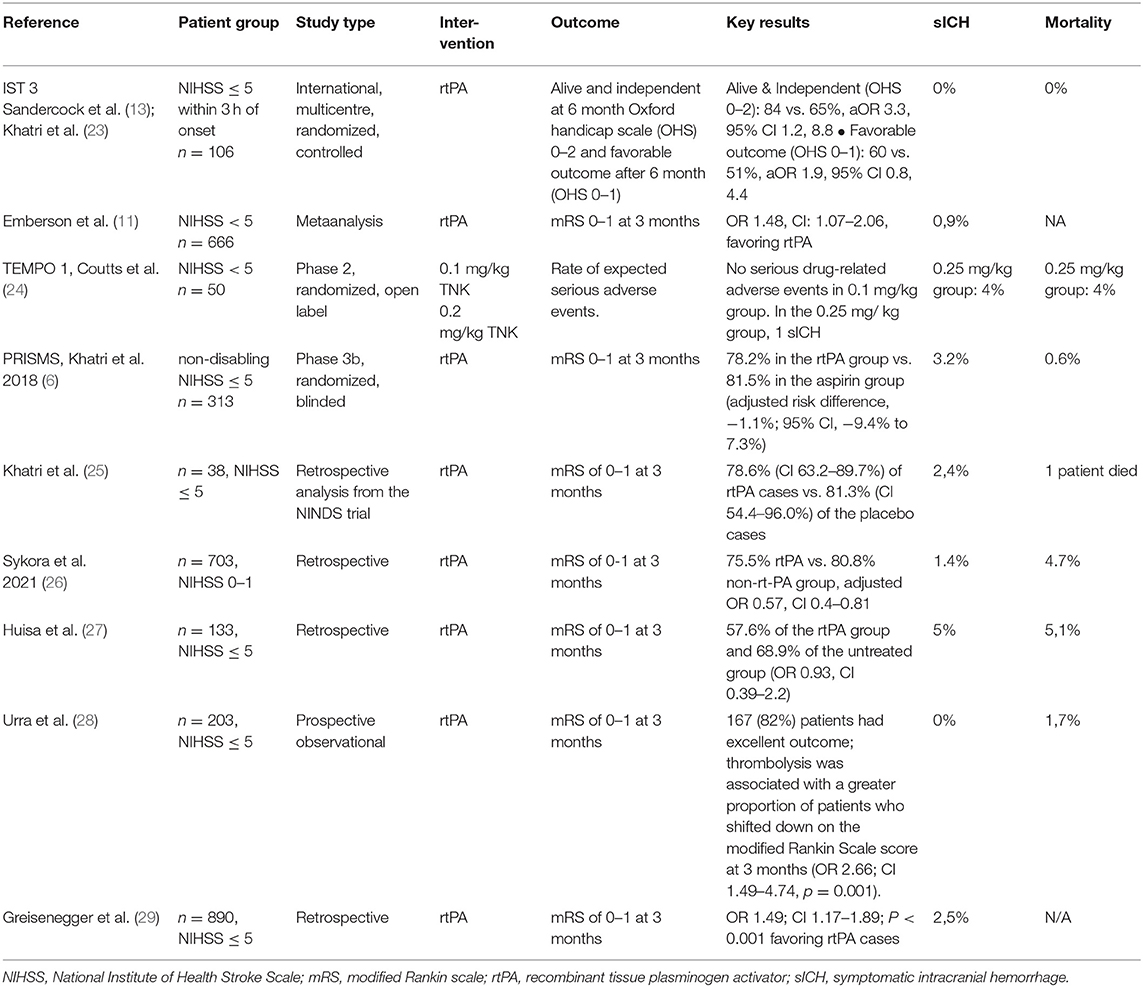
Current guidelines and recommendations state that for patients with acute minor disabling ischemic stroke of <4.5 h duration, intravenous thrombolysis with recombinant alteplase is recommended/ may be reasonable (21, 22). RCTs and observational studies addressing this topic so far showed promising results with a good functional outcome and a low complication rate (Table 1).

TABLE 1
www.frontiersin.org

Table 1. Randomized controlled trials and observational trials on thrombolysis in minor stroke.

For patients with acute minor non-disabling ischemic stroke of <4.5 h duration, no intravenous thrombolysis is recommended. One exception may be patients with non-disabling symptoms and a large vessel occlusion. However, many acute stroke centers do not perform angiography for those with NIHSS <6 as part of their internal protocol, and many centers do not have access to advanced imaging such as CT perfusion. Therefore, an unknown proportion of stroke with minor symptoms who have large vessel occlusions amenable to intervention are being missed. TEMPO 1, a case series of 50 patients with mild symptoms and intracranial vessel occlusion, which showed that administration of tenecteplase-tissue-type plasminogen activator in minor stroke with intracranial occlusion is feasible and safe (24). Wang et al. found that intravenous thrombolysis benefits though with mild stroke symptoms (NIHSS ≤ 5) and large artery atherosclerosis, though not those who had a tandem proximal intracranial occlusion and cervical internal artery lesion (complete occlusion or severe stenosis ≥ 90%) (30). They found that LAA-type patients (as defined by TOAST criteria) had significantly favorable outcomes after treatment with thrombolysis compared to untreated patients, however no such benefits were observed in other stroke subtypes, such as cardioembolic, small vessel occlusion and undetermined. This suggests that CT or MR angiography might be helpful to choose patients for thrombolysis that present with stroke with minor symptoms.

Alteplase or Tenecteplase in Patients With Minor Stroke

In recent years, the recombinant plasminogen activator tenecteplase is increasingly competing with the gold standard alteplase. The first publication of the EXTEND IA TNK study showed that higher perfusion rates and better clinical results can be achieved with tenecteplase in the 0.25 mg/kg dose than with alteplase in patients with an acute ischemic stroke (31). Tenecteplase was used as so-called bridging thrombolysis in the 4.5 h time window until the mechanical thrombectomy was performed. In addition, tenecteplase has advantages in handling, as it can be administered as single intravenous bolus and does not require a continuous infusion over 1 h, as alteplase does. The results of the EXTEND TNK study prompted the authors of the US guideline and the European Stroke Organization (ESO) to include tenecteplase in their recommendation as an alternative fibrinolytic (AHA/ASA Class IIb recommendation), although the AHA/ASA recommendation can also be considered to the 0.4 mg/kg dose for patients with less severe neurological impairments and if there are no large vessel occlusions (Level of Evidence: IIb) (22).

The second part of the EXTEND TNK study was recently published (32) which evaluated different doses of tenecteplase. The higher dose of tenecteplase (0.4 mg/kg) did not have any disadvantages in terms of safety: there were 16 and 22 death in the high and low dose groups, respectively. Symptomatic intracerebral hemorrhages 36 h after thrombolysis were numerically more frequent in the high dose group (7 vs. 2 patients), but four bleeding events in this group were associated with wire perforations during the endovascular procedure and were therefore not attributable to thrombolysis directly. The authors of the study report that the latter results are in contrast to an earlier study with the 0.40 mg/kg dose that was terminated prematurely for safety reasons, as some patients developed symptomatic intracranial hemorrhage. As a limitation, Campbell and colleagues point out that the study may not have been powered to reveal differences in efficacy. There was no restriction on clinical severity using NIHSS scores in these trials, but showed that probably a higher perfusion rate can be achieved with tenecteplase in patients with vessel occlusions. TEMPO 2 is an ongoing multicentre prospective randomized open label blinded-endpoint (PROBE) controlled trial of thrombolysis with low dose TEnecteplase vs. standard of care in Minor ischemic stroke with Proven acute symptomatic Occlusion (33). The hypothesis is that patients with mild (NIHSS < = 5) or even non-disabling symptoms due to identifiable vessel occlusion will benefit from IVT as compared to standard antiplatelet therapy. Results are expected in 2024. In summary, currently no evidence exists that tenecteplase should be preferred to alteplase in acute treatment of minor stroke patients, though further research is ongoing.


Thursday, February 11, 2021

Intravenous thrombolysis in stroke with admission NIHSS score 0 or 1

 So we still know nothing about treating mild strokes and until we do your doctors will just assume you are too good to treat and let your neurons die. The job of your doctor is to prevent disability not just stand by watching neurons die.  Contact researchers and get appropriate research going. Not doing so is an indictment of the complete stroke hospital starting at the top with the board of directors.

Tuesday, November 10, 2020

Safety and Hospital Costs Averted Using a Rapid Outpatient Management Strategy for Transient Ischemic Attack and Minor Strokes: The RAVEN Clinic

This is absolutely appalling, suggesting that TIAs and minor strokes are too good to treat because of cost concerns.  You better hope this doesn't happen to you because the damage won't magically disappear.


Safety and Hospital Costs Averted Using a Rapid Outpatient Management Strategy for Transient Ischemic Attack and Minor Strokes: The RAVEN Clinic

Show all authors First Published November 5, 2020 Research Article 

Patients presenting to emergency departments (ED) with transient ischemic attack and minor strokes (TIAMS) are often admitted for evaluation, though experience in other countries have suggested that an expedited outpatient care models may be a safe alternative. We hypothesized that a rapid access clinic for select TIAMS was feasible and would avert hospitalization costs.

This retrospective analysis included patients presenting to our institution’s ED with TIAMS and NIHSS ≤5 in calendar year 2017. We referred low-risk patients with TIAMS to a Rapid Access Vascular Evaluation-Neurology (RAVEN) clinic within 24 hours of ED discharge. We identified admitted patients who met RAVEN criteria at ED presentation. Rates of follow-up to the RAVEN clinic were recorded. Financial data collected included total hospital costs and time spent in the ED, as well hospital length of stay for admitted patients with low-risk TIAMS.

In 2017, 149 patients were referred to RAVEN clinic and 50 patients were admitted. Of the RAVEN patients 99 (94%) appeared as scheduled. None had clinical changes between ED discharge and clinical evaluation. One patient required hospitalization at the RAVEN evaluation. When compared to RAVEN patients, admitted patients had significantly higher $7,719 (SD 354) total hospital costs and were hospitalized for 2 days on average. Overall, the RAVEN strategy averted approximately $764,000 in hospitalization costs and 208 hospital bed-days in accounting year 2017.(But what the hell happened to those you didn't treat? Did they magically recover?)

For select patients presenting with TIAMS without disabling deficits, a rapid outpatient evaluation may be feasible while averting significant total hospital costs and preserving inpatient hospital beds.(My god, your focus is completely wrong, get the hell out of the stroke business and take your cost containment someplace that doesn't affect lives.)

Access Options
 

Monday, June 1, 2020

Microstroke Recovery Restores Blood Flow Before Brain Tissue

What this means is that there are NEVER strokes too good/small to treat. So your doctor has a lot of research to get accomplished to see what interventions are needed to recover from this problem.  COVID-19 has this problem on a massive scale, thrombi all over the place.

Your action point on this is to make damn sure you have all the classic symptoms, lost sensation, slurred speech, lack of movement on one side, dropped mouth. You don't want to be classified as too good to treat.

Every single stroke coming into your stroke hospital should have a protocol to follow. There is never a stroke that is too good to treat. You never magically recover from a stroke. Your doctor should never have to make a subjective decision. You have an objective damage diagnosis(The NIH Stroke Scale is not objective so we have a problem right from the start.). What should follow directly from that is a stroke protocol to remove the clot or stop the bleeding and then a protocol to stop the neuronal cascade of death or the hemorrhage cascade of death.  This is so fucking simple, why can't it be done?  Laziness? Incompetence? Or just don't care? No leadership? No strategy? Not my job?


Study: Even the smallest stroke can damage brain tissue, impair cognitive function

December 2012

Microstroke Recovery Restores Blood Flow Before Brain Tissue

Increased blood flow to the brain after a microscopic stroke doesn’t mean that part of the brain has recovered. At least not yet.
A study in Science Advances by Rice University neuroengineer Lan Luan and her colleagues used advanced neural monitoring technology to discover a significant disconnect between how long it takes blood flow and brain function to recover in the region of a microinfarct, a tiny stroke in tissue less than 1 millimeter in size.

The study led by Luan, a core faculty member of Rice’s Neuroengineering Initiative, shows “a pronounced neurovascular dissociation that occurs immediately after small-scale strokes, becomes the most severe a few days after, lasts into chronic periods and varies with the level of ischemia,” the researchers wrote.

The study in rodent models revealed the restoration of blood flow in the brain occurs first, followed by restoration of neuronal electrical activity. They observed that neuronal recovery could take weeks even for small strokes, and possibly longer for larger strokes.

The study required implants and instrumentation designed to monitor both blood flow and brain activity simultaneously before, during and after the onset of strokes.

“This started with the device,” said Luan, an assistant professor of electrical and computer engineering at Rice’s Brown School of Engineering, who developed a flexible neural electrode with co-author Chong Xie while both were at the University of Texas at Austin. “That was my transition from being trained as a material physicist to neuroengineering.

“As soon as we had the electrodes, I wanted to use them to understand brain functions and dysfunctions in a domain that was difficult to probe with previous technology,” she said. “The electrodes are extremely flexible and well suited to be combined with optical imaging in exactly the same brain regions.”

The electrodes were combined with optical lines able to measure blood flow by recording laser speckle patterns. The combined data, gathered for as long as eight weeks, gave the researchers an accurate comparison between blood flow and electrical activity.

“The strokes we focus on are so small that when they happen, it’s very hard to detect them from behavioral measures,” Luan said. “We would not easily see impairment in animal locomotion, meaning the animal could walk away just fine, from a lay perspective.

“The implications in humans are similar,” she said. “These microinfarcts can occur spontaneously, especially in aged populations. Because they’re so tiny, it’s not like you’re having a stroke. You will not notice it at all. But it has been long hypothesized that it’s related to vascular dementia.”

Luan said the neurological impact of individual microinfarcts is largely unknown. “That’s what motivated us to set up a series of experiments to really directly measure the impacts of those extremely small-scale injuries,” she said.

While the study would be hard to replicate in humans, the implications could improve diagnoses of patients who suffer microinfarcts.

“There are a lot of similarities in neurovascular coupling in rodent models and in humans,” she said. “What we observed in rodents likely has a similar signature in humans, and I hope that can be of use to clinicians.”

Luan said she is continuing her research at Rice, supported by a five-year R01 grant from the National Institute of Neurological Disorders and Stroke.

“We’re interested in knowing not just how a single microinfarct would alter neural activity but also, cumulatively, whether the effect of multiple microinfarcts that occur at different times would be stronger or weaker than the sum of the individuals,” she said.

Reference

He et al. (2020). Multimodal mapping of neural activity and cerebral blood flow reveals long-lasting neurovascular dissociations after small-scale strokes. Science Advances. DOI: https://doi.org/10.1126/sciadv.aba1933

This article has been republished from the following materials. Note: material may have been edited for length and content. For further information, please contact the cited source.

Saturday, October 5, 2019

DOUBT Study Clarifies Role of MRI for TIA or Stroke

Your action point on this is to make damn sure you have all the classic symptoms, lost sensation, slurred speech, lack of movement on one side, dropped mouth. You don't want to be classified as too good to treat.

Every single stroke coming into your stroke hospital should have a protocol to follow. There is never a stroke that is too good to treat. You never magically recover from a stroke. Your doctor should never have to make a subjective decision. You have an objective damage diagnosis(The NIH Stroke Scale is not objective so we have a problem right from the start.). What should follow directly from that is a stroke protocol to remove the clot or stop the bleeding and then a protocol to stop the neuronal cascade of death or the hemorrhage cascade of death.  This is so fucking simple, why can't it be done?  Laziness? Incompetence? Or just don't care? No leadership? No strategy? Not my job?

DOUBT Study Clarifies Role of MRI for TIA or Stroke

Diagnosis changed for 30% of study participants after MRI findings

Study Authors: Shelagh B. Coutts, Francois Moreau, et al.; Margy E. McCullough-Hicks, Gregory W. Albers
Target Audience and Goal Statement: Neurologists, radiologists, emergency department physicians, hospitalists, internists
The goal of this study was to establish the frequency of acute infarct defined by diffusion restriction detected on diffusion-weighted imaging (DWI) magnetic resonance imaging (MRI).
Question Addressed:
  • What was the rate of stroke defined by diffusion restriction detected on MRI scans among patients with low-risk suspected transient ischemic attack (TIA) or minor stroke presentations?

Study Synopsis and Perspective:
Patients with low-risk suspected TIA and minor stroke had a higher-than-expected rate of true ischemia on MRI, suggesting neurologists' clinical assessment alone did not reliably produce the correct diagnosis, researchers for the prospective observational DOUBT study reported.

Action Points

  • Patients with low-risk suspected transient ischemic attack (TIA) or minor stroke had a higher-than-expected rate of true ischemia on MRI, in a prospective, observational, international, multicenter cohort study, suggesting neurologists' clinical assessment alone did not reliably produce the correct diagnosis.
  • Realize that these data argue that an MRI is a necessary component of clinical evaluation in virtually all patients presenting with symptoms suggestive of a TIA or minor stroke, including those with short-duration motor or language deficits or persistent low-risk neurologic symptoms.

Sunday, August 26, 2018

To Treat or Not to Treat? Exploring Factors Influencing r-tPA (Recombinant Tissue-Type Plasminogen Activator) Treatment Decisions for Minor Stroke

Every single stroke coming into your stroke hospital should have a protocol to follow. There is never a stroke that is too good to treat. You never magically recover from a stroke. Your doctor should never have to make a subjective decision. You have an objective damage diagnosis(The NIH Stroke Scale is not objective so we have a problem right from the start.). What should follow directly from that is a stroke protocol to remove the clot or stop the bleeding and then a protocol to stop the neuronal cascade of death or the hemorrhage cascade of death.  This is so fucking simple, why can't it be done?  Laziness? Incompetence? Or just don't care? No leadership? No strategy? Not my job?

To Treat or Not to Treat? Exploring Factors Influencing r-tPA (Recombinant Tissue-Type Plasminogen Activator) Treatment Decisions for Minor Stroke

The authors undertook this multicenter United States-based survey to explore factors that influence intravenous thrombolysis decisions patients with minor stroke, who constitute a controversial category of acute ischemic stroke. One hundred ninety-four physicians were across the United States with 150 vignettes using a variation of the following 7 factors that were agreed on by an expert panel as most likely to influence tPA (tissue-type plasminogen activator) administration: National Institutes of Health Stroke Scale (NIHSS) score(The NIH Stroke Scale is not objective so we have a problem right from the start.), NIHSS area of deficit with emphasis on 3 levels (visual/language/weakness), baseline functional status, previous ischemic stroke, previous intracerebral hemorrhage, recent use of anticoagulation, and temporal pattern of symptoms in first hour of emergency department care. One hundred fifty-six physicians returned complete vignettes and were included in the final analysis, 80% neurologists and 20% emergency department physicians; nearly 2/3 practiced in academic institutions and comprehensive stroke centers. On the 2 extremes of the spectrum, physicians were most likely to treat patients with higher NIHSS, stable course, and no prior hemorrhage or ischemic stroke and least likely to consider treatment in those with low NIHSS, preexisting disability, and recent stroke or hemorrhage. Overall, 4 of the 7 factors weighed heavily in physician decisions, in descending order: previous intracerebral hemorrhage, anticoagulation use, NIHSS score, and previous recent ischemic stroke. However, in a conjoint model, only 25% of the variability in decision-making was accounted for. The authors also explored the effect of individual physician characteristics, such as age, years of practice, sex, and area of training; they found no significant impact on the probability to use thrombolysis. Overall, a substantial proportion of the variability in decision-making in minor stroke remains currently unexplained. See p 1933.

Thursday, February 1, 2018

Tissue Plasminogen Activator Provides No Benefit for Mild Strokes

Oh God, another too good to treat review. Your solution is to do nothing or aspirin? No smaller bolus delivered by magnetic direction? 
http://dgnews.docguide.com/tissue-plasminogen-activator-provides-no-benefit-mild-strokes?
January 30, 2018
By Alex Morrisson
LOS ANGELES -- January 30, 2018 -- Treatment of mild strokes with tissue plasminogen activator (tPA) may cause more harm than good, according to a study presented here at the 2018 International Stroke Conference (ISC).
In the PRISM trial, 78.2% of patients who experienced a stroke but did not have clearly disabling deficits and were treated with alteplase were discharged with modified Rankin Scores of 0-1. However, if these patients were treated with aspirin, 81.5% were discharged with modified Rankin Scores of 0-1.
Symptomatic intracranial haemorrhage in the trial was experienced by 5 of the 154 (3.2%) patients on alteplase compared with zero symptomatic intracranial haemorrhages in the 153 patients who were assigned to aspirin.
“Among patients with low National Institutes of Health Stroke Scale scores and not clearly-disabling deficits, alteplase may not provide benefit and increases the risk of intracranial haemorrhage,” said Pooja Khatri, MD, University of Cincinnati, Cincinnati, Ohio.
Patients in the study were randomised to receive alteplase 0.9 mg/kg plus aspirin 325 mg or aspirin alone. The intravenous drug had to be administered within 3 hours of the last time the person was known well. Patients were ineligible for the study if they had a modified Rankin Score of 2-5 prior to having the stroke. The primary endpoint was functional outcome (Rankin score of 0-1 at 90 days).
The PRISM trial was truncated due to slow enrolment. The researchers enrolled 313 patients, shy of the 948 patients that were considered necessary to determine the role of alteplase in the the treatment algorithm for stroke. The researchers analysed in an intent-to-treat method the 156 patients in the alteplase group and 157 in the aspirin only group.
“The benefits of alteplase are not likely to extend to those without clearly-disabling deficits at presentation,” said Dr. Khatri. “These findings should not be extrapolated to patients with NIHSS 0-5 scores and clearly-disabling strokes.”
[Presentation title: Alteplase for the Treatment of Acute Ischemic Stroke in Patients With Low NIHSS and Not Clearly-Disabling Deficits: Primary Results of the PRISMS Trial. Abstract LB9]

Wednesday, July 27, 2016

Minor Stroke and Transient Ischemic Attack: Research and Practice

Have you identified why some stroke patients are too good to treat? What are you doing to get rid of this asinine idea?

VIDEO: "Too good to treat" stroke patients may benefit from tPA  Feb. 2015

Outcomes mostly favorable for ‘too good to treat’ stroke patients  Dec, 2011


 The latest here:

Minor Stroke and Transient Ischemic Attack: Research and Practice

imageAleksandra Yakhkind1, imageRyan A. McTaggart2, imageMahesh V. Jayaraman1,2,3, imageMatthew S. Siket4, imageBrian Silver1* and imageShadi Yaghi1
  • 1Department of Neurology, The Warren Alpert Medical School of Brown University, Providence, RI, USA
  • 2Department of Diagnostic Imaging, The Warren Alpert Medical School of Brown University, Providence, RI, USA
  • 3Department of Neurosurgery, The Warren Alpert Medical School of Brown University, Providence, RI, USA
  • 4Department of Emergency Medicine, The Warren Alpert Medical School of Brown University, Providence, RI, USA
A majority of patients with ischemic stroke present with mild deficits for which aggressive management is not often pursued. Comprehensive work-up and appropriate intervention for minor strokes and transient ischemic attacks (TIAs) point toward better patient outcomes, lower costs, and fewer cases of disability. Imaging is a key modality to guide treatment and predict stroke recurrence. Patients with large vessel occlusions have been found to suffer worse outcomes and could benefit from intervention. Whether intravenous thrombolytic therapy decreases disability in minor stroke patients and whether acute endovascular intervention improves functional outcomes in patients with minor stroke and known large vessel occlusion remain controversial. Studies are ongoing to determine ideal antiplatelet therapy for stroke and TIA, while ongoing statin therapy, surgical management for patients with carotid stenosis, and anticoagulation for patients with atrial fibrillation have all been proven to decrease the rate of stroke recurrence and improve outcomes. This review summarizes the current evidence and discusses the standard of care for patients with minor stroke and TIA.

Background

In population-based studies, approximately two-thirds of ischemic stroke patients have mild deficits (1, 2). Minor stroke is generally defined as an National Institute of Health Stroke Scale (NIHSS) of 5 or less, which takes into account certain deficits but not the fact that some can have a more profound impact on quality of life than others. Hence, the scale does not linearly correlate deficit and disability. While studies suggest using an NIHSS of 3 or less to define minor stroke (3, 4), real-world definitions of non-disabling deficits are largely dependent on clinical judgment, which has been shown to vary widely among physicians (5). Transient ischemic attack (TIA) has a more widely accepted definition that includes focal neurological symptoms lasting for <24 h without the presence of infarction on diffusion-weighted imaging (6).
In clinical practice, both minor stroke and TIA patients undergo similar diagnostic evaluations. Due to the relatively high early risk of stroke recurrence in both groups and disability in minor stroke patients, key decisions in the management of minor strokes and TIA can have significant impacts on clinical outcomes, quality of life, and cost of care. In this review, we summarize the current research on minor stroke and TIA, and highlight key points in acute treatment and secondary stroke prevention strategies.

Acute Treatment

Thrombolytic Therapy

Thrombolytic therapy with intravenous recombinant tissue plasminogen activator (IV rtPA) is an important treatment for patients with acute ischemic stroke (7). Patients with minor deficits are often excluded from such treatment even though they demonstrate a high rate of suboptimal functional outcome. While retrospective studies show no benefit in 3-month outcome between thrombolysed and non-thrombolysed patients with mild deficits (8, 9), these studies are subject to selection bias in favor of treating patients with disabling versus non-disabling deficits. Recent evidence from a stroke registry supports the use of IV rtPA compared with routine medical management in patients with mild deficits (10). In addition, a post hoc analysis of the International Stroke Trial-3 (IST-3) found that patients with mild deficits who were treated IV rtPA compared to placebo had a favorable shift in the Oxford Handicap Scale distribution (adjusted odds ratio, 2.38; 95% confidence interval, 1.17–4.85). The most feared complication of IV rtPA is symptomatic intracerebral hemorrhage (sICH), which is seen in up to 2% of patients with minor stroke (1113). Due to the fear of hemorrhagic complications, physicians tend to offer IV rtPA to patients who they consider to have a disabling deficit, a highly subjective clinical judgment. The subjectivity of this approach highlights the need for prospective cohorts to better understand the natural history and predictors of long-term functional and cognitive outcomes in patients with minor stroke, taking into account the type of deficit, the patient, and potential for stroke recovery. Two randomized clinical trials comparing IV rtPA versus placebo in patients with minor non-disabling deficits are underway (14, 15).

Acute Endovascular Therapy

Several clinical trials recently showed that the addition of mechanical thrombectomy to best medical treatment in patients with acute ischemic stroke and evidence of a large artery occlusion resulted in significant improvement in long-term functional outcomes (16). Most of these studies excluded patients with minor stroke leading to variability in the use of mechanical thrombectomy for patients with acute large vessel occlusion and transient or minor deficits. Large vessel occlusion is an important and consistent predictor of neurological deterioration and disability in patients with minor stroke (17, 18). Excluding these patients from endovascular treatment may lead to a sevenfold increased risk of long-term disabling deficits and up to 50% of patients being functionally disabled at 3 months (17, 18). Recent AHA/ASA guidelines suggest that it is reasonable to consider endovascular treatment for patients with an NIHSS score <6 and evidence of large vessel occlusion. However, clinical trials are needed to prove the efficacy of endovascular treatment in this patient population (19).

Risk of Recurrent Stroke

The risk of recurrent stroke in patients with minor stroke and TIA is 10–13% at 90 days, with approximately half of events occurring in the first 2 days (20, 21). Multiple scores have been used to predict the early risk of stroke after a TIA or minor stroke, including the ABCD2 score (22, 23) and the ABCD3-I (24) score that include neurovascular and MR imaging (Table 1). Studies have shown imaging-supplemented scores to be superior to clinical scores alone in predicting stroke recurrence in patients with minor stroke or TIA (25, 26). In a meta-analysis of 29 studies and over 130,000 patients, the ABCD2 score lacked reliability in predicting early recurrent stroke risk and in identifying patients with symptomatic large artery atherosclerosis (27), an important prognosticator of early stroke recurrence (25, 28, 29). In fact, a recent multi-center study showed that in patients with minor stroke or TIA, the risk of early stroke recurrence or neurological deterioration was only up to 2% in the absence an infarction on neuroimaging or large artery disease stroke subtype and approximately 30% in those with large artery disease stroke subtype who have an infarction on neuroimaging. In this study, the ABCD2 score was not a predictor of stroke recurrence (30). Another study showed that the addition of perfusion imaging to parenchymal and vascular imaging in patients with minor stroke TIA improved prediction of recurrent cerebrovascular events (31).

More at link