Diane and Bob weren't so lucky within the hospital.
The latest here:
Holly Marks Earns DAISY Nurse Leader Award AllOnGeorgia July 8, 2025
Chuck Youngblood just wanted to go home. Youngblood, a 45-year-old maintenance technician at Atrium Health Floyd Medical Center, wasn’t feeling well.
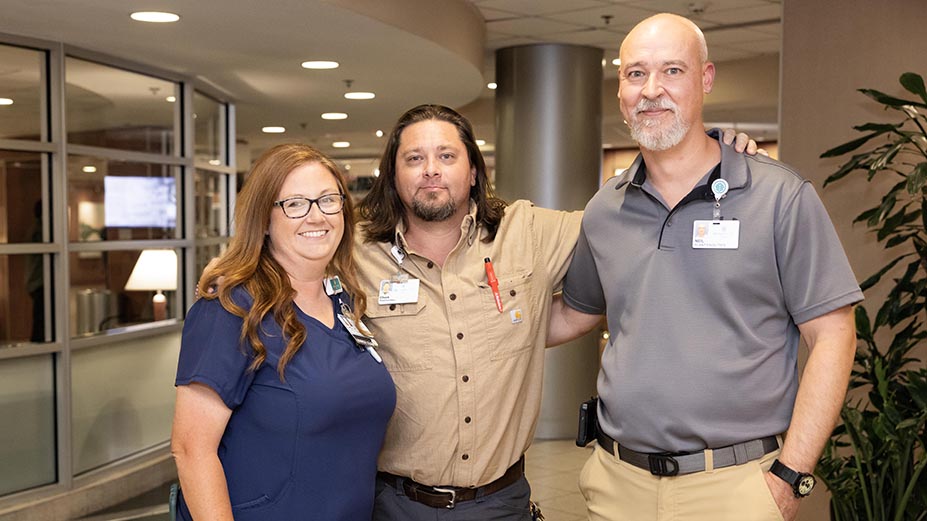
Concerned that it was something serious, his supervisor, Facilities Manager Neil Gordon, called nurse Holly Marks and asked her to check on Youngblood. “I started getting nauseous and was throwing up. I thought it was just some bad tuna salad I had eaten,” Youngblood said of the February incident. “Looking back at it, I know there was a little more to it than that.” Marks has known Youngblood for some time, and she knew something was seriously wrong. “He just didn’t look right,” Marks said. “I was like ‘hmmm this is not just nausea.’ He just kind of looked up at me with a blank stare and I told them to get a wheelchair. He tried to tell me he was going home. I said, ‘No. You are not.’ We wheeled him to the ER and they took it from there.” Youngblood was having a stroke. He said by the time he got to the ER he couldn’t really carry on a conversation. “I was in and out of it,” he said. “They gave me Tenecteplase and the next thing I knew I woke up in ICU.” Tenecteplase is used to break up blood clots. Atrium Health Floyd Medical Center is recognized as a Primary Stroke Center by The Joint Commission. The certification recognizes centers that have the critical elements to achieve long-term success in improving outcomes for stroke patients. The hospital has also earned SILVER PLUS with Target: Stroke Honor Roll Elite and Target: Type 2 Diabetes Honor Roll recognition from the American Heart Association/American Stroke Association. This award recognizes the hospital’s commitment to ensuring stroke patients receive the most appropriate treatment according to nationally recognized, research-based guidelines, leading to more lives saved and reduced disability. Patients with Type 2 diabetes, who might be at higher risk for complications, also receive the most up-to-date, evidence-based care when hospitalized due to stroke. Stroke is often called a silent killer because it can occur without warning signs. According to the American Stroke Association, stroke is the fifth-leading cause of death and the leading cause of disability for adults. Recognizing the signs of stroke and getting medical treatment as quickly as possible could improve the outcome. Use BE FAST to help you recognize the signs of a stroke:
Balance: Is there a sudden problem with balance or a loss of coordination? Eyes: Is there a sudden loss of vision in one or both eyes, or sudden blurriness or double vision?Face: Ask the person to smile. Are one or both sides of the face numb or drooping?Arms: Ask the person to raise both arms. Does one arm drift downward? Is there weakness or numbness in one arm or on one side of the body?Speech: Is the person suddenly slurring words, difficult to understand or unable to speak? Can the person correctly repeat simple phrases?Time: If you notice any of these symptoms, even if they go away, call 911 immediately!Because of her resolve to act quickly, Marks was recognized with a DAISY Nurse Leader Award. The award honors nurses who create an environment where compassionate, skillful care thrives. Marks is the neurosurgery nurse manager at Atrium Health Floyd Medical Center.
“It is awesome that they thought to call you in that emergency situation,” said Sheila Bennett, senior vice president and chief of patient services at the hospital who presented Marks with the award.
Youngblood, despite experiencing another medical emergency, has returned to work and is doing well.
“Honestly, prior to my stroke, I thought I was a fairly healthy person. I am not overweight and I get plenty of activity.” … “I’m thankful I was at work, here at Atrium Health Floyd where I could get treatment fast. I owe so much to Neil and to Holly, who stepped in to help.”


No comments:
Post a Comment