Your competent? doctor instituted blue and green spaces a long time ago, right? Oh no, IT WASNT DONE? So, incompetence reigned and you're still paying them?
Nature and Mental Health in Urban Texas: A NatureScore-Based Study

1
Center for Health & Nature, Houston Methodist Research Institute, Houston, TX 77030, USA
2
Center for Health Data Science and Analytics, Houston Methodist Research Institute, Houston, TX 77030, USA
3
Department of
Environmental and Occupational Health, School of Public Health, Texas
A&M University, 1266 TAMU, College Station, TX 77843, USA
*
Author to whom correspondence should be addressed.
Int. J. Environ. Res. Public Health 2024, 21(2), 168; https://doi.org/10.3390/ijerph21020168
Submission received: 14 December 2023
/
Revised: 13 January 2024
/
Accepted: 29 January 2024
/
Published: 1 February 2024
Abstract
In this cross-sectional study, we
examined the impact of access to nature on mental health utilization in
urban neighborhoods using Texas outpatient encounters data merged with
NatureScoreTM (0–100; low to high nature levels) and US
census data (household income, education, employment, poverty, and
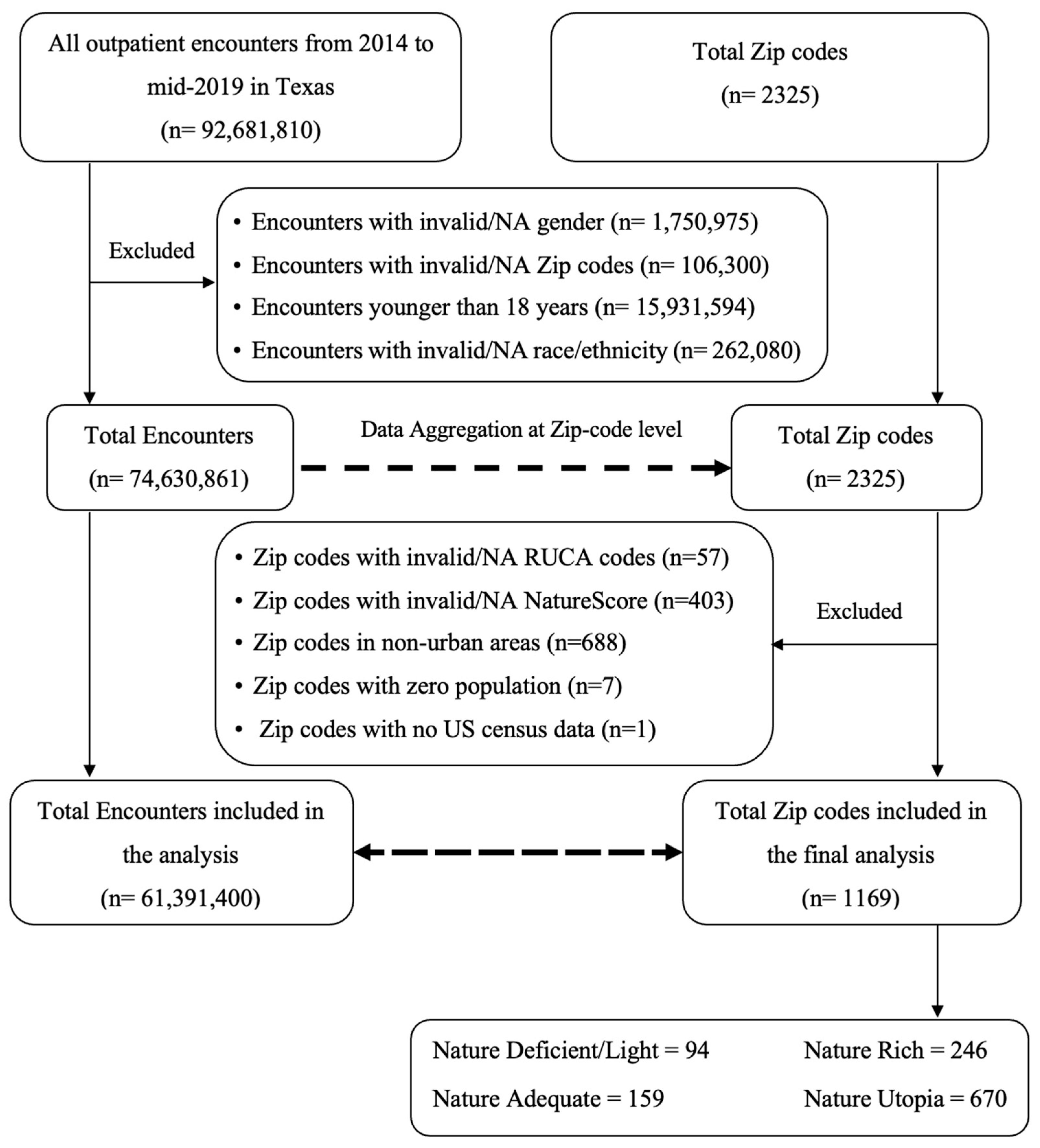
insurance coverage) at the zipcode level. Our sample size included 61
million outpatient encounters across 1169 zipcodes, with 63% women and
30% elderly. A total of 369,344 mental health encounters were
identified, with anxiety/stress and depression encounters representing
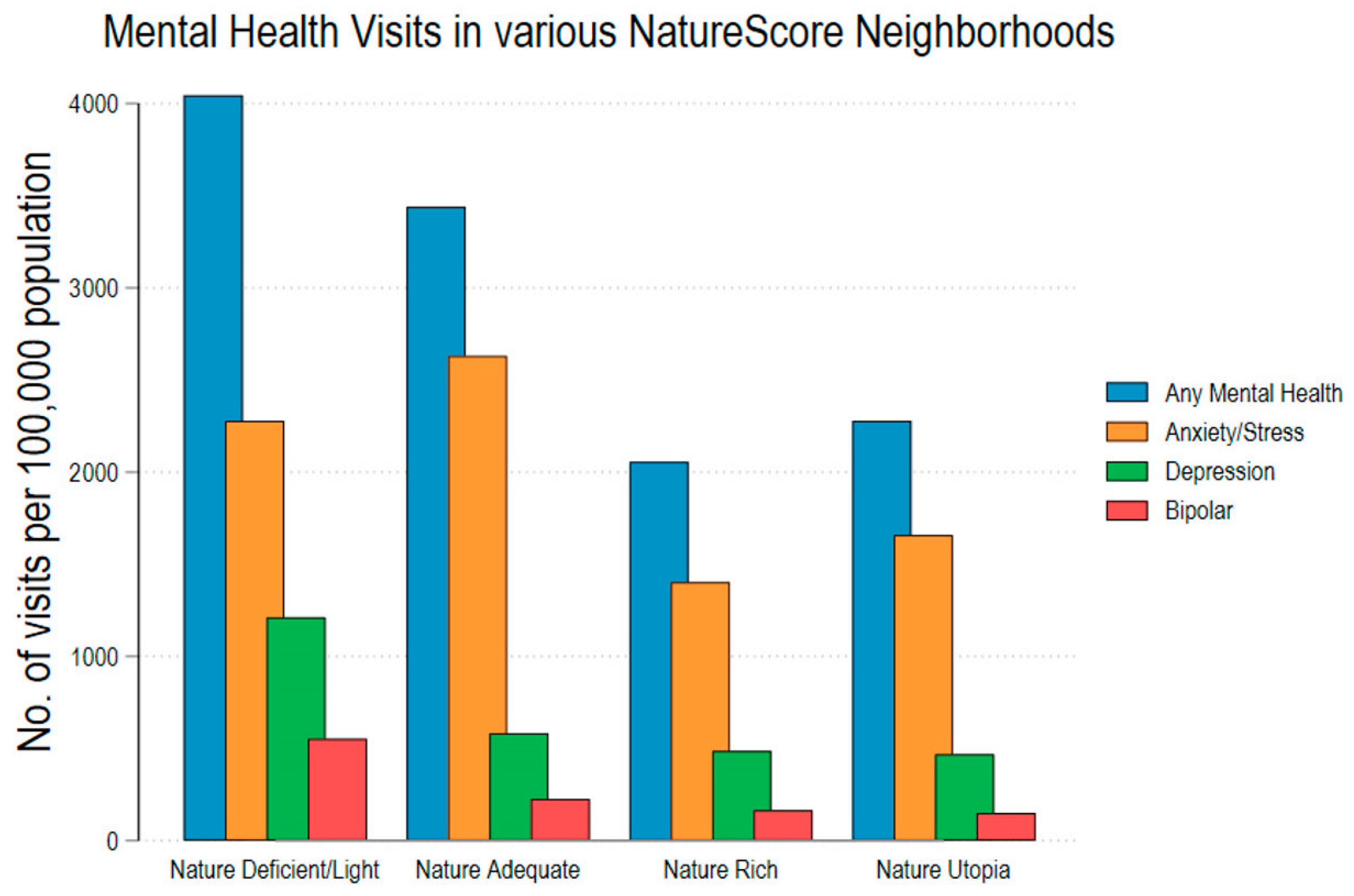
68.3% and 23.6%, respectively. We found that neighborhoods with a
NatureScore of 60+ had lower overall mental health utilization than
those below 40 (RR 0.51, 95%CI 0.38–0.69). This relationship persisted
for depression, bipolar disorder, and anxiety/stress and in
neighborhoods with a NatureScore above 80 (p
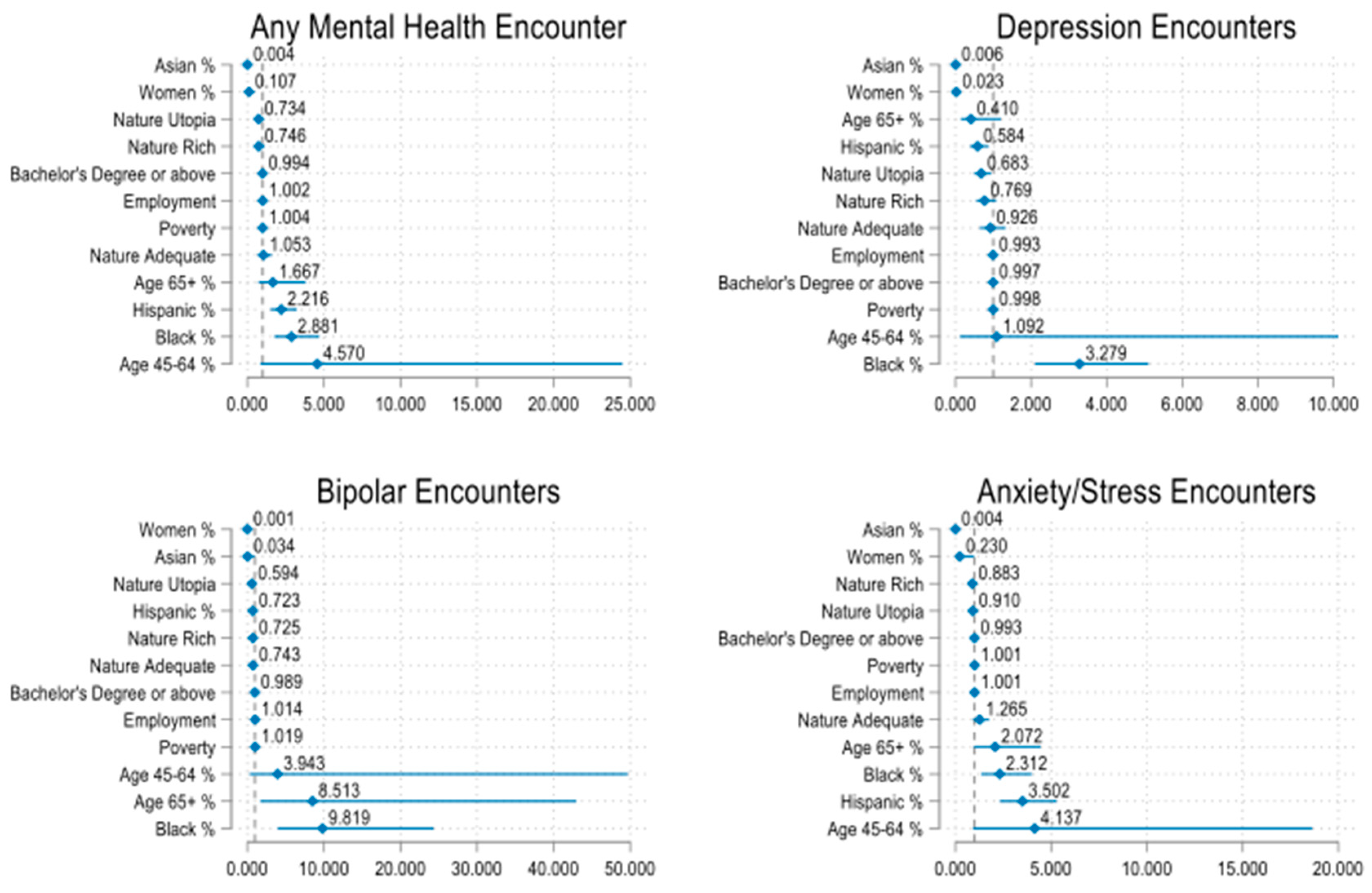
< 0.001). Compared to neighborhoods with a NatureScore below 40,
those above 80 had significantly lower depression (aRR 0.68, 95%CI
0.49–0.95) and bipolar (aRR 0.59, 95%CI 0.36–0.99) health encounters
after adjusting for demographic and socioeconomic factors. This novel
approach, utilizing NatureScore as a proxy for urban greenness,
demonstrates the correlation between a higher NatureScore and reduced
mental health utilization. Our findings highlight the importance of
integrating nature into our healthcare strategies to promote well-being
and mental health.
1. Introduction
Nature
has been an essential component of human life for thousands of years.
It has played a critical role in human development and social
experience. Interaction with the natural environment, like parks and
forests, has significantly impacted both physical and mental health [1]. Health benefits occur both through immersive nature experiences, such as forest bathing [2], and also shorter, less intense exposures, including urban nature [3,4]. Access to nature, especially in urban areas, also promotes increased physical activity [5].
The
prevalence of mental health disorders in the United States has been
surging over the last few years, affecting more than 22% of the adult
population [6].
With a substantial increase in mental health issues, a few studies have
found a relationship between the various social determinants of health
and mental health outcomes [7,8].
A significant association between urban green space and improved mental
health has been found in Australia, Finland, and Florida, USA [9,10,11].
However, defining nature and relying on subjective measures in these
studies might limit comprehension of the full-scale impact of nature
access and the built environment on human health.


No comments:
Post a Comment