Has your competent? doctor figured the best breathing protocol? OR DONE NOTHING AT ALL?
Like:
'Breath: The New Science of a Lost Art' by James Nestor.
Or;
'' by Patrick McKeown.
Or should you be doing fast breathing in
Creation of nitric oxide via Breath of Fire February 2014
And why doesn't your doctor know a damn thing about a breathing protocol?
You doctor has had years to know about this. Are you giving them a pass on being incompetent?
Brief structured respiration practices enhance mood and reduce physiological arousal
Summary
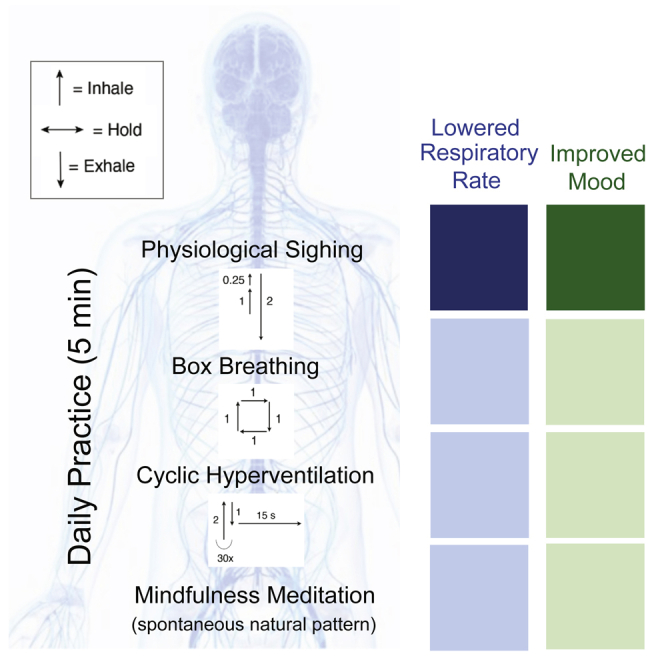
Controlled breathwork practices have emerged as potential tools for stress management and well-being. Here, we report a remote, randomized, controlled study (NCT05304000) of three different daily 5-min breathwork exercises compared with an equivalent period of mindfulness meditation over 1 month. The breathing conditions are (1) cyclic sighing, which emphasizes prolonged exhalations; (2) box breathing, which is equal duration of inhalations, breath retentions, and exhalations; and (3) cyclic hyperventilation with retention, with longer inhalations and shorter exhalations. The primary endpoints are improvement in mood and anxiety as well as reduced physiological arousal (respiratory rate, heart rate, and heart rate variability). Using a mixed-effects model, we show that breathwork, especially the exhale-focused cyclic sighing, produces greater improvement in mood (p < 0.05) and reduction in respiratory rate (p < 0.05) compared with mindfulness meditation. Daily 5-min cyclic sighing has promise as an effective stress management exercise.
Keywords: breathwork, mindfulness meditation, mood, anxiety, wearable, physiology, heart rate variability, limbic, autonomic, stress, sleep
Graphical abstract
Highlights
-
•
Daily 5-minute breathwork and mindfulness meditation improve mood and reduce anxiety
-
•
Breathwork improves mood and physiological arousal more than mindfulness meditation
-
•
Cyclic sighing is most effective at improving mood and reducing respiratory rate
In a remotely conducted randomized controlled trial, Yilmaz Balban et al. study the psychophysiological effects of controlled breathwork compared with mindfulness meditation. Breathwork produces greater improvement in mood and reduction in respiratory rate, while both result in reduction in negative emotion including state anxiety.


No comments:
Post a Comment