Changing stroke rehab and research worldwide now.Time is Brain! trillions and trillions of neurons that DIE each day because there are NO effective hyperacute therapies besides tPA(only 12% effective). I have 523 posts on hyperacute therapy, enough for researchers to spend decades proving them out. These are my personal ideas and blog on stroke rehabilitation and stroke research. Do not attempt any of these without checking with your medical provider. Unless you join me in agitating, when you need these therapies they won't be there.

What this blog is for:

My blog is not to help survivors recover, it is to have the 10 million yearly stroke survivors light fires underneath their doctors, stroke hospitals and stroke researchers to get stroke solved. 100% recovery. The stroke medical world is completely failing at that goal, they don't even have it as a goal. Shortly after getting out of the hospital and getting NO information on the process or protocols of stroke rehabilitation and recovery I started searching on the internet and found that no other survivor received useful information. This is an attempt to cover all stroke rehabilitation information that should be readily available to survivors so they can talk with informed knowledge to their medical staff. It lays out what needs to be done to get stroke survivors closer to 100% recovery. It's quite disgusting that this information is not available from every stroke association and doctors group.

Sunday, November 30, 2025

Clogged brain drains may signal early Alzheimer's risk

Since you didn't tell us how to unclog them you did useless research; YOU'RE FIRED!

 Clogged brain drains may signal early Alzheimer's risk

"Drains" in the brain, responsible for clearing toxic waste in the organ, tend to get clogged up in people who show signs of developing Alzheimer's disease, a study by researchers from Nanyang Technological University, Singapore (NTU Singapore) has discovered.

This suggests that such clogged drains, a condition known as "enlarged perivascular spaces", are a likely early-warning sign for Alzheimer's, a common form of dementia.

"Since these brain anomalies can be visually identified on routine magnetic resonance imaging (MRI) scans performed to evaluate cognitive decline, identifying them could complement existing methods to detect Alzheimer's earlier, without having to do and pay for additional tests," said Associate Professor Nagaendran Kandiah from NTU's Lee Kong Chian School of Medicine (LKCMedicine) who led the study.

Justin Ong, a fifth-year LKCMedicine student and first author of the study, added that detecting Alzheimer's early is important because it allows clinicians to step in sooner to try and slow down the worsening of a patient's cognitive issues like memory loss, slower thinking abilities and mood changes. The study was conducted as part of LKCMedicine's Scholarly Project module in the School's Bachelor of Medicine and Bachelor of Surgery programme.

The research is also significant as it is one of the few globally to look at Asians, because most studies tend to focus on Caucasian participants. Nearly 1,000 people in Singapore from different ethnicities representative of the country's population were studied by the team. The study compared people who had no cognitive issues and those with mild thinking problems.

Asian studies are crucial as past research suggests that there are differences in dementia-related conditions between people from different ethnic groups.

"For example, among Caucasians with dementia, past studies show that the prevalence of a major risk gene, apolipoprotein E4, linked to Alzheimer's is around 50 to 60 per cent. But among Singapore dementia patients, it is less than 20 per cent," said Assoc Prof Kandiah, who is also Director of the Dementia Research Centre (Singapore) in LKCMedicine. So, findings in studies on Caucasian patients might not be observed in Asians and vice versa.

Predicting Alzheimer's before it happens

Blood vessels in the brain are surrounded by spaces, called perivascular spaces, where toxic waste in the brain, such as beta amyloid and tau proteins found in large amounts for Alzheimer's patients, drain into and are cleared.

If these drains get clogged because the brain's system of clearing toxic waste is not working efficiently, they form enlarged perivascular spaces, which can be seen on MRI scans. But it was not previously clear if this condition was also linked to dementia, specifically Alzheimer's disease.

The NTU researchers sought to address issues with earlier studies by comparing the clogged brain drains against more Alzheimer's disease indicators than previously tested. They also compared the jammed drains against hallmark indicators of Alzheimer's - beta amyloid proteins and damage to the brain's white matter, which is a nerve fibre network connecting various parts of the brain.

The researchers studied close to 1,000 participants in Singapore, including nearly 350 who do not have any cognitive problems, meaning their mental abilities, such as their ability to think, remember, reason, make decisions and focus, are normal.

The rest of the participants had features suggesting early stages of cognitive disease, including mild cognitive impairment which is a stage that precedes overt dementia. According to past research, those with mild cognitive impairment have a higher risk of developing dementia like Alzheimer's disease and vascular dementia, which is a type of dementia caused by reduced blood flow to the brain.

For the latest study, the researchers analysed the MRI scans of the participants and found that those with mild cognitive impairment tend to have clogged drains in their brains, or enlarged perivascular spaces, compared to the other participants.

The scientists also took seven measurements based on specific biochemicals in the participants' blood, including beta amyloid and tau proteins. Their presence is a warning sign that a person has Alzheimer's.

The presence of clogged drains in the brain was linked to four of the seven measurements. So, people with enlarged perivascular spaces are likely to have more amyloid plaques, tau tangles and brain cell damage in their brains than normal, and are thus at higher risk of developing Alzheimer's.

The researchers also studied if damage to the brain's white matter, a well-known indicator of Alzheimer's, was linked to the biochemicals tied to the disease, and they did find such links with six of the seven biochemical measurements, but with a twist.

They further compared the white matter damage against enlarged perivascular spaces, and discovered that in participants with mild cognitive impairment, the link with biochemicals tied to Alzheimer's was stronger for enlarged perivascular spaces than for white matter damage. This suggests that choked brain drains are early indicators of Alzheimer's disease.

Knowing all this allows clinicians to better figure out what kind of treatment they should use to slow and prevent Alzheimer's early, possibly before permanent brain damage has happened.

The findings carry substantial clinical implications. Although white matter damage is more widely used in clinical practice to evaluate for dementia, as it is easily recognized on MRI scans, our results suggest that enlarged perivascular spaces may hold unique value in detecting early signs of Alzheimer's disease."

Nagaendran Kandiah, Associate Professor, NTU's Lee Kong Chian School of Medicine 

Dr Rachel Cheong Chin Yee, a Senior Consultant and Deputy Head at Khoo Teck Puat Hospital's Department of Geriatric Medicine, said that the study highlights how changes in the brain's small blood vessels - in this case enlarged perivascular spaces that surround the blood vessels and help clear waste from the brain - may contribute to Alzheimer's disease.

"These findings are significant because they suggest that brain scans showing enlarged perivascular spaces could potentially help identify people at higher risk of Alzheimer's disease, even before symptoms appear," said Dr Cheong, who was not involved in the study.

Dr Chong Yao Feng, a Consultant at the National University Hospital's Division of Neurology and who was also not involved in the NTU study, said that cerebrovascular diseases - conditions that cause problems in the blood vessels of the brain - and Alzheimer's disease are traditionally believed to be caused by different processes.

"The study's findings are intriguing as they demonstrate that both diseases do interact in a synergistic manner," said Dr Chong, who is also a Clinical Assistant Professor at the National University of Singapore's Yong Loo Lin School of Medicine.

So, if a doctor orders an MRI brain scan to evaluate a patient's cognitive symptoms and notices that the scan shows markers of cerebrovascular diseases, such as the enlarged perivascular spaces investigated in the NTU study, the clinician should not assume the patient's cognitive impairment is due only to blood vessel problems. This is because the markers' presence might increase the risk of the patient also having Alzheimer's disease.

"Doctors will then have to use their clinical judgement of the patient's scan and symptoms, as well as discuss with the patient, to determine if more checks are needed to confirm whether a patient has Alzheimer's disease or not," said Dr Chong.

The NTU research team plans to follow-up on the study participants to check how many go on to develop Alzheimer's dementia and to confirm that enlarged perivascular spaces can predict that people with these choked drains are more likely to progress to dementia.

Also, with more studies establishing the link between the clogged drains and Alzheimer's in other populations, detecting enlarged perivascular spaces in MRI scans could one day be added to the existing tools available to clinicians to determine much earlier whether a patient will develop Alzheimer's.

Source:
Journal reference:

Jit, J., et al. (2025). Association of Enlarged Perivascular Spaces With Early Serum and Neuroimaging Biomarkers of Alzheimer Disease Pathology. Neurology. doi: 10.1212/wnl.0000000000213836. https://www.neurology.org/doi/10.1212/WNL.0000000000213836

Does coffee truly boost memory and focus or is it all hype?

These pieces of research are why I do coffee, nothing about memory or focus!

Has your incompetent? doctor still not installed a 24-hour coffee station in the hospital? Massive earlier research on the benefits of coffee here!

I'm not taking chances and do a 12 cup pot of coffee a day. 

How coffee protects against Parkinson’s Aug. 2014 

Coffee May Lower Your Risk of Dementia Feb. 2013

Coffee drinkers rejoice! Drinking coffee could lower the risk of Alzheimer’s disease 

And this: Coffee's Phenylindanes Fight Alzheimer's Plaque December 2018

New research suggests drinking coffee may reduce the risk of frailty May 2025

I think I'm in this category:  I never get the jitters or flushed skin.

Genetics determine how much coffee you can drink before it goes wrong

I'm doing a 12 cup pot of coffee a day with full fat milk to lessen my chances of dementia and Parkinsons. Tell me EXACTLY how much coffee to drink for that and I'll change. Yep, that is a lot more than the 400mg. suggested limit, I don't care! Preventing dementia and Parkinsons is vastly more important than whatever problems it can cause! 

Of course, your fuckingly incompetent? doctor did nothing with this from 2 years ago!

This line is great: The findings indicate that even the Espresso Martini cocktail contains the espresso's beneficial compounds - and can contribute to staving off dementia.


The latest here:

 Does coffee truly boost memory and focus or is it all hype?

A new narrative review unpacks how coffee may sharpen thinking and protect the brain while highlighting why its true mechanisms remain elusive.

Neurocognitive and Neurological Effects of Coffee and Caffeine: A Narrative Review. Image Credit: Igor_83 / Shutterstock

Neurocognitive and Neurological Effects of Coffee and Caffeine: A Narrative Review. Image Credit: Igor_83 / Shutterstock

In a recent review published in the journal Cureus Journal of Medical Science, researchers examined the major chemical constituents of coffee and evaluated evidence from existing animal and human studies on their pain-relieving and cognitive benefits.

They concluded that coffee may offer cognitive, anti-inflammatory, and neuroprotective benefits. However, the diverse types of coffee, dosing patterns, and preparation methods make underlying mechanisms difficult to study, and the review emphasised that most evidence is associative rather than causal, and further study is needed.(I'm not waiting, Dementia and Parkinsons prevention are needed now. Not some 50 years in the future!)

Open Questions on Coffee Benefits

Epidemiological studies suggest that habitual coffee drinkers have lower risks of several neurodegenerative and cerebrovascular conditions, including Parkinson’s disease, Alzheimer’s disease, dementia, stroke, and multiple sclerosis.

Caffeine and related purine metabolites (theobromine, theophylline, and paraxanthine) are the best-known components, yet their precise roles in neuroplasticity, synaptic development, and neuronal signaling remain underexplored.

Caffeine influences multiple receptor systems, including adenosine, phosphodiesterase, and gamma-aminobutyric acid (GABA) receptors, but other caffeinated beverages do not consistently replicate coffee’s effects, suggesting coffee-specific synergies.

Given the aging global population, interest in coffee’s potential to enhance neuroprotection, memory, and cognitive performance has grown.

Experimental research in animals shows encouraging effects on memory, attention, and neurogenesis, but translating this to humans is complicated by the heterogeneity of coffee products and dosing patterns and by species differences in caffeine metabolism that limit generalisability from rodent models.

To map the current evidence, the authors conducted a narrative review. Broad searches in three medical databases retrieved 109 relevant peer-reviewed articles published in English in the past decade.

Coffee, Neuroplasticity, and Synaptic Function

Researchers found evidence of growing scientific interest in coffee’s relationship with neuroplasticity, the brain’s capacity to reorganize neural circuits through synaptic remodeling, long-term potentiation (LTP), long-term depression (LTD), and adult neurogenesis.

Aging reduces the brain’s plastic potential, making factors that maintain or enhance plasticity particularly important. Coffee constituents, especially caffeine, appear to influence several pathways involved in plasticity, including intracellular calcium regulation, receptor modulation, and neural oscillatory activity.

Evidence from animal studies indicates that caffeine can shift synaptic activity toward LTP, which supports learning and memory. However, studies also show that high or chronic caffeine exposure can attenuate LTP in the hippocampus, suggesting dose sensitivity and highlighting mechanistic uncertainty that remains unresolved in human studies.

Coffee and Human Brain Activity

Several trials reported improvements in vigilance, response time, memory accuracy, neural efficiency, and subjective alertness after consuming coffee, coffee fruit extracts, or combinations of coffee constituents with herbal supplements. These effects often appeared independent of caffeine dose, suggesting synergistic contributions from polyphenols although some trials reported neutral findings, underscoring variability across studies.

Studies also indicated benefits such as reduced fatigue, improved mood, and enhanced positive affect following regular coffee or coffee-berry extract consumption. Some interventions that combined sage or ginseng with coffee extracts produced additional benefits.

Additionally, beverages containing coffee berry extract or apple polyphenols increased cerebral blood flow and improved mood, hinting at a vascular or antioxidant contribution. Coffee can produce significant physiological, anxiety, and stress responses. 

Caffeine challenges in individuals with panic disorder induced panic symptoms in nearly half of participants, though this was not mediated by hypothalamic, pituitary, adrenal (HPA) axis activation. Conversely, coffee aroma reduced stress biomarkers and pulse rate during dental procedures. 

Regarding impacts on sleep, daily caffeine consumption in habitual coffee drinkers did not significantly alter sleep architecture, suggesting that they may adapt to its effects. Imaging studies under sleep deprivation show regional grey matter changes influenced by caffeine intake or withdrawal, highlighting coffee’s interaction with sleep-related brain plasticity. 

Population-based cohorts show that higher coffee or caffeine intake is associated with slower cognitive decline in older adults, especially women. The review notes that sex-specific hormonal interactions may contribute to these differences, though mechanisms remain unclear. 

Animal research supports caffeine’s neuroprotective roles in models of Alzheimer’s disease, metabolic disorders, stress, and seizures but results across human studies remain mixed.

Mechanisms Involving Adenosine

Caffeine’s neuroactive properties arise largely from antagonism of adenosine receptors, particularly A1 and A2A, which influence synaptic strength, neuronal excitability, inflammation, and energy balance.

Although caffeine binds all four adenosine receptors, many neuroplastic effects align most closely with A2A blockade. The review also discussed adenosine triphosphate (ATP) and adenosine as neuromodulators involved in neuroprotection, injury response, and neurodegenerative diseases.

Dysregulation of A2A and P2 receptors is implicated in Parkinson’s and Alzheimer’s disease, thus caffeine’s modulation of these pathways may underlie some epidemiological findings. 

The review also notes that caffeine’s analgesic actions, including enhanced analgesic bioavailability and modulation of nociceptive signaling, add an additional pathway through which coffee consumption may indirectly support cognitive function in people with chronic pain although this was presented as a secondary context rather than a primary mechanism of neuroprotection.

Conclusions

Current evidence suggests coffee may support cognition, neuroplasticity, and neuroprotection, but findings remain inconsistent.

Coffee’s effects are difficult to isolate because it contains many bioactive compounds, interacts with genetics and sex, and may be further modified by differences in caffeine metabolism, and is typically consumed within broader dietary patterns such as the Mediterranean diet.

Observational data show both benefits and potential risks at high intake levels, and results vary across neurodegenerative outcomes. 

However, this review’s narrative nature, reliance on heterogeneous and mainly observational studies, and limited control for factors such as bean type, preparation methods, and genetic differences in caffeine metabolism restrict firm conclusions and prevent determination of causality. 

Overall, coffee appears safe and possibly beneficial, but its mechanisms and optimal intake require more rigorous, controlled research.

Journal reference:

Astrocyte-driven approach shows potential to reverse cognitive decline in Alzheimer’s

How long will it take to get your incompetent? doctor and hospital to get human testing going? I'm betting never; they don't even know of this research!

Do you prefer your doctor, hospital and board of director's incompetence NOT KNOWING? OR NOT DOING?

 Astrocyte-driven approach shows potential to reverse cognitive decline in Alzheimer’s

Researchers at Baylor College of Medicine have discovered a natural mechanism that clears existing amyloid plaques in the brains of mouse models of Alzheimer's disease and preserves cognitive function. The mechanism involves recruiting brain cells known as astrocytes, star shaped cells in the brain, to remove the toxic amyloid plaques that build up in many Alzheimer's disease brains. Increasing the production of Sox9, a key protein that regulates astrocyte functions during aging, triggered the astrocytes' ability to remove amyloid plaques. The study, published in Nature Neuroscience, suggests a potential astrocyte-based therapeutic approach to ameliorate cognitive decline in neurodegenerative disease.

"Astrocytes perform diverse tasks that are essential for normal brain function, including facilitating brain communications and memory storage. As the brain ages, astrocytes show profound functional alterations; however, the role these alterations play in aging and neurodegeneration is not yet understood," said first author Dr. Dong-Joo Choi, who was at the Center for Cell and Gene Therapy and the Department of Neurosurgery at Baylor while he was working on this project. Choi currently is an assistant professor at the Center for Neuroimmunology and Glial Biology, Institute of Molecular Medicine at the University of Texas Health Science Center at Houston.

In the current study, researchers looked to identify mechanisms associated with astrocyte aging and Alzheimer's disease, focusing on Sox9, as this protein is a top regulator of multiple genes in aging astrocytes.

"We manipulated the expression of the Sox9 gene to assess its role in maintaining astrocyte function in the aging brain and in Alzheimer's disease models," said corresponding author Dr. Benjamin Deneen, professor and Dr. Russell J. and Marian K. Blattner Chair in the Department of Neurosurgery, director of the Center for Cancer Neuroscience, a member of the Dan L Duncan Comprehensive Cancer Center at Baylor and a principal investigator at the Jan and Dan Duncan Neurological Research Institute at Texas Children's Hospital.

An important point of our experimental design is that we worked with mouse models of Alzheimer's disease that had already developed cognitive impairment, such as memory deficits, and had amyloid plaques in the brain. We believe these models are more relevant to what we see in many patients with Alzheimer's disease symptoms than other models in which these types of experiments are conducted before the plaques form."

Dr. Dong-Joo Choi, First Author

In these Alzheimer's mice, the team over expressed or eliminated Sox9 and then assessed the cognitive function of individual mice for six months, evaluating the animals' ability to recognize objects or places. At the end of the experiment, the researchers measured plaque deposition in the brains.

Compared to reducing Sox9 expression, increasing it had the opposite effect. Sox9 knockout accelerated plaque formation, reduced astrocyte complexity and decreased clearance of amyloid deposits. Overexpression reversed these trends, promoting plaque clearance, while increasing the cells' activity and complexity. Importantly, overexpression of Sox9 also preserved cognitive function in these mice, indicating that astrocytic clearance of plaques halts neurodegenerative-related cognitive decline.

"We found that increasing Sox9 expression triggered astrocytes to ingest more amyloid plaques, clearing them from the brain like a vacuum cleaner," Deneen said. "Most current treatments focus on neurons or try to prevent the formation of amyloid plaques. This study suggests that enhancing astrocytes' natural ability to clean up could be just as important."

Choi, Deneen and their colleagues caution that more research is needed to understand how Sox9 works in the human brain over time. But their work opens the door to therapies that could one day harness the power of astrocytes to fight neurodegenerative diseases.

Sanjana Murali, Wookbong Kwon, Junsung Woo, Eun-Ah Christine Song, Yeunjung Ko, Debo Sardar, Brittney Lozzi, Yi-Ting Cheng, Michael R. Williamson, Teng-Wei Huang, Kaitlyn Sanchez and Joanna Jankowsky, all at Baylor College of Medicine, also contributed to this work.

This work was supported by National Institutes of Health grants (R35-NS132230, R01- AG071687, R01-CA284455, K01-AG083128, R56-MH133822). Further support was provided by the David and Eula Wintermann Foundation, the Eunice Kennedy Shriver National Institute of Child Health & Human Development of the National Institutes of Health under Award Number P50HD103555 and by joint resources from Houston Methodist and Baylor College of Medicine.

Source:
Journal reference:

Choi, D. -J., et al. (2025). Astrocytic Sox9 overexpression in Alzheimer’s disease mouse models promotes Aβ plaque phagocytosis and preserves cognitive function. Nature Neuroscience. DOI: 10.1038/s41593-025-02115-w. https://www.nature.com/articles/s41593-025-02115-w

Arginine slows amyloid buildup and improves brain outcomes in Alzheimer’s disease models

Will your competent? doctor guarantee that the protocol they are writing up on this will 100% prevent Alzheimers?  Why not? Can they at least get human testing going? Or are they that fucking incompetent in not knowing of that need?

All this earlier research which I bet your doctor/hospital knows nothing!

  • arginine (4 posts to December 2016)
  • arginine-rich peptides (1 post to February 2015)
  • Cationic arginine-rich peptides (1 post to March 2020)
  • poly-arginine peptides (1 post to February 2015)
  • Do you prefer your doctor and hospital incompetence NOT KNOWING? OR NOT DOING?

    Arginine slows amyloid buildup and improves brain outcomes in Alzheimer’s disease models

    New preclinical evidence shows that oral arginine reduces toxic amyloid structures and eases behavioral impairments in Alzheimer’s models, highlighting a potential therapeutic path that now requires careful human dose and safety evaluation.

    Study: Oral administration of arginine suppresses Aβ pathology in animal models of Alzheimer

    Study: Oral administration of arginine suppresses Aβ pathology in animal models of Alzheimer's disease. Image Credit: Kateryna Kon / Shutterstock

    A recent study published in the journal Neurochemistry International showed that arginine suppresses amyloid beta () pathology in preclinical Alzheimer’s disease (AD) models. AD is the most common dementia, affecting more than 50 million individuals worldwide. The aggregation of  peptides into fibrils and oligomers is likely the upstream event in the pathogenesis of AD. While various therapies have been developed targeting , they have limited efficacy, adverse effects, and high costs. As such, safe and cost-effective orally administered therapeutic approaches to inhibit  aggregation are needed.

    Rationale for Testing Arginine as an Anti-Aggregation Agent

    Previously, the authors showed that arginine suppresses the aggregation of polyglutamine (PolyQ) proteins, exerting therapeutic effects in preclinical models of PolyQ diseases. Moreover, oral arginine administration was found to improve patients with spinocerebellar ataxia type 6, a PolyQ disease. Given that arginine is a chaperone that inhibits protein misfolding and aggregation, the authors hypothesized that it might suppress the aggregation of .

    In Vitro Assays Demonstrate Strong Inhibition of Aβ Aggregation

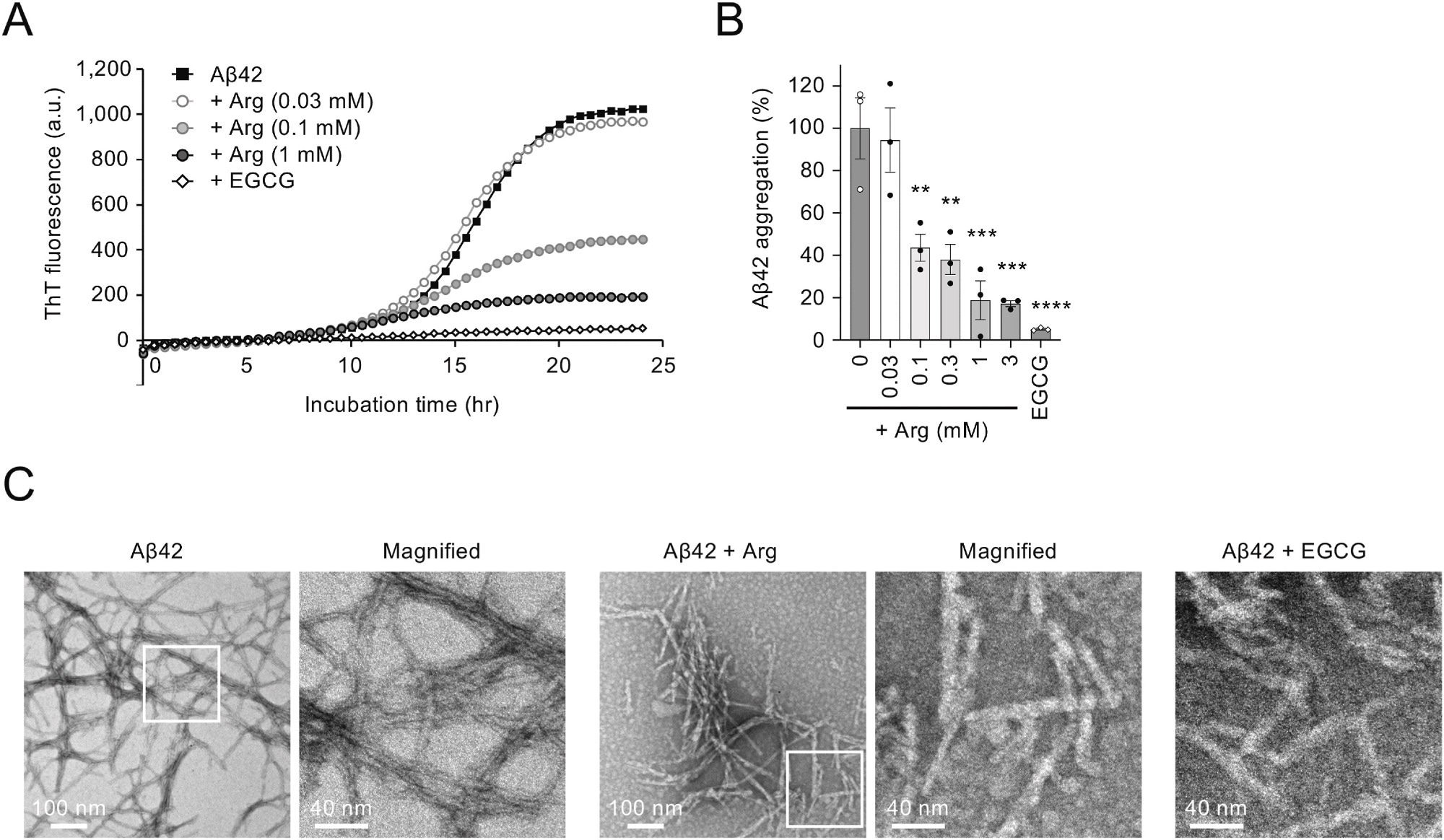
    In the present study, researchers investigated whether arginine suppresses the aggregation of  in preclinical models of AD. First, they examined the suppression of  aggregation in vitro and incubated 42 peptides in the presence of varying concentrations of arginine. The aggregation of 42 peptides was determined by Thioflavin T (ThT) fluorescence intensity.

    The team observed that co-incubation of 42 and arginine substantially reduced ThT fluorescence intensity in a dose-dependent manner, decreasing 42 aggregation by 80% at 1 mM arginine. Electron microscopy showed that fibrils were shortened, and biochemical analyses indicated reduced insoluble 42 fractions with unchanged soluble 42 levels, consistent with reduced fibrillar aggregation.

    Arginine suppresses Aβ42 aggregation in vitro. (A) Effect of arginine on Aβ42 aggregation in vitro. The incubation of Aβ42 peptide (5 μM) at 37 °C resulted in an increase in Thioflavin T (ThT) fluorescence after a short lag phase, which eventually reached a plateau. (B) Bar graph showing the ratio of Aβ42 aggregation in the presence of arginine at 24 h. (C) EM images of Aβ42 amyloid fibrils. Scale bars, 100 nm (left images) and 40 nm (right images). The panel on the right is a magnified image of the boxed region in the left panel. Statistical analysis in (B) was performed to assess differences from the control group (Aβ42 without arginine) by one-way ANOVA followed by the Dunnett

    Arginine suppresses Aβ42 aggregation in vitro. (A) Effect of arginine on Aβ42 aggregation in vitro. The incubation of Aβ42 peptide (5 μM) at 37 °C resulted in an increase in Thioflavin T (ThT) fluorescence after a short lag phase, which eventually reached a plateau. (B) Bar graph showing the ratio of Aβ42 aggregation in the presence of arginine at 24 h. (C) EM images of Aβ42 amyloid fibrils. Scale bars, 100 nm (left images) and 40 nm (right images). The panel on the right is a magnified image of the boxed region in the left panel. Statistical analysis in (B) was performed to assess differences from the control group (Aβ42 without arginine) by one-way ANOVA followed by the Dunnett's multiple comparisons test. ∗∗p < 0.01, ∗∗∗p < 0.001, ∗∗∗∗p < 0.0001.

    Arginine Reduces Amyloid Deposition in Drosophila AD Models

    Next, the researchers examined in vivo suppression of  aggregation in a Drosophila AD model carrying the 42 transgene with the E22G Arctic mutation (42arc). 42arc expression in the compound eyes led to abnormal deposition in larval eye discs and shrinkage of adult eyes due to  toxicity. However, oral arginine administration substantially decreased 42 deposition and suppressed eye shrinkage in a dose-dependent manner.

    Mouse Studies Show Reduced Amyloid Deposition and Plaque Burden

    The team further evaluated arginine in App knock-in mice carrying Arctic, Beyreuther, or Iberian, and Swedish mutations (AppNL-G-F mice), which develop age-dependent  deposition and behavioral abnormalities. The mice received 6% arginine orally from 5 weeks of age. Body weight did not differ between treated AppNL-G-F, untreated AppNL-G-F, or wildtype mice.

    Evaluation of the SLS CHARTER care model to support post-stroke care continuity and employment


    This is the whole problem in stroke enumerated in one word; 'care'; NOT RECOVERY! 

    Our non-existent stroke leadership should be demanding RECOVERY NOT 'CARE'!

    My god, anyone in the business world would be fired immediately for managing or caring about something rather than delivering RESULTS. And this is why this is a complete fucking failure! This does nothing to guarantee recovery for survivors!

    If your hospital is touting 'care' it means they are a failure because they are delivering 'care'; NOT RECOVERY! I would never go to a failed hospital! Anytime I see the word 'care' associated with a stroke hospital; I immediately think fucking failure!

    YOU have to get involved and change this failure mindset of 'care' to 100% RECOVERY! Survivors want RECOVERY, NOT 'CARE'!

    I see nothing here that states going for 100% recovery! You need to create EXACT PROTOCOLS FOR THAT!

    ASK SURVIVORS WHAT THEY WANT, THEY'LL NEVER RESPOND 'CARE'! This tyranny of low expectations has to be completely rooted out of any stroke conversation! I wouldn't go there because of such incompetency as not having 100% recovery protocols!

    RECOVERY IS THE ONLY GOAL IN STROKE!

    GET THERE!

    Evaluation of the SLS CHARTER care model to support post-stroke care continuity and employment


    We are providing an unedited version of this manuscript to give early access to its findings. Before final publication, the manuscript will undergo further editing. Please note there may be errors present which affect the content, and all legal disclaimers apply.

    Abstract

    The Stroke Life Support Central Health Alliance, Registry & Technology Enabled caRe (SLS CHARTER) Programme addresses stroke patients’ rehabilitation needs through timely evaluation and intervention, but it has not been evaluated. This study evaluated the programme’s outcomes over 6 months. The primary outcome was Post Stroke Checklist (PSC) usage per SLS participant. For the final analysis, 206 SLS and 55 control participants from a public healthcare institution in Singapore were included. Secondary economic outcomes included healthcare utilisation and return to work (RTW). Multivariate analyses, adjusted for demographics and clinical factors, used gamma-log link and Poisson regression for healthcare utilisation, and logistic and Cox regression for RTW outcomes, to evaluate associations with intervention status. PSC usage increased from 50.5% 1-month post stroke to 86.9% 6-month post stroke; mean utilisation rose from 1.76 to 4.25. SLS participants reported longer lengths of stay (LOS) in certain rehabilitation institution and less day care(NOT RECOVERY!) visits. Additionally, there was varying RTW for different patient subgroups. Our findings suggest the SLS CHARTER Programme increases PSC usage, which is useful to guide future care(NOT RECOVERY!) coordination programmes. Identification of patients at risk of poorer RTW, for proactive occupational rehabilitation, may help to reduce the economic burden of stroke.

    The Role of Error Augmentation Versus Error Minimization in Post-Stroke Gait Rehabilitation

     I think that maybe you need to recognize the errors first so you can correct them; so, a third method!

    (So you don't believe that errors and error correction are faster ways to learn? See link below.) 

    Do People With Severe Traumatic Brain Injury Benefit From Making Errors? A Randomized Controlled Trial of Error-Based and Errorless Learning

    The relevant line from there:

    Conclusion. EBL was found to be more effective than ELL for enhancing skills generalization on a task related to training and improving self-awareness and behavioral competency.


    Error augmentation in physical therapy is a training method that deliberately increases the difficulty of a task by amplifying a person's natural movement errors to enhance motor learning and improve performance. Instead of correcting mistakes, the therapist or system adds resistance, visual cues, or other challenges to make the movement harder, forcing the brain and body to adapt and develop more robust motor control. This technique is particularly used in stroke and neurological rehabilitation to help patients overcome motor deficits. 
    This was already researched in July 2018: Your mentors should have caught that.

    The Role of Error Augmentation Versus Error Minimization in Post-Stroke Gait Rehabilitation

    Azusa Pacific University 
     The Role of Error Augmentation Versus Error Minimization in Post-Stroke Gait Rehabilitation 
     by Alyssa Bradley, Isabella Davalos, Elise Garcia, and Megan Goodson has been approved by the College of Nursing and Health Sciences in partial fulfillment of the requirements for the degree Doctor of Physical Therapy

    Abstract  

    Background. 

    Post-stroke patients often undergo extensive rehabilitation to address neurological deficits and improve overall function. Gait and reaching (using the paretic side) can be largely affected. Two common strategies for rehabilitation are error augmentation (EA) and error minimization (EM). The purpose of the systematic review (SR) was to determine whether EA strategies are more effective than error minimization strategies in improving the gait of individuals post-stroke. The purpose of the critically appraised topic (CAT) was to conclude if EA strategies are more effective than EM strategies in improving upper-extremity reaching with the involved side of post-stroke individuals. 

    Methods. 

    For the SR, four reviewers independently performed a search across six databases: PubMed, Cochrane Library, Physiotherapy Evidence Database (PEDro), Cumulative Index to Nursing and Allied Health Literature, MEDLINE, and Google Scholar in September 2024 and in October 2024. Inclusion criteria were human subjects, with chronic stroke (>6 months), error augmentation and/or minimization, and gait training. Publish dates were limited between 2014 and 2024. Exclusion criteria consisted of temporary ischemic attacks (TIAs), amputations, healthy individuals, and the application of robotics and/or artificial intelligence. For the CAT, four independent reviewers searched the same databases in November 2024. The search criteria included human subjects with a chronic stroke, EA, EM, and upper-extremity function. The publication dates were limited between 2014–2024. Robotics were not excluded from this search. In selecting articles for the SR and CAT, the authors curated a logic grid relating to their population, intervention, comparison, and outcome (PICO) question. While performing the search, medical subject headings (MeSH) terms were inputted to each database. Full texts were screened for relevance, duplicates, and inclusion/exclusion criteria. The remaining articles were rated and appraised independently using the PEDro and NIH-NHLBI tools to address the risk of bias. Statistics reported for the SR related to lower-extremity gait 6 deficits such as step length symmetry, stance time symmetry, foot trajectory, foot placement, functional gait assessment, and foot targeting. Statistics reported for the CAT related to upper extremity reaching trajectory and range of motion. 

    Results. 

    The SR showed significant results with EA in improving gait deficits in five of the six articles reviewed. Statistics from the CAT showed statistically significant improvements in reaching trajectory through the use of robotics with EA compared to EM. 

    Conclusions. 

    Overall, EA improved lower-extremity gait deficits for most patients in EA groups compared to control or EM groups. Limitations in methodology, defining phases of learning, sample sizes, and lack of articles directly comparing EA versus EM suggest more research is needed for conclusive evidence that supports EA over EM as the better gait rehabilitation intervention in post-stroke patients. Correspondingly, more articles with stronger levels of evidence would be beneficial, as only two of the six articles had level I evidence. Keywords: error augmentation, error minimization, chronic stroke, cerebrovascular accident, gait symmetry, lower extremity

    6 Science-Backed Ways to Add Healthy Years to Your Life

     Ask your competent? doctor if this holds true for stroke survivors. And just WHY THE FUCK DOESN'T YOUR DOCTOR KNOW THE ANSWER?

    6 Science-Backed Ways to Add Healthy Years to Your Life

    Simple, science-backed habits that increase your healthspan.
    The number of years you live in good health, free from chronic illness or disability.
    Learn More
    , adding years of health and vitality without expensive treatments.
    At the very first Super Age Live, cardiologist and longevity
    [lon-jev-i-tee]
    noun
    Living a long life; influenced by genetics, environment, and lifestyle.
    Learn More
     researcher Dr. Eric Topol joined Super Age founder David Harry Stewart and founding editor Heather Hurlock to unpack the science of aging from his new book Super Agers. The takeaways? Longevity isn’t about hacks or expensive treatments: it comes down to a handful of daily practices, backed by decades of research, that you can start today.

    Here are the most important things you can do for a longer, healthier life, according to Dr. Topol:

    1. Move Your Body: Aerobic + Strength Training


    Resistance-based exercise to build muscle and support healthy aging.
    My doctor knew nothing and did nothing to get me exercising again.
    Learn More
    If you do nothing else, exercise.

    Aerobic activity: Aim for at least five 30-minute sessions a week of brisk walking, cycling, swimming, or other forms of cardio. Even a few thousand steps daily makes a measurable difference.
    Strength training: Just two 30-minute sessions a week of lifting weights, resistance training, or bodyweight moves builds muscle, balance, and resilience

    The ability to recover quickly from stress or setbacks.
    Learn More
    . Dr. Topol started at age 69 and says he’s now stronger than he’s ever been.
    Balance training

    Exercises that improve coordination, reduce fall risk, and enhance mobility.
    Learn More
    : Often overlooked, balance work (think yoga or stability exercises) protects against falls and helps preserve independence as you age.
    Bottom line: It’s never too late, or too early, to get stronger. Even in your 70s or 80s, muscle growth and performance gains are possible.

    2. Protect Your Sleep

    Sleep is more than rest; it’s when your brain and body repair.
    I'm much better now that I'm retired.

    Deep sleep

    The most restorative sleep stage where the body repairs and grows.
    Learn More
     clears toxic waste from the brain through the glymphatic system, helping prevent neurodegeneration.
    Regularity matters: Going to bed and waking up at consistent times keeps circadian rhythms in sync.
    Sleep quality is linked to longevity: Poor sleep raises risk of cardiovascular disease, cancer, and dementia through chronic inflammation

    Your body’s response to an illness, injury or something that doesn’t belong in your body (like germs or toxic chemicals).
    Learn More
    . Track your deep sleep to see how you can improve your sleep quality.
    Dr. Topol tracks his sleep with an Oura ring and notes that improving deep sleep is one of the most powerful levers for healthy aging.

    3. Eat Real Food, Avoid Ultra-Processed Foods

    Diet isn’t about fads—it’s about inflammation control.

    Cut ultra-processed foods (UPFs): Boxes and bags full of unpronounceable ingredients are engineered to trigger overeating and inflammation. Dr. Topol calls them “UFOs, unidentified food-like objects.”
    Favor anti-inflammatory

    Reducing inflammation, which contributes to better overall health.
    Learn More
     foods: Largely plant-based, Mediterranean-style diets, rich in fiber, vegetables, fruits, legumes, fish, and healthy oils, have the strongest evidence for reducing chronic disease risk.
    Go light on red meat: Occasional consumption is fine, but making it a staple raises inflammation and cardiovascular risk.

    4. Manage Inflammation, the Silent Driver of Aging

    And how the fuck do you do that?  You've prescribed statins since you don't know how to stop the inflammation in your arteries. 
    Nearly every age-related disease, heart disease

    Conditions affecting heart health and circulation.
    Learn More
    , Alzheimer’s, cancer, diabetes, links back to chronic inflammation and an immune system that’s out of balance. Lifestyle practices like exercise, diet, stress reduction, and sleep are all powerful anti-inflammatories.

    Emerging drugs like GLP-1 agonists (Ozempic, Mounjaro) also appear to reduce systemic inflammation, but Dr. Topol advises waiting for more data before using them preventively.

    5. Know Your Risks Through Testing

    Personalized prevention is the future. Dr. Topol highlighted tests that may soon be part of routine care:
    Testing does nothing unless there are prevention protocols based upon your risk scores. So this is way too early to consider this.
    Polygenic risk score is a genetic test that combines hundreds or thousands of small DNA variants to estimate your inherited risk for common diseases like heart disease, cancer, or Alzheimer’s. Though not a standard medical test, you can get a polygenic risk score through specialized genetic testing companies or certain medical centers, usually with a simple saliva or cheek swab kit.
    DEXA scans can do much more than measure bone density; they can also give detailed readouts of muscle mass

    The total weight of muscle in your body, critical for longevity.
    Learn More
    , fat mass, and fat distribution. The problem, he noted, is that most health systems only provide the bone density report, even though the machine collects the full body data. To get the muscle and fat measurements, you often have to ask specifically or go through independent clinics that offer full-body composition scans, sometimes at a fraction of the cost of a hospital test.
    Organ clocks (coming soon) can estimate the biological age of specific systems like the brain, heart, or immune system, helping target interventions. They work by analyzing proteins or other biomarkers in the blood to show which organs may be aging faster or slower than expected. While still emerging, some research labs and early startups are beginning to offer these tools, giving people a more precise way to target lifestyle changes or preventive care.

    6. Connection and Mindset Matter

    Longevity isn’t just biological, it’s social and emotional.
    I have massive social connections.

    Social connection protects against cognitive decline and early death as strongly as quitting smoking.
    Positive attitudes about aging are linked to longer, healthier lives.
    Nature and purpose add resilience: Time outdoors and a sense of meaning buffer stress and inflammation.
    The Simple Science of Living Longer
    Despite all the futuristic talk about senolytics, telomeres, and biotech breakthroughs, Dr. Topol stressed that the fundamentals still matter most.

    “Move. Sleep. Don’t eat dumb stuff. Talk to your neighbors,” Stewart summarized.

    Do these consistently, and research shows you can add 7–10 years of healthy life, without expensive treatments.

    Longevity isn’t about finding a miracle drug. It’s about daily habits, fitness, rest, food, and connection that shape your biology and your future.