What will your competent? doctor do to prevent this? NOTHING like usual?
Aging Spreads Through the Bloodstream
Summary: New research reveals that aging isn’t just a local cellular process—it can spread throughout the body via the bloodstream. A redox-sensitive protein called ReHMGB1, secreted by senescent cells, was found to trigger aging features in distant tissues, impairing regeneration and muscle function.
Blocking ReHMGB1 with antibodies in mice reduced cellular aging markers and improved physical performance after injury. These findings identify a key molecular messenger of systemic aging and offer a promising therapeutic target to slow or reverse age-related decline.
Key Facts:
- Aging Spreads Through Blood: ReHMGB1 transmits senescence signals from one tissue to another.
- Reversible Damage: Blocking HMGB1 improved tissue repair and function in aging mice.
- Therapeutic Potential: Targeting circulating HMGB1 could help treat age-related diseases.
Source: Korea University College of Medicine
For the first time in the world, a Korean research team discovered how cellular aging can spread systemically through the bloodstream—offering new insights and a potential therapeutic strategy to combat aging-related decline.
Professor Ok Hee Jeon’s research group at the Department of Convergence Medicine, Korea University’s College of Medicine, discovered that High Mobility Group Box 1 (HMGB1),a key extracellular senescence-associated secretory phenotype (SASP) factor, plays a critical role in transmitting senescence from aging cells to distant tissues.

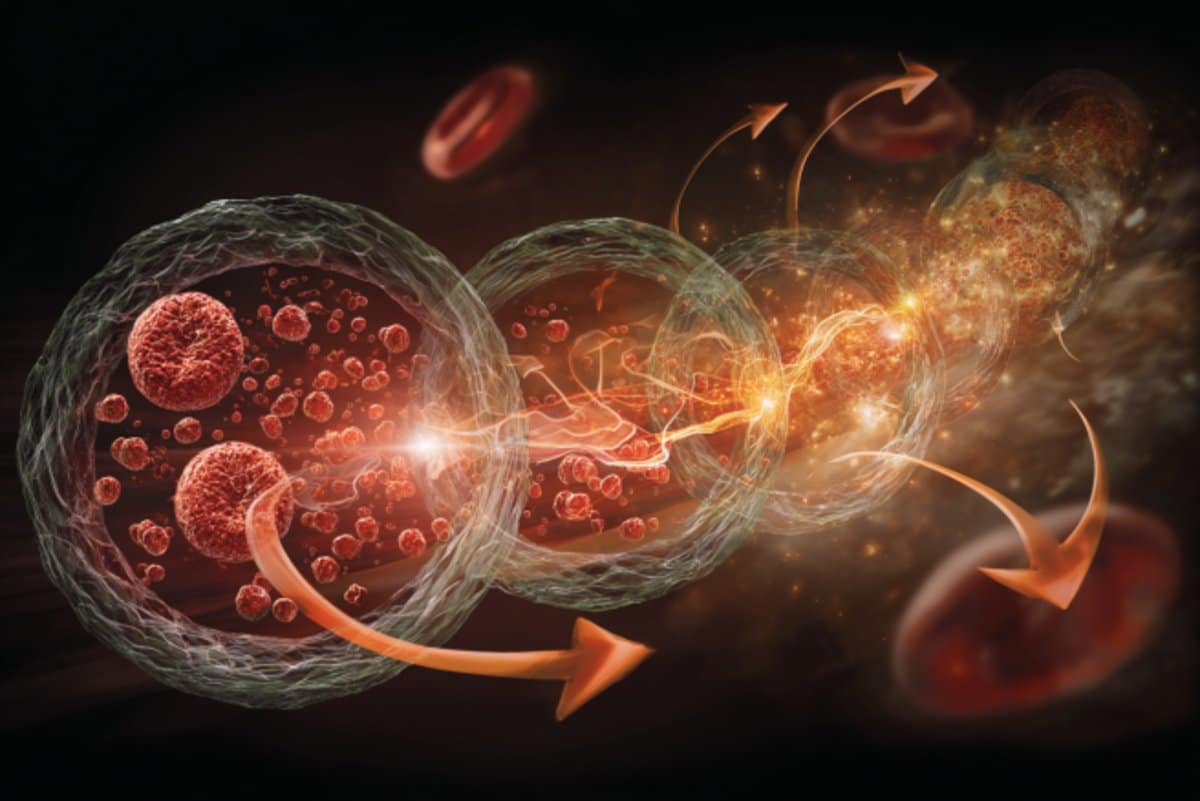
Senescent cells are known to secrete pro-inflammatory factors and signaling molecules—collectively known as SASP—which induce paracrine senescence in surrounding cells.
Over time, these senescent cells accumulate in various tissues, impairing regenerative capacity and contributing to tissue dysfunction. However, the mechanism by which senescence spreads systemically remained unclear.
In their latest study published in Metabolism – Clinical and Experimental (Impact Factor 10.9, top 4.6% in endocrinology and metabolism), Professor Jeon’s team provides the first evidence that reduced HMGB1 (ReHMGB1), a redox-sensitive isoform of HMGB1, circulates through the bloodstream and induces senescence in remote tissues.
Using both in vitro and in vivo models, the researchers demonstrated that extracellular ReHMGB1, but not its oxidized form (OxHMGB1), robustly induces senescence-like features in multiple human cell types—including fibroblasts, renal epithelial cells, and skeletal muscle cells.
Mice systemically treated with ReHMGB1 exhibited elevated senescence markers (p21, p16), increased SASP factor expression, and impaired muscle function.
Furthermore, in a muscle injury model in middle-aged mice, administration of anti-HMGB1 antibodies not only reduced senescence markers but also enhanced muscle regeneration and improved physical performance.
These findings highlight the therapeutic potential of targeting extracellular HMGB1 to reverse or mitigate age-related tissue dysfunction.
“This study reveals that aging signals are not confined to individual cells but can be systemically transmitted via the blood, with ReHMGB1 acting as a key driver,” said Professor Jeon.
“By blocking this pathway, we were able to restore tissue regenerative capacity, suggesting a promising strategy to treat aging-related diseases.”
Funding: This research was supported by the Myokine Research Center (MRC) and the Mid-sized Research Support Project of the Ministry of Science and ICT. and was conducted in collaboration with internationally recognized experts in aging biology, including Professor Irina Conboy of UC Berkeley and Professor Christopher Wiley of Turfts University.
About this aging research news
Author: Kihoon Yu
Source: Korea University College of Medicine
Contact: Kihoon Yu – Korea University College of Medicine
Image: The image is credited to Neuroscience News
Original Research: Open access.
“Propagation of senescent phenotypes by extracellular HMGB1 is dependent on its redox state” by Ok Hee, JEON et al. Metabolism
Abstract
Propagation of senescent phenotypes by extracellular HMGB1 is dependent on its redox state
Background & purpose
Cellular senescence spreads systemically through blood circulation, but its mechanisms remain unclear. High mobility group box 1 (HMGB1), a multifunctional senescence-associated secretory phenotype (SASP) factor, exists in various redox states. Here, we investigate the role of redox-sensitive HMGB1 (ReHMGB1) in driving paracrine and systemic senescence.
Methods
We applied the paracrine senescence cultured model to evaluate the effect of ReHMGB1 on cellular senescence. Each redox state of HMGB1 was treated extracellularly to assess systemic senescence both in vitro and in vivo. Senescence was determined by SA-β-gal & EdU staining, p16INK4a and p21 expression, RT-qPCR, and Western blot methods. Bulk RNA sequencing was performed to investigate ReHMGB1-driven transcriptional changes and underlying pathways.
Cytokine arrays characterized SASP profiles from ReHMGB1-treated cells. In vivo, young mice were administered ReHMGB1 systemically to induce senescence across multiple tissues. A muscle injury model in middle-aged mice was used to assess the therapeutic efficacy of HMGB1 blockade.
Results
Extracellular ReHMGB1, but not its oxidized form, robustly induced senescence-like phenotypes across multiple cell types and tissues. Transcriptomic analysis revealed activation of RAGE-mediated JAK/STAT and NF-κB pathways, driving SASP expression and cell cycle arrest.
Cytokine profiling confirmed paracrine senescence features induced by ReHMGB1. ReHMGB1 administration elevated senescence markers in vivo, while HMGB1 inhibition reduced senescence, attenuated systemic inflammation, and enhanced muscle regeneration.
Conclusion
ReHMGB1 is a redox-dependent pro-geronic factor driving systemic senescence. Targeting extracellular HMGB1 may offer therapeutic potential for preventing aging-related pathologies.


No comments:
Post a Comment