Didn't your competent? doctor prescribe this years ago?
Do you prefer your doctor and hospital incompetence NOT KNOWING? OR NOT DOING?
In my opinion competence is immediately installing protocols upon published research. Does your incompetent? doctor think that is too high a bar? FIRE THEM! And if your doctor is still there after doing nothing your board of directors is completely incompetent!
The latest here:
Mimicking Exercise in the Brain Could Slow Cognitive Decline
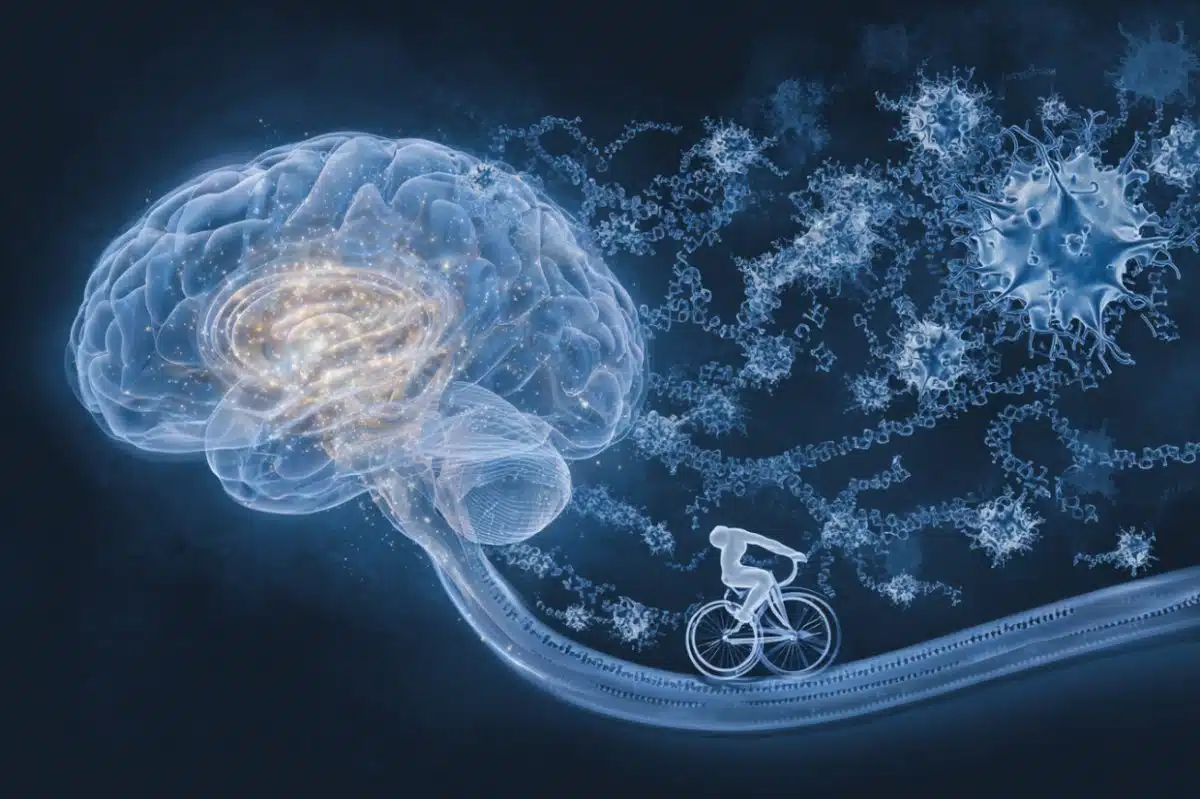
Summary: While physical activity is known to slow cognitive decline in Alzheimer’s disease, many patients are unable to exercise due to frailty or advanced symptoms. A new study identifies a specific gene, ATPPIF1, that is reactivated through exercise and supports neuroplasticity in the brain.
Researchers used single-nuclei RNA sequencing to map how brain cells in the hippocampus respond to aerobic activity, uncovering molecular pathways that may be targeted with future drug therapies. The ultimate goal is to replicate the brain-boosting effects of exercise pharmacologically, offering hope for those who can’t stay active.
Key Facts:
- Exercise Pathway Identified: The metabolic gene ATPPIF1 is reactivated by exercise and may slow Alzheimer’s progression.
- Neuroplasticity Boost: ATPPIF1 promotes neuron survival, synaptic function, and memory-related brain plasticity.
- Drug Potential: Scientists aim to mimic exercise’s cognitive benefits through gene-targeting therapies.
Source: Harvard
For years, researchers have seen a connection between exercise and the progression of cognitive disorders such as Alzheimer’s, but ramping up movement isn’t possible for many patients.
A new study looks at how to mimic those benefits without having to hit the gym.
“Instead of prescribing the exercise, we actually want to activate these molecular pathways using pharmacology to improve cognitive function in these patients.”
According to the Centers for Disease Control, an estimated 6.7 million adults have Alzheimer’s disease in the United States. That number is expected to double by 2060.
Wrann points to studies and meta-analyses that show endurance exercise like walking slows down cognitive decline in Alzheimer’s disease and dementia.
A 2022 study found that walking roughly 4,000 steps a day helped reduce the risk of developing Alzheimer’s by 25 percent while walking 10,000 steps a day reduced risk by 50 percent. But age-related frailty and other factors may make exercise difficult for patients dealing with cognitive decline, said Wrann.
“People who can do the exercise, I would always urge them to do that,” she said.
“There’s a large patient population that just doesn’t have the capability to exercise to an extent that you would get all these benefits.”
Because of this, Wrann said, her team has been motivated to try to understand how exercise impacts our cells at a molecular level. To do this, she explained, researchers have used a technology called single-nuclei RNA sequencing.
Pulling samples from mice, her team looked at the cells in the hippocampus — the region of the brain critical for memory and learning that is damaged early in Alzheimer’s disease.
“What you can do is you can take a piece of tissue that has all the cells exactly where they are and how they are supposed to be,” she said.
“And then you put it through this procedure, and you can check every single cell. You get the whole list of ‘ingredients’ that are inside the cell — the gene expression.”
Researchers then compare healthy brains to Alzheimer’s brains, and better understand how cells interact with each other and respond to exercise. Both control mice and Alzheimer’s mice were subjected to aerobic exercise — running on a wheel — before having samples taken. The team validated their discoveries by comparing the results to a large data set of human Alzheimer’s brain tissue.
“Instead of prescribing the exercise, we actually want to activate these molecular pathways using pharmacology to improve cognitive function in these patients.
“We know which cell is talking to each other cell, and what they are saying,” Wrann said.
“And we know what happens in an Alzheimer’s brain. And then we also know what happens to an Alzheimer’s brain when they get exercise.”
Specifically, researchers were able to identify the metabolic gene ATPPIF1 as an important factor in slowing the progression of Alzheimer’s. It helps create new neurons in the brain — a state known as neuroplasticity, crucial for learning and memory.
“We know that in Alzheimer’s the activity of the gene is reduced, and then it’s restored in the running exercise,” Wrann said.
“Having this gene helps nerve cells to survive noxious stimuli, helps them to proliferate and inform synapses.”
According to Wrann, the next steps toward turning their discoveries into treatments will be to use gene therapy in human subjects.
“In modern biomedical science we have a lot of ways to modulate the activity of these genes,” she said.
“And this is part of the work we are now doing — going beyond the study to figure out what the best approach is to change activity levels of this gene and find the drug candidate you would want to use in a human.”
And while cognitive diseases like Alzheimer’s can benefit from exercise and the related gene stimulation, Wrann says there is still no cure.
“One thing that is very clear is that the onset of disease is later. So people that have more physical activity, they either don’t get dementia, or they get it later. And there are some studies that show a slowing down of the cognitive decline,” she said.
“If you are in complete dementia, then it starts to get more complicated, because even the ability to partake in an exercise regimen is greatly reduced right at that stage.”
Funding:
This work was supported by funds from the National Institutes of Health.
About this genetics and neuropharmacology research news
Author: Anna Lamb
Source: Harvard
Contact: Anna Lamb – Harvard
Image: The image is credited to Neuroscience News
Original Research: Closed access.
“Protective exercise responses in the dentate gyrus of Alzheimer’s disease mouse model revealed with single-nucleus RNA-sequencing” by Christiane Wrann et al. Nature Neuroscience


No comments:
Post a Comment