Has your competent? doctor figured the best breathing protocol. OR DONE NOTHING AT ALL?
Like:
'Breath: The New Science of a Lost Art' by James Nestor.
Or;
'' by Patrick McKeown.
Or should you be doing fast breathing in
Creation of nitric oxide via Breath of Fire February 2014
And why doesn't your doctor know a damn thing about a breathing protocol?
Your doctor has had years to know about this. Are you giving them a pass on being incompetent?
What Your Breathing Says About Your Mental Health
This transcript has been edited for clarity.
Welcome to Impact Factor, your weekly dose of commentary on a new medical study. I’m Dr F. Perry Wilson from the Yale School of Medicine.
You don’t need to think about it until you think about it: breathing. The most fundamental physical function. The most basic act that our bodies undertake to keep our brains alive, exchanging cardon dioxide for oxygen, nourishing every cell inside us.
The reason you don’t need to think about breathing is because of an area of the brainstem called the pre-Bötzinger complex. It’s a group of cells that acts as a pacemaker clicking off about 12 times a minute, triggering your body, without conscious thought at all, to breathe.
Of course, you know it’s more complicated than that. You can hold your breath, after all — you are in control of the process. And it’s more complicated than that. Higher levels of your brain feed into the pre-Bötzinger complex to increase your breathing rate when your body is moving, or when energy expenditure goes up.
And it’s even more complicated than that. You may never have noticed, but when you are breathing through your nose, you’re mostly breathing through one nostril at a time, oscillating back and forth, allowing one nasal passage to regain some moisture while the other does the work.
For something you don’t think about at all, breathing is taking up a lot of brain space.
Could these complex respiratory patterns reveal something, then, about the state of our brains? Are all the yogis and gurus and influencers right about the importance of how we breathe? Is the breath the window to the soul?
If you want to really interrogate the way we breathe, you need to do some pretty precise measurements — which is why I was so intrigued by this paper, appearing this week in Current Biology.
The centerpiece of the article is a new technology: a nasal cannula, but not of the sort you’ve seen before.
Researchers led by Timna Soroka created this device, which precisely measures the airflow in and out of each nostril. They recruited 100 people to wear it for 24 full hours.
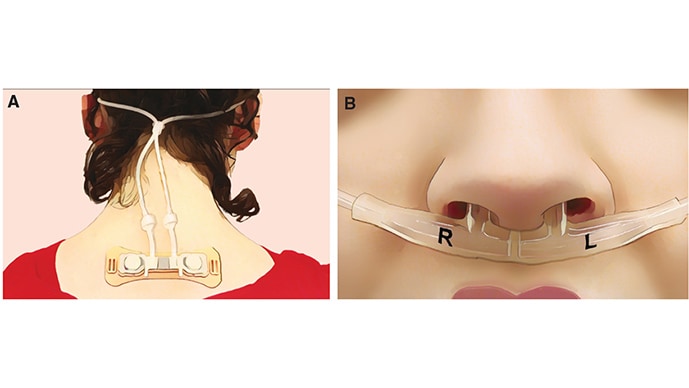
At a sampling rate of 6 Hz, this is a ton of data. In fact, compressing that stream of data into interpretable metrics is a feat in and of itself. The primary analysis derived 24 different measures from this airflow data. Some of these are intuitive: the volume of air inhaled and exhaled, the rate of airflow, the rate of oscillation between one nostril and the other.
This graph, which colors airflow from the right nostril in purple and the left in blue, shows that oscillation in a single participant.
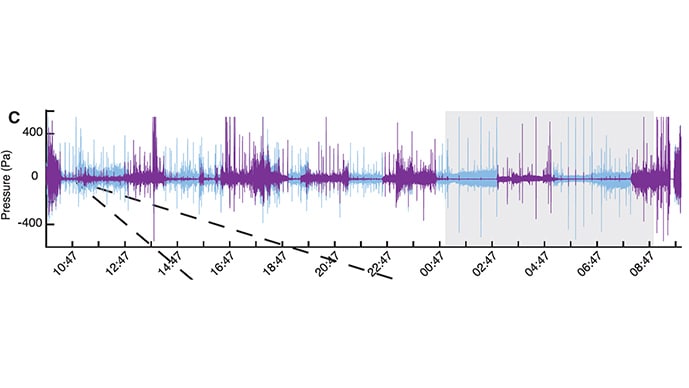
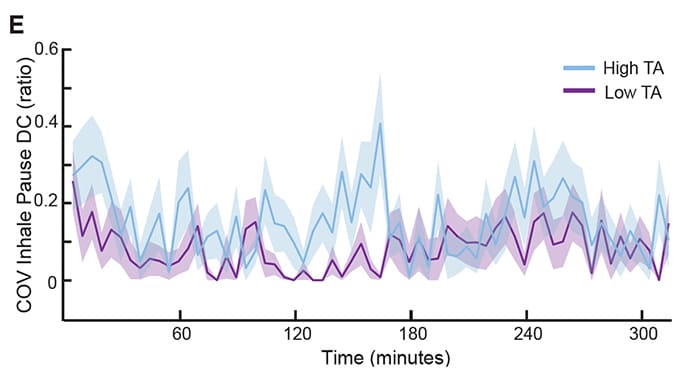
Some metrics are less obvious: the coefficient of variation of the breathing duty cycle, for example, appears to quantify how much one breath changes compared to others.
Our brains are unique, and, it turns out, so are our breathing patterns. The researchers wanted to know whether the 24 metrics derived from someone’s breathing pattern could be used to identify them. Can breathing act like a fingerprint?
The results were impressive.
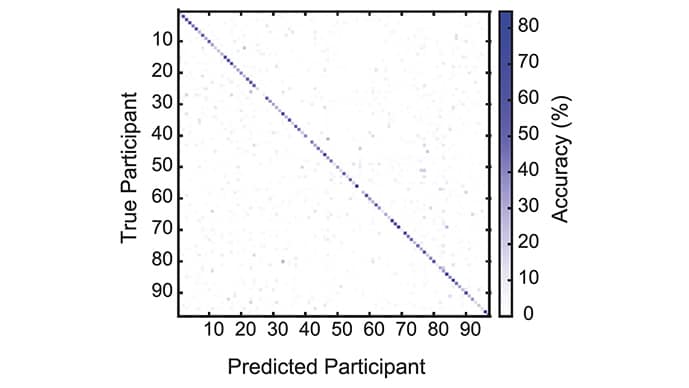
This graph shows how a computer model did when predicting which of the 100 patients a given airflow pattern came from. The diagonal lines are correct predictions. If airflow patterns were random, the machine would only get this right 1% of the time. Instead, it was correct 91% of the time. This approaches biometric levels of accuracy, similar to voice recognition.
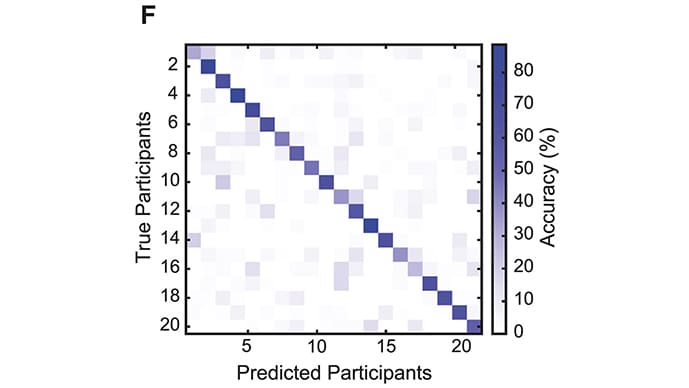
These unique respiratory fingerprints were stable over time. Forty-two of the participants came back for another round of 24-hour monitoring, somewhere between 5 days and 2 years later. The system could identify who was who with 95% accuracy even all that time later.
This is all pretty cool, but let’s be honest: You’re never going to unlock your laptop by strapping a nasal cannula to your face and breathing for a while.
Where this study gets really interesting is in the links between breathing parameters and other physical and psychological parameters.
For example, the breathing pattern was associated with body mass index. People with a higher BMI had a higher tidal volume — a larger volume of air during a typical respiration — than people with a lower BMI.
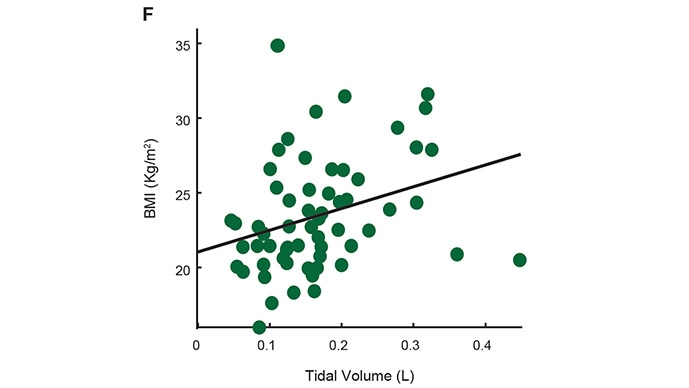
That makes some sense. People with more mass might need to exchange more air to keep oxygen and carbon dioxide levels normal.
But our psychology changes how we breathe as well. The researchers divided people into low and high scorers on the Beck Depression Inventory. Now, it’s worth noting that none of these participants suffered from clinical depression, but of course some had higher scores and some had lower scores. You can see here that the peak inspiratory flow, the fastest rate at which we breathe in, was substantially higher in those with more depressive symptoms.
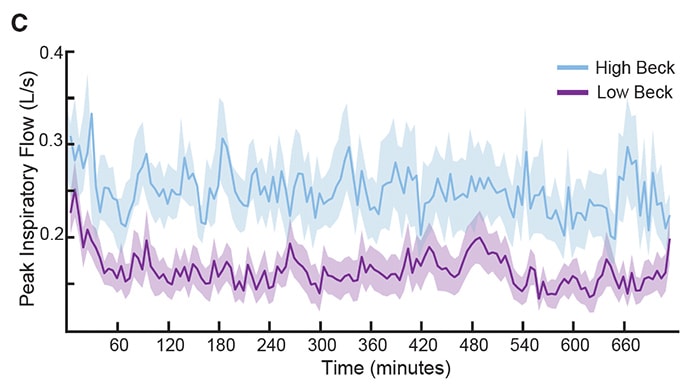
This is not a conscious process. This is the state of your brain controlling subtle features about how you breathe that can only be revealed with new technology.
It didn’t stop with depression. The researchers could distinguish between people with high vs low anxiety scores by looking at the variation in their inspiratory pause.
And you could determine who was more likely to have autistic features — again, none of these individuals had clinical autism — by looking at the percentage of breaths with an inspiratory pause.
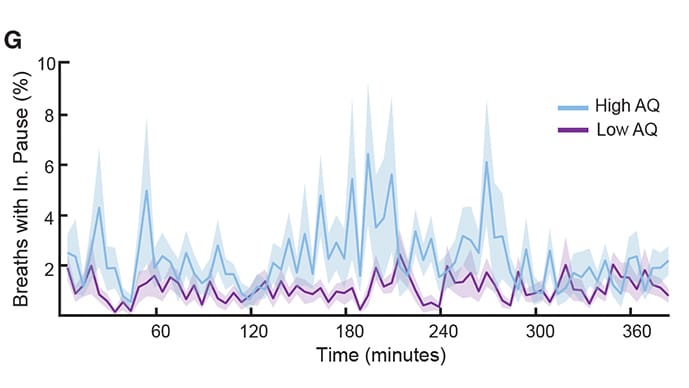
This is where this stuff starts to get interesting, because it suggests that there are physiologic links between brain states and breathing patterns and that those links can be mapped with careful measurement.
I actually think there is a practical application to this. No, I don’t think we’ll all be walking around with tubes in our noses like stillsuits from Dune. But plenty of people are wearing nasal cannulas at night — for CPAP treatment. Adding technology like this to those devices could give insights into how these metrics change over time, perhaps cluing us into changes in our mood or anxiety or other health conditions before we are even consciously aware of them.
Our breathing says a lot about us. So, to paraphrase Sylvia Plath, take a deep breath and listen to the old brag of your heart. I am, I am, I am.


No comments:
Post a Comment