Changing stroke rehab and research worldwide now.Time is Brain! trillions and trillions of neurons that DIE each day because there are NO effective hyperacute therapies besides tPA(only 12% effective). I have 523 posts on hyperacute therapy, enough for researchers to spend decades proving them out. These are my personal ideas and blog on stroke rehabilitation and stroke research. Do not attempt any of these without checking with your medical provider. Unless you join me in agitating, when you need these therapies they won't be there.

What this blog is for:

My blog is not to help survivors recover, it is to have the 10 million yearly stroke survivors light fires underneath their doctors, stroke hospitals and stroke researchers to get stroke solved. 100% recovery. The stroke medical world is completely failing at that goal, they don't even have it as a goal. Shortly after getting out of the hospital and getting NO information on the process or protocols of stroke rehabilitation and recovery I started searching on the internet and found that no other survivor received useful information. This is an attempt to cover all stroke rehabilitation information that should be readily available to survivors so they can talk with informed knowledge to their medical staff. It lays out what needs to be done to get stroke survivors closer to 100% recovery. It's quite disgusting that this information is not available from every stroke association and doctors group.

Showing posts with label weight. Show all posts

Wednesday, February 3, 2021

Can gradually gaining weight extend your lifespan? This study says yes

 I was normal until my stroke at 50, then gained an extra 30 pounds, lost 20, still need to lose 10 more to get down to 25 BMI. I'm not concerned at all about the extra weight considering my activity level.

Can gradually gaining weight extend your lifespan? This study says yes

Rachel Grumman Bender
Updated ·5 min read

Is gradually gaining weight a longevity hack?

A new study found that people who started adulthood at a normal weight and then slowly became overweight — but not obese — as they aged tended to live longer.

The findings, published in the Annals of Epidemiology, are based on an individual’s body mass index (BMI), which is a measure of body fat based on height and weight that classifies adult men and women as underweight (BMI below 18.5), normal weight (BMI 18.5 to 24.9), overweight (BMI 25 to 29.9) or obese (BMI 30 and above).

To get at the results, researchers used data from the Framingham Heart Study, a long-term study based in the town of Framingham, Mass. that set out to discover the underlying causes of heart disease by following the medical histories of the participants and their children. Both the original 4,576 study participants and 3,753 of their children were included in the latest analysis as the researchers looked at the BMI trajectories of both groups from 31 to 80 years old.

The study authors found that, in the original group from the Framingham Heart Study, “people who are normal weight at age 31 years and gradually move to overweight status in middle or later adulthood have the lowest mortality risk, even compared to those who maintain normal weight throughout adulthood,” according to the study. The same was true for the offspring of the original group.

This was followed by people who are considered overweight but were able to maintain a stable weight. Next came people with a “lower level” of normal weight and those who were overweight as adults but then lost weight over the years. People who were obese in early adulthood and then gained more weight with age showed the highest mortality rate.

women of different sizes and races modeling underwear vector illustration design
Study finds that those who gradually gain weight may live longer. (Photo: Getty Images)

So why would a BMI that slowly goes up over time be potentially more protective? “Moderate weight gain among those who are normal weight in early adulthood may confer some survival benefits,” lead author of the study, Hui Zheng, assistant professor of sociology at The Ohio State University, tells Yahoo Life. “[This] is consistent with the view that modest extra body weight in old ages, including lean tissue mass and fat mass, might provide protection against nutritional and energy deficiencies, metabolic stresses, the development of wasting and frailty and loss of muscle and bone density caused by chronic diseases such as heart failure.”

In addition, Dr. Samer Mattar, professor and chief in the division of metabolic and bariatric surgery at Baylor College of Medicine, points out that “not all weight gain is represented by fat mass.” Mattar tells Yahoo Life: “These subjects may have had their weight gain attributed to muscle mass. Moreover, these subjects probably enjoyed better nutritional profiles rendering them more immune to many disease processes, and offer[ing] protection from various nutritional deficiencies, as opposed to people who might have unintentionally lost weight due to illness, or those who gained a large amount of weight, and as a result of their obesity and metabolic syndrome, developed life-threatening diseases such as diabetes, hypertension and sleep apnea.”

In other words, using BMI as a standard metric has its limitations. “The BMI cannot distinguish between fat and muscle mass,” Mattar explains. “A healthy muscular football player may have the same BMI as a person whose body composition is mainly fat. Also, the BMI at any given time is a snapshot in time. It’s more helpful to study the BMI profile of a person over time, say, since childhood or adolescence rather than at only one time point. People who have been obese for longer periods tend to have a higher burden of disease.”

The study also highlights both good and bad news about obesity and mortality rates. Zheng tells Yahoo Life that the “obesity-related mortality rate has declined across generations.” Mattar explains this is “probably as a result of the decline in infectious diseases — COVID notwithstanding — against which people with obesity have reduced immune responses.” Mattar adds: “There is also overall greater awareness of obesity comorbidities, and patients tend to now be better treated for potentially lethal conditions such as hypertension, diabetes and sleep apnea.”

However, the study also found one important difference between the two generational groups: Unlike with their parents' generation, more people in the study’s offspring group are “in the obesity trajectory,” according to EurekAlert. “Even though obesity-related mortality has declined across generations, the percentage of deaths caused by obesity has increased because the prevalence of unhealthy weight trajectories has increased,” Zheng tells Yahoo Life.

Zheng notes that the effect of weight gain on mortality is “complex.” He says, “It depends on timing and magnitude of weight gain and baseline weight status in early adulthood. For people with normal weight in early adulthood, moderate weight gain into overweight in later adulthood is associated with lower mortality risks compared to those who remain in the range of normal weight over the course of adulthood. But, for people with overweight or obesity status in early adulthood, weight gain is associated with excessive mortality risk.”

Mattar says that it’s “critical” for people to pay attention to “what and how they eat.” He recommends practicing “moderation” in both food choices and portion sizes, along with maintaining adequate physical activity levels as much as possible. “Being a little overweight is permissible, but this should be monitored and patients should seek medical counseling should their weight enter into more concerning territory, meaning BMI of over 35,” says Mattar.


Thursday, December 10, 2020

11 Ways to Prevent Alzheimer's, According to Doctors

 But since that likely won't occur; just maybe you'll want your doctor to know about this?

The End of Alzheimer's: The First Program to Prevent and Reverse Cognitive Decline by Dale Bredesen

The latest here:

11 Ways to Prevent Alzheimer's, According to Doctors

Karina Margit Erdelyi

Rich or poor, famous or anonymous, civilian or President of the United States—Alzheimer's disease does not discriminate.

The most common form of dementia, it affects about five million Americans today. That number will increase considerably in the next 30 years, to a projected 16 million Americans in 2050—which makes gaining a greater understanding of this disease critical.

Yet Alzheimer's continues to intrigue and confound researchers. It's a complex disease with many risk factors, some of which you can't change, like your age or genes. But some promising research is being done that shows that you can reduce your risk of Alzheimer's and dementia through simple lifestyle tweaks.

Read on to discover the healthy habits that may keep Alzheimer's at bay, and to ensure your health and the health of others, don't miss these Sure Signs You've Already Had Coronavirus.

1 You're Not Getting Enough Sleep

Now that I'm retired I'm much better at that but be careful to get the right napping time. 

Taking a nap of around an hour after lunch is linked to the biggest long-term boost in mental health, new research suggests.

It worked out that people who did not nap for around an hour were cognitively five years older: 

Sad depressed woman suffering from insomnia, she is sitting in bed and touching her forehead, sleep disorder and stress concept

Harvard Health reports that sound sleep may help protect your brain against Alzheimer's disease. Studies have shown a connection between poor sleep and a higher risk of beta-amyloid protein plaque accumulation—one of the telltale signs of the disease. Amyloid proteins accumulate in your brain daily. When you are in slow-wave sleep—the deep sleep phase when your memories are shored up—your brain sweeps out any surplus amyloid proteins. If your sleep is interrupted, however, during this slow-wave phase, these amyloid proteins can build up, forming plaque on brain tissue. Researchers think this may be the initial stage of Alzheimer's, and that it may occur years before symptoms emerge.

The Rx: Getting a solid seven to eight hours of sleep is the recommendation.

2 You're Not Exercising

I try to walk for 1-2 hours a day, recumbent tricycle in the summer.

Get moving: Regular exercise can reduce your risk by up to 50 percent according to the Alzheimer's Research and Prevention Foundation. Studies show that women from ages 40 to 60 who exercised regularly demonstrated a profound reduction in cognitive decline and memory loss. The benefits of regular physical activity extend to those who have already been diagnosed: Studies show that regular exercise can slow further deterioration in those who have begun to demonstrate cognitive problems. It's thought that exercise protects against Alzheimer's and other forms of dementia by stimulating the brain's ability to maintain old connections while creating new ones.

The Rx: So, what is the recommended amount of physical activity? An ideal plan involves aerobic exercise and strength training. Aim for 30 to 40 minutes, three to four days a week.

RELATED: Simple Ways to Never Age, According to Experts

3 You're Not Eating a Mediterranean Diet

No I'm not, but I do the wine and olive oil part.

Mediterranean diet salad

Prevention starts with the food choices you make. What you eat is critical for optimal brain health, and with the right Alzheimer's diet, you can influence the health of your genes. Studies of people who ate a Western diet versus those who ate a Mediterranean diet are striking. Brain scans taken at the beginning of one study show that those eating a Western diet already had more amyloid protein deposits than those eating a Mediterranean diet. Scientists believe these proteins are a waste product from the energy expended when brain cells communicate.

The Rx: When we talk about the Mediterranean diet, we're talking about eating lots of fresh fruit and vegetables, nuts, whole grains, olive oil, fish, moderate amounts of eggs, dairy, red wine, and eating red meat sparingly.

4 You're Not Connecting Socially

Yep, I have lots of social connections, COVID-19 blew that out of the water so virtual wine tastings were invented.

woman reading on tablet at home with a cup of coffee in her hand

Humans are highly social. We do not do well in isolation, and as it turns out, neither do our brains. Studies show that staying socially engaged can protect against Alzheimer's and other dementias. Developing and nurturing a strong social network is a priority for both mental and brain health. Face-to-face connection with folks who care about you, and whom you care about, is key.

The Rx: You don't have to be the life of the party, but you do need time to connect with people who make you feel heard and who stimulate your mind.

5 You're Not Drinking — But Just a Little

One bottle of wine a week over two wine tastings.

Relaxing with a glass of wine

A glass of good wine at the end of the day can help clear the mind, and now research shows that it might actually be good for the brain too! There is conflicting evidence that moderate consumption of alcohol—one to two drinks a day for men, one for women—reduces the risk of Alzheimer's. Some studies have shown that drinking in moderation can lower inflammation in the body and help your brain clear away toxins associated with Alzheimer's. But the key is moderation: There's strong evidence that drinking heavily on a regular basis increases the risk of Alzheimer's and dementia—so tipple just a little.

The Rx: Check the French wine shelf in your local wine store. A study done in the French wine-producing region of Bordeaux found that red wine might be of particular benefit!

6 You're Not Keeping a Healthy Weight

Well, I'm still 10 lbs. over my ideal weight, not worried about it.

Woman measuring waistline

Here's another reason to trim that waistline! Recent research shows that people that obese or overweight at age 50 could be an increased risk for developing Alzheimer's at an earlier age. Researchers found that study participants with a body mass index (BMI) of 25 or higher at age 50 were likely to develop Alzheimer's seven months sooner than those in the study who were at a healthy weight. As well, the study showed that the higher the BMI, the sooner the disease occurred.

The Rx: A good way to start dropping weight is by saying bye-bye to carbonated beverages. One can of Coke contains 39 grams of added sugar, which is more than the American Heart Association recommends per day (36 grams for men and 25 grams for women)!

RELATED: Simple Ways to Avoid a Heart Attack, According to Doctors

7 You're Not Learning New Things

Hell I've learned 20,000 new things about stroke, dementia, Parkinsons, COVID-19 (See my 20,000+ blog posts).

High angle view of video conference with teacher on laptop at home. Top view of girl in video call with personal tutor on computer listening audio course, distance and e-learning education concept.

Keep learning and you can help lower your risk of Alzheimer's disease. The more you do it, the stronger your brain becomes. Research is still being done, but studies point to mental stimulation acting like a workout for your brain. A fun way to do this is to make like Rodney Dangerfield and go back to school (not high school, but enroll in a Spanish class or learn to play guitar)! According to researchers at Harvard, new brain cell growth continues even into late adulthood—and the action of learning and having new experiences can stimulate that process.

The Rx: Study a foreign language, learn to paint or sculpt, practice a musical instrument. The more novel and complex the activity, the greater the brain benefit.

8  You're Not Buckling Up or Wearing a Helmet

Doing both, required finding a one-handed magnetic catch for my bike helmet.

Cheerful female cyclist enjoying a bike ride

Keep your noggin as safe as you can. Certain types of head injuries may increase your risk of developing Alzheimer's or dementia. Factors that may affect your risk include the severity of an injury you may have had and the age when you sustained it. If you injure your head in a car accident or take a spill from your bike without a helmet, it could increase your risk of Alzheimer's years from now. Want to be "brain smart"? Buckle up every time you get in the car no matter how short the trip, and wear a helmet when biking.

The Rx: As we age, falls are an increasing risk. Check your home for places you may slip or trip. For instance, if you have an area rug, make sure it's got floor-gripping padding underneath to keep it in place. Install easy-to-grab bars in your shower to help minimize risk.

9  You're Not Getting Balanced, Practicing Coordination

It takes plenty of balance not to fall when you are walking on unmaintained trails in the words.

Mature Man With Digital Tablet Using Meditation App In Bedroom

With head injuries from falls an increasing risk as you age, staying steady on your feet becomes all the more critical. Doing balance and coordination exercises can keep you agile and help you avoid falls. Studies show that exercise is a well-established way to keep you steady and strong—and as you can see from this guide, it has multiple benefits for the brain and body.

The Rx: Try yoga, Pilates, or Tai Chi to help stay healthy and coordinated.

RELATED: COVID Symptoms Usually Appear in This Order, Study Finds

10 You're Not Managing Your Blood Pressure

Almost over managed since I got light headed after my latest increase.

Doctor Checking High Blood Pressure In Face Mask

It's not just bad for your heart; many studies also show a connection between high blood pressure and dementia. In fact, autopsy studies show it's common for people with Alzheimer's-related brain changes to also have signs of vascular damage in the brain. Observational studies have linked high blood pressure in middle age, along with diabetes and smoking, as raising one's risk for developing Alzheimer's or dementia.

The Rx: Keeping your blood pressure down is good for your heart and brain. One way to do that is to limit your alcohol intake to no more than one or two drinks a day.

11 You Didn't Quit Smoking

Never did smoke although now I'm indulging in pipe smoking while on my walks. Doesn't work very well since one handed tamping of the tobacco in the bowl doesn't induce a continuous set of coals.

Cigarette
Cigarette

Here's another reason to quit: smoking is perhaps the most preventable risk factor for Alzheimer's disease and dementia. Not everyone who smokes will get Alzheimer's, but some studies indicate that risk increases with duration and intensity of smoking, and decreases with time after quitting smoking.

The Rx: Butt out! When you stop smoking, the brain benefits from improved circulation almost immediately, and your skin will look better too. And to get through this pandemic at your healthiest, don't miss these 35 Places You're Most Likely to Catch COVID.


Saturday, January 16, 2016

Controlling your weight is key to lowering stroke risk

This is way too simplistic, I was in probably the best shape of my life and because of that is why I survived. They should come up with easy tests to measure your unstable plaque and the hardness of your arteries. Those are the real triggers to most strokes. I wish people would learn direct cause and effect.

Controlling your weight is key to lowering stroke risk


Image: iStock
There is a lot you can do to lower your chances of having a stroke. Even if you've already had a stroke or TIA ("mini-stroke"), you can take steps to prevent another.
Controlling your weight is an important way to lower stroke risk. Excess pounds strain the entire circulatory system and can lead to other health conditions, including high blood pressure, diabetes, high cholesterol, and obstructive sleep apnea. But losing as little as 5% to 10% of your starting weight can lower your blood pressure and other stroke risk factors.
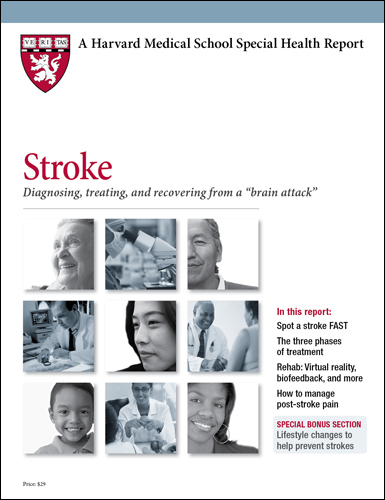
Get your copy of Stroke

Product Page - Stroke
Protect your brain: That’s the strategy that Harvard doctors recommend in this report on preventing and treating stroke. Whether you’ve already had a mini-stroke or a major stroke, or have been warned that your high blood pressure might cause a future stroke, this report provides help and advice.

Read More
Of course, you'll need to keep the weight off for good, not just while you're on a diet. The tips below can help you shed pounds and keep them off:
Move more. Exercise is one obvious way to burn off calories. But another approach is to increase your everyday activity wherever you can — walking, fidgeting, pacing while on the phone, taking stairs instead of the elevator.
Skip the sipped calories. Sodas, lattes, sports drinks, energy drinks, and even fruit juices are packed with unnecessary calories. Worse, your body doesn't account for them the way it registers solid calories, so you can keep chugging them before your internal "fullness" mechanism tells you to stop. Instead, try unsweetened coffee or tea, or flavor your own sparkling water with a slice of lemon or lime, a sprig of fresh mint, or a few raspberries.
Eat more whole foods. If you eat more unprocessed foods — such as fruits, vegetables, and whole grains — you'll fill yourself up on meals that take a long time to digest. Plus, whole foods are full of vitamins, minerals, and fiber and tend to be lower in salt — which is better for your blood pressure, too.
Find healthier snacks. Snack time is many people's downfall — but you don't have to skip it as long as you snack wisely. Try carrot sticks as a sweet, crunchy alternative to crackers or potato chips, or air-popped popcorn (provided you skip the butter and salt and season it with your favorite spices instead). For a satisfying blend of carbs and protein, try a dollop of sunflower seed butter on apple slices.
For more information on lifestyle changes you can make to help prevent a stroke, buy Stroke, a Special Health Report from Harvard Medical School.
Share this story:
Share on Facebook Share on Twitter

Friday, December 4, 2015

Pedicure

What a great thing to have done. One-handed trimming of curling toenails barely works, and the finishing up by getting rubbed done with hot stones was heavenly. The big toenail I lost last April on the  cruise has pretty much come in, except it has ingrown and is painful and bleeding. Which is not helping my resolution to get in at least 10,000 steps a day. Right now I'm on an 9 day streak and my weight is barely budging downward.

Monday, March 24, 2014

Damn I've gained weight

My image of myself as a fit person has taken huge hits over the last month. In Italy I found my neck size was no longer 16.5 - I actually knew that a long time ago  from an inability to button my neck collar button, I chalked it up to trying to do it one-handed. It was measured by a tailor at 17.5. I've started  buying clothes at thrifts to save money, good thing since  my waist pre-stroke was 35, post-stroke I had to jump to 36 to accommodate the one-handed buttoning needs. Just recently bought some 36x34s and one 38x34 at a thrift. Damn I'm only able to get the 38 inch buttoned with one hand. I chalk it up to joining a bunch of meetup groups and getting together for dinner and then a couple of beers afterwards. It was worth it to get socially connected.  Pre-stroke I would have just increased my physical activity to solve that problem. Now it's more about reducing calories since increasing activity levels is pretty much at my max already.  I will not lower myself to start drinking low-calorie beer, that swill will not touch my lips.

Wednesday, January 2, 2013

A few extra kilos may extend your life: study

This is very interesting to me since I'm invariably on the cusp, right at BMI 27-8. But no self-prescribing or diagnosing, that's for your doctors.

The article about it - readable; A few extra kilos may extend your life: study


The abstract and research behind the article;
http://jama.jamanetwork.com/article.aspx?articleid=1555137