While he's doing good, it just proves the complete failure of the stroke hospital to get him 100% recovered!
At UPMC's 'Stroke Camp,' survivors build their skills and strut their stuff
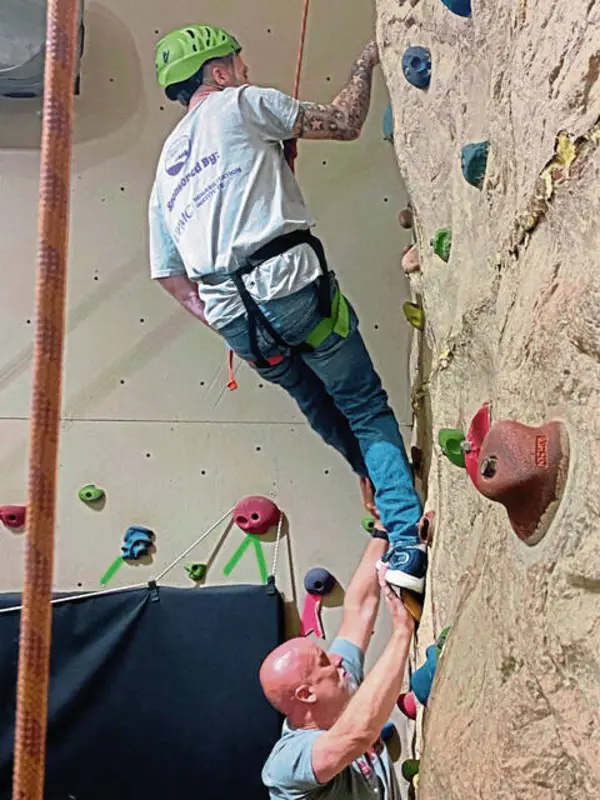
Jay Perino of Salem gets help climbing a rock wall from Mike Little, executive director of Crestfield Camp and Conference Center near Slippery Rock, during UPMC’s Retreat & Refresh Stroke Camp on Saturday.
After getting a little help with his footing, Jay Perino used his legs to push his body up the rock wall, reaching for the closest handhold.
For someone with limited mobility on the left side of his body as a result of a stroke, it was no easy feat. Must be the 50 squats he does every day.
Perino, 55, of Salem, reached his right arm high above his helmeted head to continue climbing as spectators cheered below. He’s always been motivated and in shape, but after his stroke in 2008, he’s had to use that mindset in a different way — to regain some of his independence.
“I want to run, walk better with a cane,” he said.
Perino and his mother, Debbie, were among about 30 stroke survivors and caregivers who participated in UPMC’s Retreat & Refresh Stroke Camp near Slippery Rock over the weekend. The three-day event allows survivors and caregivers time separately to connect with others while throwing in some fun, like fishing, massages, crafts and swimming. They had access to golf cart rides around Crestfield Camp & Conference Center, as well as games, activities and an evening ’70s-themed celebration.
The camp has been welcoming participants for almost 10 years. About 15 UPMC staffers in a variety of disciplines volunteered over the three days, and many survivors and caregivers come back annually, said Stacey Mlodzianowski, an occupational therapist at UPMC Mercy hospital. After participating in another United Stroke Alliance camp while at a different job in New Jersey, Mlodzianowski said, she knew she had to bring one to Pittsburgh.
The event can help both survivors and caregivers feel empowered while navigating a life-changing situation that may involve lingering mobility issues, she said.
“It’s incredible to see how that support and interaction can just build in such a short time through the weekend,” she said.
Perino can never forget the date of his stroke — it’s tattooed on his wrist. On Oct. 10, 2008, at age 38, a blood clot blocked the flow of blood to his brain, resulting in an ischemic stroke, the most common type. Blood clots cause more than 690,000 strokes annually, according to the American Stroke Association.
For more than a year afterward, he was unable to do anything himself. But that’s where his preexisting motivation factors in. Perino was active before his stroke, regularly riding a bicycle 30 miles daily, and wanted to gain back some of his independence.
He’s done it, slowly and incrementally. Now, he can walk with a cane, though issues remain with his left arm and peripheral vision. Dr. Jennifer Shen, with UPMC, notices the little improvements Perino has made through the years.
“When you see that motivation, it goes a long way,” said Shen, a physiatrist board-certified in physical medicine and rehabilitation.
Perino has therapy two or three times a week and follows a daily regimen of squats, sit-ups, weights and walking. He’s even written a book, “I Almost Had To Die … To Start Living!”, with help from his mother. Perino signed copies of it at the stroke camp while his mother watched over his shoulder, providing gentle guidance if he needed it.
For Debbie Perino, the retreat is educational and gives her an opportunity to relax and see her son accomplish things she was once told he couldn’t.
“It’s refreshing and it gives me a better attitude, just coming here and being with people in the same boat as I am,” she said. “It makes me happy that he enjoys it.”


No comments:
Post a Comment