One question to determine quality of life! Are you fully recovered? Y/N?
100% recovery is the quality of life survivors want! THAT'S NON-NEGOTIABLE! That is the only goal in stroke; 100% RECOVERY! GET THERE!
Analysis of Factors Affecting Quality of Life (QoL) in Middle-Aged Stroke Patients (Under 65 Years Old) in the Rehabilitation Phase: Multivariate Regression Analysis
Authors Lumbantobing VBM , Priastomo M, Kosasih CE, Rhamelani P , Anggadiredja K, Adnyana IK
Received 8 November 2024
Accepted for publication 26 March 2025
Published 15 June 2025 Volume 2025:18 Pages 3477—3491
DOI https://doi.org/10.2147/JMDH.S504851
Checked for plagiarism Yes
Review by Single anonymous peer review
Peer reviewer comments 2
Editor who approved publication: Professor Charles Victor Pollack
Valentina Belinda M Lumbantobing,1,2,* Mukti Priastomo,1 Cecep Eli Kosasih,3 Putri Rhamelani,4 Kusnandar Anggadiredja,1 I Ketut Adnyana1,*
1Department
of Pharmacology and Clinical Pharmacy, School of Pharmacy, Institut
Teknologi Bandung, Bandung, West Java, Indonesia; 2Department of Fundamental Nursing, Faculty of Nursing, Universitas Padjadjaran, Bandung, West Java, Indonesia; 3Department of Critical Nursing, Faculty of Nursing, Universitas Padjadjaran, Bandung, West Java, Indonesia; 4Faculty of Nursing, Universitas Padjadjaran, Sumedang, West Java, Indonesia
*These authors contributed equally to this work
Correspondence:
Valentina Belinda M Lumbantobing, Department of Pharmacology and
Clinical Pharmacy, School of Pharmacy, Institut Teknologi Bandung,
Bandung, West Java, Indonesia, Email valentina@unpad.ac.id I Ketut
Adnyana, Department of Pharmacology and Clinical Pharmacy, School of
Pharmacy, Institut Teknologi Bandung, Bandung, West Java, Indonesia,
Email ketut@itb.ac.id
Purpose: This study
analyzed factors influencing the quality of life (QoL) in stroke
patients during the rehabilitation phase so that rehabilitation
professionals, caregivers, and stroke patients can pay attention to all
aspects that contribute significantly to a better QoL and can design
appropriate interventions to improve patient welfare and support a more
significant recovery process.
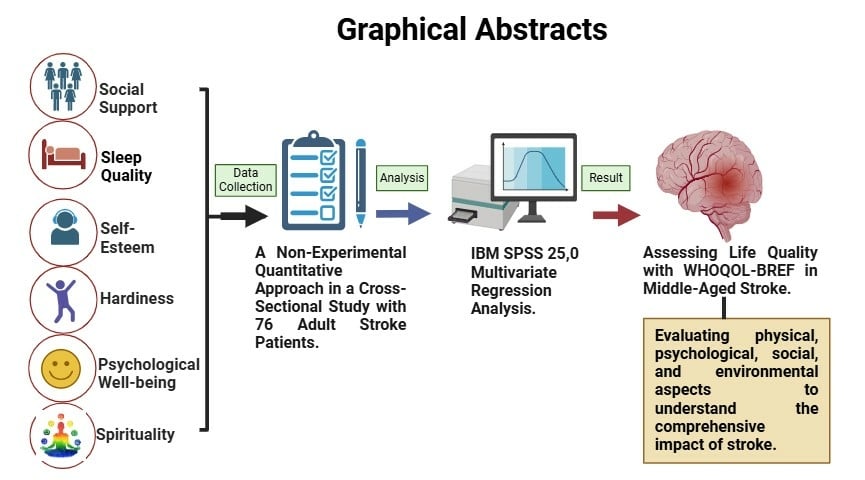
Patients and Methods: A
non-experimental quantitative approach with a cross-sectional design
was conducted with 76 adult stroke patients in the rehabilitation phase.
Data were collected using an interval-scale paper-based questionnaire
and analyzed using univariate analysis techniques and multivariate
regression analysis.
Results: The results showed
that social support, sleep quality, self-esteem, hardiness,
spirituality, and psychological well-being affected patients’ QoL in all
domains (P = 0.000). More specifically, the physical domain was
significantly affected by sleep quality (P = 0.000), spirituality (P =
0.004), and psychological well-being (P = 0.000). The psychological
domain was significantly affected by social support (P = 0.000), sleep
quality (P = 0.017), hardiness (P = 0.000), and spirituality (P =
0.007). The social domain was significantly influenced by social support
(P = 0.002), sleep quality (P = 0.044), and self-esteem (P = 0.000).
Finally, the environmental domain was significantly influenced by social
support (P = 0.002) and self-esteem (P = 0.000).
Conclusion:
The success of stroke patient recovery in the rehabilitation phase is
marked by the goodness of all domains of QoL. This study obtained the
analysis result of specific factors affecting each domain in QoL.
Therefore, patients, families, nurses, and other health care providers
have a crucial role in efforts to create a better QoL in stroke patients
in the rehabilitation phase by considering the factors that have the
most significant influence.
Plain Language Summary:
This study was conducted to determine the factors that influence the
QoL of stroke patients in the rehabilitation phase. As stroke recovery
can be a long and challenging process, understanding these factors is
essential for improving patient care and recovery outcomes. The study
involved 76 adult stroke patients and used multivariate regression
analysis to explore how social support, sleep quality, self-esteem,
spirituality, and psychological well-being impact QoL. The findings
matter because they show how different factors influence various aspects
of QoL. For instance, sleep quality, spirituality, and psychological
well-being impact the physical aspect of QoL, while social support,
sleep quality, and spirituality affect the psychological aspect. Social
support, sleep quality, and self-esteem are key to improving the social
aspect, while social support and self-esteem also influence the
environmental aspect. These results can be applied in clinical settings
by guiding healthcare providers to focus on these specific factors
during the rehabilitation phase. By addressing social support, improving
sleep, and enhancing psychological well-being, healthcare providers,
patients, and families can work together to optimize recovery, improve
QoL, and ultimately lead to better long-term outcomes for stroke
patients.
Keywords: physical support, psychosocial support, quality of life, sleep quality, spiritual support, stroke rehabilitation
Graphical Abstract:


No comments:
Post a Comment