Changing stroke rehab and research worldwide now.Time is Brain! trillions and trillions of neurons that DIE each day because there are NO effective hyperacute therapies besides tPA(only 12% effective). I have 523 posts on hyperacute therapy, enough for researchers to spend decades proving them out. These are my personal ideas and blog on stroke rehabilitation and stroke research. Do not attempt any of these without checking with your medical provider. Unless you join me in agitating, when you need these therapies they won't be there.

What this blog is for:

My blog is not to help survivors recover, it is to have the 10 million yearly stroke survivors light fires underneath their doctors, stroke hospitals and stroke researchers to get stroke solved. 100% recovery. The stroke medical world is completely failing at that goal, they don't even have it as a goal. Shortly after getting out of the hospital and getting NO information on the process or protocols of stroke rehabilitation and recovery I started searching on the internet and found that no other survivor received useful information. This is an attempt to cover all stroke rehabilitation information that should be readily available to survivors so they can talk with informed knowledge to their medical staff. It lays out what needs to be done to get stroke survivors closer to 100% recovery. It's quite disgusting that this information is not available from every stroke association and doctors group.

Showing posts with label cerebral hemorrhage. Show all posts

Tuesday, October 22, 2024

He recognized the signs of his own stroke – and got treated within 30 minutes

 So still not fast enough to get fully recovered and not the correct therapy in the hospital to get to 100% recovery. How fast do you need to get treated for a hemorrhage to get fully recovered without the need for additional therapy? Why the fuck doesn't your competent? doctor know that answer? 

Why didn't the doctor and therapists here know how to get him fully recovered before leaving the hospital?

Laziness? Incompetence? Or just don't care? NO leadership? NO strategy? Not my job? Not my Problem?

He recognized the signs of his own stroke – and got treated within 30 minutes

By Diane Daniel, American Heart Association News

Doctors told Jim Johnson that without his quick action while having a stroke, the prognosis likely would have been much worse. (Photo courtesy of Jim Johnson)

Jim Johnson woke up at his usual time of roughly 6 a.m. Something, though, was different.

His right side felt numb.

He shifted onto his back, thinking that changing positions would make a difference. It didn't.

"This could be bad," he said to himself.

He managed to get out of bed but noticed his right leg was dragging.

Definitely bad, he thought.

Johnson, then 67, knew that numbness on one side was a sign of a stroke. He was pretty sure he was having one. He knew he needed help right away – and he sought it.

Within 30 minutes, Johnson was in an emergency room in his hometown of Chattanooga, Tennessee.

After running diagnostic tests, doctors determined Johnson was having a stroke in the form of a cerebral hemorrhage. A weakened blood vessel had ruptured and was causing bleeding within his brain.

Doctors started treating him with a coagulant to stop the bleeding and admitted him to the intensive care unit.

He remained alert and didn't recognize any speech or cognition issues. During the treatment, his right-side symptoms decreased quickly.

Doctors told him that if he had waited even 15 minutes longer to get to the hospital, the stroke and his prognosis would likely have been much worse.

In general, Johnson was healthy and fit. He was a walker, runner and cyclist, and he ran a company focused on European bicycle travel. But during a neurological exam later that day, the doctor learned of several factors that might have contributed to the stroke.

Johnson had sleep apnea, and he'd been seeking relief from herbal supplements; the doctor told him to stop those and to return to using the CPAP (continuous positive airway pressure) device he'd shunned. The doctor explained that sleep apnea causes intermittent low blood oxygen, which in turn can cause spikes in blood pressure that raise the risk of stroke.

Another red flag was that Johnson had two bouts of COVID-19 by the time his stroke occurred in October 2021. He also had indications of long COVID that already had caused brain fog. The doctor said that in some cases, the inflammation often caused by COVID could lead to brittle blood vessels and, in turn, to brain bleeds.

By his fourth day in the hospital, Johnson's physical symptoms had all but disappeared. He was discharged directly from the ICU to home.

Still, he had more healing to do.

The stroke likely worsened his COVID-related brain fog and balance issues from Ménière's disease, which he'd been diagnosed with 18 years earlier. It's a disease of the inner ear that can cause episodes of vertigo, tinnitus and hearing loss.

During physical therapy, Johnson learned that his current balance issues were caused by his eyes not sending simultaneous signals to his brain, an effect of the stroke. Even the slightest difference could cause problems. He continued physical therapy several times a week for 10 months.

During that time, Johnson continued to run his business and work on his local passion projects: advocacy work for cyclists and pedestrians, along with promoting greenways.

Work had become extremely stressful. First, he lost two years' worth of business when travel abruptly stopped during the pandemic. He also had to considerably reduce his staff. Then, when travel started to roar back, he had to deal with rescheduling canceled trips and serving new customers – with fewer employees to help.

His doctor warned him that if he didn't lower his stress level, he'd be at risk of a second stroke.

"And the outcome probably won't be so favorable," the doctor added.

At about the same time, a competitor offered to buy the business and take over the debts caused by the pandemic.

"It was a painful but easy choice," said Johnson, who sold the business in 2022, when he was 68. "Health over wealth. Not the retirement I'd planned on, but one that might offer me a better long-term quality of life."

Indeed, by the end of that year, Johnson took his first overseas trip since the stroke. He visited Germany and Austria. His fears of such a long trip were eased by the fact that he was visiting friends, including a lifelong friend who's a doctor.

When Johnson returned home, he was ready for more physical therapy but wanted something in a less clinical setting. He reached out to Monika Patel, a friend and fellow greenways advocate who is also a physical therapist.

"Jim was ready to work on more of the functional things he loved, like cycling and hiking," she said. "I love doing that kind of work outside if people are open to it, which of course Jim was."

Jim Johnson (right) with his friend and physical therapist, Monika Patel. Hiking was a form of physical therapy that helped Johnson's visual stamina and balance. (Photo courtesy of Jim Johnson)

That picture demonstrates a lot of what I do for balance and recovery in my walks in the woods. Which should have been part of my physical therapy while being treated.

One exercise they did for his visual stamina and balance required Johnson to stand on one leg and move his eyes from tree to tree, including those far away. Patel also had him walk on fallen trunks, hop over branches and even roll down a hill.

"It was very progressive PT in an environment I loved and had great comfort in," Johnson said.

With Patel's help, he also reached an important goal: feeling comfortable bicycling again.

Not possible for me. See all my failures here:

"We went on a road bike ride together and that was a full-circle moment," Patel said. "To see Jim's smile and his confidence in going off into the world, that was something."

Since then, Johnson has indeed gone off into the world.

He's done bike and boat tours in Croatia, Turkey and Greece, and visited family in South Africa. His most recent adventure was traveling for four months this year in Croatia, Turkey, Bulgaria and Georgia. In the Georgia mountains, he went on hikes so rigorous he had to put his hands on a guide's shoulders to stay upright.

"Maybe I'm still at a 15% deficit," he said. "I don't really know. But the more I do, the more I want to do. I'd rather look at what's ahead than what's behind."

Jim Johnson sailing off the coast of Hvar Island in Croatia. (Photo courtesy of Jim Johnson)

Stories From the Heart chronicles the inspiring journeys of heart disease and stroke survivors, caregivers and advocates.

Monday, August 5, 2024

Research progress on high-concentration oxygen therapy after cerebral hemorrhage

 So still NO PROTOCOL  on oxygen delivery. 

 I can't see any use for HBOT unless it's delivered in the first week and there are vastly easier options for delivering oxygen than that.


  • oxygen delivery (29 posts to January 2020) Many ideas in here, if your doctor isn't already using them to save neurons immediately post stroke; you don't have a functioning stroke doctor!

Research progress on high-concentration oxygen therapy after cerebral hemorrhage

  • 1Department of Neurology, Clinical Medical School of Jiujiang University, Jiujiang, Jiangxi, China
  • 2Jiujiang Clinical Precision Medicine Research Center, Jiujiang, Jiangxi, China
  • 3Department of Anorectal Surgery, Third Affiliated Hospital of Wenzhou Medical University, Zhejiang, China

Recently, the role of high-concentration oxygen therapy in cerebral hemorrhage has been extensively discussed. This review describes the research progress in high-concentration oxygen therapy after cerebral hemorrhage. High-concentration oxygen therapy can be classified into two treatment methods: hyperbaric and normobaric high-concentration oxygen therapy. Several studies have reported that high-concentration oxygen therapy uses the pathological mechanisms of secondary ischemia and hypoxia after cerebral hemorrhage as an entry point to improve cerebral oxygenation, metabolic rate, cerebral edema, intracranial pressure, and oxidative stress. We also elucidate the mechanisms by which molecules such as Hypoxia-inducible factor 1-alpha (HIF-1α), vascular endothelial growth factor, and erythropoietin (EPO) may play a role in oxygen therapy. Although people are concerned about the toxicity of hyperoxia, combined with relevant literature, the evidence discussed in this article suggests that as long as the duration, concentration, pressure, and treatment interval of patients with cerebral hemorrhage are properly understood and oxygen is administered within the treatment window, it can be effective to avoid hyperoxic oxygen toxicity. Combined with the latest research, we believe that high-concentration oxygen therapy plays an important positive role in injuries and outcomes after cerebral hemorrhage, and we recommend expanding the use of normal-pressure high-concentration oxygen therapy for cerebral hemorrhage.

1 Introduction

Spontaneous intracerebral hemorrhage (ICH) refers to the hemorrhage of brain parenchyma caused by vascular rupture caused by non-traumatic causes. With an increase in population age and widespread use of antithrombotic drugs, risk factors such as hypertension, diabetes, obesity, and alcohol abuse have increased, and the incidence of ICH is also increasing (1). Its high mortality and disability rates are closely related to neuronal damage caused by pathological reactions such as perifocal hypoxia after ICH. Surviving patients often experience permanent sequelae (2).

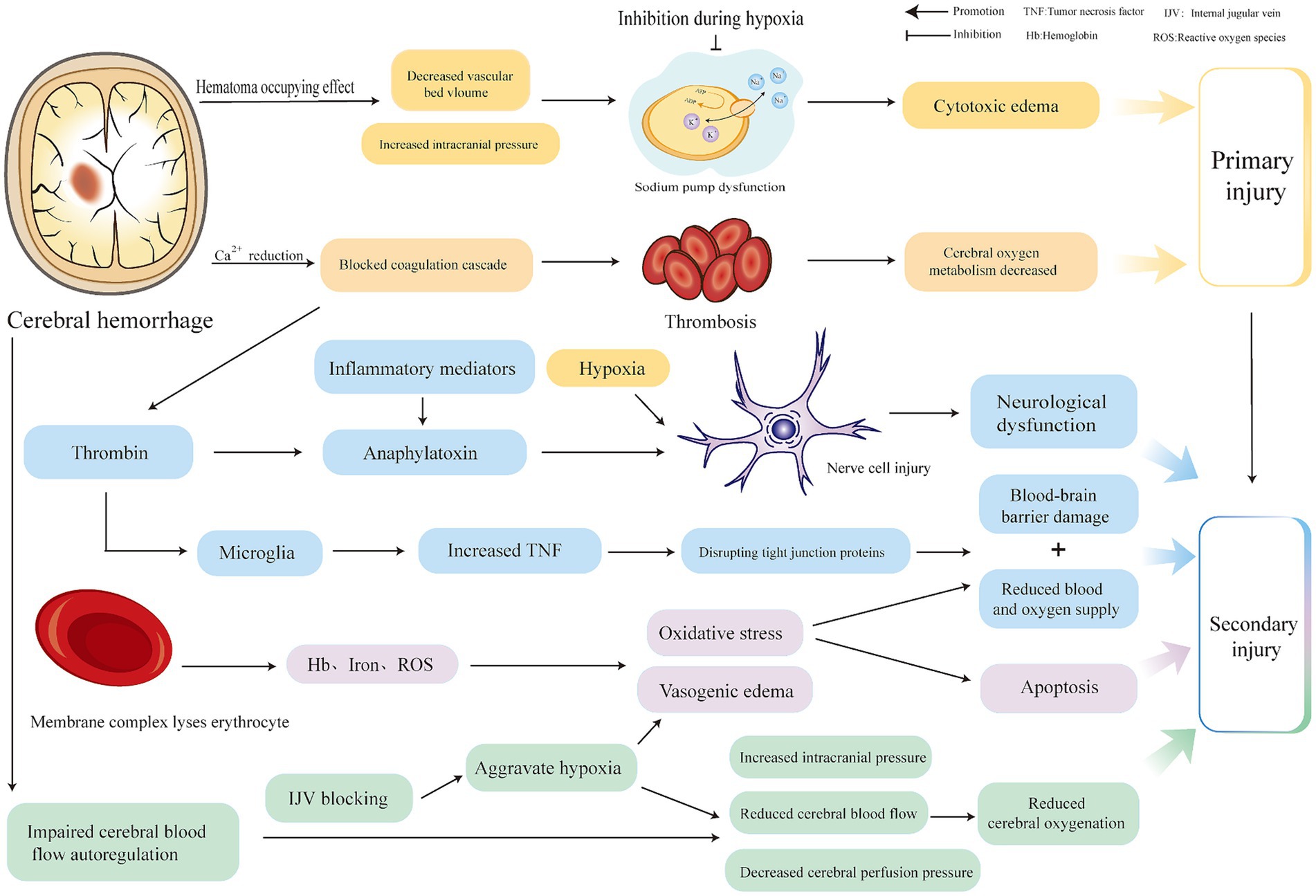
Brain injury after ICH can be classified into primary and secondary injuries. The primary injury is mechanical compression and expansion of the hematoma, which are key factors in determining the progression and outcome of ICH. They are generally caused by continued bleeding from ruptured blood vessels (3), usually occurring within 6 h after ICH, which can induce a space-occupying effect, compress blood vessels, reduce the volume of the vascular bed, increase intracranial pressure (ICP), decrease local perfusion, inhibit membrane ion pump activity (4), increase intracellular sodium ions, decrease intracellular crystal osmotic pressure, and form cytotoxic edema (5). The decrease of calcium ions in serum impairs the thrombin cascade reaction, and coagulation dysfunction (3) forms thrombosis, resulting in cerebral microcirculation obstruction and decreased oxygenation.

Hematoma components can induce secondary ICH. Thrombin is one of the components of hematoma. A high concentration of thrombin activated by the thrombin cascade reaction after ICH is closely associated with secondary ICH injury (4, 6). Thrombin can induce the production of inflammatory mediators, cause nerve cell damage (7), and influence neurological outcomes after ICH. Thrombin can also cleave the protease-activated receptors (PARs) receptor in microglia, which in turn phosphorylates the Src family kinase, thereby aggravating brain edema and the destruction of the blood–brain barrier. Stimulated microglia can also destroy tight junction proteins by up-regulating the expression of tumor necrosis factor (TNF) (6), increasing blood–brain barrier permeability. The complement cascade activated by thrombin may promote inflammation and edema after ICH through anaphylactoid toxins, or it may lyse red blood cells through membrane complexes to produce hemoglobin, iron, and oxygen free radicals, promote edema and oxidative stress and accelerate apoptosis after ICH, death, and blood–brain barrier disruption (4, 6). Red blood cells are also one of the components of hematoma. After intracerebral hemorrhage, the blood overflows from the ruptured blood vessels, and some red blood cells that are not completely phagocytized by microglia and infiltrating macrophages are directly released into the central system. Substances such as hemoglobin, iron, and carbonic anhydrase-1 are neurotoxic and are closely related to secondary brain injury after ICH (8). In addition, the automatic adjustment function of cerebral blood flow is based on a formula for cerebral blood flow, cerebral perfusion pressure (CPP), and cerebral vascular resistance (CVR). CVR can be adjusted to ensure the supply of cerebral blood flow (CBF) when ICP increases and CPP decreases. Expanded hematoma and high intracranial pressure after ICH cause decompensation of this regulation, further reducing CPP and aggravating cerebral ischemia (9). It is important to note that because hypertension is the most common cause of ICH (10), antihypertensive measures are often taken to alleviate the expansion of ICH hematoma; however, this is undoubtedly a challenge to the automatic regulation of cerebral blood flow. Therefore, attention should be paid to the tolerance of patients with hypertensive ICH to rapid blood pressure reduction; otherwise, insufficient cerebral perfusion will occur (11). Adnan et al. recommended that for intensive blood pressure reduction in ICH, systolic blood pressure should be controlled at 130–150 mmHg (12). Notably, cerebral venous outflow disorder also has a significant impact on the pathological mechanisms of ICH. Some researchers have found that cerebral venous outflow disorders are closely related to cerebrospinal fluid dynamics (13), especially in the internal jugular vein (IJV), which is the main route of brain drainage (14). Feng et al. (14) found that among patients with ICH, those with positive internal jugular venous reflux had larger perihematomal edema (PHE) volume than those with negative internal jugular venous reflux and demonstrated a positive correlation between jugular venous reflux (JVR) and PHE volume. When JVR worsens, it can further increase ICP, reduce CBF and CPP, aggravate vasogenic edema, and reduce cerebral oxygenation (14, 15). In general, secondary injuries can include vasogenic edema, neuroinflammatory reactions, blood–brain barrier damage, decompensation of cerebral blood flow autoregulation, excessive lowering of blood pressure, and cerebral venous return disorder, which are related. The pathological mechanisms are different, but to a certain extent, they can synergistically aggravate pathological reactions such as brain edema, neuroinflammatory reactions, high ICP, low CPP, oxidative stress, cell apoptosis, and destruction of the blood–brain barrier after ICH. From a comprehensive literature review, we believe that ischemia and hypoxia after ICH intersect and interact with these pathological reactions (16, 17). (The details are shown in Figure 1.)

Figure 1
www.frontiersin.org

Figure 1. Injury mechanism of cerebral hemorrhage.

A green stroke channel has been established clinically, and the slogan “time is brain” has been put forward because ICH is dangerous and progresses rapidly. Although there is currently no specific clinical treatment for ICH, the pathological basis of ICH can be explored to improve patient prognosis. Recently, high-concentration oxygen therapy has become increasingly active in the public eye. This emerging and effective intervention can alleviate ischemic hypoxic conditions after ICH, reduce intracranial pressure and cerebral edema, and improve neuroinflammatory reactions and other adverse effects. This study aimed to explore the progress in the efficacy of high-concentration oxygen therapy for ICH. Clinically, common high-concentration oxygen therapies used after ICH can be categorized into hyperbaric oxygen (HBO) and normobaric oxygen (NBO).