Changing stroke rehab and research worldwide now.Time is Brain! trillions and trillions of neurons that DIE each day because there are NO effective hyperacute therapies besides tPA(only 12% effective). I have 523 posts on hyperacute therapy, enough for researchers to spend decades proving them out. These are my personal ideas and blog on stroke rehabilitation and stroke research. Do not attempt any of these without checking with your medical provider. Unless you join me in agitating, when you need these therapies they won't be there.

What this blog is for:

My blog is not to help survivors recover, it is to have the 10 million yearly stroke survivors light fires underneath their doctors, stroke hospitals and stroke researchers to get stroke solved. 100% recovery. The stroke medical world is completely failing at that goal, they don't even have it as a goal. Shortly after getting out of the hospital and getting NO information on the process or protocols of stroke rehabilitation and recovery I started searching on the internet and found that no other survivor received useful information. This is an attempt to cover all stroke rehabilitation information that should be readily available to survivors so they can talk with informed knowledge to their medical staff. It lays out what needs to be done to get stroke survivors closer to 100% recovery. It's quite disgusting that this information is not available from every stroke association and doctors group.

Showing posts with label fine motor control. Show all posts

Thursday, December 22, 2022

The valley of recovery marks progress: Modeling how fine motor skills are regained after stroke

I can't do either of these grips due to spasticity preventing opening.

The valley of recovery marks progress: Modeling how fine motor skills are regained after stroke
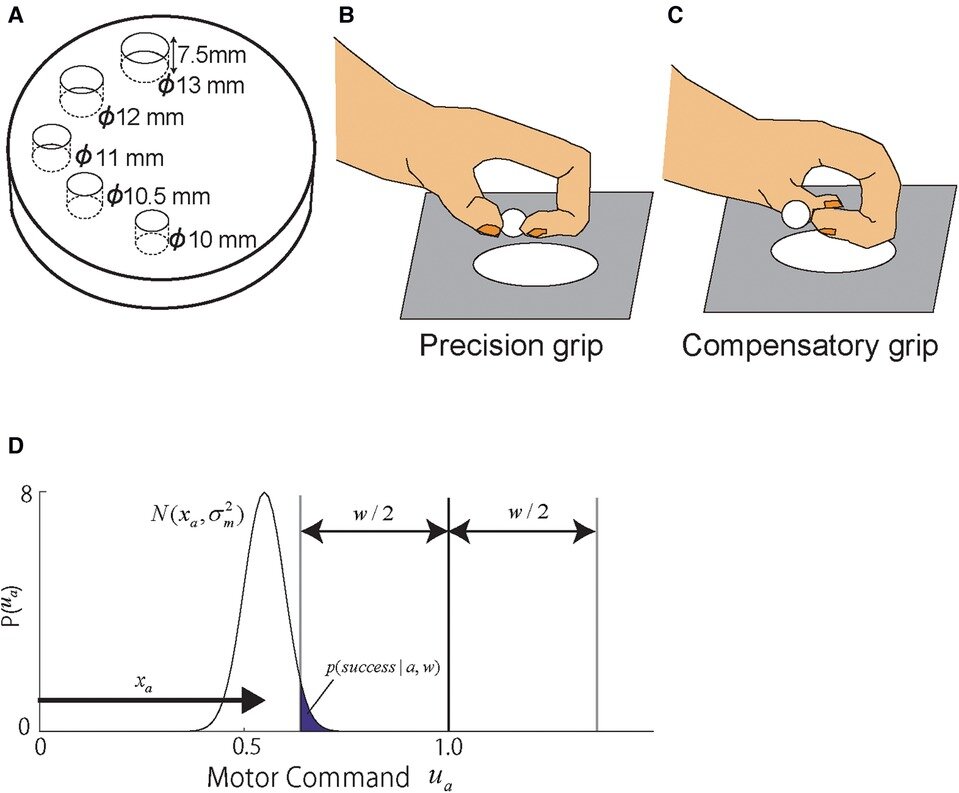
Overview of the task. (A–C) Schematic drawings of the Klüver board (A) and monkey hand postures during grasping (B,C). (A) The Klüver board containing cylindrical wells of five different diameters was used in both training and test sessions. (B,C) The monkeys used two different grip strategies, precision (B) and compensatory grips (C), during recovery from motor cortex damage. Reproduced from Figures 1, 8 of Murata et al., 2008. (D) Motor command space and reward function defined for the modeling. Credit: Frontiers in Rehabilitation Sciences (2022). DOI: 10.3389/fresc.2022.1042912

When learning to manipulate objects again after a stroke, a different grip strategy may be used as a stop gap, to compensate for any difficulties experienced during the healing period. When an area of the brain loses its supply of blood during a stroke, it is severely damaged,(Wrong, it is dead.) which affects specific functions controlled by that region.

The is the area of the brain that communicates with muscles to produce movement—damage to this area can result in the loss of fine motor skills like grasping or picking up a small object. Regaining lost function is not simply a matter of practice but often requires time for damaged brain tissue to heal.

In a study published recently in Frontiers in Rehabilitation Sciences, researchers from the University of Tsukuba modeled how are regained after a stroke to better understand how the typical recovery profile reflects interactions between these factors.

"We used equations to model how skills are relearned and retained after a stroke. The equations treat skills almost as if they were resources being stockpiled, but with , like a bucket with a slow leak," explains senior author, Professor Jun Izawa. "There is typically a point where performance suffers—almost as if the person's injury has regressed."

What causes a slowdown in the recovery process? There is a transition from compensatory skill to precision skill. Like in learning a new motor skill—for example, first learning to write letters—when relearning a skill after a stroke, the process is made up of a spontaneous part (in this case healing, rather than simply gaining the capacity with age and development) and a training-induced part (practice).

"Although the model was based on data from macaques, a similar recovery process occurs in people who experience a stroke," says Professor Jun Izawa.

An understanding of the recovery profile after gives both doctors and patients a map of the road to recovery and may one day lead to improved that shorten the journey by starting rehabilitation and learning at the right time.

More information: Jun Izawa et al, Accounting for the valley of recovery during post-stroke rehabilitation training via a model-based analysis of macaque manual dexterity, Frontiers in Rehabilitation Sciences (2022). DOI: 10.3389/fresc.2022.1042912


Friday, October 23, 2020

Mailbox assembly failure

 Nigh impossible to hold brackets together, insert bolt AND turn the nut on with just one hand. Occupational therapists should have a protocol for bringing back fine motor control.  NOT compensation!


Thursday, December 7, 2017

Postural Control and Fine Motor Skills in People With Stroke

So fucking what; guidelines and care NOT protocols.
https://clinicaltrials.gov/ct2/show/NCT03364374?term=Postural+Control&cond=stroke&draw=1&rank=2


Primary Outcome Measures:
Secondary Outcome Measures:
Current stroke rehabilitation practice guidelines support an interprofessional approach which integrates discipline-specific goals into a comprehensive plan of care. However, there has been a failure to implement interprofessional guidelines into today’s stroke rehabilitation clinical practice. Instead it is common that one discipline focuses on recovery of posture, while another discipline focuses on recovery of fine motor skills. The investigators argue that control of the hand is not independent from postural control. In fact, treating them separately ignores the kinematic and muscular linkages connecting the trunk to the hand via the scapula and proximal arm. It also ignores evidence that postural and hand muscles have overlapping cortical representations thus likely have similar neural control networks. Hence, the overall goal of this project is to demonstrate the relationship of posture and fine motor skills to advance stroke rehabilitation.
The study will include two groups, stroke survivors and neurologically healthy controls, and both will perform a tracing task while seated on a backless bench. The task will be performed twice, at baseline and after giving participants cues to improve their posture. Both task repetitions will be performed in a single session on the same day. Kinetic and kinematic data will be collected to evaluate posture, postural stability and fine motor performance. Data collected at baseline will be used to examine the relationship between postural impairments and fine motor deficits. Additionally, we will evaluate the effects of postural cues on body segment alignment, stability and fine motor performance.

Thursday, July 20, 2017

Fine motor skills are often impacted by stroke. Try these exercises to help improve strength and dexterity.

They assume high functionality already if you can even attempt these.  I'm sure these were done by normal people, not stroke survivors. With 30% of survivors having spastiscity none of those could keep fingers straight as shown in the pictures. Good conscience laundering to make the American Stroke Association feel like they are doing something. What a crock.
https://twitter.com/American_Stroke/status/887449662495625218/photo/1

Tuesday, April 12, 2016

Feasibility and efficacy of a robotic device for hand rehabilitation in hemiplegic stroke patients: A randomized pilot controlled study

Is this enough to scream it out to all stroke hospitals worldwide? Or will this once again fall thru the cracks? Because we have NO stroke leadership pushing such knowledge out to stroke medical professionals?
http://cre.sagepub.com/content/early/2016/04/06/0269215516642606.abstract
  1. Fabio Vanoglio1
  2. Palmira Bernocchi2
  3. Chiara Mulè3
  4. Francesca Garofali1
  5. Chiara Mora1
  6. Giovanni Taveggia3
  7. Simonetta Scalvini2
  8. Alberto Luisa1
  1. 1Neurological Rehabilitation Unit, Fondazione Salvatore Maugeri, IRCCS, Institute of Lumezzane, Brescia, Italy
  2. 2Care Continuity Unit, Fondazione Salvatore Maugeri, IRCCS, Institute of Lumezzane, Brescia, Italy
  3. 3Habilita Hospital, Sarnico, Bergamo, Italy
  1. Palmira Bernocchi, Unit of Care Continuity, Fondazione Salvatore Maugeri, IRCCS, Via Giuseppe Mazzini 129 – 25066 Lumezzane, Brescia, Italy. Email: palmira.bernocchi@fsm.it

Abstract

Objective: The purpose of the study was to evaluate the feasibility and efficacy of robot-assisted hand rehabilitation in improving arm function abilities in sub-acute hemiplegic patients.
Design: Randomized controlled pilot study.
Setting: Inpatient rehabilitation centers.
Participants: Thirty hemiplegic stroke patients (Ashworth spasticity index <3) were recruited and randomly divided into a Treatment group (TG) and Control group (CG).
Interventions: Patients in the TG received intensive hand training with Gloreha, a hand rehabilitation glove that provides computer-controlled, repetitive, passive mobilization of the fingers, with multisensory feedback. Patients in the CG received the same amount of time in terms of conventional hand rehabilitation.
Main outcome measures: Hand motor function (Motricity Index, MI), fine manual dexterity (Nine Hole Peg Test, NHPT) and strength (Grip and Pinch test) were measured at baseline and after rehabilitation, and the differences, (Δ) mean(standard deviation), compared between groups.
Results Twenty-seven patients concluded the program: 14 in the TG and 13 in the CG. None of the patients refused the device and only one adverse event of rheumatoid arthritis reactivation was reported. Baseline data did not differ significantly between the two groups. In TG, ΔMI 23(16.4), ΔNHPT 0.16(0.16), ΔGRIP 0.27(0.23) and ΔPINCH 0.07(0.07) were significantly greater than in CG, ΔMI 5.2(9.2), ΔNHPT 0.02(0.07), ΔGRIP 0.03(0.06) and ΔPINCH 0.02(0.03)] (p=0.002, p=0.009, p=0.003 and p=0.038, respectively).
Conclusions: Gloreha Professional is feasible and effective in recovering fine manual dexterity and strength and reducing arm disability in sub-acute hemiplegic patients

Sunday, April 10, 2016

Human-centred research for fine motor control rehabilitation after stroke in the Netherlands

It is only a 91 page thesis that your doctor can use to update your hand protocols.
http://www.theseus.fi/bitstream/handle/10024/106049/Kivihalme_Krista.pdf?sequence=1
Abstract
Stroke disables people globally every day. The rehabilitation process focuses mainly on the big muscle groups and re-learning walking. This is why the upper extremity and fine motor control rehabilitation after a stroke is usually left without significant focus. The dexterity rehabilitation after a stroke is lacking an unambiguous method and the guidelines for stroke rehabilitation present multiple recommendations.
SilverFit is a Dutch wellness technology company, whose focus is to motivate people in
rehabilitation and maintain their activity by gamification. The thesis was a part of an international product development project for finding a solution for fine motor control rehabilitation after a stroke. Thesis work focused on an iterative project trying to solve the most effective way for rehabiliating fine motor control after a stroke based on the most recent evidence-based studies and understanding the requirements and problems of the users.
The human-centred research was conducted using a Design Thinking -process with methods of online ethnography, interviews and observation.
The results from the evidence-based research and the human-centred research were com-
pared through a theme analysis. The thesis showed that the most problematic thing in fine motor control rehabiliation after a stroke is the lack of knowledge, motivation and time, which together cause feelings of insecurity in the therapists and the stroke survivors.
The recommendation for solving the current situation is to create a technological solution, which is always accessible for the stroke survivor, supports the decisions of the therapists based on the most recent evidence-based studies, gives supportive feedback during the therapy and provides realistic results about the progress of the rehabilitation. The thesis provides the first stage of an iterative product development process.
Keywords/tags (
subjects
)
Stroke, cva, rehabilitation, fine motor control, user centred research, human-centred re-
search, occupational therapy, wellness technology, online ethnography, design thinking