Oh God, what a fucking waste. You didn't even talk to any of the 10 million yearly survivors, Did you? The four points listed are not what survivors want. Survivors want 100% recovery and these problems in stroke needing to be solved.
Following the launch of its European Stroke Action Plan 2018-2030,
the European Stroke Organisation discusses with Health Europa the world
of stroke care.
Recently, the European Stroke Organisation (ESO) released a major
policy document – the European Stroke Action Plan (ESAP) for the years
2018 to 2030.
1 The action plan will serve as an important
source of reference on actions needed to increase efforts to prevent
stroke and to improve stroke services. The document was prepared in
co-operation with the Stroke Alliance for Europe (SAFE), the alliance of
patient organisations.
The European Stroke Action Plan was prompted by accumulating insights
on the need to substantially change the attention given to stroke in a
policy and priority perspective so that efforts, actions and investments
should be proportional to the effects of stroke on public health.
Stroke is the second most common cause of death in Europe. Every year,
up to 1.3 million people in Europe suffer a first-ever stroke.
Consequently, the socioeconomic impact of stroke is considerable,
with an annual cost in Europe of up to €45bn. Projections predict that
the overall stroke burden in Europe will have further increased another
35% by the year 2050 due to, for the most part, ageing of the
population. Based on recently published studies, the age-standardised
incidence of stroke in Europe at the beginning of the 21st Century
ranged from 95 to 290/100,000 per year.
Specifically, while an overall decline in stroke incidence was noted
in the last two decades, several Central and Eastern European countries
are still experiencing increasing rates in stroke incidence and
stroke-related mortality. However, there is growing evidence that acute
strokes will be both more preventable and treatable in the near future.
In only a few decades, scientific advances such as stroke unit care,
thrombolytic therapy and thrombectomy have dramatically changed the
possibilities to treat acute stroke and improve the prognosis.
There are considerable variations in the quality of care for stroke
patients in Europe, both between and within countries. ESO, the European
Society of Minimally Invasive Neurological Therapy (ESMINT), the
European Academy of Neurology (EAN) and the patient organisation SAFE
performed a survey of scientific societies and stroke experts,
2
in which the best available information on access to and delivery rates
of these treatments was collected from 44 out of 51 European countries.
The estimated mean number of stroke units was 2.9 per million
inhabitants (95% CI 2.3–3.6) and 1.5 per 1,000 annual incident strokes
(95% CI 1.1-1.9), respectively. Intravenous thrombolysis was provided in
42 of 44 countries. The average treatment rate was 7.3% of incident
ischaemic stroke patients for intravenous thrombolysis (95% CI 5.4–9.1),
and 1.9% for endovascular treatment (95% CI 1.3–2.5). However,
countries with the highest rates reached proportions of treated patients
of 20% and 6%, respectively. Despite scientific evidence and clinical
guideline recommendations, this data shows that too many patients are
not treated in stroke units and centres that can offer the best
evidence-based treatment in the acute phase.
The European Stroke Action Plan builds on two previous pan-European
consensus meetings, the 1995 and 2006 Helsingborg meetings, which were
convened to review the scientific evidence and the state of current
services, and to set targets for the development of stroke care for the
decade to follow.
The ESAP adheres to the format of the Helsingborg Declarations,
presenting a review of the ‘state of the art’, the state of current
services, research and development priorities, and targets for the main
domains in stroke care (Primary Prevention, Organisation of Stroke
Services, Management of Acute Stroke, Prevention, Rehabilitation,
Evaluation of Stroke Outcome and Quality Assessment, and Life After
Stroke).
For each domain of the European Stroke Action Plan 2018 to 2030,
specific targets were set. Beyond these targets, four over-arching
targets for 2030 were identified:
- To reduce the absolute number of strokes in Europe by 10%
- To treat 90% or more of all patients with stroke in Europe in a dedicated stroke unit as the first level of care (Care, NOT results)
- To have national plans for stroke encompassing the entire chain of care from primary prevention to life after stroke
- To fully implement national strategies for multisector public health
interventions to promote and facilitate a healthy lifestyle, and reduce
environmental (including air pollution), socioeconomic and educational
factors that increase the risk of stroke.
Speaking to Health Europa, ESO’s Bart van der Worp, Valeria Caso, and
Bo Norrving discuss the European Stroke Action Plan in more detail and
consider what can be done to improve stroke treatment and care in
Europe.
Stroke remains one of the leading causes of death and disability in
Europe despite being preventable – do you think this is indicative of a
lack of commitment to address the disease on the part of policymakers
and health authorities?
The prevention of stroke(Fuck, stop talking about prevention. Is curing stroke too hard? You aren't a leader and aren't willing to tackle any of the
BHAGs(Big Hairy Audacious Goals) of 100% recovery for all survivors? Then step aside and let survivors lead.)
is a commitment shared between governmental
bodies/ministries of health, healthcare planners and administrators, and
healthcare professionals. The activities of all of these actors have
for a long time been insufficient, and changes have been slow, as shown
by the follow-up of the WHO Global Action Plan on non-communicable
diseases. Governmental actions are important as they can lead to
population changes in lifestyle factors like physical activity, smoking,
alcohol use, and diet.
But the lesson learnt is that implementing health-promoting changes
is difficult and may be counteracted by economic interests from industry
and a political inertia to taxations and legislations that may meet
resistance from voters. Nevertheless, case studies have shown that
governmental actions are indeed possible and can lead to substantially
reduced risk of stroke.
What main actions will be needed to successfully reduce the absolute
number of strokes in Europe by 10%, and do you believe this is a
realistic target?
The actions needed are set out in the European Stroke Action Plan,
and include primary preventive actions on lifestyle risk factors on a
population level and blood pressure control, as well as secondary
preventive therapies like antiplatelet therapy, other antithrombotics,
carotid surgery, lipid-lowering treatment, and blood pressure control.
An important component in reducing the risk of stroke is treating
patients with atrial fibrillation with anticoagulants, both before a
first stroke occurs and after an ischaemic stroke.
The absolute number of strokes is influenced by three main factors:
population growth, population ageing, and the risk of having a stroke.
Recent data have shown that the effects on population growth and ageing
can indeed be counterbalanced by a reduction in the risk of stroke (by
better primary and secondary prevention), resulting in a decrease in the
absolute number of strokes.
For example, in Sweden, the absolute number of ischaemic strokes
decreased by 17% from 2010 to 2017, providing a proof-of-principle that
it is possible to make changes of the magnitude targeted in the action
plan. Reducing the absolute number of strokes will be needed to prevent
the capacity of the health systems from ‘flooding’.
What can be done to widen access to and reduce variations in quality stroke care?
A first step is to have reliable information on the quality of stroke
care. In some European countries, national quality registers for stroke
are in place, and similar registers need to be established in all the
European countries. You cannot follow a development, the progress of
implementation, and changes in inequalities without robust data.
ESO started a quality improvement programme
3 which is composed of the following pillars in order to reduce inequalities in European stroke care:
- ESO-EAST (Enhancing and Accelerating Stroke Treatment),4
which is the first comprehensive programme for improving stroke care in
Eastern Europe through the participation of stroke professionals,
professional organisations and local authorities in these countries.
ESO-EAST is planned to run at a minimum for the period 2015-2019
- Endorsement of the Angels Initiative in 2016 which has the declared
mission of increasing the number of patients treated in stroke-ready
hospitals and to optimise the quality of treatment in all existing
stroke centres
- Stroke Unit and Stroke Centre Certification based on standardised
application forms and guidelines for national and international
auditors. Key features of this certification are the availability of
trained personnel, diagnostic equipment, acute treatment and
collaboration with other stroke caregivers.
How did you arrive at the research priorities outlined in the Action Plan for Stroke in Europe 2018-2030?
This was a sequential process. For each domain, two persons had a
main task to draft potential research areas. These were then further
developed within each domain, and later on co-ordinated and aligned
across all the different domains.
The entire process was transparent, open to public comments and
input, and free from involvement of the industry. A separate working
group identified research priorities for translational stroke research.
What are the next steps with the European Stroke Action Plan?
After the preparation and release of the ESAP in 2018, the
implementation phase has now started and is currently being set up by
ESO. In the pipeline are promotion of quality registers, monitoring of
progress, establishing networks of national societies, and much advocacy
work.
The ESO is confident that the ESAP will have a major influence as it
builds on two important established facts: stroke is highly preventable
and stroke is highly treatable.


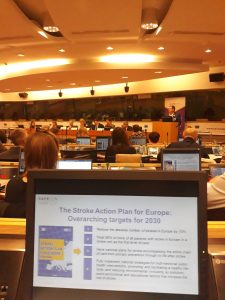 In
2018, SAFE and ESO released the “Stoke Action Plan for Europe
2018-2030”, which proposes a holistic approach to stroke management,
from prevention to acute care, rehabilitation and life after stroke. The
report sets out minimum targets to be reached by every European
country, to equilibrate the quality of care across Europe.