If your doctors and stroke hospital can't immediately see the uses for this in stroke rehab you need better doctors and hospital.
Smart technology keeps getting smaller. There are smartphones,
smartwatches and now, smart rings, devices that allow someone to use
simple finger gestures to control other technology.
Researchers at the University of Washington have created
AuraRing,
a ring and wristband combination that can detect the precise location
of someone’s index finger and continuously track hand movements. The
ring emits a signal that can be picked up on the wristband, which can
then identify the position and orientation of the ring — and the finger
it’s attached to. The research team
published these results Dec. 11 in Proceedings of the ACM on Interactive, Mobile, Wearable and Ubiquitous Technologies.
“We’re thinking about the next generation of computing platforms,” said co-lead author
Eric Whitmire,
who completed this research as a doctoral student at the Paul G. Allen
School of Computer Science & Engineering. “We wanted a tool that
captures the fine-grain manipulation we do with our fingers — not just a
gesture or where your finger’s pointed, but something that can track
your finger completely.”
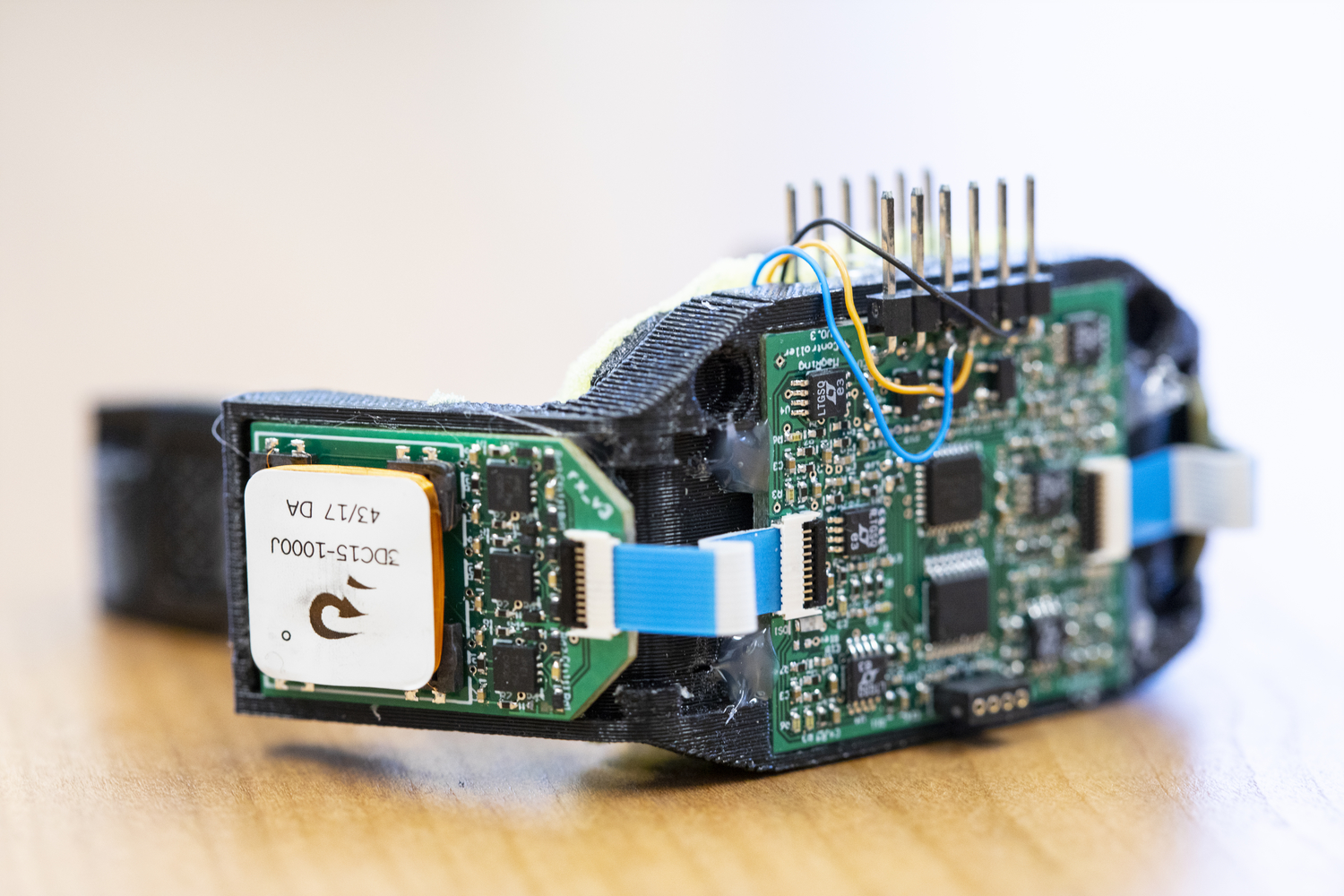
AuraRing is composed of a coil of wire wrapped 800 times around a
3D-printed ring. A current running through the wire generates a magnetic
field, which is picked up by three sensors on the wristband. Based on
what values the sensors detect, the researchers can continuously
identify the exact position of the ring in space. From there, they can
determine where the user’s finger is located.
The
ring in AuraRing (left) is composed of a coil of wire wrapped 800 times
around a 3D printed ring. The AuraRing wristband (right) uses three
sensors (one shown here: white box in the lower left) to pick up the
magnetic field generated by the ring. Credit: Dennis Wise/University of Washington
“To have continuous tracking in other smart rings you’d have to
stream all the data using wireless communication. That part consumes a
lot of power, which is why a lot of smart rings only detect gestures and
send those specific commands,” said co-lead author
Farshid Salemi Parizi,
a doctoral student in electrical and computer engineering. “But
AuraRing’s ring consumes only 2.3 milliwatts of power, which produces an
oscillating magnetic field that the wristband can constantly sense. In
this way, there’s no need for any communication from the ring to the
wristband.”
With continuous tracking, AuraRing can pick up handwriting —
potentially for short responses to text messages — or allow someone to
have a virtual reality avatar hand that mimics what they’re doing with
their actual hand. In addition, because AuraRing uses magnetic fields,
it can still track hands even when they are out of sight, such as when a
user is on a crowded bus and can’t reach their phone.

AuraRing can allow someone to have a virtual reality avatar hand that mimics what they’re doing with their actual hand.Dennis Wise/University of Washington
“We can also easily detect taps, flicks or even a small pinch versus a
big pinch,” Salemi Parizi said. “This gives you added interaction
space. For example, if you write ‘hello,’ you could use a flick or a
pinch to send that data. Or on a Mario-like game, a pinch could make the
character jump, but a flick could make them super jump.”
The researchers designed AuraRing to be ready to use as soon as it
comes out of the box and not be dependent on a specific user. They
tested the system on 12 participants with different hand sizes. The team
compared the actual location of a participant’s finger to where
AuraRing said it was. Most of the time, the system’s tracked location
agreed with the actual location within a few millimeters.
This ring and wristband combination could be useful for more than games and smartphones, the team said.
The team has a
related project called Aura, a small controller for mobile VR devices that has the location-tracking accuracy of desktop VR devices.
“Because AuraRing continuously monitors hand movements and not just
gestures, it provides a rich set of inputs that multiple industries
could take advantage of,” said senior author
Shwetak Patel,
a professor in both the Allen School and the electrical and computer
engineering department. “For example, AuraRing could detect the onset of
Parkinson’s disease by tracking subtle hand tremors or help with stroke
rehabilitation by providing feedback on hand movement exercises.”
The technology behind AuraRing is something that could be easily
added to smartwatches and other wristband devices, according to the
team.
“It’s all about super powers,” Salemi Parizi said. “You would still
have all the capabilities that today’s smartwatches have to offer, but
when you want the additional benefits, you just put on your ring.”
This research was funded by UW Reality Lab, Facebook, Google and Futurewei.
For more information, contact Salemi Parizi at
farshid@cs.washington.edu, Whitmire at
emwhit@cs.washington.edu and Patel at
shwetak@cs.washington.edu.