In clinical settings, precise movement assessment facilitates the early diagnosis, treatment planning, and monitoring of neuromuscular impairments. Consequently, movement analysis has become increasingly crucial, particularly in rehabilitation medicine, as it provides a comprehensive understanding of motor function, optimizes performance, and informs individualized rehabilitation strategies1. Over the past few decades, the development of movement analysis has accelerated, particularly with the advent of muscle synergy analysis (MSA), which employs unsupervised machine learning (ML) techniques to elucidate the neurophysiological control of movement2. A key principle of MSA is to uncover the spatial and temporal coordination of the activation of multiple muscles to produce efficient movement, rather than controlling each muscle independently3. Currently, in the fields of neurological4 and musculoskeletal5 diseases, MSA has provided valuable insights into motor control mechanisms by factorizing coordinated activation into spatial and temporal features.
Among various neuromuscular impairments, stroke has been the most frequently investigated using MSA to identify its gait features, due to its high incidence rate6. Notably, stroke is the second leading cause of death worldwide7 and causes persistent post-survival motor impairments that significantly affect the quality of life8. Many studies have elucidated specific patterns of gait dysfunction in stroke patients, such as the phenomenon of synergy merging, in which multiple muscle synergies combine into a single, less efficient, and specific synergy during gait9,10. Recovery from these pathological gait patterns is therefore considered a critical target in stroke rehabilitation to restore more normalized gait.
Several prior studies have applied muscle synergy features, particularly temporal coefficients, in combination with tree-based ML models to assess motor impairment and predict rehabilitation outcomes in stroke patients. For example, Yang et al. demonstrated the utility of temporal muscle synergy features by applying random forest classifiers to characterize impairment severity during sit-to-stand tasks11 and to estimate the effects of short-term rehabilitation12. An et al. further extended this approach to kinetic assessments using handrail force data in severely affected patients13. While these studies focused on temporal features to assess functional states, our study integrates both gait-specific temporal and spatial features, placing particular emphasis on model-level interpretability for pre-rehabilitation decision-making.
By utilizing MSA along with knowledge to understand factorized features, clinicians and practitioners can develop targeted rehabilitation protocols, optimize training strategies, and refine therapeutic interventions to improve gait performance in stroke patients. However, its clinical adoption remains limited due to ambiguities in interpreting and prioritizing synergy features, which often requires substantial practitioner expertise and introduces variability in application14,15,16. Therefore, in this study, we propose that an ensemble ML framework that highlights clinically relevant synergies may facilitate effective translation into practice. To the best of our knowledge, despite the introduction of various ML models and advancements in computer-aided diagnostic systems designed to reduce subjectivity and improve the consistency in assessments using electromyography (EMG)17,18, the application of MSA for therapeutic decision-making within an ML framework remains extremely rare. In particular, our approach introduces a bidirectional decomposition strategy anchored to normative synergy templates and incorporates SHAP (SHapley Additive exPlanations)-based individualization to enhance interpretability and clinical relevance.
In addition to their use in clinical diagnostics, EMG signals have been widely applied in robotics to train ML algorithms for controlling prosthetic arms and legs. This process typically involves a series of preprocessing steps such as signal filtering, normalization, and feature extraction in both the time and frequency domains. Among these steps, segmentation window size is critical, as it influences both temporal resolution and feature reliability. Shorter windows enhance temporal precision but increase variability, while longer windows stabilize signals but may miss transient events19. Commonly extracted features include root mean square, mean absolute value, median frequency, and wavelet coefficients. These features are then used as inputs for various ML models, including support vector machines, random forests, and deep learning architectures, to predict motor intentions and classify movement patterns. However, these studies have primarily focused on improving the model performance, often overlooking the interpretability of the contributing features or the physiological relevance of the learned representations20,21.
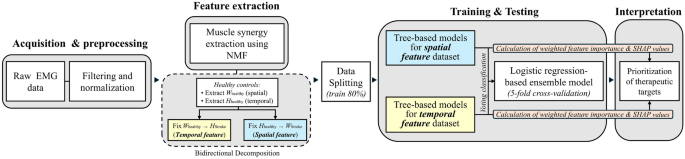
To address these limitations, this study proposed a framework aimed at enhancing the clinical interpretability of EMG data by extracting physiologically meaningful features using MSA. These features were subsequently used to train an ensemble ML model. Feature importance metrics and SHAP analysis were applied to identify synergy components that most influenced the model’s output, enabling individualized prioritization of muscle synergies, which refers to selecting the most relevant features for each patient based on SHAP-derived importance values. Furthermore, a voting-based classification approach was adopted by integrating four distinct tree-based ML models to ensure performance robustness across varying data characteristics. To support reliable interpretation, model-specific weights were assigned based on each model’s predictive performance when aggregating SHAP values and feature importance.
Notably, the spatial and temporal features derived from MSA exhibit distinct structural and statistical characteristics. Separate voting classification models were developed for each feature type and subsequently integrated into a unified ensemble model (Fig. 1). This approach provides a unified framework for decision making by consolidating predictions from both feature sets into a single model.
Accordingly, the proposed framework may offer several stage-specific advantages along the analytical pipeline. First, the use of non-negative matrix factorization (NMF) to extract muscle co-activation patterns (spatial features) and activation timings (temporal features) allows clinicians to identify which muscle groups and gait phases may be most influential in each patient. Second, these quantified features can be translated into a preliminary prioritization scheme, guiding therapists toward muscle synergies that the model indicates as clinically significant. Third, because the framework summarizes its outputs using familiar visualization tools such as feature importance scores and SHAP plots, it supports clinical interpretation without requiring expertise in ML, potentially improving usability in practice.