Use the labels in the right column to find what you want. Or you can go thru them one by one, there are only 34,358 posts. Searching is done in the search box in upper left corner. I blog on anything to do with stroke. DO NOT DO ANYTHING SUGGESTED HERE AS I AM NOT MEDICALLY TRAINED, YOUR DOCTOR IS, LISTEN TO THEM. BUT I BET THEY DON'T KNOW HOW TO GET YOU 100% RECOVERED. I DON'T EITHER BUT HAVE PLENTY OF QUESTIONS FOR YOUR DOCTOR TO ANSWER.
What this blog is for:
My blog is not to help survivors recover, it is to have the 10 million yearly stroke survivors light fires underneath their doctors, stroke hospitals and stroke researchers to get stroke solved. 100% recovery. The stroke medical world is completely failing at that goal, they don't even have it as a goal. Shortly after getting out of the hospital and getting NO information on the process or protocols of stroke rehabilitation and recovery I started searching on the internet and found that no other survivor received useful information. This is an attempt to cover all stroke rehabilitation information that should be readily available to survivors so they can talk with informed knowledge to their medical staff. It lays out what needs to be done to get stroke survivors closer to 100% recovery. It's quite disgusting that this information is not available from every stroke association and doctors group.
Sunday, August 2, 2026
Thursday, April 17, 2025
Outcome Prediction by Combining Initial Clinical Severity With Corticospinal Tract Lesion Load in Patients With Intracerebral Hemorrhage
Predicting failure to recover is TOTALLY FUCKING USELESS! You're fired!
Outcome Prediction by Combining Initial Clinical Severity With Corticospinal Tract Lesion Load in Patients With Intracerebral Hemorrhage
Published: April 17, 2025 DOI: 10.7759/cureus.82430 Peer-Reviewed Cite this article as: Yasukawa T, Uchiyama Y, Koyama T, et al. (April 17, 2025) Outcome Prediction by Combining Initial Clinical Severity With Corticospinal Tract Lesion Load in Patients With Intracerebral Hemorrhage. Cureus 17(4): e82430. doi:10.7759/cureus.82430Abstract
Conclusions:
The combination of initial clinical severity and CST-LL enhances the predictive accuracy of motor recovery in patients with intracerebral hemorrhage.
Introduction
Predicting patient outcomes is crucial(NO, it's not you blithering idiots! Try thinking like a patient for once in your life. They don't want to hear they aren't going to recover!) for planning effective rehabilitation strategies for individuals who have experienced a stroke [1]. Among the various factors influencing recovery, the severity of clinical symptoms in the early stages is particularly important, as it provides critical insights into stroke impact and guides therapeutic and rehabilitative interventions [2]. Therefore, assessing(Assessments do ABSOLUTELY NOTHING FOR RECOVERY! If you think so; GET THE HELL OUT OF STROKE!) clinical manifestations during the acute phase is essential for predicting outcomes and determining appropriate management strategies in stroke rehabilitation.
Beyond initial clinical seserity, the integrity of the corticospinal tract (CST) has been identified as a key factor in predicting functional outcomes, particularly motor recovery in the extremities [3,4]. Studies utilizing magnetic resonance imaging (MRI) have demonstrated that the overlap between the stroke lesion and the CST, known as CST lesion load (CST-LL), correlates with motor function outcomes [5,6]. In addition, computed tomography (CT), which is commonly used in stroke management, especially for hemorrhagic stroke, has been investigated as a potential tool for estimating CST-LL. Some reports suggest that CST-LL derived from CT imaging may aid in outcome prediction, particularly in cases involving putaminal or thalamic hemorrhage [7,8].
Various predictive models incorporating techniques such as machine learning and functional MRI have been developed to estimate stroke outcomes [9-11]. However, these methods often require significant computational resources and prolonged processing times, limiting their feasibility for routine clinical use. In contrast, integrating initial clinical severity assessment with CST-LL derived from standard CT scans offers a practical approach that can be readily implemented in daily clinical practice [8,12]. This study aims to evaluate the clinical utility of combining early clinical severity and CST-LL in predicting outcomes for patients with intracerebral hemorrhage.
Wednesday, July 17, 2024
Use of cortical hemodynamic responses in digital therapeutics for upper limb rehabilitation in patients with stroke
I see ABSOLUTELY NOTHING here that will get survivors recovered. Useless.
Use of cortical hemodynamic responses in digital therapeutics for upper limb rehabilitation in patients with stroke
Journal of NeuroEngineering and Rehabilitation volume 21, Article number: 115 (2024) Cite this article
-
175 Accesses
-
1 Altmetric
Abstract
Background
Stroke causes long-term disabilities, highlighting the need for innovative rehabilitation strategies for reducing residual impairments. This study explored the potential of functional near-infrared spectroscopy (fNIRS) for monitoring cortical activation during rehabilitation using digital therapeutics.
Methods
This cross-sectional study included 18 patients with chronic stroke, of whom 13 were men. The mean age of the patients was 67.0 ± 7.1 years. Motor function was evaluated through various tests, including the Fugl–Meyer assessment for upper extremity (FMA-UE), grip and pinch strength test, and box and block test. All the patients completed the digital rehabilitation program (MotoCog®, Cybermedic Co., Ltd., Republic of Korea) while being monitored using fNIRS (NIRScout®, NIRx Inc., Germany). Statistical parametric mapping (SPM) was employed to analyze the cortical activation patterns from the fNIRS data. Furthermore, the K-nearest neighbor (K-NN) algorithm was used to analyze task performance and fNIRS data to classify the severity of motor impairment.
Results
The participants showed diverse task performances in the digital rehabilitation program, demonstrating distinct patterns of cortical activation that correlated with different motor function levels. Significant activation was observed in the ipsilesional primary motor area (M1), primary somatosensory area (S1), and contralateral prefrontal cortex. The activation patterns varied according to the FMA-UE scores. Positive correlations were observed between the FMA-UE scores and SPM t-values in the ipsilesional M1, whereas negative correlations were observed in the ipsilesional S1, frontal lobe, and parietal lobe. The incorporation of cortical hemodynamic responses with task scores in a digital rehabilitation program substantially improves the accuracy of the K-NN algorithm in classifying upper limb functional levels in patients with stroke. The accuracy for tasks, such as the gas stove-operation task, increased from 44.4% using only task scores to 83.3% when these scores were combined with oxy-Hb t-values from the ipsilesional M1.
Conclusions
The results advocated the development of tailored digital rehabilitation strategies by combining the behavioral and cerebral hemodynamic data of patients with stroke. This approach aligns with the evolving paradigm of personalized rehabilitation in stroke recovery, highlighting the need for further extensive research to optimize rehabilitation outcomes.
Background
Stroke, which has become increasingly prevalent with the global aging population, poses a significant public health challenge, leading to long-term disabilities and substantial burden on healthcare systems [1]. This condition results from cerebral vascular events that cause brain damage, which manifests in various impairments ranging from motor and cognitive to emotional and linguistic difficulties, substantially affecting individuals’ quality of life [2]. Effective rehabilitation is essential for improving functional recovery, reducing disabilities, and enabling the reintegration of stroke survivors into daily life, thus alleviating the socioeconomic burdens on their families and healthcare systems [3].
To create more engaging and interactive rehabilitation experiences, recent advancements in digital technology have introduced innovative approaches to rehabilitation, employing wearable technology, gamification principles, and virtual reality (VR) systems [4, 5]. These digital rehabilitation programs leverage advanced sensors and data analytics for precise patient assessment and personalized treatment plans [6]. Furthermore, artificial intelligence algorithms process data obtained through digital platforms, optimizing therapeutic outcomes by tailoring rehabilitation programs to individual needs and enhancing treatment effectiveness and personalization [7, 8].
Understanding neuroplasticity, which refers to the brain’s ability to create new neural connections, is fundamental for the development of effective neurorehabilitation strategies [9, 10]. This concept underpins treatments aimed at leveraging neural plasticity for recovery, supported by functional brain imaging research that highlights the brain’s capacity for reorganization and adaptation following a stroke [10]. Despite the recognized benefits of digital technologies in rehabilitation, the detailed relationship between cortical activation and rehabilitation outcomes remains unclear. Notwithstanding its limitations, functional near-infrared spectroscopy (fNIRS) offers advantages such as low cost, portability, and resilience to motion artifacts, making it a promising tool for understanding and using brain activation and plasticity in digital rehabilitation [11, 12].
This preliminary study was conducted to investigate cortical activation during stroke rehabilitation, as indicated by cerebral hemodynamic signals measured through fNIRS during digital rehabilitation. The first objective was to determine the characteristics of brain activation captured by cerebral hemodynamic response signals during digital rehabilitation. The second objective was to determine whether machine learning algorithms can effectively classify brain signals and elucidate patients’ functional status. The third objective was to improve our understanding of the intricate relationship between neurophysiological changes and functional motor performance in digital rehabilitation.
More at link.
Saturday, June 29, 2024
Projections of Endovascular Therapy–Eligible Patients With Stroke for the US Population
This does ABSOLUTELY NOTHING to get survivors recovered! How do you plan to get to 100% recovery after this procedure? That's the research needed! Totally useless research, I'd have you all fired! Doesn't anyone in stroke actually think?
Projections of Endovascular Therapy–Eligible Patients With Stroke for the US Population
Abstract
BACKGROUND:
METHODS:
RESULTS:
CONCLUSIONS:
Graphical Abstract
Formats available
You can view the full content in the following formats:
Friday, May 10, 2024
Metabolic profile of motor cortex in stroke
I see ABSOLUTELY NOTHING here that will help get survivors recovered! You're fired! A lot of Ph.Ds that know nothing about stroke recovery! Book learning means nothing; talk to survivors sometime.
Metabolic profile of motor cortex in stroke
Abstract
Saturday, May 4, 2024
Modulation of the Association Between Corticospinal Tract Damage and Outcome After Stroke by White Matter Hyperintensities
I could see ABSOLUTELY NOTHING in here that will help survivors recover! Useless.
Modulation of the Association Between Corticospinal Tract Damage and Outcome After Stroke by White Matter Hyperintensities
Abstract
Background and Objectives
Methods
Results
Discussion
Introduction
Saturday, March 23, 2024
DETERMINANTS OF ACCESS TO REHABILITATION PROFESSIONALS BY POST-STROKE INDIVIDUALS IN THE FIRST SIX MONTHS AFTER HOSPITAL DISCHARGE
'Access' means absolutely nothing, survivors want recovery! Are you that blitheringly stupid?
DETERMINANTS OF ACCESS TO REHABILITATION PROFESSIONALS BY POST-STROKE INDIVIDUALS IN THE FIRST SIX MONTHS AFTER HOSPITAL DISCHARGE
Background
Currently, the best strategy to deal with disabilities after stroke is rehabilitation. National and international clinical guidelines recommend that all post-stroke individuals have access to rehabilitation professionals within 72 hours after hospital discharge. In addition, access should be continued until the individual's functional goals are achieved. However, the determinants of access to rehabilitation professionals by post-stroke individuals in middle-income countries, where the burden of this disease is high, are little known.
Objectives
To identify the determinants of access to rehabilitation professionals by post-stroke individuals one, three and six months after hospital discharge in Brazil and to compare the access obtained in each period with that referred by the multidisciplinary team at the time of hospital discharge.
Methods
A longitudinal, prospective, and exploratory study, carried out in Belo Horizonte, Minas Gerais, Brazil. Individuals after primary stroke, without previous disabilities were included. During hospital discharge, the number of rehabilitation professionals referred by the multidisciplinary team was recorded. One, three and six months after hospital discharge, individuals were contacted by telephone to identify the rehabilitation professionals accessed. Possible determinants of access were classified according to Andersen's behavioral model for using health services and included: a) predisposing factors: age, sex, education, and belief that it could improve with treatment; b) need factors: stroke severity and level of disability; c) facilitating factors: socioeconomic status, disposable income for health care and quality of care provided by rehabilitation professionals. Multiple linear regression model and Wilcoxon test were used (α=5%).
Results
201 individuals were included. Higher level of disability and stroke severity explained 31%, 34% and 39% of access to rehabilitation professionals one, three and six months after hospital discharge (p<0.01) respectively. Three months after discharge, having less education added 4% of explanation to the variation in access (p<0.01). In all evaluated periods, the number of professionals accessed was significantly lower than recommended at discharge (p<0.01).
Conclusion
In general, individuals with a more severe stroke and a higher level of disability were those who had greater access to rehabilitation professionals one, three and six months after hospital discharge. In addition, the comprehensiveness care for post-stroke individuals were compromised was compromised in all periods evaluated, indicating that current legislation in Brazil on post-stroke individuals care was partially complied.
Implications
Access to rehabilitation professionals has been directed equitably and in insufficient quantity to post-stroke individuals. Therefore, health management services must direct human and financial resources to expand immediate and comprehensive access to rehabilitation professionals for all post-stroke individuals after hospital discharge. These resources can improve the resolution of the transfer from hospital care to community care, as recommended.
Wednesday, March 20, 2024
Direction-specific Disruption of Paretic Arm Movement in Post-stroke Patients
Absolutely NOTHING here will help get survivors recovered! Useless. I'd have you all fired including the mentors and senior researchers! A fucking lot of dead wood needs to be removed from stroke and I'm willing to clean house!
Direction-specific Disruption of Paretic Arm Movement in Post-stroke Patients
Friday, December 29, 2023
Reflecting on a year of the ESO Young Stroke Physicians and Researchers Committee: A look back at 2023 and beyond
I see ABSOLUTELY NOTHING here that even remotely suggests anyone is working on 100% recovery. This is why we need survivors in charge, existing stroke medical 'professionals' are incompetent!
Reflecting on a year of the ESO Young Stroke Physicians and Researchers Committee: A look back at 2023 and beyond
Twitter:
2023 was a year full of great events, collaborative efforts and significant new research findings in the field of stroke. The ESO YSPR committee has been actively involved in these activities on numerous occasions.
In May, at ESOC 2023 in Munich, Germany offered insights into the latest developments in stroke research and clinical practice including late-breaking presentations of important large clinical trials. Following the success of previous editions, the YSRP Research Design Workshop provided a platform for young researchers to present their projects and receive valuable feedback from experts. We are looking forward to the ESOC 2024 in Basel, Switzerland – you can still submit you application for the YSPR Research Design Workshop at ESOC 2024 here.
Another highlight was the 10th Edinburgh Stroke Research Workshop, which offered aspiring stroke researchers the opportunity to connect with other researchers and develop new research questions. The 10th ESO/ESMINT/ESNR Stroke Winter School in Bern, Switzerland, welcomed 64 participants from 18 countries for this interdisciplinary teaching course. Besides, the 26th ESO Stroke Summer School took place in September in L’Aquila, Italy, where young physicians were provided with expert knowledge in cerebrovascular diseases. Would like to join one of next year’s courses? Then look out for the announcement of the 2024 workshops and do not miss the opportunity to apply.
In collaboration with the European Stroke Journal (ESJ), we continued our European Stroke Journal Young Reviewer Programme. Our selected candidates worked together with their dedicated mentors on peer-reviews. Besides, the YSRP committee is now also involved in the editing of the ESJ’s graphical abstracts, and we look forward to continuing this in the coming year.
The Department to Department Programme continued its mission to facilitate the exchange of physicians between specialized stroke departments. The experiences shared in our ESO blog give an insight into the participants’ experiences and leave no doubt that this programme represents a great opportunity to get to know other systems of stroke care, meet interesting people, and maybe make friends for life. The application is now open for the D2D visits in 2024.
For the ESO blog we will continue to share the latest advantages in stroke research in the coming year, highlight new ESJ papers and report on the activities of the YSRP and the ESOC.
At the end of the year, we would like to thank all ESO members who contributed to the success of the initiatives and events in 2023. Looking ahead, we wish everybody a fantastic new year full of collaboration, innovation, and positive impact on the stroke community.
Happy new year and see you in 2024!
—
ESOC is Europe’s leading forum for advances in research and clinical care of patients with cerebrovascular diseases. ESOC 2024 will live up to its expectation, and present to you a packed, high quality scientific programme including major clinical trials, state-of-the-art seminars, educational workshops, scientific communications of the latest research, and debates about current controversies. Learn more.
Thursday, November 30, 2023
Test-retest reliability and responsiveness of the computerized adaptive test of social functioning in persons with stroke
This does ABSOLUTELY NOTHING to get survivors recovered. Deliver social functioning for survivors by getting them 100% recovered. Will you work on proper stroke research for once?
Test-retest reliability and responsiveness of the computerized adaptive test of social functioning in persons with stroke
NARIC Accession Number: J92762. What's this?
Author(s): Chiang, Hsin-yu, Chen, Po-Ting, Lee, Shih-Chieh, Shieh, Yun-Jer, Hsueh, I-Ping, Hsieh, Ching-Lin.
Publication Year: 2023.
Abstract: Study examined the test-retest reliability, minimal detectable change (MDC), responsiveness, and efficiency of the Computerized Adaptive Test of Social Functioning (Social-CAT) in patients with stroke. Participants were 31 patients with chronic stroke and 65 patients with subacute stroke. The National Institutes of Health Stroke Scale (NIHSS) was used to monitor the patients’ stroke severity. For the test-retest reliability study, the patients completed the Social-CAT twice on tablet computers by themselves, and the NIHSS was administered twice by the occupational therapist, both at 4-week intervals to minimize the effect of possible confounding variables such as memory effects. For the responsiveness study, the patients completed the Social-CAT, and the NIHSS was administered twice at 2 time points while they received inpatient rehabilitation: within 7 days of admission to and 7 days before discharge from rehabilitation wards. The Social-CAT showed acceptable test-retest reliability (intraclass correlation coefficient = 0.80) and small random measurement error (minimal detectable change percentage [MDC%] = 18.0 percent). However, heteroscedasticity was found (r between the means and the absolute change scores: 0.32), so the MDC% adjusted cut-off score is recommended for determining real improvement. Regarding responsiveness, the Social-CAT showed large differences (Kazis’ effect size and standardized mean response: 1.15 and 1.09, respectively) in subacute patients. Regarding efficiency, the Social-CAT required an average of 5 items and less than 2 minutes for completion. Findings indicate that the Social-CAT is a reliable and efficient measure with good test-retest reliability, small random measurement error, and good responsiveness. Therefore, the Social-CAT is a useful outcome measure for routine monitoring of the changes in social function of patients with stroke.
Descriptor Terms: COMPUTER APPLICATIONS, MEASUREMENTS, OUTCOMES, PERFORMANCE STANDARDS, SOCIAL SKILLS, STROKE.
Can this document be ordered through NARIC's document delivery service*?: Request Information.
Citation: Chiang, Hsin-yu, Chen, Po-Ting, Lee, Shih-Chieh, Shieh, Yun-Jer, Hsueh, I-Ping, Hsieh, Ching-Lin. (2023.) Test-retest reliability and responsiveness of the computerized adaptive test of social functioning in persons with stroke. Archives of Physical Medicine and Rehabilitation., 104(9), Pgs. 1432-1438. Retrieved 11/30/2023, from REHABDATA database.
Wednesday, November 29, 2023
Serum β-synuclein, neurofilament light chain and glial fibrillary acidic protein as prognostic biomarkers in moderate-to-severe acute ischemic stroke
Predicting something DOES ABSOLUTELY NOTHING to get survivors recovered! Will you try to solve stroke to 100% recovery, instead of this useless waste?
Serum β-synuclein, neurofilament light chain and glial fibrillary acidic protein as prognostic biomarkers in moderate-to-severe acute ischemic stroke
- Lorenzo Barba,
- Christoph Vollmuth,
- Samir Abu-Rumeileh,
- Steffen Halbgebauer,
- Patrick Oeckl,
- Petra Steinacker,
- Alexander M. Kollikowski,
- Cara Schultz,
- Judith Wolf,
- Mirko Pham,
- Michael K. Schuhmann,
- Peter U. Heuschmann,
- Karl Georg Haeusler,
- Guido Stoll,
- Hermann Neugebauer &
- Markus Otto
Scientific Reports volume 13, Article number: 20941 (2023) Cite this article
-
5 Altmetric
Abstract
We aimed to assess the prognostic value of serum β-synuclein (β-syn), neurofilament light chain (NfL) and glial fibrillary acidic protein (GFAP) in patients with moderate-to-severe acute ischemic stroke. We measured β-syn, GFAP and NfL in serum samples collected one day after admission in 30 adult patients with moderate-to-severe ischemic stroke due to middle cerebral artery (MCA) occlusion. We tested the associations between biomarker levels and clinical and radiological scores (National Institute of Health Stroke Scale scores, NIHSS, and Alberta Stroke Program Early CT Score, ASPECTS), as well as measures of functional outcome (modified Rankin Scale, mRS). Serum biomarkers were significantly associated with ASPECTS values (β-syn p = 0.0011, GFAP p = 0.0002) but not with NIHSS scores at admission. Patients who received mechanical thrombectomy and intravenous thrombolysis showed lower β-syn (p = 0.029) und NfL concentrations (p = 0.0024) compared to patients who received only mechanical thrombectomy. According to median biomarker levels, patients with high β-syn, NfL or GFAP levels showed, after therapy, lower clinical improvement (i.e., lower 24-h NIHSS change), higher NIHSS scores during hospitalization and higher mRS scores at 3-month follow-up. Elevated serum concentrations of β-syn (p = 0.016), NfL (p = 0.020) or GFAP (p = 0.010) were significantly associated with 3-month mRS of 3–6 vs. 0–2 even after accounting for age, sex and renal function. In patients with moderate-to-severe acute ischemic stroke, serum β-syn, NfL and GFAP levels associated with clinical and radiological scores at different timepoints and were able to predict short- and middle-term clinical outcomes.
Saturday, November 11, 2023
Post-stroke deficits in the anticipatory control and bimanual coordination during naturalistic cooperative bimanual action
ABSOLUTELY NOTHING HERE GETS SURVIVORS RECOVERED. I'd have you all fired! This gross stupidity infects all of stroke!
Post-stroke deficits in the anticipatory control and bimanual coordination during naturalistic cooperative bimanual action
Journal of NeuroEngineering and Rehabilitation volume 20, Article number: 153 (2023) Cite this article
Abstract
Background
Unilateral stroke leads to asymmetric deficits in movement performance; yet its effects on naturalistic bimanual actions, a key aspect of everyday functions, are understudied. Particularly, how naturalistic bimanual actions that require the two hands to cooperatively interact with each other while manipulating a single common object are planned, executed, and coordinated after stroke is not known. In the present study, we compared the anticipatory planning, execution, and coordination of force between individuals with left and right hemisphere stroke and neurotypical controls in a naturalistic bimanual common-goal task, lifting a box.
Method
Thirty-three individuals with chronic stroke (15 LCVA, 18 RCVA) and 8 neurotypical age-matched controls used both hands to lift a box fitted with force transducers under unweighted and weighted conditions. Primary dependent variables included measures of anticipation (peak grip and load force rate), execution (peak grip force, load force), and measures of within-hand (grip-load force coordination) and between-hand coordination (force rate cross-correlations). Primary analyses were performed using linear mixed effects modeling. Exploratory backward stepwise regression examined predictors of individual variability within participants with stroke.
Results
Participants with stroke, particularly the RCVA group, showed impaired scaling of grip and load force rates with the addition of weight, indicating deficits in anticipatory control. While there were no group differences in peak grip force, participants with stroke showed significant impairments in peak load force and in grip-load force coordination with specific deficits in the evolution of load force prior to object lift-off. Finally, there were differences in spatial coordination of load force rates for participants with stroke, and especially the RCVA group, as compared to controls. Unimanual motor performance of the paretic arm and hemisphere of lesion (right hemisphere) were the key predictors of impairments in anticipatory planning of grip force and bimanual coordination among participants with stroke.
Conclusions
These results suggest that individuals with stroke, particularly those with right hemisphere damage, have impairments in anticipatory planning and interlimb coordination of symmetric cooperative bimanual tasks.
Activities of daily living are replete with goal-directed actions that engage both upper extremities in different spatiotemporal interrelationships to ensure efficient performance [1, 2]. Following unilateral stroke, many survivors show impaired function of the upper extremities, contributing to disability and discontinuation of daily activities [3]. While a considerable body of research has examined sensorimotor impairments and performance of the paretic arm after stroke [4], there is mounting evidence for performance deficits in the nonparetic arm [5]. Stroke also affects interhemispheric connections, and higher-level motor planning regions that influence how skilled bimanual actions are planned and executed [6]. It is therefore of clinical and scientific interest to determine if the planning and coordination of bimanual skills is affected in individuals with unilateral stroke, and to assess the degree to which sensorimotor deficits of the paretic arm influence bimanual coordination.
Previous research on bimanual coordination after stroke has mainly investigated rhythmic or discrete bimanual actions where each arm/hand acts independently to manipulate a separate object or accomplish a distinct movement subgoal (e.g., 7). Further, key studies investigating inter-limb coordination during isometric bimanual force control tasks have demonstrated poor accuracy, variability and impaired coordination between hands after stroke [7,8,9,10]. These investigations have provided crucial insights into the mechanisms of coupling and interference between the two arms, and the effect of stroke [11,12,13,14]. Compared to such experimental tasks, however, real-world bimanual actions are often more complex, requiring the two arms to collaborate and compensate for each other while also adapting to object properties [15, 16]. For example, while lifting a box with both hands, each hand must coordinate with the other to exert accurate forces dependent on object weight to grip and lift the box successfully. Such cooperative coordination between the hands to accomplish a common goal is likely supported by neural substrates that are distinct from those involved with bimanual coordination for independent goals. Previous research has demonstrated reduced intracortical inhibition and higher interhemispheric inhibition for bimanual common-goal as compared to independent-goal tasks in neurotypical adults during isometric force-production task [16, 17]. With distinct neurobehavioral mechanisms implementing distinct modes of coordination and the preponderance of cooperative bimanual actions in daily life, it is important to determine how cooperative naturalistic actions are planned and performed after unilateral stroke.
Previously we used kinematic analyses to determine how individuals with stroke coordinated their hands while reaching and picking up a box [18]. The results showed that, while reaching toward the box, participants with stroke coupled their arms similar to neurotypical controls. This, like other studies, suggested that parallel coordination to transport the hands to the box was relatively unimpaired after stroke. However, the time from box contact to box pick-up (pickup time) was significantly prolonged in the stroke group. Prolonged pickup times likely indicate impairments in cooperative coordination where the forces of each hand were planned and coordinated with the other to grip and lift the box. We did not collect kinetic data in that study, however, which precluded inferences about the anticipatory planning, execution and coordination of forces underlying deficient performance of lifting the box.
While lifting a box, the two hands must cooperatively interact to apply perpendicular grip force (GF) to secure the box between hands before applying tangential load force (LF) to counteract the forces of gravity and lift the box [15, 19, 20]. This cooperative coordination is dependent on the ability to plan necessary grip and load forces in an anticipatory manner and execute them for successful pickup. Anticipatory planning during pickup is driven by the sensorimotor memory of object properties such as object weight developed over 1–2 previous trials [20,21,22,23] and is reflected in the scaling of early force metrics such as the grip force rate (GFR) and load force rate (LFR) to object weight. GFR and LFR peak prior to object lift when more robust feedback of the object is available and therefore, are thought to reflect anticipatory planning [20]. As the object lift is executed, the GF and LF of each hand are tightly coordinated, increasing in smooth trajectories with the onset and increase of GF slightly preceding that of LF in neurotypical individuals [24]. Finally, to ensure that the box is lifted with minimal tilt, the relative positions and forces of the two hands are coordinated in time and space - a hallmark of cooperative coordination. Such cooperative coordination between the hands relies on the ability to sense and integrate haptic feedback across both hands and adjust forces accordingly to ensure successful box pick up [25]. Sensorimotor impairments such as unimanual paresis and sensory deficits after stroke may thus impair planning, execution and coordination between hands. The literature has thus far yielded conflicting evidence, with some reports suggesting a strong relationship between paretic arm motor impairment (e.g., Upper Extremity Fugl-Meyer, UEFM) and bimanual coordination [6], while others have failed to demonstrate such a relationship [18]. Determining the influence of sensorimotor impairments of the paretic arm on a cooperative bimanual task may help identify patients to target appropriate therapies to those deficits and improve bimanual task performance.
Previous research in unimanual actions has identified hemisphere-specific deficits in the paretic and nonparetic arm. Specifically, after left cerebrovascular accident (LCVA), anticipatory planning deficits in the early phase of movement are robustly evident, whereas after right cerebrovascular accident (RCVA), feedback-based online control in the later phases of movement is deficient during unimanual actions. For bimanual actions, evidence from neuroimaging as well as patient studies for specialized role for each hemisphere is conflicting. For example, in neurotypical adults, bimanual common-goal tasks, as compared to independent-goal tasks, are associated with greater activation of right-hemisphere structures including primary motor cortex (M1), supplementary motor area (SMA), and superior temporal gyrus (STG) [26]. Additionally, transient disruption to right STG selectively impaired performance for the common-goal task, but not independent-goal task, implying a causal role of right STG for bimanual common-goal tasks. In contrast, Schaffer and colleagues found that during a bilateral reaching task moving a common cursor, individuals with left hemisphere damage showed deficits in early phases of movement. This indicated the role of left hemisphere in anticipatory control of common-goal actions [27]. Thus, the extent to which the lesion of hemisphere influences planning, execution and coordination of cooperative bimanual actions is not clear and needs investigation to help identify patients and apply therapy targets in an individualized manner.
The goal of the present research was to determine how individuals with unilateral stroke affecting the left and right hemisphere plan, execute and coordinate the forces between the two arms during a cooperative bimanual task of picking up a box, compared to age-matched neurotypical controls. Individuals with LCVA, RCVA and age-matched controls lifted a box fitted with force transducers while the weight of the box was varied. Planning was assessed by measurement of anticipatory scaling of peak LFR and peak GFR to object weight, as the peak amplitude of these variables is scaled to the expected weight of the object before sensory feedback of the object’s weight is available at lift-off [22, 28, 29]. Given the specialized role of the left-hemisphere in anticipatory planning, we hypothesized that scaling of GFR and LFR to object weight will be impaired in the LCVA group compared to controls and RCVA group. Execution was assessed by measurement of peak load force, peak grip force and the coordination between grip and load force. Given the specialized role of the right hemisphere in feedback-based online execution, we hypothesized that peak load, grip forces as well as the coordination between grip and load forces will be more impaired in the RCVA group compared to the control and LCVA group. Bimanual coordination was assessed by measuring the spatial and temporal synchrony of grip and load force rate profiles between the two hands. Based on the prior findings indicating the role of the right hemisphere in cooperative bimanual coordination [26], we hypothesized that individuals with RCVA will demonstrate reduced spatial and temporal synchrony in grip and load forces between the two arms relative to controls and LCVA. Finally, we examined the extent to which measures of sensorimotor impairments (Action Research Arm Test, fine touch, proprioception) are related to anticipatory planning, execution, and bimanual coordination during cooperative task such as picking up a box. We hypothesized that sensorimotor impairments would be more strongly predictive of deficiencies in execution and bimanual coordination than anticipatory planning, as planning is less reliant on online sensory feedback related to the physical properties of the box.
Method
Participants
33 participants with stroke (15 LCVA MAge = 61.4, 4 females; 18 RCVA, MAge = 59.44, 9 females) and 8 neurotypical age-matched controls (MAge = 58.6 years, 1 female) completed the study. This sample size was derived from related work in unimanual grasping from Raghavan, Krakauer, & Gordon (2016; n = 8 in each group), though we increased the sample for participants with stroke to examine hemispheric differences. Participants were recruited from the Moss Rehabilitation Research Institute participant registry and from e-mail responses to distributed flyers posted at Arcadia University. Eighty-two individuals with stroke were screened. We included participants with stroke: [1] at least 6 months post-stroke with unilateral, first ischemic, or hemorrhagic anterior circulation stroke affecting cortical, internal capsule, or corona radiata regions; [2] with scores of 24 or more on the Standardized Mini Mental State Examination (SMMSE) or, for aphasic patients, scores of 4 or more on the Western Aphasia Battery (WAB) Auditory Comprehension subtest; [3] who transferred at least 10 blocks in one minute on the Box and Block Test [30] using the affected hand; and [4] with no upper extremity pain or musculoskeletal problems. We excluded participants with stroke with [1] visual neglect as tested by the Line Bisection Test of the Comprehensive Aphasia Battery (CAT) [31]; [2] joint pain in the affected arm at rest or in motion; [3] medical, neurological, or psychiatric conditions known to impact task performance; [4] comprehension deficits impeding task performance; [5] bilateral, brainstem, or cerebellar stroke; [6] complete paralyses or hemiplegia; and [11] use of pacemakers, defibrillators, or similar medical implants that may interfere with magnetic marker system. All subjects gave their informed consent according to the Declaration of Helsinki and were naïve to the purpose of the study.
Apparatus
A custom-made device designed to resemble an opaque box (15.2 × 15.2 × 15.2 cm) was used to measure the forces of the right and left hand. The sides of the device equipped with carbon fiber plates that were connected to two force transducers (Mini 45Ti ATI Industrial Automation FTI8553 Multi-Axial XDCR)- one on each side to measure the applied grip and load forces (3/800 lbf). The inside of box had a central and two lateral compartments to secure movable weights using Velcro. The rear corners of the box were instrumented with magnetic tracking systems (3D-guidance trakSTAR) to determine the vertical position and tilt of the box. Kinematic data were sampled at 200 Hz and filtered using a zero-phase lag, low-pass fourth-order Butterworth filter with a cut-off frequency of 10 Hz [18, 32].
Procedures
At the start of the testing session, participants underwent clinical testing that included measures of global cognition, handedness, motor impairment, grip strength, fine touch, proprioception, and task switching. Global cognition was measured using the Standardized Mini-Mental State Examination. Handedness was measured using the Edinburgh Handedness Inventory. Motor impairment was indexed using the Action Research Arm Test (ARAT) and Upper Extremity Fugl-Meyer scale (UEFM). Participants then performed a grip strength assessment using a JAMAR Hand Grip Dynamometer for three trials on each hand. Fine-touch sensation in each hand was assessed using Semmes Weinstein monofilament testing. Proprioceptive ability was determined using an elbow position matching task with a greater discrepancy between the passively positioned paretic arm and the actively matched non-paretic arm indicating greater proprioceptive deficits. Parts A and B of the Trail-Making Test were administered to assess executive function including attentional switching, mental flexibility, and visual scanning [30]. For a summary of these measures along with group demographics, see Table 1.
The experiment was completed on a separate day after clinical testing. Prior to testing, we placed markers for motion tracking on the wrist of the left and right hands. Participants were seated comfortably in front of a table such that their elbows were supported, and hands with clasped fingers rested on the table at 20% of their maximal arm reach distance (paretic arm for participants with stroke). The box was placed at 50% of their maximum paretic arm reach. The task goal was to reach and lift the box while minimizing any box tilt. When the experimenter said ‘go’, participants were instructed “to reach to place your palms on the sides of the box and pick-up the box to about shoulder height as fast and as smoothly as you can without tilting the box.” The hand placement was standardized to the center of the lateral surface and visually inspected at each trial. Participants lifted the box to approximately shoulder height, held it for three seconds, and placed it back on the tabletop. The experimenter counted the three seconds aloud and visually monitored the box for appropriate location of hands, object placement, and absence of an obvious tilt.
Participants completed a total of 15 trials for this experiment. During the first five trials, the box was unweighted. For the remaining 10 trials, the box contained a 2 lb. (0.91 kg) weight placed in the center of the box. The weight was added before the 6th trial and secured to the floor of the box with a Velcro strip. Participants were not aware of the added weight. Before each trial began, a poster board occluded their view of the box. The weight in the testing apparatus and trial sequence was consistent across all participants.
Data analyses
For each trial, force data from the transducers and position data of the box and hand were sampled at 400 Hz and 200 Hz respectively. Force data were filtered using a second-order low pass Butterworth filter with a cutoff frequency of 10 Hz. Below we define our dependent variables of interest.
Measures of Anticipatory planning and Execution. Anticipatory planning was characterized by the scaling of peak grip and load force rates prior to lift onset before performance-specific feedback mechanisms influenced force control. Lift onset was defined as the point at which the object was lifted above 0.25 cm and subsequently remained above this value. Peak force rate was defined as the highest point in the force rate profile that was followed by a subsequent drop of at least 50%. In secondary analyses, we examined individual variation in the scaling of grip and load force rate among participants with stroke by calculating a difference score for peak GFR and LFR values across weight conditions (weighted – unweighted) for each participant. Execution measures were identified as peak grip and load forces.
Measures of within-hand coordination. Within-hand coordination was defined by the correlation between grip and load force, which was quantified as the Pearson’s correlation of between the GF and LF profiles for each trial from LF onset (10% of max LF) to max LF for the left and right hand, separately.
Measures of bimanual coordination
Bimanual coordination was quantified using cross-correlations between the left and right-hand force rate profiles from force rate onset to offset. Spatial coordination was characterized by peak cross correlation coefficient (r); with values closer to 1 indicating greater spatial coordination. Due to the non-normal distribution of correlation coefficients, we performed a Fisher transformation to convert the coefficients to Z-scores prior to the analyses, though we report cross-correlation values for clarity of interpretation. The associated time-lag at which peak cross-correlation coefficient was obtained indicated temporal coordination between the forces of the two hands. A shorter time-lag (closer to zero) indicated stronger temporal bimanual synchrony, while a negative lag indicated that the nondominant hand lagged behind the dominant hand.
Tilt and Hand Position. Box tilt was defined as the difference in Z position (cm) between the left and right side of the box. Positive tilt values indicated that the left side of the box was higher than the right (rightward tilt), while negative values indicated that the right side of the box was higher than the left (leftward tilt). Hand position was defined via motion tracking from the markers attached to the wrist of the left and right hand.
Statistical analyses
Statistical analyses were performed in R using the lme4 package (33). Trial-wise data were analyzed using linear mixed effects modeling (LME). Significant main effects were evaluated using likelihood ratio tests comparing a model with the effect of interest against a model without the effect of interest (which approximately follows a χ2 distribution). For each primary dependent variable (measures of anticipatory planning, execution and within-hand coordination), we fit a model with fixed effects for Group (Control, LCVA, RCVA), Weight Condition (Unweighted, Weighted), Hand (Right, Left), terms for all possible two and three-way interactions between these factors, and a random intercept for Subject. For measures of bimanual coordination, we fit a model with fixed effects for Group, Weight Condition, the interaction between these factors, and a random intercept for Subject. For analyses involving tilt and hand position differences, we ran a one-sample t-tests to determine whether these measures differed significantly from a value of zero, indicating no tilt or no difference in Z-position between the two hands, and then examined effects of Group and Hand using LME. Post-hoc analyses were performed using the Tukey’s test to correct for multiple comparisons. In secondary analyses, we used backward stepwise regression analyses to examine the relation between sensorimotor and clinical measures and outcome measures of interest using the olsrr package for R. All stepwise regressions included the same predictors, including measures of sensorimotor capacity (paretic arm ARAT score, paretic arm Semmes-Weinstein monofilament test, proprioceptive difference score), hemisphere of lesion, age, and sex. We selected the paretic arm ARAT score as a measure of paretic arm motor performance rather than UEFM score due to collinearity between UEFM and monofilament scores, the primary sensory measure of interest. All dependent variables were trimmed for outliers 2.5 standard deviations above and below subject and group mean by condition and hand. The first two trials after the addition of weight are omitted from all analyses, as generally 1–2 lifts are required to scale force and force rate. Means are reported with accompanying standard deviations.
Results
Figure 1 shows the profiles for grip and load force, grip and load force rate, and box height for the right (red) and left (blue) hands for a representative control participant and an individual with stroke. Left plots show unweighted box condition and right plots show the weighted condition. For the control participant, force and force rate profiles are similar between the two arms, following smooth, single-peaked trajectories. Additionally, peak force and force rates are higher for the weighted condition as compared to the unweighted box condition, with max force rates peaking before box lift. The participant with stroke (RCVA) shows deficiencies in measures of anticipation and execution for the paretic (left) arm compared to the nonparetic (right) arm, particularly in the evolution of load force and load force rate prior to box lift.
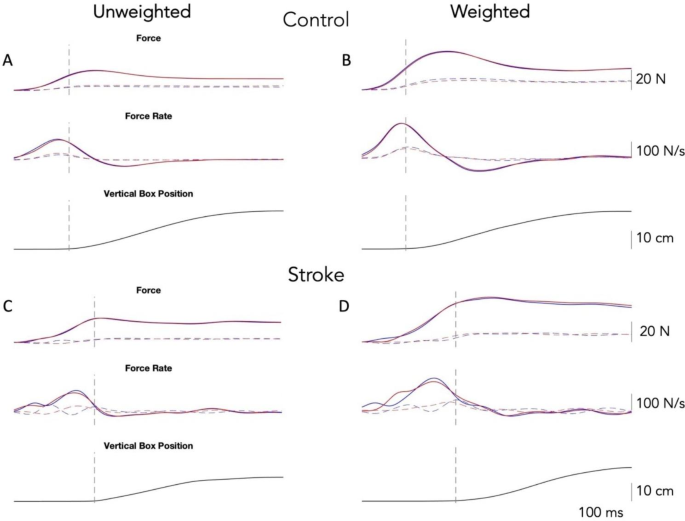
Left (blue) and right hand (red) profiles for grip force (solid) and load force (dotted), grip force rate (solid) and load force rate (dotted), and box height as a function of time for a representative neurotypical control participant and an individual with stroke (RCVA; paretic arm = left). Plots on the left show the unweighted box condition. Plots on the right show the weighted box condition. The dashed vertical line indicates the time of box lift
Measures of Anticipatory Control: GFR & LFR
To confirm that force rates peaked before box lift onset, and thus can be assessed as indices of planning, we performed separate analyses testing for differences between box lift onset time and the time of peak GFR and LFR. The analyses verified that box lift onset (M = 2.82 s) occurred significantly later in time than peak GFR (M = 2.55 s), χ2(1) = 33.57, p < .001, and peak LFR (M = 2.63 s), χ2(1) = 16.98, p < .001.
The analysis for peak GFR and LFR tested the hypothesis that participants with LCVA would show deficient scaling of force rate across box weight conditions as compared to controls and RCVA. We also predicted that differences would emerge between the paretic arm in the stroke groups (right arm for LCVA, left for RCVA) and the nonparetic arm. To examine these effects, we analyzed LFR and GFR with linear mixed effects models including terms for Group, Weight Condition, Hand, and their interaction, as well as a random effect term for Subject.
Peak GFR. The analysis of peak GFR revealed a significant Group by Weight Condition interaction, χ2(2) = 53.67, p < .001. Controls showed the greatest increase in GFR across weight conditions, followed by the LCVA group, and the RCVA group showed the smallest difference between conditions (Fig. 2). Tukey’s adjusted post-hoc contrasts examining group differences within the unweighted and weighted box conditions revealed differences between the control and RCVA groups for the weighted box condition, p = .02, with no other significant between-group differences. There were no additional significant two- or three-way interactions in the analysis, and thus no effects involving Hand (all p’s > 0.05). The analysis also yielded a significant main effect of Condition, χ2(1) = 17.54, p < .001, and no main effect of Group, χ2(1) = 5.56, p = .06.
Peak GFR as a function of weight condition for the control, LCVA, and RCVA group. Solid lines show individual subject means. Dotted lines show group means. Error bars show the standard error of the mean
As shown in Fig. 2, participants with stroke showed considerable variability in the scaling of peak GFR across weight conditions. In secondary analyses, we examined predictors of individual variation in the scaling of peak GFR using backward stepwise regression. The best fitting model, R2 = 0.30, F [3, 21] = 4.54, p = .01, included participants’ hemisphere of lesion (ß = − 0.35, p = .054), paretic arm ARAT score (ß =0.32, p = .09), and paretic side monofilament test score (ß =-0.26, p = .15). Importantly, the LCVA and RCVA groups did not differ across any predictors of motor or sensory function (all p’s > 0.05). The inclusion of hemisphere accords with the results for the analysis of GFR suggesting that the RCVA group was more impaired, relative to controls, than the LCVA group, for the scaling of GFR.
Peak LFR. The analysis of peak LFR revealed a significant Group by Weight Condition interaction, χ2(2) = 38.45, p < .001. As shown in Fig. 3, LFR increased more steeply across weight conditions for controls as compared to the LCVA and RCVA groups. Tukey’s adjusted post-hoc contrasts examining group differences within each box weight condition revealed differences between controls and the LCVA group (p = .03) and the RCVA group (p < .001) within the weighted box condition and no other group differences. There was also a significant Hand by Group interaction, χ2(2) = 71.87, p < .001. For controls, LFR values were higher for the left hand than the right hand, while the LCVA and RCVA groups produced higher LFR with the nonparetic (left in LCVA, right in RCVA) as compared to the paretic hand (right in LCVA, right in LCVA). The interaction between Weight Condition and Hand was not significant, p = .38, nor was the three-way interaction between Group, Weight Condition, and Hand, p = .14. There were significant main effects of Hand, χ2(1) = 7.73, p < .01, Weight Condition, χ2(1) = 29.99, p < .001, and Group, χ2(1) = 14.72, p < .001.
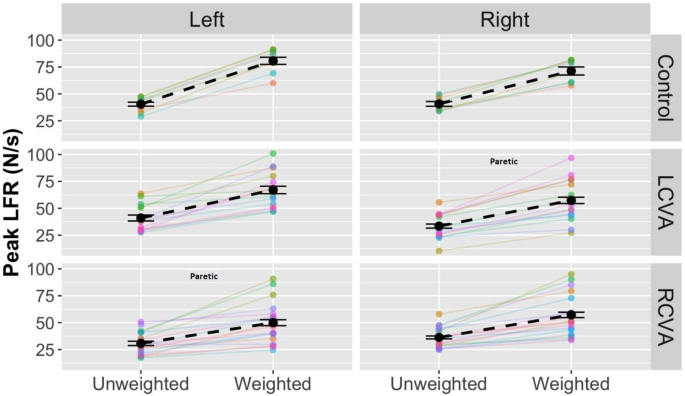
Peak LFR for the control, LCVA, and RCVA groups by Hand and Weight Condition. As indicated the right hand is the paretic hand for the LCVA group, while the left hand is the paretic hand for the RCVA group. Black points and dashed lines show group means with bars for standard error. Colored lines and points show individual participant means, with individual participants represented by a different color
In secondary analyses we examined individual variation among participants with stroke in the scaling of peak LFR across weight conditions (weighted – unweighted) in a stepwise regression. The final regression model was not significant (R2 = 0.19, p = .19).
Measures of execution: GF and LF
The analysis of measures of execution, peak GF and LF, tested the hypothesis that individuals with RCVA would be impaired in the scaling of force across weight conditions as compared to controls and LCVA, and that these deficits may be more pronounced for the paretic arm in participants with stroke. To assess these effects, we fitted LME models with terms for Group, Weight Condition, Hand, the interactions between these factors, and a random effect for Subject.
Peak GF. A main effect of Weight Condition emerged, χ2(1) = 42.4, p < .001, with no other main effects or interactions. Peak GF was higher for the weighted (36.29 ± 9.76 N) compared to the unweighted (23.13 ± 8.22 N) box condition.
Peak LF. The analysis for peak LF revealed a significant three-way interaction between Group, Weight Condition, and Hand, χ2(2) = 12.33, p < .001. As shown in Fig. 4, control participants showed the largest change in peak LF across weight conditions as compared to either stroke group, and the magnitude of scaling was greater for the nondominant arm as compared to the dominant arm in controls and in the nonparetic as compared to the paretic arm for the LCVA and RCVA groups. Accordingly, there was also a significant interaction between Group and Hand, χ2(2) = 387.58, p < .001, a main effect of Hand, χ2(1) = 6.18, p < .05, and a main effect of Weight Condition, χ2(1) = 658.03, p < .001.
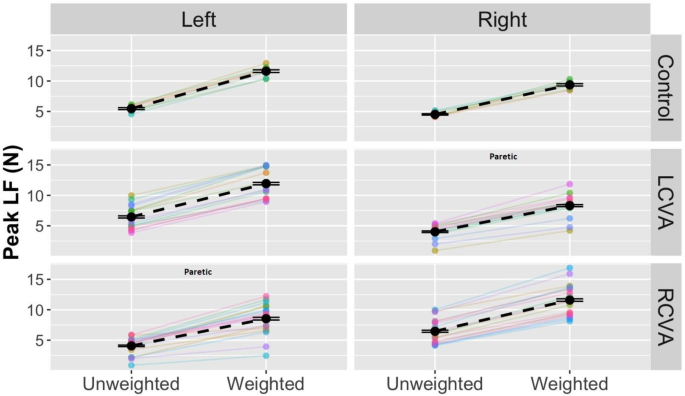
Peak LF plotted across Weight Condition by Group (Control, LCVA, RCVA) and Hand. Paretic hands are denoted for the LCVA and RCVA groups. Black points and dashed lines show group data with standard error. Colored lines and points show individual participant data
Measures of within-hand coordination of grip and load force
We predicted that participants with stroke would show deficient coordination as compared to controls with increasing task demand, and that these effects may be more pronounced in the RCVA group based on prior work showing deficiencies in coordination with disruptions to right hemisphere structures. To examine differences in the coordination of force within either hand, we analyzed GF-LF correlation coefficients using a model with terms for Group, Weight Condition, and Hand.
GF-LF correlation. Figure 5 shows GF and LF as a function of time (left panels) and GF against LF (right panels) for a representative control participant (Fig. 5A and B) and a participant with stroke (LCVA; Fig. 5C and D). For control participants, increases between GF and LF were approximately linear. Participants with stroke, however, showed significant variation in the coordination of these forces. As demonstrated in Fig. 5C and D, some individuals with stroke show marked impairments in LF production particularly with the paretic arm (i.e., the right hand in Fig. 5C and D).
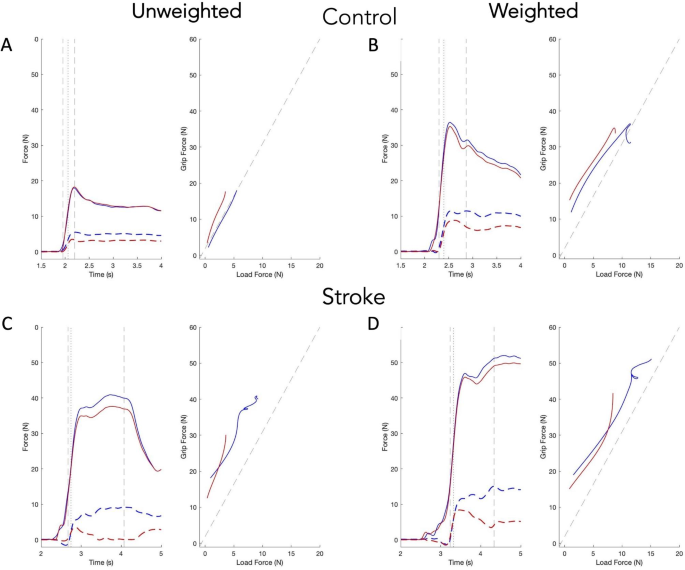
Each pair of plots shows GF (solid) and LF (dashed) as a function of time and GF plotted against LF for a single trial for a representative control participant (top) and a participant with stroke (bottom) in the unweighted (left column) and weighted (right column) condition. Blue lines show the left hand. Red lines show the right hand. Note that the participant with stroke has left CVA, thus the right hand (red) is paretic. LF onset and max are denoted using vertical dashed lines. Box liftoff is shown in the vertical dotted line
The analysis of grip-load force correlation coefficients revealed significant interactions between Group and Condition, χ2(2) = 6.15, p < .05, and Group and Hand, χ2(2) = 138.28, p < .001, with no three-way interaction between Group, Weight Condition, and Hand or Hand by Weight Condition interaction (p > .05). These interactive effects are shown in Fig. 6. For the Group by Weight Condition interaction, both the LCVA and RCVA groups showed larger differences in grip-load coordination across weight conditions as compared to controls. The interaction between Group and Hand was driven by the higher grip-load correlation coefficients for the nonparetic left hand as compared to the paretic right hand in the LCVA group and the nonparetic right hand as compared to the paretic left hand in the RCVA group, while the two hands were similar for controls. There were also significant main effects of Hand, χ2(1) = 5.73, p < .05, Group, χ2(2) = 9.17, p < .05, and Weight Condition, χ2(1) = 21.10, p < .001.
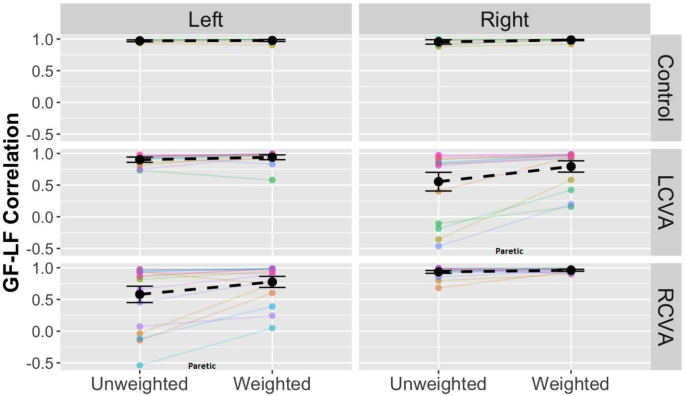
In secondary analyses, we examined predictors of individual variability in GF-LF coordination among participants with stroke using backward stepwise regression with the absolute difference in GF-LF correlation between the two arms (nonparetic-paretic) as the outcome measure and hemisphere of lesion, paretic arm ARAT score, monofilament test score, age, and sex as predictors. The best-fitting model, R2 = 0.62, F(5, 20) = 9.1, p < .001, retained participants’ paretic arm ARAT score (ß = − 0.99, p < .001), sex (ß = − 0.35, p = .02), paretic side monofilament score (ß = − 0.23, p = .10), age (ß = 0.21, p = .14), and proprioception difference (ß = 0.19, p = .17).
Bimanual coordination of force: Cross-correlation and time lag. To examine the bimanual coordination of force, we analyzed GFR and LFR cross correlation and time lags in separate models with terms for Group, Weight Condition, and their interaction.
The analysis of between-hand cross correlations of LFR yielded a significant Group by Weight Condition interaction, χ2(2) = 17.17, p < .001 (Fig. 7). The RCVA group showed the largest difference in cross-correlation values across weight conditions (Unweighted: r = .71 ± .45; Weighted: r = .84 ± .24), followed by the LCVA group (Unweighted: r = .79 ± .34; Weighted: r = .87 ± .15) and then controls (Unweighted: r = .95 ± .07; Weighted: r = .97 ± .03). There was also a significant main effect of Weight Condition, χ2(1) = 76.35, p < .001. No significant effects emerged for the analyses involving LFR time lag, GFR cross-correlation coefficients, or GFR time lag values.
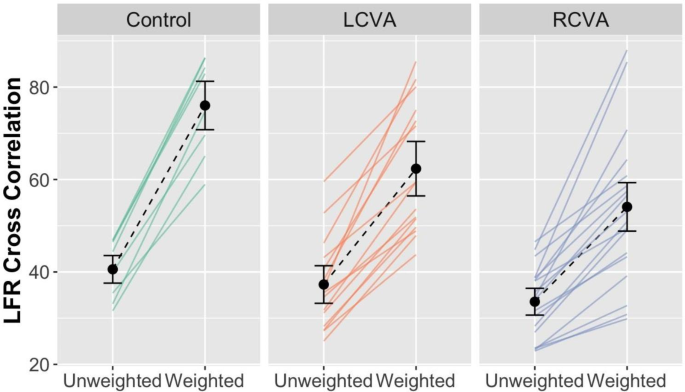
To examine predictors of bimanual coordination among participants with stroke, we analyzed mean LFR cross-correlation coefficient values in a backward stepwise regression with the same predictors as our previous analyses. The best fitting model, R2 = 0.62, F(3, 22) = 14.83, p < .001, included participants’ paretic arm ARAT score (ß = 0.83, p < .001), sex (ß =0.39, p = .006), and hemisphere of lesion (ß = 0.20, p = .09).
Box tilt and hand position
The analyses of box tilt and hand position tested whether the between-group differences in measures of anticipation, execution, or coordination might be attributed to differences in the placement of the hands or how the box was lifted between groups.
Tilt at Lift. A one-sample t-test revealed that tilt at lift values differed from zero (no tilt), indicating significant box tilt at the time of lift, t [34] = -3.62, p < .001. We examined potential effects of Group and Weight Condition using linear mixed effects modeling. The analysis yielded a significant effect of Weight Condition, χ2(1) = 5.30, p = .02. Tilt at lift values were greater for the weighted box condition (-0.22 ± 0.76 cm) than the unweighted box condition (-0.09 ± 0.25 cm). Numerically, mean tilt at lift values suggested minimal leftward tilt for the control (-0.07 ± 0.44 cm), LCVA (-0.35 ± 0.87 cm) and RCVA (-0.10 ± 0.46 cm) groups. Importantly, there were no effects of Group (p = .26) or Group by Weight Condition interaction (p = .92).
Tilt at Max Height. Tilt at max height values did not differ significantly from zero, suggesting minimal tilt (p = .16). LME analysis revealed a significant effect of Weight Condition, χ2(1) = 6.29, p = .01, with no effect of Group (p = .62) or Group by Weight Condition interaction (p = .67). Mean tilt was greater for the weighted (0.51 ± 2.96 cm) as compared to the unweighted (0.07 ± 0.51 cm) box condition. In terms of the direction of tilt by group, controls showed positive mean tilt (0.14 ± 3.25 cm), suggesting rightward tilt toward the dominant arm, while participants with stroke showed tilt toward the non-paretic arm. Participants with LCVA showed negative (leftward) tilt (-0.06 ± 1.67 cm), while participants with RCVA showed positive (rightward) tilt (0.77 ± 2.42 cm). As demonstrated by the large standard deviations, however, there was considerable individual variation in box the direction and magnitude of tilt.
Hand Position Differences at Box Lift. To examine whether the tilt at box lift emerged from differences in hand placement on the box, we examined differences in left- and right-hand Z-position at box lift. Differences in left and right-hand Z-positions did not differ significantly from zero (p = .71). LME yielded no significant effects for Group (p = .64), Weight Condition (p = .93), or Group by Weight Condition interaction (p = .86). Mean hand difference values, while highly variable, suggested a tendency to grasp lower with the left than the right for the control (-0.36 ± 0.99 cm) and LCVA (-0.64 ± 1.32 cm) groups, while the mean for the RCVA group suggested lower right-hand position relative to the left (0.31 ± 2.37 cm).
Discussion
Naturalistic actions such as picking up a box with both hands require the two hands to interact in cooperative coordination, planning and synchronously applying forces to grip and lift the box while adapting to changing object properties to ensure a smooth pickup. The present study was designed to investigate the anticipatory planning, execution, and coordination of forces between the hands as individuals with LCVA, RCVA and age-matched controls picked up a box under varying weight conditions. Our results revealed deficits in anticipatory planning, as indicated by group differences in the scaling of peak GFR and LFR across box weight conditions, as well as impaired bimanual coordination, as indicated by lower LFR cross-correlations between the two arms for participants in the RCVA group compared to controls and LCVA. Both stroke groups showed reduced within-hand grip-load force coordination for the paretic hand. Below we discuss differences across the two hands, predictors of individual variation among participants with stroke, and the relation between the present results and prior investigations of bimanual coordination after stroke.
Individuals with RCVA demonstrate impaired anticipatory scaling of force during the bimanual cooperative task
Scaling of peak GFR and LFR occurs prior to object lift, the time at which feedback about the weight becomes more robust, and hence is thought to be dependent on anticipatory control and informed by sensorimotor memory developed over 1–2 consecutive lifts [20]. As hypothesized, and similar to previous studies in unimanual grasp-lift tasks, neurotypical individuals scaled their GFR and LFR to box weight; with added weight they increased their GFR and LFR during a bimanual pickup task. Based on hemispheric specialization for unimanual actions and findings of Schaffer et al. [27] in individuals with stroke, we hypothesized that the LCVA group will show impaired anticipatory planning compared to controls and RCVA group. Contrary to our hypothesis, the RCVA group showed significantly poor scaling of grip and load force rates across object weight conditions compared to controls than the LCVA group. Kang and Cauraugh [9] reported that individuals with RCVA showed greater deficits in force accuracy and variability than those with LCVA during a bilateral isometric force matching task. Our findings extend those of Kang and Cauraugh to more naturalistic tasks and suggest that right hemisphere may preferentially contribute to planning of grip force rates in bimanual actions. Our findings, however, contrast with those of Schaffer and colleagues [27], who demonstrated that individuals with LCVA show pronounced deficits in early phases of bimanual coordination as they navigate a virtual cursor in a planar bimanual reaching task. Besides differences in the environment (virtual vs. naturalistic), these differences can be attributed to the nature of the bimanual task between the two studies. In the kinematic task employed by Schaffer and colleagues [27], the key differences between LCVA, RCVA and controls were observed in arm movements along the redundant but not non-redundant axis of the task. In the more naturalistic task employed here, redundant movements were substantially constrained by box characteristics and instructions specifying hand placement and action goals. Such naturalistic bimanual actions that rely on specific positional control for planning may preferentially engage both hemispheres [35]. Previous work suggests that bimanual control is distinct for kinematic and kinetic actions as well as influenced by task goals [10], and is likely to be task-dependent.
There were no differences in sensorimotor impairments (scores on ARAT, UEFM, Semmes-Weinstein monofilament test or grip strength) between the RCVA and LCVA groups. Thus, these differences in LCVA and RCVA may arise from the specialized role of the right hemisphere in cooperative bimanual coordination. While bilateral neural networks are engaged in bimanual coordination, mounting evidence from imaging and TMS-perturbation studies point to the role of right PMd (premotor cortex) and right STG connectivity in movement planning and execution of cooperative bimanual actions [26, 36, 37]. For example, in healthy individuals, rTMS over right PMd during both planning and execution induced deterioration of movement stability of a complex cooperative bimanual task [37]. Similarly, interhemispheric connectivity of right M1 with contralateral left PMd during movement preparation has been shown to be related to bimanual performance [38]. Further, preferential and causal engagement of right STG has been reported for execution of cooperative bimanual actions [26]. Our results showing poorer scaling of LFR and GFR, as well as poor LFR coordination in individuals with RCVA provides further support to the notion that the right hemisphere may play a specialized role in planning and execution of bimanual cooperative actions. Further research investigating the neuroanatomic underpinnings using lesion symptom mapping and tractography may help elucidate the differential role of each hemisphere in bimanual actions, as well as provide additional insight into the task characteristics that preferentially engage these distinct modes of bimanual control.
Previous work in unimanual precision grasping has demonstrated anticipatory planning impairments in the paretic arm [21]. These deficits may arise from impairments in sensory perception, the ability to utilize sensory feedback to successfully form or update object representations [20, 34], judgements about the sense of effort [39], or higher-order motor planning to utilize sensorimotor memory to modify grasp behaviors [20]. In our analyses across both stroke groups, tactile sensory impairment, as measured with the Semmes-Weinstein monofilament test score, was retained in the stepwise regression for the scaling of GFR to object weight, suggesting some improvement of model fit, but was not a significant predictor of deficient scaling. In contrast, the scaling of GFR was significantly associated with the paretic arm ARAT score, suggesting that the scaling of force rate was associated with motor performance deficits of the paretic arm. Such motor impairment may lead to abnormal grasping postures with the paretic hand that may hinder the ability to effectively utilize sensory feedback to inform the sense of effort and sensorimotor memory. Further, neuromuscular deficiencies observed in individuals with stroke such as the delayed moto-neuron recruitment observed after corticospinal tract damage may also result in slowed force rates [40, 41]. These deficits in the paretic arm, combined with known higher-order planning impairments in both the paretic and non-paretic arm may contribute to impaired scaling of GFR and LFR in the bimanual box pick up task.
Impaired paretic arm production and coordination of load force affects execution of cooperative bimanual tasks after stroke
Differences between the two hands were evident in both the control group and the stroke groups. The control group showed steeper increases in peak LF and LFR across weight conditions for the nondominant left than the dominant right hand. Moreover, mean tilt values indicated rightward tilt at max height, suggesting that the dominant arm may have been used for stability. This was a surprising finding, particularly in light of previous studies supporting the specialized role of the dominant right hand in dynamic control as compared to a greater stabilization role of the nondominant left hand during unimanual as well as asymmetric bimanual actions (42). Prior research has shown that during bimanual manipulation, healthy controls show covariation of load forces and hand placement to ensure successful performance (19). Thus, one possibility is that the asymmetry in LF and LFR could have been driven by asymmetric hand placement, with the left hand at a lower level than the right hand while picking up the box. The kinematic data, however, revealed no significant differences in the placement of the left and right hands, suggesting that participants followed the specified instructions and visual cues for hand placement during task performance. Additionally, the weight added to the box was secured within a narrow channel, and thus it is unlikely that these effects were due to shifts in the weight’s position inside the box. However, despite clear instructions, we observed that the box was tilted at box lift. This box tilt may have been mediated by asymmetry in the LF and LFR seen in the control group.
In terms of differences between the two hands, participants with LCVA and RCVA showed greater impairments in the scaling of LF and LFR for the paretic compared to the nonparetic arm, though effects of hand did not appear for GF or GFR. Additionally, there was significantly impaired within-hand GF-LF coupling for the paretic arm as compared to the nonparetic arm. Careful observation of the relation between GF and LF for individual trials (e.g., the participant with stroke in Fig. 5) suggests a particular deficit in the production and temporal evolution of load force, as compared to grip force, for the paretic arm compared to the nonparetic arm. Similarly, spatial coordination between the two arms for LFR was significantly impaired in the stroke group, suggesting deficits in the covariation of force across the paretic and nonparetic arms. Importantly, paretic arm decrements in GF-LF coupling as well as cross-correlation coefficients for LFR were predicted by the level of motor (i.e., ARAT) and sensory (Semmes-Weinstein test) impairments. Motor deficits such as longer times to peak force as well as lower peak forces, evident in the paretic arm, may contribute to impaired load force evolution and LFR coordination. Further, proximal arm kinematics in neurotypical individuals is known to affect GF-LF coupling in unimanual grasping [43]. Poor scores on UEFM are often associated with abnormal kinematics of shoulder and elbow during reaching, that may subsequently impair GF-LF coupling for the paretic arm [44]. The finding that sensory impairment was also associated with poor GF-LF coupling is in alignment with prior findings from our and other laboratories and highlight the role of sensory information in the execution of cooperative coordination of a bimanual task [18, 45]. Grip force rate scaling is known to be related to a central sense of effort gathered from sensory information from the previous trial [20] that, in a bimanual task such as the one tested here, may arise from both the paretic and nonparetic hand. Thus, stroke survivors may be able to use the information from the nonparetic arm to inform grip force scaling of both hands during subsequent trials, consistent with unimanual work showing paretic arm improvements in force production following lifts with the nonparetic arm [21]. On the other hand, the stroke groups produced greater peak LFR and higher LF values with the nonparetic arm. This suggests that the paretic arm was used to stabilize the box, while the nonparetic arm produced the tangential forces needed to counter gravity for box lift. Collectively, our data suggests that individuals with stroke demonstrate deficits in execution of cooperative task of picking a box, and these deficits, in part, can be attributed to poor control of LF and LFR secondary to sensory and motor impairments of the paretic arm. Future research that systematically manipulates the center of mass of the box while measuring grip and load force profiles may reveal how the two arms compensate for one another during cooperative bimanual tasks following stroke.
Interlimb coordination is impaired after stroke and provide unique insight into arm use strategies under bimanual actions
Finally, we also observed that, in addition to differences between the control and stroke groups, the cooperative coordination of LFR was different across the two weight conditions. Cross-correlation coefficients for LFR were significantly higher for weighted trials as compared to unweighted trials for controls and participants with stroke, suggesting that the coordinated production of force between the two arms was improved when task demands were increased through added weight. Similarly, GF-LF coordination improved for the weighted as compared to unweighted box condition for both groups. This suggests that patients likely have the capacity to coordinate LFRs between the hands, however, that capacity may be masked until task demands require them to do so (46). This finding contrasts with prior work from Kang and Cauraugh (7) reporting greater force variability in bimanual isometric force production at 50% but not 25% or 10% maximum voluntary contraction (MVC). Thus, it is possible that the weight of the box alone was insufficient to elicit 50% MVC. Alternatively, object properties and task goals may constrain the two arms differently than the isometric force production task. In an unweighted box, the paretic arm may contribute more to supporting the object while the nonparetic arm applies load forces to pick up the box. As the weight increases, the paretic hand can contribute to the production of load force in coordination with the nonparetic arm. This latent capacity to coordinate LFR between two arms in the weighted condition, but not in the unweighted condition, is akin to the phenomenon of learned non-use or reduced use. Learned nonuse is conceptualized as the disparity between the arm use and actual capacity of the paretic arm in stroke survivors (47). Though non-use (or reduced use) has primarily been studied in unimanual actions, our data suggest that gradations of ‘arm nonuse’ may arise even when the paretic arm is actively engaged during a cooperative bimanual task. However, the finding that LFR cross-correlations related to hemisphere of lesion and paretic arm ARAT scores suggests that the extent of this latent capacity may vary depending on the location of stroke and paretic arm function.
Limitations
While we observed planning deficits in bimanual actions, without concomitant testing of unimanual actions, we cannot ascertain that these planning deficits are specific to bimanual actions and not an overarching planning deficit. Additionally, there were several parameters that were relatively unconstrained during the bimanual box-pickup task that may have affected results, including hand placement, tilt, and lift height. The control sample was relatively small (N = 8); thus, it is possible that results such as the hand differences in LF and LFR may have emerged from individual variation unique to this sample. There is no generally accepted method for estimating power achieved using linear mixed effects analyses, thus the present effects, and particularly three-way interactions, should be interpreted with caution [48]. However, this dataset can be utilized for more precise sample size estimations in future studies. Finally, stepwise regression suffers several limitations, including potential distortions in model fit related to covariation among predictors, and thus should be treated as exploratory.
Clinical implications and conclusion
In summary, in the bimanual cooperative, common goal box pick-up task, individuals with chronic stroke, particularly those following RCVA differed from controls in the anticipatory scaling of force rate, as well as the coordinated production of force within and across the two arms. During execution, individuals with stroke showed specific impairments in the paretic arm for LF and LFR scaling, coordination between LF and GF, and LFR coordination between the two arms. These findings suggest that interventions targeting scaling of LF and coordination of interlimb LFR may be needed to improve bimanual performance and coordination. Impairments in planning were also evident in the scaling of GFR, suggesting the need for future work investigating whether naturalistic task practice under varied manipulations of object weight and size may improve GFR scaling during bimanual action. Future research is needed to elucidate the neural underpinnings of impairments in the anticipatory scaling of force after stroke, including the hemispheric differences that emerged in the bimanual box pick-up task. Finally, our results suggest that subtle gradations of arm non-use may emerge even when both arms are engaged and actively cooperating toward a common goal. Thus, rehabilitative strategies aimed to improve paretic arm participation should be careful to prevent such non-use from emerging, perhaps through adjustments to task demands.
Data Availability
Total Pageviews
Readings for new survivors, What I consider every survivor should read, let me know if you disagree
- 1. What to do the first day after your stroke http://oc1dean.blogspot.com/2010/09/obstacles-to-my-stroke-recovery.html
- 2. spasticity http://oc1dean.blogspot.com/2010/09/obstacles-to-my-stroke-recovery.html
- 3. drop foot http://oc1dean.blogspot.com/2010/09/stroke-rehabilitation-and-drop-foot.html
- 4. Stroke survivors sayingshttp://oc1dean.blogspot.com/2010/09/stroke-survivors-sayings.html
- 5. arm/hand exercises http://oc1dean.blogspot.com/2011/04/arm-hand-stroke-exercises-by-madfit.html
- 6. curled toes http://oc1dean.blogspot.com/2010/09/stroke-rehabilitation-of-curled-toes.html
- 7. 24 hour-a-day therapy http://oc1dean.blogspot.com/2010/09/24-hour-day-stroke-therapy.html
- 8. compensation vs. recovery http://oc1dean.blogspot.com/2010/10/compensation-vs-recovery.html
- 9. what my doctor should have told me http://oc1dean.blogspot.com/2010/08/what-my-doctor-should-have-told-me.html
- 10. fatigue http://oc1dean.blogspot.com/2010/09/stroke-fatigue.html
- 11. stages of grief http://oc1dean.blogspot.com/2011/03/5-stages-of-grief-my-take-on-stroke.html
- 12. Plateau - It doesn't exist http://oc1dean.blogspot.com/2011/04/plateau-bad-word-in-stroke-recovery.html
- 13. victim to survivor http://oc1dean.blogspot.com/2011/03/my-transformation-from-victim-to.html
- 14. neurons multitasking http://oc1dean.blogspot.com/2011/11/neuronal-multitasking-principle.html
- 15. What therapy worked? Very important to read. http://oc1dean.blogspot.com/2010/11/what-therapy-exercise-worked-best-for.html
- 16. Insanity and neuroplasticity http://oc1dean.blogspot.com/2010/09/insanity-and-neuroplasticity.html
- 17. single neuron insufficiency http://oc1dean.blogspot.com/2011/11/single-neuron-insufficiency-priciple.html
- 18. Brunnstrom vs. Bobath therapy http://oc1dean.blogspot.com/2010/10/brunnstrom-vs-bobathndt-stroke-rehab.html
- 19. Stroke books to read http://oc1dean.blogspot.com/2011/05/my-stroke-book-reading-list.html
- 20. Comics to make you laugh http://oc1dean.blogspot.com/2012/12/medical-research-stroke-rehabresearch.html http://oc1dean.blogspot.com/2013/03/your-meat-brain-and-brain-computer.html http://oc1dean.blogspot.com/2013/01/bluberries-may-lessen-heart-attacks-in.html http://oc1dean.blogspot.com/2013/01/how-to-fix-stroke-rehab-and-research.html
- 21. Test a href="http://oc1dean.blogspot.com/2013/03/your-meat-brain-and-brain-computer.html" target="_new">http://oc1dean.blogspot.com/2013/03/your-meat-brain-and-brain-computer.html
email me
Blog Archive
-
▼
2026
(2388)
-
▼
October
(98)
- The limits of neuroplasticity - or are there any?
- The question doctors could ask to estimate death r...
- Will We Ever Understand Dementia?
- “Success will be measured by access”: health leade...
- Seizure Rates Rise After Mechanical Thrombectomy f...
- Proposal for a Robot Rehabilitation Strategy Tailo...
- Subjective Social Status and Outcomes After Stroke...
- New Research Review Highlights Potential Sleep Ben...
- Global Leaders Meet to Discuss Equitable Access to...
- FDA sees promise in remote robotic-assisted stroke...
- Scientists identify a potential new treatment for ...
- Gait impairment characterization in hereditary spa...
- Directional EMG patterns reveal impairment-related...
- Meet PLUTO, IIT Madras robot that carries stroke t...
- Is It Possible For A Fat To Lower Your Diabetes Ri...
- Neural Repair Therapies After Stroke: I. Therapeut...
- The #1 Habit to Break to Reduce Visceral Fat, Acco...
- These Midlife Heart Markers Predict Who Lives to 9...
- These 5-Second Hand Exercises For Dementia Are Goi...
- Your brain changes at 9, 32, 66, and 83
- The surprising link between the size of your thigh...
- LVADs Linked to Concerning Neurologic Events, Stro...
- Microglia Rescue Vulnerable Dopamine Neurons in Pa...
- Statins Linked to Reduced Glaucoma Risk and Slower...
- Post-stroke checklist survey launched
- This One Exercise 3x a Week Could Keep Your Blood ...
- Human dental pulp stem cell secretome boosts strok...
- Medial gastrocnemius muscle and tendon morphology ...
- The one vegetable you should be eating to help you...
- Study says doing this one thing can reduce the odd...
- Identifying heterogeneous patterns of real-world u...
- Could Vagus Nerve Stimulation Help Repair Myelin a...
- Hearing aids do not reduce dementia-level impairme...
- Rehabilitation after a stroke takes on true meanin...
- Stroke Recovery’s Hidden Divide: Frailty Paths Pre...
- The one tea dietitians recommend for a healthier b...
- Could psilocybin treat brain injuries? Neuroscient...
- Study Finds Higher Fracture Risk Among People With...
- Eating Walnuts Every Day Linked to Better Mood and...
- These Foods Can Protect You from Microplastic Expo...
- COLCHICINE INDUCED NEURODEGENERATION
- Environmental enrichment in post-stroke rehabilita...
- Upper extremity motor outcomes during paired vagus...
- Distress disclosure and health behaviours in patie...
- Barriers and facilitators to telerehabilitation ad...
- Comparative evaluation of diffusion models for det...
- Predictors of futile recanalization following endo...
- Elevated platelet-to-lymphocyte ratio is associate...
- Development and validation of an interpretable mac...
- Early prediction of 3-month functional outcome aft...
- Non-linear and spectral EEG dynamics as stage–spec...
- Classical and intermediate monocytes and their rat...
- Existing Drug Could Halt Brain Inflammation in Alz...
- Effects of acute and long-term exercise modalities...
- 13 Foods You Should Eat Instead of Taking a Fiber ...
- This surprisingly simple everyday habit makes a bi...
- Centering Stroke Survivors to Improve Stroke Care
- Anxiety Disorders and Posttraumatic Stress Disorde...
- Does sleep matter for recovery after stroke? Funct...
- Whole-Plant Extract Outperforms THC on Glycemia
- These Midlife Heart Markers Predict Who Lives to 9...
- Waist Size, Not Just BMI, Predicts Mortality in Ol...
- How the Body Clock and Cold Team Up to Burn Fat
- Telomeres, Telomerase, and Immortality
- The 14 foods you should eat every week to stay hea...
- The #1 food people over 50 should eat more of, acc...
- Simple activity could help stroke survivors recove...
- A study of 52,198 people linked certain conditions...
- A ‘funny walk' isn't just ageing: Walking changes ...
- Healthy Dietary Patterns May Matter More for Heart...
- 10-minute fitness habit can help adults over 40 ma...
- Is Parkinson’s Disease a Man-Made Epidemic?
- Novel D1/D5 Agonist Juvmo Approved for Parkinson D...
- Associations between wearable‐device‐measured dayt...
- Design, synthesis, and biological evaluation of no...
- Losing muscle may increase risk of developing deme...
- Losing Muscle Could Also Increase Your Dementia Od...
- EEG Biomarkers During Upper-Limb Action Observatio...
- Noninvasive magnetic field therapy shows promise f...
- Estimating Brain Age With MRI Helps Stratify Demen...
- Losing Muscle Could Also Increase Your Dementia Od...
- Brain Age Offers Clues to Aphasia Outcomes After S...
- Scientists had people eat tomato paste every day. ...
- This Is What Science Says About Optimism & Your He...
- CSP backs Stroke Association’s call for timely reh...
- VR headset invented by Kerala man’s firm set to re...
- Doctor reveals '10-year rule' for evaluating brain...
- Cheap, common drug linked to far lower dementia ri...
- Brain Wiring Changes Distinguish Early Alzheimer’s...
- Bone loss linked to brain issues in new study
- Scientists quietly found a way to reduce the damag...
- What happens to your brain when you train your leg...
- What Vitamins Are Good for Gut Health?
- 3 breakfast foods that actually have more fiber th...
- A high intensity vs. casual speed walking interven...
- Magnetic Stimulation Improves Long COVID “Brain Fog”
- Brain Cells Measure Axons to Build the Perfect Mye...
- Proof that puzzles can reverse cognitive impairment
-
▼
October
(98)
Popular Posts
-
Really? What about these? Your incompetent? doctor won't know of these. Treating hearing loss is associated with a decrease in risk of ...
-
And you do that by your competent? doctor having EXACT 100% RECOVERY PROTOCOLS! NONE? PURE INCOMPETENCE! Rehabilitation after a stroke tak...
-
What the hell are YOU doing to stop this problem? NOTHING? Then get the hospital reconstituted with some competent stroke rehab persons! ...
-
This is why the AHA/ASA needs to be destroyed! 'Care' NOT RECOVERY! There are massive amounts of research needing followup if we h...
-
A FAILURE by not creating EXACT EXERCISE PROTOCOLS to deliver the EXACT amount of BDNF needed! You need better mentors and senior rese...
-
Firstly, ask your competent? doctor EXACTLY how much myelin damage occurred in your stroke! Then, what EXACT protocols will repair that! ...
-
I'd rather be an optimist and die joyfully than be miserable and live longer. I make sure I don't engage with pessimists and whin...
-
Your competent? doctor already has prescribed various unorthodox drugs, right? DMT (8 posts to November 2020 ) ecstasy (19 posts to N...
-
But NO protocol created; SO FUCKING USELESS! Doesn't anyone in stroke have two neurons to rub together? Proposal for a Robot Rehabili...
-
Why this research? Your mentors and senior researchers are so incompetent in not knowing of earlier research? vagus nerve (60 posts to Ju...
Copyright
Canoeing Moose
Just because my goal is to get back to canoeing and this moose is so ripped and cool looking. And he's even a solo paddler. But his right hand on the T-grip is wrong and the right arm should be extended.
Feedjit
Labels
- 'access' (42)
- 'assessments' (297)
- 'associations' (45)
- 'awareness' (96)
- 'best recovery' (3)
- 'Better outcomes' (20)
- 'black hole' (2)
- 'can' (10)
- 'care' (859)
- ‘chemo brain’ (1)
- 'concepts' (3)
- 'cope' (13)
- 'CORBYS gait rehabilitation system' (3)
- 'cost' (84)
- 'could' (6)
- 'Domestic chores' (1)
- 'efforts' (2)
- 'enhances' (4)
- 'Exercise-in-a-pill' (19)
- 'experts' (12)
- 'feels good' (4)
- 'flow state' (2)
- 'Get out of jail free card' (21)
- 'gold-plated' (1)
- 'golden hour' (1)
- ‘GPS’ for the brain (1)
- 'happy talk' (47)
- 'help' (2)
- 'hope' (9)
- 'implications' (1)
- 'improvement' (67)
- 'In the Arena' (3)
- 'likelihood' (1)
- 'magic occurs here' (8)
- 'management' (95)
- 'may' (42)
- 'measurements' (158)
- 'monitor' (5)
- 'more likely' (1)
- 'normal' (5)
- 'O' blood type (6)
- 'perspective' (2)
- 'pie in the sky' (8)
- 'potential' (57)
- 'processes' (16)
- 'prognostication' (15)
- 'recommendations' (14)
- 'Right to rehab' (1)
- 'safely' (1)
- 'services' (10)
- 'smart drug' (1)
- 'Stroke is Treatable' (71)
- 'suggestions' (7)
- 'super-spaghetti' (1)
- 'tips' (4)
- 'top doc' (1)
- 'treatment' (2)
- 'Unknown Unknowns' (2)
- 'usual care' (1)
- 'walk this way' (12)
- 'weekend warrior' (2)
- 'Weightless' song (2)
- 'Window of recovery' (1)
- 'wing it' (31)
- 'You won't recover' (2)
- "21-day rule." (1)
- "Come Back Strong" (2)
- “complexity theory of aging (1)
- “eat me” signals (1)
- “self-fulfilling prophecy” (1)
- ~20-Hz rebound (1)
- $1000 a dead neuron (29)
- 1 in 10 to get dementia (2)
- 1 in 4 have delirium post stroke (4)
- 1 in 4 per WHO that has a stroke (324)
- 1 in 8 (3)
- 1-trifluoromethoxyphenyl-3(1-propionylpiperidin-4-yl) urea (1)
- 1-year mortality (1)
- 1.9 million neurons per minute (2)
- 10 million yearly stroke survivors (203)
- 10 second balance test (4)
- 10% brain usage (5)
- 10% full recovery rate (589)
- 10% seizures post stroke (40)
- 100% recovery (4031)
- 100% recovery failure (198)
- 100% recovery protocols (454)
- 100% recovery research? (10)
- 1000 bottles of wine (4)
- 1000 failed neuroprotection trials (22)
- 10000 repetitions (4)
- 10000 steps (62)
- 10MWT (9)
- 11 Stroke risk reduction ideas (76)
- 11% pressure injuries (3)
- 11% Stroke-associated pneumonia (25)
- 12 reasons for alcohol (55)
- 12-Deoxyphorbols (1)
- 12/15-LOX (3)
- 12% post stroke pain (1)
- 12% tPA efficacy (453)
- 13 nasal delivery options (6)
- 13 problems with no cure (57)
- 13 reasons for marijuana (163)
- 13 reasons for mirror-box therapy (2)
- 13% time in stroke rehab (7)
- 14-3-3 (1)
- 15-Minute doctor visits (1)
- 15% spontaneous arm/hand recovery (2)
- 16% to 84% shoulder pain (2)
- 17 diagnosis possibilities (60)
- 17% incontinence (3)
- 177 hyperacute possibilities (46)
- 17β-estradiol (4)
- 18F-sodium fluoride PET scans (1)
- 2 Finger Test In Dementia (2)
- 2-methoxyestradiol (1)
- 2-Methoxystypandrone (1)
- 2′-Fucosyllactose (1)
- 20-25% apathy post stroke (3)
- 20-5-3 rule (1)
- 20% anxiety problems (47)
- 21% cachexia patients (2)
- 21st Century Cures (6)
- 23% chance of stroke PTSD (60)
- 24 hour a day therapy (1)
- 24 hour coffee station (63)
- 24 to 70% post-stroke cognitive impairment (4)
- 25-hydroxyvitamin D level (1)
- 2D-planar robot (1)
- 3 DOF (1)
- 3 required reporting results (3)
- 3-4-Methylenedioxymethamphetamine (1)
- 3-d printing (1)
- 3′.4′-dihydroxyflavonol (1)
- 30-day deaths (163)
- 30-minute daily walk (1)
- 30% get spasticity (31)
- 30% infection post stroke (3)
- 30% poor sleep (20)
- 31 hyperacute possibilities (59)
- 31P-MRS (1)
- 32 to 41% insomnia in stroke survivors (3)
- 33% chance of getting dementia/Alzheimers (706)
- 33% fewer years (1)
- 33% survivor depression (53)
- 39% post stroke delirium (5)
- 39% to 55% post stroke pain (5)
- 3d (105)
- 3d brains (6)
- 3D gel stacks (1)
- 3D holographic (1)
- 3d imaging (9)
- 3d printing (20)
- 3D robotics (1)
- 3d scans (7)
- 3D virtual environments (3)
- 3K3A-APC (7)
- 4-aminobenzoic acid hydrazide (1)
- 4-aminopyridine (1)
- 4/NFκB Pathway (1)
- 40 Hertz flickering light (12)
- 40 Hz cortical gamma oscillations (3)
- 40% anemia in ischemic stroke (2)
- 40% fatigue (27)
- 48% constipation (20)
- 49% malnutrition post-stroke (2)
- 4AP (1)
- 4D (2)
- 4D flow imaging (2)
- 5 causes of neuronal death (376)
- 5 lost years of brain cognition (194)
- 5 steps to solve stroke (26)
- 5 year deaths (1)
- 5-aminolevulinic acid (1)
- 5-caffeoylquinic acid (3)
- 5-Cog system (1)
- 5-CQA (2)
- 5-HT4 receptor (2)
- 5-Lipoxygenase (1)
- 5-Minute Workout (1)
- 5% epileptic seizures after stroke (25)
- 50% attention disorders (1)
- 50% cognitive impairment (3)
- 50% experience gastrointestinal complications (1)
- 50% stroke fatigue (26)
- 50% to 80% Post-stroke dysphagia (24)
- 501(c)3 (2)
- 5HT1A (1)
- 5HTTLPR (1)
- 5th grade language (2)
- 6-DOF exoskeleton (1)
- 6-Methylsulfinylhexyl Isothiocyanate (1)
- 6-MSITC (1)
- 60 Hertz flickering light (8)
- 60 minutes (2)
- 60-90 days late rehab (1)
- 65% hand disability (2)
- 69 percent sedentary time (8)
- 6MWT (8)
- 6S molecule (1)
- 7 Minute Workout (1)
- 7-Cl-O-Nec-1 (1)
- 7% Community ambulation (4)
- 70% stroke fatigue (36)
- 78% of time in sedentary behaviors (5)
- 8 Hour Time-Restricted Eating (3)
- 8 stroke problems to solve (50)
- 8-OHdG (1)
- 85 percent gait abnormalities (5)
- 85% inactivity (6)
- 9 causes of deficits (24)
- 9% vertigo strokes (2)
- 90-day 'golden period' (1)
- 90-Day Outcome (4)
- 90° leftward walking turns (1)
- 911 (2)
- 92% visual impairment (1)
- 9HPT (1)
- a-linolenic acid (1)
- A4 Study (1)
- AARP (2)
- ab workout (1)
- AB126 (2)
- ABAH (1)
- abbreviations (1)
- AbbVie researchers (1)
- ABC transporters (1)
- ABC-AF Risk Score (1)
- ABCA1 deficiency (1)
- ABCD2 score (1)
- ABCG2 protein (1)
- abciximab (1)
- abdication (4)
- abdominal CT scans (1)
- abdominal fat (6)
- abduction (2)
- Abelacimab (2)
- Abeta40 (1)
- Abeta42 (2)
- ABILHAND (3)
- ablation (7)
- able bodied (1)
- ableX (1)
- abnormal co-activation (1)
- absolute stupidity (99)
- Absolutely Nothing (254)
- abstain from alcohol (1)
- ABT263 (1)
- Abu Dhabi (1)
- AC105 (1)
- AC3-AT protein (1)
- Acamprosate (1)
- Acanthocystis turfacea Chlorella (1)
- accelerometer (55)
- acceptance (5)
- access time (1)
- Access to rehab (3)
- accommodations (1)
- accountability (8)
- accreditation (6)
- ACE inhibitors (2)
- acesulfame potassium (1)
- Acetazolamide (1)
- Acetoacetate (1)
- acetoaminophen (4)
- Acetycholine (8)
- acetyl-CoA carboxylase (1)
- acetylcholinesterase inhibitors (2)
- acid ceramidase (1)
- Acidic fibroblast growth factor (1)
- acidity (2)
- ACLY (1)
- aconite (1)
- aconitine poisoning (1)
- acopia (1)
- acoustic stimulation (2)
- acquired brain injury (13)
- acrolein (3)
- acromion-greater tuberosity (AGT) distance (1)
- ACT017 (2)
- ACTB Methylation (1)
- Actigraphy (2)
- actin networks (1)
- Actinobacterium Collinsella (1)
- action disorders (2)
- action maps (1)
- action observation (149)
- action plan (9)
- Action Plan for Stroke in Europe (7)
- Action Research Arm Test (33)
- action verbs (1)
- Actissima trial (2)
- active Information Avoidance (1)
- active mind (1)
- active movement extent discrimination apparatus (1)
- active nerve stimulation (1)
- Active Predictive Coding (1)
- active-assist exercise (3)
- Activin (1)
- Activities-specific Balance Confidence (2)
- activity levels (16)
- activity-dependent neuroprotective protein (1)
- Actos (1)
- Actovegin (1)
- actuators (5)
- acupuncture (116)
- acupuncture side effects (6)
- acute (149)
- Acute Coronary Syndrome (1)
- Acute Kidney Injury (3)
- Acute lung injury (1)
- Acute vestibular syndrome (1)
- acylcarnitines (1)
- ADAM21 (1)
- ADAMTS13 (1)
- adaptation (5)
- Adaptive Mixed Reality (1)
- ADAS-Cog (1)
- ADD (3)
- addiction (2)
- Addium (1)
- adenosine (7)
- ADGRG1 (2)
- ADHD (5)
- adherence (9)
- adhesion (1)
- adipocyte (3)
- adipogenesis (1)
- adiponectin (1)
- adiposity (5)
- adjunctive intra-arterial (IA) thrombolytics (1)
- adjustments (1)
- ADL (107)
- Adlarity (1)
- administration method (1)
- admittance target (1)
- ADNP (1)
- ADRA2b (1)
- adrenaline (1)
- adrenergic blockers (1)
- Aducanumab (8)
- Aduhelm (3)
- adult education (1)
- adult hippocampal neurogenesis (9)
- advance for physial therapy and rehab (1)
- advances in stroke (1)
- Advances in Stroke Recovery Scientific Conference (1)
- adventure (1)
- adverse outcomes (4)
- adversity (4)
- advice (2)
- advocacy (364)
- aerobic capacity (5)
- aerobic exercise (77)
- Aerobic Training (13)
- aesthetics (1)
- affective disorder (1)
- Afferent Pathway Integrity (2)
- AFO (61)
- Africa (6)
- african americans (1)
- after the fact (2)
- aftercare (1)
- aftereffects (1)
- age calculator (4)
- age limit (1)
- age norms (1)
- age out (1)
- age-standardized prevalence rates of stroke (1)
- Age-Well project (1)
- Aged Garlic Extract (14)
- aged organs (1)
- ageotypes (2)
- aggregatin (1)
- aggression (2)
- agility (1)
- aging (169)
- aging in place (13)
- agitation (1)
- Agnotology (1)
- Agomelatine (1)
- agonists (3)
- agression (1)
- agrin (1)
- AHA (164)
- AHF (2)
- Aid for Decision-Making in Occupation Choice (1)
- Aide-Memoire (1)
- AIF (1)
- aim-high (1)
- air microembolism (1)
- air pollution (16)
- air pressure treadmill (3)
- airbags (1)
- airline industry (1)
- AiWalker (1)
- Akt (3)
- Akt/Nrf2 Pathway (1)
- alagebrium (5)
- alarmist (1)
- Albert Einstein (1)
- Alberta Stroke Program Early Computed Tomography Scores (1)
- albumin (21)
- ALCAR (2)
- alcohol (228)
- ALD-401 (1)
- aldosterone (1)
- alendronate (1)
- ALEx (1)
- alexithymia (1)
- Alfred Adler (1)
- Algal Virus (1)
- Algorithm (22)
- alien limb (2)
- alirocumab (2)
- Aliskiren (1)
- AliveCor (1)
- alkaloids (2)
- all hat and no cattle (9)
- All strokes are different (233)
- AllCore360º (1)
- Allen Institute (11)
- allergy (1)
- Allogeneic cell therapy (1)
- allopregnanolone (1)
- Allopurinol (1)
- AllTrials (1)
- allyl sulfide (1)
- almonds (18)
- alpha 2 factors (2)
- alpha blockers (1)
- alpha linolenic acid (4)
- alpha oscillations (9)
- alpha tocopherol (4)
- Alpha-asarone (1)
- alpha-B-crystallin (1)
- alpha-band coherence (1)
- alpha-Lipoic Acid (2)
- alpha-synuclein (17)
- ALS (13)
- Alteplase (60)
- altered dynamic functional connectivity (1)
- altered reality (1)
- alternative (5)
- Alternative Healthy Eating Index (1)
- altitude (7)
- Altoids (1)
- aLTP (1)
- Aluminum (4)
- Alzheimer's disease progression (1)
- alzheimer's mice (1)
- alzheimer's mitigation (2)
- Alzheimer’s Proteins (1)
- Alzheimer’s Vaccine (1)
- alzheimers (417)
- alzheimers risk reduction (25)
- alzheimers cause (16)
- alzheimers detection (69)
- alzheimers drink (2)
- alzheimers drug (20)
- alzheimers link (5)
- alzheimers plaque (10)
- alzheimers prediction (16)
- Alzheimers prevention (181)
- alzheimers protein (3)
- alzheimers research (10)
- alzheimers reversal (12)
- alzheimers risk (93)
- alzheimers risk reduction (36)
- alzheimers test (19)
- alzheimers toxins (1)
- Alzheimers treatment (69)
- alzheimers vaccine (2)
- amacrine cells (1)
- Amadeo (1)
- amantadine (9)
- AMAT (1)
- Ambibaric Brain (2)
- ambien (5)
- ambiguity (1)
- ambition (1)
- Ambroxol (1)
- ambulance (34)
- ambulance delays (4)
- aMCI (2)
- AMEDA (1)
- ameliorate (1)
- American Academy of Neurology (4)
- American Brain Foundation (8)
- American College of Cardiology (2)
- American Congress of Rehabilitation Medicine (1)
- American Indians (1)
- amine-modified Pluronic F127 (1)
- amino acids (6)
- Aminopropyl Carbazole (1)
- amlexanox (1)
- Amlodipine (5)
- ammonia-oxidizing bacteria (1)
- amnesia (1)
- Amnion Cell Therapy (1)
- amniotic cells (1)
- amniotic fluid (1)
- AMP kinase (1)
- AMPA receptors (4)
- ampakine (1)
- amphetamines (7)
- AMPK (6)
- AMPK–PKC–CBP (1)
- Amplatzer Amulet occluder (1)
- amputees (1)
- AMPYRA (5)
- Amsterdam-Nijmegen Everyday Language Test (1)
- Amtrak (3)
- Amusia (1)
- Amy (22)
- Amy Farber (19)
- Amy Morin (1)
- amygdala (7)
- amylase-trypsin inhibitors (1)
- Amylin (1)
- amyloid (15)
- amyloid beta (29)
- amyloid beta proteins (3)
- amyloid plaque (24)
- amyloid precursor protein (4)
- anacetrapib (1)
- Anaerobic exercise (1)
- Anakinra (3)
- analgesic (1)
- analysis (121)
- anandamide (2)
- anatomy (4)
- anchoring (1)
- ANCOVA (1)
- ANCROD (1)
- Andexanet (3)
- Andrew Marr (43)
- ANDRO (1)
- androgapholide (1)
- androgen (1)
- androgen deprivation therapy (1)
- Andrographolide (1)
- Andy Warhol (1)
- anecdotal (6)
- anemia (6)
- Anesthesia (3)
- aneurysm (64)
- aneurysm rupture risk (8)
- Angelo Mosso (1)
- anger (18)
- angina (1)
- Angioedema (2)
- angiogenesis (149)
- Angiogenic (1)
- angiogenin (2)
- angiogram (1)
- angiography (1)
- Angioneurins (1)
- Angioplasty (1)
- angiopoietins (3)
- Angiotensin (13)
- angular gyrus (1)
- Angular momentum (2)
- Angular Separation (1)
- anhedonia (3)
- Ani DeFranco (11)
- animal fat (3)
- animal testing (1)
- animal therapy (2)
- animation (5)
- ankle (43)
- ankle exosuit (2)
- ankle extensors (1)
- ankle instability (2)
- ankle joint angle (1)
- ankle kinematics (1)
- ankle-foot rehabilitation (25)
- Anklebot (6)
- ankyrins (1)
- anle138b (1)
- ANNEXa-I (1)
- anniversary (2)
- annual report (1)
- anodal tDCS (31)
- anosmia (3)
- anosmin-1 (1)
- Anosognosia (1)
- anoxic (1)
- antacids (1)
- antagonists (5)
- anterior cingulate cortex (1)
- Anterior Insula (1)
- Anterior Mid-Cingulate Cortex (1)
- anthocyanin (18)
- Anthony Bourdain (25)
- Anthroposophical (1)
- anti-aging (27)
- anti-amyloid agents (1)
- anti-amyloid beta antibody (2)
- anti-apoptotic (1)
- anti-asthmatic drug (1)
- anti-coagulation (45)
- anti-gravity (2)
- anti-hero (1)
- anti-hyperglycemic agents (1)
- anti-hypertensives (1)
- anti-inflammation (44)
- anti-interleukin-17 therapy (1)
- anti-Nogo-A antibody therapy (1)
- anti-obesity drugs (1)
- anti-PC (1)
- anti-PD-L1 monoclonal antibody (1)
- anti-platelets (3)
- anti-thrombotic (2)
- anti-TNF therapy (2)
- Anti-tumor drug (1)
- anti-VEGF (1)
- antibacterial mouthwash (1)
- antibiotics (13)
- antibodies (2)
- Anticholinergics (14)
- anticoagulants (24)
- anticoagulation (29)
- anticonvulsant strategies (1)
- Anticytokine drugs (1)
- antidepressants (90)
- antidopaminergic antiemetics (1)
- antidopaminergic antipsychotics (1)
- antidote (1)
- antiepileptics (1)
- antigen (1)
- antiherpetic medication (1)
- Antihistamines (1)
- antihypertensives (14)
- Antimetabolites (1)
- antineuritogenic (1)
- antioxidant (44)
- Antioxidant Therapy (11)
- antiphospholipid antibodies (3)
- antiplatelet therapy (26)
- antipsychotics (1)
- antipyretic (1)
- antisaccade reaction time (1)
- Antisecretory factor (1)
- antiseizure medications (3)
- antithrombotic therapy (8)
- anxiety (140)
- any brains at all (52)
- ANY GOOD AT ALL (36)
- ANYTHING AT ALL? (174)
- AOBiome (1)
- aortic stenosis (1)
- Aortic stiffness (4)
- AP‐1 pathway (1)
- apathy (27)
- apelin peptide (2)
- aphasia (190)
- aphemia (1)
- aphorisms (1)
- apigenin (2)
- apixaban (5)
- aPKC (1)
- aPKC-CBP (1)
- apoA-1 (1)
- apoaequorin (1)
- apocynin (3)
- apoE (28)
- apolipoproteins (10)
- apologist (5)
- apomorphine (1)
- apoplexy (9)
- apoptosis (65)
- APOptotic SECretome (1)
- APOSEC (1)
- appalling (50)
- appeal to antiquity (14)
- Appeal to Authority (12)
- apple (9)
- apple physique (1)
- Apple products (6)
- apply to stroke (1)
- approval process (1)
- apraxia (5)
- aptamer locks (1)
- ApTOLL (3)
- aquaporin 4 (3)
- aquatic therapy (6)
- Arachidonic Acid (2)
- Arc protein (2)
- Are you a leader? (33)
- Are you fully recovered? Y/N? (28)
- area postrema (1)
- argatroban (5)
- Argentina (1)
- arginine (7)
- arguments (2)
- Aricept® (1)
- Aristotle (35)
- arm (111)
- arm and hand movement (29)
- arm cycling (4)
- arm exoskeleton (13)
- arm recovery (39)
- arm robotics (10)
- arm swing (11)
- arm-dominant fat distribution (1)
- ARM-Guide (1)
- ArmAble (2)
- Armeo (8)
- armsleeve (1)
- Army (1)
- army cot (1)
- ARNI (3)
- arnica (1)
- aromatherapy diffuser (1)
- aromatic herbs (1)
- aromatic turmerone (3)
- ARPA-H (1)
- ARPC (1)
- Arrhythmia (4)
- arrogant (47)
- art (10)
- artemisinin (1)
- arterial function (6)
- arterial imaging (1)
- Arterial Spin Labeling (2)
- Arterial stiffness (46)
- arteries (28)
- arteries-on-a-chip (1)
- Arteriogenesis (10)
- Arteriosclerosis (6)
- arteriotomy (1)
- artery clearing (3)
- artery dissection (1)
- arthropathy (1)
- Arthur Schopenhauer (2)
- artificial brains (4)
- artificial intelligence (128)
- artificial muscle (1)
- artificial neural connection (5)
- Artificial Neuron (5)
- Artificial sweeteners (2)
- arts (1)
- ARUBA trial (2)
- arugula (2)
- arylesterase (1)
- ASA (404)
- asanas (1)
- Ascl1 protein (2)
- ASCOD phenotyping (1)
- ascorbic acid (4)
- ASCVD (5)
- Asia (1)
- Asian Americans (1)
- Asian Mushroom (1)
- Asian spice (11)
- Asians (2)
- ASIC1a (1)
- ASMR (1)
- asparagus (1)
- Aspartame (1)
- aspartate (1)
- aspartic acid (1)
- aspirate (6)
- aspiration thrombectomy (2)
- aspirational (1)
- ASPIRE-S (1)
- aspirin (146)
- ASPR (1)
- assertive (1)
- Assessment of Motor and Process Skills (1)
- asshole (40)
- Assisted Intention Monitoring (1)
- assistive devices (33)
- associated reactions (2)
- assuage (3)
- assumption (5)
- AST-004 (2)
- Astaxanthin (4)
- asteroid (2)
- asthma drug (5)
- Astragalosides (1)
- ASTRAL (1)
- astral experiences (1)
- astringent (1)
- astrocytes (128)
- astrocytosis (1)
- astroglia (3)
- astrogliosis (15)
- Asundexian (10)
- asymmetry (7)
- asymptomatic (5)
- at a minimum (1)
- at-home test (1)
- AT2 receptor (1)
- ATACH-2 (1)
- Atalante exoskeleton (1)
- Atalante X (2)
- ataxia (11)
- atenolol (1)
- ATF-2 (2)
- ATF3 (1)
- ATH-1017 (1)
- Atherectomy (3)
- atherogenesis (4)
- atherogenic dyslipidemia (1)
- atheromas (3)
- atherosclerosis (225)
- Athersys (2)
- athlete (10)
- Atkins diet (1)
- atlas (7)
- AtMYB12 (1)
- Atomoxetine (1)
- Atorvastatin (3)
- ATP (5)
- ATPPIF1 (1)
- Atractylodin (1)
- atrial 4D flow CMR (1)
- atrial cardiopathy (1)
- atrial fibrillation (177)
- atrophy (26)
- attachment (1)
- attention (16)
- attenuate (2)
- attitude (2)
- attraction (3)
- attractive people (2)
- Atzumi (2)
- audacity (1)
- auditory (8)
- Augmented Reality (21)
- augmented reflection technology (1)
- AuraRing (1)
- Australia (204)
- Austria (2)
- autism (2)
- autoantibodies (1)
- autoimmune disease (5)
- automaticity (1)
- Autonomous sensory meridian response (3)
- autonomy (3)
- autophagosomes (1)
- autophagy (27)
- autopsy (16)
- autosomal dominant Alzheimer’s (1)
- avacado (2)
- Avantis (1)
- avatars (2)
- AVERT trial (6)
- avm (29)
- avocados (13)
- awe (3)
- AWOL (1)
- AX200 (4)
- AXO Suit (1)
- axon growth (14)
- axon initial segment (1)
- axon pathfinding (56)
- Axon Registry (1)
- axonal injury (3)
- axonal neurogenesis (1)
- axonal pathfinding (1)
- axonal regeneration (33)
- axonal remodeling (5)
- axonal sprouting (53)
- axonal transport (1)
- Axotomy (1)
- ayahuasca (4)
- Ayurvedic (4)
- azathioprine (1)
- Azurion (1)
- ɑ-klotho (1)
- B cells migration (1)
- B-1b cells (1)
- B-lymphocyte (1)
- B-Spline Modeling (1)
- B244 (1)
- B4Crry (1)
- Babel Fish (1)
- baboons (1)
- baby (2)
- BACE (1)
- BACE1 (3)
- bachelor (1)
- Bacille Calmette-Guérin vaccine (2)
- back of the brain (1)
- back to the drawing board (6)
- back to work (2)
- Backfire Effect (2)
- backlist (1)
- backpropagation (1)
- backup camera (1)
- backward walking (18)
- backyard inventor (1)
- baclofen (9)
- bacon (2)
- Bacopa (3)
- bacteria (3)
- Bacteroidetes (1)
- bad cop (1)
- Bad Healthcare Outcomes (1)
- bad patient (4)
- bad research (553)
- bad teaching (2)
- BADDS (1)
- Baduanjin (2)
- BAG-1 (1)
- Baicalein (1)
- Baicalin (1)
- balance (176)
- Balance Evaluation Systems Test (1)
- Balance Master (7)
- balance recovery (57)
- balance stability (4)
- balance training (17)
- balance-bed (1)
- balanced diet (1)
- balanced life (1)
- balancing on a beam (1)
- balancing on one leg (14)
- baldness (3)
- ball squeezing (1)
- ballet (3)
- balloon (1)
- Balloon-guided catheter (2)
- Balonikotron (1)
- Bama miniature pigs (1)
- bamboozled (8)
- bananas (15)
- bandages (1)
- Bandaid (3)
- bandaid approach (2)
- Banga (1)
- Bangaten (1)
- Bangor Gambling Task (1)
- BAP31 (1)
- baPWV (1)
- bar stool rehab (4)
- Barb (7)
- Barbara Arrowsmith Young (2)
- Barbara Browne M.D (1)
- barbells (1)
- Barbro B Johansson Award (2)
- barefoot walking (2)
- baricitinib (1)
- baroreflex sensitivity (1)
- barriers to physical activity (2)
- BART (1)
- Bart Starr (2)
- Barthel Index (40)
- basal ganglia (2)
- base of support (1)
- baseball (1)
- baseline (52)
- basic psychological needs (2)
- basil (1)
- basilar artery occlusion (22)
- Basis (1)
- basket neurons (1)
- basket weaving (4)
- basketball (3)
- bastards (54)
- baths (1)
- BATRAC (9)
- batroxobin (1)
- BAY 2433334 (1)
- Bayesian (8)
- BBB on a chip (2)
- BBC (1)
- bbq (1)
- BBT (4)
- BCAAs (1)
- BCG vaccine (1)
- BChE-K (1)
- BCI (98)
- Bcl-2 (6)
- Bcl6 (1)
- BDNF (218)
- be careful (132)
- BE FAST (1)
- beach (1)
- beagles (1)
- Beam-Me-In (1)
- bean counter (1)
- beans (2)
- BEAR-H1 (1)
- beatable (1)
- beating around the bush (1)
- beatings will continue (1)
- Beauty Parlor Stroke (5)
- Beck’s Depression Inventory (2)
- bed position (4)
- bed rest (2)
- Bedless hospitals (1)
- bedtime (5)
- bee venom (1)
- beer (66)
- beet juice (26)
- beets (9)
- Behavioral Archetypes (1)
- behavioral assessment screening (1)
- Behavioral Deficits (2)
- behaviour change approaches (4)
- behind the times (1)
- beige fat (1)
- Belgian (1)
- Belgian beer (1)
- beliefs (3)
- believes in himself (1)
- bell curve (1)
- Bell peppers (1)
- Bell's Palsy (2)
- belly (1)
- Belsomra (1)
- bempedoic acid (1)
- Benadryl (3)
- Bendavia (1)
- beneficial (3)
- benefits (4)
- Benign paroxysmal positional vertigo (1)
- Benik (3)
- benserazide (1)
- Benson’s relaxation therapy (1)
- Benzodiazepines (16)
- berberine (9)
- bereavement model (1)
- berg balance scale (66)
- Bergamot (1)
- Bermuda (4)
- Bernadette the nun (11)
- Bernie Sanders (1)
- berries (12)
- best hospitals (2)
- best in the world (1)
- Best Medical Therapy (1)
- best practices (15)
- best thing (36)
- beta blocker (3)
- beta carotene (3)
- beta hydroxybutyrate (1)
- beta oscillations (5)
- beta-2 microglobulin (1)
- beta-alanine (1)
- beta-amyloid (11)
- beta-amyloid removal (7)
- Beta-carotene (3)
- beta-catenin (1)
- beta-cryptoxanthin (1)
- beta-hydroxybutyrate (2)
- beta-methylbutyrate (2)
- betacellulin (1)
- betaglucans (2)
- betaine (1)
- betanin (1)
- better be rich (1)
- better care? (3)
- better nature (1)
- better outcomes (5)
- betting (1)
- beware (9)
- BEX1 (1)
- bexarotene (1)
- beyond my pay grade (2)
- bFGF (11)
- Bgn (1)
- BHAG (150)
- BHB (1)
- Bhutan (10)
- Bi-Manu-Track (2)
- Bi-TENS (1)
- biased (16)
- Bicephalic tDCS (1)
- biceps (2)
- bidirectional (1)
- Bifidobacterium (2)
- big data (6)
- big person pants (1)
- Big Pharma (12)
- big picture (2)
- big Whoopee (498)
- big words (39)
- BigBrain (1)
- bigger brain (1)
- bihemispheric (1)
- biking (41)
- bilateral (49)
- bilateral arm training (22)
- bilateral priming (7)
- Bilingualism (7)
- bilirubin (6)
- Bill & Melinda Gates Foundation (1)
- Bill Gates (4)
- Bill Nye (1)
- billing (2)
- billionaire friends (7)
- Billy Lister (1)
- bilobalide (1)
- bimagrumab (1)
- bimanual (17)
- bimanual coordination (2)
- bimanual training (3)
- Bimeo (1)
- binary question (4)
- binge drinking (3)
- bioavailability (4)
- Biochemical Markers (1)
- biodegradable sensors (2)
- bioelectrical impedance (3)
- bioenergetic age (1)
- bioengineered gel (1)
- biofeedback (46)
- biofilm-associated proteins (1)
- bioflavonoid (1)
- Biogen (3)
- bioimpedance (2)
- bioimpedance asymmetry (1)
- biologic adhesion molecule blocker (1)
- biological aging (63)
- Biological clock (6)
- biologics license (1)
- biomarker (25)
- biomarkers (172)
- Biomaterial (5)
- biomechanics (4)
- Biomed Industries (1)
- Biometric (1)
- biomimetic (1)
- biomimetic exoskeleton (1)
- biomolecular simulation (1)
- Bionauts (1)
- Bioness (7)
- bionics (7)
- Bionik (2)
- biophilic (2)
- Biophoton therapy (1)
- bioprinting (1)
- biopsy (1)
- biopsychosocial model of illness (1)
- biopsychosocial perspective (2)
- BioRAND study (1)
- biosensor (2)
- biosignals (1)
- biosimilar (1)
- Bioxytran (1)
- bipolar (5)
- bird songs (4)
- birdwatching (5)
- birth control (2)
- Birth Month (1)
- bis(monoacylglycerol)phosphate (1)
- bismuth (1)
- bitterness (1)
- bizarre (1)
- Bl1002494 (1)
- black americans (1)
- black beans (2)
- black pepper (3)
- black raspberry (3)
- Black rice (1)
- Black sugarcane decoction (1)
- black tea (11)
- Black veterans (1)
- blacks (1)
- bladder control (2)
- blame the doctor (63)
- blame the hospital (7)
- blame the patient (172)
- blather (11)
- BlazePod (1)
- BLED2 score (1)
- bleeding (1)
- bleeding risk (37)
- bleeding stroke (1)
- Blessed Thistle (1)
- BLETRAC (1)
- blind spot (1)
- Blinded by proximity (1)
- blinders (1)
- blinding (1)
- blindness (1)
- blinking (1)
- blister (1)
- blithering idiots (514)
- blithering stupidity (39)
- blitheringly stupid (132)
- blockchain (4)
- blocked arteries (2)
- blocking (1)
- blogs (55)
- blood (2)
- blood donation (1)
- blood brain barrier (180)
- blood brain barrier bypassing (5)
- blood brain barrier damage (11)
- blood cells (3)
- blood clot (24)
- blood clotting (10)
- blood donation (12)
- blood doping (2)
- blood draw (5)
- blood flow (93)
- blood glucose (13)
- blood lipid levels (9)
- blood pressure (162)
- blood pressure cuff (3)
- blood pressure drugs (14)
- blood pressure lowering (40)
- blood pressure management (112)
- blood pressure testing (5)
- blood pressure variability (9)
- blood proteins (8)
- blood removal (1)
- blood serum (1)
- blood sugar (5)
- blood sugar levels (4)
- blood testing (107)
- blood thinners (24)
- blood transfusions (12)
- blood type (11)
- blood urea nitrogen (BUN)-to-creatinine (Cr) ratio (BCR) (1)
- blood velocity (2)
- blood vessel health (2)
- blood vessel repair (2)
- blood vessels (14)
- Blood Volume Monitor (1)
- Blood-Alcohol Levels (1)
- Blood-to-brain communication (1)
- bloodletting (12)
- bloody hell (1)
- bloody murder (3)
- bloviating (2)
- blue color (2)
- blue corn (1)
- blue cross/blue shield (1)
- blue light (9)
- Blue Maize (1)
- blue mind state (1)
- Blue Mind Theory (1)
- blue space (11)
- blue water (3)
- blue zones (12)
- blueberries (31)
- blueberry concentrate (1)
- blueberry vinegar (2)
- bluetooth (1)
- BMD (1)
- BMDMs (1)
- BMI (60)
- BMI1 gene (1)
- BMJ (3)
- BMP lipids (4)
- Bneuron milk (1)
- BNIP protein (2)
- bo Norrving (18)
- board game (1)
- board of directors (464)
- board of directors incompetence (549)
- Bobath (80)
- bobsled (1)
- Body awareness (5)
- body cell mass (1)
- Body Clock (8)
- Body Composition (1)
- body fat (3)
- body image (7)
- body mass (1)
- body roundness index (2)
- body sway control (2)
- body temperature (1)
- body weight supported (9)
- bogus (3)
- Bolted in syndrome (1)
- bolus (2)
- bomb thrower (119)
- bone broth (1)
- Bone Conduction Transducers (1)
- bone density (4)
- Bone density scan (1)
- bone health (6)
- bone loss (2)
- bone marrow (20)
- Bone Mineral Density (1)
- bones (1)
- bonsai (1)
- bony stroke (1)
- book holding (1)
- books (124)
- bookshelf (2)
- boost memory loss (2)
- boosting iq (2)
- boot jack (1)
- boots (1)
- border route trail (1)
- boredom (4)
- Borneo (1)
- Boston (1)
- Boston Diagnostic Aphasia Examination (1)
- Boston Dynamics (1)
- Boston Naming Test (1)
- bosu ball (6)
- Boswellic acids (2)
- botanicals (1)
- botox (59)
- bottle opener (2)
- bottom up approach (11)
- BouNDless Trial (1)
- bourbon (1)
- boutons (1)
- Bowel dysfunction (2)
- bowling (6)
- Box and Block test (15)
- boxers (2)
- boxing (2)
- boycott (3)
- BPA (1)
- BPN14770 (1)
- BPPV (1)
- Braak stages (3)
- brace (1)
- bracelet (1)
- brachial-ankle pulse wave velocity (1)
- Bradford Hill criteria (1)
- bradykinesia (2)
- bradykinin (2)
- brain (7)
- Brain & Spine Foundation (1)
- brain activation (5)
- brain activity (10)
- brain aging (156)
- Brain alert (1)
- brain amyloidosis (1)
- brain assessment (1)
- brain atlas (1)
- brain atrophy (53)
- brain attack (1)
- brain attack coalition (2)
- brain augmentation (3)
- Brain Awareness contest (2)
- brain bank (2)
- brain benefits (2)
- brain bleeds (16)
- Brain Bleeds Double Dementia Risk (1)
- brain blood flow (20)
- brain blood vessels (2)
- Brain Bootcamp (1)
- Brain Care Score (10)
- brain cell communication (2)
- brain chip implants (3)
- Brain cholesterol (10)
- brain circulation (3)
- brain clearing (13)
- brain connectivity (36)
- brain control (1)
- brain cooling (3)
- brain copper (9)
- Brain Cortical Volume (1)
- brain criticality (1)
- Brain Cytoprotection (4)
- brain damage (13)
- brain dead (3)
- brain death (9)
- brain decline (5)
- brain delivery (1)
- brain dipstick (1)
- brain donation (2)
- brain edema (16)
- brain efficiency (1)
- brain endothelial cells (1)
- Brain Endurance Training (1)
- brain energy (4)
- brain enhancement (7)
- brain entropy (2)
- brain exercises (4)
- brain fat (2)
- Brain fertiliser (1)
- brain fitness program (1)
- brain flow (1)
- brain fog (30)
- Brain frailty (2)
- brain frequencies (1)
- brain fuel (1)
- brain function (7)
- brain games (8)
- brain glucose (1)
- brain glucose metabolism (1)
- brain hacking (1)
- brain health (63)
- Brain Hemorrhage (2)
- brain imaging (38)
- brain immune cells (1)
- brain implants (15)
- brain in a dish (10)
- brain in a lab (2)
- brain inflammation (10)
- BRAIn initiative (7)
- brain insulin resistance (1)
- brain integration (2)
- brain intercellular signaling (1)
- brain iron (7)
- brain lesions (2)
- brain linkage (1)
- Brain liquefaction (3)
- brain loss (1)
- brain m (1)
- brain mapping (68)
- brain microbiome (1)
- brain microdialysis (1)
- brain model (1)
- brain modem (1)
- brain myelin water fraction (1)
- brain networks (44)
- Brain on a chip (10)
- brain organoid (8)
- brain oscillation (5)
- Brain Parallel Pathways (1)
- brain performance (2)
- Brain Performance Institute (1)
- brain pictures (1)
- brain plaque (4)
- brain plasticity (4)
- Brain Plasticity Institute (1)
- brain power (11)
- Brain Preservation (1)
- brain pressure test (1)
- Brain prosthetics (2)
- brain protein (4)
- brain repair (28)
- brain research (5)
- brain reserve (37)
- brain rhythms (2)
- brain robustness (1)
- brain rot (1)
- Brain scan checklist (1)
- brain scanner (4)
- brain scans (35)
- brain shrinkage (20)
- brain sides (6)
- brain signals (7)
- brain size (2)
- brain smarts (4)
- brain stents (1)
- brain stimulation (40)
- brain structure (2)
- brain sugar (1)
- brain supplements (6)
- brain surgery (4)
- brain synchronization (1)
- brain temperature (1)
- brain thickness (1)
- brain thinning (3)
- Brain Tissue Oxygen Monitoring (2)
- brain topological resilience (1)
- brain training (21)
- brain training games (3)
- brain transplant (2)
- brain tsunamis (2)
- brain updates (1)
- brain user manual (1)
- brain vasculature (3)
- brain viability (1)
- brain visualization (1)
- brain volume (11)
- brain waste removal (30)
- brain waves (31)
- brain-activating rehabilitation (1)
- brain-heart axis (1)
- brain-to-brain (1)
- Brain-to-Vehicle Technology (1)
- brain-wave cap (1)
- brain-wide connections (1)
- Brain-zapping (1)
- Brain's Rhythm (1)
- BrainBlogger (1)
- BrainBrowser (1)
- braincore (1)
- braindead (1)
- BrainEx system (1)
- BrainHQ app (2)
- BrainPath device (1)
- brainpower boost (3)
- BrainQ (4)
- Brainquant (1)
- brainstem (4)
- BrainStorm Elite (1)
- Brainsway (1)
- brainwashed (3)
- Brandon Todd (1)
- brave (1)
- bravery (2)
- Brazil (4)
- BrdU (29)
- bread (1)
- breakfast (8)
- breaking bad news (12)
- breakthrough (1)
- breast cancer risk (1)
- breastfeeding (2)
- breath of fire (10)
- Breath Sensor (1)
- breath test (1)
- breathing (29)
- breathing exercises (4)
- breathing patterns (2)
- Bredesen Protocol (10)
- Brevetoxin (3)
- Breviscapine (1)
- brexpiprazole (2)
- bridging (3)
- Brief Executive Language Screening test (1)
- Brigham and Women's Hospital (5)
- Bright Arm Duo (1)
- bright light therapy (10)
- bright side (1)
- Brilinta (4)
- brisk walking (4)
- Britain (13)
- British Advertising Awards (1)
- Brn1 (1)
- Brn2 (1)
- Brn3a (1)
- broca (1)
- Broca's aphasia (1)
- Broccoli (8)
- Brodmann Area (1)
- Broetz Hand Test (2)
- broken (1)
- bromelain (2)
- bromocriptine (2)
- bromodeoxyuridine (1)
- brooding (2)
- Brooks Rehabilitation (1)
- brown adipose tissue (1)
- Brown Attention Deficit Disorder Scale (1)
- brown fat (10)
- brown rice (1)
- Bruce C.V. Campbell (18)
- Bruce Lee (2)
- Bruce Ovbiagele (1)
- Brunnstrom (25)
- Brussels sprouts (1)
- brute force (1)
- Bryostatin (1)
- BSc2118 (1)
- BTK inhibition (1)
- BTS-Nirvana (1)
- bubble football (1)
- bubble lipopolyplexes (1)
- bubbles (2)
- bucket list (8)
- Buckminster Fuller (1)
- buckwheat seeds (1)
- buddha (1)
- Buddhism (4)
- buddies (1)
- Buddy Holly (1)
- buddy system (1)
- budesonide (1)
- budget (1)
- Buffalo Theory (2)
- buffet (1)
- Bugher Foundation (1)
- Build it and they will come (1)
- building muscle (3)
- buildings (1)
- Bulbospinal Pathways (1)
- Bulgarian (2)
- bullshit (48)
- bumetanide (6)
- bump on the log (1)
- bungee jump (2)
- bungee jumping (1)
- Burke Medical Research Institute (1)
- burn fat (1)
- burnout (2)
- burpees (1)
- burrs (1)
- bursa (1)
- bursitis (3)
- bus (1)
- business 101 (9)
- busing (1)
- Busyness (1)
- butter (6)
- buttoning (3)
- Butylphthalide (6)
- butyrate (2)
- butyrophenones (1)
- Buyang Huanwu Decoction (5)
- buzzword (1)
- BWCA (1)
- BWSTT (58)
- BXT-25 (1)
- by guess and by golly (3)
- BYM338 (1)
- bystander (1)
- C-C motif chemokine ligand (2)
- C-IMT (1)
- c-Jun transcription factor (1)
- C-reactive protein (27)
- c-tDCS (4)
- C-Type Lectin Receptor 2 (1)
- C. elegans (7)
- C15:0 (2)
- C1q molecule (1)
- C1q/Tumor Necrosis Factor-related Protein 9 (1)
- C3 cleavage (1)
- C3a receptor (1)
- Ca++ (1)
- CA1 neurons (1)
- Ca2+ Signaling (3)
- caADAMTS13 (1)
- cabbage (1)
- cabin (1)
- cable use in recovery (1)
- CAC (1)
- cacao (3)
- Cacausians (2)
- Cachexia (3)
- cad (4)
- CADASIL (1)
- cadence (1)
- cafestol (3)
- Caffeic acid (4)
- caffeine (155)
- caffeinol (8)
- CAL-101 (2)
- calcification (8)
- calcified (1)
- calcified plaque (2)
- Calciphylaxis (1)
- calcium (29)
- calcium channel blocker (3)
- calcium channels (1)
- calcium concentration (1)
- Calcium Imaging inter-session Alignment (1)
- calcium influx (1)
- calcium scan (1)
- calcium score test (1)
- calcium signaling (2)
- calcium supplements (2)
- calcium waves (1)
- calf muscle stretching (1)
- CaliAli (1)
- Calico (1)
- California (3)
- California Medical Board (1)
- call the president (408)
- callosal motor fibers (1)
- calm (1)
- calmodulin (2)
- caloric restriction (22)
- calories (1)
- calpains (5)
- Calprotectin (1)
- camels (1)
- camera (3)
- camera inside blood vessels (1)
- CaMK (1)
- CaMKII (4)
- camp chairs (1)
- CaMPARI system (1)
- camping (3)
- CAMPROMPT test (1)
- can't fix (1)
- Canada (192)
- Canadian Partnership for Stroke Recovery (5)
- Canadian Stroke Congress (5)
- canakinumab (6)
- cancer (35)
- cancer risk (5)
- candesartan (19)
- cane (11)
- cane walking (2)
- Cannabidiol (23)
- Cannabigerol (2)
- cannabinoid (40)
- Cannabinoid Type-2 Receptor (1)
- cannabinol (1)
- cannabis (47)
- cannonau (1)
- canoeing (32)
- CANTOS (1)
- CANTOS trial (1)
- capillary (20)
- Capillary compression (1)
- capillary stalling (1)
- Caplan's Stroke (1)
- capoeira practitioners (1)
- capsaicin (7)
- Capsular Stroke (2)
- CAQK (1)
- car (4)
- car doors (1)
- car driving (7)
- car entry (2)
- car exiting (1)
- Car wrecking (1)
- carabiner (1)
- Caragana (1)
- CARAS (2)
- CARAT (1)
- carbohydrate intake (4)
- Carbohydrates (14)
- carbon dioxide (1)
- carbon dots (1)
- carbon monoxide (14)
- carbon nanotubes (4)
- carbon particles (1)
- Carbon Quantum Dots (1)
- carbon-based substrates (1)
- carbonic anhydrase inhibitors (1)
- carboxylic acid (1)
- cardamon (1)
- CARDIA Study (1)
- cardiac arrest (3)
- cardiac complications (1)
- Cardiac Ectopy (2)
- cardiac health (4)
- cardiac myocyte vulnerability (1)
- Cardiac rehab (12)
- cardiac repolarization (1)
- cardiac risk (2)
- cardiac risk factors (1)
- cardiac stem cells (1)
- cardiac troponin T (2)
- Cardiac Troponin Testing (1)
- cardiac vulnerability (1)
- Cardinal DiNardo (1)
- cardio protection (1)
- cardio workout (4)
- cardio-cerebral infarction (1)
- cardiologist (5)
- Cardiologists (2)
- cardiology (3)
- cardiometabolic disease (1)
- cardiometabolic health (6)
- cardiometabolic multimorbidity (4)
- cardiometabolic risk (3)
- cardiometabolic risk reduction (1)
- cardiometabolic syndrome (1)
- cardiomyocytes (1)
- cardiopulmonary exercise test (2)
- Cardiopulmonary responses (1)
- cardiorespiratory fitness training (6)
- cardiotoxicity (1)
- cardiovascular benefits (1)
- cardiovascular disease (31)
- cardiovascular disease research (1)
- cardiovascular events (3)
- cardiovascular exercise (8)
- Cardiovascular Fitness (20)
- cardiovascular health (19)
- cardiovascular mortality (4)
- cardiovascular risk (36)
- cardiovascular scores (1)
- cardiovascularily fit (1)
- Cards (1)
- care (116)
- care bundles (2)
- care path (1)
- care trajectories (2)
- caregiver (41)
- CARF (15)
- CARLA SHATZ (1)
- Carnegie Mellon (1)
- carnitine (3)
- carnosic acid (3)
- Carol Burnett (1)
- carotene (2)
- carotenoids (13)
- carotid artery (45)
- carotid artery dissection (3)
- carotid artery stenting (15)
- carotid bifurcation (1)
- carotid blockage (4)
- carotid body (1)
- carotid disease (1)
- carotid dissection (4)
- carotid endarterectomy (26)
- Carotid free-floating thrombus (1)
- carotid intima-media thickness (5)
- carotid occlusion (2)
- carotid plaque (13)
- carotid plaque calcification (1)
- Carotid Revascularization (3)
- carotid stenosis (21)
- carotid stenting (29)
- Carotid tortuosity (1)
- carotid web (2)
- Carotid-femoral pulse wave velocity (1)
- CARPs (1)
- Carr (1)
- Carr and Shepherd (1)
- carrageenan (1)
- carrion beetles (2)
- carrots (1)
- carrying (1)
- cars (2)
- cart before the horse (23)
- cartilage (1)
- Carvacrol (1)
- cascade of death (1178)
- case study (1)
- cashews (2)
- caspases (3)
- cast adrift (1)
- castrate (2)
- CAT (4)
- Cat Empire (1)
- catalase (1)
- Catalonia (1)
- cataracts (10)
- Catastrophizing (1)
- catch-22 (20)
- Catechol-O-Methyltransferase Polymorphism (1)
- catecholamines (2)
- caterpillar (1)
- catestatin (1)
- Catfight For The Crown (1)
- cathepsin B inhibitors (1)
- catheter (3)
- catheterization (3)
- cathodal tDCS (24)
- cats (8)
- caudate nucleus (3)
- cauliflower (1)
- causation (11)
- cause and effect (138)
- cause of death (14)
- cause of stroke (2)
- causticum (1)
- Cav-1 (1)
- Caveat emptor (6)
- caveolin-1 (3)
- CAVIDACE scale (1)
- cavities (1)
- cayenne (2)
- CB receptors (2)
- CBD (12)
- CBF (1)
- CBG (1)
- CBT (3)
- CCFP (1)
- CCL factor (5)
- CCR-5 gene (2)
- CCR1 (1)
- CCR2 (1)
- CCR5 (3)
- CCT (1)
- CD11c+ microglia (1)
- CD13 expression (1)
- CD163 (1)
- CD22 gene (1)
- CD22 protein (1)
- CD34 expression (1)
- CD34+ (1)
- CD34+ cells (1)
- CD38 signaling (1)
- CD39L3 (1)
- CD40 (1)
- CD40L levels (1)
- CD47 (2)
- CD74 (1)
- CD95 (1)
- CD98hc (1)
- CDC (9)
- CDC42 (1)
- CDR-SB (1)
- CEACAM1 (1)
- CEE (1)
- CEEVs (1)
- Ceftaroline (1)
- ceftiofur (1)
- Ceftriaxone (3)
- celecoxib (1)
- celery (3)
- Celeste device (1)
- celiac disease (1)
- cell adhesion proteins (1)
- cell bursting (1)
- cell cultures (2)
- cell death (2)
- Cell Functions Restored After Death (1)
- cell migration (1)
- Cell-cell communication (1)
- cells (1)
- cellular aging (4)
- Cellular Scale blog (1)
- celtic (1)
- censored (2)
- Centella Asiatica (1)
- centenarians (16)
- Center of Gravity trajectory (1)
- center of mass (2)
- center of pressure (3)
- Center of Pressure signal (1)
- center of pressure trajectories (1)
- Center of the Brain (1)
- Centers for Medicare & Medicaid Services (2)
- central beta rhythm (1)
- Central Neural Networks (1)
- central obesity (2)
- Central pattern generators (2)
- central post stroke pain (7)
- central sulcus (1)
- Centre for Neuro Skills (3)
- CEO of their health (1)
- ceramide (2)
- Ceramides (1)
- CerAxon (5)
- cerebellar (2)
- Cerebellar Outflow Tract (1)
- Cerebellospinal Neurons (1)
- cerebellum (14)
- cerebral amyloid angiopathy (3)
- cerebral amyloid burden (2)
- cerebral aneurysm (1)
- Cerebral Aneurysm Detection (1)
- cerebral atrophy (4)
- cerebral augmentation index (1)
- cerebral autoregulation (3)
- cerebral blood flow (62)
- Cerebral blood flow autoregulation (1)
- cerebral blood perfusion (1)
- Cerebral blood volume index (1)
- Cerebral Cavernous Malformation (2)
- Cerebral Circulation Time (2)
- cerebral collateral recycle (1)
- cerebral collateral status (1)
- cerebral cortex (3)
- cerebral disconnection (1)
- cerebral edema (16)
- Cerebral embolic protection devices (1)
- cerebral hemorrhage (2)
- Cerebral hyperperfusion syndrome (1)
- cerebral microbleeds (9)
- cerebral microvasculature (2)
- cerebral palsy (14)
- cerebral perfusion (5)
- cerebral small vessel disease (19)
- cerebral stroke (1)
- cerebral vasculature (1)
- Cerebral Venous Thrombosis (3)
- cerebral-cardiac syndrome (1)
- Cerebrolysin (15)
- cerebroprotective (1)
- Cerebrotech Medical Systems (1)
- cerebrovascular disease (2)
- cerebrovascular endothelial extracellular vesicles (1)
- CereScan (1)
- Cerevast (1)
- ceria (4)
- Cerium oxide nanoparticles (1)
- certification (7)
- certified stroke center (1)
- Certified Stroke Rehabilitation Specialist (3)
- cervical artery dissection (11)
- Cervical Manipulation (1)
- Cesamet (1)
- cesspools of incompetence (23)
- CETP (1)
- CETP inhibitor (1)
- CETP TaqIB (1)
- CeVD (1)
- Cezanne (1)
- CFS (4)
- CG-FAST (1)
- cgronic (1)
- ChABC (1)
- ChaCo scores (1)
- CHADS score (2)
- CHADS2 (7)
- chainsaw (13)
- chair (3)
- chair assembly (1)
- chair yoga (1)
- challenge (31)
- Chameleons (2)
- chamomile tea (2)
- champagne (5)
- Chanca Piedra (1)
- chandelier cells (1)
- change (1)
- change the subject (1)
- change the world (1)
- changing lives (1)
- changing minds (1)
- chanting (3)
- Chantix (1)
- chaos theory (1)
- chaps my ass (4)
- Chapstick (1)
- Character Strengths (1)
- charge-stabilized nanostructures in saline (1)
- charity (2)
- Charles Bonnet Syndrome (1)
- Charlson Comorbidity Index (2)
- ChatGPT (7)
- CHD (1)
- CHD risk (1)
- checklist (6)
- Checklist Individual Strength-20 (1)
- checkout (1)
- Chedoke Arm and Hand Activity Inventory (5)
- Chedoke-McMaster (1)
- Chedoke-McMaster Stroke Assessment (2)
- cheer up (1)
- cheerful (1)
- cheers (1)
- cheese (14)
- Cheetah robot (1)
- chelation (4)
- chelator (1)
- Chemodenervation (1)
- chemokines (10)
- chemopreservation (1)
- cherries (2)
- cherry pick (91)
- cherry picking (33)
- chess (1)
- chest thumping (143)
- chewing (3)
- chewing gum (6)
- chholesterol (1)
- chia seeds (6)
- chicken (1)
- chickenpox (2)
- chickenshit do-nothings (9)
- CHICKENSHITS!!! (20)
- chickpeas (1)
- chicory (1)
- childhood disadvantage (2)
- childhood height (1)
- Childhood intelligence (1)
- childhood self-control (1)
- children (16)
- children and grandchildren (246)
- chili (1)
- chili pepper (3)
- chimarrão (1)
- China (52)
- Chinese (25)
- Chinese Proverb (1)
- CHIP (1)
- chip clips (1)
- chiropractic adjustment (18)
- chiropractor (33)
- chitosan (1)
- Chitosan-Based Nanocapsules (1)
- Chives (1)
- Chlamydia pneumoniae (2)
- Chlor-Trimeton (1)
- chlormethiazole (1)
- chloroform (1)
- chlorogenic acid (5)
- Chlorpheniramine (1)
- chlorpromazine (1)
- chocolate (23)
- chocolate milk (1)
- choir (1)
- Cholecalciferol (1)
- cholesterol (181)
- Cholesterol crystals (1)
- cholesterol efflux capacity (1)
- cholesterol ester transfer protein (1)
- cholesterol esters (1)
- cholesterol levels (2)
- cholesterol lowering (5)
- cholesterol targets (2)
- cholesterol test (1)
- cholic acid (1)
- choline (19)
- Cholinergic agents (1)
- cholinergic cell replacement (1)
- cholinergic poststroke immune blockade (1)
- cholinesterase inhibitors (2)
- chondroitin sulfate (1)
- Chondroitin sulfate glycosaminoglycans (1)
- chondroitinase (1)
- chondroitinase ABC (3)
- chopsticks (2)
- christian (1)
- Christine O’Donnell (2)
- chromatin (1)
- chromatin accessibility (1)
- chromosome caps (1)
- chronic (478)
- Chronic Disease Self-Management Program (2)
- chronic fatigue (7)
- Chronic fatigue syndrome (3)
- chronic inflammation (3)
- chronic kidney disease (2)
- Chronic mountain sickness (1)
- chronic pain (3)
- Chronicity (1)
- ChronoDose (1)
- chronotherapy (2)
- chronotype (3)
- Chrysanthemum morifolium (1)
- CHS (1)
- chunking (2)
- church (1)
- chutzpah (1)
- CIAT (2)
- cigarettes (4)
- cigars (1)
- cilantro (1)
- ciliary neurotrophic factor (2)
- cilopradine (1)
- cilostazol (22)
- CIMT (64)
- Cincinnati Stroke Scale (2)
- cingulate gyrus (1)
- Cinnamaldehyde (1)
- cinnamon (12)
- Cipro (1)
- Cirara (2)
- circadian rhythms (16)
- circle of Willis (92)
- CircO2 (1)
- circRNAs (3)
- circuit training (5)
- circular RNAs (1)
- Circulating metabolites (1)
- circulation (1)
- circumduction (3)
- CIRI (1)
- cis-lutein (1)
- citalopram (4)
- citicoline (19)
- citrulline (2)
- citrus (5)
- city living (1)
- claims (1)
- clapping (3)
- Class I recall (1)
- classic stroke symptoms (11)
- classical complement pathway (1)
- classification (2)
- Clathrin-nanoparticles (1)
- clazosentan sodium (1)
- clean sheet of paper (1)
- cleaning house (1)
- cleanup (1)
- Clemastine (3)
- Clemizole (1)
- clenched hand (2)
- cleveland clinic (35)
- cliche (1)
- click bait (3)
- Client-centred Training (1)
- climate (1)
- climate change (4)
- climbing (5)
- Climbing a tree (2)
- climbing stairs (12)
- clincally proven (2)
- Clinical Dementia Rating (1)
- Clinical Dementia Rating Scale-Sum of Boxes (1)
- Clinical Endpoints (1)
- clinical equipoise (1)
- Clinical Frailty Scale (1)
- clinical nutrition (2)
- clinical outcome (1)
- Clinical Pathway Model (1)
- clinical practice (4)
- Clinical practice guidelines (1)
- clinical research (9)
- Clinical scores (1)
- clinical study (16)
- clinical trial results (20)
- clinical trials (220)
- clinical utility (1)
- clinically proven (4)
- clipping (2)
- clock drawing test (1)
- clonus (1)
- clopidogrel (17)
- Clot Aspiration (1)
- clot busting treatment (1)
- clot removal (6)
- clot retrieval (2)
- clothing (5)
- clothing sensors (1)
- clots (8)
- clotting (4)
- cloud technologies (1)
- clove oil (1)
- cloves (1)
- CLP209 (1)
- clueless (31)
- clupanodonic acid (1)
- Clusterin (1)
- clutching their pearls (1)
- clutter (2)
- clutter control (1)
- CMDT (1)
- CME (36)
- CMS121 (2)
- CN-105 (1)
- CNB-001 (1)
- Cnicin (1)
- CNiFERs (1)
- CNQX (1)
- CNS (2)
- CNS injury (2)
- CNTF (4)
- Co-careldopa (2)
- Co-creation (1)
- co-dergocrine mesylate (1)
- CO2 bubbles (1)
- CO2 max (1)
- coaching (3)
- coactivation (2)
- coagulopathy (1)
- coalition (1)
- coat (2)
- coat removal (2)
- coats (2)
- cobalt (1)
- Cobol (1)
- Coca-Cola (1)
- cocaine (3)
- cochrane (2)
- Cochrane Rehabilitation (1)
- cockroaches (14)
- cocoa (31)
- Cocoa flavanols (16)
- cocontraction (2)
- coconut (1)
- coconut juice (1)
- coconut milk (1)
- coconut oil (67)
- coconut water (2)
- coenzyme A (1)
- Coenzyme Q10 (10)
- coffee (437)
- Coffee Ground Extracts (1)
- coffee grounds (1)
- coffee napping (2)
- coffee pot (1)
- Cofilin (3)
- cognition (25)
- Cognition Kit (1)
- cognition screening (14)
- cognitive (81)
- cognitive fatigue (7)
- cognitive ability (11)
- cognitive activity (2)
- cognitive aging (18)
- Cognitive Arousal (1)
- cognitive assessment (13)
- Cognitive Behavior Therapy (10)
- Cognitive Behavioral Psychotherapy (2)
- cognitive benefits (10)
- cognitive bias (2)
- cognitive control (1)
- cognitive decline (422)
- cognitive deficits (18)
- cognitive disorders (18)
- cognitive engagement (3)
- Cognitive Enhancement (14)
- cognitive fatigue (2)
- cognitive fitness (3)
- cognitive flexibility (5)
- cognitive function (94)
- Cognitive Function Instrument (1)
- cognitive health (9)
- cognitive impairment (177)
- cognitive improvement (25)
- cognitive life expectancy (2)
- cognitive load (1)
- cognitive mode (1)
- Cognitive offloading (1)
- Cognitive Orientation to daily Occupational Performance (1)
- cognitive performance (4)
- cognitive recovery (33)
- Cognitive Reflection Test (1)
- cognitive rehabilitation (36)
- cognitive reserve (54)
- cognitive resilience (23)
- cognitive risks (3)
- cognitive screening (5)
- cognitive skills (2)
- cognitive speed training (22)
- cognitive stimulation (2)
- cognitive testing (12)
- cognitive therapeutic exercise (1)
- cognitive training (71)
- Cognitive-Functional Composite (1)
- cognitive-motor interference (2)
- cognitively active lifestyle (1)
- cognitively normal (1)
- cognitve impairment (1)
- COGRAT (1)
- COGWATCH (1)
- Cohen Perceived Stress Scale (1)
- Coherent hemodynamics spectroscopy (1)
- coiling (7)
- coiling risks (1)
- colchicine (29)
- cold (11)
- cold exposure (1)
- cold light (1)
- cold plunging (4)
- cold pressor test (1)
- cold shock proteins (11)
- cold shower (12)
- cold sores (5)
- cold trauma (1)
- colds (1)
- Colgate (1)
- collaboration (22)
- collagen (5)
- collagen matrix (2)
- collagen-IV/Ki67 (1)
- Collard greens (1)
- collateral vessels (9)
- collaterals (19)
- collaterome (1)
- colon cancer (2)
- colonoscopy (2)
- Color mapping (1)
- Colorado (1)
- coloring (3)
- coloring books (1)
- coma (5)
- combined intravenous and mechanical intervention (1)
- Comeback Trail (3)
- ComeBackStrong (5)
- comedy (1)
- comeuppance (147)
- comfort care (1)
- comfort zone (1)
- comforter (1)
- comic (8)
- commitment point (1)
- Common Data Elements (2)
- common ragweed (1)
- common sense (6)
- Common Spatial Patterns (1)
- communication (13)
- communication board (1)
- Communication Enhanced Environment (1)
- communication technologies (1)
- communism (3)
- community reintegration (7)
- community support (2)
- Comorbidities (3)
- comparability (1)
- comparable (1)
- compare and contrast (4)
- CompareTrials (1)
- comparison (14)
- COMPASS trial (2)
- compassion (1)
- compassionate use (1)
- compelled (2)
- compensation (50)
- compensatory movement (3)
- compensatory neural network (2)
- compensatory reorganization (1)
- competence (63)
- competent (9)
- competition (1)
- competitiveness (1)
- complacency (4)
- complacent (1)
- complaining (2)
- complement (1)
- complement component 3 (1)
- Complementary (4)
- Complementary Therapy (4)
- completely failed (1)
- complex decisions (1)
- complex jobs (1)
- complex patients (1)
- Complex regional pain syndrome (3)
- complexin I (1)
- complexin II (1)
- complexity (2)
- compliance (2)
- complications (1)
- complicit (2)
- comprehensive care teams (1)
- Comprehensive Coordination Scale (1)
- Comprehensive ICF Core Set (2)
- Comprehensive rehabilitation (1)
- comprehensive stroke center (33)
- comprehensive treatment team (1)
- compression socks (1)
- Computational models (5)
- computed tomography angiography (2)
- computed tomography perfusion deficit volumes (1)
- Computed Tomography Perfusion Imaging (1)
- computer games (4)
- computer implant (1)
- computer in your brain (1)
- computer interface (1)
- computer model (1)
- computer programmer (1)
- computer simulation (1)
- computer time (2)
- Computer-Adaptive Cognitive Training (1)
- Computer-Based Cognitive Retraining (1)
- Computerised Antithrombotic Risk Assessment Tool (1)
- computerized cognitive training (4)
- Computerized Quadrato Motor Training (1)
- Computerized rehab (1)
- computers (3)
- conact researchers (1)
- concentrate (2)
- concentric (1)
- concert (1)
- conciliatory (1)
- conclusion (7)
- Concord grape juice (1)
- concussions (72)
- conditional reprogramming (1)
- condo association (1)
- conductive education (1)
- conferences (11)
- confidence (3)
- confidence level (1)
- confirmation bias (2)
- conflicts (1)
- confucius (1)
- confuse (1)
- congress (15)
- conjugal visits (1)
- conjugated equine estrogens (1)
- conjugated linoleic acid (1)
- connections (6)
- connectome (18)
- connectomics (24)
- connexins (5)
- conotoxins (1)
- conquer (1)
- Conrad Yiu (1)
- conscience laundering (66)
- conscientiousness (8)
- Consciousness (3)
- consent (1)
- consequences (4)
- consolidation (2)
- consortium (1)
- conspiracy (1)
- Constant Therapy (4)
- constipation (14)
- constituents (1)
- constrained (1)
- constraint therapy (18)
- consumer (2)
- Contact aspiration (1)
- contact leaders (1)
- contact me (1)
- contact researcher (122)
- contamination (1)
- content (1)
- contentment (2)
- contest (2)
- Continuous Improvement (1)
- continuous passive motion (2)
- Continuum of Care (2)
- contraceptive pills (2)
- contracture (17)
- contradictions (1)
- contralateral (15)
- contralesional (28)
- contralesional hemisphere (1)
- Contralesional Motor Cortex Activation (2)
- Contralesional plasticity (1)
- Contrast-Induced Encephalopathy (1)
- Contraversive Lateropulsion (1)
- control (1)
- control group (1)
- controlled emotional response (1)
- controversy (1)
- conundrum (7)
- convergent creativity (1)
- conversation (1)
- convolutional neural network (1)
- cooking (7)
- cool (2)
- cooling vest (4)
- cooperation (1)
- coordination (2)
- coordinative exercise (1)
- cop out (1)
- copeptin (1)
- coping style (6)
- COPM (1)
- copolymer (2)
- copout (1)
- CoQ10 (19)
- cord blood (1)
- Cordocytes (2)
- Cordyceps (4)
- core and bridge symptoms (1)
- core exercises (8)
- core infarct estimation (2)
- core stability training (4)
- core stabilization (2)
- corkscrew (2)
- CORM-A1 (1)
- corner of the world (1)
- coronary artery disease (6)
- coronary artery imaging (1)
- Coronary Artery Risk Development in Young Adults (1)
- coronary collaterals (1)
- coronary flow reserve (1)
- coronary heart disease (2)
- Coronary Revascularization (1)
- coronary vasomotion (1)
- coronavirus (1)
- coroner (1)
- corpus callosum (7)
- correct order (1)
- correct stroke (3)
- corrected-assisted-synchronized-periodic therapy (2)
- correction (1)
- corrective responses (1)
- correlation (41)
- CorTec (3)
- cortex (1)
- cortical activation (4)
- Cortical Asymmetry (1)
- Cortical atrophy (1)
- cortical brain activity (2)
- Cortical Cerebral Microinfarcts (2)
- Cortical Dopamine (1)
- cortical dynamics (1)
- Cortical Excitability (13)
- cortical neural prosthesis (1)
- cortical progenitor cells (1)
- Cortical Reorganization (2)
- cortical spreading depolarizations (7)
- cortical stimulation (1)
- cortical thickness (11)
- cortico-muscular coherence (1)
- corticomotor integrity (1)
- Corticomuscular Coherence (1)
- corticomuscular coupling (2)
- Corticospinal (22)
- corticosterone (2)
- Corticotropin-releasing factor (2)
- cortisol (9)
- Corus CAD (1)
- cosmetic injection (1)
- cost of walking (2)
- cotinine (1)
- couch potato (1)
- cough reflex (1)
- cough syrup (1)
- coughing (4)
- could be wrong (1)
- coumarins (2)
- counseling (2)
- counterclockwise study (1)
- counterpulsation (2)
- Coupler (1)
- couples (4)
- couples' intervention (1)
- courage (6)
- course (3)
- coursera (1)
- covert brain infarction (1)
- COVID-19 (240)
- COVID-19 neuropathology (1)
- COVID-19 predictor (1)
- COVID-19 vaccine (5)
- COWARDS! (1)
- COX (6)
- Cox proportional hazard model (1)
- cox-1 (2)
- Cox-2 (8)
- CP-31398 (1)
- cpap (19)
- CPASS Trial (1)
- cpgnition (1)
- CPM (1)
- CPSP (23)
- CPSS (1)
- cranberries (17)
- Cranial Frill (1)
- Craniosacral therapy (1)
- Cranky people (1)
- crap (108)
- crapola (332)
- crapshoot (1)
- craptastic (29)
- crawling (1)
- crayfish (1)
- crazy (1)
- crazy ones (1)
- create (1)
- create protocol (63)
- create protocol? (261)
- create protocols (687)
- create protocols? (470)
- create solutions (4)
- create strategy (11)
- creatine (25)
- creatine monohydrate (2)
- creatinine (1)
- creative arts (1)
- creativity (18)
- creatr protocol (1)
- CREB (1)
- cresol (1)
- CRF (1)
- CRHR1 (1)
- cribbage (1)
- crickets (3)
- criminal (1)
- CRISPR-Cas13 (1)
- CRISPR/Cas9 (1)
- criticality (1)
- criticism (4)
- CRMP2 (4)
- cromolyn (1)
- cross-country skiing (15)
- Cross-Disciplinary (1)
- cross-education (9)
- cross-metathesis (1)
- cross-training (1)
- crossing legs (2)
- crossing the t's (1)
- crosswords (5)
- crowd sourcing (2)
- crowdfunding (5)
- CRP (3)
- cruciferous vegetables (2)
- cruise (5)
- crumbs (1)
- crying (1)
- cryonics (1)
- cryopreservation (2)
- Cryotherapy (1)
- Cryptogenic (15)
- cryptogenic stroke (18)
- Cryptotanshinone (1)
- crystallized intelligence (2)
- CSAM (1)
- CSF (41)
- CSF1R (1)
- CSPGs (2)
- CSRS™ (1)
- CST (1)
- CT perfusion assessment (4)
- CT scan (30)
- CTA (1)
- CTBRR (1)
- cTBS (3)
- CTE (1)
- CTRP3 levels (1)
- CTRP9 (1)
- cueing (4)
- culture (2)
- cultured neurons (1)
- cumin seed oil (1)
- cuneus region (1)
- cupcake (1)
- Curare 30cH (1)
- Curcuma Longa (1)
- curcumin (49)
- curcumin-piperine (2)
- curcuminoid therapy (2)
- cure (25)
- cure spasticity (197)
- cure? (5)
- cures (6)
- curing stroke (2)
- curiosity (1)
- curled fingers (1)
- curled toes (6)
- current knowledge (1)
- Curry (3)
- cursing (1)
- customer service (1)
- Customer Value (1)
- customers (2)
- Cut the Rope (1)
- Cutamesine (2)
- CV comorbidities (1)
- CV Fat (1)
- cv health (1)
- CV risk (1)
- CV risk factors (2)
- CV Risk Management (1)
- CVA (2)
- CVD (21)
- CVD event (1)
- cvd prediction (2)
- CVD prevention (12)
- CVD risk (153)
- CVD risk prediction (4)
- cvd risk reduction (13)
- CVD screening (2)
- CVT (1)
- CX3CL1–CX3CR1 pathway (1)
- CX3CR1 (1)
- CX3CR1CreER mice (1)
- CXCL p (1)
- CXCL protein (9)
- CXCR4 (4)
- CXCR5 (1)
- CXCR7 (1)
- cyanoacrylate glue (3)
- cyanocobalamin (1)
- Cybathlon (2)
- cyclic oligosaccharide 2-hydroxypropyl-β-cyclodextrin (1)
- cycling (11)
- cyclodextrin (2)
- cyclooxygenase-2 (1)
- Cyclooxygenase-2 inhibitors (1)
- cyclophilin A (1)
- Cyclosporin A (2)
- cyclosporine A (1)
- cynicism (3)
- CYP1A2 gene (1)
- CYP2C19 (1)
- CYP2C19 gene (1)
- CyPgs (1)
- cypinS (1)
- cyproheptadine hydrochloride (1)
- cystathionine beta-synthase (1)
- Cystathionine β-Synthase Inhibitor (1)
- cysteine (3)
- Cysteine-ASPartic proteASEs (1)
- cytochrome c (2)
- cytoflavin (1)
- cytokine storm (2)
- cytokines (51)
- Cytomegalovirus (2)
- cytoskeleton (2)
- cytotoxic edema (1)
- cytotoxicity (4)
- CyWee Z (1)
- D-4F (1)
- D-amino acid oxidase (1)
- d-cycloserine (1)
- d-dimer Level (2)
- D-lysergic acid diethylamide (1)
- Da Vinci (1)
- Dabigatran (12)
- Dactyl system (1)
- DADLE (1)
- Daily Heart Rate Per Step (1)
- daily rehabilitation time (1)
- daily tasks (2)
- daily walks (2)
- dairy (8)
- dairy fat (55)
- dairy products (5)
- dalcetrapib (1)
- Dale Carnegie (122)
- dalfampridine (8)
- DALY (15)
- damage diagnosis (94)
- damage-associated molecular patterns (1)
- damaged neurons (2)
- damn it all (14)
- DAMN THEM ALL (14)
- DAMN YOU ALL TO HELL (2)
- DAMPs (1)
- Dan Buettner (2)
- Dan Gilbert (3)
- Dan Shen agents (1)
- Dana Foundation (31)
- dancing (26)
- dandelions (1)
- dangerous (105)
- Danish (1)
- dapsone (1)
- DAPT (4)
- Dark Ages (2)
- dark beer (1)
- dark chocolate (33)
- dark side (1)
- Dark Triad (1)
- darkness (2)
- DARPA (4)
- DASH diet (22)
- DASH questionnaire (5)
- data gathering (3)
- data mining (1)
- data sharing (1)
- database (201)
- databse (1)
- daughter (1)
- dauricine (1)
- dAVFs (1)
- David G. Sherman Lecture Award (1)
- David J. Lin (1)
- David Perlmutter M.D. (1)
- David Sackett (1)
- DAWN trial (1)
- day-90 mRS score (1)
- daydreaming (1)
- daylight saving time (3)
- daytime sleepiness (5)
- DBI (1)
- DBM (2)
- DBS (15)
- DCLHb (1)
- DCS (2)
- DDIT3 (1)
- DDL-920 (6)
- DDRs (1)
- DE-CT (1)
- deacetylation (1)
- dead and damaged areas (1)
- dead brain (18)
- dead brain recovery (2)
- dead brain rehab (67)
- dead end (1)
- dead hang (2)
- dead neurons (9)
- dead salmon (3)
- Dead wood (87)
- deadlifts (2)
- deadly warrior (1)
- deal with it (2)
- Dean Kamen (1)
- Dean Ornish (1)
- death (17)
- death certificate (1)
- death clock (1)
- death panels (1)
- death prediction (1)
- death risk (2)
- Debbie Downer (6)
- Debbie Hampton (40)
- Debra Battistella (1)
- decaf (8)
- decannulation (1)
- Deceleration capacity (1)
- Decision Support (1)
- decision tree (1)
- decisions (2)
- deconditioning (1)
- decreased bone mineral density (1)
- dedicated stroke care unit (1)
- deentia risk reduction (1)
- deep brain stimulation (18)
- deep learning (3)
- deep learning models (1)
- Deep Magnetic Induction Tomography (1)
- deep sleep (8)
- deep vein thromboses (1)
- deep vein thrombosis (1)
- deep-fried Mars bar (1)
- deep-sixed (1)
- deer (6)
- deer in the headlights (3)
- default mode network (18)
- defeat (1)
- defeatism (2)
- defeatist attitude (6)
- defecation (1)
- deferoxamine (1)
- defibrillation (1)
- definition of incompetency (1)
- deflection (4)
- DEFUSE 3 trial (4)
- degrees of freedom (3)
- dehydration (8)
- delayed (1)
- delayed admission (1)
- Delayed cerebral ischemia (7)
- delayed gratification (1)
- delayed ischemia (1)
- delayed ischemic neurological deficit (1)
- Delayed Ischemic Neurological Injury (1)
- delays (2)
- Delfampridine-ER (1)
- delirium (11)
- deliver protocols (21)
- deliver recovery (43)
- delivery of care (1)
- delivery of information (1)
- delivery time (1)
- delta-catenin (2)
- delusional (3)
- demand action (81)
- demands (10)
- dementia (199)
- dementia calculator (4)
- Dementia Consortium (1)
- dementia conversion (1)
- dementia detection (13)
- dementia diagnosis (7)
- dementia mortality (2)
- dementia prediction (17)
- dementia prevention (295)
- dementia prevention 19 ways (84)
- dementia protocols (1)
- dementia reduction (2)
- dementia risk (331)
- dementia risk prediction (12)
- dementia risk reduction (126)
- dementia signs (6)
- Dementia Symptom (3)
- dementia test (13)
- dementia testing (7)
- dementia treatment (10)
- dementia types (1)
- dementia vaccine (1)
- dementiarisk reduction (1)
- Demerol (1)
- demonize (2)
- demoralization (2)
- demoted (1)
- demyelinating (25)
- demyelination (13)
- demyelination tracer [18F]3F4AP (1)
- dendrites (14)
- dendritic branching (51)
- dendritic retraction (1)
- dendritic spine formation (6)
- dendritic spines (20)
- denial of benefits (1)
- denialism (1)
- Denmark (7)
- dental (8)
- dental plaque (1)
- dental pulp (10)
- dentate gyrus (3)
- dentate nucleus (1)
- dentatothalamocortical pathway (1)
- dentist (1)
- denying (1)
- dependent (1)
- depolarization (3)
- depolarizations (2)
- depression (260)
- depression risk (9)
- depression treatment (4)
- depressive (4)
- depressive symptoms (3)
- depressive trajectories (1)
- deprivation (1)
- Deproteinized calf serum (1)
- dereliction of duty (4)
- DERIC BOWNDS (12)
- descending corticomotor control (1)
- describe a problem (321)
- describe something (61)
- description (1)
- Desert olive tree pearls (1)
- design (1)
- designer receptors exclusively activated by designer drugs (1)
- desire (2)
- desk (1)
- desk job (1)
- desmethyl carbodenafil (1)
- desmoteplase (4)
- despair (3)
- Dessintey (1)
- Destination Medical Center (1)
- destroy stroke world (26)
- destroyed (17)
- Desulfovibrio bacteria (1)
- Desynchronization (1)
- DETC-MeSO (1)
- detecting heart attacks (1)
- detecting strokes (1)
- detection (3)
- detective (1)
- detemir (1)
- deteriorate (1)
- determinants of satisfaction (1)
- determination (2)
- determinism (1)
- detoxing (3)
- developing world (1)
- devils advocate (1)
- deweighting (1)
- DEXA scan (1)
- dexamethasone (1)
- dexborneol (5)
- dexterity (5)
- Dextrain Manipulandum (1)
- dextran (1)
- dextroamphetamine (1)
- Dextromethorphan (4)
- DHA (38)
- diabetes (87)
- diabetes drug (6)
- diabetes mellitus (2)
- diabetes risk (16)
- diabetic health (1)
- diabilities (2)
- Diacetyl (1)
- diachisis (3)
- diagnose and adios (1)
- diagnosis (319)
- diagnosis failure (30)
- diagnostic cerebral angiography (1)
- Diagnostic Errors (2)
- diagram (2)
- dialysis (1)
- DiaMedica Therapeutics (1)
- Diana Nyad (1)
- DIAS-3 trial (1)
- diaschisis (5)
- dibenzoylmethane (1)
- Dicer (1)
- Dick Van Dyke (1)
- Dickkopf-1 (3)
- diclofenac (6)
- did nothing (7)
- Didgeridoo (1)
- didn't have a brain (1)
- diet (439)
- diet dementia risk (2)
- diet diversity (1)
- diet drinks (9)
- diet protocol (236)
- diet soda (5)
- diet supplements (13)
- dietary (2)
- dietary cholesterol (2)
- dietary fats (3)
- dietary guidelines (10)
- Dietary Index for Gut Microbiota (1)
- dietary inflammatory index (7)
- Dietary nitrate (2)
- dietary nutrients (2)
- dietary restriction (5)
- Dietary Supplement Health and Education Act (19)
- dietician (136)
- dieting (1)
- difficult (3)
- difficult work (2)
- diffusion MRI scan (2)
- diffusion tensor imaging (3)
- diffusion tensor imaging segmentation (1)
- diffusion-weighted imaging (9)
- digital health (1)
- Digital health technologies (2)
- digital mobility outcomes (1)
- digital music (1)
- Digital rehab (3)
- digital twin (1)
- Digits Forward/Digits Backward Test (1)
- digoxin (2)
- dihydroergotamine nasal powder (2)
- dihydroxybezoic acid (1)
- dilation (7)
- Dimetapp (1)
- dimethyloxaloylglycine (1)
- dimethyltryptamine (2)
- dingleberries (1)
- dino (1)
- dinosaur (1)
- dinosaur living in the past (1)
- DiOHF (1)
- Dipeptidyl peptidase-4 inhibitor (1)
- Diphenhydramine (4)
- diphenyl diselenide (1)
- dipshits (1)
- dipyridamole (1)
- diranersen (2)
- direct anti-Xa inhibitor (1)
- direct aspiration (1)
- direct current electric fields (1)
- Direct mechanical intervention (1)
- direct oral anticoagulants (5)
- direct to angiography (1)
- disability (15)
- Disability and Health (ICF)-based Multidisciplinary Observation Scale (1)
- Disability and Health Core Set for Stroke (1)
- disability card (3)
- disability for life (1)
- disability paradox (1)
- disability prediction (2)
- disability risk (1)
- disability-adjusted life years (1)
- disabled (1)
- disagreement (5)
- disappointment (1)
- disapproval (1)
- discharge (4)
- discharge care (2)
- discharge checklist (1)
- discharge destination (5)
- Discharge home (8)
- discharge planning (1)
- discoindin domain receptors (1)
- discomfort (1)
- Discontinuation (1)
- discourse production impairments (1)
- discuss (4)
- discussion (3)
- disease (2)
- disease burden (1)
- disease connections (1)
- dishwashing (2)
- Disinhibition (1)
- DISKO-tool (1)
- dismutase (1)
- Disney (1)
- Disorder of consciousness (2)
- Disparities (1)
- disrupted (1)
- disrupted circadian rhythms (1)
- dissection (4)
- dissembling (2)
- dissemination (3)
- dissent (1)
- dissertation (51)
- dissociation (1)
- distal (8)
- Distal Embolization (1)
- Distal medium vessel occlusions (2)
- distal perfusion (2)
- distractions (6)
- distribute protocols (152)
- Distributed Adaptive Control (DAC) theory (1)
- distributed practice (1)
- disulfide (1)
- disulfide isomerase (1)
- diterpenes (3)
- Ditropan (1)
- divergent creativity (1)
- divorce (20)
- dizziness (11)
- DJ-1 Protein (1)
- dl-NBP (1)
- DLK-1 (1)
- DM199 (4)
- DMB (1)
- DMN (1)
- DMOG (1)
- DMOs (1)
- DMSO (2)
- DMT (21)
- DMTF1 (3)
- DNA (5)
- DNA methylation (3)
- DNA repair (1)
- DNA-dependent protein kinase (1)
- DNA-PK (1)
- DNR (4)
- DO IT (1)
- do no harm (3)
- DO NOT BACK DOWN! (1)
- do nothing (1137)
- do something (3)
- do the right thing (2)
- do you not understand? (36)
- do your job (6)
- do-it-yourself (5)
- DOACs (10)
- docosahexaenoic acid (9)
- doctor (1)
- doctor advice (2)
- doctor communication (2)
- doctor competence? (1498)
- doctor discussion (4)
- doctor failure (246)
- doctor followup (65)
- doctor guarantee (109)
- doctor guess (5)
- doctor incompetence (131)
- doctor incompetence? (1565)
- doctor payment (1)
- doctor prescription (34)
- doctor question (6113)
- doctor requirement (3)
- doctor responsibility (1638)
- doctor trained? (1)
- doctor training (8)
- Doctor-rating websites (1)
- doctor/patient relationship (1)
- doctors (9)
- documentation (2)
- DOD (1)
- DOES IT WORK? (2)
- Does not compute (1)
- does nothing (61)
- doesn't care (6)
- doesn't work (2)
- DOF (3)
- dog smelling Parkinsons (1)
- dog walking (1)
- dogs (10)
- doing it wrong (10)
- dolphins (3)
- domains of care (1)
- Dominic’s Board (1)
- dominoes (1)
- domotics (1)
- don't do this (866)
- don't belong in stroke (9)
- don't care (55)
- don't do this (146)
- don't follow me (66)
- don't give a shit (72)
- don't have a functioning stroke doctor (754)
- don't have a functioning stroke hospital (283)
- don't have a functioning therapist (11)
- don't have a stroke (4)
- don't listen to me (435)
- don't worry (1)
- Donald H. Rumsfeld (1)
- donanemab (7)
- donations (9)
- donezpezil (5)
- donuts (2)
- doomed to failure (1)
- door-to-needle (62)
- doorway (4)
- dopamine (18)
- dopamine neurons (2)
- Dopamine receptor (2)
- Dopamine System (1)
- dopaminergic neurons (2)
- Dopaminergic progenitor cells (1)
- dopaminergic signaling (1)
- DORIS (1)
- dormant (1)
- dorsal medial habenula (2)
- dorsal precentral gyrus (1)
- dorsal raphe nucleus (1)
- dorsiflexion (24)
- Dorsum hand splint (1)
- dosage (2)
- dose (1)
- dose and timing (2)
- dose ranging trials (1)
- dose-finding study (1)
- Dose-Response Relationship (1)
- dotting the i's (1)
- Double Aid leggings (1)
- doublecortin (2)
- Doublecortin-positive cells (1)
- doublespeak (1)
- down-stream effects (2)
- downside? (27)
- downtime (5)
- downward gazing (1)
- Doxepin (1)
- doxorubicin (1)
- DP-b99 (1)
- DPA (1)
- DPP-4 inhibition (1)
- DPP4IS (1)
- Dr Jeyaraj Pandian (1)
- Dr Lavinia Codd (1)
- Dr Sheila Martins (1)
- Dr. Bertalan Meskó (1)
- Dr. Moskowitz (7)
- Dr. Algorithm (3)
- Dr. Amen (3)
- Dr. Andrew Demchuk (1)
- Dr. Barrett (1)
- Dr. Brain syrup (1)
- Dr. Brayer (1)
- Dr. Brent Masel (1)
- Dr. Broderick (8)
- Dr. Brodie Sakakibara (1)
- Dr. Bruce H. Dobkin (18)
- Dr. Carmichael (19)
- Dr. Charles H. Mayo (1)
- Dr. Corbett (9)
- Dr. Cullen (1)
- Dr. Dale Corbett (47)
- Dr. Donna Arnett (5)
- Dr. Eric Leuthardt (1)
- Dr. Francis Collins (2)
- Dr. Geert Verheyden (1)
- Dr. Ginger Campbell (1)
- Dr. Google (5)
- Dr. Gregory Hickok (1)
- Dr. Heidi Moawad (1)
- Dr. Ira Rashbaum (2)
- Dr. Ira Tabas (1)
- Dr. Joel Fuhrman (1)
- Dr. John Catherwood (1)
- Dr. Jose Biller (1)
- Dr. Karyn Purvis (1)
- Dr. Linus Pauling (1)
- Dr. Mariel L. Jessup (26)
- Dr. Mariell L. Jessup (1)
- Dr. Mark J. Ashley (1)
- Dr. Matthews W. Gwynn (1)
- dr. Mercola (2)
- Dr. Michael Merzenich (6)
- Dr. Michael Tymianski (47)
- Dr. Nick Ward (3)
- Dr. Pablo Celnik (1)
- Dr. Paul Knoepflmacher (1)
- Dr. Perlmutter (1)
- Dr. Petra Kaufmann (1)
- Dr. Richard Harvey (5)
- Dr. Robert Bilder (1)
- Dr. Russell Blaylock (2)
- Dr. Sacco (11)
- Dr. Seuss (3)
- Dr. Sharon Horesh Bergquist (1)
- dr. steenblock (2)
- Dr. Stephen Davis (25)
- Dr. Stephen Page (6)
- Dr. Steven Cramer (30)
- Dr. Steven Wolf (26)
- dr. Tobinick (34)
- Dr. Toni Brayer (1)
- Dr. Topol (3)
- Dr. Victor Marchione (1)
- dr. Watson (59)
- DR4 gene (1)
- draculin (4)
- drag show (1)
- DRAGON (1)
- Dragon boats (1)
- Dragon's blood (1)
- drain on society (1)
- drain snake (1)
- draining blood (1)
- Dramamine (1)
- drano (8)
- drawing (1)
- DREADDs (1)
- dreaming (10)
- dreams (4)
- dressing (3)
- drinking (42)
- drip and ship (5)
- driving (65)
- driving difficulties (1)
- dronabinol (2)
- drooling (1)
- drop of blood (2)
- drop the ball (1)
- Dropkick Me Jesus (1)
- Drosophila fruit flies (1)
- drought (1)
- DRs and PhDs (1)
- Drug and Cosmetic Act (1)
- Drug Burden Index (1)
- drug companies (1)
- drug delivery (35)
- drug delivery systems (2)
- drug development (7)
- drug discovery (3)
- drug interactions (1)
- Drug Quality and Security Act (1)
- Drug repositioning (1)
- drug repurposing (1)
- drug research (2)
- drug safety (2)
- drugs (60)
- drugs to the brain (1)
- drummng (1)
- drunk (1)
- dry needling (7)
- drying hands (1)
- Dscam1 (1)
- DSHEA (17)
- dsm- IV (1)
- DSM–5 (3)
- DSMR (1)
- DTI (14)
- DTI-ALPS (1)
- Dual-afferent sensory input (1)
- dual-antibody treatment (1)
- Dual-energy computed tomography (3)
- Dual-Learning Paradigm (1)
- dual-task interference (1)
- dual-task training (19)
- Dual-tDCS (1)
- Dual‐Energy Computed Tomography (1)
- Dubai (1)
- duchenne smile (2)
- DUH (2)
- duh! (2)
- Duke Health (1)
- Duke University (1)
- duluth (1)
- dumb down the goals (8)
- dump patients (1)
- dumpster fire (1)
- Duncan-Ely test (1)
- Dunning-Kruger Effect (3)
- Duomo (1)
- duplicate (1)
- duration (1)
- dust storms (1)
- dustheap of history (2)
- Dutch (6)
- DVT (1)
- DWI (2)
- DWI cerebellar infarct volume (1)
- DWI-FLAIR mismatch (1)
- dyad (1)
- Dyad Interventions (1)
- Dyadic Coping (1)
- dyads (1)
- dynamic causal modeling (1)
- Dynamic Functional States (1)
- Dynamic gait index (1)
- dynamic hand orthosis (1)
- dynamic Lycra® orthoses (1)
- dynamic neuromuscular stabilization (2)
- Dynamic primitives (1)
- Dynamic programming (1)
- Dynamic Resting State Functional Connectivity (2)
- Dynamic Time Warping (2)
- dynamin (1)
- Dynamin-related protein 1 (1)
- dynein (1)
- dysarthria (3)
- Dysbiosis (2)
- dysdiadochokinesia test (1)
- dysgeusia (1)
- dyshomeostasis (1)
- dyskinesia (1)
- Dyslipidemia (1)
- dyslipidemic (1)
- dysphagia (2)
- dyspnea (1)
- E-bikes (1)
- E-cadherin (1)
- E-Cigarettes (10)
- e-Patient Dave (2)
- e-skin technology (2)
- E-Textiles (2)
- E⁃textiles (1)
- E06 antibody (1)
- E64d (1)
- E955 (1)
- EAAs (1)
- ear buds (1)
- Ear tickling (2)
- ear wax (1)
- ear wiggling (1)
- earlier research (7)
- earlier the better (1)
- earlobe crease (2)
- early death (8)
- early heart disease (1)
- early intracerebral hemorrhage (1)
- Early Mobilization (32)
- Early neurological deterioration (38)
- early neurological improvement (5)
- early neurological recovery (1)
- Early Onset Psychosis (1)
- early rehabilitation (20)
- early rhythm control (1)
- Early Supported Discharge (10)
- early venous filling (2)
- Early-onset delirium (1)
- earpiece (1)
- earthing (3)
- earwax (1)
- East Asian descent (1)
- eat shit and die (2)
- Eat your own dog food (1)
- eating (4)
- eating utinsels (1)
- eating utinsils (2)
- eBay (1)
- EBM (3)
- EBP (1)
- EBRSR (1)
- ebselen (15)
- eccentric (1)
- eccentric exercise (1)
- eccentric training (1)
- ECFCs (1)
- ECG (5)
- ECG Monitoring Patch (1)
- Echolalia (1)
- eCIMT (2)
- Ecklonia cava (1)
- eclectic (1)
- eclipse (1)
- ECM (3)
- ECMO (1)
- ecological momentary assessment (1)
- ecological momentary intervention (1)
- economics (3)
- ecstasy (52)
- ectopic (1)
- Ecuador (11)
- eczema (7)
- ED drugs (1)
- Edamame (2)
- edaravone (22)
- EDAS Surgery (1)
- edavarone (1)
- edema (12)
- edema progression (3)
- edematous (1)
- edible bird’s nest (1)
- edible mushrooms (2)
- edonerpic maleate (7)
- edoxaban (3)
- education (12)
- Edward Taub (1)
- EECS (1)
- EEG (87)
- EEG biomarker (1)
- EEG hyperscanning (1)
- EEG power (1)
- effect size (1)
- effective (15)
- effective? (10)
- effectiveness (26)
- effects of stroke (1)
- efferocytosis (4)
- efficacy (174)
- effiency (1)
- Efforcytosis (1)
- EGCG (4)
- EGF (2)
- egg yolks (2)
- eggs (37)
- ego (1)
- Egocentric video (1)
- egregious (1)
- egypt (1)
- EHR (4)
- EHT (2)
- eicosadienoic acid (1)
- Eicosanoyl-5-hydroxytryptamide (2)
- eicosapentaenoic acid (5)
- EICSS (1)
- Einstein (1)
- Einstein Aging Study (1)
- Ekso Bionics (1)
- Ekso GT (2)
- Ekso vest (1)
- EksoGT exoskeleton (1)
- EksoNR (2)
- El Camino pilgrimage (1)
- Elastic Glue (1)
- Elastic Therapeutic Tape (1)
- elbow (13)
- elcosapentaenoic acid (1)
- elderberry (2)
- elderly (101)
- electric bikes (1)
- electric fields (1)
- Electrical Implant (1)
- electrical outlet (1)
- electrical pulses (1)
- electrical stimulation (39)
- electrical waves (1)
- electrical/molecular device (1)
- Electricity-Generating Backpack (1)
- Electro-Calcium (E-Ca) coupling (1)
- Electroacupuncture (9)
- electrocardiomatrix (1)
- electrodes (1)
- electrodoping (1)
- electroejaculation (1)
- electroencephalic barrier (1)
- electroencephalic mirroring (1)
- electroencephalogram (1)
- Electroencephalographic Phase Synchrony Index (1)
- electroencephalography (4)
- electrolyte levels (1)
- Electromechanical Orthosis (1)
- electromyogram (2)
- electromyography (4)
- electronic biomedical implants (1)
- electronic skin (2)
- Electronic Stethoscope (1)
- electronic tattoos (3)
- Electrophysiology (1)
- electrospray ionization (1)
- electrospun nanofibers (1)
- elephant in the room (6)
- Elevated Brain Blood Flow (1)
- Elevated microvascular resistance (1)
- Elevated Serum Amyloid A (1)
- elevated troponin (3)
- Elevated troponin levels (1)
- Elevated white blood cell counts (1)
- elevator (2)
- ELF-EMF (1)
- ELF-EMF treatment (2)
- ELF-MF (1)
- Eli Lilly (2)
- eliquis (1)
- elixir of life (1)
- Elizabeth Ashmore (1)
- Elizabeth Warren (1)
- ellagic acid (2)
- ellagitannins (1)
- elliptical (3)
- Elo Rating (1)
- Elon Musk (1)
- eloquent reperfusion (1)
- Elovanoids (1)
- EMAGINE (1)
- email (5)
- email me (1)
- embodiment (1)
- Embolization in new territories (1)
- EMBOVAC (1)
- EMDR (2)
- emergency (4)
- emergency responders (2)
- emergency room (48)
- emergency room doctors (16)
- Emerging (2)
- emetics (1)
- EMG (40)
- EMG sensors (1)
- EMG-NMS (1)
- Emilia Clarke (2)
- eminence-based medicine (1)
- emodin (1)
- Emory Functional Ambulation Profile (1)
- emotional connection (2)
- emotional engagement (4)
- Emotional Freedom Techniques (1)
- emotional health (4)
- emotional intelligence (10)
- emotional needs (2)
- emotional problems (4)
- Emotional Psychopath (1)
- emotional screening (1)
- emotional upset (1)
- emotionalism (2)
- emotionally stable (1)
- emotions (20)
- empathy (3)
- Empirical Fourier Decomposition (1)
- employment (3)
- Empty nose syndrome (1)
- EMS (4)
- EMS Gold with Target: Heart Attack Honor Roll (1)
- EMS providers (1)
- EMT (1)
- enalapril (2)
- eNAMPT (1)
- Enbrel (16)
- ENC1 (1)
- encephalopathy (2)
- Encephalophone (1)
- encouragement (1)
- end effector (1)
- end of life (5)
- End-effector Machines (1)
- end-effector robot (3)
- End-of-Life Disability (2)
- endarterectomy (38)
- Endocannabinoid (15)
- endocytosis (2)
- endoglin (1)
- endopeptidases (2)
- endophenotypes (1)
- endoplasmic reticulum (1)
- endorphins (1)
- endosomes (1)
- endothelial (91)
- endovascular (61)
- endovascular reperfusion therapy (15)
- endovascular stroke treatment (18)
- endovascular therapy (24)
- endovascular thrombectomy (116)
- endovascular treatment (19)
- endpoint (5)
- Endurance (3)
- endurance exercise (2)
- enema (1)
- energetics (1)
- energy (5)
- energy cost (5)
- energy drinks (11)
- energy expenditure (4)
- energy meridians (50)
- energy use (1)
- Energy-Starved (1)
- engagement (5)
- engineer (1)
- engineered adenovirus vector (1)
- engineered CS matrices (1)
- England (25)
- engrams (1)
- enjoyment (1)
- Ennio Morricone (1)
- eNOS (1)
- ENOS trial (1)
- enough brains? (1)
- ENRICH trial (1)
- enrichment (3)
- enrofloxacin (1)
- ENT (1)
- entangled proteins (1)
- enteral nutrition (1)
- ENTF (7)
- enthusiasm (1)
- entitlement (1)
- Entorhinal Cortex (3)
- entorhinal NFTs (1)
- Entorhinal Region (1)
- ENTP (1)
- Entresto (1)
- environment (2)
- Environmental Enrichment (63)
- envy (2)
- Enzogenol (4)
- enzymatic ubiquitylation cascade (1)
- enzyme (2)
- enzyme CD39 (1)
- Eosinophil (2)
- Eosinophil-to-Neutrophil Ratio (1)
- Eosinophilia (1)
- EP2 (3)
- EP4 (2)
- EPA (9)
- Epac1 (1)
- ePatient Dave (5)
- EPCs (1)
- EphA4 (1)
- EphB4 (1)
- ephrin signal (7)
- epic failure (10)
- Epicatechin (1)
- epichaperome (1)
- epidemic (1)
- epidermal growth factor (1)
- Epidiolex (1)
- epidural motor cortex stimulation (2)
- Epigallocatechin (4)
- epigenetic (30)
- epigenome (2)
- epilepsy (28)
- epileptic seizures (9)
- epinephrine (2)
- Episodic Memory (1)
- EPO (9)
- epothilone (1)
- Epoxyeicosatrienoic acids (1)
- epsins (1)
- Eptifibatide (6)
- Equilivest (1)
- Equinovarus Foot Deviation (2)
- Equinus (1)
- equipotoentiality (1)
- equivocation (1)
- ER (1)
- ER doctors (1)
- ERD (1)
- erectile dysfunction (2)
- Erectile Dysfunction Drugs (6)
- Erelzi (1)
- erenumab-aooe (1)
- ERGO Aktiv (1)
- ergometer (4)
- ergot (1)
- ergothioneine (6)
- Eric Barker (1)
- Erigo®Pro walking table (1)
- ERK1/2 (2)
- ERM proteins (1)
- error augmentation (3)
- error memory (2)
- error-based learning (10)
- Errorless Learning (2)
- errors (5)
- erythritol (7)
- Erythrolysis (1)
- erythrophagocytosis (1)
- erythropoiesis (1)
- erythropoietin (10)
- ESCAPE trial (1)
- escitalopram (5)
- ESCs (1)
- Esculetin (1)
- eskoGT (1)
- ESO (2)
- EsoGlove (4)
- espresso (10)
- essential amino acids (1)
- essential oils (6)
- eStim (34)
- estimated glucose disposal rate (1)
- estimates of impairment (1)
- estimating (1)
- Estradiol (1)
- Estriol (1)
- estrogen (18)
- ESUS (5)
- ESWT (2)
- ET-1 (1)
- ET-2 (1)
- ET-3 (1)
- ETA receptors (1)
- etanercept (43)
- etazolate (1)
- ETB receptors (1)
- ethics (1)
- Ethiopia (1)
- ethyl methyl hydroxypyridine succinate (1)
- etiology (5)
- eTRF (1)
- ETS-MARSE (7)
- Eubacterium limosum (1)
- eucalyptus (1)
- Eucalyptus Extract (1)
- eudaimonic well being (1)
- Eudesmane Glycosides (1)
- Euphemisms (1)
- Euro-QoL 5D questionnaire (1)
- European Academy of Neurology (2)
- European Federation of Neurological Associations (1)
- European Life After Stroke Forum (4)
- European Medicines Agency (1)
- European Society of Cardiology (4)
- European Stroke Awareness Day (1)
- European Stroke Conference (13)
- European Stroke Journal (1)
- European Stroke Master (1)
- European Stroke Organisation (30)
- European Stroke Organisation Conference (11)
- evacetrapib (1)
- evade responsibility (1)
- evaluate and treat (67)
- evaluate research (2)
- evaluated (3)
- evaluation (22)
- Evans Blue extravasation (1)
- Evans blue leakage (1)
- EVE MARDER (1)
- Event Related Desynchronization (1)
- event-related desynchronization (1)
- eversion (1)
- Evidence (2)
- evidence based medicine (40)
- evidence-based assessment (1)
- Evidence-Based Review of Stroke Rehabilitation (2)
- evobrutinib (1)
- evolocumab (2)
- evolution (1)
- EvolvRehab (3)
- EVOO-enriched diet (1)
- EvoWalk (1)
- EVT (2)
- evualation (1)
- Exablate Neuro (1)
- EXACT PROTOCOL? (97)
- exactly (1)
- excellence in stroke (1)
- excellent outcome (2)
- Exchange protein activated by cAMP-1 (1)
- excitation-inhibition balance (1)
- Excitatory neurons (1)
- excitatory-inhibitory balance (1)
- EXCITE Trial (1)
- excitotoxicity (62)
- executive control (14)
- executive control network (6)
- Executive dysfunction (6)
- Executive Function (22)
- exenatide (2)
- exendin-4 (1)
- exercise (394)
- exercise bike (2)
- exercise capacity (1)
- exercise confidence (1)
- Exercise Factors (1)
- exercise intensity (2)
- Exercise mimetics (1)
- exercise pills (1)
- exercise program (3)
- exercise sites (1)
- exercise tolerance test (1)
- exercise training parameters (1)
- exercises (6)
- exercises for seniors (1)
- exergames (6)
- exhaustion (2)
- Exoband (2)
- exocytosis (3)
- Exogenous Electrical Stimulusresea (1)
- ExoGlove (1)
- exoneuromusculoskeleton (1)
- Exopulse Mollii Suit (1)
- exoskeleton (219)
- exoskeleton gait training (6)
- Exoskeleton shorts (1)
- exosomes (68)
- exosuit (8)
- Exovite (1)
- expect nothing (1)
- expect recovery (1)
- expectations (3)
- expensive pee (1)
- experience (1)
- experience sampling method (1)
- experiences (1)
- Experiential (24)
- experimental (1)
- experiments (2)
- expert? (12)
- explicit (8)
- explore treatments (1)
- explosive puffed coffee (2)
- expressive writing (1)
- Extended International Classification of Functioning (1)
- Extended reality (1)
- extended recovery intervention (1)
- extended stroke rehab (1)
- extended time window (1)
- extension (2)
- External counterpulsation (5)
- external focus (1)
- externally oriented thinking (1)
- extra domain A (1)
- extra heartbeats (1)
- extra virgin olive oil (6)
- extracellular matrix (6)
- extracellular matrix degradation (1)
- Extracellular matrix-based hydrogels (1)
- extracellular thiol-disulphide (1)
- extracellular vesicles (8)
- extracorporeal shock wave therapy (6)
- Extracorporeal shockwave therapy (1)
- extrapolate (19)
- extrapolation (1)
- extrasynaptic GABA inverse agonists (1)
- extraversion (3)
- extravert (1)
- extreme agreeing (1)
- extreme sitting (3)
- Extremely low frequency electromagnetic field (3)
- extrinsic (1)
- extrovert (6)
- extubation (1)
- eye (1)
- eye color (1)
- eye drops (1)
- eye exam (3)
- eye movement desensitization and reprocessing (3)
- eye movement exercises (1)
- eye movements (3)
- eye scan (11)
- eye stroke (1)
- eye tracking (19)
- eye-hand coordination (1)
- Eye-movement training (1)
- EYE-SYNC (1)
- EyeToy (1)
- EyeWire (2)
- ezetimibe (2)
- ezogabine (1)
- ezrin-radixin-moesin proteins (1)
- F-bomb (4903)
- f-MRP (1)
- F-wave (1)
- F. Scott Fitzgerald (1)
- F.A.S.T. (99)
- F18 beta-amyloid imaging (1)
- FA (1)
- FAAM (1)
- FABP4 (1)
- FABP5/PPARβ/δ path (1)
- fabric power source (1)
- FAC score (1)
- face masks (1)
- Face plant (1)
- facebook (2)
- Facebook Live (1)
- FaceTime (1)
- facial exercises (1)
- facial movements (1)
- Facial Palsy (1)
- Facial Stimulation (1)
- FACT (1)
- Factor XIa (13)
- factual (5)
- faculty advisors (1)
- failed at your job (1)
- failed research (3)
- failure (1007)
- FAILURE IS NOT AN OPTION! (1)
- failure mindset (2)
- failure prediction (11)
- failure to communicate (1)
- failure to recover (27)
- failure-to-die (2)
- failures (118)
- failures in stroke (17)
- FAK Inhibitor (1)
- fall by the wayside (3)
- fall detection (1)
- fall detector (5)
- Fall Efficacy Scale (1)
- fall inducing movable platform (1)
- fall intervention (2)
- fall prediction (10)
- fall prevention (85)
- fall protection (6)
- fall recovery (1)
- fall risk (60)
- fall risk detection (6)
- fall testing (2)
- fall thru the cracks (18)
- fallacy (1)
- falling (19)
- falls (62)
- false advertising (1)
- false positives (1)
- FAME (2)
- family conference (2)
- family led rehabilitation (2)
- family resilience (1)
- family-led rehabilitation (1)
- fantasy (2)
- fantasy world (2)
- farts (7)
- fascia (1)
- Fascin (1)
- fast diagnosis (122)
- fast food (2)
- fast movements (2)
- fast tPA delivery (56)
- fast walking (8)
- FAST-ED (2)
- FasterCures (5)
- fasting (32)
- fasting glucose (2)
- Fasting-mimicking diet (2)
- fasudil (1)
- fat (22)
- fat cells (3)
- fat diet (1)
- fat distribution (1)
- fat intake (2)
- fat loss (4)
- fat removal (2)
- fatigue (157)
- Fatigue Assessment Scale (1)
- fats (5)
- Fatty acid length (1)
- fatty acid-binding protein 4 (1)
- fatty acids (1)
- fatty muscle (2)
- favorable environment (1)
- favorable outcomes (1)
- Fazekas score (1)
- FCT (1)
- FDA (102)
- FDA approval (7)
- FDA Breakthrough Device (3)
- FDCA (1)
- FDG-PET imaging (1)
- fear (9)
- fear mongering (1)
- fear of falling (5)
- feasibility (1)
- feasible (1)
- fecal transplants (6)
- Federated Joint Learning (1)
- fee fees (8)
- fee-for-service (2)
- feedback (12)
- feedforward (1)
- feel good articles (3)
- feeling old (3)
- feeling younger (2)
- feelings (5)
- feet to the fire (12)
- Feldenkrais (2)
- Felodipine (1)
- female (8)
- female doctors (2)
- Femoral artery atrophy (1)
- Fenugreek seeds (1)
- fermented foods (10)
- ferocity of training (1)
- ferritin (3)
- ferrochelatase (1)
- Ferroptosis (17)
- ferulic acid (2)
- ferumoxytol uptake (1)
- FES (94)
- fESWT (1)
- FEV (1)
- fever (3)
- fever prevention (2)
- FFAR1/ITGA4 Pathway (1)
- FFM (1)
- FGF (3)
- FGF-2 (5)
- FGF2 (2)
- FGFR pathways (1)
- FGL (2)
- fiber (2)
- fiber intake (26)
- fibrates (1)
- fibrin (2)
- fibrin-predominant clot (1)
- fibrinogen (8)
- fibrinolytic activity (2)
- fibroatheroma (1)
- Fibroblast growth factor receptor inhibitors (1)
- fibroblasts (1)
- fibronectin (2)
- fibronectin gene (1)
- fidgeting (2)
- fieable (1)
- Field Assessment Stroke Triage for Emergency Destination (1)
- Fifteen-Minute Assessment of Cognition Over the Telephone (1)
- fighting (1)
- figs (1)
- figure-of-eight walk test (2)
- Fiji (1)
- Filamin (1)
- film (5)
- filopodia (9)
- FIM (51)
- final infarct volume (1)
- financial (1)
- financial problems (3)
- FIND THE COMMONALITIES! (1)
- fine motor control (6)
- finest minds (2)
- FINGER (6)
- Finger acupressure (1)
- finger extension (6)
- Finger Force Manipulandum (1)
- Finger Individuating Grasp Exercise Robot (1)
- finger individuation (3)
- finger movement (5)
- finger pricking (5)
- finger pulse oximetry test (5)
- finger rehab (4)
- finger tapping (3)
- finger tracking (2)
- finger trainer (3)
- finger usage (1)
- Finger-Thumb Opposition (1)
- fingernails (2)
- fingerprinting (3)
- fingers (74)
- fingolimod (3)
- Finland (14)
- Fiona Jones (1)
- FIP200 (1)
- fire ants (2)
- fireable (2162)
- Firmicutes-to-Bacteroides ratio (1)
- first day (4)
- first pass effect (11)
- first week (11)
- fisetin (4)
- fish (21)
- fish consumption (3)
- Fish Jesus (1)
- fish oil (97)
- fishing (4)
- fist bump (1)
- Fitbit (23)
- Fitbit Flex (1)
- FitMi (1)
- Fitness DVDs (1)
- fitness monitor (2)
- Fitness Number (1)
- Fitt's Law (2)
- FitzHugh-Nagumo model (1)
- fix-it mentality (1)
- FK506 (1)
- flailing in the dark (56)
- FLAIR (1)
- flamed (1)
- flanker task (1)
- FLAP (1)
- Flashcard Test (1)
- Flat shoes (1)
- flat tire (1)
- flavan-3-ols (2)
- flavanols (4)
- flavonoids (74)
- flavonols (3)
- flax (1)
- flax seeds (3)
- FLCN (1)
- fleabane (1)
- fleece (1)
- flexibility (1)
- flexible technology (1)
- flexion (2)
- FlexLeg (1)
- flexors (1)
- flickering light (3)
- Flint Rehab (43)
- Flint rehabilitation (30)
- flipping a coin (1)
- flogged (2)
- flooding (1)
- floors (1)
- Florey (5)
- Florey Dementia Index (1)
- Florida (1)
- floride (1)
- Flortaucipir F18 (1)
- flossing (7)
- flour (1)
- Flourishing (2)
- flow diverter (3)
- Flow Redirection Endoluminal Device (2)
- flow restoration (1)
- Flow State Scale for Rehabilitation Tasks (1)
- flow-diverting stent (1)
- Flow-mediated (1)
- Flowers for Algernon (7)
- flu (3)
- flu shot (11)
- Flu vaccines (5)
- Fluctuations (1)
- fluff (1)
- fluid cognitive ability (1)
- Fluid Intelligence (9)
- Fluid-Attenuated Inversion Recovery (2)
- fluid‐attenuated inversion recovery (1)
- fluimucil (1)
- fluorescence imaging (1)
- fluoxetine (25)
- flushing (2)
- fly brain (1)
- flying (20)
- flying blind (13)
- flying fuck (11)
- flywheel leg press (1)
- flywheel training (1)
- FMA-UE (4)
- FMD (1)
- Fmod (1)
- fMRI (56)
- fMRI activation (1)
- Fn-EDA (1)
- FNDC5 (1)
- FNIP2 (1)
- fNIRS (5)
- foam cells (1)
- focus (1)
- focused therapeutic ultrasound (4)
- FOG (1)
- folate (12)
- folic acid (12)
- follicle stimulating hormone (1)
- follow research (16)
- followers (2)
- followthru (3)
- followup (345)
- followup interventions? (3)
- followup protocols (1)
- followup research (33)
- followup research? (30)
- followup? (149)
- food (41)
- food additives (2)
- food failure (7)
- food insecurity (1)
- food scanners (1)
- food swamp (1)
- Food-softening (1)
- foods to fight inflammation (1)
- FoodSmarts (1)
- fools errand (1)
- foot (5)
- foot bath (2)
- foot drop (41)
- foot inversion (1)
- foot sensor (1)
- foot slap (3)
- Foot Stimulation (1)
- football (19)
- foraging (1)
- force calibration (1)
- force plate (1)
- force sensors (2)
- force-control training (1)
- Forced expiratory volume (1)
- forced use (13)
- forearm (2)
- forecasting (1)
- forest bathing (48)
- forest for the trees (1)
- forgetfulness (2)
- forgetting (3)
- forgive and forget (1)
- fork theory (1)
- Forkhead-box gene 1 (1)
- fortune cookie (3)
- forum (5)
- forward reaching (2)
- Fos downstream transcript (1)
- FosDT (1)
- Fosgonimeton (1)
- fossil (3)
- fossilized dinosaur (1)
- fossils (1)
- foundation (5)
- foundation grants (36)
- Fountain Of Youth (1)
- four humours (1)
- four pronged cane (1)
- Four Tendencies (1)
- FOX genes (5)
- FP802 (1)
- fractional anisotropy (4)
- fracture risk (9)
- fractures (1)
- fragrances (1)
- frailty (45)
- Frames of Reference (1)
- framework (10)
- Framingham heart study (28)
- france (8)
- France vacation (4)
- Frank’s sign (1)
- fraud (5)
- freakonomics (1)
- freaks (1)
- FRED (1)
- free (1)
- free radicals (5)
- free will (1)
- FreeClimb 54 (1)
- freeze (1)
- freeze-dried blueberry powder (1)
- freezing of gait (2)
- French (2)
- French fries (1)
- French paradox (1)
- frequency-modulated (FM) systems (1)
- frequency-tuned electromagnetic field treatment (4)
- Fresh Cells Therapy (1)
- fresh fruit (1)
- friends (40)
- friendship (6)
- frog (4)
- Frontal Assessment Battery (1)
- Frontal Cortical Atrophy (1)
- frontal lobes (2)
- frontotemporal dementia (1)
- frozen shoulder (2)
- fructose (10)
- fruit and vegetable intake (1)
- fruit flies (7)
- fruit juice (3)
- fruit Ninja (2)
- fruits (11)
- frustration (1)
- frying fish (1)
- FSH hormone (1)
- FSSRT (1)
- FTL1 protein (4)
- FTY720 (2)
- fuck off and die (6)
- fucking failures of stroke associations (849)
- fucking point of therapy? (3)
- FUD (1)
- fuddy duddy (1)
- fuelband (2)
- Fugl-Meyer (144)
- fulfilling life (1)
- Full Body Workout (1)
- full-cycle rehabilitation (1)
- fullerene (1)
- fullerenol (1)
- fulvic acid (1)
- fun (72)
- functional bandaging (1)
- functional brain tissue replacement (2)
- functional connectivity map (1)
- Functional corticomuscular coupling (1)
- Functional Gait Assessment (2)
- functional independence (14)
- functional limitations (8)
- functional medicine (1)
- functional MRI scan (1)
- Functional near infrared light (4)
- functional neurological disorder (2)
- functional neuromuscular stimulation (1)
- functional recovery (16)
- functional task practice (3)
- functional task specific training (2)
- fund your own research (1)
- funding (7)
- fundraiser (4)
- funeral (16)
- fungi (1)
- fungus (1)
- funny (8)
- Furin (1)
- furosemide (1)
- further research (432)
- further research? (2)
- fusicoccin-A (2)
- fusing the characteristics (1)
- fusion protein (1)
- Fuster-BEWAT score (1)
- futile recanalization (15)
- futility (1)
- future (35)
- Future of Neurorehabilitation (2)
- future research (6)
- future thinking (2)
- futurist (2)
- fuzzy reasoning (2)
- FXIa inhibition (2)
- FYI (6)
- G-CSF (10)
- G-Gaiter (1)
- G-protein-coupled receptors (2)
- GABA (27)
- gabapentin (8)
- Gadolinium (3)
- GAH!!! (1)
- gain control (1)
- gait (87)
- gait analysis (130)
- gait asymmetry (10)
- gait belts (1)
- gait biomechanics (7)
- gait capacity (1)
- gait control (4)
- gait cycle (1)
- gait deficits (4)
- Gait Deviation Index (1)
- gait disorder (1)
- gait disturbance (2)
- Gait Enhancing Mobile Shoe (3)
- gait impairments (9)
- gait improvement (6)
- gait independence (2)
- Gait Initiation (2)
- gait kinematics (3)
- gait measurements (4)
- gait parameters (2)
- gait performance (8)
- gait prediction (1)
- Gait Profile Score (1)
- gait recovery (19)
- gait rehabilitation (67)
- gait robotics (3)
- gait slowness (1)
- gait speed (14)
- gait stability (3)
- gait symmetry (10)
- gait tracking (1)
- gait training (99)
- gait variability (3)
- GAITRite (1)
- galactose (2)
- galantamine (11)
- Galectin-1 (4)
- Galectin-3 (5)
- GALF (1)
- gallic acid (1)
- gamat gold g jelly (1)
- game changer (1)
- games (23)
- gaming (12)
- gaming devices (8)
- gamma oscillations (28)
- gamma agonists (1)
- Gamma amino butyric acid (1)
- Gamma Aminobutyric Acid Receptor (1)
- Gamma Entrainment (1)
- gamma waves (4)
- gamma-aminobutyric acid (1)
- Gamma-protocadherins (1)
- gammaCore (4)
- Gandhi (1)
- Ganglion Cell Dysfunction (1)
- gangrene (2)
- gantenerumab (2)
- gap junctions (1)
- GAP-43 (2)
- Gap19 (1)
- gapingvoidart (4)
- garbage (2)
- garbage disposal (4)
- Garbage in garbage out (1)
- gardening (8)
- garlic (10)
- Gasdermin D (1)
- gastric perfusion (1)
- gastrocnemius (2)
- Gastrointestinal Bleeding (7)
- Gata3 (1)
- gatekeeper (3)
- gauntlet (1)
- gaze-contingent display (1)
- GBA gene (1)
- Gbc (1)
- GCase (2)
- GCN1 (1)
- GCSF (1)
- GDF-11 (2)
- GDF-15 (1)
- GDF10 (2)
- GDF11 (5)
- GDMT adherence (1)
- GDNF (5)
- geko device (1)
- gelatin (2)
- gelatinase inhibitor drugs (1)
- gelatinase selective inhibitors (2)
- gelato (1)
- gellan gum (1)
- GEMS (1)
- Gender Bias (1)
- gender gap (1)
- gene (1)
- gene CYP1A2 (1)
- gene DJ1 (1)
- Gene Therapy (7)
- gene transfection (1)
- gene variant (1)
- general (111)
- general anesthesia (2)
- generalities (9)
- generalizable (1)
- generalization (2)
- generalize (1)
- generalized anxiety disorder (5)
- generative AI (1)
- generic (6)
- generic crap (12)
- generosity (1)
- genes (18)
- genetic dementia risk (1)
- genetic factors (1)
- Genetic Fuzzy Finite State Machine (1)
- genetic risk (2)
- genetics (10)
- Genistein (3)
- genome (2)
- Genomic risk score (1)
- genotype (1)
- Gentiana lutea (1)
- Genu recurvatum (2)
- George Burns (1)
- George Carlin (2)
- Georgetown University Medical Center (1)
- Georgia (1)
- Gephyrin protein (1)
- gerbils (4)
- Geriatric depression scale (1)
- Geriatric Nutritional Risk Index (1)
- germany (9)
- germs (1)
- gerogenes (1)
- Gesture-control (1)
- gestures (1)
- get involved (15)
- get out of responsibility card (2)
- get out of stroke (10)
- get out of the way (9)
- get the hell out (106)
- GET THERE! (456)
- Get with the Guidelines (357)
- get with the program (1)
- getbthe hell out (1)
- GFAP (10)
- GFFSM (1)
- GGF2 (3)
- Ghana (2)
- Ghostman (1)
- ghrelin (6)
- GHRH (1)
- GHRP6 (1)
- GI bleeding risk (5)
- Giant cell arteritis (2)
- giant cicadas (1)
- Gibbs free energy (1)
- gif (5)
- Gilenya (1)
- gin (1)
- ginger (7)
- gingipains (1)
- Ginkgo biloba (13)
- ginseng (8)
- ginsenoside (6)
- GIP (1)
- Girdin (1)
- give a damn (5)
- give them a pass (5)
- given up? (8)
- gives a shit (14)
- GIVING UP? (13)
- glasgow coma scale (1)
- Glasgow Outcome Scale (6)
- glaucoma (6)
- glaucoma drugs (1)
- GlaxoSmithKline (1)
- glia (19)
- glial alterations (1)
- Glial Cell-derived Neurotrophic Factor (1)
- glial cells (13)
- glial D-serine release (1)
- glial fibrillary acidic protein (8)
- glial scar barrier (2)
- glial scaring (4)
- gliaptosis (1)
- glibenclamide (2)
- gliogenesis (5)
- gliosis (3)
- gliotransmitter (2)
- glitazone (1)
- Glo1 (1)
- Global Burden of Disease Study (5)
- Global Burden of Stroke (1)
- Global Declaration on Stroke (1)
- Global Neurology Alliance (1)
- global oxygen extraction fraction (1)
- Global Stroke Action Coalition (3)
- Global Stroke Bill of Rights (1)
- global synkinesis (1)
- Globorisk (1)
- globulin-to-lymphocyte ratio (1)
- globus pallidus (1)
- gloom and doom reports (1)
- gloreha (2)
- glove (116)
- GLP-1 (10)
- GLP-1 drugs (9)
- GLP-1 receptor agonists (4)
- GLP-1R (2)
- GLT1 (1)
- Glucagon (1)
- Glucagon-like receptor-1 agonists (1)
- glucocerebrosidase (1)
- Glucocorticoids (2)
- gluconic acid (1)
- glucoregulation (1)
- glucosamine (9)
- glucose (26)
- Glucose Tolerance Test (1)
- glucose-to-potassium ratio (3)
- glucosylceramide (1)
- GluD2 receptor (1)
- gluing (17)
- GluR5 inhibitor (1)
- glutamate (70)
- glutamate oxaloacetate transaminase (1)
- glutamate poisoning (8)
- glutamate receptor (4)
- glutamate receptor antagonist (2)
- glutamate transporter-1 (1)
- glutamatergic signaling pathways (2)
- Glutamic acid (1)
- glutamine (3)
- glutathione (8)
- glutathione peroxidase (1)
- gluten (4)
- Gluteus Maximus (3)
- gluteus medius (6)
- glyburide (4)
- glycated hemoglobin A1c (1)
- glycated hemoglobin levels (3)
- glycation (16)
- glycemic control (7)
- Glycemic variability (3)
- glyceryl trinitrate (3)
- glycogen (5)
- glycogen phosphorylase (1)
- glycogen phosphorylase BB (1)
- glycolic acid (1)
- glycolysis (3)
- glyconanoparticles (1)
- glycoprotein IIb/IIIa antagonist (1)
- Glycoprotein IIb/IIIa Receptor (1)
- glycoproteins (5)
- glycopyrrolate (1)
- glymphatic clearance (11)
- Glymphatic dysfunction (3)
- glymphatic system (17)
- glymphatic toxins (1)
- glyoxalase 1 (1)
- GlyP (1)
- glypican (1)
- GM oilseed crops (1)
- GM-CSF (1)
- GMAF (1)
- GN beta 3 (1)
- GnRH (1)
- go back to school (2)
- GO game (1)
- go home (1)
- go it alone (1)
- goal (1)
- goal achievement (3)
- Goal Attainment Scaling (1)
- goal setting (58)
- goal-directed planar reaching (1)
- goals (50)
- goat milk (1)
- gobbledegook (14)
- god (7)
- GoFundMe (1)
- going forward (1)
- goji berry (1)
- gold (1)
- Gold Heart Award (1)
- gold nanoparticles (3)
- gold standard (1)
- golden hour (2)
- golden period (1)
- goldilocks dilemma (2)
- golf courses (1)
- golf swing (1)
- golfers (2)
- golgi repositioning (1)
- gondoic acid (1)
- goniometer (2)
- good cholesterol (3)
- good cop/bad cop (3)
- good fats (2)
- good life (1)
- good luck (20)
- good outcomes (25)
- good side stimulation (2)
- good side therapy (33)
- google (4)
- Google Glass (3)
- gordie howe (12)
- gorilla in the room (1)
- got nothing (11)
- Gothenburg University (1)
- gout (16)
- gout medication (4)
- government (4)
- GPCR (4)
- GPIIIa (1)
- Gpld1 (1)
- GPR17 receptor (1)
- GPR40 (1)
- GPR68 (2)
- GPS (2)
- GPVI (1)
- GPx (1)
- GPx3 (1)
- Graded Motor Imagery (1)
- grain (2)
- Grain Brain (1)
- Grana Padano cheese (7)
- grandiose (2)
- grandparents (2)
- grant (5)
- grant-giving (2)
- granulocyte (2)
- Granulocyte macrophages (1)
- grapefruit (2)
- grapes (12)
- graphene (6)
- graphic (2)
- graphic art (1)
- GRASP (7)
- grasping (40)
- grass-fed beef (1)
- gratification (1)
- gratitude (11)
- gravity (3)
- Gravity Balancing Exoskeleton (1)
- gray matter (3)
- great minds (1)
- great stroke association (556)
- great stroke leader (1)
- Greater trochanteric pain syndrome (1)
- Greek philosophers (1)
- green spaces (10)
- green tea (31)
- green tea extract (9)
- green tomatoes (1)
- green wine (1)
- greenery (4)
- greens (1)
- Gregg Popovich (1)
- grey matter (3)
- grid (14)
- grief (4)
- Grim Reaper (1)
- grin and bear it (1)
- Grip Strength (44)
- gripAble (5)
- grit (7)
- GRIT Freedom Chair (1)
- GRK2 (1)
- Gro/TLE1:Hes1 complex (1)
- grocery shopping (1)
- groin puncture time (3)
- groove rhythm (1)
- groove rhythm music (1)
- Grooved Pegboard Test (1)
- Gross National Happiness (3)
- Groton Maze Learning task (1)
- ground reaction forces (5)
- ground squirrels (1)
- grounding (2)
- group 2 innate lymphoid cells (1)
- group exercise (5)
- Group lifestyle balance (1)
- grow up (1)
- growing older (4)
- growth cone pathfinding (1)
- growth cones (7)
- growth factors (1)
- growth hormone (22)
- growth hormone deficiency (2)
- Growth hormone replacement therapy (1)
- growth-associated protein-43 (1)
- GSK compound (7)
- GSK-3β (7)
- GSNO (1)
- guanine deaminase activity (1)
- guanosine triphosphate levels (1)
- Guanxinning injection (1)
- guarantee (16)
- Guargantuan (1)
- guessing (68)
- Guided training (3)
- guidelines (294)
- guidelines not protocols (114)
- guilt (2)
- guinea pigs (46)
- Guinness (12)
- guitar (4)
- gum (7)
- gum disease (4)
- gun to my head (1)
- gut (3)
- gut bacteria (42)
- gut dysbiosis (2)
- gut health (6)
- gut inflammation (1)
- Gut Microbes (10)
- gut microbiome (77)
- gut microbiota (53)
- gut mitochondrial defects (1)
- gut permeability (1)
- gut-brain axis (48)
- gv-971 (1)
- GW1516 (1)
- GW3965 (1)
- GXNI (1)
- gym (2)
- gymnasts (1)
- Gynoid fat (1)
- Gyrification (1)
- Gyro-Roller (1)
- gyrometer (1)
- gyroscopes (4)
- Gyroscopic glove (2)
- H-FABP (1)
- H-reflex (1)
- H-type hypertension (1)
- H. pylori (1)
- H1 (1)
- H2 robotic (2)
- H3 receptors (1)
- habenula (1)
- habits (16)
- HACE (1)
- hack body electricity (1)
- hackathon (1)
- HAE-4 (1)
- hAECs (1)
- haematoma (1)
- haemoglobin (1)
- Haemostatic drugs (1)
- hair (2)
- hairballs (1)
- HAL (5)
- half a brain (1)
- half cocked (1)
- half-assed job (5)
- half-brain (1)
- halloween (1)
- hallucinations (1)
- hallucinogenic (1)
- Halo Neuroscience (1)
- hamartin (2)
- Hamilton Depression Rating Scale (2)
- hammock (2)
- hamstring (7)
- hand (296)
- hand dexerity (1)
- hand dominance (2)
- Hand dryer (1)
- Hand em Photocopies (1)
- Hand exercises (6)
- hand exoskeleton (30)
- hand function (6)
- Hand in Motion (1)
- Hand Laterality Judgment Task (1)
- Hand Mentor (1)
- Hand Mentor Pro (1)
- hand movements (1)
- hand opening (6)
- hand recovery (91)
- hand robotics (10)
- hand splint (3)
- hand washing (2)
- hand weakness (1)
- handbikes (1)
- HandCARE (1)
- HANDEXOS (1)
- Handicap (1)
- hands up in the air (1)
- handshakes (2)
- HandSOME II (1)
- Handwriting (4)
- hangers (1)
- hanging (3)
- hangover (1)
- Hanlon's razor (2)
- HAPE (1)
- haphazard (1)
- happiness (116)
- haptic cues (4)
- HapticKnob (7)
- haptics (47)
- Haptoglobin (1)
- HAR (1)
- hard truths (1)
- hard water (1)
- hardening of arteries (5)
- hardest work of your life (1)
- HARI (1)
- Harmine (1)
- harness (1)
- harv (1)
- harvard (10)
- Harvard Business Review (10)
- harvard business school (1)
- Harvard Health Letter (1)
- harvard medical school (69)
- Harvard Move Lab (1)
- HAS-BLED (1)
- Hasel artificial muscles (1)
- hat (1)
- hate mail (228)
- have fun (1)
- have the correct stroke (3)
- Havening (2)
- Hawthorne Effect (21)
- Hayflick limit (1)
- hazelnuts (1)
- HB OT (1)
- HbA1c (4)
- HbA1c level (2)
- HBOT (46)
- HCAR2 receptor (1)
- HD C-tDCS (1)
- HD-tDCS (8)
- HDAC (2)
- HDAC enzymes (1)
- HDAC2 (1)
- HDAC2 enzyme (1)
- HDAC9 (2)
- HDAC9 gene (1)
- HDFT (1)
- HDGF (1)
- HDL (23)
- HDL-C (3)
- Head Impulse-Nystagmus-Test of Skew (1)
- head in the sand (15)
- head of bed (7)
- head positioning (2)
- head transplant (5)
- head-down tilt (1)
- head-mounted display (1)
- headache (7)
- heading (1)
- heads or tails (3)
- heads up asses (47)
- Heads Up test (1)
- health (2)
- health ambiguity (1)
- Health and Retirement Study (2)
- health benefits (1)
- Health Care Delivery (5)
- health coach (1)
- health exchanges (1)
- Health for America (1)
- health guidelines (1)
- Health Literacy (1)
- health risks (3)
- health status (3)
- health study (1)
- healthcare (1)
- healthcare costs (1)
- healthcare system (2)
- Healthgrades (7)
- healthspan (37)
- healthy adults (6)
- healthy aging (64)
- healthy brain aging (12)
- healthy diet (1)
- healthy life (9)
- Healthy People 2020 (1)
- healthy side (1)
- healthy subjects (12)
- healthy volunteers (1)
- hearing aids (10)
- hearing impairment (1)
- hearing loss (24)
- Hearst Health Prize (1)
- heart (35)
- heart catheterization (2)
- heart age (4)
- heart aging (3)
- Heart and Stroke Foundation (1)
- heart attack (36)
- heart attack prediction (3)
- heart attack risk (50)
- heart damage (2)
- heart disease (23)
- heart disease risk (13)
- heart failure (15)
- heart failure risk (3)
- heart health (32)
- heart in a jar (1)
- heart murmur (1)
- heart muscle repair (1)
- heart problems (1)
- heart rate (11)
- heart rate sensor (1)
- heart rate variability (7)
- heart regeneration (1)
- heart research (1)
- heart rhythm data (1)
- heart rhythm disorder (1)
- heart risks (2)
- heart to heart talk (1)
- heart-related deaths (1)
- heartburn drugs (2)
- heartburn medication (1)
- heat (7)
- heat exposure (1)
- heat shock proteins (12)
- heavy metal (2)
- heavy traffic (1)
- Hebbian (3)
- hedgehog (1)
- heel strike (2)
- Heel-to-Toe Walk (2)
- Heidelberg Bleeding Classification (1)
- height (1)
- height loss (1)
- height of insanity (1)
- Helicobacter Pylori (3)
- helicopter (1)
- Helistroke (1)
- helium balloons (1)
- hell freezes over (4)
- helmet (3)
- helminths (1)
- helping survivors (1)
- helpline (1)
- Helsingborg Declaration (10)
- hemarthrosis (1)
- hematoma (8)
- heme oxygenase inhibitor (1)
- hemianopia (2)
- hemichannels (2)
- hemicraniectomy (1)
- hemifield eye patching (2)
- hemineglect (1)
- hemiparesis (3)
- hemiplegic gait (4)
- hemiplegic shoulder (2)
- hemispatial neglect (19)
- hemming or hawing (4)
- hemodynamic response function (1)
- hemodynamic signals (2)
- Hemodynamic Stroke (1)
- hemodynamics (1)
- hemoglobin A1c (2)
- hemoglobin levels (8)
- hemoglobin-to-red cell distribution width ratio (1)
- Hemopexin (1)
- hemorrhage (76)
- hemorrhage cascade of death (16)
- hemorrhage detector (2)
- hemorrhage prevention (1)
- hemorrhage risk (6)
- hemorrhagic (15)
- hemorrhagic stroke (17)
- Hemorrhagic transformation (33)
- hemostatic therapies (1)
- hemp (2)
- Henrietta B. and Frederick H. Bugher Foundation (2)
- Henry Ford Hospital (2)
- Henry Hoffman (2)
- HEP (1)
- heparin (59)
- Hepatocyte growth factor (4)
- heptadecanoic acid (1)
- herbal agents (1)
- herbal medicine (2)
- herbal tea (1)
- herbs (1)
- Hericium erinaceus (1)
- HERMES trial (1)
- hermogenesis (1)
- hero (2)
- HERO Grip Glove (4)
- heroes (5)
- herpes simplex virus 1 (3)
- Herpes Virus (7)
- herpes zoster (5)
- Hershey kisses (1)
- Hes6 (1)
- hesperetin (1)
- hesperidin (1)
- heterogeneity (1)
- HFD (1)
- HFpEF (1)
- HGF (2)
- HGH (2)
- hHcy (1)
- HHTN (1)
- Hi1a (1)
- hibernation (8)
- hiccus (1)
- hickey (1)
- Hidden Markov Model (1)
- Hierarchical Balance Short Forms (3)
- Hierarchical Bayesian Model (1)
- HIF (2)
- Hif-1 alpha (1)
- HIF-1α (5)
- HIF-1α/VEGF signaling pathway (1)
- Hif1a (2)
- Hif2a (1)
- high (1)
- high altitude (12)
- high blood pressure (77)
- high blood sugar levels (1)
- high concentration capsaicin patch (1)
- high density surface electromyogram (1)
- high dose statins (15)
- high fasting plasma glucose (1)
- high fat diet (2)
- high functioning (14)
- high heels (1)
- high intelligence (3)
- high intensity exercise (7)
- High Intensity Training (52)
- high intensity walking (2)
- high IQ (1)
- high knees (1)
- high mobility function (1)
- high on-treatment platelet reactivity (1)
- high performance hospitals (1)
- high residual platelet reactivity (1)
- high risk (1)
- high-fat diet (2)
- high-frequency epileptiform discharge (1)
- High-fructose diet (3)
- high-glycemic diet (1)
- high-income earners (1)
- high-intensity cardiovascular exercise (1)
- High-intensity interval training (6)
- high-risk arterial plaques (3)
- high-sensitivity cardiac troponin (1)
- high-sensitivity cardiac troponin T (1)
- high-sucrose diet (1)
- high‐acuity monitoring (1)
- high‐sensitivity cardiac troponin (1)
- higher economic status (1)
- higher functioning survivors (1)
- higher-intensity walking (1)
- highway (1)
- hiking (2)
- hip abductors (1)
- hip activation (2)
- hip adductors (3)
- hip exoskeleton (13)
- hip exosuit (1)
- hip extension (1)
- hip flexion (5)
- hip fractures (5)
- hip hiking (1)
- hip muscles (1)
- hip pain (1)
- Hip protector (1)
- hippocampal atrophy (1)
- hippocampal dentate granule cell (1)
- hippocampal neurogenesis (6)
- hippocampal sclerosis (1)
- hippocampus (79)
- hippocratic oath (3)
- hire analyst (1)
- hire researchers (25)
- histidine (1)
- HistoAge Model (1)
- histone deacetylase (1)
- histone deacetylase 9 (1)
- histone deacetylase inhibitors (2)
- Histone H1 (1)
- Histopathologic Brain Age (1)
- history (3)
- HIV (3)
- HIV drugs (2)
- HL Mencken (1)
- HMB (2)
- HMG-CoA reductase inhibitors (1)
- HMGB1 (5)
- hmNPC (1)
- HNG17 analogue (1)
- HNP1 (1)
- HOA (1)
- hobbies (5)
- HOBOE (7)
- Hobson's choice (2)
- hockey (1)
- Hocoma (1)
- Hodgkin-Huxley model (1)
- holistic (1)
- holy basil (1)
- holy grail (1)
- home adaptations (1)
- home care (5)
- home elevator (1)
- home rehabilitation (82)
- home visits (1)
- home-brew (1)
- Home-Time (1)
- Homeopathy (14)
- homeostasis (1)
- Homeostatic (3)
- homeostatic plasticity (1)
- homing system (1)
- homocysteine (11)
- Homocysteine Levels (3)
- homopathy (1)
- homunculus (4)
- honda (7)
- honesty (1)
- honey (1)
- Hong Kong (1)
- honokiol (2)
- hookers (1)
- hop extract (1)
- hope (20)
- hope like hell (11)
- hopefully (1)
- hopeless (5)
- Hopeless Challenge (1)
- hopelessness (1)
- hops (1)
- hormonal contraceptives (2)
- hormone replacement therapy (2)
- hormone therapy (3)
- hormones (2)
- horoscope (1)
- horse whipped (1)
- Horseback riding (4)
- horses (1)
- hospice (1)
- hospital competence? (124)
- hospital design (1)
- hospital discharge (1)
- hospital failure (128)
- hospital followup (28)
- hospital guarantee (2)
- hospital incompetence (102)
- hospital incompetence? (586)
- Hospital Mobility Scale (1)
- hospital question (796)
- Hospital Readmission (7)
- hospital reconstitution (33)
- hospital responsibility (492)
- hospital stay (3)
- hospital tests (1)
- hospitalist (1)
- hospitalization risk (2)
- hostility (4)
- Hot chocolate (4)
- hot drinks (1)
- hot nights (1)
- hot tub (2)
- hot water (1)
- House Energy and Commerce Committee (1)
- household chemicals (1)
- how long? (2)
- how long? decades (1)
- how the hell (1)
- HOWARD (1)
- Howie Mandel (1)
- HPV (1)
- Hpx (1)
- HRPR (1)
- HRQOL (3)
- HRT (2)
- HS-AGING (1)
- hs-cTnT (3)
- HSC70 inhibitor (1)
- HSP27 (1)
- HSPGs (1)
- HSV-1 (2)
- HTC Vive (1)
- hub and spoke (2)
- Hubert Humphrey (1)
- hubris (2)
- hubs (1)
- HUCBC (1)
- Hug shirt (2)
- hugging (4)
- hula hoop (1)
- Human Activity Recognition (1)
- Human amnion epithelial cells (2)
- Human amniotic fluid stem cells (1)
- human augmentation (1)
- human bone marrow mesenchymal stromal cells (2)
- human brain project (4)
- Human Digital Twins (1)
- human error (1)
- human milk (1)
- Human Pegivirus (1)
- human skull replacement (1)
- human testing (358)
- human thioredoxin-1 (1)
- human urinary kallidinogenase (1)
- humanin (1)
- humanized (1)
- humidity (1)
- humility (1)
- Humira (2)
- humming (3)
- humor (64)
- hunky-dory (1)
- Hunt & Hess Classification (1)
- Hunter S. Thompson (44)
- Huntington's disease (18)
- huperzine (1)
- HUS (1)
- hyaluronan (3)
- hyaluronic acid (3)
- hyaluronidase (1)
- hydergine (1)
- hydocortisone (1)
- hydration (13)
- hydrindane synthesis (1)
- hydrocephalus (1)
- hydrogels (19)
- Hydrogen Bonding (1)
- hydrogen gas (2)
- hydrogen sulfide (17)
- hydrogoniometer (1)
- hydrophobicity (1)
- hydrotherapy (2)
- hydroxychloroquine (1)
- hydroxycobalamin (1)
- hydroxymethylation (1)
- Hydroxytyrosol (2)
- Hyoid bone elongation (1)
- hypacute ttreatment (1)
- hype (2)
- hyperacute (538)
- hyperbole (1)
- hypercalcemia (1)
- Hypercapnia (1)
- hyperchloremia (1)
- hypercoagulability (6)
- hyperdense vessel sign (1)
- hyperemia (2)
- Hypereosinophilic Syndrome (1)
- hyperexcitability (2)
- Hyperextended neck (1)
- hyperextension (1)
- Hyperfine (1)
- hyperglycemia (9)
- hyperglycolysis-associated NAD (1)
- hyperintense acute reperfusion marker (3)
- hyperlipidemia (3)
- hyperoxaemia (1)
- hyperoxia (1)
- Hyperperfusion-induced cerebral hemorrhage (1)
- hyperphosphorylation (2)
- hyperreflexia (1)
- hypersomnia (1)
- hypertension (89)
- hyperthermic (2)
- hypertonicity (1)
- hyperventilation therapy (1)
- hypnosis (6)
- hypnotherapy (6)
- hypobaria (1)
- hypobaric (1)
- hypocalcemia (1)
- hypodensity (1)
- hypoglycemia risk (1)
- hypomagnesemia (1)
- hypometabolism (1)
- hyponatremia (1)
- hypoperfusion (23)
- hypopituitarism (2)
- hypotension (2)
- hypothalamus (1)
- hypothermia (63)
- hypothesis (2)
- hypoxaemia (1)
- hypoxia (47)
- hysteresis curve (1)
- I am more than my stroke (1)
- I Am Unstoppable (1)
- i-Walker (1)
- I’d like to help (1)
- I'm sorry (1)
- Iain McGilchrist (1)
- iAPF (1)
- Iberoamerican Stroke Group (1)
- IBM (6)
- Ibogaine (3)
- iBrain (2)
- ibuprofen (17)
- ICAM-5 (1)
- Icariin (2)
- ICD-10 (1)
- ICD-11 (3)
- ice (7)
- ice caves (1)
- ice cream (5)
- ice cube tray (1)
- Iceland (1)
- ICF (2)
- ICF model (3)
- ICH (7)
- ICH Score (1)
- ICH volume (1)
- ICHOM (1)
- Ichorcumab (1)
- icosapent ethyl (4)
- ICP (1)
- ict protocol (1)
- ICU (7)
- Idarucizumab (4)
- ideal patient (1)
- ideas (5)
- Idebenone (2)
- idelalisib (1)
- identify a risk (1)
- identity (1)
- idiotic (6)
- idiots (87)
- idrucizumab (2)
- Iduna (1)
- IFN-I (1)
- IFN-γ (1)
- Ig Nobel (4)
- IGF (5)
- IGF-1 (20)
- IgM (2)
- ignorance (13)
- ignoring (7)
- IHAST (1)
- IHME (1)
- Ikigai (2)
- Ilaris (1)
- iLimb (1)
- Iliopsoas haematoma (1)
- illustration (1)
- Image Guided Therapy System (1)
- image tau pathology (2)
- imaginary world (1)
- imagine (2)
- imagined imitation (1)
- imaging (8)
- imatinib (2)
- imipramine (1)
- immediate action (1)
- immersive art (1)
- immersive mixed reality concept (1)
- immersive virtual reality (26)
- immune cells (9)
- immune reactions (2)
- immune resilience (3)
- immune response (4)
- immune system (18)
- immune system cells (1)
- immune thrombocytopenia (2)
- immune-cell shutdown (2)
- immunity (1)
- immunization (1)
- immunodepression (2)
- immunology (1)
- Immunology of Stroke (1)
- immunomodulation (3)
- Immunomodulatory therapies (1)
- immunonutritional indicators (1)
- immunoprecipitation (1)
- immunosenescence (1)
- immunosuppression (1)
- immunotherapy (2)
- ImPACT software (1)
- Impaired (2)
- impaired gait (1)
- Impaired lipoprotein (1)
- Impaired lipoprotein cholesterol ratio (2)
- impairments (2)
- Imperative Care (1)
- implantation (2)
- Implanted (2)
- implanted bioelectronics (1)
- implement protocols (4)
- implement research (25)
- implications (1)
- implicit (8)
- importin beta1 (1)
- impossibile (8)
- Improbable Research (1)
- improved (2)
- improved clinical outcome (2)
- improvements (6)
- Improving Participation after Stroke Self-Management Program (1)
- impulsivity (6)
- in our lifetime (1)
- in vitro (38)
- in vivo (47)
- in-bed exercises (2)
- in-hospital strokes (21)
- in-patient (4)
- in-silico trials (1)
- inactivity (9)
- inadequate (1)
- inappropriate (1)
- inattention (5)
- Inbrija (1)
- incentives (6)
- incidental issues (1)
- inclisiran (1)
- inclusion criteria (2)
- incobotulinumtoxinA (1)
- income (1)
- incompetence (1274)
- incomplete research (3)
- incomprehensible (1)
- inconclusive (1)
- Incontinence (4)
- incorrect (1)
- incorrect movement (2)
- incretin (2)
- independence (1)
- independent walking (1)
- Index of Performance (1)
- India (42)
- indictment (1)
- indifference (3)
- Individualised treatment (2)
- Indole (3)
- indomethacin (1)
- indoor environment (1)
- indoor temperatures (2)
- industry research (1)
- ineffective (4)
- inequality (1)
- inertia (4)
- inertial sensors (14)
- INF-γ (1)
- infantilization (1)
- infants (1)
- infarct (1)
- infarct core (3)
- infarct growth (4)
- Infarct Volume (1)
- infection (23)
- infection theory (1)
- infectious burden (1)
- infectious complications (1)
- infertility (1)
- Infertility Treatments (1)
- inflammasome (18)
- inflammation (339)
- inflammation video (8)
- Inflammatory Bowel Disease (1)
- inflammatory consequences (3)
- inflammatory cytokines (3)
- inflammatory foods (3)
- inflammatory marker (5)
- inflammatory response (7)
- infographic (1)
- Informed Consent (3)
- infrared (14)
- infratentorial (1)
- infratentorial strokes (1)
- inhaled (2)
- inhibitory interneurons (1)
- Inhibitory-Spillover-Effect (1)
- initiate research (73)
- initiative (7)
- injectable wires (1)
- injury (1)
- InMotion (4)
- innate lymphoid cells (1)
- innovation (78)
- inosine (2)
- inositol (1)
- inpatient therapy (11)
- inquiring minds want to know (2)
- INR (20)
- INR monitor (1)
- insanity (5)
- iNSCs (2)
- insects (2)
- insecure (1)
- insertable cardiac monitor (2)
- insoles (10)
- Insomnia (21)
- inspiration (10)
- Inspiratory Muscle Strength Training (3)
- Institute for Neurodegenerative Diseases (1)
- Institute of Medicine (2)
- Institute of Neurological Recovery (5)
- instrumented motion analysis (1)
- instrumented shoes (3)
- instrumented walkway (1)
- Insufficient evidence (1)
- insulin (5)
- insulin resistance (6)
- insurance (20)
- insurance coverage (7)
- InTandem (2)
- Integral membrane protein 2A (1)
- Integrated Knowledge Translation (1)
- integrated medicine (12)
- integrated stress response pathway (1)
- integrative (6)
- integrin beta3 (1)
- Integrin proteins (7)
- intellectual activities (2)
- intellectual challenge (2)
- Intellectual Engagement (1)
- Intelleral (1)
- intelligence (8)
- IntelliRehab (1)
- intense therapy (1)
- intensity (8)
- intensive blood pressure (1)
- intensive gait-oriented physiotherapy (1)
- Intensive rehabilitation therapy (2)
- intensive therapy (1)
- intention to move (1)
- intention to recover (1)
- inter-rater reliability (15)
- Inter‐α inhibitor proteins (1)
- INTERACT study (2)
- interactions (1)
- Interactive carpet (1)
- interactive equipment (2)
- intercellular communication (1)
- interconnectedness (1)
- intercranial pressure (1)
- interdisciplinary practice model (1)
- interdisciplinary team (1)
- interference (1)
- Interfering Electric Fields (1)
- interferon-gamma (2)
- Interferons (1)
- Interhemispheric Connections (1)
- Interhemispheric Cortical Interactions (1)
- Interhemispheric imbalance (1)
- interhemispheric inhibition (10)
- interhemispheric interactions (3)
- interhospital transfer (1)
- interjoint coordination (1)
- Interkinetic nuclear migration (1)
- Interleaving (2)
- interleukin (1)
- interleukin markers (69)
- Interlimb Coordination Test (1)
- Interlimb coupling (2)
- interlimb use (1)
- interlimb-coordinated interventions (1)
- intermediate step (3)
- intermediate steps (1)
- Intermittent Fasting (25)
- Intermuscular adipose tissue (1)
- intermuscular coordination (1)
- internal bleeding (1)
- internal carotid artery (2)
- internal focus (1)
- internalizing disorders (1)
- International Brain Injury Association’s World Congress (1)
- International Brain Lab (2)
- International Classification of Functioning (1)
- International Classification of Functioning and Health model (1)
- International Classification of Functioning Disability and Health (3)
- International Conference on Neurodegenerative disorders and Stroke (1)
- International Congress on Stroke and Brain Hemorrhage (1)
- International Consortium for Health Outcome Measurement (1)
- international journal of stroke (17)
- international reference method (1)
- International Stroke Conference (33)
- International Stroke Recovery and Rehabilitation Alliance (3)
- International Stroke Recovery and Rehabilitation Roundtable (8)
- international travel (8)
- internet (1)
- internet use (3)
- Internet-of-Things (1)
- Interneurons (3)
- interoception (5)
- interruptions (1)
- Intersegmental Coordination (1)
- interventional (2)
- interventions (25)
- interview (8)
- intestinal epithelial stem cells (2)
- intestinal worms (1)
- INTJ (1)
- intoxication (1)
- intra-arterial cell delivery (1)
- intra-arterial therapy (3)
- Intra-arterial thrombectomy (1)
- intracellular oxidized-reduced glutathione homeostasis (1)
- Intracerebral Hemorrhage (129)
- intracerebral hemorrhage risk (3)
- intraclass correlation coefficient (1)
- Intracortical Inhibition (1)
- intracranial aneurysms (12)
- intracranial arterial tree (1)
- intracranial atherosclerotic stenosis (8)
- intracranial dolichoectasia (2)
- intracranial hemorrhage (15)
- intracranial large artery atherosclerotic disease (1)
- intracranial pressure (4)
- Intracranial Pressure Elevation (1)
- intracranial pressure monitoring (2)
- intracranial vascular positive remodeling (1)
- intralimb coordination (10)
- intramuscular electrodes (1)
- intramuscular fat (1)
- intranasal delivery (11)
- intranasal foralumab (2)
- Intranasal Insulin (3)
- intranasal oxytocin (1)
- intraperitoneal delivery (2)
- Intrathecal baclofen therapy (1)
- Intravascular lithotripsy (1)
- intravascular photoacoustic (IVPA) imaging (1)
- Intravenous immunoglobulin (2)
- Intraventricular Hemorrhage (2)
- Intrinsic capacity (2)
- intrinsic connectivity (1)
- intrinsic muscles (1)
- introspection (1)
- introvert (4)
- intubation (1)
- inulin (1)
- inulin-propionate ester (1)
- invadosomes (1)
- invalid (2)
- invasive (1)
- invasomes (1)
- inventors (3)
- inverse relationship (5)
- inverse video (1)
- inversion (1)
- investigation (1)
- invisible (2)
- invisible disabilities (2)
- invisible injury (1)
- involuntary movements (1)
- involuntary movements 1-4% (1)
- involuntary treadmill running (1)
- ion channel (5)
- iontophoresis (1)
- iontronic micropipette (1)
- IOT (1)
- iPad (30)
- IPC therapy (1)
- iPhone (26)
- IPOD (2)
- iPSCs (5)
- Ipsihand (7)
- ipsilateral (33)
- Ipsilateral Silent Period (1)
- ipsilesional (27)
- ipsilesional corticospinal tract (2)
- Ipsilesional Primary Motor Cortex (1)
- IQ (19)
- Iranian (1)
- Ireland (26)
- irish (4)
- irish coffee (2)
- Irish Heart Foundation (1)
- irisin (16)
- iron (14)
- iron chelator (1)
- Iron deficiency (3)
- iron oxide nanoparticles (1)
- iron status (2)
- irresponsible (3)
- IRT (2)
- Isaac Asimov (1)
- ischemia (2)
- ischemia-reperfusion injury (19)
- ischemic (16)
- ischemic core (3)
- ischemic preconditioning (12)
- ischemic stroke (1)
- Ischemic Thalamic Stroke (1)
- Ischiban headband (2)
- isoflurane (1)
- isoketals (1)
- isokinetic strengthening (1)
- isoleucine (1)
- isometric (1)
- isometric force control (1)
- isorhamnetin (1)
- isosorbide mononitrate (8)
- isotype switching (1)
- isovitexin (1)
- Israel (8)
- ISRIB (3)
- ISRRA (1)
- iStride gait device (1)
- It's too hard (3)
- Italy (33)
- ITB (1)
- iTBS (33)
- itching (1)
- Iterative Learning Control (5)
- ithium orotate (1)
- ITM2A (1)
- iTunes (4)
- IVIG (2)
- IVPA (2)
- IVT (3)
- ixekizumab (1)
- IαIPs (1)
- IκB kinase-β (2)
- J-shaped association (1)
- J'accuse (1)
- J147 (3)
- Jack Kerouac (1)
- jacket (2)
- jackshit (24)
- Jagged1 (1)
- jam packet (1)
- JAM-A protein (1)
- JAMA (1)
- James Nestor (10)
- James Postl (1)
- Jan Davis (2)
- Jankowski Method (1)
- Japan (35)
- Japanese (24)
- Japanese walking method (1)
- jargon (1)
- Jarid2 (1)
- jaw dropping (1)
- jazz (3)
- Jebsen Taylor Test (2)
- Jeff Kagan (1)
- jelly packets (1)
- Jerry Lee Lewis (4)
- Jerusalem artichoke (1)
- jetpack (1)
- jiadifenolide (1)
- Jill Bolte-Taylor (9)
- Jintronix (3)
- Jmjd3 (1)
- JNK (6)
- JNK2 (1)
- jo murphy (3)
- job (4)
- job description (1)
- job failure (1)
- job killer (3)
- job posting (1)
- job return (8)
- Jodi Dodds MD (1)
- Joe Namath (1)
- John Brodie (1)
- John Fetterman (1)
- John Hopkins (2)
- John Kawie (1)
- John Krakauer (10)
- Johns Hopkins (7)
- join the real world? (3)
- joint commission (124)
- joint control (3)
- Joint Kinematics (1)
- joint torque coupling patterns (1)
- joints (2)
- joke (5)
- Joni Mitchell (2)
- Joshua Gordon (1)
- Journal of International Medical Research (2)
- Journal of Rehabilitation Medicine (1)
- journalism (1)
- joy (3)
- Joyce Hoffman (6)
- judgement calls (1)
- juggling (1)
- juicing (1)
- Julius Fridriksson (1)
- July effect (1)
- jump shoes (1)
- jump the gun (1)
- jumping (13)
- jumping to conclusions (1)
- junk DNA (1)
- junk food (1)
- Juno Biomedical (1)
- JUNQ (1)
- justify failure (5)
- juxtacrine signaling (1)
- juxtaluminal (1)
- k weighted angular similarity (1)
- KA1 subunit (2)
- Kabat method (1)
- kaempferol (4)
- KAFO (3)
- kainate (1)
- Kainate Receptors (1)
- kaiser permanente (1)
- Kaizen (1)
- kale (7)
- kallikrein (6)
- Kalyanka ghrita (1)
- Kama Sutra (1)
- Kandu (1)
- Kandu Health (1)
- KANGOO (1)
- KAPS (1)
- karaoke (3)
- Karolinska Institutet (3)
- Kate Allatt (1)
- KATP channel (1)
- Kava Kava (1)
- kayaking (1)
- Kazakhstan (1)
- KCC2 (1)
- KCC2 protein (1)
- KCNJ2 gene (1)
- KCNJ2 inhibition (1)
- keel hauled (52)
- Keeogo (1)
- Keep Sharp (1)
- keeping up with research (15)
- kefir (2)
- Ken-ken (3)
- Kenya (1)
- kept current in research (5)
- Kernel (1)
- Kessler Foundation (5)
- Kessler Psychological Distress (1)
- Ketamine (5)
- ketchup (2)
- Ketogenic diet (29)
- Ketone bodies (1)
- ketones (6)
- ketosis (3)
- Keurig machine (1)
- key ring (1)
- khat (1)
- Ki67 (3)
- kicking the can (4)
- kickstart (10)
- kidney beans (1)
- kidney damage (4)
- kidney function (3)
- kids (2)
- KIINCE (1)
- Kill Bill (1)
- Killam Annual Professor (1)
- kimchi (1)
- KINARM (3)
- Kinase c (1)
- kinases (3)
- kindergartner (1)
- kindness (1)
- KineAssist (4)
- Kinect (40)
- kinematic assessment of passive stretch (1)
- kinematics (12)
- Kineret (1)
- kinesio taping (12)
- Kinesiological Instrument for Normal and Altered Reaching Movements (1)
- kinesiology (1)
- KinesiOS (1)
- Kinesthesia (4)
- kinesthetic (2)
- kinesthetic cues (1)
- Kinesthetic Illusion Therapy (1)
- kinesthetic rehabilitation (1)
- Kinetic Coordination (1)
- kinetic gait (1)
- King Gustaf III (1)
- King–Devick Test (1)
- Kirtan Kriya (1)
- kitchen sink (6)
- Klebsiella pneumoniae (1)
- KLF2 (1)
- KLF2-EXO (1)
- KLF2-overexpressing endothelial cells (1)
- KLF4 (2)
- KLOTHO (7)
- Klotho protein (3)
- knee (6)
- knee brace (1)
- knee extension (1)
- knee extensors (5)
- knee flexion (3)
- knee flexors (2)
- knee instability (1)
- knee replacement (1)
- knee sleeve (1)
- kneeling (1)
- knew nothing (4)
- knives (2)
- know a damn thing (2)
- know nothing (170)
- know what they are doing? (2)
- knowledge (1)
- knowledge to action (1)
- Knowledge-to-Action Framework (3)
- knows nothing (38)
- koan (1)
- Kohlrabi (1)
- Korea (18)
- Krakencoder (1)
- krill oil (1)
- Kruppel-like factor 2 (1)
- Kruskal-Wallis test (1)
- KSRP regulator protein (1)
- Kullback-Liebler divergence (1)
- kundalini (6)
- Kynesitherapy (1)
- Kynurenic Acid (1)
- kynurenine (1)
- Kynurenine Pathway (3)
- L-4F (1)
- L-arginine (1)
- L-carnitine (4)
- l-dopa (1)
- L-FPN (1)
- L-gutamate/L-aspartate transporter (1)
- L-theanine (2)
- L. asaccharolyticus (1)
- L1CAM (1)
- L300 Go (1)
- La Virgen (1)
- la-la land (4)
- LAAC (1)
- lab grown blood vessels (1)
- lab grown neurons (1)
- lab model (2)
- Lab on a Chip (4)
- labile (1)
- lability (1)
- laboratory rat (5)
- LACE+ scores (1)
- lack of access (1)
- lack of effort (1)
- lack of knowledge (6)
- lack of recovery (2)
- lactate (3)
- lactic acid (1)
- Lactobacillus (6)
- lactoferrin (3)
- lacunar (5)
- lacunar infarction (2)
- Lacunar stroke (7)
- lacune (2)
- Lake Michigan (1)
- Lamar Odom (1)
- Lamellipodia (2)
- laminin (4)
- Lamotrigine (5)
- lanabecestat (2)
- Lancet (6)
- Lancet Commission (3)
- language (5)
- language recovery (4)
- language test (2)
- LAP (1)
- laptop (1)
- Large Hemispheric Infarction (1)
- large language models (2)
- large screen TV (1)
- large vessel occlusion stroke (159)
- large-bore catheter stroke thrombectomy system (1)
- Larry Weed (1)
- laser (12)
- Laser shoes (1)
- LATCH (1)
- late to the game (1)
- late treatment (3)
- Late-Window Stroke (1)
- lateral entorhinal cortex (1)
- lateral frontoparietal network (1)
- lateral habenula (1)
- lateral prefrontal cortex (1)
- lateral sitting training (1)
- laterality (1)
- laterality study (2)
- lateralization (2)
- Lateropulsion (9)
- latest research? (1)
- latin (1)
- LAU-0901 (2)
- laughing gas (3)
- laughter (14)
- lauric acid (8)
- Lavado cocoa extract (1)
- lavender (7)
- lavender oil (2)
- law (2)
- lawnmower (13)
- lawsuit (5)
- lawyers (6)
- laying down on the job (1)
- layperson terms (6)
- laypersons (3)
- lazy (633)
- lazy ass (3)
- lazy research (1)
- ldl (16)
- LDL-C (4)
- LDX (1)
- leaders solve problems (21)
- leadership (103)
- leading upwards (1)
- leafy green vegetables (8)
- Leap Motion (5)
- Leapfrog (1)
- Learned helplessness (4)
- learned nonuse (29)
- learning (6)
- learning a language (4)
- Learning Impairments (1)
- learning method (2)
- learning module (1)
- learning theory (5)
- learnings (1)
- leave no survivor behind (64)
- LEC (1)
- Lecanemab (11)
- lecithin (1)
- lecture (1)
- LED (2)
- LED irradiation (1)
- led lights (1)
- left atrial appendage (2)
- Left atrial appendage closure (3)
- left atrial appendage occluder (1)
- Left atrial area index (1)
- left atrial mechanical function (1)
- left atrial myopathy (1)
- left brain (1)
- left brain/right brain (5)
- left sided neglect (1)
- left ventricular dysfunction (1)
- left ventricular ejection fraction (1)
- Left/Right Discrimination (1)
- leg (5)
- leg compressions (29)
- leg crossing (3)
- leg cycling (1)
- leg exercise (7)
- leg muscles (2)
- leg power (4)
- leg swing (1)
- leg thermal therapy (1)
- leg wraps (19)
- legal (2)
- legal marijuana (1)
- legalization (10)
- legalization of marijuana (12)
- legis (1)
- legislation (17)
- legislators (7)
- legislature (27)
- legs (1)
- legumes (1)
- leisure activity (7)
- Leisure World Cohort Study (4)
- Leisure-time physical activity (2)
- lemborexant (1)
- lemmings (1)
- LEMOCOT (2)
- lemon (2)
- lemon balm (2)
- length of stay (8)
- Lenticulostriate artery length (1)
- lentils (2)
- lentivirus (1)
- Leonardo Da Vinci (1)
- lepodisiran (1)
- leprosy (1)
- leptin (8)
- leptomeningeal collateral blood flow (1)
- leptomeningeal collateral circulation (2)
- Leqembi (2)
- lesion size (6)
- Lesion Water Uptake (2)
- less effort (1)
- let sleeping dogs lie (2)
- Lethologica (1)
- letrozole-irinotecan combination (2)
- letter and number test (2)
- letter to the editor (1)
- lettuce (3)
- leucine-rich repeat kinase (1)
- Leucocyte telomere length (2)
- Leukine (1)
- Leukoaraiosis (11)
- leukocytes (7)
- leukotriene (1)
- leukotrienes (2)
- Levaquin (1)
- Level 1 trauma care (1)
- level of consciousness (2)
- lever handles (1)
- lever wheelchair (18)
- Levetiracetam (6)
- levodopa (18)
- levosimendan (1)
- lewy body (9)
- Lexical therapy (1)
- LEXO (1)
- LF-rTMS (1)
- Lhx2 (5)
- Lhx9 (1)
- liars (1)
- libido (1)
- LIBRA Index (1)
- licensure (1)
- Lichtman (2)
- Licorice Extract (1)
- lie by omission (3)
- LIF (1)
- LiFE (1)
- life after stroke (8)
- Life After Stroke Forum (2)
- life calculator (1)
- life expectancy (12)
- life extension (4)
- life is great (22)
- life lessons (1)
- Life of a Neuron (1)
- Life Satisfaction (8)
- Life Space Assessment (1)
- life support (1)
- Life’s Essential 8 (17)
- Lifeglov (1)
- Lifes' challenges (1)
- lifespan (20)
- lifestyle changes (12)
- Lifestyle Factors (22)
- lifestyle interventions (3)
- Lift and Carry Test (1)
- lift one finger (1)
- lifting (2)
- lifting weights (3)
- light a fire (2)
- light exposure (4)
- light fires (1)
- light installation (1)
- light of day (2)
- Light Physical Activity (4)
- light rays (2)
- light therapy (19)
- lighting (2)
- lignans (1)
- lignoceric acid (1)
- likely (1)
- likely failure (1)
- LILFUS (1)
- limb heaviness (2)
- limb linkage (1)
- limb positioning (2)
- limes (1)
- limiting the study (1)
- Limonin (1)
- limonoids (1)
- limp (2)
- linagliptin (2)
- lingonberry (1)
- linguistic (1)
- Linmot® tapper (1)
- linoleic acid (5)
- Linux (1)
- Lion's Mane Mushroom (4)
- liopsomes (1)
- LIP-tES (1)
- lipid profile (5)
- lipid-lowering agents (1)
- Lipophilic index (1)
- lipophilic micelles (1)
- lipoprotein lipids (4)
- lipoprotein ratio (2)
- liposomes (7)
- Lipoxins (1)
- Liproxstatin-1 (1)
- lips flapping in the breeze (1)
- LIPUS (1)
- Liquefactive necrosis (1)
- liquid embolic agent (2)
- liquiritigenin (1)
- liraglutide (7)
- Lis1 (1)
- Lisdexamfetamine (1)
- listening on neurons (14)
- Lite-Gait (1)
- literature review (9)
- lithium (23)
- Lithuania (3)
- litigation (1)
- Little minds (1)
- live with themselves (1)
- lived experience (1)
- liver (2)
- liver damage (4)
- Liver Steatosis (1)
- Liver X receptors (3)
- living alone (6)
- living longer (38)
- living well (5)
- Lixisenatide (2)
- lizards (1)
- LLLT (2)
- Lloyds of London (1)
- LM22A-4 (1)
- LMICs (4)
- lncRNAs (1)
- loaded walking (4)
- lobar hemorrhage (1)
- loberamisal (3)
- LOC (1)
- location (1)
- locked-in syndrome (47)
- locks (1)
- locomotion (10)
- locomotor (9)
- locomotor rehabilitation (7)
- locus coeruleus (2)
- locus of control (3)
- locusts (2)
- Lodoco (1)
- LOF allele testing (1)
- logic (2)
- logistics (1)
- logo (1)
- lokomat (21)
- London (2)
- London Handicap Scale (1)
- Lone Star Stroke Consortium (1)
- loneliness (32)
- long COVID (7)
- Long Delay Free Recall (1)
- long QT syndrome (1)
- long sleeve shirts (1)
- long term care (4)
- long term goals (1)
- long work hours (1)
- long-term potentiation (4)
- Long-term Recovery (1)
- longevity (179)
- longevity diet (24)
- longevity exercises (6)
- Longitudinal Cognitive Training (1)
- longitudinal studies (3)
- look younger (1)
- LOPES (1)
- LOPES Exoskeleton (2)
- lorax (1)
- Lord's paradox (1)
- Loretta Lynn (1)
- LOS (2)
- Los Angeles Motor Scale (1)
- lose weight (17)
- losing temper (1)
- losmapimod (1)
- Loss of consciousness (1)
- Loss of identity (2)
- lost (2)
- lost in stroke (1)
- love (4)
- Lovenox (9)
- low and middle income countries (1)
- low back pain (1)
- low conscientiousness (1)
- low dose (1)
- low dose alcohol (2)
- low expectations (3)
- low physical function (2)
- Low socioeconomic status (1)
- low sulfated heparins (1)
- low-attenuation plaque (1)
- Low-carb diet (1)
- low-dose THC (2)
- low-fat (1)
- low-fiber diet (1)
- Low-frequency oscillations (4)
- Low-Frequency Stimulation (1)
- low-grade inflammation (1)
- low-intensity pulsed ultrasound (2)
- lower limb (94)
- lower limb blood flow (2)
- lower limb symmetry (2)
- lower limbs CIMT (1)
- lower mortality (5)
- lowering expectations (1)
- lowering the bar (1)
- Loyola (1)
- LPFC (1)
- LRRK2 (2)
- LSD (20)
- LSVT®-BIG (1)
- LT3001 (1)
- LTP (5)
- lubeluzole (1)
- LucentAD test (1)
- Lucerne International Classification of Functioning (1)
- lucid dreaming (26)
- Lucid Robotic System (1)
- luck (14)
- luging (1)
- lumbar drainage (1)
- lumbar joint mobilization (1)
- Lumipulse test (1)
- lung capacity (1)
- lung function (1)
- lunges (1)
- lupus (2)
- lutein (11)
- luteolin (2)
- LVAD (4)
- LVOS (3)
- Lxrα (1)
- Lxrβ (1)
- Lycium barbarum (1)
- lycopene (29)
- Lycra sleeves (1)
- lying (34)
- lyme disease (2)
- lymphangions (1)
- lymphatic system (4)
- lymphocyte ratio (1)
- lymphocytes (10)
- Lyrica (1)
- lyse (1)
- lysoPC (1)
- lysosomes (6)
- LZK gene (1)
- M-channel openers (1)
- M-CIN (1)
- M-FPN (1)
- M*A*S*H (1)
- M1 population (1)
- M2 Occlusions (1)
- M2 population (1)
- MAAVNS (1)
- mAb 1B7 (1)
- macaques (3)
- MACE (1)
- Machiavellianism (2)
- machine learning (66)
- machine learning algorithms (5)
- Machine Learning Methods (5)
- machine tasks (1)
- MACRA (1)
- macrophages (29)
- macular degeneration (6)
- mad (1)
- mad as hell (2)
- Madagascar (4)
- Madison Kimrey (1)
- Madison Memory Study (1)
- MAG (3)
- MAG proteins (1)
- maggots (7)
- magic (13)
- magic mushrooms (41)
- magical world (2)
- magnesium (50)
- magnesium sulfate (2)
- magnesium-enriched salt (1)
- magnesium-L-threonate (1)
- magnetic (42)
- magnetic seizure therapy (1)
- magnetic stimulation (9)
- magnetic therapy (20)
- magnetically enhanced diffusion (1)
- magnetoelectric implant (1)
- magnetoencephalography (5)
- magnetoencephalography scanner (1)
- magnetometers (1)
- magnetotherapy (1)
- Magnolol (1)
- Mahalanobis (1)
- Mahatma Gandhi (1)
- mahjong (2)
- Maillard reaction (2)
- Maintenance of Certification (1)
- major adverse cardiovascular events (1)
- major depressive disorder (2)
- makes no sense (2)
- making money (2)
- Malaysia (5)
- Malcolm Gladwell (2)
- Maldives (1)
- male (5)
- malfeasance (3)
- malice (1)
- Malignant infarction (1)
- malnutrition (6)
- malonate esters (1)
- malpractice (2)
- manage (7)
- management of patients (1)
- managers (1)
- mango (1)
- manicure (1)
- manifesto (1)
- manscaping (1)
- mantors (1)
- manual dexterity (3)
- manual dexterity training (1)
- Manual Muscle Testing (1)
- map folding (1)
- map protocols (13)
- map recovery (1)
- map-2 (1)
- MAPC (1)
- MAPK (7)
- maple syrup (5)
- maps (1)
- MAPSTROKE project (3)
- marathons (2)
- maraviroc (4)
- March of Dimes (1)
- Margaret Yekutiel (79)
- margarita (1)
- Margin of stability (1)
- marginal zone B cells (1)
- marijuana (170)
- marijuana risk (1)
- Marinol (1)
- Mark Twain (2)
- marker Chx10 (1)
- markerless motion capture technology (5)
- marketing blather (1)
- marmite (1)
- marriage (23)
- marrow stromal cells (1)
- marshmallow test (7)
- Marsi Active Knee (1)
- masculine norms (1)
- Masitinib (2)
- masks (2)
- Massachusetts General Hospital (1)
- massage (10)
- massed practice (1)
- masseuse stroke (1)
- massive stroke (1)
- MAST cells (1)
- mastication (4)
- masturbation (1)
- Matcha tea (2)
- MATE (1)
- math (2)
- Math Models (1)
- mathematical model (1)
- mating (1)
- matrix metalloproteinases (1)
- matrix-assisted laser desorption/ionization (1)
- Matt Lopez (42)
- Matthew Sanford (1)
- mature cells (1)
- Maugeri Model (2)
- Mauk model (1)
- maverick (1)
- Max Planck (1)
- Max Planck Institute for Human Cognitive and Brain Sciences (1)
- maximum tolerated dose (1)
- maximum walking propulsion force (1)
- mayo clinic (47)
- MBI (3)
- MC I (1)
- MC1R/MC4R (1)
- MCA (6)
- MCAO (1)
- MCC950 (1)
- MCDTT (1)
- MCI (104)
- MCI prediction (1)
- mCIMT (7)
- McMaster Optimal Aging Portal (1)
- McMaster University (1)
- MCP-1 (2)
- MCT (2)
- mDia (1)
- Mdm2 (1)
- MDMA (18)
- MDMA HCI (1)
- MDS-UPDRS III (1)
- meal timing (3)
- mean corpuscular volume (1)
- mean platelet volume (1)
- meaningful activity participation assessment (1)
- meaningful life (2)
- meaningless (1)
- measurable (3)
- measurement (128)
- meat (2)
- MEAT-COMMS (1)
- meaty diet (2)
- mechanical endovascular thrombectomy (2)
- mechanical revascularization (1)
- mechanical stretch (1)
- Mechanical thrombectomy (142)
- mechanical tissue resuscitation (1)
- mechanics (1)
- mechanism of action (10)
- mechanomyography (1)
- Mechanosensing (1)
- mechatronic devices (1)
- Mecobalamin (2)
- Medevac the Doc (1)
- medial frontoparietal network (1)
- Medicaid (3)
- medical battery (1)
- medical cannabis (1)
- medical certification (1)
- medical community (1)
- Medical Complications (1)
- Medical Error (8)
- medical establishment (2)
- medical knowledge (1)
- Medical Literature (1)
- medical malpractice (18)
- medical marijuana (45)
- Medical Rants (1)
- medical records (1)
- medical reseach (1)
- medical team failure (6)
- medical tests (1)
- medical world (4)
- medicare (23)
- medication (5)
- medication adherence (1)
- medication liability claim (1)
- medieval (2)
- medio-lateral movements (1)
- Mediocrity (6)
- meditation (68)
- Mediterranean diet (116)
- Mediterranean lifestyle (1)
- Medium B Treatment (1)
- Medium Vessel Occlusion Stroke (2)
- MedRhythms (2)
- Medtronic (6)
- MedyMatch (3)
- meetings (1)
- MEF2 (2)
- mefenamic acid (1)
- MEG (6)
- MEG scanner (1)
- megakaryocytes (2)
- MEK/ERK (1)
- melanin nanozymes (1)
- melanocortin (1)
- melatonin (38)
- meldonium (1)
- Melodic intonation therapy (3)
- memantine (15)
- Membrane lipid rafts (1)
- meme (4)
- Memorial Hermann (2)
- Memorial Sloan Kettering Cancer Center (2)
- memory (254)
- memory boost (6)
- memory consolidation (8)
- memory decline (16)
- memory enhancement (9)
- memory formation (4)
- memory loss (33)
- memory loss reversal (7)
- memory rehabilitation (8)
- Memory Self-efficacy (1)
- Memory Self-efficacy training (1)
- Memory skills groups (1)
- memory test (4)
- MEMS (1)
- memtrax continuous recognition test (1)
- men (13)
- men's health (3)
- MEND (1)
- Mendelian randomization (7)
- meninges (2)
- menopause (8)
- MeNPs (1)
- mens sana in corpore sano (1)
- menstruation (1)
- mental abilities (2)
- mental activities (1)
- mental agility (5)
- mental clarity (1)
- mental decline (1)
- mental filter (1)
- Mental Flexibility (1)
- mental focus (2)
- mental health (34)
- mental imagery (33)
- mental math (1)
- mental practice (28)
- mental support (1)
- mental therapy (72)
- mentally ill (1)
- mentally strong (23)
- menthol (2)
- mentors (401)
- mentos (1)
- Merck (1)
- mercury (1)
- merry go round (1)
- MESA SR4500 (1)
- mescaline (2)
- Mesenchymal Stem Cells (9)
- mesh (1)
- mesh electronics (1)
- Meso-Brain (1)
- meta learning (2)
- metabolic changes (3)
- metabolic disregulation (1)
- metabolic dysregulation (1)
- Metabolic profile (5)
- metabolic stress (4)
- metabolic syndrome (3)
- metabolic tracer (1)
- metabolism (1)
- metabolite changes (2)
- metabolites (3)
- Metabolomics (1)
- metabotropic glutamate receptor 5 (1)
- Metacognition (5)
- metal accumulation (1)
- metaplasticity (2)
- Metformin (30)
- methamphetamine (3)
- Methane Saline (1)
- methionine (2)
- method of action (1)
- methotrexate (3)
- methylation (1)
- methylcobalamin (1)
- Methylene blue (3)
- methylglyoxal (1)
- methylphenidate (8)
- methylprednisolone (2)
- methylthiohydantoin-tryptophan (1)
- metoclopramide (2)
- metopimazine (2)
- metoprolol (2)
- metronome (11)
- METS-IR (1)
- Mexican Americans (1)
- Mexico (12)
- MFGE8 (1)
- Mfn2 (1)
- MG (1)
- mGluR5 (2)
- MgT (1)
- MHC class-1 complex (1)
- mHealth Platform (1)
- MI risk (1)
- Miami (1)
- MiBMI (1)
- MICARS (1)
- mice (944)
- micelle (1)
- Michael Brainin (1)
- Michael Chopp (1)
- Michael J. Fox Foundation (38)
- Michael Johnson (2)
- Michael Mosley (1)
- michigan (3)
- micro-glia (85)
- micro-TENNs (1)
- Micro-ultrasound (1)
- microangiopathic complications (1)
- MicroAngioscope (1)
- microbeads (3)
- microbes (1)
- microbiome (9)
- microbiota (2)
- microbleeds (6)
- microbots (1)
- microbubbles (11)
- microcirculation (2)
- microclots (3)
- Microcurrent (1)
- microdosing (5)
- microfibers (1)
- microfluidic device (1)
- microglia (17)
- Microglial activation (5)
- microglial inflammation (2)
- microglial polarization (1)
- Microglial ZEB1 (1)
- Microgliosis (1)
- microgravity (1)
- Microgreens (1)
- microguidewires (1)
- microinfarcts (2)
- microneedles (6)
- micronutrients (2)
- microparticles (2)
- microplastics (7)
- microribbons (1)
- microRNA (44)
- microrobots (3)
- microscope (2)
- microsensor implants (1)
- microsleep (1)
- Microsoft Surface (1)
- microstructural integrity (1)
- microthrombi (10)
- Microthrombosis (1)
- Microtubules (1)
- microvasospasms (2)
- microvessels (1)
- microwave (1)
- microwave antenna (1)
- microwave helmet (1)
- Microwave Imaging (1)
- MIDAS (3)
- midazolam (1)
- midcingulo-insular network (1)
- middle age (1)
- Middle Ages (1)
- middle cerebral artery (2)
- middle cerebral artery dynamic response (1)
- middle cerebral artery infarct (3)
- Middle Cerebral Artery Occlusion (2)
- middle cerebral artery plaque (1)
- midlife (10)
- midlife strokes (1)
- midline shift (1)
- midwives (1)
- migraine (49)
- migraine treatment (3)
- Migraine with aura (15)
- Migrasomes (4)
- migration (55)
- mild carotid narrowing (1)
- mild exercise (1)
- mild stroke (4)
- MILESTONESM Study (1)
- military (2)
- milk (18)
- milk carton (2)
- milk chocolate (1)
- Millennials (1)
- milli-spinner thrombectomy (4)
- Million Hearts initiative (1)
- milquetoast (17)
- milrinone (1)
- Milvexian (3)
- MIME (1)
- Mimetic (1)
- mimics (3)
- MIND Diet (42)
- mind reading (3)
- mind wandering (2)
- mind-body (2)
- mind–body (1)
- MindBeagle (1)
- mindbodygreen (102)
- MindFit Project (1)
- mindfulness (5)
- Mindfulness training (16)
- MindMaze (3)
- MindMotion Pro (3)
- MindMotion™ GO (1)
- MindPlayPRO (1)
- MiNDS (1)
- mindset (9)
- MINDWATCH (1)
- minerals (1)
- Mini Habits (1)
- Mini Mental State Examination (3)
- Mini Nutritional Assessment Short-Form (1)
- mini robot (4)
- mini-brains (7)
- mini-strokes (3)
- minimal clinically important difference (1)
- Minimal Detectable Change (1)
- Minimally Actuated Tendon-based exercise Environment (1)
- minimally invasive surgery (1)
- minions (12)
- minnesota (1)
- minocycline (19)
- minor stroke (7)
- minute clinic (1)
- MIP-2 (2)
- miracle (13)
- mirror box (9)
- mirror contractions (1)
- mirror neurons (19)
- mirror symmetric bimanual movement (1)
- mirror therapy (140)
- mirror training (2)
- Mirror visual feedback (2)
- mirroring exercise (1)
- miscarriage (1)
- misdiagnosis (46)
- misdirection (55)
- miserable (1)
- misfeasance (1)
- misfits (1)
- misfolded proteins (2)
- Mishel Uncertainty in Illness Scale (1)
- mismatch (1)
- mismatch criteria (1)
- mismatch negativity (1)
- Misogi (1)
- missed opportunities (1)
- misshapen protein (2)
- missing brain (1)
- missing the point (1)
- mission (1)
- mission statement (1)
- mistakes (6)
- MISTIE III (1)
- MIT (9)
- MIT Media Lab (2)
- MIT-Manus (8)
- MIT-Manus robotic gym (1)
- Mitchell Elkind (1)
- mitigation (2)
- mitochondria (26)
- mitochondria-anchoring protein syntaphilin (1)
- mitochondrial apoptosis-inducing factor (1)
- mitochondrial biogenesis (2)
- Mitochondrial Dynamics (1)
- Mitochondrial Dysfunction (9)
- mitochondrial fission (2)
- Mitochondrial Protective Agents (1)
- mitochondrial unfolded protein response (1)
- mitophagy (4)
- MitoQ (2)
- Mitoquinone (1)
- MitoSNO (1)
- mittens (3)
- mixed nuts (1)
- MK2 (1)
- MK2/3 protein (1)
- MLC901 (1)
- mMCI (1)
- MMP (9)
- MMP-14 (1)
- MMP-2 (1)
- MMP-7 (1)
- MMP-9 (26)
- MMP12 (2)
- MMP13 (1)
- MMP3 (1)
- mmse (21)
- Mn (III) tetrakis (1)
- MNCs (1)
- MNES (1)
- MNPs (1)
- Mo Costandi (3)
- mobile (1)
- mobile applications (4)
- mobile exo-neuro-musculo-skeleton (1)
- Mobile Health applications (1)
- mobile health platform (1)
- mobile stroke team (1)
- mobile stroke unit (66)
- mobility (15)
- mobility aids (1)
- Mobility assessment (3)
- mobility limitations (2)
- mobility routine (2)
- mobilization (1)
- MoCA (8)
- modafinil (15)
- modalities (1)
- modeling (1)
- moderate drinkers (4)
- moderate to vigorous intensity physical activity (2)
- modern stroke system (1)
- Modified Ashworth Scale (25)
- modified cardiac rehab (1)
- Modified Fatigue Impact Scale (1)
- Modified Heckmatt scale (1)
- Modified Intracerebral Hemorrhage (1)
- modified Rankin Scale (12)
- modularity (2)
- mole-rats (3)
- moleac (8)
- molecular changes (1)
- molecular crosstalk (1)
- Molecular stress (1)
- molecular switch (1)
- molecular tweezers (1)
- Mollii garment (2)
- Molly (3)
- Monascin (1)
- money rules? (1)
- money tree (1)
- money's worth? (1)
- monitoring (19)
- monkey on the back (4)
- monkeys (15)
- monkeys back (1)
- Monoclonal Antibodies (1)
- monocyte depletion (1)
- Monocyte-to-Lymphocyte Ratio (3)
- Monocytes (15)
- monotherapy (1)
- monounsaturated fatty acids (2)
- montelukast (2)
- month of birth (1)
- Montoya Staircase (1)
- Montreal Cognitive Assessment (13)
- Monty Python (3)
- mood (13)
- mood disorders (1)
- moody (1)
- moon shot (23)
- moral cognition (1)
- morbidity (2)
- morels (7)
- Morgan Freeman (2)
- Morgellons disease (1)
- moribund (1)
- moringin (1)
- Mormons (1)
- Morning People (1)
- morons (1)
- morphia (1)
- morphine (2)
- morphometry (1)
- mortality (24)
- mortality prediction (6)
- mortality risk (40)
- mortality risk reduction (8)
- MOSE (1)
- mosquito (3)
- MossRehab (1)
- Motek C-Mill treadmill (2)
- Motel of the mysteries (1)
- Moterum I Stride device (6)
- mothership (2)
- motion analysis (4)
- motion capture (23)
- Motion Compensation (1)
- Motion Pattern Tracking (1)
- motion segment size (1)
- motion sensors (19)
- motion sickness (1)
- motivate stroke medical 'professionals' (16)
- motivation (148)
- MOTOmed (1)
- Motor Activity Log (9)
- motor assessment scale (2)
- motor capacity (1)
- motor cortex (12)
- motor cortex excitability (9)
- Motor Decision-Making (3)
- motor deficits (1)
- motor function (1)
- motor imagery (95)
- motor lateralization (1)
- motor learning (11)
- Motor Learning Principles (3)
- Motor Learning Strategies (1)
- motor memory (9)
- motor memory consolidation (1)
- motor neuron disease (1)
- motor neurons (1)
- motor overflow (4)
- motor priming (6)
- motor primitives (2)
- motor recovery (33)
- motor relearning (1)
- Motor Sequence Consolidation (1)
- Motor Sequence Learning (1)
- motor skills (4)
- Motor Status Scale (1)
- motor system neurons (1)
- motor therapy (1)
- motor training (1)
- motor unit control (1)
- motorcycle riding (2)
- motorcyclist (1)
- motoric cognitive risk syndrome (1)
- Motorika (1)
- motorized bike (1)
- Motricity Index (8)
- motto (1)
- Motus Nova (1)
- Mount Sinai (1)
- mouse brains (1)
- mouth implant (1)
- mouthwash (1)
- movement (2)
- movement analysis (5)
- Movement distributions (1)
- movement initiation (1)
- movement preparation (2)
- movement quality (3)
- movement speed (1)
- movement tracking (1)
- movement-oriented training (1)
- movie (19)
- Moxibustion (4)
- Mozart (2)
- MP Neuro (1)
- MPH-220 (1)
- MPI-CBS (1)
- MPO (1)
- MR angiography (1)
- MR CLEAN (10)
- MR imaging (1)
- MR PREDICTS decision tool (1)
- MR-proANP (1)
- Mr. Baranski (16)
- Mr. Nobody (1)
- MRCP (1)
- MRI (110)
- MRI scan (7)
- MRINZ (1)
- mRNA (6)
- mRNA delivery (1)
- mRNA vaccine (2)
- MRP (2)
- MRproANP (1)
- mRS score (26)
- MS (30)
- MSBR (1)
- MSE (2)
- MSG (1)
- MSUT2 (1)
- mTBI (1)
- MTBR-tau243 biomarker (1)
- MTfp (1)
- mTOR (1)
- mTOR pathway (2)
- mTORC1 (1)
- mtUPR (1)
- mu rhythm (1)
- mu suppression (1)
- MUFAs (1)
- Muktananda (1)
- multi-dimensional super-resolution imaging (1)
- multi-directional step exercises (1)
- multi-disciplinary treatment (6)
- multi-joint (5)
- multi-modality fusion (1)
- multi-objective optimal control (1)
- multi-omics (5)
- Multi-perturbation Shapley Analysis (1)
- multi-user (1)
- multidisciplinary team (10)
- Multifocal Myoclonus (1)
- Multilineage-differentiating stress-enduring (Muse) cells (1)
- multimorbidity (2)
- multimorbidity risk (1)
- Multiparity (1)
- Multiphase CTA (1)
- multiple sclerosis (64)
- multisensory (2)
- MultiStem (2)
- multitasking (20)
- multivariate analysis (1)
- multiverse (18)
- multivitamin (19)
- multiwall carbon nanotubes (1)
- Mumbo jumbo (2)
- Munc13 (1)
- munchies (1)
- MUNDUS (1)
- Munich ChronoType Questionnaire (1)
- murder (1)
- MURDOCK Study (1)
- muscle strength (2)
- muscle activation patterns (4)
- muscle adiposity (1)
- muscle atrophy (49)
- muscle cramps (1)
- muscle damage (5)
- muscle decline (5)
- muscle energy techniques (1)
- muscle fat (1)
- muscle fatigue (2)
- muscle fitness (2)
- muscle health (3)
- muscle loss (16)
- Muscle Mass (8)
- muscle memory (1)
- muscle movement (14)
- muscle pains (1)
- Muscle Re-education (1)
- muscle reactive oxygen species (1)
- muscle recruitment (1)
- muscle rejuvenation (1)
- muscle relaxants (4)
- Muscle Shortening Maneuver (1)
- muscle stem cells (3)
- muscle strength (1)
- muscle strength assessment (3)
- muscle strength impairment (1)
- Muscle strengthening (4)
- muscle synergy (12)
- muscle torque (1)
- muscle wasting (7)
- Muscle weakness (1)
- muscles (5)
- muscular dystrophy (1)
- musculoskeletal injury (1)
- Muse (1)
- museum activities (4)
- mushrooms (16)
- music (149)
- music glove (2)
- music playing (2)
- music therapy (115)
- music training (6)
- musical instruments (1)
- musical training (15)
- musicians (2)
- mutant erythropoietin (1)
- mutism (1)
- MW150 (1)
- MW151 (1)
- MW189 (2)
- My Life Check (1)
- Myalgia (1)
- Myanmar (1)
- myelin (79)
- Myelin asymmetry ratios (3)
- myelin production (3)
- myelin regeneration (5)
- myelin repair (19)
- myelin water fraction (1)
- myelin-associated glycoprotein (3)
- myelin-associated inhibitors (1)
- myelination (8)
- myeloid cells (2)
- Myeloperoxidase (1)
- myers-Briggs (2)
- MyHand rehab device (2)
- MyndMove (2)
- Myndmove™ (1)
- MyndStep (1)
- myo-inositol (2)
- myocardial atrophy (1)
- Myocardial Infarction (4)
- MyoCI (1)
- myocyte enhancer factor 2 (1)
- myoelectric computer interface (3)
- myoelectric control (1)
- myoelectric interface for neurorehabilitation (1)
- myoelectric pattern recognition (1)
- myoelectrically driven FES (1)
- myofascial stretching (1)
- Myoglobin (1)
- MyoGuide (1)
- myokines (1)
- MyoPanda (1)
- myopathy (3)
- myopic astigmatism (1)
- MyoPro brace (2)
- myoprotective (1)
- MyoRegulator (1)
- myosin (1)
- Myosuit (2)
- myoton (1)
- myotonometer (1)
- myovision (1)
- Myovolt (1)
- MyPhysioRebab (1)
- myricetin (2)
- Myrid device (1)
- MYSM1 (1)
- myths (5)
- Myths vs.Facts (1)
- mytokines (1)
- N (3)
- n-3FA (1)
- N-acetyl aspartate (2)
- N-Acetylaspartic acid (1)
- N-acetylcysteine (1)
- N-acetylcysteine derivatives (1)
- N-Acetylserotonin (1)
- N-back training (1)
- N-dimethyltryptamine (2)
- N-nitroso-diethylamine (1)
- N-stilbenyl carboxamides (1)
- N-tert-butyl-a-phenylnitrone (1)
- N3A receptors (1)
- NA-1 (8)
- Na/K-ATPase signaling (1)
- NAA (2)
- NaB (1)
- nabiximols (6)
- NAD (36)
- NAD+ precursor (1)
- nagging coaches (1)
- naked emperor (14)
- Naked Mole-Rats (2)
- NaKtide (1)
- Naloxone (1)
- name names (1)
- names (1)
- naming (1)
- NAMPT (2)
- nanby pamby (1)
- Nancy Brown (6)
- nano (25)
- nano agents (1)
- Nano Ruffles (1)
- nano-polymer (1)
- nano-therapy (2)
- nanobots (6)
- nanobowls (1)
- nanocapsules (1)
- nanocarriers (17)
- nanoceria (2)
- nanochip (1)
- nanocoffee (1)
- nanocomposites (2)
- nanodevices (1)
- nanodiamonds (1)
- NanoElectronic Threads (1)
- nanoemulsion (1)
- nanoflowers (1)
- nanogel (1)
- Nanograft (1)
- nanolipoidal carriers (1)
- nanoliposomes (1)
- nanomaterials (4)
- nanomedicine (11)
- nanomesh (1)
- nanomicelles (1)
- nanomissiles (1)
- nanoneedles (2)
- nanoneurotoxicity (1)
- nanoparticles (110)
- nanopatch (1)
- nanopeptide (1)
- nanophytomedicine (1)
- nanoplastics (2)
- nanopropellers (1)
- nanoRobots (14)
- nanorockets (1)
- nanorods (1)
- nanoscale (2)
- nanosensors (7)
- nanospear (1)
- nanospheres (1)
- nanostructures (1)
- nanosubmarine (1)
- nanotechnology (9)
- nanotherapeutic (5)
- nanotube fibers (1)
- nanotubes (5)
- Nanovesicles (3)
- nanowires (26)
- Nanozymes (2)
- Napier's 8 Grips (1)
- Naples prognostic score (1)
- napping (26)
- naproxen (1)
- narcissism (1)
- narcissist (2)
- Naringenin (1)
- naringin (3)
- Narrative therapy (1)
- narrow blood vessels (1)
- Narrow-Base Walking (1)
- NASA (1)
- nasal (36)
- nasal cannula (3)
- nasal delivery (11)
- Nasal Release Technique (1)
- NASEM Report (1)
- NASH (1)
- natalizumab (2)
- National Accreditation Board for Hospitals and Healthcare Providers (1)
- National Adult Reading Test (2)
- National Alzheimer's Plan (4)
- National Clinical Guidelines for rehabilitation (1)
- National Health and Nutrition Examination Survey (1)
- National Institute for Health and Care Excellence (3)
- National Institutes of Health Stroke Scale (1)
- National Stroke Awareness Month (16)
- National Stroke Foundation (1)
- national stroke plan (12)
- National Stroke Programme (1)
- National Stroke Quality Team (1)
- Nattokinase (2)
- natural (1)
- natural area (1)
- Natural killer cells (3)
- naturalistic light (2)
- Naturally Fermented Red Wine (1)
- nature (13)
- NatureScore (1)
- naturopathy (3)
- Navy Seal (1)
- NBS (1)
- NBT (1)
- NCATS (1)
- NCCT scans (1)
- NCD (2)
- NCyborg Project (1)
- ND0612 (1)
- NDEA (1)
- NDI (1)
- NDT (27)
- NEADL (3)
- nealy (3)
- neanderthal (3)
- near infrared light (13)
- near win (1)
- near-infrared spectroscopy (11)
- Nebraska State Stroke Association (1)
- Nec-1 (1)
- neck (5)
- neck adjustments (2)
- Neck circumference (3)
- neck scans (2)
- necroptosis (6)
- necrosis (14)
- necrotic core (1)
- needle free (6)
- needling (1)
- needs to be shot (2)
- negative (5)
- negative affect (1)
- negative allosteric modulators (1)
- negative effect (1)
- negative emotions (3)
- negative information (2)
- negative pressure (1)
- negative reinforcement (2)
- negative results (3)
- negative stiffness (1)
- negative thinking (15)
- neglect (1)
- neglect syndrome (2)
- neighborhood poverty (1)
- NEIL1 (1)
- Neiromidin® (1)
- nematode worms (2)
- NEO Five-Factor Inventory (1)
- Neocortical Microcircuitry (1)
- Neofect (1)
- Neogenin (1)
- neonatal (1)
- neovascularization (3)
- NEP1-40 (1)
- NeReBot (1)
- nerinetide (14)
- nerve block (3)
- nerve cell growth (3)
- nerve contacts (1)
- nerve regeneration (9)
- nerve repair (1)
- nerve stimulation (12)
- Nerve Transfer (1)
- nestin (1)
- Nestin+ (1)
- Net Water Uptake (6)
- netherlands (6)
- netrin-1 (5)
- netrin/RGM receptor (1)
- network (1)
- network diffusion model (1)
- networks (3)
- Neubond (1)
- Neumimic (1)
- NeuRA Blog (4)
- neural correlates of walking (2)
- neural dust (1)
- neural effort (1)
- neural guidance (2)
- neural lace (1)
- neural mobilization (2)
- neural networks (3)
- neural plasticity (1)
- neural precursor cells (2)
- neural progenitor cells (1)
- neural progenitors (2)
- neural regeneration (3)
- neural rhythms (1)
- neural stem cells (6)
- neural substrates (2)
- neural transplants (1)
- Neuralink (2)
- neuregulin-1 (3)
- neuregulin-1β/ErbB4 signaling (1)
- neurioplasticity (2)
- neurite density (1)
- neurite elongation (1)
- neurite outgrowth (34)
- neuritogenesis (1)
- neuro physiotherapists (1)
- neuro-glio-vascular (1)
- neuro-hacker (1)
- neuro-infrah (1)
- Neuro-Innovators (1)
- neuro-prostheses (1)
- neuro-recovery (1)
- neuroaid (14)
- neuroanimation therapy (2)
- neuroathletic training (1)
- Neuroball (1)
- Neurobehavioural Consequences (1)
- neurobiology (1)
- neurocardiogenic (2)
- Neurochecks (1)
- neurocognitive networks (2)
- NeuroD1 (1)
- Neurodegeneration (132)
- neurodegenerative disease risk (5)
- neurodegenerative diseases (15)
- NeuroDerm (1)
- neurodevelopment (2)
- Neuroeconomics (1)
- neuroendovascular (1)
- Neuroenhancement (2)
- Neuroepidemiology (1)
- neurofacilitation (1)
- neurofatigue (1)
- neurofeedback (48)
- Neurofenix (2)
- neurofibrillary tangles (3)
- neurofilament light (7)
- Neurofilament light chain (16)
- Neurofilament light protein (1)
- neurofilaments (1)
- NeuroFlexor (1)
- neurofunctional exercises (1)
- neurogenesis (649)
- neurogenic (1)
- neurogenic response by the SVZ (1)
- Neurogenin2 (2)
- neurogensis (5)
- neuroglobin (2)
- neurograins (1)
- NeuroGrid (1)
- NeuroGrow Brain Fitness Program (1)
- Neuroheal (1)
- neurohormones (1)
- neurohospitalist model of care (1)
- neuroimaging (9)
- Neuroimmune (1)
- neuroinflammation (73)
- Neurointervention (1)
- neurointerventionalist (2)
- NeuroLife Sleeve (1)
- neurologic dysfunction (1)
- neurologic examination (1)
- neurological deterioration (1)
- neurological disease (75)
- neurological stroke device (1)
- neurological therapy (2)
- neurologists (128)
- neurology (1)
- Neurology Now (2)
- neuromodulation (31)
- neuromodulators (1)
- neuromonitoring (1)
- neuromotor (1)
- neuromuscular coupling (1)
- Neuromuscular stimulation (2)
- neuron (1)
- neuron activity (4)
- neuron building (1)
- neuron connections (14)
- Neuron Dynamics Model (1)
- neuron identity (1)
- neuron migration (6)
- neuron signaling (12)
- neuron types (3)
- neuron-specific enolase (2)
- Neuronal Aging (1)
- Neuronal Apoptosis (1)
- Neuronal Barrier Modulation (1)
- neuronal circuits (2)
- neuronal collaboration (2)
- neuronal connections (6)
- neuronal death (1)
- neuronal degeneration (2)
- neuronal development (1)
- neuronal ensembles (1)
- neuronal firing (1)
- neuronal growth (1)
- neuronal loss (2)
- neuronal progenitors (1)
- neuronal signals (3)
- neuronal sprouting (3)
- neurons (19)
- neurons that fire together wire together (3)
- Neurontin (1)
- NeuroPace implants (1)
- neuropathic pain (2)
- NeuroPhage Pharmaceuticals (1)
- Neuropilins (1)
- Neuropixels (2)
- neuroplasticity (599)
- neuroplasticity exercises (6)
- neuroplasticity on demand (53)
- neuropriming (1)
- Neuroprognostication (1)
- neuroprosthesis (7)
- neuroprotection (338)
- neuroprotective (13)
- neuroprotective multimodal pharmacological therapy (1)
- Neuropsych Diagnoses (1)
- neuropsychiatric complications (2)
- neuropsychiatric disturbances (1)
- neuropsychiatric issues (1)
- Neuropsychiatric sequelae (1)
- neuropsychiatric symptoms (4)
- neuropsychological assessment (2)
- Neuropsychological Assessment Battery (1)
- neuroregeneration (6)
- neurorehabilitation (16)
- neuroreplacement (1)
- Neurorestoration (5)
- Neurorestorative (1)
- Neurorestoratology (1)
- neurorobotic (3)
- neuroscience (2)
- Neuroscience News (1)
- neurosonology (1)
- neurostimulants (4)
- neurostimulation (9)
- neurosurgery (1)
- neurotechnology (2)
- Neurothrombectomy (2)
- Neuroticism (12)
- neurotomy (1)
- neurotoxicity (13)
- neurotransmission (7)
- neurotransmitters (4)
- neurotrophic factors (10)
- neurotrophic growth factors (1)
- neurotrophic protectors (1)
- neurotrophin (4)
- neurotrophin-3 (1)
- neurotrophin-4 (1)
- neurotrophins (4)
- neurottrophin (1)
- neurovascular coupling (2)
- Neurovasculome (2)
- NeuroVirt (1)
- neurtrophils (1)
- NeuStim™ (1)
- neutoplasticity (1)
- Neutrophil (11)
- neutrophil counts (2)
- Neutrophil extracellular traps (4)
- neutrophil infiltration (1)
- neutrophil percentage (1)
- neutrophil swarming (1)
- neutrophil-mediated processes (1)
- neutrophil-to-high-density lipoprotein cholesterol ratio (1)
- Neutrophil-to-Lymphocyte Ratio (21)
- neutrophils (26)
- NeuView Glasses (1)
- never (2)
- never do (2)
- never do this (1)
- never give up (10)
- never know (61)
- never mind (13)
- never occur (467)
- new normal (1)
- New Scientist (4)
- New York Academy of Sciences (1)
- New Zealand (55)
- Newcastle U. (1)
- NewGait (1)
- news reports (1)
- newsletter (1)
- Nexium (1)
- Nexletol (1)
- Nexstim (4)
- next steps (10)
- next stroke (1)
- NF-κB (9)
- NF-κB pathway (1)
- NF-κB signaling pathway (6)
- NFIA (1)
- NFIX (1)
- NFL (1)
- NFTs (1)
- NFκB (1)
- NG2 proteoglycan (1)
- NGF (17)
- NgR ligands (1)
- NgR1/NgR2/NgR3 (1)
- NGV (1)
- NHANES (2)
- NHPT (1)
- NHS (45)
- NHS long term plan (3)
- niacin (10)
- niaspan (1)
- NIBS (6)
- nicardipine (2)
- NICE (2)
- NICE guidance (1)
- NICE lesions (1)
- nicergoline (1)
- NICHE trial (3)
- NICO BrainPath (1)
- nicotine (44)
- nicotinic acid (1)
- nicotinic receptor (3)
- nifedipine (8)
- Nigella sativa seed oil (1)
- nigeria (3)
- night lighting (1)
- night owl (3)
- NIH (44)
- NIH stroke scale (4)
- nihilism (28)
- NIHSS (49)
- NIHSS score (13)
- NIHTB-CB (1)
- Nike (4)
- Nikola Tesla (1)
- NiLiBoRo (1)
- Nilvadipine (2)
- NIMH (1)
- Nimodipine (10)
- NINDS (21)
- Nine Hole Peg Test (8)
- nintendo (3)
- NIRS (1)
- nitrates (8)
- nitric oxide (131)
- nitrite (1)
- Nitro fatty acids (1)
- Nitro-oleic acid (2)
- Nitrogen balance (1)
- nitroglycerin (7)
- Nitrones (1)
- Nitrous oxide (5)
- Nix (1)
- NK Cells (1)
- NKCC1 (1)
- NLR (1)
- NLRC4 (1)
- NLRP3 (12)
- NMDA (48)
- NMDAR (9)
- NMES (48)
- NMJ (1)
- NMN (2)
- NMNAT2 (2)
- NMR (1)
- NO research (1)
- no accomplishments (1)
- NO actionable interventions (1)
- NO advances in stroke (1)
- no alcohol (1)
- no amounts (1)
- no answer (2)
- NO basis (1)
- no benefit (2)
- NO BRAINS (7)
- no brains at all (5)
- no can do (1)
- no clue (323)
- no common sense (1)
- no conclusions (1)
- no consequences (4)
- no controls (1)
- No cure (4)
- no database (2)
- no diagnosis (1)
- no efficacy rating (1)
- no excuses (316)
- NO FOCUS (1)
- no followup (5)
- NO future (1)
- no goal (1)
- no guessing (1)
- no help (1)
- no hope (3)
- no idea (7)
- no intervention (4)
- no knowledge (8)
- NO leadership (1448)
- no measurements (46)
- no objective (5)
- no objectivity (2)
- no one cares (2)
- No one in the world (6)
- NO plan (3)
- NO problems (2)
- NO progress (12)
- NO protocol (1029)
- No protocols (200)
- no pushoff (3)
- no quality (2)
- no recovery (3)
- no research (2)
- no responsibility (26)
- no results (13)
- no solution (361)
- no specifics (18)
- no statistics (1)
- NO strategy (835)
- NO thinking (74)
- NO treatment (4)
- no understanding (18)
- no use (2)
- NO value (3)
- no-choice option (1)
- no-reflow (11)
- NOACs (8)
- Nobel (4)
- Nobel prize (18)
- Nobel winners (3)
- nobody cares (3)
- nocebo (53)
- nociceptin (3)
- nocotine (1)
- nocturia (1)
- nofollowup (1)
- Noggin (2)
- nogo (8)
- Nogo receptor 1 (1)
- nogo-A (15)
- noise (1)
- noisy galvanic vestibular stimulation (1)
- nomogram (28)
- non medical (1)
- non-action (1)
- non-adherence (4)
- Non-contrast CT (2)
- non-fermented milk (1)
- non-HDL-C (1)
- non-inferiority (5)
- Non-Invasive Optimal Vessel Analysis (1)
- non-ischemic cerebral enhancing lesions (2)
- non-negative matrix factorization (1)
- non-negotiable (1)
- non-paretic knee immobilization (1)
- Non-pulsed Sinusoidal Electromagnetic Field (1)
- non-shivering thermogenesis (1)
- Non-Sleep Deep Rest (1)
- non-use (7)
- non–HDL-C (1)
- noncoding RNA (1)
- Nonconformists (1)
- Nonfeasance (1)
- noninferior outcomes (2)
- noninferiority (2)
- nonprofits (1)
- nonrepeatable (9)
- nonsurgical (1)
- nonuse (17)
- Nootropics (9)
- noradrenaline (1)
- noradrenaline reuptake inhibitor (1)
- noradrenergic action (1)
- noradrenergic drugs (1)
- Nordic diet (4)
- Nordic walking (5)
- norepinephrine (7)
- normal weight (1)
- normalcy (1)
- normalisation process theory (1)
- normalize failure (8)
- Norman Doidge (3)
- Normobaric oxygen (14)
- Northern Ireland (5)
- Norway (10)
- NOS-1 (1)
- nose bacteria (1)
- nose balloons (1)
- nose hair trimmer (1)
- nose picking (3)
- nose-to-brain (4)
- Nose2Brain (1)
- Nostalgia (2)
- not 'care' (2)
- not a medical device (1)
- NOT ACCEPTABLE (1)
- not applicable (1)
- not cure (5)
- not doing (503)
- not doing this (1)
- not effective (1)
- not enough (3)
- not enough information (1)
- not following research (5)
- not for me (5)
- not for survivors (1)
- not give a shit (1)
- NOT GOOD ENOUGH! (244)
- not guidelines (16)
- not impossible (1)
- not inferior (1)
- not knowing (510)
- not medically trained (551)
- not my job (159)
- not my problem (71)
- not objective (22)
- not one thing (3)
- not peer reviewed (1)
- NOT protocols (38)
- not recommended (1)
- NOT RECOVERY! (544)
- not repeatable (53)
- NOT RESULTS! (215)
- not solving stroke (136)
- not specific (2)
- not that stupid (1)
- NOT time (1)
- not transferable (1)
- not understanding (8)
- not useful (5)
- Notch (14)
- Notch1 signaling (4)
- notch4 (1)
- nothing less (4)
- nothing new (1)
- nothing specific (2)
- nothing works (1)
- noticing (1)
- Nottingham Extended Activities of Daily Living (3)
- NOVA (1)
- Novartis (1)
- NOX activity (7)
- Noxactivity (1)
- NPAS4–NuA4 (1)
- NPC (6)
- NPR (1)
- NPS89636 (1)
- NPT088 (1)
- NPTX2 (1)
- Nrf2 pathway (5)
- Nrf2/ARE (1)
- nrg-1 (1)
- NSA (342)
- NSAID (24)
- NSCs (11)
- NSE (1)
- NSFW (1)
- NSI-566 (1)
- NSI-566.stem cells (1)
- NSPCs (2)
- NT RECOVERY! (1)
- NT-3 (1)
- NT-proBNP (5)
- NT–proBNP (1)
- NTBS (1)
- NTera2 (1)
- nti-coagulation (1)
- nuclear factor I (NFI) transcription factor (1)
- Nuclear Factor I X (1)
- nuclear factor-κB (1)
- nuclear reprogramming factors (1)
- nuclear speckles (1)
- nucleic acids (1)
- nucleus accumbens (3)
- nudist (1)
- Nuedexta (1)
- number needed to treat (1)
- number puzzles (2)
- numbing (1)
- nun study (6)
- NuroSleeve (1)
- nurse navigators (1)
- nursing (15)
- nursing home (6)
- nursing robot (2)
- nurturing touch (2)
- nusinersen (1)
- nut conpsumption (1)
- nut consumption (26)
- nutlin (1)
- nutmeg (1)
- nutraceuticals (3)
- nutrient deficiencies (1)
- nutrient intake (1)
- Nutrigenomics (1)
- nutrition (12)
- nutrition research (4)
- nutritional risk index (1)
- nutritional status (1)
- nutritional supplements (4)
- nutritionist (71)
- nuts (28)
- NVG-291 (1)
- NXY-059 (2)
- NYC (5)
- Nystatin (1)
- NYTimes (4)
- o negative (3)
- o-Vanillin (1)
- OA-NO2 (1)
- OAC (1)
- oat bran (1)
- Oatmeal (6)
- obama (1)
- obese (3)
- obesity (61)
- obesity paradox (3)
- obicetrapib (2)
- objective (257)
- objective balance (1)
- objective damage diagnosis (109)
- objective diagnosis (30)
- objective starting point (6)
- objectives (9)
- oblivious (3)
- observational studies (5)
- observational study (1)
- observe trauma (1)
- observed UL motor function (1)
- obsessive worry (2)
- obsfucate (2)
- obsolete (4)
- Obstacle Avoidance (2)
- obstacle crossing (3)
- obstacle-crossing test (1)
- occams razor (34)
- Occipital Stroke (1)
- Occludin in (1)
- occlusion (5)
- occupation (1)
- occupational therapist (40)
- occupational therapy (16)
- ocean views (2)
- ocean waves (1)
- Oct4 pathway (1)
- Octogenarians (1)
- Oculus Rift (1)
- odanacatib (1)
- odds ratio (1)
- oestradial (1)
- Oestrogen Drug (1)
- oestrogen receptor (1)
- OFC (1)
- Off-hour effect (1)
- off-label (12)
- OFQ/N (1)
- OHCA (1)
- ok with that (2)
- olanzapine (1)
- old age (14)
- old brains (1)
- old English (2)
- Old Man Test (1)
- old mice (1)
- Old Mouse Brains (1)
- older (12)
- older doctors (2)
- older men (1)
- oldest-old (3)
- oleic acid (2)
- olfaction (1)
- olfactory bulb (2)
- olfactory enrichment (1)
- Olig2PC-Astros (1)
- oligodendrocyte cells (38)
- oligodendrocytes (1)
- Oligodendrogenesis (5)
- oligomannate (2)
- oligomer antagonist (1)
- Oligomers (2)
- olive leaf extract (1)
- olive oil (38)
- olives (1)
- Olympics (1)
- Omalizumab (1)
- oman (1)
- ombudsman (1)
- omega-3 (132)
- omega-6 (3)
- OMgp (2)
- OMgp proteins (1)
- omission (23)
- Omnidirectional treadmills (1)
- On and Off switches (1)
- on demand (2)
- on your own (341)
- once and done (1)
- One Brave Idea (1)
- one damn bit of good (5)
- one damn thing (144)
- one handed (6)
- one idea (1)
- one in a million (2)
- One Mind (1)
- one more time (1)
- one person clinical trial (3)
- one size fits all (1)
- one year recovery (1)
- one-handed (7)
- one-on-one therapy (1)
- One-Sided Workout (1)
- one-wheeled (1)
- onions (2)
- onjective (1)
- online adaptive modulation (1)
- online course (1)
- online resources (1)
- only goal in stroke (520)
- ontogenesis (1)
- onyx (5)
- oops (157)
- OPC (1)
- OPCs (2)
- open access (5)
- open data (1)
- open knowledge foundation (1)
- open mindedness (1)
- open water swimmers (1)
- Open-Motion 3.0 device (1)
- opening (1)
- opening a bottle (2)
- openness (1)
- ophthalmic acid (1)
- opinion (138)
- opinionated (1)
- opiod system (1)
- opiods (4)
- Opioid antagonists (1)
- opposite rehab (3)
- Optic Tract (1)
- optical blood flow monitor (1)
- optical coherence tomography (1)
- optical imaging system (1)
- optical mouse (1)
- optimism (41)
- optimize energy (1)
- OptiNose (1)
- optoacoustic tracking (1)
- optogenetics (18)
- optokinetic stimulation (3)
- OptoSTIM1 (1)
- oral bacteria (3)
- Oral Contraceptives (1)
- oral health (8)
- Oral hygiene (2)
- Oral Microbiome (4)
- Oral Triglyceride test (1)
- orange (3)
- orange juice (4)
- oranges (4)
- OrbIT (1)
- orbitofrontal cortex (1)
- oregano (1)
- orexin receptor antagonist (1)
- organ aging (3)
- organ damage (1)
- organ growing (1)
- organ transplants (1)
- organic bioelectronics (1)
- Organisation for Psychological Research into Stroke (1)
- organizational culture (1)
- organophosphate flame retardants (1)
- organophosphate pesticides (1)
- orgasm (3)
- originality (1)
- oromucosal spray (3)
- orphan drug (2)
- orphan G protein–coupled receptor (1)
- orphanin FQ (1)
- orthodoxy (3)
- orthostatic hypotension (1)
- orthotic therapy (70)
- osanetant (2)
- Oscillation (3)
- Oscillibacter (1)
- ossified (1)
- osteoarthritis (2)
- Osteocalcin (1)
- osteopath (1)
- Osteopontin (3)
- Osteoporosis (4)
- OT (1)
- OT RECOVERY (1)
- OTC antihistamine (1)
- otters (1)
- ounce of brains (1)
- out of body (1)
- out of date (4)
- out of my league (1)
- out of shape (2)
- Out of sight (1)
- Out of sight - out of mind (2)
- out of the loop (1)
- out of touch (2)
- out-of-date (87)
- outcome measures (1)
- outcome prediction (6)
- outcomes (17)
- outcommes (1)
- outdoor light at night (1)
- outdoors (4)
- outed (1)
- outlier (27)
- outliers (1)
- outline (1)
- outpatient (7)
- outpatient visits (1)
- outrage (1)
- outrageous (1)
- outreach (5)
- outside the box (1)
- over engineered solutions (1)
- over my head (1)
- overdose (2)
- overground robotic exoskeleton (3)
- overground training (1)
- oversight (1)
- overthrow (1)
- overton window (1)
- overweight (15)
- overwhelmed (1)
- owls (1)
- OX-42 (1)
- oxaloacetate (1)
- Oxamyl dipeptide caspase inhibitors (1)
- Oxford Cognitive Screen (1)
- Oxford University (2)
- oxidation (1)
- oxidative balance score (2)
- oxidative injury (5)
- oxidative stress (12)
- oxidized phospholipids (1)
- oximeter (1)
- oximetry (1)
- Oxy-17 (1)
- Oxy-Hb (1)
- Oxybutynin (1)
- Oxycyte (2)
- oxygen (18)
- oxygen concentrator (2)
- oxygen cost (1)
- oxygen cost prediction (1)
- oxygen delivery (49)
- oxygen deprivation (1)
- oxygen extraction fraction (1)
- Oxygen Glucose Deprivation (1)
- oxygen nanobubbles (1)
- oxygen radicals (3)
- oxygen saturation (1)
- oxygen therapy (2)
- Oxygen Transport (1)
- oxygen uptake (5)
- oxygen-glucose deprivation (3)
- oxygen–glucose deprivation (2)
- oxygenated hemoglobin concentration (1)
- oxygenation (13)
- oxysterols (1)
- oxytocin (6)
- Oxytocin Receptor (1)
- oynx glue (1)
- Ozempic (1)
- ozone (2)
- ozone therapy (3)
- p-Akt/p-eNOS pathways (1)
- p-tau181 (9)
- p-tau217 (8)
- p-values (3)
- P-Wave Axis (1)
- P2X1 receptor (1)
- P2Y1 (1)
- P2Y12 (2)
- P300 (1)
- P300 wave (1)
- p38 MAP kinase target (1)
- p45 proteins (1)
- p53 gene (1)
- p5RHH-siRNA (1)
- p62 (1)
- p65 nuclear factor-kappa B (1)
- p75 proteins (1)
- p75NTR (1)
- P7C3 (1)
- P7C3-A20 (4)
- pablum (7)
- PAD risk (1)
- Pad Thai (1)
- paddleboarding (1)
- Paeoniflorin (1)
- paeonol (1)
- PAF (2)
- PAFEx (1)
- PAI–039 (1)
- pain (31)
- pain in the ass (2)
- painful hemiplegic shoulder (1)
- painkiller (2)
- Paired associative stimulation (3)
- Paired Stimuli (1)
- paired vagus nerve stimulation (3)
- Pakistan (1)
- paleo (3)
- paleo diet (2)
- palliation (1)
- palliative care (20)
- palmitic acid (1)
- Palmitoleate (1)
- Panama (1)
- Panax Ginseng/Quinquefolius (1)
- Panax notoginseng saponins (1)
- pandemic (2)
- pandiculation (1)
- pannexins (4)
- pants (2)
- pants clasp (1)
- PANX1 (1)
- paper folding (1)
- paper towel holder (1)
- Paracrine Effect (11)
- paradigm (1)
- paradox (2)
- paradox of aging (1)
- paraesthesia (1)
- paraglider (1)
- parallel universe? (4)
- paralysis (3)
- paramedics (3)
- paraoxonase (1)
- paraplegia (2)
- parasite (1)
- Parasitic Worms (1)
- Paravascular (1)
- paraventricular nucleus (1)
- paraxanthine (2)
- parenchyma (1)
- parenchymal hemorrhage (1)
- parents (1)
- Paretic Propulsion (20)
- parietal (1)
- parkin (5)
- parkin overexpression (1)
- parkin protein (2)
- Parkinson’s Freezing (1)
- parkinsons (195)
- parkinsons diagnosis (16)
- parkinsons prediction (3)
- Parkinsons prevention (93)
- parkinsons risk (215)
- parkinsons test (8)
- parkinsons treatment (29)
- parkour (1)
- parody music video (1)
- Paroxysmal (1)
- Parp1 (1)
- PARP14 (2)
- PARP9 (2)
- Parsley (2)
- part of the problem (1)
- parthanatos (3)
- partial weight support (2)
- participation (4)
- participation trophy (1)
- Participatory Research (1)
- partier (1)
- partners (1)
- Partners for Cure (1)
- Parvalbumin neurons (9)
- PAS (1)
- passing the buck (2)
- passion (3)
- passive (17)
- Passive interpersonal light touch (1)
- passive movement (14)
- passive static streching (1)
- passport (1)
- pasta (4)
- pat yourself on the back (1)
- patent (16)
- patent medicine (6)
- path forward (1)
- pathetic (65)
- pathogenesis (5)
- pathology (1)
- pathophysiology (1)
- pathway of stroke care (1)
- patience (1)
- patient (3)
- Patient Activation Measure (1)
- patient advocate (2)
- patient centered (3)
- patient council (1)
- patient engagement (13)
- patient engagement committee (1)
- patient experience (2)
- patient free time (1)
- patient harms (2)
- patient involvement (1)
- patient leader (1)
- patient learning (1)
- patient outcomes (1)
- patient participation (2)
- patient partnership (1)
- patient perspective (5)
- patient recovery (1)
- patient registries (1)
- Patient research (1)
- patient safety (1)
- patient satisfaction (9)
- patient selection (3)
- patient solutions (2)
- patient stories (2)
- patient therapist relationship (1)
- patient voice (1)
- patient-based (1)
- Patient-centric Healthcare Model (1)
- Patient-led (2)
- Patient-Perspective (1)
- Patient-Reported Outcome Measures (1)
- patient-reported outcomes (3)
- Patient-Specific Functional Scale (2)
- Patient’s Choice (1)
- patients (1)
- Patients as Partners (1)
- Patients Excluded (1)
- Patients Like Me (1)
- PatientsLikeMe (1)
- PATJ gene (2)
- patterns (1)
- Pavlov (2)
- PAX6 (1)
- Paxil (2)
- pay for performance (24)
- pay for results (46)
- paying it forward (47)
- paywall (4)
- PBT (2)
- PbTx-2 (2)
- PCAF (1)
- PCBs (1)
- PCC (1)
- PCI (2)
- PCNA (1)
- PCORI (5)
- pcsk9 (12)
- PDE-3 inhibitors (1)
- PDE-4 (1)
- PDE-Is (1)
- PDE4 (1)
- PDGF (2)
- PDI (1)
- PDK1 (1)
- peachy keen (2)
- peak flow meter (1)
- Peak width of skeletonized mean diffusivity (1)
- peanut butter (9)
- peanut butter and jelly (1)
- peanuts (10)
- pear physique (1)
- PEAR1 (1)
- Pearls before Swine (1)
- pedaling (1)
- pediatric (2)
- pediatric stroke (6)
- pedicure (6)
- pedometer (2)
- pedriatric (1)
- PEDro (4)
- Pedro Bach-y-Rita (35)
- pedunculopontine nucleus (1)
- pee cup (2)
- peer review (1)
- peer support (2)
- PEG (1)
- PEG-HCC (1)
- PEG-TB (1)
- PEGylation (1)
- Pelizaeus-Merzbacher disease (1)
- Pelvic Belt Orthosis (1)
- pelvic floor muscle training (1)
- Pelvic Obliquity (1)
- Pema Chodron (1)
- PEMF (4)
- pendulum test (1)
- Penn State (1)
- Pennsylvania (1)
- Pentinin (1)
- pentoxifylline (1)
- Pentraxin 3 (1)
- Pentylenetetrazole (PTZ)-induced kindling (1)
- penumbra (75)
- Penumbra System (1)
- penumbra treatment (1)
- peppermint (2)
- peppermint tea (2)
- peppers (3)
- peptide (60)
- Perampanel (3)
- perception (12)
- perceptual (1)
- Perconditioning (1)
- percutaneous coronary intervention (2)
- perfect patient (1)
- perfect stroke (2)
- perfect stroke symptoms (1)
- perfect world (5)
- perfection (2)
- perfectionism (2)
- perfectionists (1)
- performance (6)
- Performance capture technology (2)
- performance goals (11)
- perfusion (13)
- perfusion imaging (1)
- perfusion profile (1)
- peri-infarct regions (1)
- pericytes (54)
- Pericytes strangling capillaries (28)
- peridontal disease (4)
- perihand space (1)
- Perihematomal edema (3)
- periinfarct (1)
- Perilesion (1)
- perinatal stroke (2)
- perineuronal nets (3)
- Periodic limb movements (1)
- periodontal disease (3)
- periodontitis (3)
- periostin (1)
- peripheral arteries (1)
- peripheral artery disease (2)
- peripheral axons (1)
- Peripheral magnetic stimulation (1)
- peripheral nerve (1)
- peripheral nerve stimulation (1)
- peripheral nerves (1)
- peripheral vision (1)
- Periprocedural Stroke (1)
- perivascular spaceS (2)
- periventricular hyperintensity (1)
- PERK (2)
- perlecan domain V (2)
- peroneal nerve (3)
- peroxiredoxin 2 (1)
- peroxiredoxin-4 (1)
- peroxisomal fission (1)
- Peroxisome (2)
- peroxisomes (1)
- perseverance (10)
- Persimmons (1)
- persistence (14)
- persistent deficits (1)
- person-centered care (1)
- Person-centred care (1)
- personal (459)
- personal factors (1)
- personal rehab (5)
- personal rehab failures (38)
- personal responsibility (1)
- personal trainer (1)
- Personal transport (1)
- Personality (9)
- personality changes (3)
- personality traits (11)
- personality type (1)
- personalized diets (1)
- personalized medicine (2)
- Perspective (1)
- persuasion (4)
- perturbational complexity index (2)
- perturbations (79)
- Peru (1)
- perverse incentive (1)
- pescetarians (1)
- pesonal (4)
- pessimist (31)
- pet ownership (2)
- PET scan (32)
- Peter F. Drucker (167)
- Peter Levine (51)
- PEth (1)
- petition (4)
- petri dish blood vessels (1)
- petri dish brains (1)
- Petri Net Modeling (1)
- pets (6)
- PEx-4 (1)
- PFA (1)
- Pfizer (3)
- PFMT) (1)
- Pfn1 (1)
- PFO (23)
- PFO closure (18)
- PFT-α (1)
- PGB (1)
- PGC1α (1)
- PGE2 (1)
- ph levels (1)
- Ph.D. (1)
- PHACTR1 (1)
- phagocytes (4)
- phagocytosis (6)
- Pharmacotherapy (1)
- phase angle (2)
- phase I/II trials (1)
- phase III trial (3)
- phenol (5)
- phenolic acids (2)
- phenolics (3)
- phenols (1)
- phenomenological analysis (6)
- phenotropil (1)
- phenotypic (1)
- phenylalanine (1)
- phenylindanes (3)
- phenylpiracetam (2)
- phenytoin (1)
- PHF20 (1)
- Philip B. Gorelick (1)
- Philippines (3)
- Philips (1)
- phlebotomist (1)
- phlebotomy (1)
- phone (1)
- phone calls (1)
- phosphatases (1)
- Phosphatidic Acid (1)
- phosphatidylethanol (1)
- phosphatidylserine (3)
- Phosphatidylserine acid (1)
- phosphatidylserine receptor (1)
- phosphodiesterase 4 (1)
- phosphodiesterase inhibitors (1)
- phosphodiesterase-5 inhibitor PF-03049423 (1)
- phospholipids (2)
- Phosphorylated tau (2)
- phosphorylation (2)
- phosphorylcholine (1)
- Photo-neuro-immuno-endocrinology (1)
- photobiomodulation (17)
- photonic probes (1)
- phototherapy (1)
- Phrenology (1)
- phyllodulcin (1)
- Phylogica (1)
- Phylomer (1)
- PHYS-STROKE trial (1)
- physiatrist (10)
- physical activity (61)
- physical contact (2)
- Physical Decline (3)
- physical exercise (8)
- physical fitness (21)
- Physical fitness training (4)
- physical inactivity (2)
- physical test (2)
- physical therapist (29)
- physical therapy (13)
- physical training (1)
- physical well-being (1)
- physically active (2)
- physically exhausting jobs (1)
- Physician burnout (1)
- physics (2)
- physiotherapist (2)
- physiotherapy (3)
- Phytochemical agents (1)
- phytochemicals (2)
- phytonutrients (2)
- phytosomes (1)
- phytosterols (1)
- PI3-kinase signaling (1)
- PI31 (1)
- PI3K/Akt (2)
- PI3K/Akt pathway (1)
- PI3K/AKT signal paths (1)
- PI3K/AKT signaling pathway (1)
- PI3Kδ (2)
- pianist (1)
- piano (5)
- piano playing (1)
- picamilon (1)
- pickpockets (1)
- picroside II (1)
- picture (2)
- pie eating (1)
- pie in the sky (11)
- piece of crap (1)
- piece of shit (7)
- piecemeal approach (1)
- Pierce Boyne (1)
- Piezo1 (1)
- Piezo2 (1)
- pifithrin-α (1)
- pig brains (2)
- pigs (3)
- pigs fly (2)
- Pilates (1)
- pile of shit (48)
- pillowcase (1)
- pinch grip (2)
- pine nuts (1)
- Pineapple (3)
- ping pong (2)
- pink noise (9)
- PINK1 (8)
- pinot noir (1)
- Pioglitazone (7)
- piperine (1)
- Piracetam (4)
- PirB (2)
- PIRI score (1)
- PISCES study (3)
- piss on them (1)
- piss poor (3)
- pistachios (6)
- Pitavastatin (1)
- pitiable objects (1)
- pittsburgh rehabilitation participation scale (1)
- pity props (1)
- pizza (2)
- PKC (1)
- Pla2g2f (1)
- place neurons (1)
- placebo (74)
- placement (1)
- placenta (1)
- Placenta cells (1)
- placental growth factor (1)
- Plan B (2)
- plan your own recovery (1)
- plan your stroke (1)
- plane crash (1)
- planks (4)
- planning (13)
- planning your stroke (1)
- plant fat (1)
- plant oils (1)
- Plant-Based Diet (4)
- plantar pressure (1)
- plantar sensation (1)
- plantarflexion (9)
- plaque (61)
- plaque formation (36)
- plaque removal (12)
- Plaque Sander (3)
- plaque volume (1)
- plasma anion gap (1)
- plasma Aβ40 (1)
- Plasma cholinergic markers (1)
- plasma D-dimer (2)
- plasma DDC levels (1)
- plasma membrane (1)
- Plasma proteins (1)
- plasma volume status (2)
- Plasma β-Amyloid (1)
- plasmalogens (1)
- plasmin (1)
- plasmin-meditated complement cascade activation (1)
- plasminogen (1)
- Plasminogen Activation System (1)
- plastic bags (1)
- plasticity-inhibiting signals (1)
- plateau (31)
- Platelet endothelial aggregation receptor-1 (1)
- platelet hyper-reactivity (1)
- platelet-to-lymphocyte ratio (3)
- platelet-to-white blood cell ratio (1)
- platelets (3)
- platitudes (1)
- Plato (2)
- PLAUR (1)
- plausible deniability (1)
- Plavix (2)
- play (1)
- play a musical instrument (3)
- play an instrument (1)
- playing cards (1)
- PlayStation 3 (1)
- pleasure (3)
- pleiotropic effects (8)
- Plexin receptors (1)
- Plexin-B1 Protein (1)
- PlexinD1 (1)
- PLGA (2)
- Pliny the Elder (1)
- Plk1 (1)
- pLTF (1)
- Pmaip1 (1)
- PMCA2 (1)
- PMCA3 (1)
- pMF (1)
- PMR (12)
- PMS (3)
- pneumatic intervention (11)
- pneumonia (19)
- Pneumonia Vaccine (17)
- PNF (15)
- Pnky (1)
- PNNs (1)
- PNS (1)
- pocketknife (1)
- podcast (3)
- podcasts (1)
- poems (2)
- Poincaré Descriptors (1)
- Poincare maps (1)
- point of research (1)
- point of stroke research (65)
- pointing movements (1)
- poison ivy (3)
- Poland (3)
- pole exercises (1)
- police (2)
- policosanol (1)
- political leaders (1)
- pollution (2)
- pollyannish (5)
- poly(ADP-Ribose) (1)
- poly(lactic acid-co-glycolic acid) (1)
- Poly(lactic-co-glycolic acid) (1)
- polygenic (36)
- polyhedrocytes (1)
- Polymorphism (2)
- polymorphonuclear granulocytes (1)
- polypharmacy (1)
- polyphenols (40)
- polypill (2)
- polyrhythms (1)
- polyunsaturated fats (1)
- Pomegranate (22)
- pomelit (3)
- PoNS (6)
- Pontine (1)
- Pooja Khatri (1)
- pool (1)
- poor babies (1)
- poor biological health (1)
- poor diets (2)
- poor functional outcome (4)
- poor health (1)
- poor recovery (3)
- pop psychology (3)
- popcorn (2)
- popcorn hull (1)
- popping neck (1)
- poppycock (1)
- porn (1)
- porphyrin (1)
- Porta-potty (1)
- portable (1)
- portable brain scanner (1)
- portable MRI scan (2)
- Portable Neuromodulation Stimulator device (1)
- Portfolio diet (1)
- Portugal (4)
- Portuguese (3)
- posiphen (1)
- position sense (2)
- position-cortical coherence (3)
- positioning (3)
- positive affect (4)
- positive affectivity (1)
- positive age stereotypes (2)
- positive airway pressure (1)
- positive attitude (4)
- positive benefits (1)
- Positive Mental Training (2)
- positive outlook (8)
- positive psychological well-being (1)
- positive thinking (19)
- positivity (3)
- positivity bias (1)
- Posner clusters (1)
- possibility (5)
- Post antibiotics (1)
- post conditioning (1)
- post mortem (1)
- post stroke dementia (2)
- post stroke depression (108)
- post stroke fatigue (68)
- post stroke pain (5)
- post stroke-depression (2)
- post traumatic growth (3)
- Post-Concussive Symptoms (1)
- post-stroke (5)
- post-stroke balance dysfunction (1)
- Post-stroke cognitive dysfunction (1)
- post-stroke disability (1)
- post-stroke epilepsy (25)
- Post-Stroke Rehabilitation Outcomes Project (1)
- post-stroke sensory reweighting (1)
- Post-traumatic growth (3)
- postacute (1)
- postconditioning (4)
- poster (1)
- Posterior Cerebral Artery Infarct (1)
- posterior cerebral artery occlusion (1)
- posterior cingulate cortex (1)
- posterior circulation stroke (3)
- Posterior cortical atrophy (1)
- posterior default mode network (1)
- postgraduate work (1)
- postisometric relaxation (1)
- POSTN (1)
- postpone (2)
- postsynaptic density protein 95 (1)
- posttreatment (14)
- postural (1)
- postural alignment (1)
- Postural Assessment Scale (1)
- Postural Asymmetry (1)
- postural control (11)
- postural insoles (2)
- postural instability (2)
- postural motor control (1)
- Postural muscle responses (1)
- postural perturbations (2)
- postural rehabilitation (1)
- Postural stability (6)
- postural transitions (1)
- posture (2)
- posture control (3)
- posture‑dependent resistance (1)
- posturography machine (1)
- pota (1)
- potassium (27)
- potassium channels (1)
- potassium-enriched salt (2)
- potatoes (4)
- potentially inappropriate medications (1)
- potlyphenols (1)
- Pou3f2 (1)
- Pou3f3 (1)
- pound sand (1)
- Pound Satisfaction Scale (1)
- POWER (1)
- power assist (3)
- power assisted exercise (1)
- power density spectrum (1)
- power of crowds (1)
- power spectral density analysis (1)
- power test (2)
- Power vest (1)
- powered AFO (1)
- powered exoskeleton (5)
- PPAR agonists (1)
- PPI (1)
- PPIs (2)
- ppostmortem (1)
- PPWB (1)
- PQQ (1)
- Practice (4)
- practice makes perfect (6)
- practice medicine without a license (6)
- pradaxa (9)
- Praluent (1)
- prasugrel (1)
- Praxbind (1)
- prayers (4)
- prazosin (1)
- pre-clinical (1)
- Pre-existing conditions (4)
- pre-motor (3)
- prebiotics (1)
- PRECiS (1)
- precision medicine (6)
- Preconditioning (12)
- precuneus (2)
- prediabetes (5)
- predict mortality (6)
- predicting damage (8)
- predicting death (3)
- predicting failure to recover (185)
- predicting stroke (3)
- prediction (135)
- prediction errors (2)
- prediction models (1)
- prediction research (1)
- predictions (11)
- predictions are useless (84)
- PREDIMED (1)
- PREDIMED study (1)
- preeclampsia (3)
- prefrontal cortex (4)
- Pregabalin (1)
- pregnancy (15)
- prehospital (2)
- prehospital delay (1)
- prehospital treatment (1)
- Preikestolen (1)
- premature (1)
- premature death (1)
- premature graying (1)
- premeditatio malorum (1)
- premies (1)
- premorbid (1)
- premorbid disability (1)
- premotor (1)
- premotor cortex (12)
- PREP2 algorithm (2)
- Preparedness Assessment (1)
- prescription (65)
- presentation (6)
- presevere (1)
- presidential candidates (1)
- press releases (161)
- pressure garments (1)
- pressure injury (2)
- pressure sensitive (1)
- prestroke mRS (1)
- presynaptic inhibition (1)
- preterm birth (1)
- pretreatment (29)
- Prevacid (1)
- prevent mortality (1)
- preventable deaths (1)
- Preventable harm (2)
- preventable strokes (10)
- Preventing Loss of Independence through Exercise (1)
- prevention (347)
- prevention crapola (2)
- preventive care (1)
- Prevotella copri (1)
- price (1)
- pride movement (1)
- Prilosec (1)
- Primary (Level III) Stroke Facility (2)
- primary care (1)
- Primary Care Physician (2)
- primary measure (6)
- primary motor cortex (4)
- primary prevention (4)
- primary problem (67)
- primary stroke center (28)
- primates (7)
- priming (10)
- Primseq (2)
- principles (1)
- printing (1)
- prion (2)
- prior research (3)
- priorities (3)
- priority setting (1)
- prism (3)
- prism adaption (5)
- prize (5)
- prnumbra (1)
- pro2cool (1)
- proactive (1)
- proangiogenic (1)
- probability (1)
- probenecid (1)
- probiotics (45)
- problem determination (1)
- problem solving (43)
- Problematising risk (1)
- problems in neuroscience (1)
- problems in stroke (593)
- procalcitonin (1)
- procedural (1)
- procedures (2)
- Process Mining (1)
- processed meat (6)
- processing speed (1)
- prodromal (1)
- product (1)
- productivity (4)
- Prof Julie Bernhardt (17)
- Professor Dame Nancy Rothwell (1)
- Professor Jeyaraj Pandian (1)
- Professor Rose Anne Kenny (1)
- Professor Urs Fischer (1)
- Profilin 1 (1)
- profits (2)
- progenitor cells (1)
- progesterone (13)
- Prognosis (15)
- prognosis scale (1)
- Prognostic Marker (1)
- prognostic scores (1)
- prognostication (26)
- program for neurological restoration (1)
- programming (1)
- progranulin (1)
- Progress in Rehabilitation Research (1)
- PROGRESS trial (1)
- progressive abduction loading (1)
- proinflammatory (1)
- Prokineticin 2 (1)
- prolong life (1)
- Prolonged cardiac monitoring (1)
- prolonged disorders of consciousness (1)
- promethazine (1)
- PROMIS (1)
- promises (2)
- promising target (1)
- promoting physical activity (1)
- pronation (10)
- Proneurotrophins (1)
- pronosupination (1)
- pronunciation (1)
- proof (2)
- propaganda (1)
- prophet (1)
- Propofol (1)
- proportional recovery (19)
- proposed protocol (1)
- proposes (1)
- propranolol (1)
- Proprietary blend (1)
- proprioception (82)
- proprioceptive exercise (5)
- Propriospinal Excitation (2)
- propsed protocol (1)
- propulsion (6)
- propulsive force (2)
- pros and cons (36)
- Prosopagnosia (1)
- Prospective memory (3)
- prostacyclins (1)
- prostaglandins (4)
- prostate cancer (5)
- prosthetics (3)
- proteasome (4)
- protein (40)
- protein accumulation (1)
- protein ATF4 (1)
- protein blocker (1)
- protein diet (3)
- protein drink (1)
- protein intake (1)
- protein Kdm1a (1)
- protein kinase inhibitors (2)
- protein kinase RNA–like endoplasmic reticulum kinase (1)
- protein misfolding (1)
- protein MLKL (1)
- protein networks (1)
- protein receptors (1)
- protein structure (1)
- Protein synthesis (3)
- protein timing (1)
- proteinases (1)
- proteins (32)
- proteoglycans (9)
- Proteomics (9)
- proteostasis (5)
- prothesis (1)
- prothymosin α (1)
- protocol delivery (1)
- protocol location? (29)
- protocols (329)
- Proton Magnetic Resonance (10)
- proton pump inhibitors (6)
- prourokinase (1)
- proverbs (2)
- provisional protocol (2)
- proximal (11)
- proximal to distal (2)
- proximal vessel occlusion strokes (1)
- prozac (4)
- prucalopride (3)
- prunes (2)
- pruning saw (1)
- PRX002/RG7935 (1)
- PS4 (1)
- PSA (1)
- PSA-NCAM (1)
- PSCI (2)
- PSD (2)
- PSD95 (11)
- pseudo occlusion (1)
- Pseudobulbar affect (PBA) (7)
- pseudocoma (1)
- Pseudomedicine (2)
- psilocin (3)
- psilocybin (59)
- PSMD (1)
- psoriasis (12)
- PSR-1 (1)
- Psyblog (2)
- Psychedelic Research (1)
- Psychedelics (37)
- psychiatric symptoms (3)
- Psychiatry (7)
- psychobiotic (1)
- psychodynamic theory (1)
- psychoeducational interventions (1)
- psychological distress (10)
- psychological stress (3)
- psychological therapy (10)
- psychologically rich life (1)
- psychologist (15)
- psychology (2)
- psychometric (2)
- psychomotor vigilance task (1)
- psychopath (6)
- Psychopathology (1)
- Psychopathy (2)
- Psychosis (7)
- psychosocial (5)
- Psychostimulant (2)
- psychotherapy (1)
- PtdSer (1)
- PTEN (2)
- Pterostilbene (1)
- PTPσ (1)
- PTSD (100)
- public (1)
- public domain (2)
- publication (3)
- publicly available (2)
- PubMed (2)
- Puerarin (3)
- PUFA (1)
- puff piece (1)
- puffery (24)
- pullups (2)
- pulmonary arterial hypertension (1)
- pulmonary embolism (1)
- Pulsating blood vessels (1)
- pulse (1)
- Pulse oximetry (2)
- pulse wave velocity (1)
- pulse‐wave velocity (1)
- pulsed field ablation system (2)
- pumpkin (1)
- puncture to recanalization (1)
- punicalagin (2)
- Punk? (1)
- punting (2)
- pupil dilation (1)
- Pupil measurements (2)
- Pure Food and Drug Act of 1906 (1)
- purinergic signalling (1)
- purines (2)
- Purkinje cells (2)
- purple grape juice (1)
- purple toe (2)
- purpose (8)
- purpose in life (10)
- purpose of stroke research (4)
- push off force (1)
- push them out the door (1)
- push/pull (1)
- pusher behavior (3)
- pusher syndrome (1)
- pushoff (2)
- pushups (8)
- putamen (2)
- Putamen Atrophy (1)
- putrescine (1)
- puzzles (4)
- pyramidal neurons (1)
- pyridoxal phosphatase (1)
- pyroptosis (3)
- pyrrolidine dithiocarbamate (1)
- Pyrroloquinoline Quinone (2)
- pyruvate (1)
- Pythagoras theorem (1)
- Q-SYMBIO (1)
- QALYs (1)
- Qatar (1)
- qBEANS (1)
- qBEANS test (1)
- QEEG (1)
- Qi Zhi Tong Luo (1)
- Qigong (7)
- QNZ-46 (1)
- qogong (1)
- Qol (21)
- QPI-1007 (1)
- QStroke (1)
- QT Interval Dispersion (1)
- quackery (26)
- quackery? (166)
- quadriceps (1)
- quality improvement (4)
- quality measures (11)
- quality of care (1)
- quality of life (92)
- quality of movement (1)
- Quanterix (1)
- quantifiable (1)
- quantification (7)
- quantify risks (1)
- quantifying (2)
- quantitative brain measurement (1)
- Quantitative Electroencephalography (2)
- quantity (1)
- Quantum (9)
- quantum computing (1)
- quantum signalling (1)
- quaternary ammonium compounds (1)
- Queen Square Upper-Limb (1)
- Quercetain (1)
- Quercetin (13)
- Quest AD-Detect test (1)
- question (1)
- questionable research practices (2)
- questionaire (4)
- questionnaire (13)
- questions (4)
- quibble (1)
- Quick Dementia Rating System (1)
- quiet standing balance (1)
- quinic acid (2)
- Quinidine (3)
- quinoa (2)
- quintiles (1)
- quit smoking (3)
- quitting (7)
- quiz (7)
- quotes (9)
- Qure.ai (1)
- QZTL (1)
- r-tPA (3)
- RAAS inhibitors (1)
- rabbit (9)
- Rabep2 (1)
- RAC1 protein (1)
- race (19)
- racial disparity gap (2)
- racial reasons (1)
- RACK1 (1)
- racquet sports (2)
- RADA16-SVVYGLR (1)
- radial extracorporeal shockwave (1)
- radial nerve (2)
- radiation (2)
- radical scavengerAntioxidant Therapy (1)
- radicals (1)
- radiomics (3)
- radiosurgery (1)
- radish (1)
- radixin (1)
- RAGT (2)
- railroad therapy (3)
- railroaded (1)
- rain (1)
- raisan test (1)
- RAISE awards (10)
- raisins (1)
- raloxifene (1)
- ramen (1)
- Ramón y Cajal (2)
- ramp (1)
- randomized controlled trial (1)
- Randy Travis (2)
- range of motion (13)
- Rankin Scale (66)
- rankings (2)
- rants (229)
- rap (1)
- Rap1GAP (1)
- RAPAEL Smart Glove (7)
- rapamycin (10)
- rapeseed oil (3)
- rapid motor skills (1)
- Rapid Rehab (1)
- rapid treatment (1)
- rapped knuckles (1)
- Ras homolog (Rho)-associated kinases (1)
- RAS inhibitor agents (1)
- Rasch analysis (3)
- Rasch Measurement Theory (2)
- rasher (1)
- raspberrires (2)
- RAST (2)
- rat (16)
- rat poison (5)
- rat whiskers (2)
- rate-pressure product (1)
- raters (1)
- rates (1)
- Rating Evidence (1)
- rating scales (2)
- ratings (2)
- rats (491)
- rats' ass (2)
- Raven’s Progressive Matrices Test (1)
- raw foods (3)
- Raymond Chandler (1)
- RBM3 (1)
- RBP4 (1)
- RCP (1)
- RCT (5)
- re-education (4)
- Re-Kinesis (1)
- Re-Step (1)
- reach and grasp (1)
- reach to grasp (1)
- reach-to-grasp (19)
- reaching (64)
- reaction time (2)
- reactive balance control strategies (1)
- reactive neurogenesis (1)
- reactive oxygen species (12)
- read a book (1)
- read between the lines (3)
- read the riot act (1)
- readability (4)
- readable research (1)
- reading (18)
- reading between the lines (1)
- reading deficits (1)
- reading errors (1)
- reading nouns (1)
- readmission after stroke (1)
- readmissions (4)
- readmits (1)
- reaearcher incometence? (1)
- real world (1)
- real world patients (5)
- Real-time quaking-induced conversion (1)
- real-time visual feedback (1)
- realism (2)
- realist view (1)
- Realistic Environment Applied Learning (1)
- Realistic Medicine (1)
- reality (1)
- reanalization (1)
- reanimation (2)
- rearrange the deck chairs on the Titanic (3)
- reason for living (2)
- reason for research (2)
- reasoning (2)
- reatinine-cystatin C ratio (1)
- Rebecca Dutton (5)
- Rebel Health: A Field Guide to the Patient-Led Revolution in Medical Care (1)
- Rebless (1)
- reboxetine (1)
- rebrand failure (2)
- recall (1)
- recanalization (56)
- reciprocal (1)
- Reciprocal inhibition (4)
- reclog vessels (1)
- recnalization (1)
- Recombinant factor VIIa (1)
- recombinant human erythropoietin (1)
- Recombinant Human Growth Hormone (1)
- Recombinant Osteopontin (1)
- Reconsolidation (1)
- recovering from a stroke (1)
- recoveriX (3)
- recovery (57)
- recovery failure (9)
- recovery institute of Chicago (2)
- recovery journey (1)
- recovery on demand (1)
- recovery plan (1)
- recovery prediction (217)
- recreational therapist (4)
- Recrudescence (4)
- recumbent (7)
- recurrent vascular events (1)
- red blood cells (1)
- Red Bull (2)
- red cabbage (1)
- Red cell distribution width (2)
- red color (1)
- Red Cross (2)
- red grapes (1)
- red light therapy (3)
- red meat (23)
- red wine (131)
- redox homeostasis (1)
- reduce inflammation (1)
- Reduced Cortical Thickness (1)
- reducing (3)
- reducing mortality risk (2)
- reefer madness (10)
- Reemo (1)
- Reeses (1)
- references (2)
- referral (1)
- reflections (1)
- reflexology (4)
- Refractory Pain (1)
- refrigerator (3)
- regenerating nerves (2)
- regeneration (5)
- regenerative medicine (2)
- Regent suit (1)
- Regional Variation (1)
- registry (1)
- ReGrasp Bionic Glove (1)
- regression (1)
- Regression Discontinuity Design (1)
- regrow blood vessels (1)
- regrow neurons (1)
- regulatory (1)
- regulatory scientific tool (1)
- regurgitation (1)
- rehab design (1)
- rehab dream team (1)
- rehab equipment (1)
- Rehab Facility (1)
- rehab failures (6)
- rehab quanity (1)
- Rehab-CompassTM (1)
- Rehabili-Mouse (1)
- rehabilitation (15)
- Rehabilitation 2030: a call for action (1)
- rehabilitation definition (1)
- rehabilitation discharge (1)
- Rehabilitation Gaming System (1)
- rehabilitation intensity (1)
- rehabilitation monitoring (1)
- rehabilitation outcomes (3)
- Rehabilitation Phases (1)
- Rehabilitation Provider Type (1)
- rehabilitation robot (2)
- Rehabilitation Treatment Specification System (1)
- rehabilitation unit (1)
- rehabilomics (1)
- ReHapticKnob (1)
- ReHMGB1 (1)
- rehospitalization (1)
- reiki (1)
- reimbursement (1)
- reincarnation (1)
- rejuvenation (2)
- REL/SOD2 Pathway (1)
- relationships (8)
- Relative Fat Mass index (1)
- relative risk (1)
- relatives (2)
- relax (2)
- relaxation (1)
- relaxin (2)
- RELEAS Splint (1)
- release form (3)
- religion (7)
- religious (6)
- religious attendance (1)
- Religious Belief (1)
- REM Behavior Disorder (1)
- REM sleep (9)
- REM Sleep Behavior Disorder1 (1)
- remedial training (3)
- Remicade (1)
- reminiscence therapy (1)
- remodeling of the extracellular matrix (1)
- remote conditioning (3)
- remote detection (1)
- Remote ischemic conditioning (22)
- remote ischemic postconditioning (6)
- remote monitoring (1)
- remote physical therapy (1)
- remote tDCS (1)
- remyelination (13)
- ReNeuron (6)
- renin angiotensin system (3)
- renin-angiotensin-aldosterone system inhibitors (2)
- rentosertib (1)
- reocclusion (2)
- ReoGoⓇ--J robot (2)
- Rep. Alexandria Ocasio-Cortez (1)
- Repatha (3)
- repeatable (45)
- repeatable on demand (21)
- Repeated Social Defeat (1)
- reperfusion (180)
- reperfusion catheters (1)
- reperfusion hemorrhage (1)
- reperfusion injury (41)
- reperfusion therapy (1)
- Repetition suppression (1)
- repetitions (19)
- repetitive (8)
- Repetitive facilitative exercise (1)
- Repetitive peripheral magnetic stimulation (3)
- repetitive peripheral sensory stimulation (3)
- repetitive practice (1)
- Repetitive Task Practice (1)
- repetitive task training (2)
- repetitive transcranial magnetic stimulation (1)
- repetitive transorbital alternating current stimulation (1)
- replacement brain (1)
- replacing doctors (2)
- replicable (2)
- replication (1)
- Report Card (2)
- Reporting Standards (1)
- representations of motor actions (1)
- representative (1)
- reproducibility (3)
- reproducible (1)
- reproductive years (1)
- Reprogrammed Brain Cells (1)
- Reprogramming Neurons (1)
- Repulsive Guidance Molecule a (1)
- repulusion (1)
- repurposed (3)
- request for proposal (3)
- rescue stenting (1)
- research (839)
- research advice (1)
- research aids (13)
- research analysis (2)
- research analysis employee (12)
- research analyst (37)
- research approval (1)
- research availability (1)
- research center (1)
- research disparities (1)
- research duplication (1)
- research failure (9)
- research faiure (1)
- research followup (1)
- research funding (6)
- research incompetence? (3)
- research into practice? (3)
- research misconduct (1)
- research objective (2)
- research opportunities (2)
- research paper (1)
- research papers (2)
- research requirements (1)
- research trials (10)
- research vetting (2)
- research with survivors (1)
- researcher (2)
- researcher failure (1)
- researcher incompetence? (98)
- researcher question (238)
- researcher responsibility (13)
- researchers (23)
- Resentment (1)
- reservatrol (1)
- resesarcher incompetence? (1)
- resesrch analyst (1)
- resignation (1)
- resilience (50)
- resiliency (55)
- resistance exercise (7)
- resistance to change (1)
- resistance training (17)
- resistant starch (1)
- resistin (1)
- resistive torque (1)
- resistive walk training (1)
- resolution (4)
- resolvins (3)
- Resource Directory (1)
- resource-constrained hospital (1)
- resources (1)
- respect (2)
- respiratory muscle training (3)
- response (2)
- response time (1)
- responsibility (18)
- Rest (4)
- rest periods (1)
- rest-activity rhythm (1)
- restenosis (7)
- resting motor threshold (1)
- Resting on your laurels (1)
- resting state connectivity (7)
- resting state networks (2)
- restless leg syndrome (1)
- restoration of dignity (1)
- restorative therapies (2)
- ReStore Exo-Suit (2)
- restore memory (1)
- restraints (1)
- restrooms (1)
- results (402)
- resveratrol (72)
- resveratrol analogues (1)
- resveratrol preconditioning (2)
- rESWT (1)
- reteplase (2)
- reticulospinal (1)
- Reticulospinal Outflow (1)
- Reticulospinal Tract (1)
- retigabine (1)
- retina (1)
- retinal (1)
- Retinal Changes (1)
- Retinal Damage (1)
- retinal microvasculature (1)
- Retinal photos (1)
- retinal stroke (1)
- Retinal vascular analysis (1)
- retinal vasculometry (1)
- Retinoic acid (2)
- Retinol (2)
- Retinol-binding protein 4 (1)
- retinopathy (1)
- retire (7)
- retirement (21)
- retirement age (1)
- retraction (4)
- retraining (4)
- retropulsion (1)
- return to (1)
- return to daily life (2)
- return to home (1)
- return to work (28)
- Revacept (1)
- Revascularization (12)
- reversal agent (12)
- reverse aging (2)
- reverse causation (2)
- reverse cellular aging (1)
- reversion (1)
- review (7)
- revolution (1)
- ReWalk (9)
- reward (2)
- rewards (5)
- rewiring your brain (3)
- Rex Bionics (1)
- REX exoskeleton rehabilitation robot (1)
- RFP (40)
- RG-7112 (1)
- RGB-D sensor (2)
- RGL (1)
- RGM (1)
- RGMa (1)
- rhabdomyolysis (4)
- Rheb (1)
- rhEPO (2)
- rhesus monkeys (3)
- rheumatoid arthritis (4)
- Rho GTPases (1)
- Rho kinases (4)
- Rho/ROCK pathway (1)
- RhoA (2)
- RhoA-ROCK Signaling (1)
- RhoA/Rho kinase pathway (1)
- Rhodiola Rosea (1)
- rhTrx-1 (1)
- rhythm (2)
- Rhythm Tapping Ability (1)
- rhythmic auditory cueing (17)
- rhythmical (1)
- ribisin (1)
- Ribonuclease 4 (1)
- ribosomes (4)
- RIC (16)
- rice (1)
- Rice University (1)
- rich (1)
- Richard Branson (1)
- Rick Steves (1)
- Riddoch phenomenon (1)
- ridicule (1)
- rifampicin (2)
- riff raff (1)
- right brain (2)
- Right Care initiative (1)
- right inferior frontal cortex (1)
- right side sleeping (1)
- right temporoparietal junction (1)
- right to rehab (1)
- righteous anger (2)
- rigid thinking (1)
- rigor (1)
- riluzole (6)
- rimonabant (1)
- rintatolimod (1)
- riot act (4)
- rising from floor (1)
- risk (41)
- risk and reward (1)
- risk calculator (6)
- risk factors (5)
- risk marker (1)
- risk of dying (6)
- risk reduction (5)
- risk-taking (6)
- risks (86)
- risky behavior (1)
- Risperidone (2)
- ritalin (6)
- rituals (2)
- rivaroxaban (16)
- rivastigmine (3)
- Rivermead Mobility Scale (6)
- RKO (1)
- RLS (2)
- RMB3 (1)
- RMT (1)
- RNA (6)
- RNA transport (1)
- RNS60 (2)
- Ro 25-6981 (1)
- RO27-3225 (1)
- road map (1)
- Road Scholar (1)
- road trip (3)
- road warrior (1)
- roadblocks (1)
- roadmap (1)
- Robert Teasell (2)
- Robin Moore (1)
- Robot and Frank (3)
- robot assisted therapy (28)
- Robot coaches (2)
- Robot Networks (1)
- robot therapy (8)
- Robot-assisted (11)
- robot-assisted gait training (29)
- Robotherapist 3D (1)
- robotic assisted therapy (41)
- robotic exosuit (1)
- robotic glove (2)
- Robotic hip exoskeleton (3)
- Robotic Knee Orthosis (1)
- Robotic mirror therapy (1)
- robotic pets (1)
- robotic priming (1)
- robotic sleeve (1)
- robotic tail (1)
- robotic training (17)
- robotic-assisted gait training (8)
- robotics (351)
- robots (9)
- robust evidence base (1)
- Robyn Moore (10)
- ROCK (1)
- rock bottom (1)
- rock climbing (1)
- ROCK enzyme (1)
- Rockefeller University (2)
- rocker board (1)
- rocking chair (1)
- ROCKs (1)
- Rocky Horror Picture Show (1)
- rodent inflammation (5)
- rodents (49)
- ROFLMAO (16)
- Rolandic mu rhythm (1)
- roles in rehabilitation (1)
- rolipram (3)
- Rollerblades (1)
- rolling cane (1)
- rolling in bed (1)
- Romania (1)
- Romberg (1)
- Rome (1)
- Romneys (1)
- Rood (3)
- roof of mouth (1)
- rooibos tea (1)
- room design (2)
- root cause (14)
- rope skipping (1)
- ropinirole (2)
- rOPN (1)
- RORα neurons (1)
- ROS scavenger (1)
- rose (2)
- rose colored world (1)
- rose hip neurons (1)
- Roseburia (1)
- rosemary (11)
- ROSIER (2)
- rosiglitazone (1)
- rostral migratory system (1)
- Rosuvastatin (1)
- rotating treadmill (4)
- rotenone (1)
- Rotigotine (4)
- Rotterdam Study (1)
- roundworms (2)
- rowing (3)
- rowing wheelchair (9)
- Rowland Universal Dementia Assessment Scale (1)
- Royal College of Physicians (1)
- royal jelly (1)
- Royal Philips (1)
- Royal Society of Medicine (1)
- RP-1127 (1)
- RPM-1 (2)
- rPMS (10)
- RS-tDCS (1)
- RSFC (1)
- RSPO3 (1)
- RSV vaccine (4)
- rt-PA (3)
- RT-QuIC (1)
- rTMS (77)
- rTPJ (1)
- rub two neurons together (189)
- Rubber Ball Grafting Therapy (1)
- rubrospinal system (1)
- Ruckusmaker day (1)
- RUDAS (1)
- rudderless (2)
- rules (1)
- rules of life (1)
- rumination (25)
- RUN AWAY! (152)
- run clinical trials (1)
- running (67)
- running away (5)
- Rupert Spira (1)
- rupture (6)
- rural (1)
- Russian (16)
- rutin (2)
- rutin–phospholipid complexes (1)
- Rwanda (1)
- RydaMablet (1)
- Ryman Prize (1)
- S 38093 (1)
- S-100B (1)
- S-4-Carboxyphenylglycine (1)
- S-4-CPG (1)
- S-GAP Test (2)
- S-HDL (1)
- s-MoCA (1)
- S-nitrosohemoglobin (1)
- S-nitrosylation (1)
- S100 calcium binding protein B (1)
- S100B (2)
- S1P receptors (1)
- S3 Rehab application (1)
- saccades (2)
- saccharin (1)
- sadness (1)
- saebo (23)
- SAF (1)
- SafeGait (1)
- safety (5)
- Safflor Yellow B (1)
- saffron (12)
- Safinamide (1)
- sage (6)
- SAGE test (2)
- SAGE testing (1)
- SAH (9)
- sailing (2)
- SalA (1)
- salad (1)
- salbutamol (4)
- sales (2)
- sales pitch (1)
- salicylamine (1)
- salicylate (1)
- Salidroside (1)
- saliva (2)
- Saliva Test (5)
- Salk Institute (3)
- salmon (3)
- Salmon (2)
- Salovum (1)
- salt (48)
- salt restriction (4)
- salt shaker (1)
- salt substitutes (4)
- salty commentary (1)
- Salvador Dalí (1)
- Salvia Officinalis/Lavandulifolia (1)
- salvianolate (1)
- salvianolic acid (3)
- Samuel Becket (1)
- sand dunes (2)
- sandals (1)
- Sandoz Clinical Assessment Geriatric (1)
- sandwiches (1)
- sanggenon C (1)
- Sanjay Gupta (1)
- sanshool (1)
- saponins (1)
- Sarah Tyson (1)
- sarcasm (15)
- sarcomeres (4)
- sarcopenia (54)
- sardines (4)
- Sardinia (1)
- SARS-CoV-2 test (1)
- SASP (1)
- satisfaction (1)
- Sativex (4)
- saturated fat (24)
- saturated fats (1)
- saturday morning breakfast cereal (1)
- Saudi Arabia (2)
- sauna (24)
- savanna theory of happiness (1)
- SAVR (2)
- saw (1)
- saxophone (7)
- sayings (1)
- SB-3CT (2)
- SB623 (2)
- Scaffolding Theory of Cognitive Aging (1)
- scaffolds (30)
- scaffols (1)
- Scallions (1)
- scam? (2)
- Scandinavian (1)
- scar tissue (2)
- scattershot (2)
- scavenger cells (1)
- scent leaf (1)
- scents (2)
- SCF (3)
- SCFAs (1)
- Schedule I drug (5)
- schizophrenia (5)
- scholarship (1)
- school (2)
- Schrödinger's cat (2)
- Schwann cells (1)
- SCI (42)
- sciatic nerve mobilization (1)
- Science Based Medicine (4)
- science fiction (1)
- Scientific Advisory Board (1)
- Scientific American (1)
- scientific approach (1)
- Scientific Breakthrough Award (1)
- scientific evidence (9)
- scientific principles (4)
- Scientometric Analysis (1)
- scintigraphy (1)
- Scitland (2)
- scopolamine (1)
- scorpion (1)
- Scot Adams (1)
- Scotland (36)
- Scoville (1)
- scp776 (1)
- Scrabble (1)
- Scrambler therapy (1)
- scream bloody murder (8)
- screaming (120)
- screen (1)
- screen for dementia (1)
- screen time (1)
- screenings (10)
- Script generation (1)
- scuba (2)
- SDF1 (3)
- SDF1α (1)
- sea kayaking (3)
- seal oil (1)
- seat at the table (1)
- seat of pants (1)
- seaweed (1)
- Seaweed polyphenols (1)
- Seborrhoeic dermatitis (1)
- second day (1)
- second stroke (5)
- second wave of recovery (1)
- secondary problem (1)
- secondary problems (166)
- secondary stroke prevention (18)
- secondhand smoke (1)
- Secret Sunrise (1)
- secreted peptides in urine (1)
- secreted phospholipase (1)
- sedation (1)
- sedentary (1)
- sedentary behavior (44)
- see no evil;speak no evil;do no evil (2)
- Seek discomfort (1)
- Seemant Chaturvedi (1)
- Segmental Body Composition (1)
- seizures (19)
- sel-balancing (1)
- selection criteria (1)
- selective reporting bias (1)
- selenide (1)
- selenium (18)
- selenoprotein (1)
- self care (2)
- self esteem (1)
- self medication (1)
- self selection (1)
- self treat (2)
- self- diagnosis (1)
- Self-Administered Gerocognitive Examination (1)
- Self-affirmation (1)
- Self-awareness (3)
- self-balancing (1)
- self-balancing exoskeleton (1)
- self-care (1)
- self-control (5)
- self-defense (1)
- Self-Determination Theory (1)
- self-directed rehabilitation (6)
- self-efficacy (2)
- Self-Efficacy Questionnaire (1)
- self-enhancement (1)
- Self-management (15)
- self-medication (2)
- self-mobilization with movement (1)
- self-perceived burden (2)
- Self-perceived Burden Scale (1)
- self-perception (2)
- self-propelled powder (1)
- self-reflection (2)
- Self-regulation (2)
- self-rehabilitation (3)
- self-report measures (1)
- self-reported functional recovery (1)
- self-selected maximum walking speed (1)
- self-training (1)
- self-treat (1)
- Sema3A (1)
- Sema3A inhibitor (1)
- Sema3A/Neuropilin (1)
- semaglitude (1)
- Semaglutide (5)
- Semantic Feature Analysis (1)
- semaphorins (12)
- sEMG (3)
- seminar (100)
- Semmes-Weinstein Monofilament Test (1)
- semorinemab (2)
- Sen. John Fetterman (1)
- Sen. Kirk (8)
- senescence (3)
- Senescence (11)
- senescence-associated glycoprotein (1)
- senescence-associated secretory phenotype (1)
- senescent astrocytes (1)
- senescent cells (13)
- senior researchers (379)
- Senior Well-Being (1)
- Senolytics (9)
- senotherapeutics (1)
- sensation (81)
- sensation of hunger (1)
- sense of coherence (1)
- senses (1)
- sensing chair (1)
- Sensing Glove (1)
- sensor (1)
- sensor suit (1)
- sensorimotor (36)
- sensorimotor cortex (2)
- sensorimotor deficits (2)
- sensorimotor functions (1)
- Sensorimotor Network (1)
- sensorimotor rehabilitation (7)
- sensors (7)
- sensory attenuation model (1)
- sensory deprivation (1)
- Sensory Impairments (1)
- sensory nutrition (1)
- sensory prediction errors (1)
- sensory signals (1)
- sensory stimulation (24)
- Sentinel Stroke National. Audit Programme (2)
- sequelae (7)
- sequencing (1)
- serelaxin (1)
- serial casting (1)
- serine-threonine kinase (1)
- serious adverse events (3)
- Serious Psychological Distress (1)
- serotonin (17)
- serotonin receptor (1)
- Serpina3k (1)
- Serpine1 (1)
- sertraline (2)
- Serum 25-hydroxyvitamin D (1)
- Serum A20 levels (1)
- serum albumin (2)
- Serum amyloid A (1)
- Serum antioxidant vitamins (1)
- serum BH4 levels (1)
- serum bicarbonate levels (1)
- serum bilirubin (1)
- serum calcium (4)
- Serum Cortisol (1)
- serum creatinine ratio (1)
- serum cytokines (1)
- Serum glucose (1)
- Serum Hcy Level (1)
- Serum hepatocyte growth factor (1)
- serum iron levels (1)
- serum kynurenines (1)
- Serum Lactate (1)
- Serum Lactate Dehydrogenase (1)
- Serum lipid profiles (3)
- Serum metabolites (1)
- serum netrin-1 levels (1)
- Serum Neurofilament Light Chain (2)
- serum S100β levels (1)
- serum sodium levels (4)
- Serum uric acid (4)
- Serum β-synuclein (1)
- Serum β2-Microglobulin (1)
- sesquiterpenes (1)
- Sestrin (1)
- seth godin (75)
- seung (7)
- Seven Countries Study (1)
- seven degrees of separation (1)
- severe stroke (5)
- sevoflurane (2)
- sex (109)
- sex differences (4)
- sex hormones (1)
- sex-specific (1)
- sexes (2)
- Sexual dysfunction (1)
- sexy (3)
- sexy dice (1)
- sexy people (1)
- sFlt1 (1)
- sFRP3 (1)
- SFX-01 (1)
- SGLT2 inhibitors (4)
- Shai Efrati (10)
- Shakespeare (5)
- shaking (1)
- shaming (1)
- shape-memory metal (1)
- SHAPES (1)
- shared decision making (4)
- Sharon Begley (1)
- sharp wave ripples (2)
- Shear Wave Elastography (2)
- shear-activated (3)
- Sheila Martins (1)
- shelter in place (1)
- Sherman Lecture (1)
- shift work (1)
- Shilajit (1)
- shingles (16)
- Shingrix vaccine (11)
- Shinrin-yoku (4)
- Shirky Principle (2)
- Shirley Chisholm (1)
- Shirley Ryan AbilityLab (2)
- shit creek (2)
- shit for brains (29)
- shitcanned (4)
- shitshow (62)
- shitworthy (2)
- Shock proteins (1)
- shock wave therapy (1)
- shock waves (1)
- shoelacing (9)
- shoes (23)
- Shogun pillow syndrome (1)
- shopping carts (1)
- short association fibres (1)
- short chain fatty acids (3)
- Short Parallel Assessments of Neuropsychological Status (1)
- Short Physical Performance Battery (2)
- shortcuts (1)
- should (1)
- should never occur (1)
- shoulder (30)
- shoulder abduction (1)
- Shoulder and Hand (1)
- shoulder joint torques (1)
- shoulder pain (19)
- shoulder taping (2)
- Shoulder-hand syndrome (2)
- shoulders shrugged (1)
- shoveling snow (1)
- showering (2)
- SHP-1 (1)
- shunt (1)
- shut down brain (1)
- Siah2 (1)
- SIAS (1)
- sICH (1)
- sickle cell disease (3)
- Sickness Impact Profile (1)
- Siddha Yoga (1)
- side effects (35)
- side sleeping (11)
- SIDS (1)
- Siebens Domain Management Model (1)
- Siemens Healthineers (1)
- Sierra Leone (1)
- siFES (1)
- sigma receptors (3)
- sign language (2)
- signaling (3)
- sildenafil (1)
- Sildenafil (7)
- silence protocol (3)
- silent brain infarctions (13)
- silicon (1)
- silicon chip (1)
- Silicon neuromodulating implant (1)
- silk (1)
- silk fibroin-based biomaterial (2)
- silkworms (1)
- silliness (1)
- silos (19)
- SilverFit (1)
- SIM60 (1)
- Simoa (2)
- Simple Test for Evaluating Hand Function (1)
- simulation (3)
- simulator (1)
- simvastatin (2)
- simvastatin and fluoxetine drug combination (1)
- Sinequan (1)
- Singapore (4)
- singing (14)
- singing bowl sound meditation (1)
- single (2)
- single neuron (2)
- single neuron death (1)
- single nucleotide polymorphisms (1)
- single-cell transcriptomics (1)
- single-joint (1)
- sinusitis (1)
- sinusoids stimulation (1)
- Sip1 (1)
- siRNA (2)
- SIRT proteins (12)
- Sisyphean task (1)
- sit less move more sleep better (1)
- sit on asses (82)
- sit-to-stand (36)
- sitagliptin (1)
- sits on the shitter (1)
- sitting (6)
- sitting balance (5)
- sitting boxing program (1)
- six degrees of separation (2)
- six m (1)
- size and location (14)
- SKA2 (1)
- skateboard (2)
- skates (1)
- Skeletal muscle mechanics (1)
- skeptical (1)
- Skeptical Cardiologist (1)
- SKI-1 (1)
- skill learning (5)
- skin (1)
- Skin biopsies (1)
- Skin biopsy test (1)
- skin cells (9)
- skin in the game (1)
- Skinny fat (1)
- Skipping breakfast (2)
- skull removal (2)
- sky is falling (1)
- skydiving (1)
- slack angle (1)
- slackers (2)
- slacklining (2)
- slaps upside the head (1)
- slapstick job (1)
- SLC26A11 protein (1)
- SLC6A4 (1)
- sleeing pills (1)
- sleep (245)
- sleep apnea (42)
- sleep deprivation (7)
- sleep disruption (8)
- sleep naked (2)
- sleep oscillations (1)
- sleep position (1)
- sleep protocol (1)
- sleep protocol? (15)
- sleep quality (2)
- sleep–wake disturbances (1)
- sleeping pills (41)
- sleeve (2)
- slide by (1)
- slide shows (1)
- Slim Jim (1)
- SLIT2 protein (1)
- Slit2/Robo1 expression (1)
- slits (1)
- sliver (1)
- slope walking (1)
- sloppy (1)
- slow (1)
- slow breathing (7)
- Slow Eccentric Training (1)
- slow running (1)
- slow walking (1)
- slow-wave sleep (1)
- SLT (1)
- SMAF (1)
- Small (1)
- small bore idea (5)
- small donors (2)
- Small Ubiquitin-like Modifier (1)
- small vessel disease (3)
- small vessel disease strokes (1)
- small-minded (1)
- SMAP (1)
- smart (3)
- SMART Arm (1)
- Smart Brain (1)
- smart devices (18)
- smart drug (3)
- smart phone (23)
- SMART study (2)
- smarter than a 5th grader (2)
- smartest neurologist (10)
- smartphone apps (52)
- SmartRehab platform (1)
- smartwatches (2)
- smbc comics (1)
- smell test (4)
- smile (3)
- smile transplant (1)
- smiling (1)
- SMM (1)
- smoking (22)
- smoking cessation (1)
- smoking.marijuana (1)
- smooth muscle cells (2)
- Smooth muscle myosin-2 (1)
- smoothies (3)
- sMRI (1)
- snail (2)
- snake (1)
- snake bite (1)
- snake oil (2)
- snake venom (9)
- SNAP-25 (1)
- snarky (3)
- sncRNA715 (1)
- sneeze (5)
- SNF (8)
- Snf2h (1)
- SNFs (1)
- sniff test (1)
- snipe hunting (1)
- SNIS (1)
- SNL (1)
- snoball (1)
- snoring (2)
- snow (7)
- SNPH (1)
- SNRIs (1)
- so what? (4)
- SOAP notes (1)
- soccer (1)
- social participation (1)
- social anxiety (2)
- social cognition (1)
- social connections (218)
- Social connections (1)
- Social Determinants of Health in Stroke (1)
- social disadvantages (1)
- social distancing (1)
- Social environment (12)
- social health (1)
- social isolation (19)
- social media (1)
- social reward learning (1)
- social support (53)
- Social Vulnerability Index (1)
- social workers (4)
- socialeconomic transition (1)
- Socially assistive robots (10)
- Societal Inequities (1)
- society for neuroscience (1)
- Society of NeuroInterventional Surgery (1)
- socio-environmental factors (1)
- socioeconomic status (3)
- socks (2)
- SoCoBo (1)
- socrates (2)
- Socrates cafe (1)
- soda (12)
- sodium (4)
- sodium benzoate (1)
- Sodium channel gating (1)
- sodium channels (1)
- sodium intake (1)
- Sodium Phenylbutyrate (1)
- sodium valproate (4)
- SOFIA Flow Plus aspiration catheter (1)
- sofritos (1)
- soft exosuit (18)
- soft neural electrodes (1)
- Soft Robotics (43)
- soft wearables (1)
- software (1)
- soju (1)
- sole cutaneous sense (1)
- Solesense (1)
- soleus (2)
- Solitaire (1)
- Soluble Amyloid (1)
- soluble epoxide hydrolase (2)
- solution (24)
- solutions (29)
- solve the correct problem (81)
- solving stroke (46)
- Somatosensory (44)
- somebody else's problem (208)
- SOMI (1)
- sommeliers (2)
- sonic hedgehog (5)
- sonication (3)
- Sonification (14)
- Sonolysis (3)
- Sonomyography (1)
- sonothrombolysis (6)
- Sony (1)
- sore throats (1)
- Sotagliflozin (1)
- SOTOF (1)
- sound processing (1)
- sound therapy (1)
- sound waves (2)
- South Africa (2)
- South Korea (7)
- Souvenaid (1)
- Sovateltide (2)
- sowthistle-leaf ixeris seedling (1)
- Sox genes (2)
- Sox9 (1)
- soy (4)
- soybeans (1)
- spa (1)
- space (1)
- Spaced repetition (1)
- spacial awareness (1)
- Spain (8)
- Spain trip (7)
- SPAK-NKCC1 cascade (1)
- spam (1)
- SPANS (1)
- Sparrow (5)
- Spastic Equinovarus Foot (2)
- spasticity (503)
- Spasticity Alliance (1)
- spatial frequency domain imaging (1)
- spatial mapping (2)
- spatial neglect (22)
- Spatio-temporal parameters (2)
- Spaun (1)
- SPBS (1)
- speak up (4)
- speaking (2)
- specialist stroke centres (1)
- specific (7)
- specific names (6)
- specificity (2)
- speckle contrast optical spectroscopy laser (1)
- SPECT scans (11)
- spectroscopy (8)
- Speculation (2)
- speech (25)
- speech entrainment (2)
- Speech pathologist (1)
- speech production (2)
- speech test (2)
- speech therapist (14)
- speed (4)
- speed of intervention (1)
- speed of movement (1)
- Spencer technique (1)
- spermidine (5)
- spermine (1)
- Spermine NONOate (1)
- Sphenopalatine Ganglion (5)
- sphincter opening (1)
- sphingolipid metabolism (1)
- sphingolipids (2)
- sphingosine-1-phosphate agonist (1)
- spices (3)
- spicy food (4)
- spider silk (2)
- spider venom (6)
- spider webs (1)
- spin (1)
- spinach (9)
- spinal (2)
- spinal cascade of death (1)
- spinal circuits (1)
- spinal cord (19)
- spinal cord stimulation (10)
- spinal injury repair (1)
- spinal motoneurons (1)
- spinal muscular atrophy (1)
- spinal nerve signals (1)
- spinal roots (1)
- Spinal stretch reflex (1)
- spinal tap (1)
- spindle orientation (1)
- spine density (1)
- spine implant (1)
- Spinraza (1)
- spiritual (8)
- Spirulina (2)
- spit test (1)
- spleen (4)
- Splenectomy (2)
- splicing factors (1)
- splinter (2)
- splinting (6)
- split-belt treadmill (19)
- split-brain (1)
- Spondyloarthritis (1)
- sponges (1)
- sponsor research? (1)
- spontaneous intracerebral hemorrhage (4)
- Spontaneous micro-aggregation of platelets (1)
- spontaneous recovery (73)
- spontaneous vertebral artery dissection (1)
- spoon theory (3)
- spoon-fed (1)
- sports (3)
- spouse (4)
- Spreading depolarization (1)
- Spring 2019 Hospital Safety Grades (1)
- spring-cam mechanism (2)
- SPS3 (1)
- squares (1)
- squats (3)
- SQUID (1)
- squirrel monkeys (1)
- squirrels (1)
- SR144528 (1)
- Src homology 2-containing phosphatase-1 (1)
- Sri Lanka (3)
- SrokeNet (1)
- sSAH (1)
- SSO2 (1)
- SSP (1)
- SSQOL (2)
- SSRIs (32)
- ST2/IL-33 signaling (1)
- stability (3)
- stabilometry (1)
- staff education (1)
- staff time (1)
- stages (1)
- Stages of Objective Memory Impairment (1)
- stair climbing (6)
- staircase approach (1)
- stairs (7)
- stakeholders (1)
- Stan Rogers (1)
- stand up paddleboarding (3)
- standard of care (22)
- standard of treatment (3)
- standards (10)
- standing (7)
- standing up (3)
- stanford (46)
- Stanford Medicine (1)
- Stanford Medicine X (1)
- Star Trek (1)
- starting point (1)
- STAT activator (4)
- state of the art (4)
- State of the Nation’s Health Care (1)
- State-Trait Anxiety Inventory (1)
- Static magnetic fields (1)
- statin pretreatment (3)
- statin side effects (70)
- stating the obvious (6)
- statins (227)
- stationary cycling (2)
- statistician (1)
- statistics (102)
- statodynamic exercises (1)
- status quo (135)
- stearic acid (1)
- steatohepatitis (1)
- stem cells (409)
- stem cell delivery (1)
- stem cell factor (1)
- stem cell problems (3)
- stem cells (65)
- Stemedica (2)
- stenosis (19)
- stent retriever (19)
- stenting (26)
- stents (16)
- step activity monitoring (1)
- step aside (1)
- step back into your life (1)
- step counts (7)
- step goal (1)
- step length (1)
- Step length asymmetry (6)
- Stephanie Wever Courage Award (1)
- Stephen Hawking (1)
- Stephen J. Dubner (1)
- stepping training (31)
- Stereology (1)
- stereoscopic (1)
- steroids (6)
- steve Jobs (1)
- Steven Novella (2)
- stevia (1)
- stick-in-the-mud (1)
- sticky blood (1)
- Stiff-Knee Gait (6)
- stigma (2)
- stillbirth (1)
- StimRouter (1)
- stimulation (18)
- stinging nettle (1)
- stingless bee honey (2)
- Stochastic (1)
- stochastic resonance (1)
- Stockdale Paradox (1)
- stoic (1)
- stoke mortality (1)
- stomach (1)
- stomach bleeds (1)
- stop bleeding (1)
- stories (2)
- strap (1)
- strategy (153)
- Strategy Training (4)
- stratification (2)
- strawberries (6)
- STREAM (3)
- strength training (18)
- strep (1)
- Streptococcus anginosus (1)
- stress (153)
- Stress Granule Formation (1)
- stress hyperglycemia ratio (2)
- Stress Myocardial Perfusion Imaging (1)
- stress single-photon emission computed tomography myocardial perfusion imaging (1)
- stretch receptors (1)
- stretch-activated ion channels (1)
- stretchable electronics (2)
- stretching (22)
- Striatin-interacting phosphatase and kinase (1)
- striatum (2)
- stride (1)
- Stride Management Assist (1)
- STRIPAK (1)
- stroke testing (1)
- stroke addled (61)
- Stroke Advisory Board (1)
- stroke airplane transport (1)
- Stroke Alliance for Europe (10)
- stroke anniversary (2)
- stroke apps (2)
- stroke association (520)
- stroke association customers (1)
- stroke association question (3)
- stroke awards (4)
- Stroke awareness (25)
- Stroke Belt states (1)
- stroke bill of rights (2)
- stroke care (2)
- Stroke Care Bundle (1)
- stroke cause (1)
- Stroke Clot Composition (1)
- Stroke Coach (2)
- stroke conferences (1)
- stroke connection magazine (2)
- stroke core (1)
- stroke courses (2)
- stroke crisis (3)
- stroke damage (3)
- stroke deaths (8)
- stroke definition (5)
- stroke delivery (1)
- stroke department (17)
- stroke department head (28)
- stroke detection (8)
- stroke every 40 seconds (1)
- stroke expert discussion (2)
- stroke forum (5)
- Stroke Foundation (1)
- stroke hero (5)
- Stroke Hero Awards (3)
- stroke hospital (3)
- Stroke Impact Scale (3)
- Stroke Impairment Assessment Set (1)
- Stroke in progression (1)
- stroke instructions (1)
- stroke lesion anatomy (1)
- stroke manifesto (1)
- Stroke Mechanisms (1)
- stroke medical 'professionals' (530)
- stroke medical professionals (277)
- stroke medical world (317)
- stroke mimics (14)
- stroke monitoring system (1)
- stroke mortality (14)
- Stroke Neuroimaging Phenotype Repository (1)
- stroke onset (3)
- stroke outcome (5)
- stroke pain (1)
- stroke performance measures (2)
- stroke prediction (16)
- stroke prevention (184)
- stroke prevention research (1)
- stroke problems (25)
- stroke protocol (15)
- stroke protocol? (26)
- stroke protocols (2514)
- stroke protocols? (29)
- stroke recovery (74)
- Stroke Recovery and Rehabilitation Roundtable (24)
- Stroke Recovery Navigator (4)
- stroke recurrence (1)
- stroke rehab (60)
- Stroke Rehabilitation Assessment of Movement (3)
- stroke research (35)
- stroke researchers (12)
- stroke risk (642)
- stroke risk calculator (28)
- stroke risk factor (6)
- stroke risk monitoring (2)
- stroke risk prediction (1)
- stroke risk reduction (15)
- Stroke Rounds (1)
- stroke sayings (8)
- stroke scale (2)
- stroke seal of approval (1)
- stroke severity (7)
- Stroke subtypes (3)
- stroke support group (24)
- stroke surgeon (1)
- stroke survivor needs (1)
- Stroke Systems of Care (1)
- stroke testing (3)
- stroke units (15)
- stroke volume index (1)
- stroke war (1)
- stroke-addled (1)
- Stroke-heart syndrome (3)
- Strokebusters? (1)
- StrokeCog-15 (1)
- strokefinder (1)
- StrokeNet (1)
- strokengine (5)
- StrokeSmart (1)
- strokie (1)
- stromal (2)
- Structural Dimension Analysis of Motor Memory (1)
- Structural Integrity (1)
- structural network efficiency (1)
- structured balance recovery (1)
- Structured Observational Test of Function (1)
- STS101 (1)
- stuck in the past (1)
- students (5)
- stumble recovery (1)
- stun gun (1)
- stupidity (574)
- subacute (6)
- subarachnoid hemorrhage (62)
- subarachnoid iodine leakage (1)
- Subclinical brain infarcts (1)
- suberoylanilide hydroxamic acid (1)
- subgranular zone (2)
- subjective (50)
- subjective age (4)
- subjective cognitive decline (1)
- subjective well-being (1)
- subliminal (1)
- sublingual (3)
- subluxation (6)
- submarine (1)
- substance P (1)
- Substance P signalling (1)
- substance use (1)
- substantia nigra (2)
- subventricular zone (15)
- subway (1)
- success? (25)
- Successful Aging (2)
- succinate (1)
- Sucralose (2)
- sudden cardiac arrest (2)
- sudden cardiac death (1)
- sudoku (6)
- sue for malpractice (5)
- suffering (2)
- sugar (22)
- sugar substitute (3)
- Sugary drinks (1)
- suicide (26)
- suing (1)
- sulcus (1)
- sulfate (1)
- sulfinpyrazone (1)
- sulfonylurea receptor 1 (1)
- sulforaphane (5)
- sulfoxide (1)
- Sulfuretin (1)
- sulindac (1)
- SUMO (4)
- SUMOylation (4)
- Sun exposure (4)
- Sun Tzu (1)
- sunburn (2)
- Sunflower Seeds (1)
- sunglasses (1)
- sunlight (4)
- Super Age (96)
- super ager (73)
- Super Saturated Oxygen Therapy (2)
- super-fit (1)
- super-spaghetti (1)
- supercomputers (1)
- superfoods (9)
- superheroes (2)
- supersmeller (1)
- superstar (3)
- SuperStroke Survivor (4)
- supervised controlled feeding trials (1)
- supination (10)
- supine (1)
- supplements (77)
- supported standing practice (1)
- Supramarginal Gyrus (1)
- Suprascapular Nerve Block (1)
- supraspinal (2)
- supratentorial intracerebral hemorrhage (1)
- SUR (1)
- surf therapy (1)
- surface electromyography (5)
- surgeon (1)
- surgery (14)
- surgical aortic valve replacement (2)
- surrogate marker (1)
- survey (39)
- survival (5)
- survivor (6)
- survivor contacts (1)
- survivor focused (4)
- survivor goals (1)
- survivor input (6)
- survivor question (1)
- survivor recovery? (6)
- survivor rights (2)
- survivor video (3)
- survivors in charge (466)
- Susannah Fox (1)
- Susceptibility Vessel Sign (1)
- suspended animation (1)
- Sutter Health (1)
- Suvorexant (6)
- swallowing (6)
- SWD (1)
- swearing (10)
- sweat (3)
- sweat lodge (1)
- sweden (21)
- sweep under rug (1)
- sweetened drinks (1)
- SWELL1 (1)
- SWIFT Cast (1)
- SWIFT-PRIME (1)
- swimming (10)
- swimsuit (1)
- swine (1)
- swing phase (2)
- Swiss ball exercise (2)
- swiss chard (1)
- Switzerland (1)
- swords (1)
- Sydney Stroke Study (1)
- Syk Inhibition (2)
- symbiotics (1)
- symposium (6)
- symptomatic (2)
- symptomatic intracranial hemorrhage (4)
- synapses (63)
- Synaptic Remodeling (1)
- synaptogenesis (20)
- Synaptotagmin 10 (1)
- SYNC Act (1)
- Synchron (1)
- Synchronization (2)
- Synchrony (1)
- Syndros (1)
- synergies (40)
- Synergium (15)
- synesthesia (2)
- SynPhNe (2)
- synthetic (1)
- Synthetic hydrogel (1)
- synthetic myelin (1)
- synthetic tissue (1)
- SynuClean-D (1)
- synucleinopathy (1)
- syphilis (2)
- Syrian hamsters (1)
- Syringe injectable electronics (1)
- syringe injection (1)
- System Usability Scale (1)
- systematic reviews (74)
- systematic reviewsNO protocol (1)
- systemic inflammation (4)
- Systemizing (1)
- systems of care (2)
- systolic blood pressure variability (2)
- Syt10 (1)
- szechuan pepper (6)
- T cells (11)
- T-006 (1)
- T-shirt (1)
- t-stochastic neighbour embedding (1)
- T-tau (1)
- T. purpurea (1)
- table tennis (2)
- tablet based therapy (7)
- tacrolimus (1)
- TACS (9)
- tactile (9)
- tadalafil (2)
- tai chi (30)
- Taiko drumming (2)
- taiwan (3)
- take charge (4)
- take no prisoners (64)
- take resposibility (1)
- takeaway (1)
- Takotsubo cardiomyopathy (1)
- takotsubo syndrome (2)
- talent (1)
- Talin (2)
- talk therapy (3)
- talk to survivors (153)
- talk to the president (1)
- tandem lesions (2)
- tangentially (1)
- tangled computer wires (1)
- tangles (1)
- tannic acid (2)
- tannins (2)
- Tanshinone (1)
- tantrums (1)
- tanycytes (1)
- tao of dating (3)
- taping (1)
- Tara Fall (1)
- tardigrades (1)
- Tart Cherry Juice (5)
- task-oriented training (23)
- Tasmanian Test keyboard tapping test (3)
- Tat-NR2B9 (1)
- Tat-NR2B9c (1)
- tattoo (2)
- tau (5)
- tau buildup (39)
- tau tangles (1)
- Tau784 mice (1)
- tauopathy (5)
- taurine (4)
- Tauvid (1)
- tavapadon (1)
- TAVI (1)
- TAVR (10)
- Taylor Swift (1)
- TBI (368)
- TBR1 (2)
- TBR2 (2)
- TBS (2)
- TCAR (5)
- TCM (42)
- tDCS (115)
- tea (17)
- tea making (1)
- teaching hospitals (2)
- tear down and rebuild (1)
- tears (1)
- tech literacy (2)
- technology (6)
- technology enriched rehabilitation gym (1)
- TecTraum Inc (1)
- TED talks (80)
- Teddy Roosevelt (1)
- Tedy Bruschi (2)
- TEE (2)
- teetotalism (1)
- teff (1)
- telehealth (12)
- telemedicine (21)
- telemeres (1)
- telencephalin (1)
- Teleneurology (1)
- telerehabilitation (30)
- telestroke (37)
- telocytes (1)
- telomerase (4)
- telomeres (38)
- temozolomide treatment (1)
- temperature management (1)
- temporalis muscles (1)
- temporospatial scales (1)
- Temu (1)
- tenacity (1)
- tenecteplase (2)
- Tenecteplase (49)
- tennis (1)
- Tenodesis-Induced-Grip Exoskeleton Robot (1)
- TENS (7)
- tension (1)
- tensor-independent component analysis (1)
- tent (5)
- tequila (1)
- teriflunomide (1)
- terpenoids (2)
- terrified (1)
- terrorist (1)
- tES (3)
- TESLA trial (1)
- Test (1)
- testing (5)
- testosterone (22)
- Tet2 (1)
- tetrahydrocannabinol (2)
- Tetrahydrofolate (1)
- tetramethylpyrazine analog (1)
- tetraplegia (1)
- tetris (2)
- text messages (1)
- Textile Muscles (1)
- texting (1)
- TFEB (1)
- tFUS (1)
- Tg2576 mice (1)
- TGF (3)
- TGF-β1 (1)
- TH17 immune cells (1)
- Thai therapies (1)
- Thailand (1)
- Thalamic atrophy (2)
- thalamic oxygen levels (1)
- thalamus (1)
- thalmic (1)
- Thammasat University (1)
- thankful (1)
- THC (16)
- tHcy (2)
- The “WORLD” test (1)
- The Challenge (1)
- The Flapper (1)
- The Onion (1)
- The Princess Bride (1)
- The Scripps Research Institute (2)
- The way forward (3)
- Theanine (4)
- theapist failure (1)
- theater (2)
- theobromine (11)
- theophylline (1)
- theoretical (1)
- Theoretical Domains Framework (1)
- theory (3)
- theraband (2)
- TheraMem (1)
- theranostic tool (1)
- therapist failure (59)
- therapist faiure (1)
- therapist fatigue (1)
- therapist icompetence? (1)
- therapist incompetence? (42)
- therapist question (387)
- therapist responsibility (42)
- therapist time (1)
- therapists (72)
- therapy (177)
- therapy aids (4)
- therapy amount (2)
- therapy caps (1)
- therapy denial (1)
- therapy failure (2)
- therapy protocol (9)
- therapy time (5)
- TheraSuit (1)
- Theratogs (1)
- thermal stimulation (11)
- thermally responsive elastin-like polypeptide (1)
- thermogenesis (2)
- Thermography (2)
- thermoneutrality (1)
- thesis (40)
- theta waves (6)
- thiamine (3)
- thiazolidinediones (1)
- Thich Nhat Hanh (1)
- thiirane (2)
- thinking (15)
- thinking about death (1)
- thinking outside the box (6)
- thiol (1)
- thioredoxin reductase (1)
- thought control (2)
- thought leaders (2)
- thought-provoking work (1)
- THR-18 (2)
- threatened stroke (1)
- THRIVE-EVT (1)
- thriving (2)
- Thrombectomy (42)
- Thrombectomy Centers (2)
- thrombin (6)
- thrombocytopenia (2)
- Thromboelastography (1)
- thromboinflammation (1)
- thrombolysis (60)
- Thrombosis (3)
- Thrombosomes (1)
- thrombus (4)
- throwing up hands in defeat (13)
- thumb (10)
- Thumb Localizing Test (1)
- thyme (1)
- Thymosin beta 4 (4)
- thymulin (1)
- thymus (3)
- THYNC (1)
- thyroid (1)
- thyroid hormones (5)
- thyrotropin-releasing hormone (1)
- TIA (32)
- tibialis anterior muscle (1)
- Tic-Tac-Toe (1)
- TICA (1)
- ticagrelor (7)
- tick spit (2)
- tickling (2)
- ticks (1)
- ties (1)
- TIGER (1)
- Tilianin (1)
- tilt table (6)
- tilting at windmills (1)
- Tim Curry (1)
- time (2)
- time clock (1)
- time frame (2)
- time in bed (2)
- time is brain (42)
- time limits (1)
- time neurons (1)
- time of day (1)
- time of day exercise (1)
- time of onset (1)
- time to hospital (1)
- time to reperfusion (1)
- time to treatment (1)
- time tracking (1)
- time travel (3)
- time warp (1)
- time window (1)
- time-to-surgery (1)
- time–ischemia construct (1)
- timed up and go (15)
- timing of rehab (1)
- timing your stroke (2)
- Timor Leste (1)
- Timothy H. Murphy (2)
- TIMP2 (6)
- tingling (1)
- tinnitus (2)
- Tiny Buddha (16)
- Tip60 HAT (1)
- tiplaxtinin (1)
- tipping point (30)
- tire inflation (1)
- tirofiban (16)
- TIRR Memorial Hermann (3)
- tirzepatide (1)
- tissue acidosis (1)
- tissue clock (3)
- tissue inhibitor of metalloproteinases (2)
- Titanic (1)
- tizanidine (2)
- tldr (6)
- TLR4 (3)
- TMAO (12)
- Tmax Maps (1)
- TMS (86)
- TNF (29)
- TNF-α (22)
- TNK (1)
- toast (1)
- tobacco (3)
- tocilizumab (1)
- tocotrienols (12)
- toe clearance (2)
- toe crest (6)
- toenail (1)
- toes (5)
- tofu (2)
- Together to End Stroke (2)
- toilet paper (1)
- toilets (5)
- Toll-like receptor 4 (2)
- Toll-like receptors (2)
- Tolperisone (1)
- tomatidine (1)
- tomato juice (2)
- Tomato Sauce (1)
- tomatoes (22)
- Tommye-K. Mayer (12)
- tomography (3)
- tone(don't use this word) (4)
- tongue exercises (5)
- tongue in cheek (1)
- tongue stimulation (5)
- tongue-drive wheelchair (1)
- tonic stretch reflex threshold (1)
- too good to treat (16)
- toolkit (5)
- toothbrush (3)
- toothpaste (1)
- top brain/bottom brain (1)
- Top Doctor (1)
- top down (19)
- top hospitals (1)
- Topesthesia (1)
- topological data analysis (1)
- toque (3)
- Torrance Test of Creative Thinking (1)
- Torso Posture Correction (1)
- total joint arthroplasty (1)
- total-Tau (1)
- touch-screen therapy tool (2)
- touching (5)
- tough it out (2)
- Tough shit (1)
- tour responsibility (1)
- Tower of London (1)
- toxic items (4)
- toyota (5)
- tPA (294)
- tPa bolus (1)
- tPA delivery (48)
- tPA replacement (1)
- tPA treatment (1)
- tPA window (1)
- TPP (1)
- TPPU (1)
- tracheostomy (1)
- tracheostomy tube (1)
- Trackhold (1)
- tracking (4)
- tracking neurons (1)
- trail clearing (16)
- Trail Making Test A and B (1)
- Trailing Limb Angle (2)
- trails (23)
- TRAIN (1)
- train a chimpanzee (15)
- train your doctor (51)
- trained? (1)
- trainee (1)
- training (4)
- trajectory (1)
- trampoline (1)
- tranexamic acid (18)
- trans-fat (6)
- trans-lutein (1)
- trans-resveratrol (2)
- trans-theoretical model (1)
- Transcallosal Inhibition (1)
- transcallosal motor tract (2)
- transcatheter aortic valve implantation (1)
- transcatheter aortic valve replacement (4)
- Transcervical Percutaneous Carotid Angioplasty and Stenting Therapy (1)
- Transcirculation Embolization (1)
- transcranial (2)
- transcranial alternating current stimulation (2)
- transcranial Doppler (5)
- Transcranial Stimulation (12)
- transcription factors (4)
- transcriptomics (1)
- transcytosis (2)
- transdermal drug delivery (6)
- transendothelial migration (1)
- transesophageal echocardiography (1)
- Transfer Package (1)
- transfer time (3)
- Transfer-In patients (1)
- transferrin (2)
- transformation (1)
- transfusion (2)
- transient oxygen challenge (1)
- transition (1)
- Transitions of care clinic (1)
- translational (122)
- transparent brain (2)
- transplant glial cells (1)
- transplantation (4)
- transport (1)
- transscription (1)
- transsulfuration pathway (1)
- transthoracic echocardiography (3)
- transthyretin (3)
- transverse plane (1)
- trauma (3)
- traumatic nerve damage (1)
- travel (10)
- Traverse City Film Festival (1)
- trazodone (2)
- trazodone hydrochloride (1)
- Treacle (1)
- treadmill (56)
- treadmill training (5)
- treatment (5)
- treatment effect (1)
- treatment goals (3)
- treatment plan (2)
- treatment variability (1)
- Treatment-limiting decisions (1)
- TREAX Pads (1)
- tree (3)
- tree nuts (1)
- tree pruning (1)
- Treg (1)
- Treg/TH17 balance (1)
- TREM1 (2)
- TREM2 (4)
- TREM2m (1)
- tremor (6)
- Trendelenburg (3)
- trepanation (6)
- TRH (2)
- TRH hormone (1)
- tri-culture model (1)
- triage (8)
- trial and error (1)
- trial design (1)
- Tricaprin (1)
- triceps surae muscle (1)
- Trichloroethylene (2)
- trichostatin A (1)
- triclosan (1)
- tricorder (40)
- tricycle (2)
- trifluoperazine (1)
- trigeminal nerve stimulation (2)
- triggering receptor expressed on myeloid cells-1 (1)
- triggers (1)
- triglyceride (20)
- Triglyceride-glucose index (8)
- Trigonelline (1)
- Triiodothyronine (1)
- TRIM9 (2)
- trimethylamine N-oxide (8)
- Triol (1)
- tripartite synapse (1)
- tripeptides (1)
- triphenylphosphonium (1)
- triphosphate diphosphohydrolase-3 (1)
- triptans (2)
- triptolide (1)
- tristetraprolin (1)
- trivia (4)
- TrkA (1)
- TrkB (10)
- TrkB signaling (2)
- TrkB.T (1)
- troculeucel (1)
- trodusquemine (1)
- Trodusqueminea (1)
- Trojan horse (1)
- trombone (2)
- trophic properties (2)
- troponin levels (1)
- troponin T (1)
- TRPC6 channel (1)
- TRPM (2)
- TRPM2 (1)
- TRPM4 complex (1)
- TRPM7 (1)
- TRPV4 (1)
- true occlusion (1)
- Trumpcare (1)
- trunk control (43)
- Trunk Impairment Scale (7)
- trust (4)
- truth hurts (1)
- truthfulness (1)
- tryptophan (5)
- TSPO (1)
- TSRI (4)
- TSU (1)
- tsunami of stroke (24)
- tsundoku (1)
- TTCT (1)
- TTE (2)
- TTLL (1)
- TTP (1)
- tub bathing (1)
- Tubridge (1)
- tubulin (2)
- Tufts University School of Engineering (1)
- Tui Na Massage (3)
- tumeric (28)
- tumors (1)
- Tungsten (1)
- turkeys (1)
- Turkish (2)
- turnaround time (1)
- turning (5)
- TUS (1)
- tVFS (1)
- tweeting (3)
- twiddles their thumbs (10)
- twins (2)
- TWIST Algorithm (1)
- TWIST tool (1)
- two and two together (10)
- two by four upside the head? (1)
- two-photon microscopy (1)
- TXA (2)
- TXA127 (1)
- TXM-peptides (1)
- TyG-BMI (1)
- type I interferon (1)
- tyramine (1)
- tyranny of low expectations (758)
- tyrosine activity (9)
- tyrosol (1)
- TyrRS stress response pathway (1)
- Tysabri (1)
- Tβ4 (2)
- U.K. Biobank Dementia Risk Score (2)
- U.S. Preventive Services Task Force (3)
- ubiquitin (8)
- ubiquitination (3)
- UC-Denver (1)
- UCH-L1 (1)
- UCHL1 (1)
- UCLA (4)
- UCSF (1)
- UDCA (1)
- UE-MI (1)
- UFOV (1)
- UK (202)
- UK Biobank (1)
- UK Stroke Forum (2)
- UKBDRS (1)
- Ukraine (1)
- Ultra-Flexible Tentacle Electrodes (1)
- ultraprocessed foods (9)
- ultrasonic (1)
- ultrasonograph (3)
- ultrasound (79)
- ultrastructural size principle (1)
- ultraviolet light (3)
- Ultraviolet radiation (1)
- umbilical cord blood (11)
- umbrella (2)
- unacceptable (1)
- unaffected hand (1)
- unaffected side (4)
- Unbroken (1)
- Unc5b (1)
- UNC5C (1)
- unclear (1)
- uncontrolled manifold analysis (2)
- under-cabinet jar opener (1)
- underwater treadmill (7)
- underweight (1)
- unemployment (1)
- unfiltered coffee (2)
- unfolded protein response (1)
- unhappy (3)
- Unhealthy Lifestyle (1)
- UNI-CUB (1)
- Uniform Data System for Medical Rehabilitation (1)
- uniformed (1)
- unilateral (4)
- unilateral neglect (2)
- uninformed (2)
- uninsured (1)
- University of Cambridge (1)
- University of Chicago (1)
- University of Dundee (1)
- unknown mechanism (1)
- unknown time of onset (2)
- unmet needs (6)
- unnecessary (3)
- unpublished (1)
- unreadable (2)
- unregulated (1)
- unresponsive (1)
- unruptured (1)
- unstable plaque (10)
- unstable shoes (8)
- untreated (1)
- unweighting (1)
- up their ass (2)
- Up-regulates (1)
- up-to-date (131)
- uPA (2)
- Upbeat attitude (1)
- update protocols (1)
- UPEI-100 (1)
- UPF (1)
- upload knowledge (2)
- upper body strength (2)
- Upper extremity pain (1)
- upper gastrointestinal endoscopy (1)
- upper limb (897)
- upperblimb (1)
- upright position (1)
- upscaling (1)
- urban (1)
- urgency (7)
- Uric acid (14)
- Uridine (1)
- Urinary Metals (1)
- urinary retention (1)
- urinary tartaric acid concentrations (1)
- Urinary Tract Infection (1)
- urination (14)
- urine (14)
- urocanic acid (1)
- urokinase (2)
- urolithin A (5)
- ursodeoxycholic acid (2)
- ursolic acid (4)
- Uruguay (1)
- US health system (1)
- US Advanced Projects Agency for Health (1)
- US Advanced Projects Agency for HealthARPA-H (1)
- US Census Bureau (1)
- usability testing (1)
- use it or lose it (18)
- used coffee grounds (1)
- useful field of view training (1)
- useless (2197)
- useless bag of mostly water (1)
- user testing (1)
- USP30 (1)
- USP7 (1)
- USPSTF (4)
- ustekinumab (1)
- Utah (1)
- utility (2)
- utopia (1)
- Utrecht Scale for Evaluation of Rehabilitation (3)
- UVB radiation (1)
- Uzbekistan (1)
- VA (3)
- vacation (9)
- vaccenic acid (1)
- vaccination (16)
- vaccine (29)
- vagus nerve (149)
- Val66Met (2)
- Valium (1)
- Välkky (1)
- valproate (2)
- valproic acid (2)
- Valsalva maneuver (1)
- value based payments (2)
- Valued Living Questionnaire (1)
- valvular heart disease (2)
- vampire bat (3)
- vampires (7)
- Vanderbilt (1)
- vanilla (1)
- vaping (1)
- varenicline (2)
- varicose veins (1)
- VariLeg (1)
- Varipulse pulsed field ablation system (1)
- varying your routine (1)
- Vasa concept (4)
- Vascepa (1)
- vascular (2)
- vascular aging (4)
- vascular anatomy (1)
- vascular cognitive impairment (4)
- vascular dementia (12)
- vascular dysfunction (1)
- Vascular Enabled Nanosecond pulse (1)
- vascular function (1)
- vascular health (1)
- vascular inflammation (4)
- Vascular malformations (1)
- vascular neurologist (1)
- vascular occlusion detection (1)
- vascular remodeling (2)
- vascular risk factors (1)
- Vascular Stat3 (1)
- vasculature (1)
- vasculogenesis (4)
- vasoconstrictor (1)
- vasodilation (5)
- vasodilator-stimulated phosphoprotein (1)
- Vasomotion (3)
- vasoprotective (1)
- Vasospasms (12)
- VBDA (1)
- VCAM-1 (1)
- vegans (9)
- VEGD (1)
- vegetable fat (3)
- vegetables (7)
- vegetarian (10)
- Vegetarian Diet (6)
- vegetative state (4)
- VEGF (71)
- vein blood clots (1)
- VEIN pulse (1)
- veins (1)
- velcro (3)
- veliparib (1)
- Venki Ramakrishnan (1)
- venom (3)
- venom library (1)
- venom toxins (1)
- venomKB (1)
- venous drainage (1)
- venous outflow (8)
- venous thromboembolic prophylaxis strategies (1)
- venous thromboembolism (4)
- ventral medial prefrontal cortex (1)
- ventral tegmental area (2)
- ventricular volumes (1)
- Vepoloxamer (1)
- verapamil (1)
- verbal intelligence (2)
- vertebral (3)
- Vertebral Artery (1)
- vertebrobasilar artery occlusions (1)
- verticality (1)
- vertigo (6)
- vestibular rehabilitation (6)
- vestibulospinal (1)
- veterans (3)
- vexing (1)
- VGSC gating modifiers (1)
- VH298 (1)
- viable brain tissue (1)
- viagra (28)
- ViaTherapy (1)
- vibration (59)
- vibrator (1)
- vibratory feedback (1)
- vibratory insole (4)
- vibratory stimulation (1)
- Vibroacoustic Therapy (2)
- vibrotactile stimulation (11)
- vicariation (1)
- video (119)
- video analytics (1)
- video games (91)
- Vietnam (1)
- Vietnamese (2)
- Viewing photos (1)
- views (2)
- vigorous exercise (1)
- Viktor Frankl (1)
- Vincent van Gogh (2)
- vinegar (1)
- Vinod Khosla (3)
- vinpocetine (7)
- viola music (1)
- Vioxx (1)
- viral infections (1)
- Viridans Streptococci (1)
- virtial reality (1)
- virtual (3)
- virtual avatars (1)
- virtual environment (8)
- virtual hugs (1)
- Virtual International Stroke Trials Archive (1)
- Virtual Lobby Days (2)
- virtual nursing (1)
- Virtual Physiological Human (1)
- virtual reality (240)
- virtual reality training (28)
- virtual scalpel (1)
- virtual therapy (4)
- virtual training (1)
- Virtual Wheelchair Control System (1)
- VIRTUES study (1)
- virtuous (2)
- virus (6)
- visceral fat (33)
- viscoelasticity (2)
- viscosity (4)
- visfatin (1)
- visibility (1)
- vision (13)
- vision impairment (1)
- vision loss (2)
- vision testing (1)
- visionary (3)
- visiting hours (1)
- visual (2)
- visual amplification (1)
- Visual cue training (3)
- visual defects (18)
- visual dynamics evaluation (1)
- visual feedback (8)
- visual illusion (2)
- visual loss (2)
- visual neglect (1)
- visual skills training (1)
- Visual Vertical (2)
- visual-acoustic alarm (1)
- visualisation (1)
- visualisation software (1)
- visually evoked vascular responses (1)
- visuo-motor coordination (1)
- visuomotor (2)
- Visuomotor Discordance (1)
- Visuomotor learning (4)
- visuomotor neurons (1)
- visuospatial (2)
- Visuospatial Neglect (4)
- VitalFlow (1)
- vitality (1)
- vitamin A (1)
- vitamin B (15)
- vitamin B1 (3)
- vitamin B12 (8)
- Vitamin B12 (29)
- vitamin B12 deficiency (2)
- vitamin B3 (6)
- vitamin B6 (7)
- vitamin B9 (1)
- vitamin C (18)
- vitamin D (96)
- vitamin D deficiency (1)
- vitamin D3 (9)
- vitamin E (22)
- vitamin K (7)
- vitamin K antagonists (2)
- vitamin P (1)
- vitamins (28)
- Vivistim (6)
- Vivistim System (10)
- Viz Aneurysm (1)
- Viz.Ai (2)
- VLDL (1)
- VmPFC (1)
- VNS (1)
- VO2 max (15)
- voacamine (1)
- vocabulary (2)
- Voice recordings (1)
- voiding (1)
- Vojta (1)
- Vojta reflex locomotion therapy (1)
- volition (3)
- Volumetric analysis (1)
- Volumetric Integral Phase-shift Spectroscopy (1)
- voluntary activation deficits (1)
- voluntary exercise (1)
- Voluntary Physical Rehabilitation (1)
- volunteering (6)
- von Economo neurons (2)
- von Willebrand factor (4)
- Vorapaxar (1)
- vortioxetine (1)
- voxel (2)
- voxel responses (2)
- Voxel-Based Morphometry (1)
- VPS35 (1)
- VTA (1)
- VTE (2)
- VTS Glove (3)
- vulnerable atherosclerosis (1)
- vulnerable plaque (4)
- W.C. Fields (1)
- Wada test (1)
- WAICH (1)
- waist sensor (1)
- waist size (3)
- waist-to-height ratio (8)
- waist-to-hip ratio (3)
- waistline (2)
- wait 50 years (221)
- wait on having a stroke (6)
- wait until you are dead (8)
- Waiting for Godot? (1)
- waiting for therapy (1)
- waiver (4)
- Wake Forest Baptist Medical Center (1)
- Wake therapy (1)
- wake-up stroke (8)
- WAKE-UP trial (1)
- Wales (2)
- Walgreens (1)
- walk 100 meters (1)
- walk again (1)
- walk and talk (1)
- walk in real world (1)
- walkaide (4)
- walker (1)
- Walkerbot (1)
- walking (651)
- walking ability (2)
- walking assist (15)
- walking backwards (1)
- walking bike (1)
- walking biomechanics (1)
- walking endurance (1)
- walking energy expenditure (1)
- walking exoskeleton (3)
- walking frame (1)
- walking independence (3)
- Walking o’Clock (1)
- walking pace (3)
- walking pattern (1)
- walking recovery (9)
- walking rehab (4)
- walking resistance (1)
- walking speed (16)
- walking speed.cure spasticity (1)
- walking trail (1)
- walking training (1)
- walking tricycle (1)
- WALKX (1)
- wall shear stress (1)
- wall sits (2)
- Wallerian degeneration (2)
- Wallerstein Foundation (1)
- walnuts (29)
- Walt Whitman (1)
- wand waving (1)
- Wandercraft Atalante X exoskeleton (1)
- wandering mind (1)
- war (1)
- War is Peace (1)
- warfarin (87)
- warfarin risks (2)
- warfarin side effects (33)
- Warfarin-associated intracerebral hemorrhage (1)
- warm light (1)
- warm water bathing (1)
- warning (1)
- warning signs (1)
- wars (1)
- wasabi (1)
- wash their hands (2)
- washing dishes (2)
- waste (30)
- waste disposal system (2)
- waste of money (49)
- waste of time (154)
- wasted (7)
- wasted research (3)
- watching TV (2)
- WATCHMAN Device (5)
- water (3)
- water bottle (1)
- water consumption (1)
- water cure (1)
- Water diffusion (1)
- water flossing (1)
- water is wet (2)
- water maze (1)
- water therapy (2)
- water-based exercises (1)
- water-only fasting (1)
- watermelon (32)
- watermelon juice (2)
- wayback machine (2)
- WBC/HDL ratio (1)
- WCCE (1)
- we are all patients (1)
- we don't know (1)
- weak research (1)
- wearability (1)
- wearable (44)
- wearable EMG (1)
- wearable arms (1)
- wearable computing (3)
- wearable devices (42)
- wearable electronic device (1)
- wearable exoskeletons (1)
- Wearable inertial measurement units (3)
- wearable inertial sensor (2)
- wearable motion-tracking (1)
- wearable myoelectric interface for neurorehabilitation (1)
- wearable robotics (1)
Followers
Brain map
Ask your doctor to map damage to this, distinguishing between gray matter and white matter damage


