Use the labels in the right column to find what you want. Or you can go thru them one by one, there are only 34,347 posts. Searching is done in the search box in upper left corner. I blog on anything to do with stroke. DO NOT DO ANYTHING SUGGESTED HERE AS I AM NOT MEDICALLY TRAINED, YOUR DOCTOR IS, LISTEN TO THEM. BUT I BET THEY DON'T KNOW HOW TO GET YOU 100% RECOVERED. I DON'T EITHER BUT HAVE PLENTY OF QUESTIONS FOR YOUR DOCTOR TO ANSWER.
Changing stroke rehab and research worldwide now.Time is Brain!trillions and trillions of neuronsthatDIEeach day because there areNOeffective hyperacute therapies besides tPA(only 12% effective). I have 523 posts on hyperacute therapy, enough for researchers to spend decades proving them out. These are my personal ideas and blog on stroke rehabilitation and stroke research. Do not attempt any of these without checking with your medical provider. Unless you join me in agitating, when you need these therapies they won't be there.
What this blog is for:
My blog is not to help survivors recover, it is to have the 10 million yearly stroke survivors light fires underneath their doctors, stroke hospitals and stroke researchers to get stroke solved. 100% recovery. The stroke medical world is completely failing at that goal, they don't even have it as a goal. Shortly after getting out of the hospital and getting NO information on the process or protocols of stroke rehabilitation and recovery I started searching on the internet and found that no other survivor received useful information. This is an attempt to cover all stroke rehabilitation information that should be readily available to survivors so they can talk with informed knowledge to their medical staff. It lays out what needs to be done to get stroke survivors closer to 100% recovery. It's quite disgusting that this information is not available from every stroke association and doctors group.
Showing posts with label Michael J. Fox Foundation. Show all posts
Showing posts with label Michael J. Fox Foundation. Show all posts
If we had anything other than fucking failures of stroke associations, we could get quarterly updates on the progress towards 100% recovery. But since we have shit for brains in stroke leadership; NOTHING EVER GETS DONE FOR SURVIVORS! Until we get survivors in charge, we'll never solve stroke to 100% recovery! Hope you don't mind your children and grandchildren having the same shitty recovery you did!
Does your competent? doctor know that this is needed because of your risk of Parkinson's post stroke?
Your risk of Parkinson's here:
Parkinson’s Disease May Have Link to Stroke March 2017 (Your doctor has had 6 years to put together Parkinson's prevention protocols. Was your doctor competent in doing that?)
NEW
YORK — Michael J. Fox was sitting in his Upper East Side office
surrounded by Emmys and an Oscar — one he received not for his acting
but for his Parkinson’s philanthropy. (“Humanitarian stuff,” he said
nonchalantly.) He wore blue trousers and a T-shirt, and Adidas sneakers
with no socks. His hair, years ago always perfect, was a bit disheveled,
and he was in constant movement in his chair, a hallmark of the
Parkinson’s disease that has defined half of his life.
This past year has been particularly difficult for Fox. As he sipped
Coke Zero through a straw — drinking is hard with Parkinson’s — the
61-year-old icon recounted how he had broken multiple bones in a fall,
including some in his hand and his face.
“It’s been a terrible year,” he said.
But, he added, in some ways he was “feeling better.” He won that Oscar. A new documentary on his life will be coming out in May. And, most importantly, there was the scientific discovery he wanted to talk about.
“This is the thing,” he said. “This is the big reward. This is the big trophy.”
The trophy is science — and specifically research funded by the
Michael J. Fox Foundation for Parkinson’s Research that has resulted in
the clearest evidence yet that the presence of a particular misfolded
protein, alpha-synuclein, can be used to determine if people have
Parkinson’s. It is an advance that may soon be used to develop better
diagnostics, but more importantly could rapidly accelerate the search
for treatments for the disease.
The new findings, published in The Lancet Neurology, are
the result of a 1,123-person study that has cost the Fox Foundation
hundreds of millions of dollars since it began in 2010. Right now,
alpha-synuclein can only be detected by taking a spinal tap, a difficult
and uncomfortable procedure. But scientists say they hope that it could
be detected in blood, a skin biopsy, or possibly even in a swab of the
nose. An editorial in the medical journal called the test “a game-changer in Parkinson’s disease diagnostics, research, and treatment trials.”
The result is convincing in part because of the unique resource of
patient volunteers that Fox was able to bring together, said Vikram
Khurana, chair of movement disorders at Brigham & Women’s Hospital.
“It is certainly head and shoulders, in my view, the best resource
that we have in the Parkinson’s disease research community to really
analyze the behavior and molecular and clinical aspects of our
patients,” Khurana said.
Fox, who was diagnosed with a very early case of Parkinson’s at age
29, said that he keeps going back to documentary footage of his
childhood. At the time, there was no way to know he would develop the
disease; soon, he said, a child like that might be able to simply get a
nasal swab at 2 or 3 or 4. “It’s all changed. It can be known and
treated early on. It’s huge.”
If we had any leadership at all in stroke we could accomplish so much. But no, we have shit for brains instead.
Oops, I'm not playing by the polite rules of Dale Carnegie, 'How to Win Friends and Influence People'.
Telling stroke medical persons they know nothing about stroke is a no-no even if it is true.
Politeness
will never solve anything in stroke. Yes, I'm a bomb thrower and proud
of it. Someday a stroke 'leader' will try to ream me out for making them look bad by being truthful , I
look forward to that day.
No one knows why some people with
Parkinson’s will have their disease turn severe while others may not,
but artificial intelligence researchers at IBM and the Michael J. Fox
Foundation think they may have cracked the code.
Using Big Blue’s machine learning algorithms to analyze data gathered
from patients over as many as seven years, the programs were able to
spot patterns in their symptoms linked with neurodegeneration.
This led to a computer model that could help predict how a patient’s
particular case may progress—assisting physicians in prescribing the
right therapies at the right time, or determining who may benefit the
most from a clinical trial.
In fact, the AI helped uncover a series of overlapping courses that
the disease may take—while accounting for the differences among
individuals and the effects of different medications—suggesting that a
rigid classification of Parkinson’s by simple subtype might not be
enough to illustrate the whole picture.
In a paper published in The Lancet Digital Health,
researchers identified eight unique states in Parkinson’s, with both
motor and non-motor symptoms, and found that the disease could move
among them over time in no particular order.
This could include different periods where the patient may have more
trouble balancing their posture or walking, and when tremors and muscle
rigidity may vary from mild to severe—all before terminal disease, the
eighth category, which includes severe cognitive impairment.
When held up against the effects of different medications,
dopaminergic drugs helped improve slow muscle movements and
rigidity, also might increase sleepiness, a symptom more common
in certain disease states the team identified.
The trove of data was collected from the Michael J. Fox Foundation’s
Parkinson’s Progression Markers Initiative, a clinical study first
launched in 2010 in partnership with more than 30 biotech,
pharmaceutical, non-profit and private companies.
Enrolling more than 1,400 patients worldwide, the study has collected
years of patient information from health records, wearable devices and
smartphones, while sequencing genomes and analyzing specimens taken over
the course of their disease.
The project also compares its results to a control group of healthy
volunteers, which helped validate the AI model that IBM researchers
have been developing since mid-2018.
Next, the team said
it plans to further refine the computer model for a more granular look
into different Parkinson’s disease states while incorporating genomic
and brain-imaging biomarkers. The researchers have also said their AI
approach may be useful in other chronic, neurodegenerative diseases,
such as Alzheimer’s and ALS.
Last year, backed by dedicated donors like you, The Michael J. Fox Foundation (MJFF) awarded $75 million in 231 grants to projects designed to translate promising research into real solutions for people living with Parkinson’s.
Patients’
greatest need remains a therapy to slow or stop progression of the
disease. To meet that need, we are building a diversified portfolio of
targets and treatments that gives us more shots on goal toward more wins
for the Parkinson’s community. Here’s a snapshot of what’s in the pipeline:
Today, more than 20 approaches focused on three key
genetic targets — alpha-synuclein, LRRK2 and GBA — have entered human
trials, with many more in pre-clinical development.
Five treatments are currently in human trials for
inflammation, which impacts neurodegenerative diseases and has ties to
genetic factors and the environment.
Studies of approved treatments with the potential to be repurposed for Parkinson’s continue, including one MJFF-funded project investigating a drug for enlarged prostate after it was linked to lower PD risk.
Every project serves a unique purpose as we work quickly
to gather more insight into the disease and illuminate pathways to
stop, slow and ultimately end Parkinson’s for good. Your donation ensures no stone is left unturned.
Another proof that the tyranny of low expectations infects all of stroke. If you got survivors 100% recovered you wouldn't have to do this kind of stuff at all. Please work yourself out of a job like the Michael J. Fox Foundation is trying to do. Since your hospitals have to do this it means they are a complete failure in getting survivors recovered.
There are nine million people living with stroke in Europe.
The pandemic has worsened the stroke burden and the number of stroke
survivors is predicted to increase due to an ageing population. Life
after stroke care and support is even more important than ever and must
be a priority for health and social care across Europe.
The life after stroke series of free interactive events is an
opportunity to build the life after stroke healthcare, research and
patient community, stimulate debate and ultimately improve life after
stroke care and build interest for our 1st European Life After Stroke Forum on 11 March 2022.
Life after stroke: priorities, challenges and ways forward?
In our opening session on Friday 12 March 09.00-10.30 GMT, our aim is
to highlight key issues affecting stroke survivors in the longer-term
after stroke and share examples of good practice and what ‘good’
long-term support looks like in a post-pandemic context.
We will hear updates from Bo Norrving (Sweden)(former president of the WSO, I could see nothing that he accomplished for survivors.), Juliet Bouverie (UK),
Liam Healy (Ireland) and Caterina Pistarini (Italy) on people’s
experiences of the impact of stroke before and during the pandemic, and
how healthcare and support services have adapted to meet the challenges
of post-pandemic stroke care.
We will learn about new and creative ways of offering support such as
using telemedicine and telerehabilitation and remote methods of looking
after stroke survivors.
This interactive session is for anyone with an interest in stroke
support and care including clinicians, stroke survivors and carers as
well as stroke support organisations across the globe.
This is getting to be me, my Trochanteric Bursitis in my left hip requires me to slow down some while walking and get closer to a full stride. Still impossible since my spasticity will never be cured. So another 40 years of crapola walking.
After
living with Parkinson’s for 30 years, the actor still counts himself a
lucky man. He reflects on what his diagnosis has taught him about hope,
acting, family and medical breakthroughs
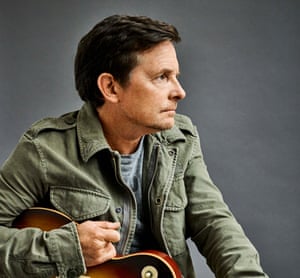
Michael J Fox: ‘My kids found a picture of me from 1983 with Eddie Van Halen, and I thought, what a cool life I’ve lived.’
Photograph: Jeff Lipsky/CPi Syndication
The last time I spoke to Michael J Fox,
in 2013, in his office in New York, he was 90% optimistic and 10%
pragmatic. The former I expected; the latter was a shock. Ever since
1998, when Fox went public with his diagnosis of early-onset Parkinson’s
disease, he has made optimism his defining public characteristic,
because of, rather than despite, his illness. He called his 2002 memoir Lucky Man, and he told interviewers that Parkinson’s is a gift, “albeit one that keeps on taking”.
During our interview, surrounded by the memorabilia (guitars, Golden
Globes) he has accrued over the course of his career, he talked about
how it had all been for the best. Parkinson’s, he said, had made him
quit drinking, which in turn had probably saved his marriage. Being
diagnosed at the heartbreakingly young age of 29 had also knocked the
ego out of his career ambitions, so he could do smaller things he was
proud of – Stuart Little,
the TV sitcom Spin City – as opposed to the big 90s comedies, such as
Doc Hollywood, that were too often a waste of his talents. To be honest,
I didn’t entirely buy his tidy silver linings, but who was I to cast
doubt on whatever perspective Fox had developed to make a monstrously
unjust situation more bearable? So the sudden dose of pragmatism
astonished me. Finding a cure for Parkinson’s, he said, “is not
something that I view will happen in my lifetime”. Previously, he had talked about finding “a cure within a decade”. No more. “That’s just the way it goes,” he said quietly. It was like a dark cloud had partly obscured the sun.
Well, seven years is a long time, especially when you have a
degenerative disease, and since then, that little cloud turned into a
full thunderstorm. In 2018, Fox had surgery to remove a tumour on his
spine, unrelated to the Parkinson’s. The aftermath was arduous and
dangerous, as tremors and a lack of balance caused by the Parkinson’s
threatened the recovery of his fragile spinal cord. One day, at home on
his own, after assuring his family he’d be fine without them, he fell
over and smashed his upper arm so badly it required 19 screws.
Thankfully, he didn’t damage his spine, but the injury plunged him into
previously unplumbed despair. “There is no way to put a shine on my
circumstance,” he writes in his new memoir, No Time Like The Future: An Optimist Considers Mortality .
“Have I oversold optimism as a panacea, commodified hope? In telling
other patients, ‘Chin up! It will be OK’, did I look to them to validate
my optimism? Is it because I needed to validate it myself? Things don’t
always turn out. Sometimes things turn shitty. My optimism is suddenly
finite.”
Things
being as they currently are, this time Fox and I are meeting by video
chat, me in my home in London, him in his office in New York, which
looks just as I remember it. “We were here last time, right? I
remember,” Fox says, pointing with his chin towards the sofa. Behind him
is a photo of him and his wife of 32 years, the actor Tracy Pollan,
both of them looking so young, beautiful and in love. There is also a
painting of his dog, Gus, who is in his usual place, sleeping at Fox’s
feet. Fox himself, still as boyishly handsome as ever, looks much better
than I’d feared. He is 59 now, close to the average age for a
Parkinson’s diagnosis – except that Fox has already had it for 30 years
and is in the advanced stages. As he says, “You don’t die from
Parkinson’s, but you do die with it,” and typically the longer you have
it, the harder it becomes to carry out basic functions. He can no longer
play his beloved guitar, and can’t write or type; this latest book was
dictated to Fox’s assistant. He has increasing difficulty in forming
words, and occasionally needs a wheelchair. I worried beforehand that
talking to me for an hour would be too much, and – less professionally –
that I might cry at seeing the physical degeneration of the actor who
meant so much to me as a kid.
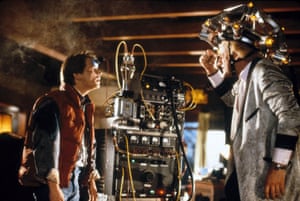
Michael J Fox and Christopher Lloyd in Back To The Future. Photograph: Universal Pictures
It
soon becomes apparent that both these concerns hugely underestimate
Fox. He talks for not just one hour but almost two, and while the
tremors, stiffness and occasional word stumbles are more pronounced than
when I last saw him, he is very much the funny, thoughtful and engaged
man I remember – so much so that within minutes I stop noticing the
effects of the Parkinson’s. Here’s a typical exchange: at the time of
our interview, the US election is still three weeks away, so we talk
about that. “Every worst instinct in mankind has been played on [by
Trump], and for me that’s just anathema. Biff is president!” he says,
with justified exasperation, given that Back To The Future’s evil bully
Biff Tannen was modelled on Trump.
I ask how he felt during the 2016 campaign when Trump mocked
the New York Times reporter Serge Kovaleski, who has a disability.
“When you see your particular group mocked, it’s such a gut punch. It’s
so senseless and cheap. There’s no way I get up in the morning and mock
orange people,” he says, and then makes the grin that, for those of us
who grew up watching him in the 1980s and 90s, is our Proustian
madeleine.
Back in the mid-80s, Fox was one of the biggest stars in the world. He was in the TV sitcom Family Ties, playing the Reaganite son of a pair of hippies, and the lead in the most successful movie of 1985, which was, of course, Back To The Future.
It was a meteoric rise for a former army brat who, only a few years
earlier, had dropped out of high school in Vancouver to become an actor
in Los Angeles. Fox’s parents couldn’t afford a colour TV until the
mid-70s, by which point he was already appearing on Canadian TV shows,
having taken himself off to auditions as a teenager.
From the start, Fox had terrific screen presence, partly because of
his athleticism. As a kid, his small size belied his hockey talents
(“It’s a Canadian thing”), and directors quickly spotted his gift for
physical comedy: think of when he dances to Surfing USA on top of the van in Teen Wolf, or how he tries to mirror James Woods in the bafflingly underrated 1991 comedy The Hard Way. And most of all, think of the skateboarding, the guitar-playing and all that frantic running
in Back To The Future. So for Fox to get an illness that affected his
bodily control was an irony that was not lost on him. “I had always
liked being an actor that editors would cut to at any time for an
appropriate reaction – my character would be animated and engaged.
Gradually, with the effects of Parkinson’s, my face began retreating to
a passive, almost frozen disposition,” he writes in No Time Like The
Future.
In Teen Wolf in 1985. Photograph: Moviestore/Rex/Shutterstock
Advertisement
But, I tell Fox, I think he’s done some of his best acting since his diagnosis, especially as the slippery lawyerLouis Canning in The Good Wife, who exploits his disability to win his cases; and as the pill-popping paraplegic Dwight on his friend Denis Leary’s show, Rescue Me
(he was nominated for three Emmys for The Good Wife, and won for Rescue
Me.) “It’s like my walking. I used to walk fast, but every step is now
like a frigging math problem, so I take it slow. And with acting, I used
to race to the punchline. But I started to really pay attention because
I couldn’t just skate over any moment.” Since 2018, he has had to put a
pause on the acting. “If something changes, great, or maybe I can
figure out how to do it a different way,” he says, but sounding more as
if this is for my benefit than an actual expectation.
Fox felt uniquely prepared for lockdown. “All the virtual meetings
and keeping 5ft away from people? I do that anyway,” he says. One of the
most poignant moments in his book comes when he describes making a
surprise visit to his mother on her 90th birthday, and his fear of
knocking her over due to his worsening balance. “That is difficult. But
Parkinson’s is harder for the people around me than it is on me. The
wide variety of movement, from being frozen to careening down the street
like a pinball, yeah, that’s hard. But in terms of my feelings about
the progress of it, that’s just my situation,” Fox says.
His optimism has, he says, “dimmed or softened” over the years, maybe
because of age, maybe because of the inexorable progress of the
disease. But one thing that has not changed is his refusal to be
self-pitying. “I just don’t see the upside in extracting sympathy from
people, or leading with your vulnerability. I need to be understood
before I’m helped, because you have to get me before you can get me
there,” he says. Pollan, his wife, is not, he says, “all soft-eyed,
like, ‘Are you OK?’ She’s like, ‘Are you really wearing that shirt?’”
Because you’re not a patient to her, you’re her husband. “Exactly,” he says, with a relieved grin: I have understood him.
This aversion to self-pity nearly kiboshed the book when coronavirus
hit, because, he says, “I couldn’t write about myself and my inner
wahhhh when the world is falling apart.” (His publishers disagreed and
told him, “Use the time to make your deadline.”) It would have been a
real shame if he had junked it, because the book is great: moving but
also properly funny (only Fox would take up golf after
developing Parkinson’s), and now that he has, to varying degrees,
jettisoned the fig leaf of determined optimism, it gives the clearest
description of life with Parkinson’s I’ve ever read. Ostensibly, it’s a
memoir of his past few years, but Fox describes it more accurately as
“an internal travelogue”. “I believe in all the hopeful things I said
before,” he says. “But that all seems silly when you’re lying on the
floor, waiting for the ambulance because you broke your arm, and you
feel like an idiot because you told everyone you’d be fine and you’re
not,” he says.
Advertisement
But
how could he have known? By dint of having Parkinson’s, Fox has had to
become the public’s and his family’s guide to the illness – the world’s
highest-profile expert on it, even. But in truth, he’s just figuring it
out as he goes along. “Yeah, I’m not playing this on TV,” he laughs. It
must have been strange seeing his son – who looks so much like him – go
past the age of 29, and to see how obscenely young he was when he was
diagnosed, I say.
“Oh yeah, I was a baby. It took me a long time to get my act together
and start addressing it,” he says. “It’s such an insidious disease,
because when you’re first diagnosed, what you’re presenting is
relatively minor. I had a twitching pinky and a sore shoulder. They
said, ‘You won’t be able to work in a few years,’ and I’m thinking,
‘From this?’”
When Fox was diagnosed, he had been married for three years and his
son, Sam, was a toddler. At first, he couldn’t believe it; then he tried
to figure out why. It is believed that a combination of genetic and environmental factors, such as pesticides and pollution, may cause Parkinson’s; Fox later learned that at least four cast members of Leo & Me,
a Canadian TV show he starred in as a teenager, also developed
early-onset Parkinson’s. “But believe it or not, that’s not enough
people to be defined as a cluster, so there hasn’t been much research
into that. But it is interesting. I can think of a thousand possible
scenarios: I used to go fishing in a river near paper mills and eat the
salmon I caught; I’ve been to a lot of farms; I smoked a lot of pot in
high school when the government was poisoning the crops. But you can
drive yourself crazy trying to figure it out.”
Eventually his symptoms became sufficiently noticeable that he had to
quit his sitcom Spin City (for which he won three Golden Globes and an
Emmy), and make his diagnosis public. He established the Michael J Fox Foundation,
which helped sustain his optimism, and in two decades raised more than
$1bn for research. It is one of the most high-profile and effective
organisations fighting for a cure.
***
The ultimate source of his motivation is Pollan. The couple met in
1985 on the set of Family Ties, when she guest-starred as his
girlfriend. One day on a lunch break, Fox – a rising star and cocky with
it – teased her about her garlic breath. Instead of being intimidated,
Pollan snapped back: “That was mean and rude and you are a complete and
total fucking asshole.” Fox fell in love instantly. She has helped keep
him in line ever since, and he says she got him out of his depressive
slump in 2018. She is, clearly, a hell of a woman. Four years after
Fox’s diagnosis, they had their twin daughters, Schuyler and Aquinnah.
After the twins’ fifth birthday – and only two years after he’d had
brain surgery to quell the tremors on his left side (it worked, but with
Parkinson’s characteristic cruelty, the tremors then moved to his right
side) – Pollan told Fox she wanted another baby; their youngest, Esme,
was born in 2001. I tell Fox that after my twins’ fifth birthday, I
didn’t want another child, I wanted a Valium.
Advertisement
“Ah,
it was getting too quiet at home. We knew it needed to be noisier,” he
smiles. No Time Like The Future is studded with memories of big family
holidays, neither Fox nor Pollan letting the Parkinson’s hold them back.
Although that, too, is starting to change: the family trips to the
beach have become tricky, as it’s hard for Fox to walk around. But he’s
still determined to go on one soon, with Pollan to St Barts: “Sometimes I
write cheques I can’t cash, but what the hell,” he shrugs.
Another factor that has helped is the wealth Fox reaped when he was
younger, not least from Back To The Future. But he nearly wasn’t in that
film at all. Eric Stoltz was originally cast as Marty McFly, until
director Robert Zemeckis realised Stoltz didn’t have what was later
described as “the screwball energy”Marty needed,
and he knew which actor did. Fox has never resented being so defined by
one film, but for a long time he was bemused by Back To The Future’s
impact. “It’s only recently that I’ve begun to understand it. I showed
my son Sam movies from that time which I loved – 48 Hrs, The Jerk
– and he didn’t get them. But if you show a kid today Back To The
Future, they get it. It’s this thing that’s timeless, which is ironic
because it’s about time,” he says.
A large part of that timelessness is down to Fox. His bright-eyed
charm and, yes, screwball energy give the film a joyful momentum that
makes it an enduring pleasure. For me, it is that rarest of things: a
perfect movie, easily up there with The Godfather and Some Like It Hot. But there is one scene that has become more painful to watch as the years have passed. Marty (Fox) is playing guitar at the school dance
where his parents, George (Crispin Glover) and Lorraine (Lea Thompson),
originally got together, but it looks as if that might not happen now.
As George walks away, Marty’s fingers stop working as they should. Then
his legs go, and he collapses on to the floor. “I can’t play,” he
mutters, shocked. Just then, George kisses Lorraine, and Marty snaps up,
as if on springs. He looks with relief at his now functioning hand, and
then launches into his performance of Johnny B Goode. But life, as Fox
says several times in his book, is not like a movie.
In The Good Wife in 2015. Photograph: CBS/Getty Images
Advertisement
What
is the middle ground between optimism and despair? Before talking with
Fox, I’d have suggested pragmatism, but that gets dangerously close to
despair when you’re having to be pragmatic about a degenerative disease
with, as yet, no cure. So Fox found a different path. “When I broke my
arm, it was relatively minor, but that was the thing that destroyed me. I
thought, what further indignity do I have to suffer? What have I done?
Maybe I was wrong to think I couldn’t complain before, maybe optimism
doesn’t work,” he says. There were, he says, some dark days spent lying
on the sofa, but after a while he got bored. “Then I came to a place of
gratitude. Finding something to be grateful for is what it’s about,” he
says. Optimism is about the promises of the future, gratitude looks at
the present. Fox has retrained his focus from running towards what will
be, to seeing what is.
He and Pollan spent lockdown on Long Island with all their children:
Sam, 31, Schuyler and Aquinnah, 25, and Esme, 19. “We were always
linger-after-dinner people anyway, and now we were lingering and talking
about what people were going through. Doing jigsaws, Tracy cooking up a
storm, everyone there, these wonderful children and this great wife,”
he says. When Fox says “I can’t believe I have this life”, he is not
referring to the restrictions of Parkinson’s – he is talking about his
happy home.
We have now gone more than 40 minutes over the allotted time, and he
repeatedly assures his assistant, who comes in to check, that he wants
to keep talking. I tell him that since we last met I’ve interviewed
pretty much every major player from Back To The Future.
“How’s Crispin?” he asks, with palpable curiosity about his notoriously eccentric former co-star. Pretty out there, I say, which is an understatement.
“I haven’t spoken to Crispin since the movie, but I always liked him.
I remember on the first movie, him and Bob Zemeckis really going at
each other about this one scene: Crispin wanted to do it with a broom
and Bob didn’t, and oh my God! The indignation! As soon as they moved on
and it was safe, I poked my head out of the dressing room, and Chris
[Lloyd] poked his head out, and we looked at one another and were like,
‘Thank God that was nothing to do with us!’” he says, bugging his eyes
out, Christopher Lloyd-style.
Lloyd is no slouch in the eccentricity department himself. When I interviewed him in 2016,
the one time he showed real, non-ironised emotion was when talking
about Fox: “What he’s had to deal with, and he just moves ahead with
humour and sensitivity. I was watching Back To The Future recently and I
thought, ‘Wow, the way he moved… ’”
Marty and Doc’s friendship feels so real on screen that it has been homaged endlessly, including the cartoon Rick And Morty.
Were they close when they made the film? “We were both so focused on
what we were doing, and I was also making Family Ties at the same time,
so we didn’t really hang out. But we became close after the movies, and
now we’re really tight,” Fox says.
Advertisement
By
this point, I let my guard down so much that, to my horror, I hear
myself telling Fox that, whenever anyone asks me who my favourite
interviewee is, in my two decades of talking to celebrities, I always
say him. I also burble that interviewing him in 2013 for ever changed my
perspective of chronic illness and what constitutes a life well lived.
He smiles the smile of a man who is used to hyperbolic compliments from
strangers, but does not doubt their authenticity.
“This will sound strange, but Eddie Van Halen passed away the other day, and he had a cameo in Back To The Future,” he says. (Van Halen played the music that Marty plays to George,
to convince him he’s being visited by an alien.) “My kids found a
picture of me from 1983 with Eddie Van Halen, where I look 12, and he
looks 14, and I thought, ‘What a cool life I’ve lived, where my kids can
find a picture of me with Van Halen on the internet.’ It’s like looking
back on footprints in the sand. Look where I’ve been.”
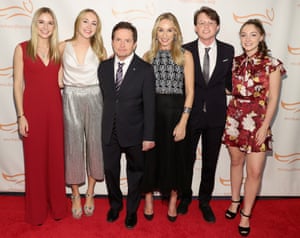
Michael J Fox with his family, from left: Schuyler,
Aquinnah, his wife, Tracy Pollan, Sam and Esme in 2018. Photograph:
Getty Images
Does he ever watch his old movies? “I don’t. I might watch for a few
minutes, then I change the channel. It’s just… ” he trails off. He
changes the subject to Muhammad Ali, who was diagnosed with Parkinson’s
in his early 40s and died in 2016. “I wondered what he thought when he
saw old footage of himself, so I asked his wife, Lonnie, if it made him
sad. She said, ‘Are you kidding? He loves it! He’d watch it all day if
he could.’ For him, any feelings of loss or wistfulness were overtaken
by the celebration that it existed: it’s a fact, it’s evidence and it’s
preserved.”
His
children, he says, don’t really watch his movies. When his daughters
were younger and read magazines about One Direction, he would say,
“Thirty years ago, that was me!” What did they do? “They would roll
their eyes. But my son, Sam, he gets it. He knows all about filmmakers
and films, so he really understands my career.”
Maybe that’s a way for him to get to know you in the past, I say.
Like Marty meeting a young George. “Yeah, maybe. I think he appreciates
it. But I never wanted my kids to know me as anything other than their
dad.”
His assistant comes in to ask him about lunch. He says he’s happy to
keep talking, but I say I’d feel bad if I kept him from going out for
lunch with his wife. “OK, it was nice to see you. I’ll write another
book just to do this again,” he says, cheerfully.
Before he goes, I sneak in another question: given that he uses the
word in his book’s title, how does he feel about the future now? “I
don’t make a lot of plans. I’m a little – I sometimes wonder how… ” he
trails off again. Until so recently, he maintained momentum: travelling,
golfing with his friends, determinedly moving forward. How is he
finding staying still? “Some of those changes are hard. But as limited
as I am in some regards, if you’d told me when I was diagnosed that I’d
have this life now and do the things that I do, I’d have said, ‘I’ll
take it.’ I can move around – it takes some planning, but I can move. I
can think, I can communicate and I can express affection. What else do
you want?”