Showing posts with label creatine. Show all posts
Showing posts with label creatine. Show all posts
Sunday, August 30, 2026


Friday, August 28, 2026
Can Creatine Help Non-Athletes? A Physical Therapist Weighs In
Ask your competent? doctor EXACTLY what should be done with this! Hemming or hawing is grounds for firing!
creatine (21 posts to February 2015)
Can Creatine Help Non-Athletes? A Physical Therapist Weighs In
Creatine may have less risk than other supplements, but who might benefit is unclear
Creatine may help boost athletes' ability to perform high-intensity activities like resistance training, sprinting, and jumping.
But can it help others?
Muscle mass declines with age, and the purported benefits of creatine supplements may extend beyond athletes to other people who don't have a contraindication, said Brian DeVeaux, DPT, of Northwell STARS Rehabilitation and Hofstra University in Hempstead, New York.
While a 2004 randomized trial found that patients did not benefit from creatine 12 weeks after anterior cruciate ligament reconstruction, DeVeaux believes the supplement can help improve recovery after injury, especially for people who have been in a brace for some time and haven't been mobile.
"I think it can help enhance strength gains," DeVeaux told MedPage Today, noting that patients need more than creatine supplements to support the rehabilitation process.
Creatine might have other benefits. The overall body of literature about creatine and brain health is inconsistent and has significant knowledge gaps, but in a study of 20 Alzheimer's patients who received creatine monohydrate supplements, brain creatine increased by 11% from baseline over 8 weeks -- an outcome that should be interpreted with caution, the researchers said.
Creatine is produced naturally in the body. It helps improve metabolism by regenerating adenosine triphosphate (ATP) from adenosine diphosphate (ADP).
Creatine supplements are not recommended for adolescents due to limited data. Except for people with significant kidney disease, creatine appears to be safe for most adults if it's accurately labeled, Pieter Cohen, MD, of Cambridge Health Alliance and Harvard Medical School in Boston, said in an interview last year with MedPage Today.
"The problem is that's not assured, because all creatine is being sold as dietary supplements," Cohen pointed out.
"Supplements don't get vetted like pharmaceutical or even over-the-counter medications do," he said. "Study after study has demonstrated that what's in a supplement product is not necessarily what's on the label." A good way to prevent that would be to buy a supplement that's verified by a high-quality third-party certification program like the U.S. Pharmacopeia (USP) dietary supplement verification program, he added.
Large clinical trials are not required to promote the benefits of supplements, Cohen noted. "Unlike pharmaceutical drugs, a supplement could be promoted as having health benefits, even when none are proven in humans," he said.
Individuals need to be aware of what kind of creatine they are buying and how much they are taking, DeVeaux emphasized. The product should be creatine monohydrate, he added. A daily dose of 3 to 5 grams is considered standard.
Creatine users may have gastrointestinal problems like bloating or stomach discomfort, DeVeaux noted. Not staying well-hydrated while taking the supplement can lead to dehydration and cramping.
People who want to use creatine need to start with a good nutrition plan from food and not rely on supplements, DeVeaux observed. Creatine can help "build strength and power," he stated. But it's critical to have a solid strength and conditioning program and guidance "on top of that" for creatine to be effective, he said.
5 Unexpected Ways Creatine Supports A Sharper, Healthier Brain by mindbodygreen
Ask your competent? doctor EXACTLY what should be done with this! Hemming or hawing is grounds for firing!
5 Unexpected Ways Creatine Supports A Sharper, Healthier Brain
Sunday, August 16, 2026
Seven lifestyle changes that are more effective than longevity treatments
With all this research on longevity, healthspan and lifespan; SHOULDN'T YOUR COMPETENT? DOCTOR ALREADY HAVE PROTOCOLS PREPARED? NO? So, PURE INCOMPETENCE!
And your board of directors is so incompetent they don't recognize incompetence in their hospital! YOU better start running that hospital!
- longevity
(129 posts to October 2013)
- longevity diet
(19 posts to July 2021)
- longevity exercises
(6 posts to November 2020)
- healthspan
(31 posts to December 2024)
- lifespan
(17 posts to September 2016)
- lifestyle interventions
(3 posts to August 2017)
Seven lifestyle changes that are more effective than longevity treatments
Dr Clare Nieland, 51, is a general practitioner with more than 20 years of experience working in the NHS and private sector at Hooke Clinic in London and the Windsor Wellness Clinic. She believes strongly in the power of nutrition and healthy lifestyle choices for achieving optimum wellbeing.
Longevity is a real buzzword nowadays. It is particularly rife on social media, where numerous brands and influencers claim they hold the secret to living past 100.
Whilst it is great that many of us are striving to live longer, the obsession with longevity misses a crucial point – we need to ensure those extra years are spent in good health. I help my patients improve their “healthspans”, to keep them independent, mobile and mentally sharp for as long as possible.
There is no use in buying “anti-ageing” supplements or spending thousands of pounds on therapies that claim to reverse biological ageing if you are not mastering the basics of a healthy lifestyle – nutrition, physical activity, sleep and stress management. You cannot out-run a bad diet or cure chronic stress with a single supplement.
In my NHS and private practices, I apply a combination of conventional and lifestyle medicine as both methods are important. Conventional medicine trains doctors to treat the disease, whilst the world of lifestyle medicine is markedly different – we are taught the fundamentals of good health and how to prevent issues from occurring in the first place.
A larger focus on preventative medicine is in the NHS 10-year-plan, and I would love to see this become a reality. When I trained as a doctor, we were not taught about the power of nutrition or physical activity in creating good health and preventing disease. Nowadays, though, it is encouraging to see some medical schools introducing lifestyle medicine into the curriculum. Hopefully this momentum continues.
Related video: Research reveals the habits scientifically proven to add a decade to your lifespan (Talking With Docs)However, it goes without saying that not everyone can afford such testing. Luckily, there are all sorts of habits you can adopt in your daily life to improve your healthspan. As a proponent of the lifestyle-first approach, I try my best to practise what I preach – these are my top tips for ageing well.
1. Cook from scratch with your friends and family
I live in Windsor with my husband Nick, a former Olympian, our three rugby-obsessed teenage boys, and our gorgeous black labrador Bella. Life is always busy, and certainly never boring, so I try my best to optimise the fundamentals of eating well, getting enough sleep, regularly moving, and connecting with others.
strong relationships as we age. In fact, a wealth of research links social isolation to a heightened risk of disease and early death.
It is important to me that my boys can cook, are self-sufficient and feel comfortable in the kitchen. Sadly, I think we are failing the future generation with our over-reliance on ultra-processed foods (UPFs) at the expense of cooking with fresh, healthy ingredients. We know that UPFs are incredibly bad for us, with a range of studies linking them to adverse health outcomes including obesity, type 2 diabetes and cardiovascular diseases.
(Not for me, cooking one-handed is just waiting for me to cut myself, I buy meal kits from Home Chef.)
2. Keep your cupboards stocked with beans and brown rice
I inherited good genes, but there is a mild family history of pre-diabetes and cardiovascular disease, so I try to stick to the Mediterranean diet pattern, as it is consistently linked with a reduced risk of chronic disease.
My cupboards are always stocked with lentils, tinned tomatoes, beans, chickpeas and brown rice, as well as onions and garlic, plus a full spice rack. These are great (and cheap) staple ingredients and have a range of powerful health benefits.
Research suggests that swapping white rice for brown rice improves blood sugar levels and can help with weight control. Meanwhile, lentils are a rich source of protein, fibre, essential amino acids and minerals. Plus, they are packed with polyphenols – anti-inflammatory and antioxidant compounds – which help to prevent chronic diseases like diabetes and obesity.
Each week, I stock my fridge with fresh meat from the local farm shop. As I live with four active men, I try to ensure our meals are high in quality protein, which is important for muscle growth, bone density and satiety. I love batch-cooking a rich and meaty ragu at the weekend, which keeps us going for a few days. Planning and batch-cooking for the week ahead, incorporating cheap cupboard staples with fresh sources of protein and vegetables – instead of stocking up on ready meals – is a great way to cut back on UPFs.
3. Practise balancing while brushing your teeth
As our balance naturally declines with age, our risk of falling increases, which also increases fracture risk. However, there are simple measures we can take to improve it. At my NHS practice, I work closely with a health coach who advises patients to incorporate balancing into their daily routine – whether that is standing on one leg while brushing your teeth or squatting as you wait for the kettle to boil. At Hooke, we measure your balance as a baseline and it is a trainable skill.
Improved balance means you are less susceptible to falls and hip fractures – both of which are linked to an increased risk of early mortality in older adults. It will also result in better co-ordination, increased stability and stronger muscles. Even if you do fall, the extra padding from your muscles and improved bone strength means you are less likely to have a fracture.
One study published in the British Journal of Sports Medicine found that people in middle to later life who could not stand on one leg for 10 seconds had almost double the risk of premature death.
On my good leg I can do this, my bad leg not even close. Since I haven't been able to do this since my stroke at age 50 I guess I should have died sometime in the ensuing 20 years. I thought the Berg Balance Scale testing that was common, was totally worthless since there never was any specific therapy given to address the failure points I had in that test. So 20 years of failure already and my next 30 years will be no better, totally useless for me!
Balance is therefore a powerful predictor of ageing and longevity, as is grip strength. If your muscles are strong, so is your grip. One influential study, published in 2015, followed more than 140,000 adults across 17 countries and found that grip strength predicted mortality and cardiovascular events more strongly than systolic blood pressure.
You can test your grip strength simply by squeezing a foam ball in your hand. Squeeze it for as long as you can before your grip fatigues and continue to practise this regularly, whilst improving your overall body strength with resistance exercises. Over time, you should be able to grip the ball for a longer period, suggesting your muscles have strengthened.
My doctor and therapists COMPLETELY FAILED AT RECOVERING MY LEFT HAND! So this really has no basis for me, but my right hand is stronger than ever.
4. Prioritise morning sunlight
I try to get outside for a walk with Bella within an hour of waking, even if it is just for 10 minutes. Morning sunlight improves sleep quality by stimulating the release of melatonin, the sleep hormone. It also supports long-term cardiometabolic health, by helping to regulate our circadian rhythm and promoting vitamin D synthesis.
the sunlight is a simple habit to reduce stress, with a wealth of research suggesting that it helps to reduce levels of cortisol, the stress hormone.
Not everyone can get outside first thing – plus, you might not want to during the dreary winter months. A good alternative is to buy a seasonal affective disorder (SAD) lamp, as they emit bright light that mimics natural sunlight, and can improve alertness, mood and sleep-wake timing. It may even reduce symptoms of SAD, but it is important to note that you don’t produce vitamin D this way.
Even having a brisk lunchtime walk helps, although be aware that the later you get outside, the later your brain will signal that it is time to sleep in the evening.
5. Give creatine a try – and have your vitamin D levels tested
In an ideal world, you would have a bespoke supplement created for you that addresses your various needs and deficiencies. Some people can afford such a luxury, that is not the reality for many. Whilst I am against wasting money on pills and potions that have no significant evidence base, I believe creatine and vitamin D are worth taking.
Creatine is one of the most extensively studied supplements. It is proven to boost strength and power in resistance training, while a meta-analysis by Oxford University found that creatine supplementation enhanced measures of memory performance in healthy individuals, especially in those aged 66-76.
The standard dose of creatine is 3-5g per day, although emerging evidence suggests 10-15g may be better to reap the cognitive benefits. This is safe for most healthy adults, but I would advise sticking to the 3-5g dose for now, as research continues to develop. When buying creatine, make sure it is pure, with nothing added (I use Bulk Powders “Pure Creatine”, which is very affordable).
The NHS recommends that everyone take a daily vitamin D tablet in the winter months, with recent data suggesting that almost half of UK adults have lower than “optimal” levels. The standard guidance is 400 international units (or 10 micrograms) of vitamin D per day, but in reality we need so much more.
I advise my patients to have their vitamin D levels tested on the NHS or privately, and then to start taking a daily supplement containing 2,000-3,000 international units, or a tailored amount according to results. Yes, that is a much higher dosage, but vitamin D is crucial for the immune system, bone health, muscle function and brain.
6. Get creative with resistance training
I lift heavy weights three times a week and take pride in having muscles – they are a longevity organ. Just two to three short resistance sessions a week can reduce frailty, insulin resistance and cognitive decline more than cardio alone.
Lots of women worry that strength training will make them bulky, but it simply won’t happen because there is not enough testosterone floating around in our bloodstreams. After 40, we start to experience muscle loss (sarcopenia), which means we actively need to build or maintain muscle mass. The same is true for bone density – as our hormones start to decline, our bones weaken and we are more likely to develop osteopenia or osteoporosis. This can lead to bone fractures, even from minor falls or strains.
Strength training can help you to avoid these fates. Whilst joining a gym is a great way to meet new people and strengthen social connections, you can also get creative at home. Start small – whether that is raising tins of beans above your head or practising chair squats. It is never too late to start!
7. Experiment with hot and cold therapy
There are plenty of fads and quick fixes in the world of biohacking (the process of implementing scientifically-backed lifestyle interventions to optimise health) that lack solid evidence and are not worth your money. I would urge you to master the basics before trying anything which claims to be the key to longevity – there is no use spending hundreds of pounds on cryotherapy, which uses extreme cold to enhance recovery and reduce inflammation, if you spend your weekends binge drinking alcohol and don’t exercise.
However, I would recommend hot and cold therapy. If you have access to a gym or spa, this involves alternating between a sauna and ice bath; or you could simply start with a cold shower.(I just bought a personal sauna, will use the cold shower instead of an ice bath. Not sure I could get out of an ice bath with only one useable arm/hand)
The alternate temperatures help to boost circulation by causing blood vessels to rapidly expand and restrict, creating a “vascular pump” that improves blood flow, oxygen delivery and nutrient transport. It also creates hormesis – the “good” type of stress, which helps your body to adapt and strengthen.
Evidence suggests that regular sauna use could reduce dementia risk and, now, there are lots of affordable options for in-home saunas. You don’t need to spend a fortune on a fancy spa membership!
Yeah, your FUCKINGLY INCOMPETENT? DOCTOR hasn't told you about heat and cold shock proteins, right?
- cold shock proteins
(10 posts to October 2023)
- heat shock proteins
(11 posts to April 2013)
As told to Ella Nunn. You can find Dr Clare on Instagram @windsorwellnessdoctor
Recommended
I'm 55 with the biological age of a 20-year-old. These are my cheapest and easiest health tips
Monday, August 10, 2026
We Asked Doctors Which Supplements Actually Support Healthy Aging—These Are the 9 They Recommended
And you think your doctor actually knows anything about this?
We Asked Doctors Which Supplements Actually Support Healthy Aging—These Are the 9 They Recommended
Fact checked by Nick Blackmer
Supplements are everywhere these days, promising to help improve nearly every facet of your health—some also say they can boost longevity or promote healthy aging.
Taking supplements can’t guarantee that you’ll live longer, and many products aren’t doctor-approved or backed by medical research.
But certain products stand out amongst the rest when it comes to helping you age well. Here are the nine supplements experts recommend.
Always Check With a Doctor First
Talk to your doctor before trying new supplements to see if they’re right for you. Some can negatively interact with certain prescription medications or worsen symptoms of underlying health conditions.(You really think your doctor has any clue about supplements? WOW!)
1. Omega-3 (Fish Oil)
Exploratory studies have found that omega-3, which is found in fish oil capsules, is associated with better memory. It may also be able to help slow biological aging when combined with vitamin D and exercise.
“Omega-3 fatty acids reduce chronic inflammation and support heart and brain health, [as well as] healthy aging,” John Rinker, MD, internal medicine physician at OSF HealthCare, told Health.
Related video: These 3 Foods Should Be Eaten by Everyone Over 50 to Preserve Muscle Mass (Welltica+)Thomas Perls, MD, MPH, professor of medicine at the Boston University Chobanian & Avedisian School of Medicine and director of the New England Centenarian Study, told Health. However, research is mixed.Who should take it: Most people over 40 can take 1-2 grams of omega-3 fish oil capsules per day, Rinker said. Just be sure to avoid high doses if you’re taking a blood thinner, Kien Vuu, MD, author and performance and longevity medicine consultant, told Health.
(Newer research which I'm sure your doctor doesn't know about;
Taking omega-3 for your brain health? A new study says there are better options)
2. Vitamin D3 + K2
Vitamin D3 and K2 are often combined into one supplement because they work together in a very specific way, and are “critical for immune balance, bone health, and vascular strength,” Vuu said.
Also known as cholecalciferol, “vitamin D3 is necessary for calcium absorption for bone and muscle strength,” Chris Renna, DO, family medicine physician and founder of LifeSpan Medicine, told Health. It can also support immune function and create healthy skin, he said.
Meanwhile, vitamin K2 is used to make proteins involved in blood clotting and bone metabolism. Plus, it may help prevent the buildup of minerals in your arteries.Who should take it: Supplements containing both vitamins D3 and K2 are specifically helpful for people over 50, Rinker said. But people should use caution if they’re taking Warfarin, or if they have existing calcium disorders or kidney dysfunction, he said.
3. B Vitamins
There are eight types of B vitamins, and each one plays a crucial role in your health. They help with metabolism, DNA production, and immune system function, and can “protect neural pathways and enhance energy,” said Vuu.
For older adults, deficiencies in vitamin B can contribute to health issues such as cardiovascular disease, stroke, cognitive disorders, mental health issues, and more.
Researchers have suggested that vitamin B12, in particular, may be involved in aging at the cellular level, but evidence is still preliminary.
Who should take it: If bloodwork shows that you have low vitamin B levels, your doctor might recommend you take a complex supplement once daily.
4. Magnesium
While most people take magnesium to improve sleep or reduce stress, experts said it could help with healthy aging, too.
Magnesium deficiency has been linked to increased chronic inflammation and other concerning cellular changes, which may raise people's risk of conditions such as heart disease, cancer, and Alzheimer’s disease.
Plus, low levels of magnesium can also mess with your sleep, which is connected to longevity.
Who should take it: “Magnesium typically helps most adults, especially those with a deficiency,” Rinker said. That can be diagnosed with a blood test. There are many different types and formulations of magnesium supplements, and a healthcare provider can help you choose which one might work best.
5. CoQ10
Coenzyme Q10, or CoQ10, is an antioxidant that’s abundant in the body. It also helps with mitochondrial function, where it provides energy for cell growth. This is “vital to high-energy-demanding organs like our brain, heart, and skeletal muscle,” Renna explained.
As you age, your CoQ10 levels naturally decline. But research suggests taking CoQ10 supplements may help reduce inflammation, support heart health, and protect cells from damage called oxidative stress.
Who should take it: Some research suggests CoQ10 could lower “blood pressure and blood sugar, which may not be helpful to some people taking medicine prescribed to do those same things,” said Renna.
6. Fiber
According to Vuu, fiber supports your gut barrier’s integrity and calms chronic inflammation. It’s also been associated with a lower risk of all-cause mortality, as well as a lower risk of death from cardiovascular disease or cancer.
Who should take it: The vast majority of Americans don’t get enough fiber each day. If you struggle to hit your goals, daily fiber supplements containing psyllium (Metamucil) or wheat dextrin (Benefiber) could help improve your gut and immune health as you age.
7. Calcium
As you age, your bones get weaker. This increases the risk of conditions like osteoporosis, and in turn, bone fractures.
Calcium supplements may help prevent this. The mineral has been linked to improved bone strength and bone density.
Who should take it: Most people don't get enough calcium, and a supplement can be helpful if you struggle to get enough in your diet. However, excess calcium can be dangerous—have a healthcare provider check your levels before starting a supplement, particularly if you have other health conditions.
8. Creatine
Creatine is often thought of as a “bodybuilder supplement.” But according to Rinker, creatine can help people preserve muscle mass and reduce the risk of muscle wasting, or sarcopenia, as they get older. It could “also help with inflammation and joint health,” he added.
Some evidence suggests that creatine supplementation for older adults can enhance memory, though more research is needed.
Who should take it: Most creatine comes in powder form that’s mixed into beverages, and it can be taken anytime. The supplement is great for active people, but use it with caution if you have existing kidney issues.
Ask your competent? doctor if you need this and EXACT AMOUNTS TO USE!
4 Signs You Would Benefit From A Creatine Supplement If You’re 40+
9. Curcumin (Turmeric)
Curcumin—the main active ingredient in turmeric—helps tamp down inflammation in the body, Darshan Shah, MD, surgeon, longevity medicine specialist, and founder of Next Health, told Health.
Because of this, it could be helpful for longevity purposes. One study suggested curcumin may have a positive effect against neurodegenerative diseases, cognitive decline, and sarcopenia. Another review found that taking curcumin extract may be able to relieve knee pain from osteoarthritis.
Who should take it: Oral turmeric supplements are popular and could be beneficial for people with inflammatory conditions, Rinker said. "But it's advisable to exercise caution if you have gallstones or [gastrointestinal] sensitivity," he added.
Other Tips for Healthy Aging
Supplements alone cannot replace a healthy lifestyle—to live longer and healthier, it's crucial to:
- Eat nutritious food
- Exercise
- Manage stress
- Connect with others
- Attend regular checkups with your doctor
“Supplements are meant to amplify, not replace, other activities,” said Rinker. “I would really view supplements as the cherry on top, assuming you are doing all of those other lifestyle changes.”
Also, keep in mind that the Food and Drug Administration (FDA) does not regulate supplements in the same way that it does foods and medications.
Check with your doctor about which formulations to purchase, and “look for independent third-party testing such as National Sanitation Foundation (NSF) and United States Pharmacopeia (USP)” labels on the bottles, said Rinker.
Bottom Line
Taking supplements cannot guarantee that you’ll live longer. But certain ones could lower your risk of disease and tamp down inflammation, which may protect your health as you age.
It’s also important to remember that supplements promising the “fountain of youth” are likely overselling things. At the end of the day, nutritious eating, exercise, good sleep, and other healthy lifestyle factors have the greatest impact on your longevity.
Read the original article on Health
4 Signs You Would Benefit From A Creatine Supplement If You’re 40+ by mindbodygreen
Ask your competent? doctor if you need this and EXACT AMOUNTS TO USE!
4 Signs You Would Benefit From A Creatine Supplement If You’re 40+
Saturday, July 11, 2026
Is Creatine Supplementation for Brain Health Worth a Try?
Not until your competent? doctor approves it.
Is Creatine Supplementation for Brain Health Worth a Try?
Creatine supplements have been recently examined for their potential to improve brain health and prevent dementia. Given the lack of effective therapies for dementia, it is worth considering whether these supplements are safe and effective.
What Role Does Creatine Play in the Body?
Creatine is endogenously synthesized in the liver and kidneys, and its amino acid precursors are also provided by a variety of foods, including meat and vegetables. Most of the body’s creatine is stored in muscle cells as phosphocreatine; creatine serves to help replenish adenosine triphosphate during physical activity, which is why we have seen creatine supplements increasingly used in the setting of weight training and exercise over the past decade.
With the emerging understanding of its role in the brain, research on creatine supplementation has moved from the gym to the brain lab.
How Creatine May Affect Brain Health
Creatine is produced in the brain and retina through a process that involves the enzyme guanidinoacetate methyltransferase, which is highly expressed in glial cells. In addition to information on markers of creatine synthesis and activity, evidence is accumulating regarding the action of creatine in the brain.
Interest in creatine for brain health grew out of the knowledge that creatine deficiency or dysfunction may adversely affect cognition. Defects in the creatine transporter (CRT) gene (SLC6A8) result in low brain creatine levels, along with severe neurologic symptoms, defined as CRT deficiency syndrome. The mechanism of neurologic dysfunction is still unclear, and currently there is no treatment for CRT deficiency syndrome.
There are different creatine formulations. The most common one used in studies is powder mixed with water, which has a more established bioavailability. Other commercial forms include pills, capsules, and gummies.
The first step is to verify that creatine supplementation affects brain creatine levels. This is supported by a few small-scale human studies, but the increase is less than that seen in skeletal muscle.
Authors of a review noted that creatine supplementation may help improve mood, cognition, and sleep in healthy adults. The observed improvements were generally more notable among women than men, which the authors attributed to lower baseline endogenous creatine stores in women.
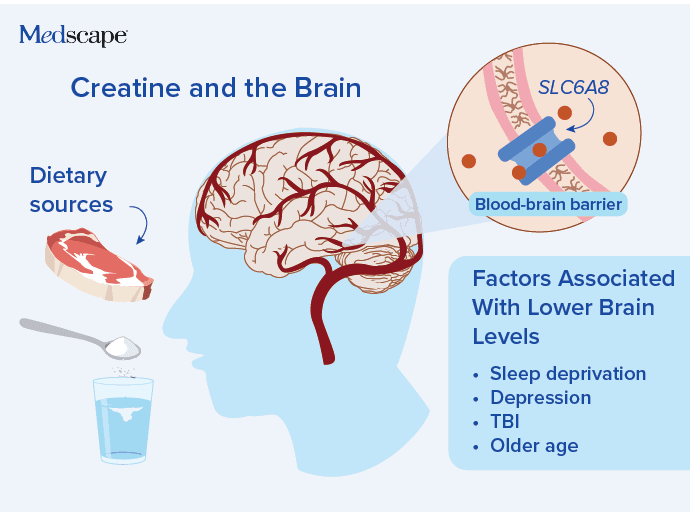
In a 2026 study in 29 sleep-deprived but otherwise healthy adults, 0.2 g/kg creatine monohydrate supplementation was associated with up to a 12% improvement of sleep deprivation-induced deterioration in cognitive skills. For a 150-lb adult, this dosage would be about 14 g of creatine per day.
Creatine Supplementation for Treating Brain Disorders
While experimental evidence suggesting that creatine supplementation may help healthy people does not automatically imply that extra creatine would be beneficial in the context of brain disease, there appears to be promise in the use of creatine supplements as an adjunctive treatment in some brain disorders.
According to a 2022 review in Nutrients, creatine supplementation may help reduce some symptoms of traumatic brain injury and concussion.
Creatine also has been explored as a possible treatment for Alzheimer’s disease symptoms or as a disease-modifying therapy. A single-arm pilot trial in 20 patients with Alzheimer’s disease found that 20 g/d creatine monohydrate for 8 weeks was associated with increased total brain creatine and modest improvements on cognitive tests.
Is There a Place for Creatine Supplementation for Healthy Adults?
The evidence is still not solid regarding potential benefits of creatine supplements for healthy individuals or for people who have dementia. And while creatine appears to be safe when used as a supplement for exercise and for building muscle, safety concerns have not been entirely ruled out. Furthermore, established dosing and dietary references are lacking.
Despite these shortcomings, it may be worthwhile for healthy adults or those with cognitive symptoms to try creatine supplements. So far, this supplement shows promise (albeit inconsistent) for short-term cognitive benefits, rather than a lasting impact on brain health. It is the short-lived nature of the effects that makes it worth trying. Many people use other supplements for brain health, like ginkgo biloba or ginseng, and can judge for themselves whether they see any benefits. The same principle applies to creatine – anyone taking it can assess if it improves their cognition or mood, without bearing the burden of deciphering whether a clinically undetectable effect is taking place.
Heidi Moawad, MD, is a neurologist and medical editor. She is on the teaching faculty at Case Western Reserve University. Dr Moawad resides in Cleveland, Ohio, and enjoys traveling, cooking, and taking exercise classes.
Subscribe to:
Posts (Atom)