Changing stroke rehab and research worldwide now.Time is Brain! trillions and trillions of neurons that DIE each day because there are NO effective hyperacute therapies besides tPA(only 12% effective). I have 523 posts on hyperacute therapy, enough for researchers to spend decades proving them out. These are my personal ideas and blog on stroke rehabilitation and stroke research. Do not attempt any of these without checking with your medical provider. Unless you join me in agitating, when you need these therapies they won't be there.

What this blog is for:

My blog is not to help survivors recover, it is to have the 10 million yearly stroke survivors light fires underneath their doctors, stroke hospitals and stroke researchers to get stroke solved. 100% recovery. The stroke medical world is completely failing at that goal, they don't even have it as a goal. Shortly after getting out of the hospital and getting NO information on the process or protocols of stroke rehabilitation and recovery I started searching on the internet and found that no other survivor received useful information. This is an attempt to cover all stroke rehabilitation information that should be readily available to survivors so they can talk with informed knowledge to their medical staff. It lays out what needs to be done to get stroke survivors closer to 100% recovery. It's quite disgusting that this information is not available from every stroke association and doctors group.

Showing posts with label stability. Show all posts

Sunday, December 10, 2023

Improving Strength and Mobility with Healthy Stability: A Case Report

If your therapists don't understand that the way to get to this is 100% recovery protocols; then you don't have a functioning therapist!

Improving Strength and Mobility with Healthy Stability: A Case Report

Written By: Lori Duncan, DPT, MTC, CPT
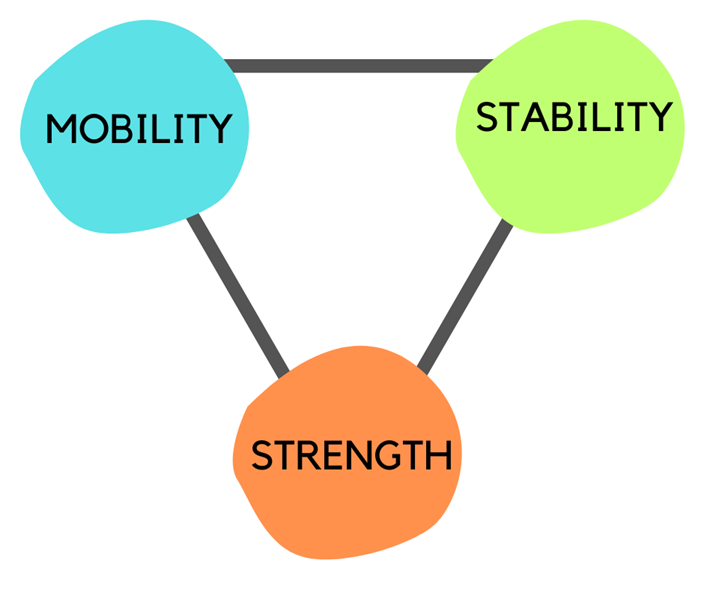


As therapists, we are always trying to optimize our patient’s function and independence. This requires a combination of strength, mobility, and stability. So where do we start?

Over the years, I have found that stability is often missed, skipped, or devalued in a patient’s rehabilitation program; however, the first 6-8 weeks of muscle gain is a chit-chat between the muscle and brain. This is neuromuscular recruitment (i.e. stability or motor control) not a change in muscle fiber size. In general, poor stability results in poor symptom resolution, and decreased strength and function. This is a schematic I use (I draw this for my patients) to show them the relationship of mobility, stability, and strength. Notice that strength is below, or after, mobility and stability. Yet so many rehabilitation programs begin with strength.

Here is a case report of a patient I am currently treating to illustrate the importance of the stability link to optimize our patient outcomes.


Clinical Notes:

September 2023: A 47-year-old man presented with significant right quadriceps atrophy after experiencing rhabdomyolysis from a compression injury in July 2023. He had been in rehab for 4+ weeks prior to our meeting but was still experiencing significant knee pain, functional weakness with stairs, and right quad a trophy.

For review, rhabdomyolysis is when damaged muscle releases muscle cell contents (i.e. Myoglobin, creatine kinase, etc.) into the blood. This release of cell contents can then cause a host of different organ damage. Luckily, this patient was treated quickly enough and only had resultant muscle atrophy.

His program from August-September 2023 (prior to coming to my clinic):

  • Lunges, squats, bridging, and walking on the treadmill

Lunges, squats, and bridging are FABULOUS exercises, but they are very strength-based. For a patient dealing with such significant quad atrophy, this was simply too much on the system and he was loading his knee joint. Watch the progression we used to resolve his knee pain and develop his quadriceps muscle. It’s not strength-based movements at first. 

September 2023 (initial program at my clinic):

  • Stability/Mobility: Pilates-based movements for the VMO, glutes and quads
  • Stability/Mobility: Physioball supine walkouts and HS curls

October 2023 (after 1 month he reported his symptoms were improving and was able to negotiate stairs with more confidence):

  • Stability/Mobility: Continued Pilates-based movements
  • Stability/Mobility: BOSU kneeling and bird dog
  • Strength: SL squat assisted and only to mid-range
  • Carioca for coordination and improved confidence with RLE

November 2023 (after 2 months he reported he was able to get up and down from the floor without pain):

  • Stability/Mobility: Pilates side-series for glutes, VMO and RLE endurance
  • Stability/Mobility: Physioball forearm planks, lateral lunge supported
  • Stability/Mobility: BOSU SL kneeling, bird dog knee to nose and standing SL balance
  • Strength: SL squat + hover over the chair, squat to toes reach
  • Mobility isolated: prone quad stretch to tolerance, dynamic not static

This is only one example of how the emphasis on early stability and mobility will optimize patient symptoms and outcomes; the possibilities are endless for how to incorporate this principle into treatment. In the end, our role as clinicians is to meet each patient where they are at and progress them appropriately so they can have a healthy return to their life and independent function outside of rehab.

Interested in learning more? Attend any or all of my 4 Live Streams on Improving Strength and Mobility taking place January 26th & 27th. Hope to see you there!


Explore online continuing education courses from Lori below:

Strengthening Core Stability

Optimizing Functional Movement

Tuesday, August 15, 2017

Effect of Core Stability Training on Trunk Function, Standing Balance, and Mobility in Stroke Patients

I see nothing here that suggests they used any type of repeatable protocol or had objective diagnosis of deficits prior to starting.  As such this research is worthless,  being nonrepeatable
http://journals.sagepub.com/doi/full/10.1177/1545968316675431#articleShareContainer

A Randomized Controlled Trial

First Published November 7, 2016 Research Article


Background. Trunk function is important for standing balance, mobility, and functional outcome after stroke, but few studies have evaluated the effects of exercises aimed at improving core stability in stroke patients.  
Objective. To investigate the effectiveness of core stability training on trunk function, standing balance, and mobility in stroke patients.  
Methods. An assessor-blinded, randomized controlled trial was undertaken in a stroke rehabilitation ward, with 32 participants randomly assigned to an experimental group or a control group (n = 16 each). The experimental group received 400 minutes of core stability training in place of conventional programs within total training time, while the control group received only conventional programs. Primary outcome measures were evaluated using the Trunk Impairment Scale (TIS), which reflects trunk function. Secondary outcome measures were evaluated by pelvic tilt active range of motion in the sagittal plane, the Balance Evaluation Systems Test–brief version (Brief-BESTest), Functional Reach test, Timed Up-and-Go test (TUG), and Functional Ambulation Categories (FAC). A general linear repeated-measures model was used to analyze the results.  
Results. A treatment effect was found for the experimental group on the dynamic balance subscale and total score of the TIS (P = .002 and P < .001, respectively), pelvic tilt active range of motion (P < .001), Brief-BESTest (P < .001), TUG (P = .008), and FAC (P = .022).  
Conclusions. Core stability training has beneficial effects on trunk function, standing balance, and mobility in stroke patients. Our findings might provide support for introducing core stability training in stroke rehabilitation.

Thursday, September 4, 2014

Measures of gait stability: performance on adults and toddlers at the beginning of independent walking

I would think that your doctor and therapist should be objectively evaluating your gait stability prior to discharge. 
http://www.jneuroengrehab.com/content/11/1/131/abstract
Maria Cristina Bisi, Federico Riva and Rita Stagni

For all author emails, please log on.
Journal of NeuroEngineering and Rehabilitation 2014, 11:131  doi:10.1186/1743-0003-11-131
Published: 3 September 2014

Abstract (provisional)

Background

Quantifying gait stability is a topic of high relevance and a number of possible measures have been proposed. The problem in validating these methods is the necessity to identify a-priori unstable individuals. Since proposed methods do not make any assumption on the characteristics of the subjects, the aim of the present study was to test the performance of gait stability measures on individuals whose gait is a-priori assumed unstable: toddlers at the onset of independent walking.

Methods

Ten toddlers, ten adults and ten elderly subjects were included in the study. Data from toddlers were acquired longitudinally over a 6-month period to test if the methods detected the increase in gait stability with experience, and if they could differentiate between toddlers and young adults. Data from elderly subjects were expected to indicate a stability value in between the other two groups. Accelerations and angular velocities of the trunk and of the leg were measured using two tri-axial inertial sensors. The following methods for quantifying gait stability were applied: stride time variability, Poincare plots, harmonic ratio, short term Lyapunov exponents, maximum Floquet multipliers, recurrence quantification analysis and multiscale entropy. An unpaired t-test (level of significance of 5%) was performed on the toddlers and the young adults groups for each method and, for toddlers, for each evaluated stage of gait development.

Results

Methods for discerning between the toddler and the adult groups were: stride time variability, Poincare plots, harmonic ratio, short term Lyapunov exponents (state space composed by the three linear acceleration of the trunk), recurrence quantification analysis and multiscale entropy (when applied on the vertical or on the antero-posterior L5 accelerations).

Conclusions

Results suggested that harmonic ratio and recurrence quantification analysis (What's this?) better discern gait stability in the analyzed subjects, differentiating not only between unstable toddlers and stable healthy adults but also evidencing the expected trend of the toddlers towards a higher stability with walking experience, and indicating elderly subjects as stable as or less stable than young adults.

The complete article is available as a provisional PDF. The fully formatted PDF and HTML versions are in production.