Changing stroke rehab and research worldwide now.Time is Brain! trillions and trillions of neurons that DIE each day because there are NO effective hyperacute therapies besides tPA(only 12% effective). I have 523 posts on hyperacute therapy, enough for researchers to spend decades proving them out. These are my personal ideas and blog on stroke rehabilitation and stroke research. Do not attempt any of these without checking with your medical provider. Unless you join me in agitating, when you need these therapies they won't be there.

What this blog is for:

My blog is not to help survivors recover, it is to have the 10 million yearly stroke survivors light fires underneath their doctors, stroke hospitals and stroke researchers to get stroke solved. 100% recovery. The stroke medical world is completely failing at that goal, they don't even have it as a goal. Shortly after getting out of the hospital and getting NO information on the process or protocols of stroke rehabilitation and recovery I started searching on the internet and found that no other survivor received useful information. This is an attempt to cover all stroke rehabilitation information that should be readily available to survivors so they can talk with informed knowledge to their medical staff. It lays out what needs to be done to get stroke survivors closer to 100% recovery. It's quite disgusting that this information is not available from every stroke association and doctors group.

Showing posts with label evaluated. Show all posts

Monday, September 21, 2026

Could Your Webcam Help With Dementia and Stroke Rehab? This Startup Thinks So

 Have your competent? doctor evaluate this for bringing into the hospital.
Can't do that? PURE INCOMPETENCE!

Could Your Webcam Help With Dementia and Stroke Rehab? This Startup Thinks So

Grocery shopping or putting food away involves more than memory. You need to recognize objects, decide what to do with them, and coordinate your movements. For someone experiencing cognitive difficulties, those familiar routines can become challenging.

South Korean company InTheTech is developing EYAS Dual around that connection between thinking and movement. Its platform combines cognitive exercises with physical actions, using a camera to let people interact with activities such as sorting recycling or shopping for groceries.

The potentially useful part is how the company intends to deliver it: through ordinary computers, tablets, and smartphones, without requiring a dedicated rehabilitation machine.

“It runs on any device you already own, no hardware purchase,” InTheTech representative Lucy Lee told me during our interview.

The direction is clear. InTheTech wants to make movement-based cognitive training easier to bring into care facilities and, eventually, people’s homes.
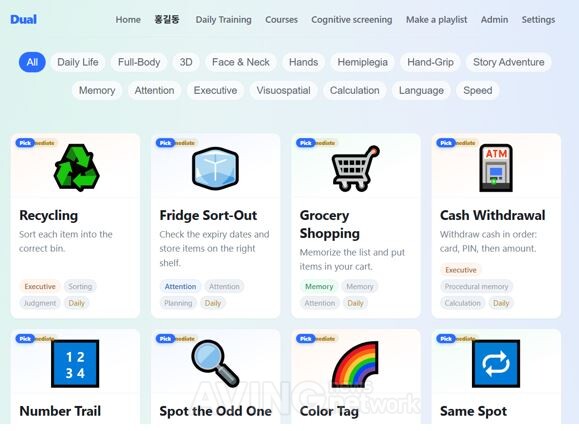
Cognitive rehabilitation training program screen of ‘EYAS Dual’ | Image provided by INTHETECH

 
InTheTech already has an established rehabilitation business and a family of EYAS products. EYAS Dual represents a new delivery model within that business, with the company aiming to reduce the equipment and setup needed to access its exercises.

During the demonstration, I noticed that much of the interaction involved the arms and upper body. I asked Lee what moving an arm adds compared with tapping a touchscreen.

She explained that the goal is to practice actions such as reaching and grasping while completing a cognitive task. For example, a person might need to identify an item, decide where it belongs, and move it to the appropriate location.

This approach is generally called dual-task training: combining a physical activity with a thinking task. It is an established area of rehabilitation research, and there is evidence supporting its potential.

An August 2026 review published in PLOS Digital Health examined 23 randomized trials involving 1,674 older adults with cognitive decline. It found that dual-task programs delivered outside clinics could improve cognitive performance, including a modest average advantage over other active interventions.

InTheTech’s technology also has a published research history. A 2023 randomized study involving 60 stroke patients used the company’s virtual-reality content as part of an eight-week rehabilitation program and reported encouraging cognitive and functional results.

Context: the earlier program combined adapted VR exercises with workbook training in a hospital setting. The broader review covered different interventions and patient groups. Neither establishes that EYAS Dual will produce the same outcomes.

Lee made that distinction during our conversation, explaining that the research supports the general training method while validation of the new product is still underway.

The platform could also be useful to therapists and caregivers. According to InTheTech, it starts with an assessment, selects exercises, and generates reports from session data, including response times and movement measurements. Automating some of that work could make progress easier to follow and reduce administrative effort.

Using consumer hardware for a medical application is entirely plausible. FDA-authorized software such as EndeavorRx already runs on mobile devices at home. What matters is the particular software’s evidence and authorized use.

Pricing is also provisional. Lee suggested approximately $50 per month, or $30 per month for home use, while emphasizing that the business model was unfinished. At the time of our interview, demos were available, but the product had not launched. A subsequent public release date remains unconfirmed.

What interests me most is the possibility of making a useful rehabilitation approach easier to access through familiar hardware. InTheTech’s next challenge is to show that EYAS Dual can turn that convenience into measurable benefits in people’s everyday lives. InTheTech plans to showcase EYAS Dual at CES 2027 and is competing for a CES Innovation Award.

Saturday, July 29, 2023

Cognitive Impairment After Stroke Is Common, Early Diagnosis and Treatment Needed

Being evaluated is COMPLETELY FUCKING WORTHLESS! Damn it all create protocols that prevent this problem.  Do YOU UNDERSTAND NOTHING ABOUT SOLVING STROKE?

Cognitive Impairment After Stroke Is Common, Early Diagnosis and Treatment Needed

More than half of stroke survivors may develop cognitive impairment within 1 year after their stroke, and 1 in 3 are at risk for developing dementia within 5 years, according to a new American Heart Association (AHA) scientific statement published today in the journal Stroke.

“Cognitive impairment is an often under-reported and under-diagnosed, yet very common, condition that stroke survivors frequently deal with,” said Nada El Husseini, MD, Duke University Medical Center, Durham, North Carolina. “Stroke survivors should be systematically evaluated for cognitive impairment so that treatment may begin as soon as possible after signs appear. Cognitive impairment after stroke ranges from mild impairment to dementia and may affect many aspects of life, such as remembering, thinking, planning, language and attention, as well as a person’s ability to work, drive or live independently.”

According to the statement:

  • Cognitive impairment after stroke is common in the first year after a stroke, occurring in up to 60% of stroke survivors. It is most common within the first 2 weeks after a stroke.
  • About 40% of people who survive a stroke have cognitive impairment during the first year after the stroke that does not meet diagnostic criteria for dementia, yet it still impacts their quality of life.
  • Up to 20% of stroke survivors who experience mild cognitive impairment fully recover cognitive function, and cognitive recovery is most likely within the first 6 months after a stroke.
  • Post-stroke cognitive impairment is often associated with other conditions, including physical disability, sleep disorders, behavioural and personality changes, depression, and other neuropsychological changes -- each of which may contribute to lower quality of life.

There is no gold standard for cognitive screening after a stroke, according to the scientific statement. However, some brief screening tests (≤30 minutes) are widely used to identify cognitive impairment after a stroke, such as the Mini-Mental State Examination and the Montreal Cognitive Assessment.

While early detection during the initial hospitalisation for stroke is important for immediate care planning, it’s also important to assess cognitive changes over time. Stroke survivors who experience unexplained difficulties with cognitive-related activities of daily living, following care instructions or providing a reliable health history may be candidates for additional cognitive screening. When cognitive impairment is detected, healthcare professionals are encouraged to assess an individual’s daily functioning with neuropsychological screenings, which evaluate areas of brain function that affect behaviour and may provide a more thorough picture of the individual’s cognitive strengths and weaknesses.

Healthcare professionals are encouraged to offer guidance to patients and their caregivers regarding home safety, returning to work and driving after a stroke, and connect caregivers and stroke survivors to community resources for social support.(SO YOU'RE NOT EVEN GIVING THEM ANYTHING TO RESOLVE THE PROBLEM? THEY SHOULD JUST DEAL WITH YOUR INCOMPETENCE?)

Interdisciplinary collaboration among healthcare professionals, such as physicians, speech language therapists, occupational therapists, neuropsychologists and nurses, is often needed for optimal monitoring and care for people with cognitive impairment after a stroke. In addition, the statement suggests behavioural cognitive rehabilitation and physical activity may help improve cognition after a stroke.

Preventing another stroke is a key consideration to prevent the worsening of cognitive impairment after a stroke. This includes treatments for stroke risk factors, such as high blood pressure, high cholesterol, type 2 diabetes, and atrial fibrillation. Blood pressure control is associated with reduced risk for recurrent stroke and for mild cognitive impairment.

Further research is needed to determine best practices for cognitive screening after a stroke, including the development and use of screening instruments that consider demographic, cultural and linguistic factors in determining “normal” function.

“Perhaps the most pressing need, however, is the development of effective and culturally relevant treatments for post-stroke cognitive impairment,” said Dr. El Husseini. “We hope to see big enough clinical trials that assess various techniques, medications and lifestyle changes in diverse groups of patients that may help improve cognitive function.”

Reference: https://www.ahajournals.org/doi/10.1161/STR.0000000000000430

SOURCE: American Heart Association

Tuesday, July 30, 2019

Role of Interhemispheric Cortical Interactions in Poststroke Motor Function

Evaluated and potential. WOW!  I see nothing useful here.

Role of Interhemispheric Cortical Interactions in Poststroke Motor Function 

First Published July 22, 2019 Research Article
Background/Objective. We investigated interhemispheric interactions in stroke survivors by measuring transcranial magnetic stimulation (TMS)–evoked cortical coherence. We tested the effect of TMS on interhemispheric coherence during rest and active muscle contraction and compared coherence in stroke and older adults. We evaluated the relationships between interhemispheric coherence, paretic motor function, and the ipsilateral cortical silent period (iSP).  
Methods. Participants with (n = 19) and without (n = 14) chronic stroke either rested or maintained a contraction of the ipsilateral hand muscle during simultaneous recordings of evoked responses to TMS of the ipsilesional/nondominant (i/ndM1) and contralesional/dominant (c/dM1) primary motor cortex with EEG and in the hand muscle with EMG. We calculated pre- and post-TMS interhemispheric beta coherence (15-30 Hz) between motor areas in both conditions and the iSP duration during the active condition.  
Results. During active i/ndM1 TMS, interhemispheric coherence increased immediately following TMS in controls but not in stroke. Coherence during active cM1 TMS was greater than iM1 TMS in the stroke group. Coherence during active iM1 TMS was less in stroke participants and was negatively associated with measures of paretic arm motor function. Paretic iSP was longer compared with controls and negatively associated with clinical measures of manual dexterity. There was no relationship between coherence and. iSP for either group. No within- or between-group differences in coherence were observed at rest.  
Conclusions. TMS-evoked cortical coherence during hand muscle activation can index interhemispheric interactions associated with poststroke motor function and potentially offer new insights into neural mechanisms influencing functional recovery.