Use the labels in the right column to find what you want. Or you can go thru them one by one, there are only 34,148 posts. Searching is done in the search box in upper left corner. I blog on anything to do with stroke. DO NOT DO ANYTHING SUGGESTED HERE AS I AM NOT MEDICALLY TRAINED, YOUR DOCTOR IS, LISTEN TO THEM. BUT I BET THEY DON'T KNOW HOW TO GET YOU 100% RECOVERED. I DON'T EITHER BUT HAVE PLENTY OF QUESTIONS FOR YOUR DOCTOR TO ANSWER.
Changing stroke rehab and research worldwide now.Time is Brain!trillions and trillions of neuronsthatDIEeach day because there areNOeffective hyperacute therapies besides tPA(only 12% effective). I have 523 posts on hyperacute therapy, enough for researchers to spend decades proving them out. These are my personal ideas and blog on stroke rehabilitation and stroke research. Do not attempt any of these without checking with your medical provider. Unless you join me in agitating, when you need these therapies they won't be there.
What this blog is for:
My blog is not to help survivors recover, it is to have the 10 million yearly stroke survivors light fires underneath their doctors, stroke hospitals and stroke researchers to get stroke solved. 100% recovery. The stroke medical world is completely failing at that goal, they don't even have it as a goal. Shortly after getting out of the hospital and getting NO information on the process or protocols of stroke rehabilitation and recovery I started searching on the internet and found that no other survivor received useful information. This is an attempt to cover all stroke rehabilitation information that should be readily available to survivors so they can talk with informed knowledge to their medical staff. It lays out what needs to be done to get stroke survivors closer to 100% recovery. It's quite disgusting that this information is not available from every stroke association and doctors group.
I hold no hope. It
seems that 6+ years ago research suggested using neuregulin-1 as a
hyperacute therapy, but I bet we never got human trials going. Failure
once again. Why should this succeed since we have NO STROKE LEADERSHIP following up to make sure research is completed and protocols written? This is why stroke survivors need to be in charge, we know hold to handle difficult tasks, like trying to recover from stroke with NO useful help from your stroke hospital, doctors or therapists.
A stroke treatment developed by researcher Byron Ford at the University of California, Riverside, has moved toward clinical trials.
The treatment focuses on neuregulins, a family of naturally occurring
proteins that has shown promise for treating stroke, a leading cause of
death in the United States and the major cause of long-term disability.
During stroke, blood supply to the brain is interrupted. Most often,
an artery to the brain gets blocked by a clot or a blood vessel
ruptures. With no blood — and therefore no oxygen or nutrients —
reaching the brain, cells in the brain begin to die locally, at the
“core,” within a couple of hours. Subsequently, the core cells burst
and release their components into the surrounding area, which then
experiences a dramatic inflammatory response. This area, called the
ischemic penumbra, dies over the course of several hours or days.
Neuregulin-1, or NRG-1, one of four proteins in the neuregulin family,
prevents this inflammation and cell death.
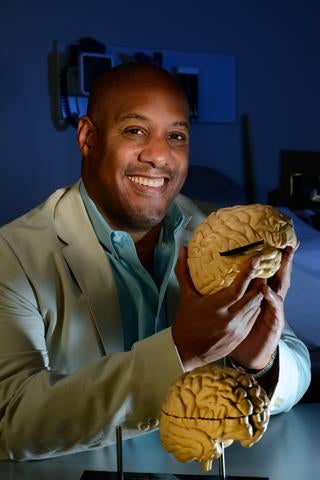
Byron Ford is a professor of biomedical sciences at UC Riverside. (UCR/Carrie Rosema)“Cells in the core die by getting overexcited and exploding,” said Ford, a professor of biomedical sciences at the UCR School of Medicine, whose company, Brain-Gen,
has patents for the use of NRG-1 to treat stroke. “Cells in the
ischemic penumbra die by committing suicide. This happens, we believe,
to prevent the whole brain from dying. An analogy: imagine a grenade is
flung into a crowded theater, and a few people throw themselves on the
grenade. They will die, but due to their sacrifice, others may very
likely be spared.”
Brain-Gen is co-owned by his brother Gregory Ford,
a neuroscientist and the dean of the College of Arts and Sciences at
Fort Valley State University in Georgia. Byron Ford explained that
Zensun Biotech, a Shanghai-based Chinese company with which Brain-Gen
has recently partnered, has patents to use a particular form of
neuregulin, called Neucardin, to treat heart failure. Zensun Biotech
does not have patents, however, for Neucardin’s use in clinical trials
for stroke. Brain-Gen tested Neucardin and found it works for stroke in
animal models.
The two companies have signed an agreement to collaboratively move
Neucardin toward clinical trials for stroke and to form a joint venture.
The new company plans to approach the Food and Drug Administration, or
FDA, to expand the use of Neucardin for stroke and to explore the
possibility of securing funding from the National Institutes of Health,
or NIH, with the aim of joining its StrokeNet clinical trials program.
Involving more than 200 hospitals in the country, StrokeNet conducts
small and large clinical trials and research studies to advance acute
stroke treatment, stroke prevention, and recovery and rehabilitation
following a stroke.
“To our advantage, Zensun has already completed phase I and phase II
clinical trials for heart failure and shown that Neucardin is safe and
improves heart function in patients,” Ford said. “A stroke is like a
heart attack in the brain. If the FDA says we can cross-reference
Zensun’s data for approval to treat stroke, this would greatly expedite
matters as we apply to become part of the NIH StrokeNet.”
Each year, nearly 800,000 Americans have a stroke, of which about
140,000 die. The “Stroke Belt,” an area in the southeastern United
States and Mississippi Valley, has the highest rate of stroke mortality
in the country.
Currently, the only FDA-approved drug to treat stroke is tissue
plasminogen activator, or t-PA, which melts the clot. It has no effect
on brain cells, however, and can be used only within a three-hour window
from the witnessed time of stroke onset, beyond which t-PA damages
blood vessels and causes bleeding. Further, only 3%-5% of stroke
patients qualify for t-PA due to the limited time window and access to
primary stroke centers. In contrast, Neucardin can be given to a patient
more than 12 hours after a stroke and has been shown to be safe in
patients.
Ford proposes that Neucardin be administered intravascularly to the
patient along with t-PA to offer protection to the brain and potentially
block t-PA’s negative effects that lead to bleeding in the brain.
“Neucardin can possibly be delivered in an ambulatory setting due to
its relatively safe profile,” he said. “It can be given to the patient
even before it has been determined if a stroke took place. It can also
be delivered days following stroke to stimulate repair and regeneration
in the brain. All this significantly boosts our hope for treating
stroke.”
How closely is your doctor following this? You likely will need this whenever it becomes available. 1. A documented 33% dementia chance post-stroke from an Australian study?May 2012. 2. Then this study came out and seems to have a range from 17-66%. December 2013. 3. A 20% chance in this research.July 2013.. It seems that 4 years ago research suggested using neuregulin-1 as a hyperacute therapy, but I bet we never got human trials going. Failure once again.
Boosting levels of a specific protein in the
brain alleviates hallmark features of Alzheimer's disease in a mouse
model of the disorder, according to new research published online August
25, 2016 in Scientific Reports.
The protein,
called neuregulin-1, has many forms and functions across the brain and
is already a potential target for brain disorders such as Parkinson's
disease, amyotrophic lateral sclerosis and schizophrenia.
"Neuregulin-1 has broad therapeutic potential, but mechanistically,
we are still learning about how it works," says the study's senior
investigator Kuo-Fen Lee, a professor in the Salk Institute's Clayton
Foundation Laboratories for Peptide Biology and holder of the Helen
McLoraine Chair in Molecular Neurobiology. "We've shown that it promotes
metabolism of the brain plaques that are characteristic of Alzheimer's
disease."
Previously, researchers have shown that treating cells with neuregulin-1, for example, dampens levels of amyloid precursor protein,
a molecule that generates amyloid beta, which aggregate and form
plaques in the brains of Alzheimer's patients. Other studies suggest
that neuregulin-1 could protect neurons from damage caused by blockage
of blood flow.
In the new study, Lee's team tested this idea in a mouse model of
Alzheimer's disease by raising the levels of one of two forms of
neuregulin-1 in the hippocampus, an area of the brain responsible for
learning and memory. Both forms of the protein seemed to improve
performance on a test of spatial memory in the models.
What's more, the levels of cellular markers of disease—including the
levels of amyloid beta and plaques—were noticeably lower in mice with
more neuregulin-1 compared to controls.
The group's experiments suggest that neuregulin-1 breaks up plaques
by raising levels of an enzyme called neprilysin, shown to degrade amyloid-beta.
But that is probably not the only route through which neuregulin-1
confers its benefits, and the group is exploring other possible
mechanisms—such as whether the protein improves signaling between
neurons, which is impaired in Alzheimer's—says the study's first author
Jiqing Xu, a research associate in Lee's group.
A neuregulin-1 treatment is not available on the market, though it is
being explored in clinical trials as a potential treatment for chronic heart failure
and Parkinson's disease. One advantage of neuregulin-1 as a potential
drug is that it can cross the blood brain barrier, which means that it
could be administered relatively noninvasively even though the
efficiency is not clear. On the other hand, other research suggests too
much of the protein impairs brain
function. Working with chemists at Salk, Lee's team has come up with a
small molecule that can raise levels of existing neuregulin-1 (rather
than administering it directly) and are testing it in cells. This
alternative therapy could be a better way to prevent plaques from
forming because small molecules more readily cross the blood brain barrier.
The group is also interested in neuregulin-1 for its ties to
schizophrenia. An alteration in the neuregulin-1 gene—a single change in
one letter of the DNA code for the protein—has been found in families
with schizophrenia and linked to late-onset Alzheimer's disease with
psychosis. The protein may be a way to understand the overlap between
Alzheimer's and other brain disorders, Lee says.
An important caveat is that the new research was conducted in a single type of mouse model
of Alzheimer's. Lee's group is testing neuregulin-1's affects across
other models. "There's much more work ahead before neuregulin-1 could
become a treatment, but we are excited about its potential, possibly in
combination with other therapeutics for Alzheimer's disease," Lee says.
We have previously shown that
neuregulin-1 (NRG-1) protects neurons from ischemic brain injury if
administered before focal stroke. Here, we examined the therapeutic
window and functional recovery after NRG-1 treatment in rats subjected
to 90 mins of middle cerebral artery occlusion (MCAO) and 24 h of
reperfusion. Neuregulin-1 (2.5 ng/kg bolus, 1.25 ng/kg/min infusion)
reduced infarct volume by 89.2%41.9% (means.d.; n=8; P less than 0.01)
if administered immediately after the onset of reperfusion. Neuroprotection was also evident if NRG-1 was administered 4 h (66.4%52.6%; n=7; P less than 0.01) and 12 h (57.0%20.8%; n=8; Pless than 0.01)
after reperfusion. Neuregulin-1 administration also resulted in a
significant improvement of functional neurologic outcome compared with
vehicle-treated animals (32.1%5.7%; n=9; Pless than 0.01).
The neuroprotective effect of the single administration of NRG-1 was
seen as long as 2 weeks after treatment. Neurons labeled with the
neurodegeneration marker dye Fluoro-JadeB were observed after MCAO in
the cortex, but the numbers were significantly reduced after NRG-1
treatment. These results indicate that NRG-1 is a potent neuroprotective
compound with an extended therapeutic window that has practical
therapeutic potential in treating individuals after ischemic brain
injury.


 41.9% (mean