Use the labels in the right column to find what you want. Or you can go thru them one by one, there are only 33,991 posts. Searching is done in the search box in upper left corner. I blog on anything to do with stroke. DO NOT DO ANYTHING SUGGESTED HERE AS I AM NOT MEDICALLY TRAINED, YOUR DOCTOR IS, LISTEN TO THEM. BUT I BET THEY DON'T KNOW HOW TO GET YOU 100% RECOVERED. I DON'T EITHER BUT HAVE PLENTY OF QUESTIONS FOR YOUR DOCTOR TO ANSWER.
Changing stroke rehab and research worldwide now.Time is Brain!trillions and trillions of neuronsthatDIEeach day because there areNOeffective hyperacute therapies besides tPA(only 12% effective). I have 523 posts on hyperacute therapy, enough for researchers to spend decades proving them out. These are my personal ideas and blog on stroke rehabilitation and stroke research. Do not attempt any of these without checking with your medical provider. Unless you join me in agitating, when you need these therapies they won't be there.
What this blog is for:
My blog is not to help survivors recover, it is to have the 10 million yearly stroke survivors light fires underneath their doctors, stroke hospitals and stroke researchers to get stroke solved. 100% recovery. The stroke medical world is completely failing at that goal, they don't even have it as a goal. Shortly after getting out of the hospital and getting NO information on the process or protocols of stroke rehabilitation and recovery I started searching on the internet and found that no other survivor received useful information. This is an attempt to cover all stroke rehabilitation information that should be readily available to survivors so they can talk with informed knowledge to their medical staff. It lays out what needs to be done to get stroke survivors closer to 100% recovery. It's quite disgusting that this information is not available from every stroke association and doctors group.
Showing posts with label Socially assistive robots. Show all posts
Showing posts with label Socially assistive robots. Show all posts
Didn't your hospital evaluate and get this socially assistive robot from
August 2018? Or did they incompetently not even know about it? So you don't have a functioning stroke hospital, do you?
Using a socially assistive
robot (SAR) in post-stroke rehabilitation improves outcomes, according
to Ben-Gurion University of the Negev researchers. They conducted the
first long-term study of robot use in physical therapy. The study opens a
totally new method for rehabilitation exercises.
Socially assistive
robots use speech, facial expressions, and gestures to guide and coach
patients. No appointment is needed: they will come to your house and
stay there. What is more, they are endlessly encouraging and perceived
as nonjudgmental. Prof. Shelly Levy-Tzedek, Dr. Ronit Feingold-Polak and
Oren Barzel found that SARs worked better than computers or no
technological intervention when combined with usual care.
Their findings were published recently in IEEE Transactions on Neural Systems and Rehabilitation Engineering.
"Use
of robots could vastly improve rehabilitation outcomes by encouraging
people to continue their treatment in what they feel is a non-judgmental
setting. Our study found that people enjoyed their interactions with
the SAR, which seems to have helped improve their recovery over working
with a computer or without any technological assistance," says Prof.
Levy-Tzedek.
26 participants at the
Adi Negev Rehabilitation Center outpatient clinic completed the
clinical trial. They were randomly divided into three groups:
training with a SAR in addition to usual care;
training with a computer in addition to usual care; and
usual care with no additional intervention.
The
intervention sessions took place three times/week, for a total of 15
sessions/participant. The study was conducted over two years, during
which 306 sessions were held.
Participants
in the SAR group significantly improved in their kinematic and clinical
measures which included smoothness of movement, action research arm
test (ARAT), and Fugl-Meyer upper-extremity assessment (FMA-UE). No
significant improvement in these measures was found in the computer or
the control groups. 100% of the participants in the SAR group gained
improvement which reached—or exceeded—the minimal clinically significant
difference in the ARAT, the gold standard for upper-extremity activity
performance post-stroke.
"This study
demonstrates both the feasibility and the clinical benefit of using a
SAR for long-term interaction with post-stroke individuals as part of
their rehabilitation program," says Dr. Ronit Feingold Polak.
More information:
Ronit Feingold-Polak et al, Socially Assistive Robot for Stroke
Rehabilitation: A Long-Term in-the-Wild Pilot Randomized Controlled
Trial, IEEE Transactions on Neural Systems and Rehabilitation Engineering (2024). DOI: 10.1109/TNSRE.2024.3387320
Provided by Ben-Gurion University of the Negev
This story was originally published on Medical Xpress. Subscribe to our newsletter for the latest sci-tech news updates.
Socially assistive robots
(SARs) are transforming physiotherapy for post-stroke patients,
significantly improving rehabilitation outcomes by providing consistent,
encouraging guidance and interaction.
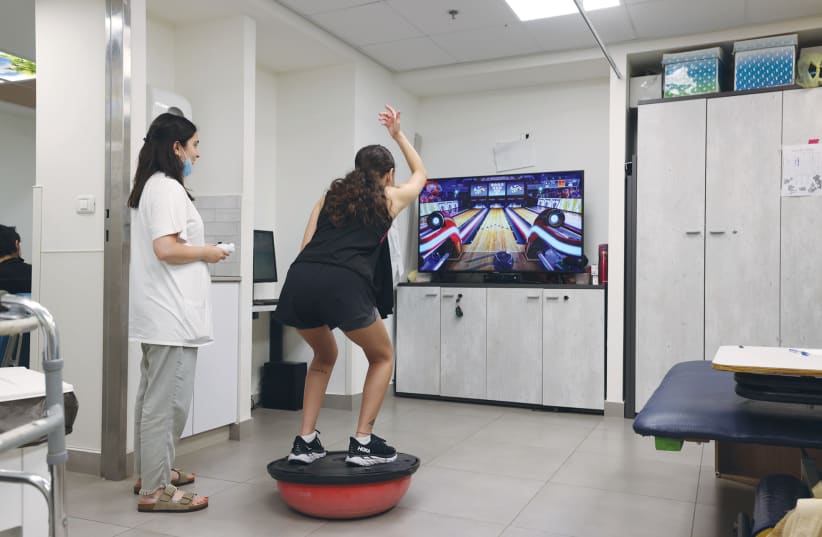
By JUDY SIEGEL-ITZKOVICH A PATIENT undergoes physiotherapy treatment combined with innovative technology.(photo credit: ZIV KOREN)
Glad to see this patient round side down on the Bosu. It's more difficult to stay upright but I thought that standing on the round side increased the chances of rolling my ankle.
Most people know nothing about what a physiotherapist does
until they, a friend, or a relative needs one. These well-trained and
licensed healthcare professionals, working according to evidence-based
protocols, can treat a large number of injuries and conditions – from
arthritis, stroke, and back pain to bone fractures, carpal-tunnel
syndrome, and sciatica.
Although
the four Israeli public health funds provide physiotherapists for many
patients even at no cost but with a limited number of sessions, for some
conditions and in many countries, physiotherapists are hard to get, and
queues are long.
For
physiotherapy to succeed, the patient must cooperate and perform
exercises as instructed on a regular basis. Patient cooperation and
active involvement in the process are vital for successful
rehabilitation, and a lack of motivation is often one of the main
reasons for poor outcomes.
You don't understand ONE GODDAMN THING ABOUT SURVIVOR MOTIVATION, DO YOU?
You create EXACT 100% recovery protocols and your survivor will be motivated
to do the millions of reps needed because they are looking forward to
100% recovery. GET THERE!
The problem is stroke researchers are not motivated to solve stroke. What the fuck is your solution to that failure? We still don't know how to motivate stroke medical 'professionals' to solve stroke to 100% recovery!
Can
robots supplement the work of human physiotherapists? Using a socially
assistive robot (SAR) in post-stroke rehabilitation improves outcomes,
according to researchers at Beersheba’s Ben-Gurion University of the Negev
(BGU). They conducted the first long-term study of using robots for
physical therapy, opening a totally new method for rehabilitation
exercises.
Given
the fact that over 10,000 soldiers were wounded in the Gaza war and on
the northern front since October 7, the need for physical rehabilitation
is immense.
Socially
assistive robots use speech, gestures, and facial expressions to guide
and coach patients. There is no need to make an appointment; they will
be brought to your home and stay with you. In addition, they are
programmed to provide endless encouragement without judging the patient!
Prof.
Shelly Levy-Tzedek, Dr. Ronit Feingold-Polak, and Oren Barzel found
that SARs worked better than computers or no technological intervention
when combined with the usual care.
Professor Shelly Levy-Tzedek (credit: DANI MACHLIS)
Levy-Tzedek
is a member of BGU’s physical therapy department in the Recanati School
for Community Health Professions and a member of the Institute for
Advanced Studies at Germany’s University of Freiburg. Feingold-Polak is
also a member of that department, as well as at Jerusalem’s Herzog
Medical Center, while Barzel works at Sheba Medical Center at Tel
Hashomer and the Adi-Negev Rehabilitation Center, the first and only
rehabilitation hospital in southern Israel.
THEIR
FINDINGS have just been published in IEEE Transactions on Neural
Systems and Rehabilitation Engineering – one of the leading rehab
journals – under the title “Socially assistive robot for stroke
rehabilitation: a long-term in-the-wild pilot randomized controlled
trial.”
“The
use of robots could greatly improve the results of rehabilitation by
encouraging people to continue their treatment in what they feel is a
non-judgmental setting. Our study found that people enjoyed their
interactions with the SAR, as they helped improve their recovery over
working with a computer or without any technological assistance,”
Levy-Tzedek said in a press release issued by BGU.
A
total of 26 patients receiving the usual care were randomly divided
into three groups: also training with a SAR, also training with a
computer, and getting no additional intervention. The intervention
sessions took place three times weekly for 15 sessions per patient over
two years, with 306 sessions held.
In
five of the games, the patient had to arrange a set of real objects
used daily such as cups or jars according to an image shown on the
robot’s or the computer’s screen. The other two games were an
interactive card game. In the first five sets there were several
difficulty levels that increased by changing the height of the platform,
as well as the weight and the number of the objects.
The Kaylie Rehabilitation Medical Center at ADI Negev-Nahalat Eran has improved the care of Negev residents
in need of inpatient rehabilitation following a serious illness,
accident, or terror attack by implementing revolutionary rehabilitation
techniques, using international experts in various fields to train its
medical residents and offering services unavailable anywhere else in
Israel.
By
providing inpatient and long-term outpatient services and treatments,
the facility is keeping families together throughout the rehabilitation
process while also immersing them in the village’s inclusive environment
offering physiotherapy, hydrotherapy, occupational therapy,
communication therapy, and a sports center.
Those
in the SAR group significantly improved their smoothness of movement,
the action research arm test, and the Fugl-Meyer upper-extremity
assessment. No significant improvement was found in the computer or the
control groups. Each of the SAR participants gained improvement that
reached or exceeded the gold standard for activity performance of the
upper limbs after a stroke.
In
a press release, Feingold Polak concluded that, “We showed both the
feasibility and the clinical benefit of using a SAR for long-term
interaction with post-stroke individuals as part of their rehabilitation
program.”
Didn't your hospital evaluate and get this socially assistive robot from
August 2018? Or did they incompetently not even know about it? So you don't have a functioning stroke hospital, do you?
Researchers at Ben-Gurion University of the Negev
have found that the use of a socially assistive robot (SAR) improves
outcomes in the rehabilitation undergone by patients who have suffered a
stroke.
A clinical trial, conducted at Adi Negev Rehabilitation Center
outpatient clinic by Prof. Shelly Levy-Tzedek, Dr. Ronit Feingold-Polak
and Oren Barzel, divided 26 participants into three groups.
One group worked with a SAR in addition to their usual care; one
worked with a computer in addition to their usual care; and a third
group received usual care with no further intervention.
The trial included three sessions per week for each participant, with each receiving a total of 15 sessions.
The researchers found that the participants who received SAR input
showed significant improvements that were not evident in the
participants in the other two groups.
In fact, BGU says, all of the members of the SAR group displayed
improvement that reached or exceeded the gold standard for post-stroke
upper-extremity activity.
“This study demonstrates both the feasibility and the clinical
benefit of using a SAR for long-term interaction with post-stroke
individuals as part of their rehabilitation program,” said Feingold
Polak.
“Use of robots could vastly improve rehabilitation outcomes by
encouraging people to continue their treatment in what they feel is a
non-judgmental setting. Our study found that people enjoyed their
interactions with the SAR, which seems to have helped improve their
recovery over working with a computer or without any technological
assistance,” said Levy-Tzedek.
The findings were recently published in the leading rehabilitation journal IEEE Transactions on Neural Systems and Rehabilitation Engineering.
Didn't your hospital evaluate and get this socially assistive robot from
August 2018? Or did they incompetently not even know about it? So you don't have a functioning stroke hospital, do you?
Using a socially assistive robot
(SAR) in post-stroke rehabilitation improves outcomes, according to
researchers at Ben-Gurion University of the Negev in Israel.
The
finding from the first long-term study of robot use in physical therapy
could open up a totally new method for rehabilitation exercises.
Prof.
Shelly Levy-Tzedek is a member of the Department of Physical Therapy,
Recanati School for Community Health Professions, Zelman Center for
Neuroscience, at Ben-Gurion University of the Negev.
The
researcher said: “Use of robots could vastly improve rehabilitation
outcomes by encouraging people to continue their treatment in what they
feel is a non-judgmental setting.
“Our study found that people
enjoyed their interactions with the SAR, which seems to have helped
improve their recovery over working with a computer or without any
technological assistance.”
Socially assistive robots use speech, facial expressions and gestures to guide and coach patients.
The robots can see people in their homes and stay there, with no appointment needed.
They are alsso encouraging and perceived as nonjudgmental, the researchers said.
Prof.
Shelly Levy-Tzedek, Dr Ronit Feingold-Polak and Oren Barzel found that
SARs worked better than computers or no technological intervention when
combined with usual care.
A total of 26 participants at the Adi Negev Rehabilitation Center outpatient clinic completed the clinical trial.
They
were randomly divided into three groups: 1) training with a SAR in
addition to usual care; 2) training with a computer in addition to usual
care; and 3) usual care with no additional intervention.
The intervention sessions took place three times/week, for a total of 15 sessions/participant.
The study was conducted over two years, during which 306 sessions were held.
Participants
in the SAR group significantly improved in their kinematic and clinical
measures which included smoothness of movement, action research arm
test (ARAT), and Fugl-Meyer upper-extremity assessment (FMA-UE).
No significant improvement in these measures was found in the computer or the control groups.
100
per cent of the participants in the SAR group gained improvement which
reached – or exceeded – the minimal clinically significant difference in
the ARAT, the gold standard for upper-extremity activity performance
post-stroke.
Dr Ronit Feingold Polak is a member of the Department
of Physical Therapy, Recanati School for Community Health Professions,
Ben-Gurion University of the Negev as well as the Herzog Medical Center.
She
said: “This study demonstrates both the feasibility and the clinical
benefit of using a SAR for long-term interaction with post-stroke
individuals as part of their rehabilitation programme.”
Figure 01 learned how to make coffee by watching a human do it, and now it can speak to you like a person.
In the new promotional video, a technician
asks Figure 01 to perform a range of simple tasks in a minimalist test
environment resembling a kitchen.(Image credit: Figure)
A self-correcting humanoid robot that learned to make a cup of coffee just by watching footage of a human doing it can now answer questions thanks to an integration with OpenAI's technology.
In the new promotional video,
a technician asks Figure 01 to perform a range of simple tasks in a
minimalist test environment resembling a kitchen. He first asks the
robot for something to eat and is handed an apple. Next, he asked Figure
01 to explain why it handed him an apple while it was picking up some
trash. The robot answers all the questions in a robotic but friendly
voice.
The
company said in its video that the conversation is powered by an
integration with technology made by OpenAI — the name behind ChatGPT.
It's unlikely that Figure 01 is using ChatGPT itself, however, because
that AI tool does not normally use pause words like "um," which this
robot does.
LATEST VIDEOS FROM livescience
With
OpenAI, Figure 01 can now have full conversations with people-OpenAI
models provide high-level visual and language intelligence-Figure neural
networks deliver fast, low-level, dexterous robot actionsEverything in
this video is a neural network: pic.twitter.com/OJzMjCv443March 13, 2024
Should
everything in the video work as claimed, it means an advancement in two
key areas for robotics. As experts previously told Live Science, the
first advancement is the mechanical engineering behind dexterous,
self-correcting movements like people can perform. It means very precise
motors, actuators and grippers inspired by joints or muscles, as well
as the motor control to manipulate them to carry out a task and hold
objects delicately.
Even
picking up a cup — something which people barely think about
consciously — uses intensive on-board processing to orient muscles in
precise sequence.
The
second advancement is real-time natural language processing (NLP)
thanks to the addition of OpenAI's engine — which needs to be as
immediate and responsive as ChatGPT when you type a query into it. It
also needs software to translate this data into audio, or speech. NLP is
a field of computer science that aims to give machines the capacity to
understand and convey speech.
But are the exercises being monitored delivering 100% recovery? If not, why are you supporting the tyranny of low expectations that survivors jest have to deal with limited recovery?
Socially
assistive robots are increasingly being explored to improve the
engagement of older adults and people with disability in health and
well-being-related exercises. However, even if people have various
physical conditions, most prior work on social robot exercise coaching
systems has utilized generic, predefined feedback. The deployment of
these systems still remains a challenge. In this paper, we present our
work of iteratively engaging therapists and post-stroke survivors to
design, develop, and evaluate a social robot exercise coaching system
for personalized rehabilitation. Through interviews with therapists, we
designed how this system interacts with the user and then developed an
interactive social robot exercise coaching system. This system
integrates a neural network model with a rule-based model to
automatically monitor and assess patients’ rehabilitation exercises and
can be tuned with individual patient’s data to generate real-time,
personalized corrective feedback for improvement. With the dataset of
rehabilitation exercises from 15 post-stroke survivors, we demonstrated
our system significantly improves its performance to assess patients’
exercises while tuning with held-out patient’s data. In addition, our
real-world evaluation study showed that our system can adapt to new
participants and achieved 0.81 average performance to assess their
exercises, which is comparable to the experts’ agreement level. We
further discuss the potential benefits and limitations of our system in
practice.
1 Introduction
As
the world’s older population continues to grow at an unprecedented
rate, the current supply of care providers is insufficient to meet the
current and ongoing demand for care services (Dall et al. 2013). Researchers have explored an opportunity of socially assistive robots (Feil-Seifer et al. 2005; Tapus and Mataric 2006) that aim to enable people with cognitive, sensory, and motor impairments or assist the clinical workforce (Riek 2017). One potential application is socially assistive robots for rehabilitation therapy (Matarić et al. 2007; Lee et al. 2020, 2022). During rehabilitation, patients require completing a significant amount of self-directed exercises (O’Sullivan et al. 2019; Lee et al. 2022). However, low treatment adherence is a problem across several healthcare disciplines of physiotherapy (Kåringen et al. 2011). To address these problems, there has been increasing attention on social robot coaching systems (Riek 2017; Matarić et al. 2007; Lee et al. 2020, 2022).
These systems autonomously monitor patients’ exercises and provide
encouragement to support patients’ engagement in well-being-related or
rehabilitation exercises through social interaction (Tapus et al. 2007; Feil-Seifer et al. 2005).
Prior
work on robotic exercise coaching systems has demonstrated that older
adults or post-stroke subjects can successfully exercise and stay
engaged with a robot over sessions (Fasola and Matarić 2013; Görer 2013).
However, despite the potential of a robot to monitor and guide
exercises, prior work is limited to providing generic, predefined
corrective feedback on patient’s exercise performance (e.g., checking
angular difference with the prespecified motion (Görer 2013; Fasola and Matarić 2013; Guneysu and Arnrich 2017)).
It is still challenging to empower a social robot exercise coaching
system to generate tailored corrective feedback on an individual
patient’s motion (Görer 2013) and adopt these systems broadly yet.
In
this work, we design, develop, and evaluate a socially assistive robot
coaching system that automatically monitors and coaches physical
rehabilitation therapy. Specifically, we selected a test domain as
stroke, which is the second leading cause of death and disability
(Feigin et al. 2017).
We then conducted interviews with therapists to design and develop a
socially assistive robot coaching system. This system integrates a
machine learning (ML) model with a rule-based (RB) model and can be
tuned with held-out user data to assess the performance of exercises for
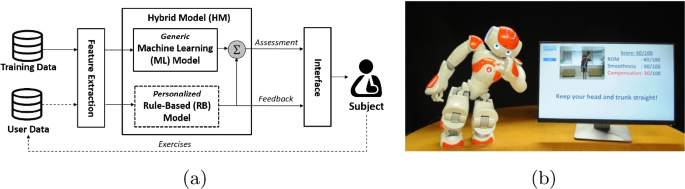
personalized post-stroke therapy (Fig. 1a) (Lee et al. 2020). Building upon the previous work (Lee et al. 2020),
we demonstrated the benefit of our approach to adapt a new user and
provide personalized assessment compared to the commonly used transfer
learning technique on a feed-forward neural network model (Zhuang et al.
2020)
(i.e., pretrains a model using the dataset from post-stroke survivors
and then fine-tune it based on the data from a new post-stroke
survivor).
During the real-world study with ten participants, our
interactive system can be adapted to new participants and achieved 0.81
average performance to assess participants’ quality of motion, which is
comparable to experts’ agreement level (i.e., 0.80 average performance).
Overall, participants expressed positive opinions on our system to
monitor and provide feedback on their exercises, but also described
practical issues to be improved.
Fig. 1
a Flow diagram of an interactive approach of a socially assistive robot for personalized physical therapy. b
a setup of the system with a visualization interface and a socially
assistive robot that provides corrective feedback (e.g., audio, visual,
gestures of the robot)
The semi-humanoid Pepper robot is being used in The Cognition, Aging and
Rehabilitation Lab at Ben-Gurion University of the Negev to help
stroke patients.
New studies on rehabilitation support the theory that not all therapy needs to be hands-on.
Take
stroke patients, for instance. While for most stroke patients,
rehabilitation requires physical therapy as patients need to relearn
simple motor activities like walking and sitting, occupational therapy
(relearning daily activities like eating and dressing), and speech
therapy, formal caregivers are not always available due to budget
constraints or insufficient staff, and informal caregivers (spouses,
family members) don’t always have the skill set or the patience.
Prof.
Shelly Levy-Tzedek says socially assistive robots, or robots that
assist using social cues, can help support and treat patients in
rehabilitation from stroke or other conditions when human caregivers are
not available. In her work leading The Cognition, Aging and
Rehabilitation Lab at Ben-Gurion University, she regularly conducts
studies with other researchers on how these social robots help improve
the well-being of people who need rehabilitation.
Prof.
Shelly Levy-Tzedek and her team at The Cognition, Aging and
Rehabilitation Lab are using socially assistive robots to help stroke
patients. Photo by Dani Machlis / BGU
Earlier
this year, Levy-Tzedek, and fellow professors Ayelet Dembovski and Yael
Amitai, published the methodology for their system and the initial
results of a study that highlighted the use of socially assistive robots
that support patients dealing with stroke. The team developed a
robot-based gamified exercise platform for long-term post-stroke
rehabilitation, came up with seven gamified based on functional tasks,
and used the semi-humanoid robot Pepper manufactured by Softbank
Robotics for the study.
The study looked at mixed attitudes
towards the robots, motivation for use, and the differences in
interaction between the patient and a human therapist vs. a patient and
an assistive robot. The study was published in the journal Frontiers in Rehabilitation Science.
Socially
assistive robots “help the person, not physically – they don’t move
their limbs or they don’t move something in the world for the person –
but they get them to do something themselves. So one of the biggest
projects in the lab in the past few years has been a socially assistive
robot that helps people who’ve had a stroke, do their exercise,” Prof.
Shelly Levy-Tzedek tells NoCamels.
While the person can do the
exercise on their own, Prof. Levy-Tzedek says socially assistive robots
can provide extra benefits like motivation, companionship, and a
gamified system that could make the patient feel like he is playing a
game rather than relearning skills or completing tasks.
The other benefit is that the robot could be taken home in the future.
In
the study, researchers collected and analyzed information from 23
patients (11 stroke patients and 12 informal caregivers) who
participated in a total of six focus-group discussions. The patients
answered questions regarding the use of a socially assistive robot to
promote physical exercises during the rehabilitation process including
the advantages and disadvantages, specific needs the robot would
address, adaptions the patient would propose to include, and concerns
regarding the technology.
A team headed by Prof. Shelly Levy-Tzedek used the semi-humanoid robot Pepper to help support stroke patients. Deposit Photos
“We
found that the majority of the participants in both groups were
interested in experiencing the use of a SAR (socially assistive robot)
for rehabilitation, in the clinic and at home,” the authors wrote in the
study.
“This is a study that we ran in the clinic with patients
who have had a stroke, previously being healthy individuals. This was a
pilot experiment in the lab, and then we ran it with actual stroke
patients in the clinic. We did over two years during COVID-19,” she
explains.
The clinical results have not yet been published, but Levy-Tzedek says they are “promising.”
“This
is the first experiment of its kind in the world in that it’s a
long-term experiment with stroke patients in the clinic with a social
robot. So this hasn’t been done before. There were studies with stroke
patients that were just one-off meetings with a robot which is a good
first start, but You need to do the experiment in the long term because
rehabilitation is a long-term endeavor. So you have to see how people
react to it over the long term and whether the novelty wears off after a
while. And then do people still continue and we see that they do,” she
says.
Rehab robots assist stroke patients
Levy
Tzedek, a biomedical engineer who studied at UC Berkeley and earned a
Master of Science and PhD from Massachusetts Institute of Technology
(MIT,) uses what she calls “off-the-shelf robots” and fits them with a
platform developed in the lab. “Off-the-shelf” means they are
commercially available.
“It’s
not a robot we built. What we did is build a whole platform around it,”
she explains. In the case of stroke patients, “this is a platform that
helps people after stroke perform exercises.”
“Now, you might
wonder, is it the robot that matters? Or is it the platform that we
developed? People who used the computer instead of the robot to give
them instructions and feedback – so exactly the same platform, but a
computer was providing the instructions and the feedback [instead of the
robot] – they also got better, but not to the same extent,” she
explains, “So more people got better with a robot.”
People who
have had a stroke often lose the ability to perform tasks that were
trivial before something like buttoning their own shirt, slicing bread,
or placing a jar on a shelf. These are things that have to be practiced
thousands of times, and some of this practice is done in a clinic with a
physical therapist or an occupational therapist, but a lot of the
practice has to be done on its own.
“In general, when we look at
compliance with physical therapy exercises, it’s around 30 percent. So
we wanted to get people to do more self-exercise, but in a guided way –
giving them motivation but also feedback. So that’s the idea behind
this,” she says.
Stroke patients often lose the ability to perform
daily actions with everyday objects. Tasks that were trivial before —
like buttoning a shirt, slicing bread, or placing a jar on a shelf — are
suddenly tasks that have to be practiced thousands of times. Some of
the practice is done in a clinic with a physical therapist but a lot of
it is done at home, where the patient needs to do it on his own.
Prof. Shelly Levy-Tzedek (left) and Lab Engineer Yuliya Berdichevsky. Photo by Dani Machlis / BGU
“So
if they have to relearn how to button a shirt, they actually have to
use a button and try to do the actual activity because they have to
relearn how to coordinate their muscle activity. And just strengthening
their muscles is not enough, using virtual reality is good, but not
sufficient, they have to actually do the tasks that they’re trying to
relearn how to do, which is why we use everyday objects in all of the
practice,” Levy-Tzedek explains, “
The everyday objects have RFID
(radio frequency identification) tags on them. RFID is a form of
wireless communication that can identify an object. This is done so researchers can know where each item is placed and the robot can give feedback to the person.
“What
they do is they give a task using the screen and also speech and they
say to place the, in this case, orange, green and blue cups in this
particular arrangement. And the person does that. And because we have
these sensors, we know exactly where they place the objects and we and
the robot can then give them feedback,” Levy-Tzedek says.
During
the interview, Levy-Tzedek showed some of the setups where a patient was
practicing various tasks using the help of a socially assistive robot.
In one kitchen setup, the patient was tasked with placing kitchen items
on a shelf. They had to place the items as well as remember where they
should be placed. In another escape room setup, they had to find items
as requested by the robot. In a third setup, a robot played Blackjack
with the patient and the patient had to remember his cards and play the
game correctly.
The value of a socially assistive robot
What
is it about the robot that makes it better or different from a human?
Levy-Tzedek says it’s “something that we’re trying to figure out.” Her
team has done numerous in-depth interviews with people over time,
including in the beginning and middle of the experiment, and even after
they’ve completed it.
“We asked them about their experience and
what they thought and it seems that at the same time they were treating
it as a human but then also not as a human,” she explains, citing
examples that the robot made mistakes (they would tell the patient he
did something wrong when he was correct) and some were frustrated by the
incident while others let it roll off their back. On the other hand,
patients were afraid that a human therapist would be judgemental of
them, even though therapists aren’t supposed to be judgemental. The
robot could not be judgemental and this was a plus.
“At the same
time, they treat it as a human, but then also not as a human. And they
take the best out of each. And I will say, though, that people were
most interested in continuing to work with a robot when they felt that
they actually had a benefit to their functional rehabilitation and when
they felt they got better when they would go home at the end of the
session, and they were able to do something that they weren’t able to do
before,” Levy-Tzedek explains, “That was the strongest predictor of how
much they would want to come and then work with it again, and continue
working with a robot. So it wasn’t just some sort of halo effect of
using technology, but the actual benefit that they reaped from working
with it.
What would be vastly more important is to create robots that cause your doctors to solve the 5 causesof theneuronal cascade of death in
the first week saving billions of neurons. Because rehab only gets you almost fully recovered 10% of the time. So rehab is essentially a total failure and you are promoting more of that failure. You're focusing on completely the wrong part of stroke.
Socially
assistive robots (SARs) have been proposed as a tool to help
individuals who have had a stroke to perform their exercise during their
rehabilitation process. Yet, to date, there are no data on the
motivating benefit of SARs in a long-term interaction with post-stroke
patients.
Methods
Here,
we describe a robot-based gamified exercise platform, which we
developed for long-term post-stroke rehabilitation. The platform uses
the humanoid robot Pepper, and also has a computer-based configuration
(with no robot). It includes seven gamified sets of exercises, which are
based on functional tasks from the everyday life of the patients. The
platform gives the patients instructions, as well as feedback on their
performance, and can track their performance over time. We performed a
long-term patient-usability study, where 24 post-stroke patients were
randomly allocated to exercise with this platform—either with the robot
or the computer configuration—over a 5–7 week period, 3 times per week,
for a total of 306 sessions.
Results
The
participants in both groups reported that this rehabilitation platform
addressed their arm rehabilitation needs, and they expressed their
desire to continue training with it even after the study ended. We found
a trend for higher acceptance of the system by the participants in the
robot group on all parameters; however, this difference was not
significant. We found that system failures did not affect the long-term
trust that users felt towards the system.
Conclusions
We
demonstrated the usability of using this platform for a long-term
rehabilitation with post-stroke patients in a clinical setting. We found
high levels of acceptance of both platform configurations by patients
following this interaction, with higher ratings given to the SAR
configuration. We show that it is not the mere use of technology that
increases the motivation of the person to practice, but rather it is the
appreciation of the technology’s effectiveness and its perceived
contribution to the rehabilitation process. In addition, we provide a
list of guidelines that can be used when designing and implementing
other technological tools for rehabilitation.
Trial registration: This
trial is registered in the NIH ClinicalTrials.gov database.
Registration number NCT03651063, registration date 21.08.2018. https://clinicaltrials.gov/ct2/show/NCT03651063.
Background
Retraining coordination of reach-to-grasp movements is one of the major functional goals of rehabilitation after stroke [1], as it is the basis of a substantial number of daily activities, such as reaching to pick up a cup for drinking [2]. Intensive, repetitive task-specific training [3,4,5], over multiple sessions, can improve arm function post stroke [1, 6].
However, intensive practice, which requires a large number of
repetitions, is challenging both for the patient and for the therapist [4, 6],
for a variety of reasons, including the limited time in the individual
therapy sessions dedicated to both acquiring and practicing new
abilities, the fatigue of the patient [7, 8] and the lack of motivation of the individual with stroke to keep on training alone [9]. Therefore, it is imperative to devise feasible, alternative methods for long-term rehabilitation [4],
which do not depend solely on the availability of the therapist, to be
used both in the rehabilitation center and in patients’ homes [10].
These methods need to promote and motivate patients to practice their
exercise, in order to improve the function of the impaired arm [4]. In order for the patient to repeat a certain task many times, they have to be highly motivated and engaged [5].
One of the ways to enhance motivation and engagement is to gamify the
task; in the context of rehabilitation, this would translate to
gamifying the repetitive exercise. Gamification has been demonstrated to
increase patient motivation, learning, confidence, and positivity
through achievement and social interaction [11].
Competitive and cooperative gamified tasks have been shown to increase
motivation and exercise intensity of stroke patients when playing with
another patient [12] or when playing with a healthy individual as a partner [9].
These suggest that the presence of a partner and of competition
increases motivation and engagement. This can be achieved, for example,
using competitive elements (such as a score) on a computer screen, or by
using interactive robots, which may take on the role of a competition
partner, or a coach. Socially Assistive Robots (SARs) have been designed
for this purpose [13,14,15,16,17,18,19,20,21].
Previous works [13,14,15,16],
on short-term interactions with a SAR, suggest that incorporating SARs
into a practice regime that calls for repetitive tasks can increase
stroke patients’ motivation. In previous works, patients were asked to
do tasks such as magazine stacking [13], button pressing [16] or to imitate movements made by the robot [13]
while receiving feedback from a SAR in a one-session interaction. These
foundational studies demonstrated the feasibility of such an
interaction with stroke patients. However, it is not yet known whether
stroke patients' motivation will be maintained during a long-term
interaction with the SAR, and whether it can lead to an improvement in
their functional ability—that is, their ability to perform everyday
tasks with their impaired arm, such as reaching to pick up a cup and
drink from it.
Our goals in the current work were therefore
threefold: first, to build a platform for functional post-stroke
rehabilitation, which can track the performance of patients over time.
More specifically, we aimed to build two implementations of this
platform, in which the instructions and the feedback to the patient are
given either by a socially assistive robot or by a computer screen.
Second, to conduct a usability study with stroke patients, who will
undergo a long-term intervention in the clinic with these two
implementations of the platform. Third, to measure the patients’
willingness to exercise with the platform following a long-term
intervention with it (15 exercise sessions conducted over 5–7 weeks),
and to test the differences in the willingness of participants to use
the system when using the SAR configuration, compared to the computer
one.
We hypothesized that participants in the SAR group would show
greater motivation and willingness to keep on exercising with the
system compared to the computer group as will be measured (i) by the
usability questionnaire, and (ii) by the dropout rates.