The holy grail of VR is immersion: to truly feel like
you're in a virtual world. While most modern VR headsets do a pretty
good job of this, the experience isn't perfect. One problem standing in
the way of true immersion are the
. They're OK for basic tasks like picking up objects, but they still feel a little unnatural. Even VR gloves like the
offer only vibration feedback; it lets you know you've touched something, but not
you're touching. A new startup, however, aims to change that. It's
introducing a pair of gloves that promises to make your virtual hands
feel just like real ones.
The gloves are made by HaptX, which used to be known
as AxonVR. It changed its name partially because there are a lot of
other companies that are using the name Axon -- it's the name of a
phone, a trucking company and a maker of non-lethal weapons. HaptX also
happens to be the name of the technology that makes the realistic touch
possible.
When the company says "realistic touch," it means the
gloves let you feel the shape, texture and even temperature of whatever
you're holding -- you can even feel if an object is hard or soft.
That's right; the gloves will actually prevent your hand from going
through virtual objects.
At the heart of the technology is microfluidics,
which is a study of how fluids move through small, sub-millimeter
channels. HaptX CEO and co-founder Jake Rubin spent several years at Cal
Poly researching the subject, along with the company's other
co-founder, Dr. Robert Crockett. This led to the creation of the HaptX
skin, which is made up of hundreds of tiny little air pockets. Whenever
you touch something in the virtual world, these air bubbles -- also
known as haptic actuators -- inflate, displacing your skin in the same
way a real object would. The actuators can be woven into fabric, which
results in what Rubin and co. call the HaptX smart textile.
"These are basically tiny little haptic
pixels," said Jake Rubin, CEO and founder of HaptX. "And by changing
their pressure over time, very quickly, we can create any sensation in
your skin." He likens it to a visual display, with each pixel changing
in color to create an image. He explained that with the HaptX gloves,
the pixels are tiny and in high density near the fingers -- where the
most sensitivity is needed -- and larger and lower density at the palm.
The sensitivity of the displacement can be up
to 2 millimeters, which Rubin said is much higher of than that of other
VR gloves. Other haptic gloves like the GloveOne and the aforementioned
Manus use vibrating motors that buzz or rumble, the Teslasuit uses
electrodes that deliver small electric shocks, and still others like the
VRgluv use motors that provide resistance on the fingers. None of
these, according to Rubin, offer the same accuracy and finesse as the
HaptX.
I tried a prototype of the gloves, and I was
trepidatious at first. For one, the test glove was too big for my hands
-- Rubin says most of the HaptX engineers have larger mitts than I do.
The issue is that in order for the HaptX material to work, my fingers
need to touch the glove's fingertips.
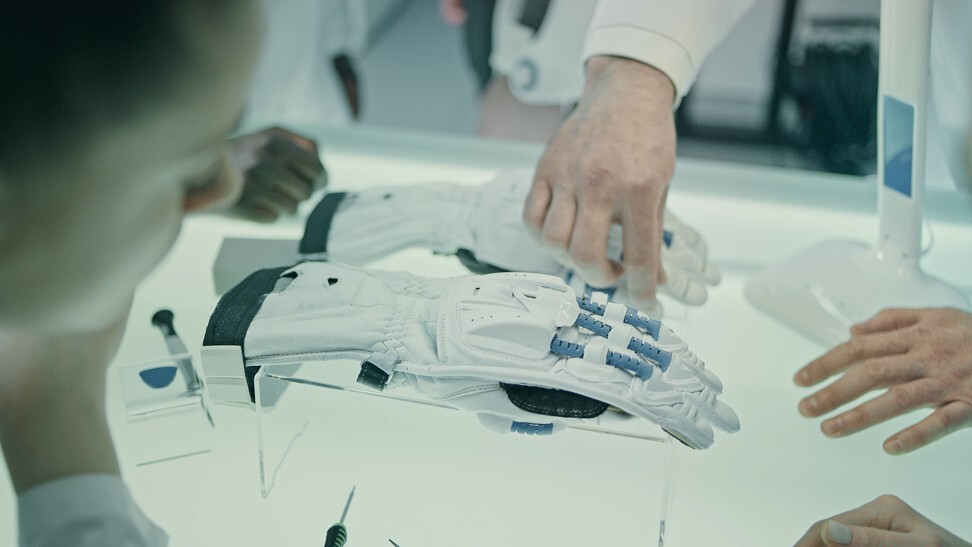
After some pulling, however, my hand fit. The
glove was made out of a mesh fabric on the inside and a Vive receiver
was attached to the outside; my fingertips were secured by what felt
like plastic clamps. The glove was attached to a wire connecting to a
large Xbox-like machine. This, Rubin said, houses all the valves to
control air flow.
The glove felt bulky, heavy and a little
uncomfortable. Rubin tells me that the final version will come in
different sizes and be slimmed down, so hopefully, this is only an issue
with the prototype.
Then, I had an HTC Vive strapped to my head
and the HaptX folks fired up the demo. A small farm appeared in front of
me, with raining clouds, a barn and a wheat field. I placed my hand
underneath one of the clouds and immediately felt light raindrops. I
waved my hand through the wheat field and felt every strand run through
my fingers.
Next, a small fox ran out. When I placed my
palm in front of it, it leapt into my hand, giving me a ticklish
sensation as it ran around. When the fox finally lay down, I felt its
whole body in the palm of my hand. Next, a huge spider crawled into
view; it too climbed onto my hand. Its eight legs felt so fuzzy and
realistic that it sent shivers up my spine, and I cringed in reaction.
I also squeezed the clouds and the rocks to
see which was softer. I felt more resistance with the rocks but still
managed to close my fingers into a fist, forcing the rocks to slip out
of my hand. Ideally, I shouldn't be able to close my fingers at all.
Rubin said that could be because the glove didn't fit my hand well
enough in the first place.
Despite the unpleasant feeling of the glove, I
was surprised by how realistic the touch sensations felt. It's unlike
any other VR controller I've tried. That said, there are a few flaws.
For one, the gloves need to be attached to the aforementioned box. Rubin
said they could be put it in a backpack for untethered applications
when doing room-scale VR, but that sounds a little clunky. He thinks the
technology will get to the point where they won't need a box, but it's
not there yet.
Also, the prototype I tried didn't have a
temperature setting, because that version uses water instead of air.
Rubin said the company is focusing on the non-temperature version of the
gloves so it can get them to market sooner.
As impressive as the HaptX gloves felt, Rubin
doesn't intend for them to be used for video games, at least not yet.
Right now, Rubin is marketing HaptX to be used for commercial
applications like training simulation in medical, military and
industrial spaces, location-based entertainment for theme parks, and
design and manufacturing using telerobotics. This is because, in those
applications, fidelity and finesse are way more important than in
gaming.
"Some of these full-scale military simulators
cost tens of millions of dollars," said Rubin. "And there are these
entertainment companies that are overlaying VR on physical environments
but you still need a very large room. It's not very scalable." With
something like HaptX, however, all you'd need to is change the software.
He said that HaptX can be used when prototyping products, so
manufacturers can "feel" what a car's interior is like, for example.
Rubin
hopes to release the first version of the gloves starting next year. He
doesn't rule out the technology trickling down to consumers, but that's
not the company's focus. "We expect the price to come down quickly over a
course of two to three years, to the point where consumers can have
it," he said. "It may never be, you know, $100 but it should be cheap
enough within a couple of years that a consumer could certainly purchase
and own this kind of technology."
Interestingly, Rubin also said it's possible
for the HaptX material to be built into a full bodysuit. "
When you
combine these existing arm exoskeletons, our haptic wearables and a
locomotion solution like an omnidirectional treadmill or a lower-body
exoskeleton, it would get you very close to a holodeck -- a full
immersion in a virtual environment."
- This article originally appeared on Engadget.