Changing stroke rehab and research worldwide now.Time is Brain! trillions and trillions of neurons that DIE each day because there are NO effective hyperacute therapies besides tPA(only 12% effective). I have 523 posts on hyperacute therapy, enough for researchers to spend decades proving them out. These are my personal ideas and blog on stroke rehabilitation and stroke research. Do not attempt any of these without checking with your medical provider. Unless you join me in agitating, when you need these therapies they won't be there.

What this blog is for:

My blog is not to help survivors recover, it is to have the 10 million yearly stroke survivors light fires underneath their doctors, stroke hospitals and stroke researchers to get stroke solved. 100% recovery. The stroke medical world is completely failing at that goal, they don't even have it as a goal. Shortly after getting out of the hospital and getting NO information on the process or protocols of stroke rehabilitation and recovery I started searching on the internet and found that no other survivor received useful information. This is an attempt to cover all stroke rehabilitation information that should be readily available to survivors so they can talk with informed knowledge to their medical staff. It lays out what needs to be done to get stroke survivors closer to 100% recovery. It's quite disgusting that this information is not available from every stroke association and doctors group.

Showing posts with label psoriasis. Show all posts

Wednesday, June 25, 2025

Psoriasis: an emerging risk factor for ischemic stroke?

Your competent? doctor has had a treatment protocol for this for over a decade? Right? Oh no, you DON'T have a functioning stroke doctor, do you? And your board of directors is so incompetent they don't fire incompetent doctors?

  • psoriasis (11 posts to April 2011)
  • Psoriasis: an emerging risk factor for ischemic stroke?


    • 1Department of Neurology, Medical University of Warsaw, Warsaw, Poland
    • 2Chair and Department of Experimental and Clinical Physiology, Laboratory of Centre for Preclinical Research, Medical University of Warsaw, Warsaw, Poland
    • 3Department of Pathology, Medical University of Warsaw, Warsaw, Poland

    In 2020 nearly 12 million people worldwide suffered a stroke, and acute ischemic stroke (AIS) is the most frequent stroke subtype, accounting for approximately 65% of total stroke incidence. Therefore, primary prevention, including non-traditional risk factors, should be recognized as a major public health priority. Research has shown that autoimmune diseases associated with chronic systemic inflammation, such as psoriasis, are commonly linked to AIS incidence. Psoriasis is a chronic autoimmune erythematous-squamous disease that primarily affects the skin, nails, and joints. Psoriasis is known to be a systemic inflammatory condition affecting multiple organs. Patients with psoriasis are at a higher risk of stroke than the general population, and a more severe disease course can increase this risk by up to 44%. One possible explanation for this phenomenon is that chronic systemic inflammation is associated with endothelial dysfunction and atherosclerotic plaque development. On the other hand, patients with psoriasis have an increased prevalence of traditional cardiovascular risk factors, including metabolic syndrome. This narrative review synthesizes the scientific literature to provide a comprehensive overview of the current understanding of the association between psoriasis and AIS.

    Introduction

    Stroke is the second leading cause of death and disability worldwide (1). In 2020, nearly 12 million people worldwide suffered a stroke, and acute ischemic stroke (AIS) is considered the most common subtype of stroke, accounting for approximately 65% of the total stroke incidence (2). Cheng et al. estimate that the global incidence of stroke will have exceeded 21 million cases by the year 2050 (3). Therefore, primary prevention, which includes not only the management and control of traditional cardiovascular risk factors such as hypertension, diabetes mellitus, dyslipidemia or atrial fibrillation but also lifestyle modifications, should be prioritized in public health (4). Inflammatory and infectious diseases have also long been considered potential risk factors for AIS, but the exact causal relationship remains uncertain (5). Recent studies indicate that autoimmune conditions associated with chronic systemic inflammation are often linked to AIS. Among these, rheumatoid arthritis appears to have the strongest association, yet there is also emerging evidence for the involvement of psoriasis in AIS pathophysiology (6).

    Psoriasis is a chronic autoimmune erythematous-squamous disorder defined by proliferative changes predominantly affecting the skin, nails, and joints (psoriatic arthritis) (7–10). The prevalence of psoriasis varies from country to country, e.g., it affects only 0.05% of the general population in Taiwan, which makes it the country with the lowest psoriasis prevalence in the world (11). On the other hand, the prevalence of psoriasis in the United States has been estimated to be as high as 3%, making it one of the most common immune-mediated disorders there (12). Nonetheless, it is a common condition worldwide, affecting people of all ages (7) with a higher prevalence in adults, although it can also occur in children (11). Psoriasis affects both women and men, but in women, the onset typically occurs approximately 10 years earlier than in men, and is more common in patients with a positive family history of the disease (9). The pathophysiology of psoriasis has been linked to genetic susceptibility, in particular the presence of the HLA-C*06:02 risk allele, but also to environmental factors such as tobacco smoking, alcohol consumption, diet, obesity, low physical activity, streptococcal infections or stressful life events (7, 13). However, the exact etiology of psoriasis is complex and remains unclear (14).

    For many years, psoriasis was considered a skin disease primarily treated with topical medications and, if necessary, phototherapy. It is now well known that psoriasis is a systemic inflammatory condition with multi-organ involvement (15). This state of chronic low-grade inflammation, usually subclinical, may be associated with comorbidities such as obesity, diabetes mellitus, non-alcoholic fatty liver disease, and cardiovascular disorders (15–17). For instance, according to a systematic review conducted by Correa et al., five out of eight studies included in their analysis indicated that psoriasis increased the risk of myocardial infarction (18). In addition to atherosclerotic diseases, psoriasis might be associated with increased risk of heart failure (19), also in in younger populations (20). According to a cross-sectional study conducted by Eckembrecher et al., among 2,485 hospitalizations of psoriasis patients, 13.7% had comorbid cardiovascular disease (21). Moreover, these individuals tended to have significantly longer hospital stays and generated higher medical costs compared to those without cardiovascular disease (21). Additionally, the risk of developing cardiovascular disorders in psoriatic patients increases with the severity of the underlying disease (17). Notably, the treatment of psoriasis can also modulate the cardiovascular risk profile, with tumor necrosis factor (TNF)-α inhibitors and methotrexate demonstrating beneficial effects (22).

    Also, patients with psoriasis are at a higher risk of stroke than the general population, and a more severe course of the disease may increase this risk by 44% (23). A large Danish cohort study based on nationwide registries found that psoriasis is linked to an increased risk of atrial fibrillation (AF), one of the major AIS risk factors in the elderly, as well as to a severity-dependent increase in AIS risk (24). This relationship is complex and not fully understood. Nonetheless, psoriasis is associated with AIS not only through risk factors that are more common in patients with psoriasis but also through shared inflammatory pathways (16, 23). Moreover, endothelial dysfunction might represent a key mechanistic link between chronic systemic inflammation and the elevated cardiovascular risk in patients with psoriasis (25). Finally, in a study by Gelfand et al., the increased risk of stroke was present regardless of the treatment used, whether it potentially increased it, like oral retinoids, or theoretically reduced it, such as methotrexate (26). Figure 1 summarizes the multifaceted connection between psoriasis and AIS.
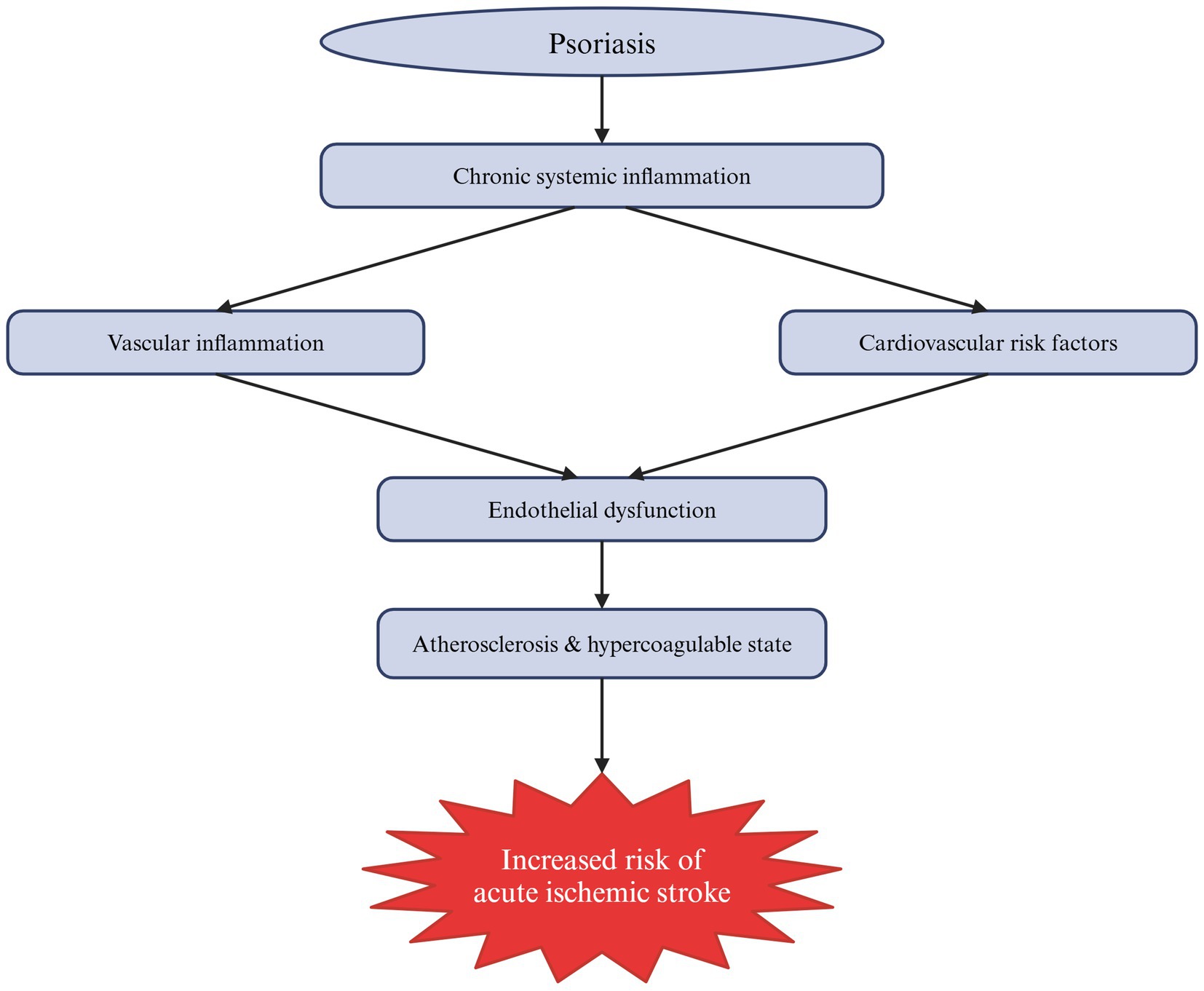
    Figure 1
    www.frontiersin.org

    Figure 1. Schematic summary of the mechanisms by which psoriasis contributes to the increased risk of acute ischemic stroke (AIS). As a systemic autoimmune disease, psoriasis is associated with chronic low-grade inflammation that directly affects blood vessels, causing their inflammation, and indirectly influences cardiovascular risk factors. Collectively, these mechanisms lead to endothelial dysfunction, atherosclerosis and a hypercoagulable state, ultimately increasing the risk of AIS.

    This narrative review aims to summarize the scientific literature and provide a comprehensive overview of the current understanding of the link between psoriasis and AIS, highlighting the potential role of the inflammatory pathomechanism underlying psoriasis in contributing to AIS incidence. It also explores psoriasis connection to traditional AIS risk factors.

    Methodology

    A comprehensive literature search was conducted using the PubMed and Google Scholar databases, covering studies from their inception to 5 February 2025. Both experimental and clinical studies were analyzed. A review of the current literature on the relationship between psoriasis and AIS identified key areas to be explored in this review. The pathophysiology of psoriasis and its role in systemic inflammation is discussed, as is the contribution of inflammation as a risk factor for AIS. Also, the analysis extends beyond inflammatory pathways to examine the role of psoriasis-associated comorbidities in stroke development. Titles and abstracts were searched for key terms such as ‘psoriasis’, ‘systemic inflammation’, and ‘acute ischemic stroke’. However, the major limitation of this review is the predominance of observational and cross-sectional studies, which by design, are unable to establish temporal relationships or causality. These studies are prone to a variety of biases, including selection bias. Moreover, the lack of randomized or longitudinal data limits causal inference and underscores the need for more rigorous prospective studies to validate the associations described in this paper. To ensure comprehensive coverage, relevant references from identified articles were also manually reviewed. However, articles written in languages other than English and papers not published as full scientific papers, such as conference abstracts, were excluded from our search to ensure the relevance of the review. The literature search was conducted independently by three authors (PO, KK, RPP) in January and February 2025.


    More at link.

    Saturday, July 20, 2019

    Warfarin-induced skin necrosis within psoriatic plaques

    You can check out these other warfarin side effects from taking rat poison. Luckily I had none and was only on it for a couple of months, now I'm on 325 aspirin and don't seem to have the bleeding side effects from that.


    Warfarin-induced skin necrosis within psoriatic plaques 

    Abstract 

    A myriad of different phenomena exist in the dermatological literature which are based on the concept of locus minores resistentiae. The most commonly described phenomenon is the Koebner phenomenon, which is classically associated with the emergence of psoriatic lesions post trauma. Warfarin-induced skin necrosis (WISN) is a rare but severe side effect that leads to necrosis of the skin, predominantly on areas with increased subcutaneous fat. The presented case reports on WISN within psoriatic plaques.
    Pictures at link.

    Tuesday, February 5, 2019

    Anti-inflammatory psoriasis agents could prevent heart disease

    Ask your doctor if this treatment could vastly reduce your chances of getting another stroke or heart attack.
    What other treatments does your doctor have you on to reduce atherosclerosis? Any of these? Or is your doctor not treating your vascular inflammation at all?

    VIP-U: Psoriasis treatment reduces vascular inflammation Feb. 2018

    Researchers develop new biomedical polymer to treat atherosclerosis May 2017 

    Vitamin D and cardiovascular disease: From atherosclerosis to myocardial infarction and stroke Jan. 2017 

    Watermelon juice reverses hardening of the arteries Nov. 2011 

    New study shows aged garlic extract can reduce dangerous plaque buildup in arteries  Jan. 2016 

    The latest here:


    Anti-inflammatory psoriasis agents could prevent heart disease

    Anti-inflammatory biologic therapy for treatment of severe psoriasis reduced coronary artery plaque, raising questions about whether such agents could have a role in prevention of CHD, researchers reported in Cardiovascular Research.
    “Classically a heart attack is caused by one of five risk factors: diabetes, hypertension, high cholesterol, family history or smoking,” Nehal N. Mehta, MD, chief of inflammation and cardiometabolic diseases at the NHLBI, said in a press release from the NIH. “Our study presents evidence that there is a sixth factor, inflammation; and that it is critical to both the development and the progression of atherosclerosis to heart attack.”

    Mehta and colleagues conducted a prospective observational study of 121 patients with moderate to severe psoriasis and low risk for CVD (mean age, 51 years; 58% men; median Framingham risk score, 3), who completed 1-year follow-up and had not had biologic treatment at baseline. During the study period, 89 patients were treated with biologic therapy.
    All patients underwent coronary CTA at baseline and 1 year to quantify total plaque coronary burden and plaque subcomponents in three coronary vessels of at least 2 mm in diameter.
    According to the researchers, biologic therapy was associated with reductions in noncalcified plaque burden (6%; P = .005) and necrotic core (57%; P = .03), but not in fibrous burden (P = .71).
    Compared with patients who were not treated with biologics, those who were had a greater decrease in noncalcified plaque burden (–0.07 mm2 vs. 0.06 mm2; P = .02), which persisted after adjustment for traditional CV risk factors (beta = 0.2; P = .02), Mehta and colleagues wrote.
    The group treated with biologics had a reduction in C-reactive protein at 1 year (P < .001), but the untreated group did not (P = .21).
    The treatment effect was greatest in patients treated with , according to the researchers.
    “We found that these anti-inflammatory drugs commonly used to treat severe psoriasis also improve plaque in the coronary artery, making them more stable and less likely to cause a heart attack. This occurred in the absence of changes in traditional cardiovascular risk factors including blood pressure and blood lipids,” Mehta said in a press release from the European Society of Cardiology. “This preliminary study provides the first evidence that biologic therapy is associated with coronary plaque reduction and stabilization, and provides strong rationale for conduct of a randomized trial testing the impact of biologic therapy on the progression of coronary disease in patients with psoriasis.” – by Erik Swain
    Disclosures: Mehta reports he received research grants to his employer, the NHLBI, from AbbVie, Celgene, Janssen and Novartis. Please see the study for all other authors’ relevant financial disclosures.

    Wednesday, February 21, 2018

    VIP-U: Psoriasis treatment reduces vascular inflammation

    Ask your doctor if this treatment could vastly reduce your chances of getting another stroke or heart attack. 
    What other treatments does your doctor have you on to reduce atherosclerosis? Any of these? Or is your doctor not treating your vascular inflammation at all?


    Researchers develop new biomedical polymer to treat atherosclerosis May 2017 

    Vitamin D and cardiovascular disease: From atherosclerosis to myocardial infarction and stroke Jan. 2017 

    Watermelon juice reverses hardening of the arteries Nov. 2011 

    New study shows aged garlic extract can reduce dangerous plaque buildup in arteries  Jan. 2016 

    The latest here:

    VIP-U: Psoriasis treatment reduces vascular inflammation


    Vascular inflammation was reduced in patients who were treated for psoriasis with ustekinumab, according to results from the VIP-U study presented at the American Academy of Dermatology Annual Meeting.
    “What’s important at this stage is the concept and the promise,” Joel M. Gelfand, MD, MSCE, director of the Psoriasis and Phototherapy Treatment Center, vice chair of clinical research, medical director of the dermatology clinical studies unit, professor of dermatology and professor of epidemiology in biostatistics and epidemiology at the University of Pennsylvania, told Cardiology Today. “We know inflammation is an important risk factor for CVD. Just recently, the CANTOS trial proved that blocking inflammation with an antibody against interleukin-1b lowers the risk of major cardiovascular events
    . Our study demonstrates that blocking interleukin-12/23 not only improves inflammation in the skin, joints and bowels, but also in the aorta, proving that it is capable of biologically hitting the target.” Researchers analyzed data from 43 patients (mean age, 42 years) who had a psoriasis area severity index greater than 12 and a body surface area of at least 10. At baseline, patients were washed out of their psoriasis treatment. Patients were assigned to ustekinumab (Stelara, Janssen) or placebo for 12 weeks. The primary outcome of interest was aortic inflammation, which was measured by fluorine-18 fluorodeoxyglucose PET/CT scans at baseline and 12 weeks. At 12 weeks, 41 patients completed the trial. Seventy-seven percent of patients assigned ustekinumab achieved a 75% reduction in psoriasis area severity index compared with 11% of patients in the placebo group (P < .001). At the end of the study, total aortic vascular inflammation was reduced by 6.6% in patients assigned ustekinumab and increased by 12.1% in patients assigned placebo (P = .001). “There is a need for treatments that can lower CV risk by modulating inflammation while not significantly increasing the risk of side effects such as infection,” Gelfand told Cardiology Today. “The emerging biologics in psoriasis have an impressive safety profile and may ultimately prove to offer benefits beyond the skin, extending to cardiovascular disease prevention.” – by Darlene Dobkowski Gelfand JM, et al. Abstract 6645. Presented at: American Academy of Dermatology Annual Meeting; Feb. 16-20, 2018; San Diego. The study was funded by Janssen Scientific Affairs. Gelfand reports he is a consultant for Bristol-Myers Squibb, Coherus, Dermira, Dr. Reddy’s Labs, GlaxoSmithKline, Janssen Biologics, Menlo Therapeutics, Novartis, Pfizer, Regeneron and Sanofi; receives honoraria and research grants from AbbVie, Celgene, Janssen, Novartis, Pfizer, Regeneron and Sanofi; and has received payment for CME work related to psoriasis that was supported by AbbVie, Lilly and Valeant.

    Friday, June 2, 2017

    Can Psoriasis Tx Diminish Atherosclerosis?

    What other treatments does your doctor have you on to reduce atherosclerosis? Any of these?

    Researchers develop new biomedical polymer to treat atherosclerosis May 2017 

    Vitamin D and cardiovascular disease: From atherosclerosis to myocardial infarction and stroke Jan. 2017 

    Watermelon juice reverses hardening of the arteries Nov. 2011 

    New study shows aged garlic extract can reduce dangerous plaque buildup in arteries  Jan. 2016 

    Pomegranate juice consumption for 3 years by patients with carotid artery stenosis reduces common carotid intima-media thickness, blood pressure and LDL oxidation  June 2004 


    Regular coffee drinkers have 'cleaner' arteries

     The possible druggie way to address this;

    Can Psoriasis Tx Diminish Atherosclerosis?

    Observational study links improvements in skin, vascular inflammation

    • by Contributing Writer, MedPage Today
    Treatments that eased psoriasis were tied to reductions in vascular inflammation as well, a small study found.
    After a year of treatment for the skin condition -- a mix of of topical therapy (60%), biological therapy (66%, mostly anti-tumor necrosis factor [anti-TNF] therapy), and phototherapy (15%) -- there was a median 33% improvement in psoriasis (P<0.001) that was linked to a 6% reduction in vascular inflammation as measured by PET/CT, even after adjusting for traditional risk factors (P=0.03), according to Nehai N. Mehta, MD, MSCE, of the National Heart, Lung, and Blood Institute in Bethesda, Md., and colleagues.
    They noted in their JAMA Cardiology study that patients achieving at least a 75% reduction in skin inflammation severity had an 11% improvement in vascular inflammation (P<0.003).
    "These findings suggest that controlling remote target organ inflammation (e.g., in the skin) may improve vascular diseases; however, randomized clinical trials are needed to confirm these findings," wrote Mehta's group.
    For one, the randomized Vascular Inflammation in Psoriasis-Extension Trial is in the works as investigators study the effect of anti-TNF therapy with adalimumab on skin and vascular inflammation.
    "These data are intriguing and support a rigorous testing of the hypothesis that intervening on psoriatic disease may mitigate vascular disorders, but there are several unanswered questions that frame our understanding of the role of inflammation in vascular disease," according to Calum A. MacRae, MD, PhD, of Brigham and Women's Hospital in Boston.
    Writing in an accompanying editorial, MacRae said it was unclear "whether the correlation observed by [the authors] reflects a shared pathobiology or a serendipitous shared responsiveness to a specific anti-inflammatory intervention. It is difficult to infer from these data that treating skin inflammation directly results in diminished vascular inflammation."
    "Even mild cases of psoriasis exhibit evidence of fluorodeoxyglucose uptake, particularly in the proximal aorta, but the distribution of these findings in the arterial tree and the absence of reliable correlates in typical atherosclerotic coronary disease complicates straightforward inferences regarding the underlying biology."
    Mehta and colleagues admitted that their observational study left room for residual confounding despite adjustment. Furthermore, participants got a mix of therapies that precluded drawing any conclusions about the role of anti-TNF therapy.
    Their prospective study had followed 220 patients, with 115 consecutive participants making it to 1-year follow-up. Mean age of the participants was 49.7 years; the group was 59% men. The study population also started with low baseline cardiovascular risk (Framingham risk score) and mild-to-moderate psoriasis (median Psoriasis Area and Severity Index score 5.2).
    Psoriasis severity, measured as a Psoriasis Area and Severity Index score, was associated with vascular inflammation at baseline (P=0.03). Vascular inflammation, a well-known contributor to atherosclerosis, was quantified as target-to-background ratio on 18fluorodeoxyglucose positron emission tomography/CT.
    Moving forward, it's important to further elucidate the role of inflammation in atherosclerosis, MacRae suggested.
    "Inflammation affects multiple stages of human atherosclerosis. Cellular and humoral immunity have been implicated in the initiation and evolution of atherosclerotic plaques, in plaque vulnerability, and in acute coronary syndromes," he said. "Distinctive inflammation biology has also been implicated in other vascular syndromes, including aortic root disease, carotid arteriopathy, and peripheral arterial disease, revealing a substantial etiologic heterogeneity that has been confirmed by genetics and other studies."
    "Despite these insights and increases in our understanding of the role of inflammation in atherosclerosis models, immunology has hardly influenced clinical cardiology."
    Mehta and MacRae disclosed no relevant conflicts of interest.
    Study co-authors reported numerous relationships with industry.

    Friday, October 9, 2015

    Severity of skin psoriasis linked to blood vessel inflammation, cardiovascular risk

    Be careful out there. 

    Severity of skin psoriasis linked to blood vessel inflammation, cardiovascular risk


    People with more psoriasis may also have more inflammation in theirblood vessels, according to research published in the American Heart Association journalArteriosclerosis, Thrombosis and Vascular Biology.
    Psoriasis is a chronic inflammatory disease affecting about 3 percent of U.S. adults. It occurs when skin cells grow too quickly, resulting in thick white or red patches of skin.
    Previous research suggests psoriasis may be linked with a higher risk of cardiac events and cardiovascular-related death. This may be the first study to examine whether psoriasis severity impacts inflammation in the blood vessels.
    In the study, researchers analyzed 60 adults (average age 47) with psoriasis and 20 (average age 41) without psoriasis. All study participants were at low risk for cardiovascular disease based on a traditional risk assessment. They underwent a nuclear scan that measured blood vessel inflammation, and a dermatologist assessed the amount of psoriasis.
    Researchers found:
    • Patients had psoriasis ranging from mild (only a few patches, less than 3 percent of the skin surface affected) to severe (when patches cover more than 10 percent of the skin surface).
    • Patients had high levels of inflammation in their blood vessels — even though they were at low risk for cardiovascular disease.
    • The most extensive forms of psoriasis were associated with a 51 percent increase in blood vessel inflammation.
    • The relationship between psoriasis and increased blood vessel inflammation didn’t change much after accounting for other heart disease risk factors.
    “The most important observation we made was that the more psoriasis was on the skin, the more inflammation there was in the blood vessels,” said senior study author Nehal N. Mehta, M.D., M.S.C.E., a Lasker clinical investigator in the Cardiovascular and Pulmonary Branch of the National Heart, Lung, and Blood Institute in Bethesda, Maryland. “In other words, what we see on the outside is mirrored on the inside.”
    The findings support the idea that the skin disease and cardiovascular disease may share an immune-related underlying mechanism, but doesn’t prove one causes the other.
    “People who have psoriasis — particularly if it is severe — should be assessed by their doctor for cardiovascular risk factors, including diabetes, high cholesterol and obesity,” Mehta said. “They should also maintain an active lifestyle, avoid smoking and follow a balanced diet.”
    Co-authors are Haley B. Naik, M.D., M.H.Sc.; Balaji Natarajan, M.D.; Elena Stansky, B.S.; Mark A. Ahlman, M.D.; Heather Teague, Ph.D.; Taufiq Salahuddin, B.S.; Qimin Ng, B.S.; Aditya A. Joshi, M.D.; Parasuram Krishnamoorthy, M.D.; Jenny Dave, M.S.; Shawn M. Rose, M.D., Ph.D.; Julia Doveikis, B.S.; Martin P. Playford, Ph.D.; Ronald B. Prussick, M.D.; Alison Ehrlich, M.D.; Mariana J. Kaplan, M.D.; Benjamin N. Lockshin, M.D.; and Joel M. Gelfand, M.D., M.S.C.E.
    The NHLBI Intramural Research Program and National Psoriasis Foundation funded the study.
    Additional Resources:
    http://newsroom.heart.org/news/severity-of-skin-psoriasis-linked-to-blood-vessel-inflammation-cardiovascular-risk?preview=9d1232c2cd4549625d357c593db8e09f

    Thursday, June 11, 2015

    New drug can clear all psoriasis symptoms

    So would clearing it up this way then effectively reduce your stroke risk? What does your doctor say?

    Psoriasis Raises Risk of Heart Disease and Stroke

    The latest here:

    New drug can clear all psoriasis symptoms

    A University of Manchester led trial of a new psoriasis drug has resulted in 40 percent of people showing a complete clearance of psoriatic plaques after 12 weeks of treatment and over 90 percent showing improvement.
    The research tested 2,500 people with psoriasis.  Half were given a new drug – ixekizumab – either once every two or four weeks. The other half were given a placebo or a widely used drug for psoriasis called etanercept.
    The ixekizumab groups showed quick and extensive improvements in their condition, outperforming the groups on placebo or etanercept.  Around half of these patients showed improvement as early as week four of the trial and up to 71% had shown a high level of improvement, as measured using a scale called the Psoriasis Area and Severity Index, by week 12.
    Chris Griffiths, Foundation Professor of Dermatology in the University’s Faculty of Medical and Human Sciences and Salford Royal NHS Foundation Trust, led the research.  He said: “The visible effects of psoriasis can have a major and life-ruining impact on people’s confidence and self-esteem.
    “What we saw in this trial was not just the physical aspects of the disease clearing up, but people on the new drug also reporting a marked improvement in their quality of life as they felt more confident and suffered less from itching – far more than in the other two groups.”
    Ixekizumab is a monoclonal antibody – a cloned antibody – which neutralises the inflammatory effects of an  interleukin (IL) a protein in the skin which carries signals to cells – known as (IL)-17A.  This protein is increasingly becoming recognised as one of the causes of the characteristic red, scaly plaques of psoriasis which affect around 2% of people in the UK.
    New treatments are changing the prospects for people with psoriasis according to Professor Griffiths. “The objective for treating psoriasis has been to reduce the visible symptoms,” he said. “But new drugs are fast showing us that a realistic goal for all patients should be attaining clear skin and this trial very much sets us on that path.”

    Tuesday, August 20, 2013

    Psoriasis Raises Risk of Heart Disease and Stroke

    Has your doctor told you this? 

    Psoriasis Raises Risk of Heart Disease and Stroke


    Action Points

    • Explain to patients that this study showed that psoriasis patients have an increased risk of heart disease and stroke compared with the general population.
    • Point out that the findings were based on a retrospective analysis of data from studies that were not designed to evaluate the risk of CHD and stroke.
    • Note that this study was published as an abstract and presented as a poster at a conference. These data and conclusions should be considered to be preliminary until published in a peer-reviewed journal.
    More at link and from your doctor.
     

    Tuesday, August 21, 2012

    Psoriasis Drugs May Curb Heart Disease Risk

    Remember the unproven  miracle drug etanercept from a year and a half ago? It supposedly reduced the TNF, tumor necrosis factor, just like this drug does. So contact your researcher  and have them see if reducing TNF actually helps in stroke rehab and then if this drug might help. No one else is going to push this so you have to. 

    Psoriasis Drugs May Curb Heart Disease Risk


    Treating psoriasis patients with biologic drugs that inhibit tumor necrosis factor (TNF) may cut risk of heart attack compared with other treatments, observational results suggested.
    TNF-treated patients were half as likely to have a myocardial infarction (MI) as those treated with topical drugs after adjustment for other factors, Jashin J. Wu, MD, of the Kaiser Permanente Los Angeles Medical Center, and colleagues found in a retrospective cohort study.
    Oral drugs and phototherapy were also significantly better than topical treatment in terms of MI risk, though rates tended to be even lower with the TNF inhibitors, the researchers reported online in the Archives of Dermatology.
    "It seems that controlling psoriasis with aggressive therapy and, thus, lowering inflammation leads to a reduction in MI risk," they wrote.
    As a systemic inflammatory disease, psoriasis is linked to many cardiovascular risks, from obesity and atherosclerosis to type 2 diabetes, stroke, MI, and cardiac death.
    The same is true in rheumatoid arthritis, but a large observational study linked TNF blockers to reduced cardiovascular events in that disease.
    To evaluate the effect in psoriasis, Wu's group retrospectively analyzed the Kaiser Permanente Southern California health plan databases.
    Among the 8,845 members with multiple diagnostic claims codes for psoriasis or psoriatic arthritis and no history of MI at baseline:
    • 19% took a TNF inhibitor for at least 2 months
    • 24% were TNF-inhibitor naive and received other systemic agents, like methotrexate, or phototherapy
    • 57% received none of the above and were classified as treated only topically
    During a mean 4.3 years of follow-up, MI incidence was 3.05 per 1,000 patient-years in the anti-TNF-treated group compared with 3.85 in those on oral drugs or phototherapy and 6.73 in those on topical drugs.
    That translated to an unadjusted 55% lower risk of MI with the TNF inhibitors and 43% lower risk with oral drugs or phototherapy compared with topical agents (both P less than 0 data-blogger-escaped-.001=".001" data-blogger-escaped-p="p" greater than TNF blockers were associated with 21% lower MI risk compared with other systemic drugs or phototherapy in that analysis, though the difference wasn't statistically significant.
    In an age-stratified analysis, both treatments appeared more protective against MI in older adults. Compared with topical agents, the hazard ratios were:

    • Among patients age ≤60, 0.46 with TNF inhibitors (95% CI 0.25 to 0.88) and a nonsignificant 0.60 with oral therapy and phototherapy
    • Among patients age >60, 0.32 with TNF inhibitors (95% CI 0.14 to 0.73) and 0.35 with oral agents or phototherapy (95% CI 0.21 to 0.59)
    "One reason for this is that older patients are more likely to have type 2 diabetes mellitus, and the benefits of TNF inhibitor use may be mediated through improving risk of type 2 diabetes," the researchers noted.
    Alternatively, older patients may be less likely to get a TNF inhibitor because of lower coverage of prescription benefits through Medicare for these costly drugs, or because of recent history of cancer as a contraindication for TNF inhibitor therapy, they added.
    The study didn't compare the individual TNF blockers -- infliximab (Remicade), etanercept (Enbrel), and adalimumab (Humira) -- used in psoriasis.
    The study was limited by lack of data on psoriasis severity, which could have been a confounding factor if severe cases were more likely to receive no systemic therapy.
    Other limitations were lack of adjustment for over-the-counter medications like nonsteroidal anti-inflammatory drugs and for duration and dosing of drugs analyzed in the study (statins, beta-blockers, or methotrexate).

    Wednesday, January 18, 2012

    Risk of Myocardial Infarction in Patients With Psoriasis

    Just out so ask your doctor about this inflammatory disease. Be careful. 

    Risk of Myocardial Infarction in Patients With Psoriasis


    pictures here:
    http://healthwise-everythinghealth.blogspot.com/2012/01/many-faces-of-psoriasis.html

    Abstract

    Context Psoriasis is the most common T-helper cell type 1 (TH1) immunological disease. Evidence has linked TH1 diseases to myocardial infarction (MI). Psoriasis has been associated with cardiovascular diseases, but has only been investigated in hospital-based studies that did not control for major cardiovascular risk factors.
    Objective To determine if within a population-based cohort psoriasis is an independent risk factor for MI when controlling for major cardiovascular risk factors.
    Design, Setting, and Patients A prospective, population-based cohort study in the United Kingdom of patients with psoriasis aged 20 to 90 years, comparing outcomes among patients with and without a diagnosis of psoriasis. Data were collected by general practitioners as part of the patient's medical record and stored in the General Practice Research Database between 1987 and 2002, with a mean follow-up of 5.4 years. Adjustments were made for hypertension, diabetes, history of myocardial infarction, hyperlipidemia, age, sex, smoking, and body mass index. Patients with psoriasis were classified as severe if they ever received a systemic therapy. Up to 5 controls without psoriasis were randomly selected from the same practices and start dates as the patients with psoriasis. A total of 556 995 control patients and patients with mild (n = 127 139) and severe psoriasis (n = 3837) were identified.
    Main Outcome Measure Incident MI.
    Results There were 11 194 MIs (2.0%) within the control population and 2319 (1.8%) and 112 (2.9%) MIs within the mild and severe psoriasis groups, respectively. The incidences per 1000 person-years for control patients and patients with mild and severe psoriasis were 3.58 (95% confidence interval [CI], 3.52-3.65), 4.04 (95% CI, 3.88-4.21), and 5.13 (95% CI, 4.22-6.17), respectively. Patients with psoriasis had an increased adjusted relative risk (RR) for MI that varied by age. For example, for a 30-year-old patient with mild or severe psoriasis, the adjusted RR of having an MI is 1.29 (95% CI, 1.14-1.46) and 3.10 (95% CI, 1.98-4.86), respectively. For a 60-year-old patient with mild or severe psoriasis, the adjusted RR of having an MI is 1.08 (95% CI, 1.03-1.13) and 1.36 (95% CI, 1.13-1.64), respectively.
    Conclusions Psoriasis may confer an independent risk of MI. The RR was greatest in young patients with severe psoriasis.

    Tuesday, August 16, 2011

    Attributable Risk Estimate of Severe Psoriasis on Major Cardiovascular Events

    More knowledge for all you readers. 

    Attributable Risk Estimate of Severe Psoriasis on Major Cardiovascular Events


    Patients with severe psoriasis have an additional 6.2% absolute risk of major adverse cardiac events compared to the general population. This finding could have important therapeutic implications for cardiovascular risk stratification and prevention in patients with severe psoriasis.

    Abstract

    Background

    Recent studies suggest that psoriasis, particularly if severe, may be a risk factor for major adverse cardiac events, such as myocardial infarction, stroke, and mortality from cardiovascular disease. We compared the risk of major adverse cardiac events between patients with psoriasis and the general population and estimated the attributable risk of severe psoriasis.

    Methods
    We performed a cohort study in the General Practice Research Database. Severe psoriasis was defined as receiving a psoriasis diagnosis and systemic therapy (N=3603). Up to 4 patients without psoriasis were selected from the same practices and start dates for each patient with psoriasis (N=14,330).

    Results
    Severe psoriasis was a risk factor for major adverse cardiac events (hazard ratio 1.53; 95% confidence interval, 1.26-1.85) after adjusting for age, gender, diabetes, hypertension, tobacco use, and hyperlipidemia. After fully adjusted analysis, severe psoriasis conferred an additional 6.2% absolute risk of 10-year major adverse cardiac events.

    Conclusion
    Severe psoriasis confers an additional 6.2% absolute risk of a 10-year rate of major adverse cardiac events compared with the general population. This potentially has important therapeutic implications for cardiovascular risk stratification and prevention in patients with severe psoriasis. Future prospective studies are needed to validate these findings.

    Sunday, April 10, 2011

    Mindfulness meditation improves connections in the brain

    I know there is nothing specific about stroke rehab in this. But if we can strengthen brain connections we can apply this to stroke rehab. 

    Mindfulness meditation improves connections in the brain


    When I’m stressed, I listen to a 20-minute mindfulness meditation tape. It always helps me feel calmer and more relaxed. Many meditative practices can do this. But mindfulness meditation is getting a lot of attention because it seems to help with so many physical and psychological problems—like high blood pressure, chronic pain, psoriasis, sleep trouble, anxiety, and depression. It’s also been shown to boost immune function and stop binge eating. No one knows for sure what’s behind these benefits, but physical changes in the brain probably play a role.
    Mindfulness meditation is a mental discipline. You start by focusing your attention on your breath, a sensation in the body, or a chosen word or phrase. You note the thoughts, emotions, and background sounds that arise from moment to moment, observing them without analyzing them or making judgments about what’s going on around you. If you drift into thoughts about the past or concerns about the future, you bring your attention back to the present, for example, by refocusing on your breathing. It takes practice.
    A new study, published in the May 2011 issue of Neuroimage, suggests that one effect of all this focusing and refocusing is increased brain connectivity. Researchers at the University of California-Los Angeles compared the brain activity of volunteers who had finished eight weeks of mindfulness-based stress reduction training with that of volunteers who did not do such training. Functional MRI scans showed stronger connections in several regions of the meditators’ brains—especially those associated with attention and auditory and visual processing. Unfortunately, the study didn’t scan the volunteers’ brains before mindfulness training, so no one can say for sure that mindfulness training was responsible for the differences.
    At Massachusetts General Hospital, researchers used MRI scans to document before and after changes in the brain’s gray matter—the “processing” neurons—associated with mindfulness meditation. The density of gray matter increased in regions governing such distinctly different activities as memory, self-awareness, and compassion, and decreased in the amygdala—the part of the brain associated with fear and stress. We covered this intriguing research in the April issue of Harvard Women’s Health Watch.
    At the moment, scientists can only speculate about the relationship between these brain changes and the health benefits associated with mindfulness meditation. But the research adds to growing evidence that meditative practices can alter the body at a fundamental level—even, it turns out, at the level of our genes. Meditation elicits the “relaxation response,” a state of deep relaxation first described more than 35 years ago by mind-body pioneer Dr. Herbert Benson, currently emeritus director of the Benson-Henry Institute of Mind-Body Medicine at Massachusetts General Hospital. Since then, Benson and his colleagues at Massachusetts General Hospital and Beth Israel Deaconess Medical Center have discovered that relaxation techniques (including meditation and yoga) turn certain sets of genes on and off in people who practice them regularly. Benson, who is the medical editor of Stress Management: Approaches for preventing and reducing stress (a Special Health Report from Harvard Health Publications, which also publishes Harvard Women’s Health Watch), says these genes are involved with controlling “how the body handles free radicals, inflammation processes, and cell death.” You can read about the gene research here.


    So besides our physical exercises we need mental ones too. No rest for the weary. Ask your doctor if this would help.