Changing stroke rehab and research worldwide now.Time is Brain! trillions and trillions of neurons that DIE each day because there are NO effective hyperacute therapies besides tPA(only 12% effective). I have 523 posts on hyperacute therapy, enough for researchers to spend decades proving them out. These are my personal ideas and blog on stroke rehabilitation and stroke research. Do not attempt any of these without checking with your medical provider. Unless you join me in agitating, when you need these therapies they won't be there.

What this blog is for:

My blog is not to help survivors recover, it is to have the 10 million yearly stroke survivors light fires underneath their doctors, stroke hospitals and stroke researchers to get stroke solved. 100% recovery. The stroke medical world is completely failing at that goal, they don't even have it as a goal. Shortly after getting out of the hospital and getting NO information on the process or protocols of stroke rehabilitation and recovery I started searching on the internet and found that no other survivor received useful information. This is an attempt to cover all stroke rehabilitation information that should be readily available to survivors so they can talk with informed knowledge to their medical staff. It lays out what needs to be done to get stroke survivors closer to 100% recovery. It's quite disgusting that this information is not available from every stroke association and doctors group.

Showing posts with label cerebral amyloid angiopathy. Show all posts

Wednesday, February 4, 2026

Hidden brain condition may quadruple dementia risk in older adults, study suggests

 Your competent? doctor has known of this a long time ago and has protocols to detect and prevent the problem, right! Oh NO, your doctor knows nothing and has done nothing; too bad, you get the results of not getting competent persons in your stroke hospital. Your doctor gets off scot-free, yet is still getting paid.

  • cerebral amyloid angiopathy (2 posts to August 2018)
  • Hidden brain condition may quadruple dementia risk in older adults, study suggests

    A little-known brain blood vessel disorder could quadruple the risk of dementia in older adults, according to a preliminary study from the American Heart Association.

    Cerebral amyloid A little-known brain blood vessel disorder could quadruple the risk of dementia in older adults, according to a preliminary study from the American Heart Association.

    Cerebral amyloid angiopathy (CAA) is a condition in which protein builds up in the brain and weakens blood vessels. 

    As people age, some of these proteins can collect in the brain’s blood vessels with few to no symptoms, according to the association. 

    ALZHEIMER’S DECLINE COULD SLOW DRAMATICALLY WITH ONE SIMPLE DAILY HABIT, STUDY FINDS

    When the buildup begins to affect brain function, doctors may diagnose the condition, typically through MRI or PET scans. In severe cases, CAA can result in a stroke.

    Approximately 23% to 29% of people above the age of 50 have moderate to severe CAA, according to Cleveland Clinic.

    Older woman Alzheimer's

    In the new study, researchers analyzed health data for nearly two million adults with and without CAA, tracking new dementia diagnoses from 2016 to 2022. All participants were at least 65 years old and covered by Medicare.

    The adults were grouped into four medical categories: no CAA or stroke, CAA only, stroke only, or both CAA and stroke.

    LOWER DEMENTIA RISK LINKED TO ROUTINE VACCINATION IN MAJOR NEW ANALYSIS

    About 42% of people with CAA were diagnosed with dementia within five years, compared to only 10% of those without it — roughly a fourfold difference. 

    The risk remained elevated even if the person had no history of stroke.
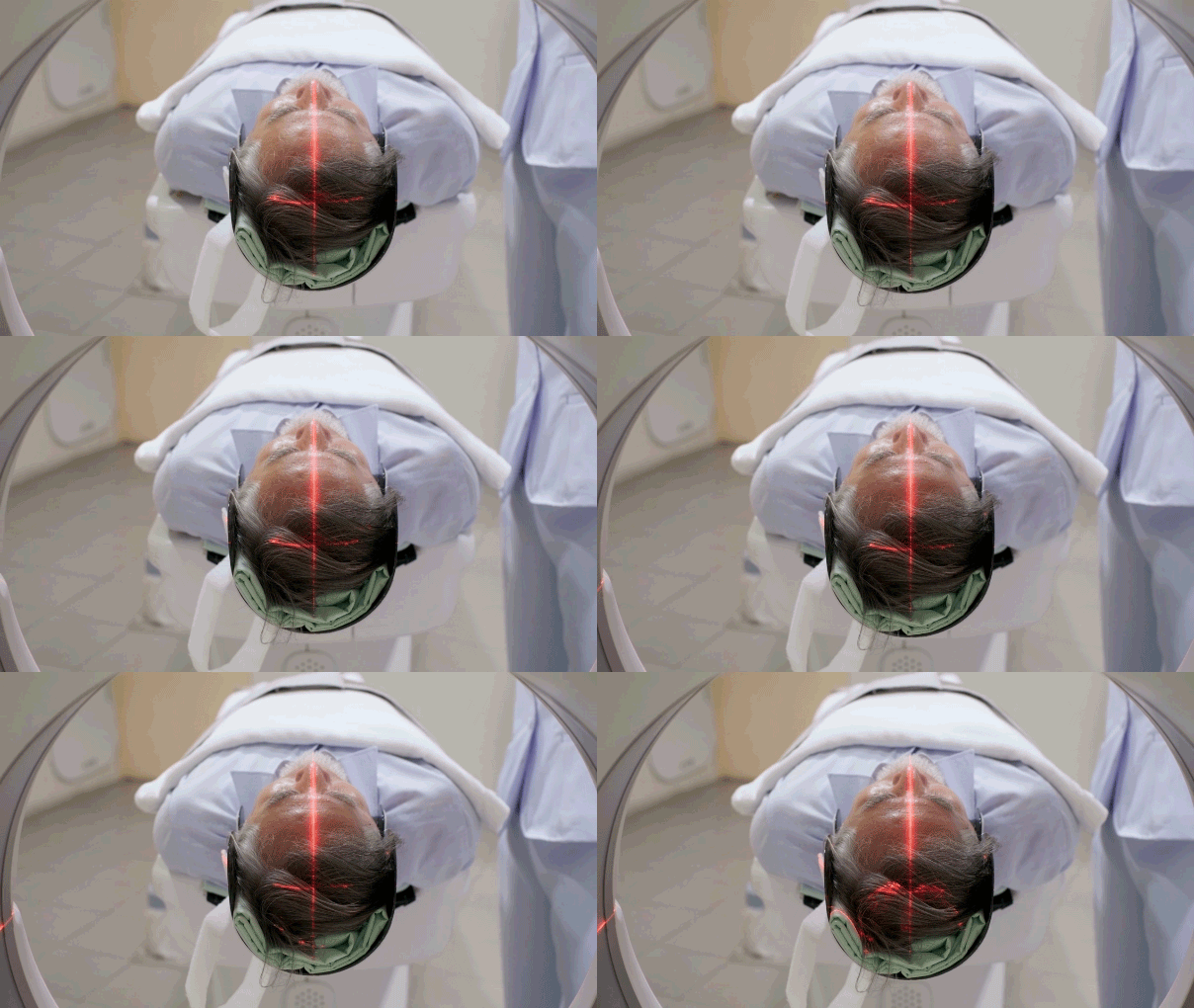
    Man getting brain scan MRI cognitive health screening

    “What stood out was that the risk of developing dementia among those with CAA without stroke was similar to those with CAA with stroke, and both conditions had a higher increase in the incidence of dementia when compared to participants with stroke alone,” study author Samuel S. Bruce, an assistant professor of neurology at Weill Cornell Medicine in New York City, said in a press release.

    CLICK HERE TO SIGN UP FOR OUR HEALTH NEWSLETTER

    “These results highlight the need to proactively screen for cognitive changes after a diagnosis of CAA and address risk factors to prevent further cognitive decline,” he added.

    CLICK HERE FOR MORE HEALTH STORIES

    The early research will be presented as a preliminary study at the American Stroke Association’s International Stroke Conference this week in New Orleans, and it may undergo further peer review before final publication.

     (CAA) is a condition in which protein builds up in the brain and weakens blood vessels. 

    As people age, some of these proteins can collect in the brain’s blood vessels with few to no symptoms, according to the association. 

    ALZHEIMER’S DECLINE COULD SLOW DRAMATICALLY WITH ONE SIMPLE DAILY HABIT, STUDY FINDS

    When the buildup begins to affect brain function, doctors may diagnose the condition, typically through MRI or PET scans. In severe cases, CAA can result in a stroke.

    Approximately 23% to 29% of people above the age of 50 have moderate to severe CAA, according to Cleveland Clinic.

    Older woman Alzheimer's

    In the new study, researchers analyzed health data for nearly two million adults with and without CAA, tracking new dementia diagnoses from 2016 to 2022. All participants were at least 65 years old and covered by Medicare.

    The adults were grouped into four medical categories: no CAA or stroke, CAA only, stroke only, or both CAA and stroke.

    LOWER DEMENTIA RISK LINKED TO ROUTINE VACCINATION IN MAJOR NEW ANALYSIS

    About 42% of people with CAA were diagnosed with dementia within five years, compared to only 10% of those without it — roughly a fourfold difference. 

    The risk remained elevated even if the person had no history of stroke.

    Man getting brain scan MRI cognitive health screening

    “What stood out was that the risk of developing dementia among those with CAA without stroke was similar to those with CAA with stroke, and both conditions had a higher increase in the incidence of dementia when compared to participants with stroke alone,” study author Samuel S. Bruce, an assistant professor of neurology at Weill Cornell Medicine in New York City, said in a press release.

    CLICK HERE TO SIGN UP FOR OUR HEALTH NEWSLETTER

    “These results highlight the need to proactively screen for cognitive changes after a diagnosis of CAA and address risk factors to prevent further cognitive decline,” he added.

    CLICK HERE FOR MORE HEALTH STORIES

    The early research will be presented as a preliminary study at the American Stroke Association’s International Stroke Conference this week in New Orleans, and it may undergo further peer review before final publication.


    Sunday, October 13, 2024

    Post-stroke hippocampal neurogenesis is impaired by microvascular dysfunction and PI3K signaling in cerebral amyloid angiopathy

     What is your competent? doctor doing to get this tested and solved for in humans? Nothing? Like Usual? So you don't have a functioning stroke doctor, do you? 

    Post-stroke hippocampal neurogenesis is impaired by microvascular dysfunction and PI3K signaling in cerebral amyloid angiopathy

    Highlights

    Function and tissue recovery after ischemic stroke are significantly impaired in 5xFAD mice
    Changes in the BBB reduce blood flow and reperfusion capability in the 5xFAD genotype
    Transcriptomic analysis links endothelial cells and hippocampal NPCs via the PI3K pathway
    Activation of the PI3K pathway rescues neurogenesis in 5xFAD mice post stroke

    Summary

    Ischemic stroke and cerebral amyloid angiopathy (CAA) pose significant challenges in an aging population, particularly in post-stroke recovery. Using the 5xFAD mouse model, we explore the relationship between CAA, ischemic stroke, and tissue recovery. We hypothesize that amyloid-beta accumulation worsens stroke outcomes by inducing blood-brain barrier (BBB) dysfunction, leading to impaired neurogenesis. Our findings show that CAA exacerbates stroke outcomes, with mice exhibiting constricted BBB microvessels, reduced cerebral blood flow, and impaired tissue recovery. Transcriptional analysis shows that endothelial cells and neural progenitor cells (NPCs) in the hippocampus exhibit differential gene expression in response to CAA and stroke, specifically targeting the phosphatidylinositol 3-kinase (PI3K) pathway. In vitro experiments with human NPCs validate these findings, showing that disruption of the CXCL12-PIK3C2A-CREB3L2 axis impairs neurogenesis. Notably, PI3K pathway activation restores neurogenesis, highlighting a potential therapeutic approach. These results suggest that CAA combined with stroke induces microvascular dysfunction and aberrant neurogenesis through this specific pathway.

    Graphical abstract

    Graphical abstract undfig1

    Wednesday, August 15, 2018

    Two simple tests could help to pinpoint cause of stroke

    So write up a protocol and get it distributed to all stroke hospitals.  Do you really think every stroke hospital has staff to read research and implement in their hospital? You as a survivor are screwed because your hospital is incompetent in that regard.

    Two simple tests could help to pinpoint cause of stroke

    Detecting the cause of the deadliest form of stroke could be improved by a simple blood test added alongside a routine brain scan, research suggests.
    Combining the with a brain scan could provide key genetic information that may help identify those most at risk from a second , doctors say.
    Experts say the new approach could revolutionise the way doctors manage strokes caused by bleeding in the brain, known as intracerebral haemorrhage (ICH).
    ICH accounts for up to 50 per cent of all strokes worldwide.(Does no one vet your information? 80-85% are clot based.) Around half of those affected die within one year.
    Researchers used the and brain scan images to detect a condition known as cerebral amyloid angiopathy (CAA), which can cause ICH and is linked to a higher risk of further strokes and dementia.
    CAA is caused by a build-up of a protein known as amyloid in the walls of vessels in the brain.
    University of Edinburgh researchers used computed tomography (CT) scans in more than 100 patients who died following their first ICH. They collected blood samples to test a gene called APOE, which is linked to CAA.
    By combining simple CT scan images with a genetic blood test, researchers could accurately spot if an ICH had been caused by CAA.
    This new approach could help identify people who are at higher risk after their ICH, scientists say.
    It could also improve ICH diagnosis in developing countries as CT scanning and blood testing is available worldwide.
    Dr Mark Rodrigues, Wellcome Trust Clinical PhD Programme Fellow at the University of Edinburgh, said: "Identifying the cause of a haemorrhage is important to planning patient care. Our findings suggest that the combination of routine CT scanning with APOE gene testing can identify those whose ICH has been caused by CAA - a group who may be more at risk of another ICH or dementia."
    The study is published in Lancet Neurology and was funded by the Medical Research Council, Stroke Association and Wellcome Trust.
    More information: Lancet Neurology (2018). DOI: 10.1016/S1474-4422(18)30006-1

    Journal reference: Lancet Neurology search and more info website
    Provided by: University of Edinburgh search and more info website