Changing stroke rehab and research worldwide now.Time is Brain! trillions and trillions of neurons that DIE each day because there are NO effective hyperacute therapies besides tPA(only 12% effective). I have 523 posts on hyperacute therapy, enough for researchers to spend decades proving them out. These are my personal ideas and blog on stroke rehabilitation and stroke research. Do not attempt any of these without checking with your medical provider. Unless you join me in agitating, when you need these therapies they won't be there. Did your doctor somehow miss the recovery protocol that Pedro Bach-y-Rita used to recover fully back in 1958 with only a partial brain?

What this blog is for:

My blog is not to help survivors recover, it is to have the 10 million yearly stroke survivors light fires underneath their doctors, stroke hospitals and stroke researchers to get stroke solved. 100% recovery. The stroke medical world is completely failing at that goal, they don't even have it as a goal. Shortly after getting out of the hospital and getting NO information on the process or protocols of stroke rehabilitation and recovery I started searching on the internet and found that no other survivor received useful information. This is an attempt to cover all stroke rehabilitation information that should be readily available to survivors so they can talk with informed knowledge to their medical staff. It lays out what needs to be done to get stroke survivors closer to 100% recovery. It's quite disgusting that this information is not available from every stroke association and doctors group.

Showing posts with label nonsurgical. Show all posts

Saturday, November 21, 2026

Semi-implantable peroneal nerve stimulation is a life-long treatment for central drop foot

 What's so hard about coming up with a non-surgical drop foot solution?

Semi-implantable peroneal nerve stimulation is a life-long treatment for central drop foot

We’re sharing this article early to provide faster access to peer-reviewed, accepted research. It is citable and carries a permanent DOI. This version is subject to further edits and will be replaced automatically by the final Version of Record. All legal disclaimers apply.

Abstract

Background

Central drop foot, arising in conditions such as stroke and multiple sclerosis, results in an unstable gait pattern, altered gait mechanisms, and increased risk of falls. Semi-implantable functional electrical stimulation (siFES) of the peroneal nerve provides an effective therapy, as indexed by walking speed. Reports indicate that it retains its efficacy up to a year after implantation. However, whether the effects persist over an extended period beyond this time was unknown.

Methods

We evaluated the outcome over a mean of 8.5 years post-implantation in a patient cohort (N = 45) for whom improvements were previously reported at one year, assessing maximum and comfortable gait velocity and quality of life using the Short Form 36 questionnaire.

Results

At this extended time point, gait velocity was faster, both at maximum and at comfortable pace, with stimulation on than off (p’s < 0.001). Main effects of Stimulation (on, off) and Time (one day, three months, one-year, extended period) were observed for maximum gait velocity (p < 0.001; p = 0.012). Walking was faster with stimulation on, with no change in response to stimulation over time. The effect of Stimulation persisted when correcting for severity of paresis and age. For comfortable gait velocity, only the effect of Stimulation was significant (p < 0.001), and a significant interaction was seen between Stimulation and Age (p = 0.002). Although larger stimulation effects were observed in younger patients, the magnitude of the stimulation-induced speed difference did not show a significant linear correlation with age. The initial quality of life score improvement was followed by a gradual decline, with a remaining trend towards better quality of life at the extended period than initially (p = 0.13), which may reflect age-related challenges and developing comorbid conditions.

Conclusions

These findings suggest that siFES for central drop foot continues to provide effective treatment nearly a decade after implantation, rendering it a useful life-long treatment.

Thursday, January 21, 2021

Nonsurgical treatment for cerebral infarction using wearable wireless ultrasound devices

 Now we just need our stroke doctors and hospitals to contact researchers and get this tested in humans. Only 7 days of intervention to get to mostly a normal level. Does your stroke hospital even follow stroke research?

Nonsurgical treatment for cerebral infarction using wearable wireless ultrasound devices

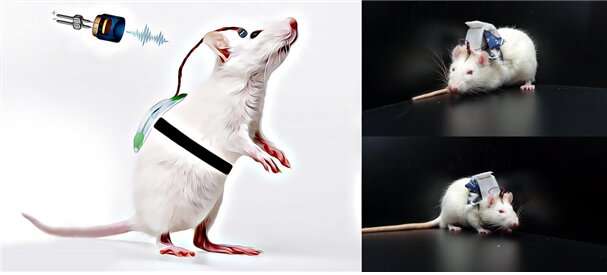
Photographs of animal model using the developed wireless wearable brain stimulation system. Credit: Korea Institute of Science and Technology (KIST)

Cerebral infarction, commonly known as ischemic stroke, has a high mortality rate and causes severe damage to nervous cells in the brain owing to the loss of oxygen, which results in limiting body movements. Several technologies, including physiotherapy and brain stimulation techniques, are being developed and tested for the rehabilitation of brain nervous cells damaged by a stroke. In particular, low-intensity focused ultrasound is expected to be effective for rehabilitating neurological diseases such as stroke, as it can excite or inhibit nerve cells by delivering mechanical energy with high precision at the desired position, while ultrasound is penetrating the cranium without requiring a surgical operation.

Korea Institute of Science and Technology (KIST) announced that the research team at the Center for Bionics, led by Dr. Kim Hyungmin, developed a wireless rehabilitation treatment technology for brain nervous system damaged by a stroke by fabricating a wearable, wireless low-intensity focused ultrasound brain stimulator. Additionally, to verify its effectiveness, this brain stimulator was applied to animal models of stroke.

In 2018, the research team developed a treatment method in which a low-intensity focused ultrasound was applied to the cerebellar core to recover that deteriorated owing to hemiplegia, and in 2020, they proved that the low-intensity focused ultrasound applied to the cerebellar core after a stroke is closely related to the changes in a delta wave in the brain.

To harness this technology efficiently in rehabilitating stroke patients in various environments, the ultrasound device should be easy to be used in everyday life. However, the existing brain stimulator is heavy and fixed, and is therefore only applicable to experiments involving anesthetized or restrained animals, thereby making it difficult to be commercialized.

Nonsurgical treatment for cerebral infarction using wearable wireless ultrasound devices

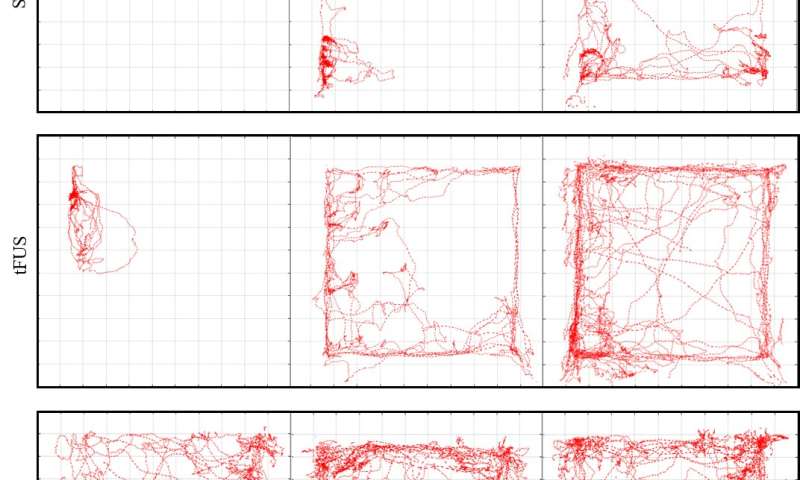
Representative trajectories for stroke model rats treated with sham and tFUS, compared to a healthy rat (bottom row) Credit: Korea Institute of Science and Technology (KIST)

Based on the findings of previous studies, the research team at KIST developed a wearable light-weight brain stimulator, which weighs approximately 20 g, that can be wirelessly controlled. In addition, they verified the rehabilitation effectiveness after assessing the ability of a rat stroke model with the device. When ultrasound was applied with a pressure of approximately 426 kPa to the part of the brain that controls motor functions in a rat stroke model, the motor functions were significantly improved after three days compared to the rat stroke model to which ultrasound was not applied; the motor functions were improved to a level similar to that of normal rats after seven days of rehabilitation.

The brain stimulator developed by Dr. Kim's research team is light in weight and operates wirelessly, which does not limit the physical movements of a body as it continues stimulating the part of the brain that controls motor functions via ultrasound, thereby restoring the nervous system damaged by a . The results obtained from the study are expected to soon contribute to the development of a wearable ultrasound brain stimulation technology at a clinical level.

According to Dr. Kim Hyungmin at KIST, "Recently, the wearable stimulation technology is advancing rapidly, and the significance of this study is in verifying the possibility of non-invasive neurorehabilitation therapy using a wearable device," and he added that "In order to ensure the safety and effectiveness of the treatement, further research is required to optimize stimulation protocol by determining the molecular and cellular mechanisms of ultrasonic neuromodulation."


Explore further

Wearable brain stimulation could safely improve motor function after stroke

More information: Evgenii Kim et al, Wearable transcranial ultrasound system for remote stimulation of freely moving animal, IEEE Transactions on Biomedical Engineering (2020). DOI: 10.1109/TBME.2020.3038018
Provided by National Research Council of Science & Technology