Changing stroke rehab and research worldwide now.Time is Brain! trillions and trillions of neurons that DIE each day because there are NO effective hyperacute therapies besides tPA(only 12% effective). I have 523 posts on hyperacute therapy, enough for researchers to spend decades proving them out. These are my personal ideas and blog on stroke rehabilitation and stroke research. Do not attempt any of these without checking with your medical provider. Unless you join me in agitating, when you need these therapies they won't be there.

What this blog is for:

My blog is not to help survivors recover, it is to have the 10 million yearly stroke survivors light fires underneath their doctors, stroke hospitals and stroke researchers to get stroke solved. 100% recovery. The stroke medical world is completely failing at that goal, they don't even have it as a goal. Shortly after getting out of the hospital and getting NO information on the process or protocols of stroke rehabilitation and recovery I started searching on the internet and found that no other survivor received useful information. This is an attempt to cover all stroke rehabilitation information that should be readily available to survivors so they can talk with informed knowledge to their medical staff. It lays out what needs to be done to get stroke survivors closer to 100% recovery. It's quite disgusting that this information is not available from every stroke association and doctors group.

Showing posts with label promises. Show all posts

Saturday, June 27, 2026

New Hope for Stroke Survivors UMD Study Shows Promise for Speech Recovery After Stroke

 Will your incompetent? doctor do nothing to change this from 'promise' TO WILL RECOVER!

New Hope for Stroke Survivors UMD Study Shows Promise for Speech Recovery After Stroke


It’s estimated that 795,000 people have strokes each year in the United States. Two million are living with post-stroke aphasia—a loss or reduction of language skills. This communication challenge can affect a person’s identity, relationships, and overall sense of belonging.

A team in the UMD Department of Communication Sciences and Disorders (CSD) is pilot-testing a promising therapeutic approach for aphasia. Associate Professor Sharyl Samargia-Grivette leads the study, which is integrating existing behavioral therapy with noninvasive brain stimulation.

“A big research priority right now in the field of speech-language pathology is trying to find more effective therapy strategies—or combining the therapy strategies that we have now to be more effective,” Samargia-Grivette explains.

Instructor Lynette Carlson and three CSD graduate students are part of the team in Samargia-Grivette’s Neural Function and Recovery Lab working on the project. The students are assisting with various aspects of the research, from the literature review to therapy sessions and data analysis.

Carlson directs the Robert F. Pierce (RFP) Speech-Language-Hearing Clinic and has practiced in medical settings. She has extensive experience working with people with aphasia. “As a therapist thinking of the future of the profession and of people who have aphasia, this research is so exciting and motivating,” she says.

Hopeful Preliminary Results

Samargia-Grivette received National Institutes of Health funding through the National Center of Neuromodulation for Rehabilitation at the Medical University of South Carolina for this research. The pilot study includes five participants.

Participants visit the lab, located in the Chester Park Building 17 times during the study. They are evaluated for language, memory and brain activity, using electroencephalography (EEG)—both at the beginning and end of the research. During the intervention sessions, participants engage in a high-intensity therapy approach in which they must use speech during a matching card game with Carlson as the facilitator. A graduate student provides cues to the participant as needed. As they progress, the game increases in verbal complexity. Words become phrases and sentences.

During a portion of the sessions, participants simultaneously receive Transcranial Direct-Current Stimulation (tDCS). The idea is that stimulating the brain with a low, direct electric current while practicing word and phrase retrieval can help to rebuild neural pathways to the damaged portion of the brain that controls language.

Samargia-Grivette reports positive preliminary results. “Data analysis is still underway … but qualitatively, what we’ve noticed is they’re noticing a benefit from the interventions—and spouses of the participants reported that their loved ones were talking a lot more—that they had really noticed a big increase in their communication,” she says.

Haley Evans, one of the graduate students on the project, says that hearing such feedback from clients and their spouses has been rewarding. “It's hard for us as young students to really believe that we are making a difference … So to be able to hear that firsthand, it's really a strong, powerful feeling,” she says.

Evans says the experience has also helped her feel more confident as a clinician. Carlson points out that research is an integral piece of student education and future career preparation. “As a speech-language pathologist, it is important to know the research process and appreciate how the process is pushing the profession forward.”

Carlson is humbled to be a part of “research that so directly and impactfully makes a difference in everyday life.” She says helping clients “reclaim their voices” is important for individuals and their sense of belonging to the community. “If I can sit down and have a conversation with a dear friend or a grandchild, or talk about who I am, or simply order coffee by myself—that’s the essence of human connection.”

Listen to this article

Saturday, August 24, 2024

Extended Reality in Revolutionizing Neurological Disease: A New Era for Chronic Condition Treatment

 Survivors don't need promises and hope, they need ACTUAL 100% RECOVERY PROTOCOLS! When the hell will you start to deliver them?  50 years from now?

Extended Reality in Revolutionizing Neurological Disease: A New Era for Chronic Condition Treatment

Hariharan V • Malini Prithiva Kumari PK • Rajanandh MG

Published: August 23, 2024

DOI: 10.7759/cureus.67633 

 Peer-Reviewed

Cite this article as: V H, PK M, MG R (August 23, 2024) Extended Reality in Revolutionizing Neurological Disease: A New Era for Chronic Condition Treatment. Cureus 16(8): e67633. doi:10.7759/cureus.67633

Abstract

Extended reality (XR), which includes virtual reality (VR), augmented reality (AR), and mixed reality (MR), provides promising advancements in managing chronic neurological disorders such as Parkinson's disease (PD), multiple sclerosis (MS), Alzheimer's disease, and stroke. This review examines the impact of XR technologies on neurological care, highlighting their ability to create immersive, interactive environments that enhance rehabilitation through tailored motor and cognitive exercises. XR supports neuroplasticity by providing engaging, contextually relevant exercises and real-time feedback, offering innovative alternatives to traditional methods. The technical issues, clinical validation, and accessibility must be addressed despite the potential benefits. Future developments should focus on refining XR applications, integrating them with complementary technologies, and establishing robust policies to guide their effective and ethical use. XR is poised to revolutionize neurological rehabilitation, promising improved patient outcomes and transforming medical training.

Introduction & Background

According to the World Health Organization (WHO), neurological disorders have a profound impact on nearly one billion people worldwide. This extensive category encompasses conditions such as seizures, Alzheimer's, stroke, migraines, brain injury, multiple sclerosis (MS), and Parkinson's disease (PD). Approximately 50 million individuals are affected by epilepsy, while an additional 24 million are affected by Alzheimer's and other dementias. These disorders do not discriminate and influence people across all nations, irrespective of their age, gender, education, or socioeconomic status, contributing to an estimated 6.8 million fatalities annually [1]. These problems are caused by a variety of factors, including head injuries, strokes, and neurodegenerative diseases, including PD and MS [2]. As the global population ages, the prevalence of neurological disorders increases. However, advancements in medical research are offering new hope for those affected by conditions such as Alzheimer's, PD, and MS [3].

Treating neurological disorders often requires complex, long-term drug therapies to alleviate symptoms and slow disease progression. While traditional treatments, such as medications, gene therapies, and stem cell research, have shown promise, they can be tedious, leading to a loss of motivation and a decline in patient outlook on rehabilitation [2]. New technologies, including assistive devices, communication aids, and home automation systems, are being developed to help those with neurological problems live more independently. However, there is no one-size-fits-all approach to treating neurological conditions, as each patient's situation is unique [3].(Well, you blithering idiots, FIND THE COMMONALITIES! My directors would have me fired for such lazy excuses!)

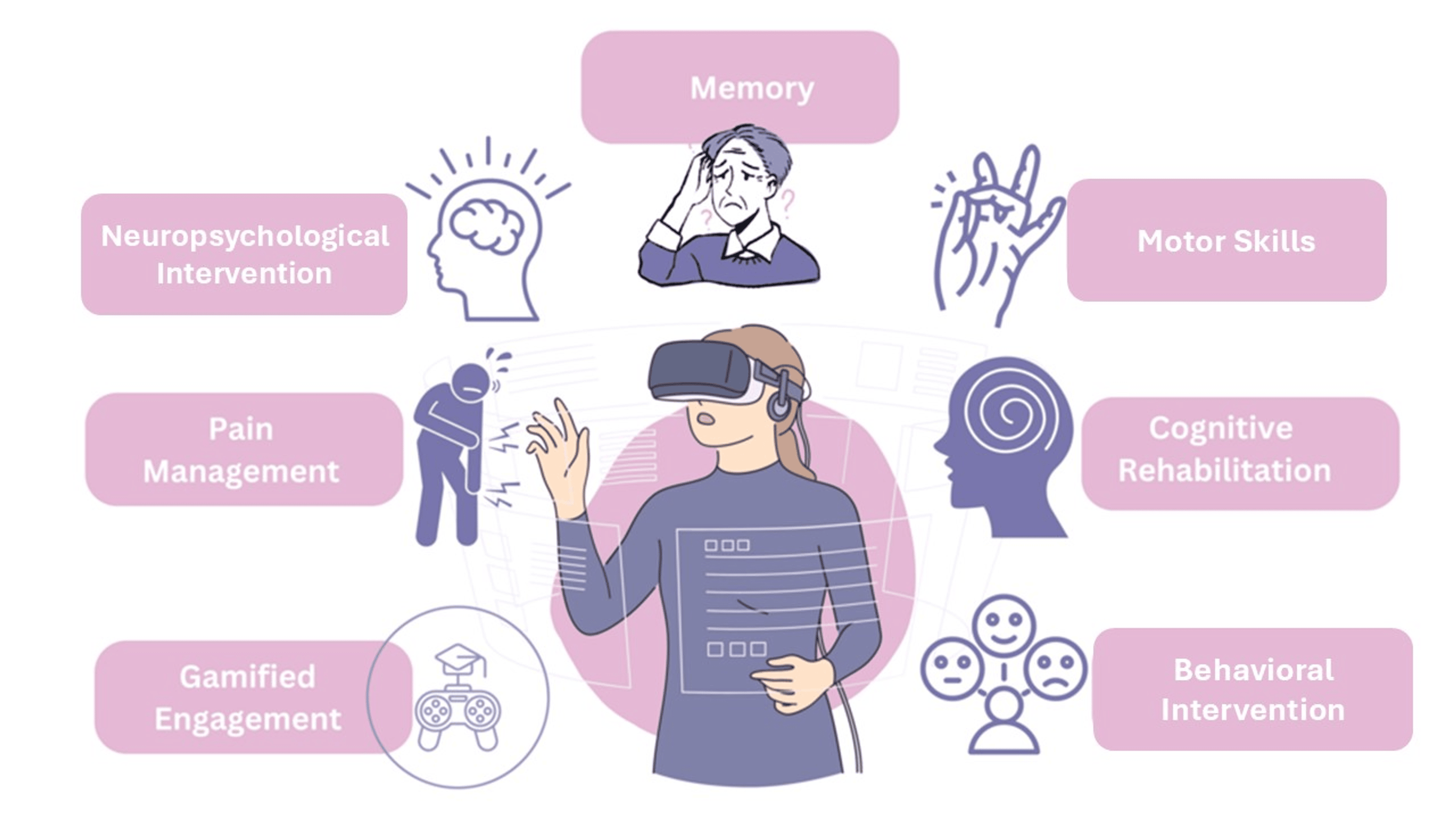
In recent years, extended reality (XR) technologies, encompassing virtual reality (VR), augmented reality (AR), and mixed reality (MR), have emerged as promising tools in neurological care. XR technologies differ from traditional therapies by offering immersive, sensory-rich environments that provide real-time feedback, enhancing therapeutic engagement and outcomes [4,5]. For example, VR is increasingly recognized for its role in cognitive research, evaluation, and rehabilitation. It allows patients to engage in realistic activities and receive precise performance measurements in a safe, controlled setting (Figure 1). Given the limitations of traditional treatments and the unique benefits XR technologies offer, this narrative review explores its potential, current applications, limitations, and future directions of XR technologies in managing chronic neurological conditions. In examining how XR can complement or enhance traditional therapies, this review aims to shed light on the evolving landscape of neurological rehabilitation and care.