Changing stroke rehab and research worldwide now.Time is Brain! trillions and trillions of neurons that DIE each day because there are NO effective hyperacute therapies besides tPA(only 12% effective). I have 523 posts on hyperacute therapy, enough for researchers to spend decades proving them out. These are my personal ideas and blog on stroke rehabilitation and stroke research. Do not attempt any of these without checking with your medical provider. Unless you join me in agitating, when you need these therapies they won't be there.

What this blog is for:

My blog is not to help survivors recover, it is to have the 10 million yearly stroke survivors light fires underneath their doctors, stroke hospitals and stroke researchers to get stroke solved. 100% recovery. The stroke medical world is completely failing at that goal, they don't even have it as a goal. Shortly after getting out of the hospital and getting NO information on the process or protocols of stroke rehabilitation and recovery I started searching on the internet and found that no other survivor received useful information. This is an attempt to cover all stroke rehabilitation information that should be readily available to survivors so they can talk with informed knowledge to their medical staff. It lays out what needs to be done to get stroke survivors closer to 100% recovery. It's quite disgusting that this information is not available from every stroke association and doctors group.

Showing posts with label negative emotions. Show all posts

Sunday, March 28, 2021

Negative Mood Linked to Prolonged Amygdala Activity

 With huge amounts of anxiety, depression and apathy after your stroke this testing would seem to be required post stroke.

These are all secondary problems after stroke. You wouldn't have to treat for this if you had effective stroke rehab protocols leading to 100% recovery.  Survivors have negative mood because their doctors and therapists have no fucking clue how to get them recovered and survivors pick that up.

Negative Mood Linked to Prolonged Amygdala Activity

Summary: A new study reveals activity in the amygdala remains consistent when a person views neutral stimuli following viewing negative stimuli. The persistent activity increased negative mood and decreased positive feelings.

Source: SfN

How the amygdala responds to viewing negative and subsequent neutral stimuli may impact our daily mood, according to new research published in Journal of Neuroscience.

The amygdala evaluates the environment to find potential threats. If a threat does appear, the amygdala can stay active and respond to new stimuli like they are threatening too.

This is helpful when you are in a dangerous situation, but less so when spilling your coffee in the morning keeps you on edge for the rest of the day.

In a recent study, Puccetti et al. examined data collected from the “Midlife in the US” longitudinal study. Participants completed a psychological wellbeing assessment and eight daily telephone interviews to assess their mood. They also came into the lab for an fMRI task: they viewed negative, positive, and neutral images with a picture of a neutral facial expression in between each image.
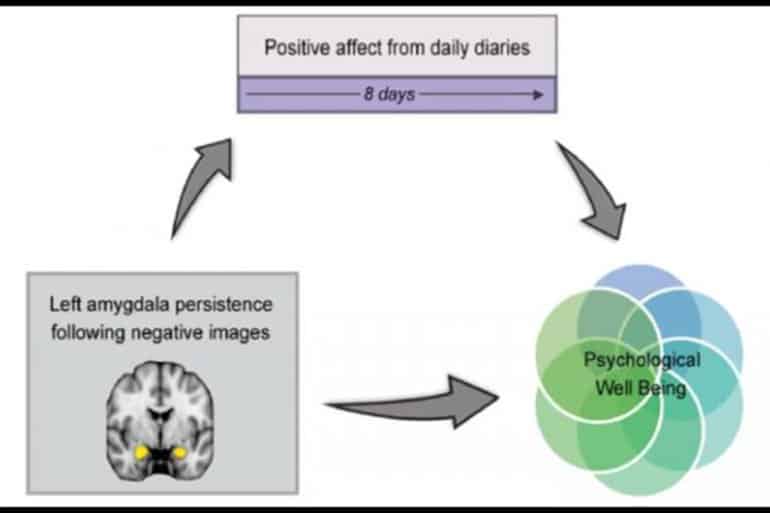
This is a diagram from the study
Left amygdala persistence following negative images predicts psychological well-being via daily positive affect. Credit: Puccetti et al., JNeurosci 2021

When the amygdala activated in a similar pattern as the participants viewed negative images and the neutral faces that followed, this persistent activity predicted increases in negative daily mood and decreases in positive daily mood. In turn, participants who experienced increased positive mood displayed greater psychological wellbeing.


These results suggest amygdala activity influences how a person feels day-to-day, which can impact overall psychological wellbeing.

About this neuroscience research mood

Source: SfN
Contact: Calli McMurray – SfN
Image: The image is credited to Puccetti et al., JNeurosci 2021

Original Research: Closed access.
Linking Amygdala Persistence To Real-World Emotional Experience and Psychological Well-Being” by Nikki A. Puccetti, Stacey M. Schaefer, Carien M. van Reekum, Anthony D. Ong, David M. Almeida, Carol D. Ryff, Richard J. Davidson and Aaron S. Heller. Journal of Neuroscience


Sunday, March 7, 2021

Mood and well-being of novice open water swimmers and controls during an introductory outdoor swimming programme: A feasibility study

This does REQUIRE YOUR DOCTOR TO GET YOU 100% RECOVERED. Right now I would drown if I tried to swim. Since a good chunk of survivors have a negative mood this would seem an obvious easy way to improve that.  I've seen surfers in Lake Michigan in winter, but they are wearing thick wetsuits, here is a guide. Wetsuits are impossible to get on one-handed, with lots of time and swearing I can get on my drysuit.

Don't want to try that? Then ask your doctor if substituting cold showers works as well. 

Adapted cold shower as a potential treatment for depression January 2017 

Could cold water hold a clue to a dementia cure? October 2020


   Mood and well-being of novice open water swimmers and controls during an introductory outdoor swimming programme: A feasibility study

Authors:
  • Extreme Environments Laboratory, University of Portsmouth
Background 
Anecdotal evidence suggests that outdoor swimming can improve mood. This feasibility study examined the mood and well‐being in participants attending an outdoor swimming course. 
Methods 
Profile of Mood States and Short Warwick–Edinburgh Mental Well‐being Scale questionnaires were completed by participants on a 10‐week introductory outdoor swimming course (61 swimmers) and 22 controls who sat on the beach. Questionnaires were completed before and after three sessions: the first session (pool based), their first outdoor swim (session 4) and their final outdoor swim (session 10). Results 
Swimmers reported acute increases in positive subscales (Esteem and Vigour, P < .001) and reductions in negative subscales (Tension, Anger, Depression, and Confusion and Total Mood Disturbance [TMD], P < .001, d = 1.1–1.7). TMD was also reduced between sessions (P < .001, d = 0.08). Well‐being also increased during the course in swimmers (P < .001, d = 3.7) and controls (P = .019, d = 0.2). Greater reductions in TMD (P < .001, d = 0.8–2.5) and increases in well‐being were observed in swimmers than controls (P = .034, r = .23). 
>Novice outdoor swimmers participating in a 10‐week introductory outdoor swimming course had acute and chronic reductions in negative mood, increases in well‐being and acute increases in positive mood. Controls mood scores fluctuated and were similar at the start and end of the course, whereas well‐being scores improved by the final session. Tension scores peaked in both swimmers and controls immediately before the first outdoor swim. Nonetheless the swimmers’ improvement in mood and well‐being scores was significantly greater than that of the controls. The nature of the study does not provide mechanistic understanding; there are likely to be a number of explanations (physiological, psychological and sociological) for the changes in mood and well‐being in swimmers and controls that can be investigated further.

Friday, May 31, 2019

Why we should say no to positivity — and yes to our negative emotions

I'm hearing it is ok to scream at your doctor for not providing ANY ROUTE TO RECOVERY. I disagree with the be polite statement.  

Why we should say no to positivity — and yes to our negative emotions

May 8, 2019 / +

It sounds paradoxical, but accepting our negative emotions can actually make us happier in the long run. Psychologist Susan David explains how.This post is part of TED’s “How to Be a Better Human” series, each of which contains a piece of helpful advice from someone in the TED community; browse through all the posts here.

Most of us have been told to “Cheer up” or “Look on the bright side” by well-meaning family and friends. Sometimes, it’s because they see us looking sad, angry, anxious or frustrated, but it can also happen because we look pensive, uncertain or just about any state other than joyful. While we may be tempted to tell them “Stuff it,” we don’t because, well, feelings.
Next time, feel free to do so (but please be polite). “Being positive has become a new form of moral correctness,” says psychologist Susan David, founder and codirector of the Institute of Coaching at McLean Hospital of Harvard University Medical School, an instructor in psychology at Harvard, and author of Emotional Agility (read an excerpt here).
Suppressing or turning away from our difficult emotions is not healthy or helpful, says David. “What happens is, it undermines our ability to deal with the world as it is, not as we wish it to be,” she says. “This is associated with lower levels of resilience, lower levels of wellbeing, and higher levels of depression and anxiety. And it also impacts our relationships and our ability to achieve our goals.”
So, what should we do instead?
“Instead of pushing it aside or forcing positivity, one critical way of dealing with a difficult emotion is to label it effectively. In my work, so often people will use very black-and-white labels to describe how they’re feeling,” says David. “‘Stressed’ is one of the most common ones. But there’s a world of difference between the stress of true overwhelm, stress because you’re disappointed, or the stress of knowing you’re in the wrong job or the wrong relationship. When we can label our emotions more accurately, it helps us understand the cause of those emotions and activates what’s called a ‘readiness potential,’ your ability to set goals and to make real concrete changes.”
Next, when you identify your emotion, “notice the emotion with compassion. People frequently think that compassion is about being weak or lazy or lying to yourself,” says David. “Actually compassion allows you to create a safe space within yourself in which you are then able to take more risks. You’re able to explore the world, and you’re able to be more effective, because you know that if things don’t go right that you will still like yourself, you’ll still be kind to yourself. Compassion is associated with greater levels of effectiveness.”
Finally, “try to notice the emotional story for what it is,” says David. Create some space between you and what you’re feeling by acting as an observer and naming all the dimensions of your experience. Instead of simply saying “I’m sad,” she suggests, “say something like, ‘I’m noticing that I’m feeling sad, I’m noticing that I’m feeling undermined, I’m noticing the urge to leave the room.’ This allows you to bring other parts of yourself — such as your values and your intentions — forward.” Doing this also puts you in charge rather than the emotion. “What’s more important is not whether you have negative thoughts or emotions but whether you get hooked into them,” she says, “which is when those thoughts start to drive your behaviors and your interactions.”
Watch her TEDWomen Talk now: