Changing stroke rehab and research worldwide now.Time is Brain! trillions and trillions of neurons that DIE each day because there are NO effective hyperacute therapies besides tPA(only 12% effective). I have 523 posts on hyperacute therapy, enough for researchers to spend decades proving them out. These are my personal ideas and blog on stroke rehabilitation and stroke research. Do not attempt any of these without checking with your medical provider. Unless you join me in agitating, when you need these therapies they won't be there.

What this blog is for:

My blog is not to help survivors recover, it is to have the 10 million yearly stroke survivors light fires underneath their doctors, stroke hospitals and stroke researchers to get stroke solved. 100% recovery. The stroke medical world is completely failing at that goal, they don't even have it as a goal. Shortly after getting out of the hospital and getting NO information on the process or protocols of stroke rehabilitation and recovery I started searching on the internet and found that no other survivor received useful information. This is an attempt to cover all stroke rehabilitation information that should be readily available to survivors so they can talk with informed knowledge to their medical staff. It lays out what needs to be done to get stroke survivors closer to 100% recovery. It's quite disgusting that this information is not available from every stroke association and doctors group.

Showing posts with label Monty Python. Show all posts

Thursday, June 19, 2025

Smart Thrombosis Care: The Rise of Closed-Loop Diagnosis-to-Treatment Nano Systems

 There is much earlier research on nano stuff for recovery. HAS YOUR INCOMPETENT? DOCTOR DONE NOTHING WITH THIS? So, you DON'T have a functioning stroke doctor, do you? And complete incompetence(for over a decade!) in the stroke medical world which seems to have NO idea on how to solve stroke! They are all blithering idiots straight from the pages of Monty Python. Like this:

Monty Python's Flying Circus - Upper Class Twit of the Year (1971)
  • nanoparticles (83 posts to June 2012)
  • nanomissiles (1 post to June 2022)
  • nanoneedles (2 post to March 2015)
  • nanopatch (1 post to August 2024)
  • nanopeptide (1 post to October 2017)
  • nanophytomedicine (1 post to May 2021)
  • nanopropellers (1 post to May 2020)
  • nanoRobots (14 posts to March 2012)
  • nanorockets (1 post to December 2016)
  • nanorods (1 post to January 2016)
  • nanosensors (3 posts to November 2017)
  • nanospear (1 post to June 2018)
  • nanospheres (1 post to June 2025)
  • nanostructures (1 post to November 2019)
  • nanosubmarine (1 post to November 2015)
  • nanotechnology (9 posts to December 2014)
  • nanotherapeutic (5 posts to April 2015)
  • nanotubes(5 posts to February 2012)
  • Nanovesicles (2 posts to November 2021)
  • nanowires (23 posts to January 2012)
  • Nanozymes (2 posts to June 2024)
  • Smart Thrombosis Care: The Rise of Closed-Loop Diagnosis-to-Treatment Nano Systems

    Authors Wu J, Zhang Y, Chen W, Hao T, Ran C, Zhou Y, Shen Y, You W, Wang T

    Received 27 March 2025

    Accepted for publication 10 June 2025

    Published 19 June 2025 Volume 2025:20 Pages 7851—7868

    DOI https://doi.org/10.2147/IJN.S530884

    Checked for plagiarism Yes

    Review by Single anonymous peer review

    Peer reviewer comments 2

    Editor who approved publication: Prof. Dr. RDK Misra


    Jiong Wu,1,* Yuanyuan Zhang,2,* Wu Chen,1,* Tianjiao Hao,1 Chuanjiang Ran,1 Yuanyuan Zhou,1 Yan Shen,1 Wei You,3 Tao Wang4

    1Department of Pharmaceutics, School of Pharmacy, China Pharmaceutical University, Nanjing, Jiangsu Province, 210009, People’s Republic of China; 2Department of Pharmacy, Jiangsu Cancer Hospital, Jiangsu Institute of Cancer Research, Nanjing Medical University Affiliated Cancer Hospital, Nanjing, People’s Republic of China; 3Department of Cardiology, Nanjing First Hospital, Nanjing Medical University, Nanjing, People’s Republic of China; 4Department of Clinical Laboratory, Second People’s Hospital of Taixing City, Taixing, Jiangsu Province, 225400, People’s Republic of China

    *These authors contributed equally to this work

    Correspondence: Wei You, Email youwei@njmu.edu.cn Tao Wang, Email 13775743588@163.com

    Abstract: Thrombosis continues to be a leading cause of morbidity and mortality worldwide, presenting complex pathophysiological challenges that complicate effective diagnosis and treatment. A holistic approach to thrombosis management, incorporating integrated diagnostic and therapeutic systems, is essential for improving patient outcomes. This review explores the emerging concept of closed-loop diagnosis-to-treatment nanosystems in thrombosis care, with a focus on integrating advanced technologies. Specifically, we examine the targeting of critical components involved in thrombosis, including platelets, coagulation factors, endothelial cells, the fibrinolytic system, and the immune system. Techniques such as platelet aggregation assays, coagulation function tests, biomarker detection, and nanotechnology-based therapies are discussed. Moreover, the application of these integrated systems is reviewed in both the acute and chronic phases of thrombosis, covering conditions such as acute coronary syndrome, acute pulmonary embolism, chronic deep vein thrombosis, and post-surgical thrombosis prevention. Finally, the review highlights potential future developments in integrated thrombosis care, with an emphasis on personalized treatment strategies and the role of emerging technologies in enhancing clinical outcomes. These insights underscore the transformative potential of closed-loop nano-systems in achieving more precise, timely, and effective thrombosis management.

    Keywords: thrombosis, nanotechnology, integrated management

    Graphical Abstract:
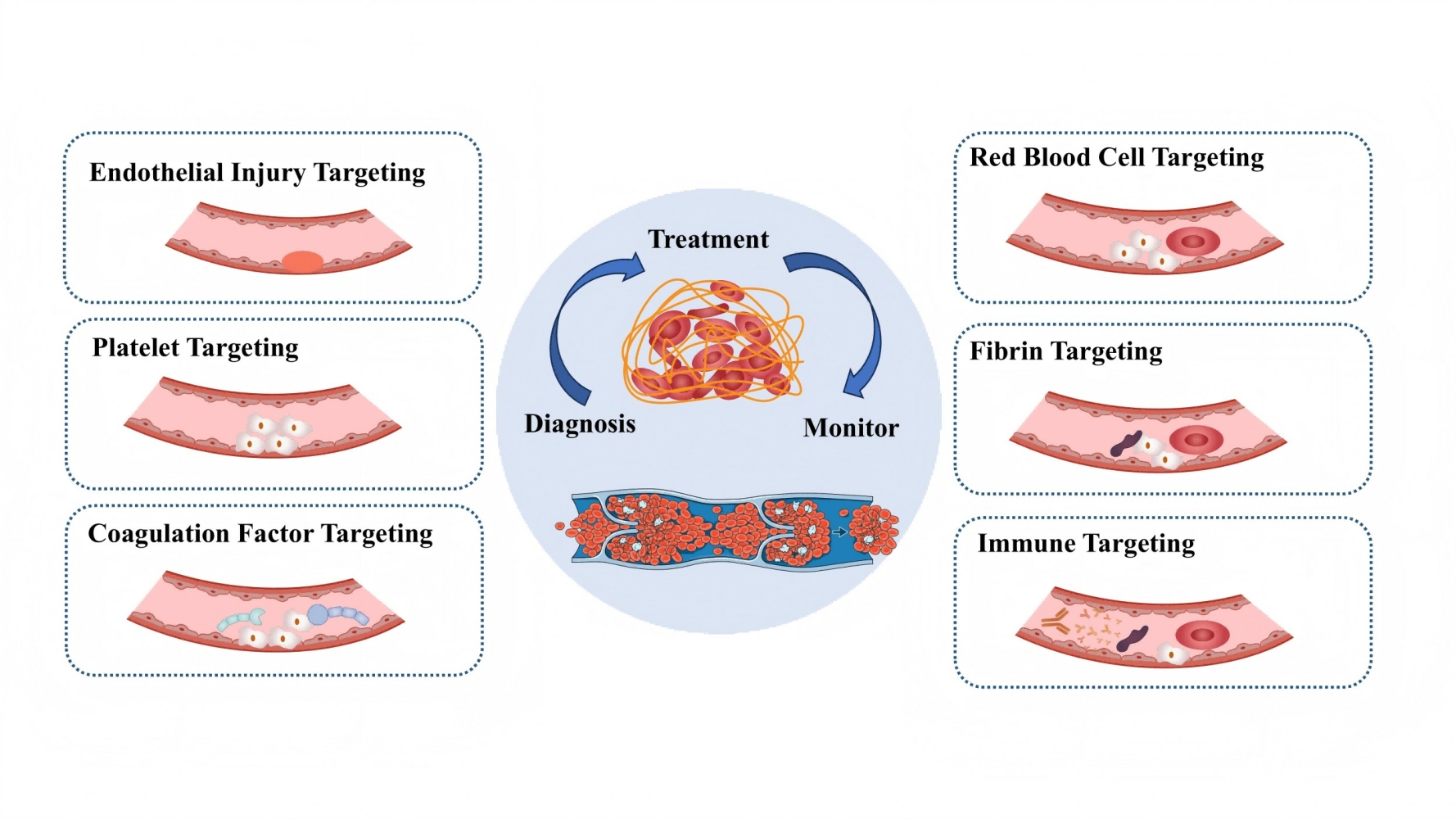
    Introduction

    Thrombosis-related diseases, including deep vein thrombosis (DVT), pulmonary embolism (PE), and coronary artery thrombosis, impose a substantial global health burden. These conditions contribute to high morbidity and mortality rates, with venous thromboembolism (VTE) alone affecting millions of individuals annually.1 In the United States and Europe, VTE accounts for an estimated 300,000 to 600,000 deaths per year, often due to complications such as PE. The economic burden is equally significant, as healthcare systems allocate substantial resources to hospitalization, long-term anticoagulation therapy, and the management of recurrent thrombotic events.2 Development of diagnosis and treatment of thrombosis is shown in Figure 1. Despite advancements in thrombosis management, major challenges persist in early diagnosis, risk stratification, and individualized treatment, underscoring the urgent need for more effective and integrated approaches.3

    Wednesday, June 18, 2025

    Platelet Membrane-Based Nanoparticles for Targeted Delivery of Deferoxamine to Alleviate Brain Injury Induced by Ischemic Stroke

     There is much earlier research on nano stuff for recovery. HAS YOUR INCOMPETENT? DOCTOR DONE NOTHING WITH THIS? So, you DON'T have a functioning stroke doctor, do you? And complete incompetence(for over a decade!) in the stroke medical world which seems to have NO idea on how to solve stroke! They are all blithering idiots straight from the pages of Monty Python. Like this:

    Monty Python's Flying Circus - Upper Class Twit of the Year (1971)
  • nanoparticles (83 posts to June 2012)
  • nanomissiles (1 post to June 2022)
  • nanoneedles (2 post to March 2015)
  • nanopatch (1 post to August 2024)
  • nanopeptide (1 post to October 2017)
  • nanophytomedicine (1 post to May 2021)
  • nanopropellers (1 post to May 2020)
  • nanoRobots (14 posts to March 2012)
  • nanorockets (1 post to December 2016)
  • nanorods (1 post to January 2016)
  • nanosensors (3 posts to November 2017)
  • nanospear (1 post to June 2018)
  • nanospheres (1 post to June 2025)
  • nanostructures (1 post to November 2019)
  • nanosubmarine (1 post to November 2015)
  • nanotechnology (9 posts to December 2014)
  • nanotherapeutic (5 posts to April 2015)
  • nanotubes(5 posts to February 2012)
  • Nanovesicles (2 posts to November 2021)
  • nanowires (23 posts to January 2012)
  • Nanozymes (2 posts to June 2024)
  • Platelet Membrane-Based Nanoparticles for Targeted Delivery of Deferoxamine to Alleviate Brain Injury Induced by Ischemic Stroke

    Authors Wang P, Lv X, Tian S, Yang W , Feng M, Chang S, You L, Chang YZ

    Received 8 January 2025

    Accepted for publication 8 June 2025

    Published 16 June 2025 Volume 2025:20 Pages 7533—7548

    DOI https://doi.org/10.2147/IJN.S516316

    Checked for plagiarism Yes

    Review by Single anonymous peer review

    Peer reviewer comments 2

    Editor who approved publication: Professor Jie Huang


    Peina Wang,1,2,* Xin Lv,1,* Siyu Tian,1 Wen Yang,2 Mudi Feng,1 Shiyang Chang,2 Linhao You,1 Yan-Zhong Chang1

    1Laboratory of Molecular Iron Metabolism, Key Laboratory of Animal Physiology, Biochemistry and Molecular Biology of Hebei Province, Ministry of Education Key Laboratory of Molecular and Cellular Biology, Department of Physiology, College of Life Science, Hebei Normal University, Shijiazhuang, Hebei Province, 050024, People’s Republic of China; 2Department of Histology and Embryology, College of Basic Medical Sciences, Hebei Medical University, Shijiazhuang, Hebei Province, 050017, People’s Republic of China

    *These authors contributed equally to this work

    Correspondence: Yan-Zhong Chang; Peina Wang, Email chang7676@163.com; 19301641@hebmu.edu.cn

    Background: Timely thrombolysis serves as the primary therapeutic approach for ischemic stroke, one of the most serious global public health problems, although reperfusion can cause severe ischemia reperfusion (I/R) injury. Oxidative stress and activation of cell death pathways are the main mechanisms of I/R injury. Our previous studies have demonstrated that iron overload stimulates the generation of reactive oxygen species and facilitates the activation of iron-dependent ferroptosis in the pathogenesis of I/R injury. Removal of excess free iron by deferoxamine (DFO), an iron chelator, may inhibit iron toxicity and reverse I/R-induced neurological deficits. Despite its therapeutic potential, DFO’s clinical translation for I/R injury is hampered by rapid systemic clearance, suboptimal bioavailability, and a lack of ischemic lesion-targeting ability. Nanoscale delivery platforms enabling targeted DFO release in stroke lesions may overcome these pharmacokinetic barriers and enhance clinical outcomes.
    Methods: On the basis of the properties of liposomes in carrying hydrophilic substances and crossing the leaky blood–brain barrier in cerebral I/R, we first encapsulated DFO within traditional liposomes to improve its biocompatibility. Subsequently, inspired by the natural homing properties of platelets to damaged blood vessels during I/R injury, the isolated platelet membranes were coated onto the DFO-liposomes, thus endowing the nanodrug with the ability to target stroke lesion.
    Results: Our results demonstrate that Platesome-DFO exhibits accurate lesion-targeting ability and significantly decreases lesion iron content, thereby preventing neuronal ferroptosis and ultimately reversing neurological deficits in I/R mice.
    Conclusion: Platesome-DFO provides a novel therapeutic approach for cerebral I/R injury by regulating brain iron status and iron-dependent pathways, highlighting its promising application in the clinical treatment of cerebral I/R injury.

    Keywords: ischemic stroke, iron, ferroptosis, deferoxamine, platelet membrane, nanomedicine

    Introduction

    Stroke is an acute and severe cerebrovascular disease with high morbidity, mortality, and medical cost. It has been reported that ischemic stroke, which results from a lack of blood supply to the brain, accounts for approximately 84% of all stroke cases.1 Irreversible neurological injury can be avoided only if the blocked blood vessels are reperfused within the therapeutic time window. However, ischemia/reperfusion (I/R) can immediately cause dysregulation of oxidation and antioxidation, disrupt the balance between the generation and scavenging of reactive oxygen species (ROS), eventually leading to the accumulation of ROS in the ischemic brain, which exacerbates the activation of inflammatory responses and results in secondary neurological damage.2 Therefore, I/R injury is considered the main culprit and an inevitable obstacle in the therapy of ischemic stroke. Despite the development of various drugs and functional nanoparticles with ROS scavenging ability, effective treatment options for I/R injury remain disappointingly limited.

    Many studies have indicated that a higher iron status is a critical risk factor associated with neuronal damage following cerebral I/R. Standard clinical analysis has repeatedly shown that elevated plasma ferritin levels are associated with poor outcomes in patients with ischemic stroke.3,4 Iron overload exacerbates brain edema and hemorrhagic transformation in ischemic stroke patients receiving thrombolytic therapy with tissue plasminogen activator.5,6 Mechanistically, our previous research has demonstrated that excessive iron exacerbates neuronal damage by catalyzing the Fenton reaction to convert superoxide and hydroxyl radicals into highly reactive toxic radicals or catalyzing lipid peroxidation as a cofactor of lipid oxidation enzymes.7–9 Of note, we and others have recently described the induction of neuronal ferroptosis, a newly identified form of regulated cell death resulting from the catastrophic accumulation of iron-dependent lipid reactive oxygen species, in I/R brains.8,10–12 Therefore, iron is a key factor that stimulates ROS generation and facilitates the subsequent activation of cell death pathways, particularly the ferroptosis pathway, in I/R injury. Iron depletion via chelator may protect neuronal cells against ferroptosis and is expected to emerge as a promising strategy for the treatment of cerebral I/R.

    Among the clinically available iron chelators, deferoxamine (DFO) has long been used to remove excess iron in iron overload diseases, such as the secondary iron overload that afflicts thalassemia patients, and has been shown to be the most effective option with the most favorable toxicity profile.13,14 Moreover, DFO has demonstrated its protective effects in animal stroke models of I/R as well as in clinical studies in which ischemic stroke patients administered DFO exhibited improved outcomes.5,15–17 However, the poor bioavailability and the extremely short plasma half-life (20 min in humans) of DFO limits its use in stroke treatment.18,19 More important, at the high doses needed to achieve effective concentrations, DFO can cause serious side effects, including renal and liver complications.13 Another limitation of DFO for use in stroke treatment is that systemic administration does not specifically target to the injured region of the I/R brain. New delivery approaches that can target deliver DFO to the injured brain region and improve the local DFO concentration are expected to provide significant improvements in stroke outcomes.

    Despite advancements in stroke-targeted nanoplatforms, such as polymeric carriers, metallic nanoparticles, and carbon-based systems, current materials face persistent translational barriers, including compromised biosafety profiles, suboptimal therapeutic efficacy, and insufficient blood–brain barrier penetrability.20,21 Recently, cell membrane-based biomimetic cloaking has emerged as a new strategy for enhancing synthetic nanoparticles delivery, leveraging retained membrane functionalities to overcome systemic biological barriers while preserving immunoevasive properties. Platelets (PLT) play a critical role in the development and progression of thrombosis. Previous studies have shown that the platelet membrane exhibits properties in binding to injured vasculature and has advantages for targeting ischemic brain regions.22–26 Therefore, we propose a new type of PLT membrane-coated biomimetic nanodevice to deliver DFO specifically to the ischemic brain. On the basis of the properties of liposomes in carrying hydrophilic substances and crossing the leaky blood–brain barrier in cerebral I/R,27 we first encapsulated DFO within traditional liposomes through hydration to improve its biocompatibility. Subsequently, the isolated PLT membranes were coated onto the DFO-liposomes by coextrusion, endowing this nanodrug with stroke lesion targeting ability (Figure 1a). This PLT membrane-cloaked, DFO-loaded nanoliposome, named Platesome-DFO, can deliver DFO to the targeted lesion, increasing intracellular drug concentrations to markedly higher levels than those achievable through systemic administration. Particularly, we confirmed the chelation of excess iron by Plateletsome-DFO, and the consequent inhibition of iron-dependent lipid peroxidation and ferroptosis in the cerebral I/R brain (Figure 1b). 2,3,5-triphenyltetrazolium chloride (TTC) staining measurement from mouse models demonstrated that the Platesome-DFO treatment effectively alleviated I/R-induced brain damage. Our Platesome-DFO formulation offers a viable strategy for specifically targeting lesions to inhibit neuronal death, demonstrating potential to improve outcomes in cerebral I/R injury.

    Figure 1 Schematic illustration of Platesome-DFO structure and its proposed protective mechanism in ischemic stroke. (a) The Platesome-DFO was fabricated by coextrusion of platelet membranes and Liposome-DFO to form nanoparticles that inherit the natural characteristics of the platelet membrane, including targeting damaged blood vessels and immune escape capabilities, by the presence of specific membrane proteins, such as CD36, CD41, and CD47. (b) After intravenous injection, Platesome-DFO is delivered to the injured brain region after stroke, followed by the release of DFO, which chelates excessive iron and inhibits ferroptosis of neuronal cells.


    More at link.

    Thursday, June 11, 2020

    Inpatient stroke rehabilitation: prediction of clinical outcomes using a machine-learning approach

    What world do you live in where predictions to the failures of status quo rehab mean anything to survivors? This gives you enough time to compose your speech on breaking the bad news of the lack of recovery your patients are going to get? Hell, my doctor knew I wasn't going to recover, so he totally ran away and told me nothing. Like this.

    Brave Sir Robin Ran Away


    Inpatient stroke rehabilitation: prediction of clinical outcomes using a machine-learning approach


    Abstract

    Background

    In clinical practice, therapists often rely on clinical outcome measures to quantify a patient’s impairment and function. Predicting a patient’s discharge outcome using baseline clinical information may help clinicians design more targeted treatment strategies and better anticipate the patient’s assistive needs and discharge care plan. The objective of this study was to develop predictive models for four standardized clinical outcome measures (Functional Independence Measure, Ten-Meter Walk Test, Six-Minute Walk Test, Berg Balance Scale) during inpatient rehabilitation.

    Methods

    Fifty stroke survivors admitted to a United States inpatient rehabilitation hospital participated in this study. Predictors chosen for the clinical discharge scores included demographics, stroke characteristics, and scores of clinical tests at admission. We used the Pearson product-moment and Spearman’s rank correlation coefficients to calculate correlations among clinical outcome measures and predictors, a cross-validated Lasso regression to develop predictive equations for discharge scores of each clinical outcome measure, and a Random Forest based permutation analysis to compare the relative importance of the predictors.

    Results

    The predictive equations explained 70–77% of the variance in discharge scores and resulted in a normalized error of 13–15% for predicting the outcomes of new patients. The most important predictors were clinical test scores at admission. Additional variables that affected the discharge score of at least one clinical outcome were time from stroke onset to rehabilitation admission, age, sex, body mass index, race, and diagnosis of dysphasia or speech impairment.

    Conclusions

    The models presented in this study could help clinicians and researchers to predict the discharge scores of clinical outcomes for individuals enrolled in an inpatient stroke rehabilitation program that adheres to U.S. Medicare standards.

    Background

    Stroke remains one of the leading causes of disability worldwide, with the majority of stroke survivors requiring specialized rehabilitation [1]. Inpatient stroke rehabilitation is a program of medical intervention and targeted therapies, which aims to maximize a patient’s functional recovery and facilitate reintegration into the community [2, 3]. To evaluate progress, clinicians use standardized assessment tools or clinical outcome measures such as the Functional Independence Measure [4] (FIM) for level of disability or the Ten-Meter Walk Test [5] (TMWT) for walking ability. Understanding the factors that affect these outcomes may help clinicians to streamline the treatment plan and efficiently allocate rehabilitation resources [6, 7]. Further, clinicians assess a patient’s functional abilities based on performance in these standardized tests, such as classifying patients as household ambulators or limited community ambulators based on walking speed score from the TMWT [8, 9]. Estimating a patient’s future discharge scores early in a rehabilitation program would help clinicians set realistic rehabilitation goals and anticipate needs for additional care or medical equipment at discharge.
    Several studies have investigated predictors of clinical outcomes after acute inpatient stroke rehabilitation [10,11,12,13,14,15]. Their main focus was to predict individual’s ability to perform activities of daily living, as measured by the FIM and the Barthel Index [16], or to predict walking speed as measured by the TMWT [14]. These studies found that the clinical assessment scored at discharge could be predicted based on patient demographics such as age [10,11,12,13, 15] and sex [11], medical information such as the time from stroke onset to rehabilitation admission [11, 13] and the admission score of the predicted outcome [10,11,12,13,14]. However, there are some notable gaps in our knowledge and understanding of these outcomes. Specifically, previous studies have primarily investigated predictors of a single clinical outcome measure, while therapists often use multiple standardized tests to gauge functional abilities. The American Physical Therapy Association highly recommends additional tests [6], including the Berg Balance Scale [17] (BBS), which assesses balance outcomes and fall risk, and the Six-Minute Walk Test [18] (SMWT), which assesses walking endurance and aerobic capacity. Understanding interactions among different clinical outcomes may help identify the tests that provide unique information about specific functional abilities compared to tests that may be redundant or unrelated to those abilities. Second, studies have predicted the discharge score of a clinical outcome using admission scores from a small subset of other clinical outcomes [14, 19]. For example, discharge walking speed has been predicted from admission scores of BBS and the Motor Assessment Scale [20]. Considering additional admission assessments should improve predictive accuracy, while including additional discharge assessments should provide a more comprehensive overview of a patient’s functional outcomes. Finally, previous studies developed predictive models for clinical outcomes using stepwise methods based on the predictors’ significance level (p-value). However, the ability of the p-value to determine the importance of predictors and to output the optimal set of predictors is limited, especially for small sample sizes, small ratio of sample size to predictors, and correlated predictors [21,22,23,24,25,26,27]. Conversely, certain machine learning approaches aim to reduce model error by selecting a targeted set of predictors based on relative importance [28] and incorporate regularization mechanisms to produce more accurate and generalizable predictions [29].
    The objective of this study was to use machine-learning algorithms to develop predictive models for discharge scores of four standardized clinical tests (FIM, TMWT, SMWT, BBS) after inpatient stroke rehabilitation. Potential predictors included patient demographics, stroke characteristics, and the scores of each of the four tests at admission. We also investigated the correlations between the clinical outcomes and the predictors, stated the predictors’ significance level and compared their relative importance in effecting the discharge scores.