Changing stroke rehab and research worldwide now.Time is Brain! trillions and trillions of neurons that DIE each day because there are NO effective hyperacute therapies besides tPA(only 12% effective). I have 523 posts on hyperacute therapy, enough for researchers to spend decades proving them out. These are my personal ideas and blog on stroke rehabilitation and stroke research. Do not attempt any of these without checking with your medical provider. Unless you join me in agitating, when you need these therapies they won't be there.

What this blog is for:

My blog is not to help survivors recover, it is to have the 10 million yearly stroke survivors light fires underneath their doctors, stroke hospitals and stroke researchers to get stroke solved. 100% recovery. The stroke medical world is completely failing at that goal, they don't even have it as a goal. Shortly after getting out of the hospital and getting NO information on the process or protocols of stroke rehabilitation and recovery I started searching on the internet and found that no other survivor received useful information. This is an attempt to cover all stroke rehabilitation information that should be readily available to survivors so they can talk with informed knowledge to their medical staff. It lays out what needs to be done to get stroke survivors closer to 100% recovery. It's quite disgusting that this information is not available from every stroke association and doctors group.

Showing posts with label propulsion. Show all posts

Tuesday, May 12, 2026

Exoskeleton frontal and sagittal plane hip torque improves propulsion and transient stability during walking in individuals with hemiparesis

 My problem is spasticity preventing a free swinging lower leg and a foot that angle to the left 15 degrees preventing any pushoff at all.  Nothing here fixes that at all.

Exoskeleton frontal and sagittal plane hip torque improves propulsion and transient stability during walking in individuals with hemiparesis

    We are providing an unedited version of this manuscript to give early access to its findings. Before final publication, the manuscript will undergo further editing. Please note there may be errors present which affect the content, and all legal disclaimers apply.

    Abstract

    Background

    Millions of people around the world experience post-stroke hemiparesis, making it difficult to move one side of the body. Hemiparesis impairs an individual’s muscle strength and coordination which limits gait speed, efficiency, and endurance and contributes to reduced community participation. These limitations in strength and control also negatively impact balance, leading to a high prevalence of instability, falls, and fall-related injuries. Assistive technologies like powered exoskeletons that apply torques to the hips in the sagittal plane (hip flexion and extension) and frontal plane (hip abduction and adduction) may benefit both gait efficiency and stability in hemiparetic populations.

    Methods

    In this study, we investigate the impact of exoskeleton-delivered frontal and sagittal plane hip torque in eight individuals with hemiparesis. Participants completed two-minute walking bouts on an instrumented treadmill with no exoskeleton, and then with the exoskeleton applying phase-based flexion and extension assistance. They then completed a series of abduction torque trials, in which they walked with the exoskeleton-supplied sagittal-plane assistance for 10 strides, and then sagittal-plane assistance and constant abduction torque for 10 strides. The abduction torque series consisted of four levels of abduction torque, each repeated 5 times, in random order.

    Results

    Compared to steady-state walking without the exoskeleton, the application of sagittal plane torques significantly increased propulsive forces at push-off for the non-paretic limb by 0.83 ± 0.32% BW (p = 0.0373) and had little impact on step width or margin of stability. In the transient period following onset, hip abduction torques significantly increased step width by 0.053 ± 0.011 m (adjusted p < 0.025) and margin of stability for the paretic and non-paretic limb by 0.039 ± 0.006 m (adjusted p < 0.025) and 0.014 ± 0.004 m (adjusted p = 0.01), respectively. These outcomes are correlated with the level of abduction assistance.

    Conclusion

    These results provide initial evidence supporting the use of a hip exoskeleton to impact foot placement, margin of stability, and propulsion in individuals with hemiparesis, which may benefit both gait efficiency and stability.

    Tuesday, June 8, 2021

    Using a simple rope-pulley system that mechanically couples the arms, legs, and treadmill reduces the metabolic cost of walking

    Highly unlikely this could translate to stroke patients, it was tested on healthy people. And for me since I have no arm swing I could never assist my leg propulsion.

    Using a simple rope-pulley system that mechanically couples the arms, legs, and treadmill reduces the metabolic cost of walking


    Abstract

    Background

    Emphasizing the active use of the arms and coordinating them with the stepping motion of the legs may promote walking recovery in patients with impaired lower limb function. Yet, most approaches use seated devices to allow coupled arm and leg movements. To provide an option during treadmill walking, we designed a rope-pulley system that physically links the arms and legs. This arm-leg pulley system was grounded to the floor and made of commercially available slotted square tubing, solid strut channels, and low-friction pulleys that allowed us to use a rope to connect the subject’s wrist to the ipsilateral foot. This set-up was based on our idea that during walking the arm could generate an assistive force during arm swing retraction and, therefore, aid in leg swing.

    Methods

    To test this idea, we compared the mechanical, muscular, and metabolic effects between normal walking and walking with the arm-leg pulley system. We measured rope and ground reaction forces, electromyographic signals of key arm and leg muscles, and rates of metabolic energy consumption while healthy, young subjects walked at 1.25 m/s on a dual-belt instrumented treadmill (n = 8).

    Results

    With our arm-leg pulley system, we found that an assistive force could be generated, reaching peak values of 7% body weight on average. Contrary to our expectation, the force mainly coincided with the propulsive phase of walking and not leg swing. Our findings suggest that subjects actively used their arms to harness the energy from the moving treadmill belt, which helped to propel the whole body via the arm-leg rope linkage. This effectively decreased the muscular and mechanical demands placed on the legs, reducing the propulsive impulse by 43% (p < 0.001), which led to a 17% net reduction in the metabolic power required for walking (p = 0.001).

    Conclusions

    These findings provide the biomechanical and energetic basis for how we might reimagine the use of the arms in gait rehabilitation, opening the opportunity to explore if such a method could help patients regain their walking ability.

    Trial registration: Study registered on 09/29/2018 in ClinicalTrials.gov (ID—NCT03689647).

    Background

    The mechanical and neural benefits that stem from the natural coordination of the arms and legs during walking have inspired scientists and practitioners to emphasize this natural behavior during gait rehabilitation [1,2,3,4,5,6,7,8,9]. For instance, Behrman and Harkema [2] were the first to exploit the benefit of coordinating the arms' swinging motion with the stepping motion of the legs during treadmill training with body weight support [1, 2]. In a series of case studies, physical therapists would instruct patients to intentionally swing their arms or facilitate their arm motion with hand-held poles [2]. Alternatively, a recumbent stepper or cycle ergometer can allow for an individual to actively coordinate their arm and leg movements while remaining seated. As opposed to the passive arm motion facilitated by hand-held poles, these devices have the added benefit of putting the patient in control. Through this process, individuals can use their arms to modulate the amount and timing of assistance that help drive the motion of their legs, thereby becoming actively engaged in their gait re-training. Experiments studying the training effects of actively coordinating the arms and legs with these devices have shown functional improvements in walking performance in individuals with incomplete spinal cord injury [10] or chronic stroke [11, 12]. The improvements seen in recumbent stepping and cycling may have arisen from exploiting the neural coupling that underlies the coordinated motion of the arms and legs [2,3,4].

    While recumbent stepping and cycling have shown benefits, a notable concern is that this type of activity lacks some gait-related task specificity [13]. For example, the recumbent stepping and cycling kinematics of the hip, knee, elbow, and shoulder joints are fundamentally different from walking [5, 13]. Additionally, these devices do not allow the lower limbs to undergo continuous loading and unloading, as done during treadmill training with body weight support. The act of rhythmically loading and unloading the legs is recognized as a critical sensory cue for promoting walking recovery during gait rehabilitation [14, 15]. In order to promote walking recovery, the training task should have similar sensory cues as the goal task [2, 16]. Therefore, developing a strategy where an individual can simultaneously benefit from actively coordinating the arms and legs (as done in recumbent stepping and cycling) and rhythmically loading and unloading the leg during treadmill walking could further optimize task specificity and enhance walking recovery. However, an approach that allows an individual to actively use their arms to drive the motion of their legs during treadmill walking has remained elusive.

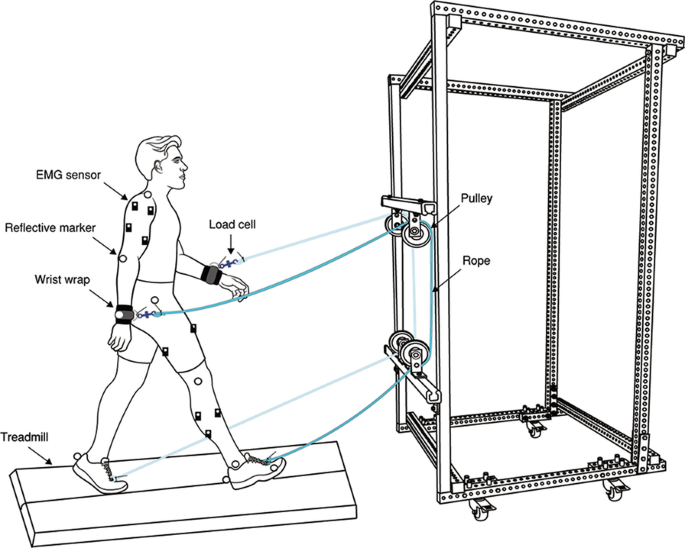
    To explore this idea, we developed a rope-pulley system that physically links the ipsilateral arm and leg during treadmill walking (Fig. 1). With this approach, we imagined that individuals could use their arms to assist the legs, allowing them to be more actively engaged in their gait re-training. This approach would require a greater demand from the arms, but we suspected this would lower the demand placed on the legs. Therefore, we set out to establish proof-of-concept by first understanding how our method of linking the arms and legs would influence the mechanical, muscular, and metabolic demands of walking in a cohort of healthy, neurologically-unimpaired individuals. We presumed that a user could pull on the rope as the arm swings backward and, thus, generate a force along the rope to assist with ipsilateral leg swing. We reasoned that increasing the muscular demand of the arms would incur a metabolic cost; however, if the assistive force is transmitted effectively along the rope, we expected this assistive force to decrease the muscular and metabolic demand to swing the leg, which is estimated to comprise between 10 and 33% of the net metabolic cost of walking [17,18,19]. Given our logic, we hypothesized that (1) walking with the arm-leg pulley system would increase the arm’s muscular demand to generate an assistive force, but a trade-off would be a decrease in the leg’s muscular demand to swing the leg, and (2) any metabolic cost incurred to actively use the arms would be counterbalanced by the reduction in the cost to swing the legs, bringing about no change in the net metabolic cost of walking. A test of our first hypothesis would provide proof-of-concept that it is possible to actively use the arms to move the legs during treadmill walking. A test of our second hypothesis would give insight into whether this approach comes at the expense of an increased metabolic cost or not. Our overall goal in this study is to provide a fundamental understanding of how physically coupling the arms and legs affects the biomechanics and energetics of walking. We believe this fundamental understanding will provide insight into its potential use as a rehabilitation strategy for individuals with impaired lower limb function, such as those recovering from a spinal cord injury or stroke.

    Fig. 1
    figure1

    Arm-leg rope pulley system. Subjects walked on a split-belt force measuring treadmill while attached to a simple device that connects the ipsilateral arm and leg using a rope. The horizontal pulley bars are height adjustable, allowing for relative changes in rope length. Furthermore, the load cell is in series with the rope and used to measure rope tension during treadmill walking. Note that the reflective markers were attached to both sides while EMG sensors were placed only on the right side of the body due to a limited number of sensors available in our lab

    Methods

    Participants

    Eight healthy, young subjects participated in this study (3 women and 5 men; age = 23.25 ± 3.37 years, mass = 73.88 ± 18.46 kg, height = 173.84 ± 13.95 cm; mean ± SD). Prior to the experimental session, a telephone interview was conducted to ensure the participants met the inclusion criteria of a healthy participant, i.e., physically active, non-smoker, body mass index < 30.0 kg/m2, and free from musculoskeletal injuries. A health screen form was then completed, reviewed, and signed by the subject the day of the experimental session. In addition, they read and signed an informed consent document. This study was reviewed and approved by the University of Houston Institutional Review Board.


    Friday, October 11, 2019

    Computational Design of FastFES Treatment to Improve Propulsive Force Symmetry During Post-stroke Gait: A Feasibility Study

    I got nothing.

    I didn't understand these earlier propulsion researches either:

    Paretic Propulsion and Trailing Limb Angle Are Key Determinants of Long-Distance Walking Function After Stroke June 2015 

    Evaluation of measurements of propulsion used to reflect changes in walking speed in individuals poststroke  June 2018

    The latest here:

    Computational Design of FastFES Treatment to Improve Propulsive Force Symmetry During Post-stroke Gait: A Feasibility Study


    • 1Computational Biomechanics Laboratory, Department of Mechanical and Aerospace Engineering, University of Florida, Gainesville, FL, United States
    • 2Neuromechanics Laboratory, Wallace H. Coulter Department of Biomedical Engineering, Emory University and Georgia Institute of Technology, Atlanta, GA, United States
    • 3Motion Analysis Laboratory, Department of Rehabilitation Medicine, Emory University School of Medicine, Atlanta, GA, United States
    • 4Rice Computational Neuromechanics Laboratory, Department of Mechanical Engineering, Rice University, Houston, TX, United States
    Stroke is a leading cause of long-term disability worldwide and often impairs walking ability. To improve recovery of walking function post-stroke, researchers have investigated the use of treatments such as fast functional electrical stimulation (FastFES). During FastFES treatments, individuals post-stroke walk on a treadmill at their fastest comfortable speed while electrical stimulation is delivered to two muscles of the paretic ankle, ideally to improve paretic leg propulsion and toe clearance. However, muscle selection and stimulation timing are currently standardized based on clinical intuition and a one-size-fits-all approach, which may explain in part why some patients respond to FastFES training while others do not. This study explores how personalized neuromusculoskeletal models could potentially be used to enable individual-specific selection of target muscles and stimulation timing to address unique functional limitations of individual patients post-stroke. Treadmill gait data, including EMG, surface marker positions, and ground reactions, were collected from an individual post-stroke who was a non-responder to FastFES treatment. The patient's gait data were used to personalize key aspects of a full-body neuromusculoskeletal walking model, including lower-body joint functional axes, lower-body muscle force generating properties, deformable foot-ground contact properties, and paretic and non-paretic leg neural control properties. The personalized model was utilized within a direct collocation optimal control framework to reproduce the patient's unstimulated treadmill gait data (verification problem) and to generate three stimulated walking predictions that sought to minimize inter-limb propulsive force asymmetry (prediction problems). The three predictions used: (1) Standard muscle selection (gastrocnemius and tibialis anterior) with standard stimulation timing, (2) Standard muscle selection with optimized stimulation timing, and (3) Optimized muscle selection (soleus and semimembranosus) with optimized stimulation timing. Relative to unstimulated walking, the optimal control problems predicted a 41% reduction in propulsive force asymmetry for scenario (1), a 45% reduction for scenario (2), and a 64% reduction for scenario (3), suggesting that non-standard muscle selection may be superior for this patient. Despite these predicted improvements, kinematic symmetry was not noticeably improved for any of the walking predictions. These results suggest that personalized neuromusculoskeletal models may be able to predict personalized FastFES training prescriptions that could improve propulsive force symmetry, though inclusion of kinematic requirements would be necessary to improve kinematic symmetry as well.

    Tuesday, September 10, 2019

    Fore-aft resistance applied at the center of mass using a novel robotic interface proportionately increases propulsive force generation in healthy nonimpaired individuals walking at a constant speed

    Do we need better propulsion to improve our walking? WHOM do we go to to ask that extremely simple question? I want specific names so we can determine competence in following up stroke survivor question/needs. 

    Your doctor can explain and provide protocols for all your paretic propulsion needs. At least if competent. You may have to call the hospital president if there is nothing for paretic propulsion.

    Fore-aft resistance applied at the center of mass using a novel robotic interface proportionately increases propulsive force generation in healthy nonimpaired individuals walking at a constant speed

    Abstract

    Background

    Past studies have utilized external interfaces like resistive bands and motor-generated pulling systems to increase limb propulsion during walking on a motorized treadmill. However, assessing changes in limb propulsion against increasing resistance demands during self-controlled walking has not been undertaken.

    Purpose

    We assessed limb propulsion against increasing fore-aft loading demands by applying graded fore-aft (FA) resistance at the center of mass during walking in a novel, intent-driven treadmill environment that allowed participants to control their walking speeds. We hypothesized that to maintain a target speed against progressively increasing resistance, participants would proportionately increase their limb propulsion without increasing vertical force production, with accompanying increases in trailing limb angle and positive joint work.

    Methods

    Seventeen healthy-nonimpaired participants (mean age 52 yrs., SD = 11) walked at a target, self-controlled speed of 1.0 m/s against 10, 15, 20, and 25% (% body weight) FA resistance levels. We primarily assessed linear slope values across FA resistance levels for mean propulsive force and impulse and vertical impulse of the dominant limb using one-sample t-tests. We further assessed changes in trailing and leading limb angles and joint work using one-way ANOVAs.

    Results

    Participants maintained their target velocity within an a priori defined acceptable range of 1.0 m/s ± 0.2. They significantly increased propulsion proportional to FA resistance (propulsive force mean slope = 2.45, SD = 0.7, t (16) =14.44, p < 0.01; and propulsive impulse mean slope = 0.7, SD = 0.25, t (16) = 11.84, p < 0.01), but had no changes in vertical impulse (mean slope = − 0.04, SD =0.17, p > 0.05) across FA resistance levels. Mean trailing limb angle increased from 24.3° at 10% resistance to 27.4° at 25% (p < 0.05); leading limb angle decreased from − 18.4° to − 12.6° (p < 0.05). We also observed increases in total positive limb work (F (1.7, 26) = 16.88, p ≤ 0.001, η2 = 0.5), primarily attributed to the hip and ankle joints.

    Conclusions

    FA resistance applied during self-driven walking resulted in increased propulsive-force output of healthy-nonimpaired individuals with accompanying biomechanical changes that facilitated greater limb propulsion. Future rehabilitation interventions for neurological populations may be able to utilize this principle to design task-specific interventions like progressive strength training and workload manipulation during aerobic training for improving walking function.

    Thursday, June 21, 2018

    Evaluation of measurements of propulsion used to reflect changes in walking speed in individuals poststroke

    I got absolutely nothing out of this. No clue what propulsion means in this context. 

    Evaluation of measurements of propulsion used to reflect changes in walking speed in individuals poststroke 


    Jopurnal of Biomechanics , Volume 49(16) , Pgs. 4107-4112.

    NARIC Accession Number: J78529.  What's this?
    ISSN: 0021-9290.
    Author(s): Hsiao, HaoYuan; Zabielski Jr., Thomas M.; Palmer, Jacqueline A.; Higginson, Jill S.; Binder-Macleod, Stuart A..
    Project Number: 90AR5028.
    Publication Year: 2016.
    Number of Pages: 6.
    Abstract: Study examined the relationships between walking speed and different measurements of propulsion in individuals poststroke. The primary purposes of this study were to determine which measurement of propulsion (1) is most closely related to their self-selected walking speeds and (2) best reflects changes in walking speed within a session. Forty-three participants with chronic poststroke hemiparesis walked at their self-selected and maximal walking speeds on a treadmill. Propulsive impulse, peak propulsive force, and mean propulsive value (propulsive impulse divided by duration) were analyzed. In addition, each participant’s cadence was calculated. Pearson correlation coefficients were used to determine the relationships between different measurements of propulsion versus walking speed as well as changes in propulsion versus changes in walking speed. Stepwise linear regression was used to determine which measurement of propulsion best predicted walking speed and changes in walking speed. The results showed that all 3 measurements of propulsion were correlated to walking speed, with peak propulsive force showed the strongest correlation. Similarly, when participants increased their walking speeds, changes in peak propulsive forces showed the strongest correlation to changes in walking speed. In addition, multiplying each measurement by cadence improved the correlations. The present study suggests that measuring peak propulsive force and cadence may be most appropriate of the variables studied to characterize propulsion in individuals poststroke.
    Descriptor Terms: AMBULATION, BIOENGINEERING, BODY MOVEMENT, EVALUATION TECHNIQUES, MEASUREMENTS, STROKE.


    Can this document be ordered through NARIC's document delivery service*?: Y.
    Get this Document: https://www.ncbi.nlm.nih.gov/pmc/articles/PMC5164961/.

    Citation: Hsiao, HaoYuan, Zabielski Jr., Thomas M., Palmer, Jacqueline A., Higginson, Jill S., Binder-Macleod, Stuart A.. (2016). Evaluation of measurements of propulsion used to reflect changes in walking speed in individuals poststroke.  Jopurnal of Biomechanics , 49(16), Pgs. 4107-4112. Retrieved 6/21/2018, from REHABDATA database.