Changing stroke rehab and research worldwide now.Time is Brain! trillions and trillions of neurons that DIE each day because there are NO effective hyperacute therapies besides tPA(only 12% effective). I have 523 posts on hyperacute therapy, enough for researchers to spend decades proving them out. These are my personal ideas and blog on stroke rehabilitation and stroke research. Do not attempt any of these without checking with your medical provider. Unless you join me in agitating, when you need these therapies they won't be there.

What this blog is for:

My blog is not to help survivors recover, it is to have the 10 million yearly stroke survivors light fires underneath their doctors, stroke hospitals and stroke researchers to get stroke solved. 100% recovery. The stroke medical world is completely failing at that goal, they don't even have it as a goal. Shortly after getting out of the hospital and getting NO information on the process or protocols of stroke rehabilitation and recovery I started searching on the internet and found that no other survivor received useful information. This is an attempt to cover all stroke rehabilitation information that should be readily available to survivors so they can talk with informed knowledge to their medical staff. It lays out what needs to be done to get stroke survivors closer to 100% recovery. It's quite disgusting that this information is not available from every stroke association and doctors group.

Showing posts with label smoking. Show all posts

Friday, August 28, 2026

Three Factors Tied to 13 Additional Dementia-Free Years

 Never smoked, hypertension started at age 58(past midlife), no diabetes or pre-diabetes. I should easily get to 100 without dementia(30 years to go).

Three Factors Tied to 13 Additionedal Dementia-Free Years

Key Takeaways

  • Midlife vascular health was associated with nearly 13 more dementia-free years in a prospective U.S. cohort study.
  • At age 55, healthier study participants averaged 30.1 additional years without dementia.
  • Smoking, hypertension, and diabetes together sharply increased dementia risk and mortality.

Maintaining three key health factors during midlife -- normal blood pressure, no diabetes, and not smoking -- was associated with nearly 13 additional dementia-free years, a study of 12,000 people in the U.S. showed.

Individuals who met these criteria at age 55 lived an average 30.1 more years dementia-free, reported Josef Coresh, MD, PhD, of NYU Langone Health in New York City, and co-authors.

Conversely, those who smoked, had hypertension, and had diabetes at age 55 had dementia-free survival of only 17.5 years, Coresh and colleagues wrote in Neurology Open Access.

People with all three risk factors had a higher incidence of dementia (HR 2.69, 95% CI 1.94-3.73) and a higher incidence of dying before a dementia diagnosis (HR 5.61, 95% CI 4.67-6.74) compared with those who had no risk factors.

Overall, women lived longer without dementia than men at all risk levels. White participants had more years free of dementia than Black participants, and APOE4 carriers had shorter dementia-free survival than noncarriers.

"Our findings argue that people need to actively avert these factors in midlife as a strategy for preserving brain health for more than a decade," Coresh said in a statement. "Discovering new ways to delay dementia is crucial with 42% of Americans at risk for developing the condition at any time after age 55."

The findings were based on 12,409 participants in the prospective Atherosclerosis Risk in Communities (ARIC) study, which started in 1986 to evaluate midlife vascular risk factors and late-life dementia.

Previous research from the ARIC cohort suggested that 22% to 44% of dementia risk by age 80 could be attributed to three vascular risk factors measured in midlife and early late life, after accounting for risk factor concurrence and interactions.

Hypertension was defined as systolic blood pressure ≥130 mm Hg, diastolic blood pressure ≥80 mm Hg, or the use of blood pressure medication; diabetes as fasting glucose ≥126 mg/dL, non-fasting glucose ≥200 mg/dL, a physician's diagnosis, or the use of any diabetes medication; and current smoking was self-reported.

"Our study complements this important work by shifting focus from probability-based and attributable risk metrics to a time-based estimand -- dementia-free survival years, which quantifies the expected duration of life lived cognitively intact," Coresh and colleagues wrote.

"This outcome integrates two clinically relevant processes: incident dementia and death before dementia, therefore reflecting the competing risks that shape real-world aging trajectories," they pointed out. "In contrast to previous ARIC studies, this framework emphasizes how vascular health influences the balance between longevity and cognitive health over the life course."

In the current analysis, ARIC participants had a mean baseline age of 56 and 56% were women. Dementia was tracked through cognitive assessments, informant interviews, and continuous surveillance. Deaths without dementia were captured from multiple sources including the National Death Index.

Over a median follow-up of 26.3 years, 3,008 cases of dementia and 5,238 deaths without dementia were documented. Better vascular health was linked with longer dementia-free survival in a dose-response pattern.

"Several biologic pathways likely underlie our observed associations between vascular health and dementia-free survival, including chronic cerebrovascular injury, neuroinflammation triggered by vascular damages through hypertension and diabetes, and cumulative oxidative stress resulting from smoking," Coresh and colleagues wrote. "Together, these factors likely accelerate atherosclerosis, increase stroke risk, and may facilitate Alzheimer's disease pathology through promoting amyloid plaques and tau tangles."

The findings relied on one midlife assessment of risk factors, the researchers acknowledged. Dementia ascertainment may have differed between participants who attended recent visits and those who didn't. In addition, the study was observational and residual confounding may have influenced outcomes.

Judy George covers neurology and neuroscience news for MedPage Today, writing about brain aging, Alzheimer’s, dementia, MS, rare diseases, epilepsy, autism, headache, stroke, Parkinson’s, ALS, concussion, CTE, sleep, pain, and more. Connect:

Thursday, February 26, 2026

Smoking Linked to Lower Parkinson’s Risk but Higher Mortality

 Have your competent? doctor EXPLAIN EXACTLY HOW THEY ARE GOING TO PREVENT Parkinsons! They've known of the problem for years! Are they still incompetent in having done nothing?

Smoking Linked to Lower Parkinson’s Risk but Higher Mortality

Summary: A large-scale study of over 410,000 adults reveals a complex relationship between smoking and neurological health. Published in Neurology, the research found that individuals who were currently smoking had a lower risk of developing Parkinson’s disease compared to those who had quit.

However, the study strongly emphasizes that quitting smoking significantly lowers the overall risk of death. The findings suggest that the potential “protective” association with Parkinson’s is tied specifically to current smoking status rather than long-term history, highlighting a need for targeted therapies that mimic these effects without the lethal risks of tobacco.

Key Facts

  • The Parkinson’s Paradox: Persistent smokers had the lowest risk of Parkinson’s; those who quit (sustained or recent) had a 60% to 61% higher risk of developing the disease.
  • Mortality Trade-off: While quitters faced a higher Parkinson’s risk, they had a significantly lower risk of death (17% lower for sustained quitters) compared to persistent smokers.
  • Current Status Matters: Relapsed smokers (those who quit but started again) had a Parkinson’s risk similar to persistent smokers, suggesting the association is linked to active smoking.
  • Massive Study Scale: The research followed 410,000 adults in South Korea for an average of nine years, tracking smoking changes across multiple health screenings.
  • No “Safe” Smoking: Researchers warn that the risks of smoking—including cancer and heart disease—far outweigh any observed neurological associations, and these results should not encourage smoking.

Source: AAN

A new study of smokers finds that currently smoking is associated with a lower risk of developing Parkinson’s disease, but quitting smoking was associated with a lower risk of death.

The study was published on February 25, 2026, in Neurology.

The study does not prove that smoking prevents Parkinson’s; it only shows an association.

This shows a brain in an ashtray.
Researchers are investigating the link between active smoking and reduced Parkinson’s risk, while emphasizing that quitting smoking is essential for overall longevity and health. Credit: Neuroscience News

“The severe health risks of smoking cannot be overlooked, as it remains a leading cause of preventable death and contributes to heart disease, cancer and chronic lung disorders,” said study author Jun-Hyuk Lee, MD, PhD, of Eulji University School of Medicine in Seoul, South Korea.

“While our study found smokers who quit showed a higher risk of Parkinson’s disease than those who were currently smoking, it also found they had a lower risk of death. The health benefits of quitting smoking remain substantial and clear.”

The study involved more than 410,000 adults in South Korea who were smokers at the beginning of the study. Their average age was 52, and they were followed for an average of nine years.

Participants completed health screenings at the start of the study, about two years later, and then another two years later. They were asked how much and how often they smoked.

Researchers divided participants into four groups: persistent smokers who never quit, relapsed smokers who quit a couple years into the study but then resumed smoking, recent quitters who smoked the first four years of the study and then quit, and sustained quitters who quit early in the study and never resumed smoking.

During the study, 1,794 people developed Parkinson’s disease: 0.33% of persistent smokers, 0.41% of relapsed smokers, 0.67% of recent quitters and 0.71% of sustained quitters.

Also, 31,203 people died, including 7.24% of persistent smokers, 8.09% of relapsed smokers, 8.76% of recent quitters and 7.91% of sustained quitters.

After adjusting for factors such as income level, alcohol use and physical activity, researchers found that persistent smokers had the lowest risk of developing Parkinson’s disease. Recent quitters and sustained quitters had a 60% to 61% higher risk of Parkinson’s compared to persistent smokers. Relapsed smokers had a risk similar to persistent smokers.

When looking at risk of death, researchers found that sustained quitters had a 17% lower risk of death and recent quitters had a 3% lower risk compared to persistent smokers. Relapsed smokers had the same rate as persistent smokers.

“Overwhelming evidence from multiple previous studies shows quitting smoking is much better for long-term health overall,” Lee said.

“Our study suggests a lower risk of Parkinson’s is not necessarily associated with how long someone smokes, but rather if they are currently smoking. Future studies are needed to better understand which components of smoking contribute to the reduced risk, and to develop safe and targeted therapies that replicate the effects of smoking for Parkinson’s without the harmful health consequences.”

A limitation of the study was that data was self-reported, so people providing responses may not have recalled all information accurately. Also, the participants were mostly Korean male participants, so results may not be generalizable to women or other populations.

Key Questions Answered:

Q: Does smoking actually prevent Parkinson’s?

A: The study shows an association, but it doesn’t prove cause-and-effect. While active smokers in the study had lower rates of Parkinson’s, the biological reason isn’t fully understood yet. It might be a specific chemical in tobacco, or it could be related to how “addictive” brains are wired differently.

Q: Should I keep smoking to avoid Parkinson’s?

A: Absolutely not. Even with a lower Parkinson’s risk, persistent smokers in the study had the highest risk of death. Quitting smoking is still the single best thing you can do for your heart, lungs, and overall lifespan.

Q: What is the “secret ingredient” in cigarettes that helps the brain?

A: That’s the multi-million dollar question. Scientists are trying to isolate which components of tobacco might be helping neurons so they can create safe, targeted medications that offer protection without the cancer-causing smoke.

Editorial Notes:

  • This article was edited by a Neuroscience News editor.
  • Journal paper reviewed in full.
  • Additional context added by our staff.

About this Parkinson’s disease research news

Author: Renee Tessman
Source: AAN
Contact: Renee Tessman – AAN
Image: The image is credited to Neuroscience News

Original Research: The findings will appear in Neurology

Thursday, January 11, 2024

Effect of smoking on Brain-Derived Neurotrophic Factor (BDNF) blood levels: A systematic review and meta-analysis

I highly doubt that your doctor will recommend smoking to increase your BDNF levels.  And they didn't seem to test marijuana smoking to see if you could get two for one. 

 I assume your competent? stroke doctor has already given you everything you need on BDNF. But I'm sure I'm making an incorrect assumption. If your doctor doesn't know of all these BDNF stroke research articles there is a good reason!  PURE INCOMPETENCE!

  • BDNF (169 posts to April 2011)

Didn't your competent? doctor prescribe marijuana years ago to help your stroke recovery?  Oh, you don't have a functioning stroke doctor, do you? 

Effect of smoking on Brain-Derived Neurotrophic Factor (BDNF) blood levels: A systematic review and meta-analysis

, , , , , , ,
https://doi.org/10.1016/j.jad.2024.01.082Get rights and content

Abstract

Background

Brain-Derived Neurotrophic Factor (BDNF) is a neurotrophin that plays a crucial role in neuronal survival and plasticity. Previous studies have suggested that smoking may influence BDNF levels, but the findings have been inconsistent.

Methods

A comprehensive search of electronic databases was conducted to identify relevant studies. Inclusion criteria were applied to select studies that investigated the relationship between smoking and blood levels of BDNF. A random-effects model was used to estimate the overall effect size.

Results

A total of 23 studies were included. The meta-analysis revealed a significant association between smoking and increased blood levels of BDNF (standardized mean difference [SMD] = −0.38, 95 % confidence interval [CI] 0.15 to 0.62, p = 0.002). Subgroup analyses based on BDNF source showed a significant increase in plasma-derived BDNF levels (SMD = 1.02, 95 % CI 0.50 to 1.53, p = 0.0001), while no significant difference was observed in serum-derived BDNF levels (SMD = 0.02, 95 % CI -0.19 to 0.22, p = 0.87). The pooled analysis revealed a non-significant difference in blood levels of BDNF between former smokers and non-smokers (random-effects model, SMD = 0.21, 95 % CI -0.04 to 0.46, p = 0.1).

Conclusion

Smokers exhibited significantly higher plasma levels of BDNF compared to non-smokers. Further research is needed to elucidate the underlying mechanisms and explore the potential therapeutic implications of targeting BDNF in smoking.

Introduction

In 2019 alone, there were 1.14 billion smokers worldwide, an increase from 0.99 billion in 1990, with tobacco accounting for 13.6 % of all deaths in the same year (Reitsma et al., 2021). In 2020 this number increased to 1.18 billion (Dai et al., 2022). Smoking tobacco is a leading cause of ischemic heart disease, chronic obstructive pulmonary disease, lung cancer, and tracheal cancer, impacting an estimated 7 million lives a year on average (WHO/ Fact-Sheet/ Tobacco, n.d.). Although its toxic effects on the pulmonary and cardiovascular systems are well established, its association with neurological disorders is a point of contention, with studies highlighting its role in the development of Alzheimer's disease and, paradoxically, the prevention of Parkinsons disease (Hajdusianek et al., 2021).

BDNF, a member of the neurotrophin family, is a growth factor found in the nervous system and platelets, and plays a key role in synaptic plasticity, neuronal growth, and numerous functions related to neural differentiation and maturation (Park and Poo, 2013; Fujimura et al., 2002). Since the measurement of CNS levels is challenging, blood levels of BDNF are frequently used as a proxy, with multiple studies supporting a close correlation between peripheral and CNS levels (Gejl et al., 2019a). Blood BDNF levels have been proposed as a biomarker for several psychiatric disorders (Fernandes et al., 2015a; Polyakova et al., 2015; Fernandes et al., 2015b), with their fluctuations linked with a multitude of states (e.g., stress, response to treatment) (Zhang et al., 2016a; Lin and Huang, 2020) and lifestyle habits (Sandrini et al., 2018; Ornell et al., 2018; Sleiman et al., 2016). A variation in the BDNF gene known as a single-nucleotide polymorphism (SNP) resulted in changes to the intracellular transport and activity-dependent release of mature BDNF, impacting hippocampal function. Studies showed that chronic nicotine administration is likely to escalate the BDNF level, additionally, the chromosomal region 11p13, where the BDNF gene is situated, is likely to contain susceptibility genes associated with nicotine dependence, specifically (Xia et al., 2019). Studies evaluating the influence of smoking on BDNF levels (Umene-Nakano et al., 2010; Kim et al., 2007; Abdelkhalek et al., 2022; Al-Mshari et al., 2022) have led to conflicting results with some observing significantly elevated BDNF levels in smokers (Abdelkhalek et al., 2022), while others noted significantly lower levels (Umene-Nakano et al., 2010).

As far as our understanding extends, there has been no comprehensive review investigating the correlation between blood BDNF levels and smoking. This study is designed to address this gap by exploring the potential connection between blood BDNF levels and smoking. Additionally, it aims to investigate: a) potential differences in BDNF levels between former smokers and non-smokers, b) the impact of smoking cessation on blood BDNF levels, and c) examine potential changes in serum BDNF and plasma BDNF through subgroup analysis. Understanding the relationship between smoking and BDNF level may be useful for addiction treatment and also screening the patients who are considered to be high risk for cognitive impairment due to BDNF dysregulation.

Friday, June 16, 2023

Night Owls’ Lifespan Less Linked to Sleep Patterns, More to Lifestyle Choices

I'm definitely a night owl, may not get to bed until 2-3 in the morning, pumping out more blog posts. Don't smoke and since they didn't mention any factual basis on alcohol use, this amounts to useless information.

Night Owls’ Lifespan Less Linked to Sleep Patterns, More to Lifestyle Choices

Summary: Recent research refutes the idea that ‘night owls’ face a shorter lifespan due to their late-night tendencies, emphasizing lifestyle factors like smoking and drinking as the more significant contributors.

The study involved almost 23,000 twins from Finland, tracked over a period of 37 years. It found that while evening types have a slightly increased risk of mortality, it is more attributable to unhealthy habits than sleep patterns.

The researchers highlight the importance of considering lifestyle when examining health impacts related to chronotype – the body’s natural sleep rhythm.

Key Facts:

  1. At the start of the study, participants were asked to identify themselves as ‘definitely’ or ‘to some extent’ either a morning or an evening person. This was to establish their chronotype or natural sleep pattern.
  2. The study revealed that ‘definite evening types’ were less likely to report getting a full 8 hours of sleep, indicating that they had shorter average sleep durations.
  3. It was found that the marginally increased mortality risk for evening types was majorly linked to lifestyle choices like smoking and alcohol consumption.

Source: Taylor and Francis Group

Staying up late at night has little impact on how long ‘night owls’ live, according to new research published in the peer-reviewed journal Chronobiology International.

Data based on nearly 23,000 twins, however shows that evening types have a slightly increased risk of dying than morning types, but this is largely linked to smoking and drinking.

The study which tracked people over the course of more than 37 years in Finland suggests that lifestyle should be considered.

This shows a person awake late at night.
This is when analyzing the impact on health of chronotype – the body’s natural inclination to sleep at a certain time. Credit: Neuroscience News

This is when analyzing the impact on health of chronotype – the body’s natural inclination to sleep at a certain time.


Tuesday, February 14, 2023

Risk of recurrent stroke 48% higher among young marijuana users

 And earlier research suggests bias in the testing: The authors of the study, published Thursday in the American Heart Association journal Stroke, suggested that bias in who gets a drug test following a stroke may be skewing the data, and they recommend developing more standardized guidelines for toxicology screening of stroke patients. 

It is highly more likely that the smoking part is the problem, not the marijuana, and a huge majority of these were smokers(73.9%)

But this!

Pot Smoking Baby Boomers Are On The Rise, Why Are Scientists So Happy For Them? Hint: Benefits For The Aging Brain

Studies that showed improved memory, decreased brain inflammation and increased hippocampal neurogenesis in older brains after the daily stimulation of cannabinoid receptors.

And this:

Smoking Is Leading Predictor of Alzheimer’s Disease Resilience

And this:

The Experiments Revealing How Marijuana Could Treat Dementia

The latest here:

 Risk of recurrent stroke 48% higher among young marijuana users 


The new analysis, based on data from 1.6 million patients, found that a medical marijuana prescription for chronic pain may increase a person's overall arrhythmia risk. Medical marijuana

Young adults who regularly smoke marijuana may face an elevated risk of recurrent stroke, according to new data presented at the American Stroke Association’s International Stroke Conference 2022.

“Since marijuana use is more common among younger people and is now legal in several U.S. states, we felt it was crucial to study the various risks it may impose,” lead author Akhil Jain, MD, lead author of the study and a resident physician at Mercy Fitzgerald Hospital in Darby, Pennsylvania, said in a statement. “First-time stroke risk among cannabis users is already established, so it intrigued us to investigate whether continued marijuana dependence also predisposes younger people to develop further strokes.”

Jain et al. examined data from the National Inpatient Sample, focusing on more than 161,000 adult patients with a history of stroke or transient ischemic attack (TIA) who were hospitalized from October 2015 to October 2017. All patients were between the ages of 18 and 44 years old.

More than 4,500 patients included in the analysis were diagnosed with cannabis use disorder. The median age was 37 years old. These patients were more likely to be male (55.2% vs. 40.9%), smoke tobacco (73.9% vs. 39.6%) or be diagnosed with depression (20.4% vs. 16.1%). They were also much more likely to abuse alcohol (16.5% vs. 3.6%). Meanwhile, high blood pressure (53.1% vs. 55.6%), diabetes (16.3% vs. 22.7%), high cholesterol (21.6% vs. 24.1%) and obesity (12% vs. 19.6%) were all less likely among this patient population.

Overall, the team found, 6.9% of young adults with cannabis use disorder and a history of stroke or TIA were hospitalized for a recurrent stroke. Among patients who did not have cannabis use disorder, the rate was 5.4%.

After making multiple adjustments, the team added, patients with cannabis use disorder were a whopping 48% more likely to be hospitalized for recurrent stroke.

“Young marijuana users who have a history of stroke or TIA remain at significantly higher risk of future stroke,” Jain said. “Therefore, it is essential to increase awareness among younger adults of the adverse impact of chronic, habitual use of marijuana, especially if they have established cardiovascular disease risk factors or previous stroke episodes.”

Friday, October 28, 2022

Coffee, smoking and aspirin are associated with age at onset in idiopathic Parkinson’s disease

Based upon your Parkinson's risk post stroke, what EXACT protocols does your doctor have to lower or prevent that risk? I'm not taking up smoking but if nicotine would help, I'd do nicotine patches since the nicotine gym was cancelled.  I'm doing 325 daily aspirin and up to 12 daily cups of coffee so I assume I'm good in that regard.

Your risk of Parkinsons here:

Parkinson’s Disease May Have Link to Stroke March 2017


How coffee protects against Parkinson’s Aug. 2014 

Coffee, smoking and aspirin are associated with age at onset in idiopathic Parkinson’s disease

Abstract

Parkinson’s disease (PD) is a progressive neurodegenerative disorder. Genetic modifiers, environmental factors and gene–environment interactions have been found to modify PD risk and disease progression. The objective of this study was to evaluate the association of smoking, caffeine and anti-inflammatory drugs with age at onset (AAO) in a large PD cohort. A total of 35,963 American patients with idiopathic PD (iPD) from the Fox Insight Study responded to health and lifestyle questionnaires. We compared the median AAO between different groups using the non-parametric Mann–Whitney U test. Non-parametric Spearman’s correlation was used for correlation assessments and regression analysis was used to assess interaction between variables. We found that smoking (p < 0.0001), coffee drinking (p < 0.0001) and aspirin intake (p < 0.0001) show an exploratory association with AAO in PD, that was further supported by multivariate regression models. The association of aspirin with PD AAO was replicated in another cohort (EPIPARK) (n = 237 patients with PD).

Introduction

Parkinson’s disease (PD) is a progressive neurodegenerative disorder, characterized by dopaminergic neuronal loss in the substantia nigra and the presence of Lewy Bodies [1, 2]. It is the second-most common neurodegenerative disorder and the fastest-growing neurological disease currently affecting over 7 million patients worldwide [3].

A phenomenon in PD is variable age at onset (AAO) that is considered a consequence of genetic and environmental factors. Tobacco use and smoking are already known protective factors for PD risk [4,5,6]. However, research specifically on AAO is not as extensive. Studies report that disease onset in patients with idiopathic or monogenic PD is later among smokers, dependent on the dosage [7,8,9,10,11,12,13]. The largest cross-sectional cohort was comprised of 715 PD patients, of whom 312 were smokers and 404 never smoked [5]. Likewise, caffeine consumption was associated with lower PD risk, with a dosage-dependent level of protection [14]. In terms of AAO, there is evidence that the onset of PD among coffee drinkers is later compared to non-drinkers [11, 15, 16], also indicating a dosage effect [12, 17]. However, earlier studies report opposing effects of an earlier AAO with higher coffee intake [7]. Non-steroidal anti-inflammatory drug (NSAID) intake has been found to be associated with a lower risk for PD [18], supporting work that describe a role for neuro-inflammatory signaling in PD [19]. NSAIDs (ibuprofen and aspirin) have been found to influence the penetrance of LRRK2 [20]. However, there are currently no studies published that investigate an association between aspirin and AAO in idiopathic PD (iPD).

Herein, we focused on lifestyle factors implicated in PD risk and investigated the association of smoking, the consumption of caffeine and the use of aspirin on AAO in patients with iPD. We hypothesize these factors are associated with AAO in a large cohort of American iPD patients (n = 35,963).

Methods

Demographics and participant examination

Our study is composed of 35,963 American patients with PD (Table S1) from the Fox Insight Study (Supplementary text and Fig. S1). Due to the nature of the data collection and accessibility via an online data platform, some entries were highly unlikely or impossible; thus, we excluded PD patients with an AAO lower than 3 years. Most of the patients were White/Caucasian (89.9%) (Table S1). PD patients had a mean age at examination (AAE) of 65.7 ± 10.2 SD years (range 13.8–119.0 years) and a mean AAO of 60.4 ± 11.0 SD years (range 5.1–115.4 years); 40.4% of PD patients were female. Patient recruitment for the Fox Insight Study has been previously described [21]. Data from a separate replication cohort of German iPD patients (EPIPARK) were used to test novel associations [22]. In the EPIPARK cohort, PD patients had a mean AAE of 67.7 ± 10.3 SD years (range 30.0–90.0 years) and a mean AAO of 54.8 ± 13.2 SD years (range 13.0–81.0 years); 37.3% of PD patients were female. Participant questionnaires are described in detail in the Supplementary text.

Lifestyle factors

Patients were classified as tobacco users, if they smoked more than 100 cigarettes in their lifetime or if they smoked at least one cigarette per day over a minimal period of 6 months or if they used smokeless tobacco at least once per day for more than 6 months. Patients were classified as coffee consumers if they regularly drank caffeinated coffee at least once per week over a period of at least 6 months. The same classification was used for caffeinated black tea. Lastly, patients were classified as aspirin users if they took at least two pills per week over a minimum of 6 months.

Duration of smoking, caffeine consumption and aspirin intake were estimated according to the age the patients started using either substance subtracted from the age at termination. If the patients terminated the consumption after their AAO, the age the patients started was subtracted from their AAO. Periods where the patients stopped regularly consuming were not included in the duration. Smoking dosage was estimated as cigarettes smoked per day within smoking duration time excluding implausible values, so that only values lower than 100 cigarettes per day were included in the analyses. Coffee and black tea dosage was defined as cups per week the patients drank within drinking duration time, excluding all values higher than 100 cups per week from the analysis. Aspirin dosage was defined as pills per week the patients took within aspirin intake duration time. The number of cigarettes for non-smokers, cups of coffee or black tea for non-drinkers and pills per week for aspirin non-users was set to zero. The intensity of each environmental factor is estimated as dosage over duration (dosage × duration).

Statistical analysis

For statistical analyses, non-parametric Mann–Whitney U test was performed to compare the distribution of AAO between different groups. For correlation analyses, non-parametric Spearman’s correlations and linear regression analyses were used to assess correlations and interactions between variables (GraphPad Software Inc., San Diego, CA, USA). Various multi-linear regression models were used to investigate the relationship between environmental factors, age, gender and potential comorbidities (IBM SPSS Statistics, Stanford, CA, USA) (details of each model are in Supplementary text). Reported p values remain descriptive because they are not corrected for multiple testing and results are exploratory. Patients with missing data on AAO or use of environmental and lifestyle factors were not included in the analyses.

Regression models

Regression model investigating AAO, AAE, environmental factors (binary/dosage/duration)

Age is considered a risk for PD and affects the general dosage and duration of environmental factors. We applied a multiple regression model using AAO as dependent variable and AAE and each environmental factor as covariates. Environmental factors were handled in three different ways: (1) binary (yes–no indication), (2) dosage as a continuous variable, and (3) duration as a continuous variable (IBM SPSS Statistics). Including age at examination as a covariate improves the understanding of how it might influence our models (details in Supplementary text).

Regression model investigating AAO, AAE, gender, environmental factors (binary/dosage/duration) and comorbidities

We estimated a multiple regression model using AAO as dependent variable and further variables as covariates: AAE, gender, and each environmental factor handled in three different ways: (1) binary (yes–no indication), (2) dosage as a continuous variable, and (3) duration as a continuous variable. For the investigation of smoking and aspirin, several potential comorbidities (lung diseases; heart diseases, arthritis, back pain and surgeries with anesthesia) were explored (IBM SPSS Statistics) (details in Supplementary text).

Regression model investigating AAO and combined environmental factors

To evaluate whether the environmental factors show a combined effect, this multiple regression model used the AAO as dependent variable and smoking, coffee drinking and aspirin intake, all handled binary, as covariates (details in Supplementary text).

Regression model investigating AAO, AAE, gender, combined environmental factors and comorbidities

To evaluate potential confounders and a possible combined effect of all three environmental factors, this multiple regression model adjusted for more covariates, using the AAO as dependent variable and AAE, gender, a selected comorbidity (back pain), and smoking, coffee drinking and aspirin intake as covariates (details in Supplementary text).

Literature review

We performed a systematic literature review for environmental factors that influence AAO in PD and searched for literature via PubMed that was published before December 14, 2021. We used the free text search terms “Parkinson onset smoking”, resulting in 221 articles, “Parkinson onset caffeine”, resulting in 46 articles, “Parkinson onset coffee”, resulting in 52 articles and “Parkinson onset aspirin”, resulting in 13 articles. Detailed descriptions of exclusion criteria are summarized in Fig. S2.

Results

Smoking

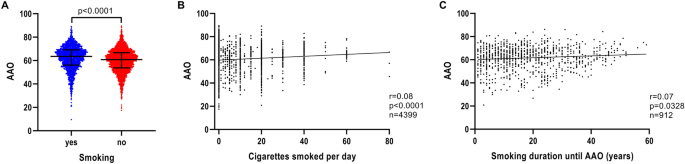
Patients with iPD, who reported use of tobacco, had a later AAO (n = 2148; median AAO = 63.5 years; IQR = 56.1–69.1) compared to non-users (n = 3375; median AAO = 60.8 years; IQR = 53.7–66.7) (p < 0.0001) (Fig. 1A and Table 1). Investigation of possible smoking dosage effects on AAO showed that the number of cigarettes per day was associated with later AAO (n = 4399, r = 0.08, p < 0.0001) (Fig. 1B), despite a small correlation strength. Similarly, a longer duration of smoking showed a positive correlation with AAO (n = 912, r = 0.07, p = 0.0328) (Fig. 1C), but again with a small correlation strength.

Fig. 1
figure 1

Association of AAO and tobacco use, smoking intensity and smoking duration in iPD. a Scatter plot of AAO of patients with iPD stratified by smoking status. Median values and interquartile ranges (IQR) are depicted. b Correlation between number of cigarettes smoked per day and AAO of patients with iPD. c Correlation between number of years of smoking until AAO and AAO of patients with iPD. p value: exploratory Mann–Whitney U test was performed for pairwise comparisons; non-parametric Spearman’s correlation and simple linear regression analyses were used to assess interactions between variables; p = Spearman’s exploratory p value, r = Spearman’s rank correlation coefficient

Table 1 Association of environmental factors and AAO

We investigated whether AAE contributed to the correlation between smoking and AAO as age is considered a risk for PD. When modeled in a linear regression to predict AAO, AAE (p < 1 × 10–5, β > 0.9277, SE < 0.0168), smoking (binary) (p = 0.0002, β = 0.5354, SE = 0.1424) and smoking dosage (p = 0.0016, β = 0.0172, SE = 0.0055) remained in the model as independent predictors, but the smoking duration (p = 0.5583, β = 0.0074, SE = 0.0127) did not (Table S2).

When investigating smoking, we found a correlation between dosage and duration (p < 1 × 10–5, r = 0.25).

To evaluate more potential predictors of AAO, we performed a sensitivity analysis. When modeled in a linear regression to predict AAO (Supplementary text), with covariates smoking binary/dosage or duration, AAE, gender, and lung diseases, smoking (binary) (p = 0.0005, β = 0.5051, SE = 0.1456) and smoking dosage (p = 0.0030, β = 0.0165, SE = 0.0055) showed a positive association with AAO. However, smoking duration (p = 0.5741, β = 0.0074, SE = 0.0131) was not found to be associated with AAO. A positive relationship for AAO with AAE (p < 1 × 10–5, β > 0.9254, SE < 0.0179) was also observed. We also tested for lung diseases including chronic obstructive pulmonary disease (COPD) as potential comorbidity, but these did not show any association with AAO (p > 0.7642, β > 0.0053, SE < 0.4432) (Table S2).

Caffeine

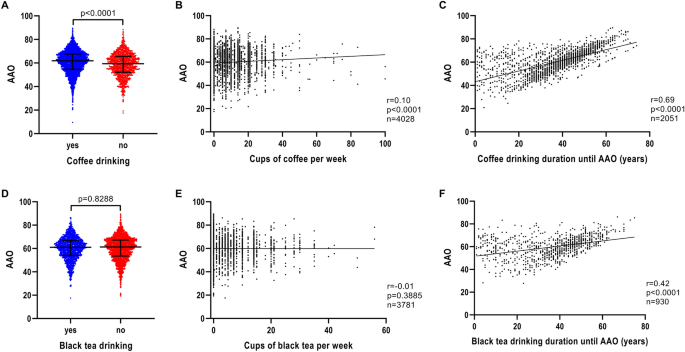
Patients with iPD who drank coffee regularly had a later AAO (n = 3993; median AAO = 61.9 years; IQR = 54.7–67.6) compared to patients with iPD who did not drink coffee at all (n = 1133; median AAO = 59.4 years; IQR = 52.1–65.6) (p < 0.0001) (Fig. 2fA and Table 1). Investigation of a possible coffee dosage effect revealed that the number of cups of coffee per week was associated with AAO, although the correlation strength was small (n = 4028, r = 0.10, p < 0.0001) (Fig. 2B). Longer coffee drinking duration also showed a positive correlation with AAO (n = 2051, r = 0.69, p < 0.0001) (Fig. 2C).

Fig. 2
figure 2

Association of AAO and caffeine consumption, caffeine drinking intensity and caffeine drinking duration in iPD. a Scatter plot of AAO of patients with iPD stratified by coffee consumption. Median values and interquartile ranges (IQR) are depicted. b Correlation between number of cups of coffee per week and AAO of patients with iPD. c Correlation between number of years of coffee drinking until AAO and AAO of patients with iPD. d Scatter plot of AAO of patients with iPD stratified by black tea consumption. e Correlation between number of cups of black tea per week and AAO of patients with iPD. f Correlation between number of years of black tea drinking until AAO and AAO of patients with iPD. p value: exploratory Mann–Whitney U test was performed for pairwise comparisons; non-parametric Spearman correlation and simple linear regression analyses were used to assess interactions between variables; p = Spearman’s exploratory p value, r = Spearman’s rank correlation coefficient

We investigated whether AAE contributed to the correlation between coffee drinking and AAO. When modeled in a linear regression to predict AAO, AAE (p < 1 × 10–5, β > 0.8239, SE < 0.0122), coffee drinking (binary) (p < 1 × 10–5, β = 0.9176, SE = 0.1704), coffee drinking dosage (p = 8 × 10–5, β = 0.0309, SE = 0.0078) and coffee drinking duration (p < 1 × 10–5, β = 0.1268, SE = 0.0083) all remained in the model as independent predictors (Table S2).

Again, coffee drinking dosage and duration were correlated (p < 1 × 10–5, r = 0.16).

We performed a sensitivity analysis to evaluate more potential predictors of AAO. When modeled in a linear regression to predict AAO (Supplementary text), with covariates coffee drinking binary/dosage or duration, AAE and gender, a positive relationship with coffee drinking (binary) (p < 1 × 10–5, β = 0.9379, SE = 0.1750), coffee drinking dosage (p = 0.0001, β = 0.0321, SE = 0.0081) and coffee drinking duration (p < 1 × 10–5, β = 0.1276, SE = 0.0084) was revealed. In addition, a positive relationship for AAO with AAE (p < 1 × 10–5, β > 0.8237, SE < 0.0125) was also observed (Table S2).

In contrast to the findings for coffee and AAO, black tea drinking was not observed to be associated with AAO (Fig. 2D and Table 1). There was also no association between the number of cups of black tea per week and AAO (n = 3781, r = − 0.01, p = 0.3885) (Fig. 2E). However, there was a positive correlation of black tea drinking duration with AAO (n = 930, r = 0.42, p < 0.0001) (Fig. 2F).

Aspirin

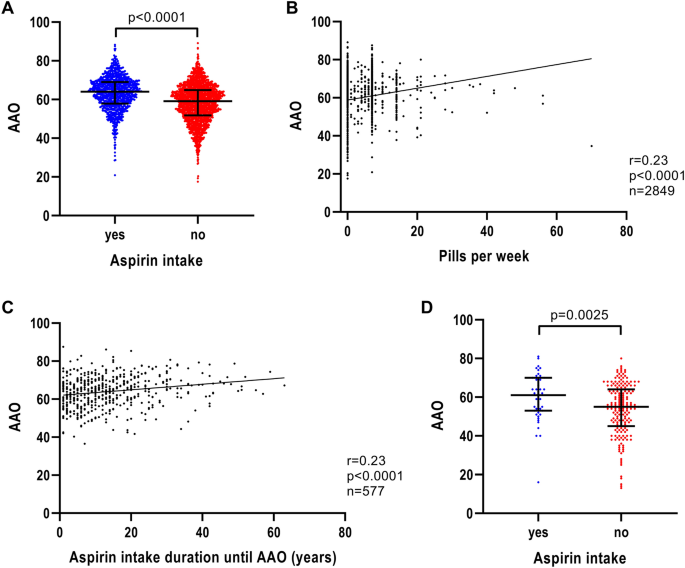
When investigating the effect of anti-inflammatory medication on AAO of patients with iPD, aspirin showed the greatest difference in AAO. Patients with iPD, who reported the use of aspirin, had a 5-year later AAO (n = 1003; median AAO = 64.0 years; IQR = 57.9–69.0) compared to patients who did not take aspirin (n = 1989; median AAO = 59.1 years; IQR = 51.8–64.9) (p < 0.0001) (Fig. 3A and Table 1). The difference in AAO for ibuprofen-based non-aspirin medication was small (ibuprofen users: n = 1087; median AAO = 60.6 years; IQR = 53.2–66.3; ibuprofen non-users: n = 2008; median AAO = 61.1 years; IQR = 54.2–67.0; p = 0.0345) or in the case of other anti-inflammatory medication we found no association at all (other anti-inflammatory drug users: n = 498; median AAO = 61.5 years; IQR = 54.0–66.9; other anti-inflammatory drug non-users: n = 2393; median AAO = 60.7 years; IQR = 53.7–66.6; p = 0.2495). As the association of ibuprofen was not as strong as the association with aspirin, we focused on aspirin and AAO for a more in-depth analysis.

Fig. 3
figure 3

Association of AAO and aspirin intake, aspirin intake intensity and aspirin intake duration in iPD. a Scatter plot of AAO of patients with iPD stratified by aspirin intake. Median values and interquartile ranges (IQR) are depicted. b Correlation between number of aspirin pills per week and AAO of patients with iPD. c Correlation between number of years of aspirin intake until AAO and AAO of patients with iPD. d Scatter plot of AAO of patients with iPD from the EPIPARK replication cohort stratified by aspirin intake. p value: exploratory Mann–Whitney U test was performed for pairwise comparisons; non-parametric Spearman correlation and simple linear regression analyses were used to assess interactions between variables; p = Spearman’s exploratory p value, r = Spearman’s rank correlation coefficient

The number of aspirin pills per week was associated with AAO (n = 2849, r = 0.23, p < 0.0001) (Fig. 3B). Likewise, the aspirin intake duration showed an association with AAO (n = 577, r = 0.23, p < 0.0001) (Fig. 3C), indicating a later AAO the longer the patients took aspirin before disease onset.

When examining the effect of AAE on aspirin intake and AAO by modeling in a linear regression to predict AAO, AAE (p < 1 × 10–5, β > 0.9195, SE < 0.0198), aspirin intake (binary) (p = 9 × 10–5, β = 0.7654, SE = 0.1958) and aspirin intake duration (p = 0.0165, β = 0.0319, SE = 0.0133) remained in the model but the aspirin dosage diminished as independent predictor (p = 0.0972, β = 0.0315, SE = 0.0190) (Table S2).

To evaluate more potential predictors of AAO, we performed a sensitivity analysis. When modeled in a linear regression to predict AAO (Supplementary text), with covariates aspirin intake binary/dosage or duration, AAE, gender, and potential comorbidities (heart diseases/arthritis/back pain/surgeries with anesthesia), aspirin intake (binary) showed a positive relationship with AAO (p < 0.0008, β > 0.6732, SE < 0.2063) as well as aspirin intake duration (p < 0.0153, β > 0.0338, SE = 0.0140). In contrast to this, aspirin intake dosage was not associated with AAO (p > 0.1188, β < 0.0303, SE < 0.0197). However, in all aspirin intake models, a positive relationship for AAO with AAE (p < 1 × 10–5, β > 0.9193, SE < 0.0213) was observed. In addition, in the models that included aspirin intake (binary) or aspirin intake dosage as covariate, a negative relationship for back pain with AAO (p < 0.0264, β < − 0.4144, SE < 0.1867) was found (Table S2).

Replication cohort

Since the aspirin and PD AAO association has not been investigated and published previously, we utilized a separate German iPD cohort to investigate further. In the EPIPARK cohort, patients with iPD who reported the use of at least one aspirin pill per week over a minimal period of one month had a more than 6 year later AAO (n = 49; median AAO = 61.0 years; IQR = 53.0–70.0) compared to patients who did not take aspirin (n = 188; median AAO = 55.0 years; IQR = 45.0–64.0) (p = 0.0025) (Fig. 3D).

Combined effect of smoking, coffee drinking and aspirin intake

To investigate whether there is a combined effect of smoking, coffee drinking and aspirin intake, we used a linear regression model to predict AAO (Supplementary text), showing that all three factors smoking (binary) (p < 1 × 10–5, β = 1.8261, SE = 0.3767), coffee drinking (binary) (p < 1 × 10–5, β = 2.5233, SE = 0.4158), as well as aspirin intake (binary) (p < 1 × 10–5, β = 4.8768, SE = 0.3698) remained in the model as an independent predictors (Table S2).

To consider more potential predictors of AAO and comorbidities, we performed a sensitivity analysis (Supplementary text). When modeled in a linear regression to predict AAO, with covariates smoking (binary), coffee drinking (binary), aspirin intake (binary), AAE, gender, and back pain, we found a positive relationship with smoking (binary) (p = 0.0014, β = 0.6400, SE = 0.2006), coffee drinking (binary) (p < 1 × 10–5, β = 1.1057, SE = 0.2222), aspirin intake (binary) (p = 0.0003, β = 0.7463, SE = 0.2041), AAE (p < 1 × 10–5, β = 0.9224, SE = 0.0109) and a negative relationship with back pain (p = 0.0034, β = − 0.5435, SE = 0.1855) (Table S2).

Discussion

We found an association between the general intake of aspirin, number of pills per week and aspirin intake duration with later AAO. These results were additionally investigated in a multivariate linear regression model to predict AAO and revealed an association with aspirin intake when examined dichotomous as well as with aspirin intake duration, which was further validated after including more covariates and potential comorbidities. We further replicated our findings concerning aspirin in a separate German iPD cohort (EPIPARK) [22]. The effect on PD AAO was not extended to other NSAIDs in the Fox Insight cohort. The difference in AAO for ibuprofen-based non-aspirin medication was only small between users and non-users and for other anti-inflammatory medication there was no association at all with AAO. Therefore, we focused our investigations on aspirin. The clinical effect of NSAIDs is still subject to controversial discussion. While some studies indicate a protective effect of NSAIDs or at least an association with PD [19, 23], others may see a neuro-protective potential of NSAIDs but not an association with PD at the population level [24, 25]. No other studies have explored aspirin and AAO in a large iPD cohort so far (Fig. S2). In addition to the novel findings on aspirin, we replicated previous associations for smoking and caffeine with AAO in PD, summarized in a systematic literature review (Fig. S2 and Table S3) [5, 7, 8, 10,11,12,13, 15,16,17, 26,27,28,29,30,31,32,33,34,35,36,37,38,39,40]. Thus far, 25 studies analyzed the effect of tobacco or caffeine on PD AAO. These cross-sectional studies have a patient sample size ranging from n = 58 to 715.

This effect was further supported by multivariate regression models. When evaluating the independence of smoking and coffee drinking from AAE by pairwise correlations, it showed that smoking (binary), smoking dosage, coffee drinking (binary), coffee drinking dosage, and coffee drinking duration remained in the model as independent predictors, however, smoking duration did not. These results were robust when including more covariates in the models.

Whether smoking delays AAO is still under debate. In our literature review (Figure S2 and Table S3) ten studies showed a delay in AAO, while two studies showed an opposite effect, and nine studies did not show a directionality. Gallo et al. [5] investigated the risk for PD for smokers and non-smokers in different groups of AAO and showed that there is a prevention of PD onset. However, they argued against a delaying effect of smoking on AAO. An association with a later AAO does not necessarily indicate a causal link. Therefore, we cannot be certain whether the negative association we found in our study is caused by smoking or by other associated factors. Further studies are required to investigate the underlying cause of a later AAO in smokers. In addition, former smokers with PD and current smokers with PD need to be separated to predict a possible long-lasting effect of smoking.

Although the correlation strength for the number of cups of coffee was relatively low, the coffee drinking duration showed a strong correlation, consistent with previous studies [23, 41,42,43], which was also verified in the regression models. Consistent with our study, seven other studies showed that coffee drinkers have a later PD onset. However, two studies showed an opposite effect, and two studies did not report a difference in AAO (Table S3). Caffeine is the speculated reason for the protective effect of coffee. Nevertheless, black tea had a more modest association with AAO, likely due to a lower amount of caffeine, which would further explain the strong correlation between a longer black tea drinking duration and a later AAO. The effect of coffee consumption and potential long-term effects need to be investigated in further longitudinal studies.

One strength of our study was the large sample size that provided sufficient power to assess lifestyle factors and PD onset, but also allows small magnitude associations to show significance. In addition, online self-report data collections offer many possibilities to promote epidemiological research because of convenience and accessibility for the participants and researchers. A previous study compared self-reported demographic characteristics, symptoms, medical history, and PD medication use of the Fox Insight PD cohort to other in-person observational research study cohorts [44]. They found that patterns of responses to patient-reported assessments that were obtained online on the PD cohort of the Fox Insight study were similar to PD cohorts assessed in-person. Patient-reported outcomes are becoming increasingly important to research, therapeutic development and healthcare delivery, which was already investigated in another previous study on Fox Insight [45]. However, due to the self-report assessments, data may also contain more subjective perceptions that are difficult to standardize. Additionally, we were limited to the questionnaires and data collected by Fox Insight in this study. This includes the selection of environmental factors as well as the types of questions. Thus, we were unable to assess other potential protective factors and thoroughly investigated smoking, coffee and aspirin intake. In addition, we were limited to the six-month exposure determination. This period of time might not be sufficient to show a measurable delay in AAO and a higher exposure time might be needed to demonstrate a stronger effect. Nevertheless, these findings may help to acquire a better understanding of this complex disease that can be used to developed specific therapeutic strategies.

This study is a comprehensive assessment of smoking, caffeine and aspirin intake on the onset of iPD. Besides replicating previous findings in a large self-report American cohort, novel associations of aspirin use with PD AAO were observed. These findings are so far only exploratory; however, they set the stage for future longitudinal assessments on these factors and PD clinical features.

 
More at link.