Changing stroke rehab and research worldwide now.Time is Brain! trillions and trillions of neurons that DIE each day because there are NO effective hyperacute therapies besides tPA(only 12% effective). I have 523 posts on hyperacute therapy, enough for researchers to spend decades proving them out. These are my personal ideas and blog on stroke rehabilitation and stroke research. Do not attempt any of these without checking with your medical provider. Unless you join me in agitating, when you need these therapies they won't be there.

What this blog is for:

My blog is not to help survivors recover, it is to have the 10 million yearly stroke survivors light fires underneath their doctors, stroke hospitals and stroke researchers to get stroke solved. 100% recovery. The stroke medical world is completely failing at that goal, they don't even have it as a goal. Shortly after getting out of the hospital and getting NO information on the process or protocols of stroke rehabilitation and recovery I started searching on the internet and found that no other survivor received useful information. This is an attempt to cover all stroke rehabilitation information that should be readily available to survivors so they can talk with informed knowledge to their medical staff. It lays out what needs to be done to get stroke survivors closer to 100% recovery. It's quite disgusting that this information is not available from every stroke association and doctors group.

Showing posts with label Shakespeare. Show all posts

Wednesday, March 11, 2026

Reciting Hamlet helped stroke recovery, says ex-MP

 Your competent? doctor knew this over a decade ago and prescribed this reading, right! Sorry about your incompetent doctor not knowing of this as part of your cognitive recovery!

I wonder if reading old English would do the same for an extra hard challenge, you might recover faster.

Reciting Hamlet helped stroke recovery, says ex-MP

A former Labour MP has revealed he recited Shakespeare from his hospital bed as he battled to get his speech back after suffering a stroke. Jonathan Ashworth said he feared he would never speak again after falling ill on New Year's Day The 47-year-old, who represented Leicester South between 2011 and 2024, reflected on his recovery as he was made a CBE for "political and parliamentary service" and charity work in a ceremony at Windsor Castle on Tuesday. "I found out I was getting honoured by this prestigious recognition for my work on behalf of children of alcoholics - and then a couple of days later I was hit with a stroke, but I'm recovering," the former shadow health secretary said.Ashworth was given his CBE medal by the Princess Royal at Windsor CastleAshworth said he recited lines from Shakespeare's Hamlet in the days after he was hit by a stroke as he fought to test his speech and memory at the Leicester Royal Infirmary."They must have thought me very eccentric in the hospital, because I sat there quoting Shakespeare monologues," he said after his investiture ceremony. "There's a monologue about how a man is so infinite in his faculties and so noble in his movement and reason, and yet in the end, it's just dust."Bit of a depressing monologue, probably not the most cheery monologue to be talking about on a day of celebration like this." He added he was "so worried" he would not be able to speak at the investiture. Ashworth, who stepped down as chief executive of influential think-tank Labour Together in July, also refused to rule out a return to front-line politics. "I'll quote Tony Benn, somebody who is not often quoted, I suspect, in Windsor Castle," he said. "Tony Benn famously said there's no final defeats or final victories, you just keep on going." Ashworth, whose own father died of alcoholism, is a patron of the National Association for Children of Alcoholics (NACOA). "I felt particularly moved and touched when I heard the Lord Chamberlain mention that this was also my recognition for advocacy on the behalf of children of alcoholics," he said.

Wednesday, March 9, 2016

Mental Flexibility Improved By Reading Literature With One Important Quality

You need this because you have to design your own recovery solutions. Your doctor and therapists do not seem to have any useful stroke protocols that get you anywhere close to 100% recovery.  You need mental flexibility. I bet Wordsworth and Shakespeare would qualify and they also boost the brain.
http://www.spring.org.uk/2016/03/reading-this-type-of-literature-can-improve-your-mental-flexbility.php?
People who read poetry and other texts that required them to re-evaluate the meaning showed fascinating changes to patterns of activation in the brain.
Rather than always being guided by habits, people with greater mental flexibility are better at seeking out new solutions.

More at link.

Thursday, November 28, 2013

Preliminary medical testing results have shown that aspirin may prevent dementia and intestinal cancers

Give me this, marijuana,  some beer, some more dark beer,  and a volume of Shakespeare and I'll delay dementia until I die. And have a chat with these nuns.
Challenge your doctor to give you something better to prevent dementia. Something better than this from Harvard Medical School. Or this generic stuff.
http://au.news.yahoo.com/a/20059273/aspirin-may-prevent-dementia-and-cancers-worlds-largest-study-shows/
The study of 15,000 healthy Australians aged over 70 was the largest ever clinical trial on the use of aspirin to prevent disease in the elderly.
Professor Mark Nelson from Hobart's Menzies Research Institute says the clinical trials could lead to cheap and simple treatment procedures.

Friday, July 5, 2013

Shakespeare and Wordsworth boost the brain, new research reveals

I wonder if reading old English would do the same. So I bet your doctor should be prescribing Shakespeare reading for you after your stroke, and I bet reading it aloud would be even better.  

Shakespeare and Wordsworth boost the brain, new research reveals

Scientists, psychologists and English academics at Liverpool University have found that reading the works of the Bard and other classical writers has a beneficial effect on the mind, catches the reader’s attention and triggers moments of self-reflection.
Using scanners, they monitored the brain activity of volunteers as they read works by William Shakespeare, William Wordsworth, T.S Eliot and others.
They then “translated” the texts into more “straightforward”, modern language and again monitored the readers’ brains as they read the words.
Scans showed that the more “challenging” prose and poetry set off far more electrical activity in the brain than the more pedestrian versions.

More at the link
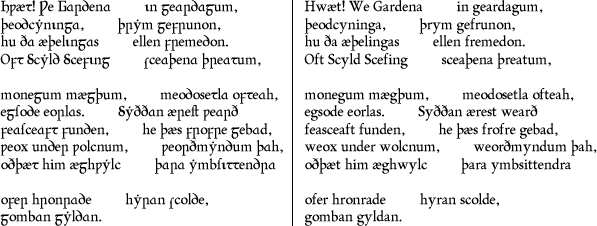
Beowolf old English from the link above.

Sample text in Old English (Prologue from Beowulf)

Old English sample text (Prologue from Beowulf)