Changing stroke rehab and research worldwide now.Time is Brain! trillions and trillions of neurons that DIE each day because there are NO effective hyperacute therapies besides tPA(only 12% effective). I have 523 posts on hyperacute therapy, enough for researchers to spend decades proving them out. These are my personal ideas and blog on stroke rehabilitation and stroke research. Do not attempt any of these without checking with your medical provider. Unless you join me in agitating, when you need these therapies they won't be there.

What this blog is for:

My blog is not to help survivors recover, it is to have the 10 million yearly stroke survivors light fires underneath their doctors, stroke hospitals and stroke researchers to get stroke solved. 100% recovery. The stroke medical world is completely failing at that goal, they don't even have it as a goal. Shortly after getting out of the hospital and getting NO information on the process or protocols of stroke rehabilitation and recovery I started searching on the internet and found that no other survivor received useful information. This is an attempt to cover all stroke rehabilitation information that should be readily available to survivors so they can talk with informed knowledge to their medical staff. It lays out what needs to be done to get stroke survivors closer to 100% recovery. It's quite disgusting that this information is not available from every stroke association and doctors group.

Showing posts with label milli-spinner thrombectomy. Show all posts

Wednesday, September 24, 2025

New Device Destroys Blood Clots By Shrinking Them And Setting Red Blood Cells Free, Leading To Much Higher Stroke Survival Rates


Success is 100% recovery NOT REPERFUSION! When you have the wrong objective, you'll never get to survivor requirements of 100% recovery! The only goal in stroke is 100% recovery and you aren't working on that! 

Does this get it done in 3 minutes? In this research in mice the needed time frame for tPA delivery is 3 minutes for full recovery.

Electrical 'storms' and 'flash floods' drown the brain after a stroke

New Device Destroys Blood Clots By Shrinking Them And Setting Red Blood Cells Free, Leading To Much Higher Stroke Survival Rates

According to the World Stroke Organization, one in four adults will have a stroke at some point in their lifetime.
Worldwide, this adds up to 12.2 million strokes every year – and 6.5 million of those people will die as a result of their stroke.

For those who survive, some have life-changing consequences, including disability, struggles with speech and eating, and more. According to the charity, at least 101 million people are living with the after-effects of strokes worldwide, largely as a result of the difficulty of treating strokes before they have lifelong impacts on the patient.

That’s because strokes – in this case ischemic strokes, in which a blood clot prevents oxygen from flowing to the brain – can cause damage to the brain and the body in even a short space of time, meaning that doctors are in a race against the clock to remove the clot as quickly as possible.

Due to the difficulties of invasive procedures on the brain and the limitations of current technology, all too often doctors struggle to remove the clots, either in full or at all, leading to serious long-term consequences, and even the death of the patient.

However, thanks to newly developed technology from Stanford University School of Engineering, the sorry statistics could very soon be a thing of the past, with more patients seeing their clots removed fully and quickly than ever before, therefore saving their lives and preventing, or at least reducing the severity of lifelong symptoms.

The new device, a tiny robot called the milli-spinner, could soon be used in a procedure known as milli-spinner thrombectomy, thanks to its proven capacity to remove blood clots more efficiently and effectively than existing technology, with the team’s impressive results recently published in the journal Nature.

In fact, its success rate is staggering, as the study’s co-author – Stanford’s Jeremy Heit – explained in a statement:

“For most cases, we’re more than doubling the efficacy of current technology, and for the toughest clots – which we’re only removing about 11% of the time with current devices – we’re getting the artery open on the first try 90% of the time. It’s unbelievable. This is a sea-change technology that will drastically improve our ability to help people.”

While the current technology sucks out blood clots from an artery, the success rate simply isn’t high enough due to the lack of precision of existing methods, meaning that sometimes clots get broken up instead of totally sucked out, leaving them to roam the body and potentially cause further serious consequences.

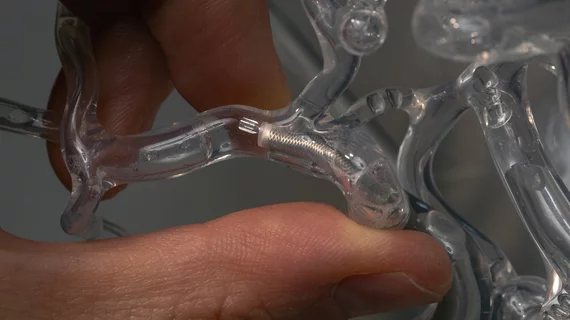
The milli-spinner, however, first works on making the clot smaller before it is sucked out, to ensure total removal. This takes advantage of the clot’s composition, in which fibrous strands tangle red blood cells together.
By spinning the clot rapidly, the researchers found that they are able to compress the fibers into a small ball (up to 5% of its initial size) to easily extract, whilst releasing the trapped red blood cells back into the body, as they explain in the statement:

“Imagine a loose ball of cotton fibers (or a handful of long hair pulled from a hairbrush, if you’d prefer). If you press it between your palms (compression) and rub your hands together in a circle (shear), the fibers will become increasingly tangled into a smaller, denser ball. The milli-spinner is able to do this same thing to the fibrin threads in a clot, using suction to compress the clot against the end of the tube and rapidly spinning to create the necessary shear.”

And as the paper’s senior author Renee Zhao continued, this change is significant in the ability to treat patients efficiently, so that their brain cells can have their oxygen flow returned as quickly as possible:

“With existing technology, there’s no way to reduce the size of the clot. They rely on deforming and rupturing the clot to remove it. What’s unique about the milli-spinner is that it applies compression and shear forces to shrink the entire clot, dramatically reducing the volume without causing rupture. It works so well, for a wide range of clot compositions and sizes. Even for tough, fibrin-rich clots, which are impossible to treat with current technologies, our milli-spinner can treat them using this simple yet powerful mechanics concept to densify the fibrin network and shrink the clot.”

Thanks to its incredible success in testing, the research team are hoping to get the milli-spinner rolled out into clinical settings as soon as possible. They’re also experimenting with free-swimming milli-spinners that could work in the body without the use of a catheter, as well as possibilities for the technology to aid other conditions including kidney stones.

And with the technology constantly developing, these tiny robots could one day be saving your life too.

Wednesday, June 18, 2025

Tiny clot-busting robots could transform care for stroke and heart attack patients

 Your competent? doctor has been using these earlier techniques and knows about them, right? NO? So, you DON'T have a functioning stroke doctor, do you?
  • clot busting treatment (1 post to May 2016)
  • clot removal (5 posts to September 2016)
  • clot retrieval (2 posts to June 2021)
  • Do you prefer your doctor and hospital incompetence NOT KNOWING? OR NOT DOING?

    Tiny clot-busting robots could transform care for stroke and heart attack patients


    Researchers with Stanford University have developed tiny robots capable of swimming through a patient’s vascular system and removing blood clots. The new technology, called milli-spinner thrombectomy, could potentially be used to treat strokes, heart attacks, pulmonary embolisms and other clot-related cardiovascular conditions.

    “For most cases, we’re more than doubling the efficacy of current technology, and for the toughest clots—which we’re only removing about 11% of the time with current devices—we’re getting the artery open on the first try 90% of the time,” Jeremy Heit, MD, PhD, chief of neuroimaging and neurointervention at Stanford and an associate professor of radiology, explained in a statement. “It’s unbelievable. This is a sea-change technology that will drastically improve our ability to help people.”

    Heit is the co-author of a new analysis focused on this state-of-the-art technology. Published in Nature, the research explored the impact of these tiny robots in both flow models and animal studies.[1]

    “The milli-spinner thrombectomy directly modifies the clot microstructure to facilitate clot removal, improving mechanical thrombectomy success rates compared with current methods that rely on clot rupture or cutting,” the study’s authors concluded. “This approach offers a promising new direction for mechanical thrombectomy devices, especially for treating ischemic stroke, pulmonary embolism and peripheral thrombosis.”

    A brand new way to target blood clots

    Milli-spinner thrombectomy is a continuation of the work of Renee Zhao, PhD, an assistant professor of mechanical engineering at Stanford and senior author of the Nature study. Zhao’s previous research with these robots was primarily focused on dispensing medicine. The spinning hollow structure of the robots, with their tiny fins and slits, were originally intended to be used as a propulsion mechanism. However, Zhao and her team noted that the structures were also providing localized suction that could be used to help eliminate blood clots in a fast, effective manner.

    Renee Zhao, PhD, from Stanford University

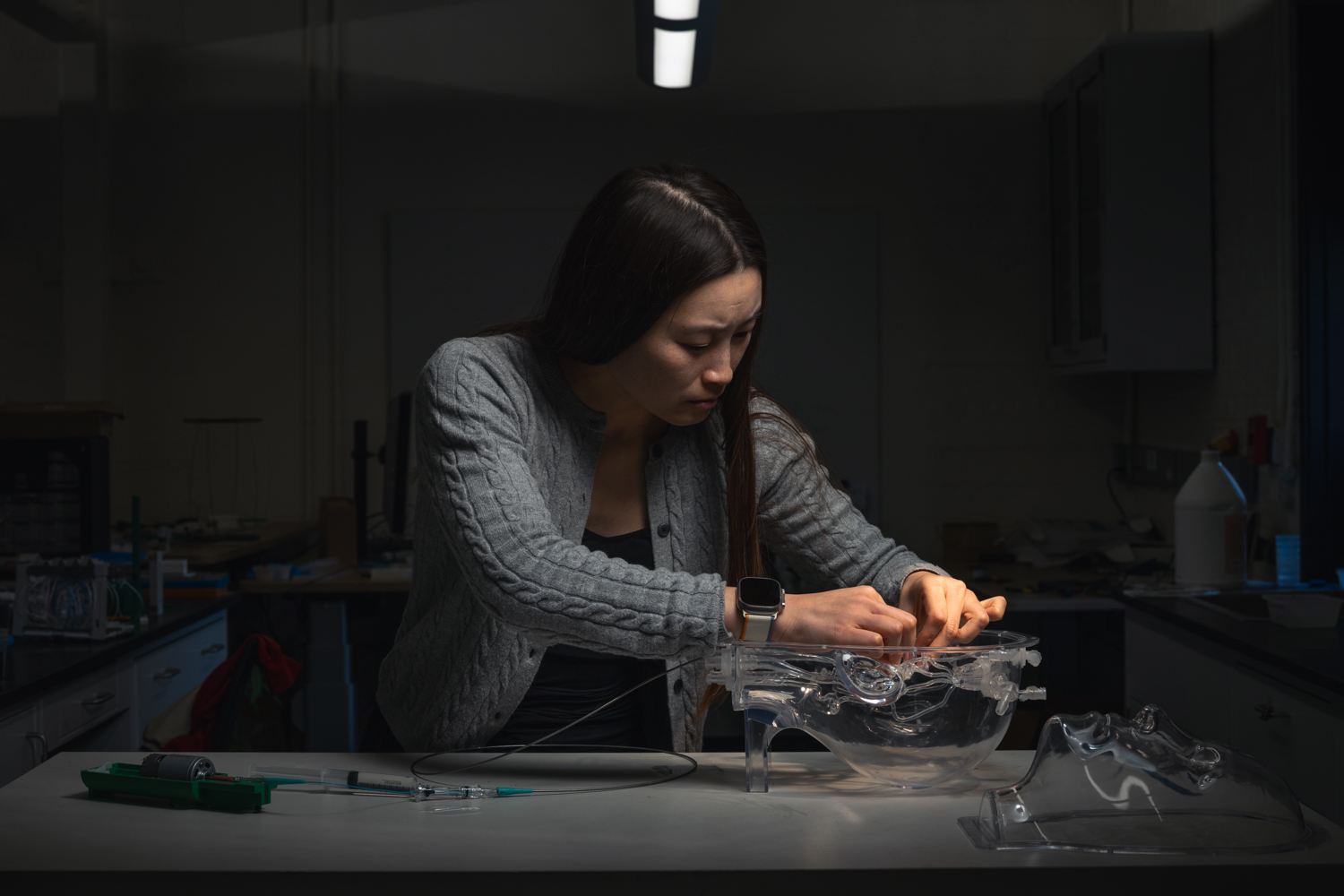
    Renee Zhao, PhD, working on her milli-spinner thrombectomy technology. Image courtesy of Andrew Brodhead/Stanford University.

    “At first, we simply wondered whether this suction could help remove a blood clot,” Zhao said in the same statement. “But when we tested the spinner on a clot, we observed a striking clot color change, from red to white, along with a dramatic reduction in volume. Honestly, it felt like magic. We didn’t fully understand the mechanism at the time.”

    For the current version of this technology, clinicians deliver the tiny robot to its intended location with a catheter and then it remains in one location. However, researchers are also exploring the possibility of an “untethered version” of the milli-spinner that could freely move through the vascular system.

    There is also hope that this same technique could go beyond busting blood clots and be used to remove kidney stone fragments.

    “We’re exploring other biomedical applications for the milli-spinner design, and even possibilities beyond medicine,” Zhao explained. “There are some very exciting opportunities ahead.”

    This technology is still under development. More research will still be required before it gains FDA approval.

    Click here to read the Nature study. In addition, Stanford has produced a video about this breakthrough that is now available online.

    Monday, June 9, 2025

    New technique improve success rates in treating strokes and other clot-related diseases

     Success is 100% recovery NOT REPERFUSION! When you have the wrong objective, you'll never get to survivor requirements of 100% recovery! The only goal in stroke is 100% recovery and you blithering idiots don't know that!

    New technique improve success rates in treating strokes and other clot-related diseases

    When treating an ischemic stroke – where a clot is blocking the flow of oxygen to the brain – every minute counts. The more quickly doctors can remove the clot and restore blood flow, the more brain cells will survive, and the more likely patients are to have a good outcome. But current technologies only successfully remove clots on the first try about 50% of the time, and in about 15% of cases, they fail completely.

    Researchers at Stanford Engineering have developed a new technique called the milli-spinner thrombectomy that could significantly improve success rates in treating strokes, as well as heart attacks, pulmonary embolisms, and other clot-related diseases. In a paper published June 4 in Nature, the researchers used both flow models and animal studies to show that the milli-spinner significantly outperforms available treatments and offers a new approach for fast, easy, and complete clot removal.

    For most cases, we're more than doubling the efficacy of current technology, and for the toughest clots – which we're only removing about 11% of the time with current devices – we're getting the artery open on the first try 90% of the time. It's unbelievable. This is a sea-change technology that will drastically improve our ability to help people."

    Jeremy Heit, co-author, chief of Neuroimaging and Neurointervention at Stanford and an associate professor of radiology

    Taking advantage of tangles

    Blood clots are held together by tangles of fibrin, a tough, thread-like protein that traps red blood cells and other material to form a sticky clump. Typically, doctors try to remove them by inserting a catheter into the artery and either vacuuming up the clot or snaring it with wire mesh. But these methods don't always work and can snap the fibrin threads, causing pieces of the clot to break off and get lodged in new, harder to reach places.

    With existing technology, there's no way to reduce the size of the clot. They rely on deforming and rupturing the clot to remove it. What's unique about the milli-spinner is that it applies compression and shear forces to shrink the entire clot, dramatically reducing the volume without causing rupture."

     Renee Zhao, assistant professor of mechanical engineering and senior author on the paper

    The milli-spinner, which also reaches the clot through a catheter, consists of a long, hollow tube that can rotate rapidly, with a series of fins and slits that help create a localized suction near the clot. This applies two forces – compression and shear – to roll the fibrin threads into a tight ball without breaking them.

    Imagine a loose ball of cotton fibers (or a handful of long hair pulled from a hairbrush, if you'd prefer). If you press it between your palms (compression) and rub your hands together in a circle (shear), the fibers will become increasingly tangled into a smaller, denser ball. The milli-spinner is able to do this same thing to the fibrin threads in a clot, using suction to compress the clot against the end of the tube and rapidly spinning to create the necessary shear.

    Zhao and her colleagues showed that the milli-spinner could reduce a clot to as little as 5% of its original volume. The process shakes free the red blood cells, which move normally through the body once they aren't trapped in fibrin, and the now-tiny fibrin ball is sucked into the milli-spinner and out of the body.

    • Brought to you by Pfizer Medical Affairs, EM-USA-plb-0156

    "It works so well, for a wide range of clot compositions and sizes," Zhao said. "Even for tough, fibrin-rich clots, which are impossible to treat with current technologies, our milli-spinner can treat them using this simple yet powerful mechanics concept to densify the fibrin network and shrink the clot."

    A surprising success

    The milli-spinner design is an extension of Zhao's work on millirobots – tiny, origami-based robots built to swim through the body to dispense medicine or assist with diagnostics. The spinning hollow structure with fins and slits was intended as a propulsion mechanism, but when the researchers realized that it was also creating localized suction, they decided to see if it could have other uses as well.

    "At first, we simply wondered whether this suction could help remove a blood clot," Zhao said. "But when we tested the spinner on a clot, we observed a striking clot color change, from red to white, along with a dramatic reduction in volume. Honestly, it felt like magic. We didn't fully understand the mechanism at the time."

    Intrigued by this unexpected and unprecedented clot response, the researchers set out to uncover the underlying mechanism and then went through hundreds of design iterations to make the milli-spinner as efficient and effective as possible. But they haven't forgotten about its propulsion possibilities. Zhao and her colleagues are also working on an untethered version of the milli-spinner that could swim freely through blood vessels to target and treat clots.

    While they have focused on treating blood clots first, there are many other potential uses for the milli-spinner, Zhao said. She and her team are already working on using the milli-spinner's localized suction to capture and remove kidney stone fragments.

    "We're exploring other biomedical applications for the milli-spinner design, and even possibilities beyond medicine," Zhao said. "There are some very exciting opportunities ahead."

    Knowing the difference it could make for stroke patients and those with other blood clot-related diseases, Zhao, Heit, and their colleagues are hoping to get the milli-spinner thrombectomy approved for patient use as soon as possible. They have started a new company that licenses the technology from Stanford in order to develop and bring it to market, with clinical trials planned for the near future.

    "What makes this technology truly exciting is its unique mechanism to actively reshape and compact clots, rather than just extracting them," Zhao said. "We're working to bring this into clinical settings, where it could significantly boost the success rate of thrombectomy procedures and save patients' lives."

    Source:
    Journal reference:

    Chang, Y., et al. (2025). Milli-spinner thrombectomy. Nature. doi.org/10.1038/s41586-025-09049-0.

    Thursday, June 5, 2025

    Tiny clot-busting robots could transform care for stroke and heart attack patients


     Of course, your competent? doctor has been enabling research into nanobots for a long time already! NO? So, you don't have a functioning stroke doctor or hospital?

    Tiny clot-busting robots could transform care for stroke and heart attack patients

    Researchers with Stanford University have developed tiny robots capable of swimming through a patient’s vascular system and removing blood clots. The new technology, called milli-spinner thrombectomy, could potentially be used to treat strokes, heart attacks, pulmonary embolisms and other clot-related cardiovascular conditions.

    “For most cases, we’re more than doubling the efficacy of current technology, and for the toughest clots—which we’re only removing about 11% of the time with current devices—we’re getting the artery open on the first try 90% of the time,” Jeremy Heit, MD, PhD, chief of neuroimaging and neurointervention at Stanford and an associate professor of radiology, explained in a statement. “It’s unbelievable. This is a sea-change technology that will drastically improve our ability to help people.”

    Heit is the co-author of a new analysis focused on this state-of-the-art technology. Published in Nature, the research explored the impact of these tiny robots in both flow models and animal studies.[1]

    “The milli-spinner thrombectomy directly modifies the clot microstructure to facilitate clot removal, improving mechanical thrombectomy success rates compared with current methods that rely on clot rupture or cutting,” the study’s authors concluded. “This approach offers a promising new direction for mechanical thrombectomy devices, especially for treating ischemic stroke, pulmonary embolism and peripheral thrombosis.”

    A brand new way to target blood clots

    Milli-spinner thrombectomy is a continuation of the work of Renee Zhao, PhD, an assistant professor of mechanical engineering at Stanford and senior author of the Nature study. Zhao’s previous research with these robots was primarily focused on dispensing medicine. The spinning hollow structure of the robots, with their tiny fins and slits, were originally intended to be used as a propulsion mechanism. However, Zhao and her team noted that the structures were also providing localized suction that could be used to help eliminate blood clots in a fast, effective manner.

    Renee Zhao, PhD, from Stanford University

    Renee Zhao, PhD, working on her milli-spinner thrombectomy technology. Image courtesy of Andrew Brodhead/Stanford University.

    “At first, we simply wondered whether this suction could help remove a blood clot,” Zhao said in the same statement. “But when we tested the spinner on a clot, we observed a striking clot color change, from red to white, along with a dramatic reduction in volume. Honestly, it felt like magic. We didn’t fully understand the mechanism at the time.”

    For the current version of this technology, clinicians deliver the tiny robot to its intended location with a catheter and then it remains in one location. However, researchers are also exploring the possibility of an “untethered version” of the milli-spinner that could freely move through the vascular system.

    There is also hope that this same technique could go beyond busting blood clots and be used to remove kidney stone fragments.

    “We’re exploring other biomedical applications for the milli-spinner design, and even possibilities beyond medicine,” Zhao explained. “There are some very exciting opportunities ahead.”

    This technology is still under development. More research will still be required before it gains FDA approval.

    Click here to read the Nature study. In addition, Stanford has produced a video about this breakthrough that is now available online.