Use the labels in the right column to find what you want. Or you can go thru them one by one, there are only 34,365 posts. Searching is done in the search box in upper left corner. I blog on anything to do with stroke. DO NOT DO ANYTHING SUGGESTED HERE AS I AM NOT MEDICALLY TRAINED, YOUR DOCTOR IS, LISTEN TO THEM. BUT I BET THEY DON'T KNOW HOW TO GET YOU 100% RECOVERED. I DON'T EITHER BUT HAVE PLENTY OF QUESTIONS FOR YOUR DOCTOR TO ANSWER.
Changing stroke rehab and research worldwide now.Time is Brain!trillions and trillions of neuronsthatDIEeach day because there areNOeffective hyperacute therapies besides tPA(only 12% effective). I have 523 posts on hyperacute therapy, enough for researchers to spend decades proving them out. These are my personal ideas and blog on stroke rehabilitation and stroke research. Do not attempt any of these without checking with your medical provider. Unless you join me in agitating, when you need these therapies they won't be there.
What this blog is for:
My blog is not to help survivors recover, it is to have the 10 million yearly stroke survivors light fires underneath their doctors, stroke hospitals and stroke researchers to get stroke solved. 100% recovery. The stroke medical world is completely failing at that goal, they don't even have it as a goal. Shortly after getting out of the hospital and getting NO information on the process or protocols of stroke rehabilitation and recovery I started searching on the internet and found that no other survivor received useful information. This is an attempt to cover all stroke rehabilitation information that should be readily available to survivors so they can talk with informed knowledge to their medical staff. It lays out what needs to be done to get stroke survivors closer to 100% recovery. It's quite disgusting that this information is not available from every stroke association and doctors group.
Evidence
supporting the clinical use of neuroprotective drugs for cerebral
ischemia remains limited. Spatial and temporal disorientation, along
with cognitive dysfunction, are among the most prominent long-term
consequences of hippocampal neurodegeneration following cerebral
ischemia. Cannabigerol (CBG), a non-psychotomimetic constituent of
Cannabis sativa, has demonstrated neuroprotective effects in
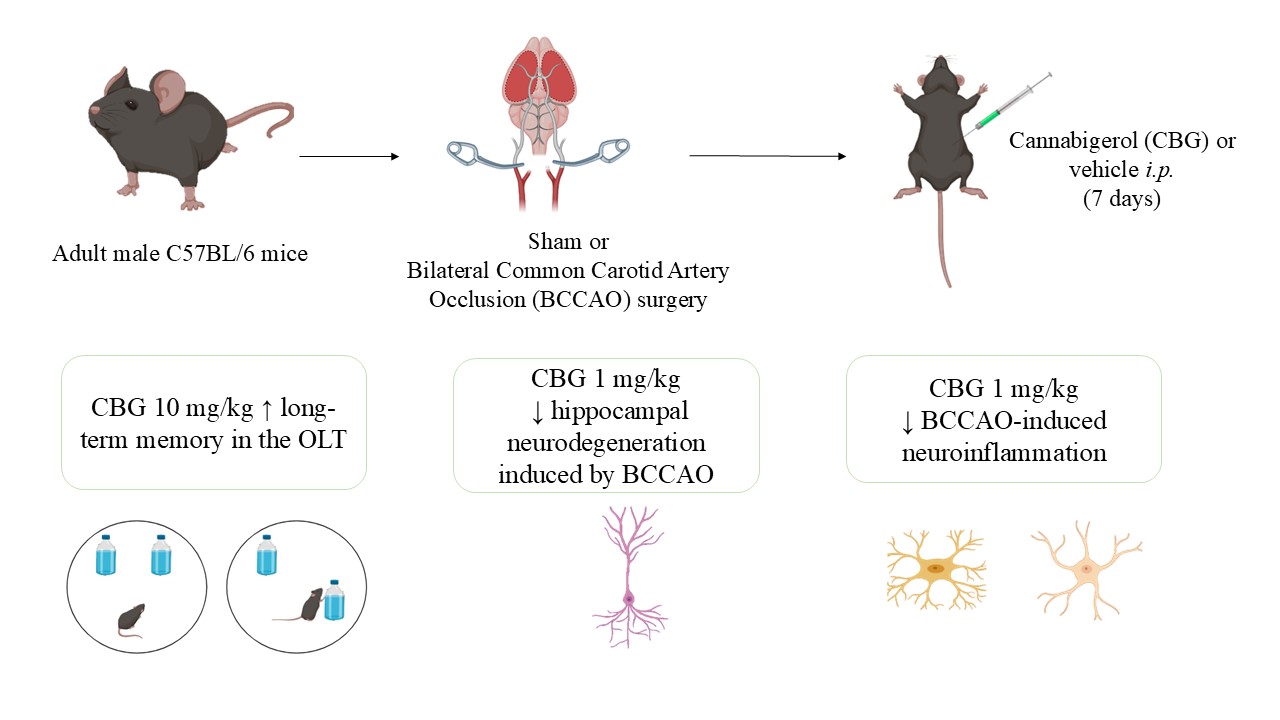
experimental models of cerebral injury. This study investigated the
neuroprotective mechanisms of CBG in mitigating memory impairments
caused by transient global cerebral ischemia in C57BL/6 mice using the
bilateral common carotid artery occlusion (BCCAO) model. Mice underwent
sham or BCCAO surgeries and received intraperitoneal (i.p.) injections
of either a vehicle or CBG (1, 5, or 10 mg/Kg), starting 1 h
post-surgery and continuing daily for 7 days. Spatial memory performance
and depression-like behaviors were assessed using the object location
test (OLT) and tail suspension test (TST), respectively. Additional
analyses examined neuronal degeneration, neuroinflammation, and neuronal
plasticity markers in the hippocampus. CBG attenuated ischemia-induced
memory deficits, reduced neuronal loss in the hippocampus, and enhanced
neuronal plasticity. These findings suggest that CBG’s neuroprotective
effects against BCCAO-induced memory impairments may be mediated by
reductions in neuroinflammation and modifications in neuroplasticity
within the hippocampus.
Copyright: This open access article is published under a Creative Commons CC BY 4.0 license, which permit the free download, distribution, and reuse, provided that the author and preprint are cited in any reuse
How soon will your competent? doctor prescribe this for you? Or are EXACT 100% RECOVERY PROTOCOLS already provided to you so you don't have massive anxiety about recovering from your stroke? So which is it? The correct way, solving the primary problem of 100% recovery? Or the half-assed method of treating the secondary problem of anxiety?
Summary: A new study shows that Cannabigerol (CBG)
significantly reduces anxiety without the intoxicating effects of THC.
The clinical trial found that 20 mg of CBG reduced anxiety and stress in
participants, with memory enhancement as an unexpected benefit. The
study highlights CBG’s potential as an alternative anxiety treatment.
Further research is needed to confirm these findings and explore
additional benefits.
Key Facts:
CBG significantly reduced anxiety and stress in a clinical trial.
CBG did not produce the intoxication or cognitive impairments associated with THC.
The study found CBG may enhance memory recall.
Source: Washington State University
A
lesser-known cannabinoid that is gaining in popularity Cannabigerol
(CBG) effectively reduced anxiety in a clinical trial without the
intoxication typically associated with whole plant cannabis. It may even
have some memory enhancing effects, according to a new study in Scientific Reports.
For the study, Carrie Cuttler, an associate professor of psychology
at Washington State University, and colleagues conducted the first human
clinical trial investigating the acute effects of CBG on anxiety,
stress and mood.
Contrary to expectations based on THC’s known effects on memory, CBG
significantly enhanced the ability to recall lists of words. Credit:
Neuroscience News
The
research revealed that 20 mg of hemp-derived CBG significantly reduced
feelings of anxiety at 20, 45 and 60 minutes after ingestion compared to
a placebo. Stress ratings also decreased at the first time point
compared to the placebo. The findings align with survey data from a
previous study led by Cuttler that indicated 51% of CBG users consume it
to decrease anxiety, with 78% asserting its superiority over
conventional anxiety medications.
“CBG is becoming increasingly popular, with more producers making
bold, unsubstantiated claims about its effects,” Cuttler said. “Our
study is one of the first to provide evidence supporting some of these
claims, helping to inform both consumers and the scientific community.”
For
the study, Cuttler’s team at WSU and colleagues at the University of
California, Los Angeles, conducted a double-blind, placebo-controlled,
experimental trial with 34 healthy cannabis users. The participants
completed two sessions over Zoom during which they provided baseline
ratings of their anxiety, stress and mood.
They then ingested
either 20 mg of hemp-derived CBG or a placebo tincture mailed to them
ahead of time. The participants then rerated their mood, stress, anxiety
and other variables such as feelings of intoxication and whether they
liked how the drug made them feel at three different time points
post-ingestion. Additionally, they reported on potential side effects
like dry eyes and mouth, increased appetite, heart palpitations and
sleepiness.
The sessions were repeated a week later with the
participants taking the alternate product prior to completing the same
assessments. The design ensured that neither the participants nor the
research assistants knew which product was administered.
One
of the most surprising outcomes was CBG’s effect on memory. Contrary to
expectations based on THC’s known effects on memory, CBG significantly
enhanced the ability to recall lists of words. Participants were able to
recall more words after taking 20 mg of CBG than after taking a
placebo.
“We triple-checked to ensure accuracy, and the enhancement was statistically significant,” Cuttler said.
Furthermore,
the study found that CBG did not produce cognitive or motor
impairments, or other adverse effects commonly associated with THC, the
psychoactive ingredient in cannabis. Participants in the experimental
group reported low intoxication ratings and minimal changes in symptoms
like dry mouth, sleepiness and appetite. Contrary to previous
self-report surveys where users touted CBG’s antidepressant effects, the
participants in the current study did not report significant mood
enhancement after taking CBG.
While the research is promising,
Cuttler cautions the results should be interpreted carefully due to the
study’s limitations. The use of experienced cannabis users, the modest
dose of CBG and the timing of assessments might have influenced the
findings. Additionally, the study’s remote nature, conducted via Zoom,
and lack of physiological measurements further constrain the
conclusions.
“We need to avoid
claims that CBG is a miracle drug. It’s new and exciting, but
replication and further research are crucial,” Cuttler said. “Ongoing
and future studies will help build a comprehensive understanding of
CBG’s benefits and safety, potentially offering a new avenue for
reducing feelings of anxiety and stress without the intoxicating effects
of THC.”
Moving forward, Cuttler and her team are designing a new clinical
trial to replicate their findings and include physiological measures
such as heart rate, blood pressure and cortisol levels. They also plan
to extend the research to non-cannabis users. Additionally, Cuttler is
planning a study on CBG’s effects on menopause symptoms in women.
About this anxiety, memory, and psychopharmacology research news
Author: Sara Zaske Source: Washington State University Contact: Sara Zaske – Washington State University Image: The image is credited to Neuroscience News