Use the labels in the right column to find what you want. Or you can go thru them one by one, there are only 34,102 posts. Searching is done in the search box in upper left corner. I blog on anything to do with stroke. DO NOT DO ANYTHING SUGGESTED HERE AS I AM NOT MEDICALLY TRAINED, YOUR DOCTOR IS, LISTEN TO THEM. BUT I BET THEY DON'T KNOW HOW TO GET YOU 100% RECOVERED. I DON'T EITHER BUT HAVE PLENTY OF QUESTIONS FOR YOUR DOCTOR TO ANSWER.
Changing stroke rehab and research worldwide now.Time is Brain!trillions and trillions of neuronsthatDIEeach day because there areNOeffective hyperacute therapies besides tPA(only 12% effective). I have 523 posts on hyperacute therapy, enough for researchers to spend decades proving them out. These are my personal ideas and blog on stroke rehabilitation and stroke research. Do not attempt any of these without checking with your medical provider. Unless you join me in agitating, when you need these therapies they won't be there.
What this blog is for:
My blog is not to help survivors recover, it is to have the 10 million yearly stroke survivors light fires underneath their doctors, stroke hospitals and stroke researchers to get stroke solved. 100% recovery. The stroke medical world is completely failing at that goal, they don't even have it as a goal. Shortly after getting out of the hospital and getting NO information on the process or protocols of stroke rehabilitation and recovery I started searching on the internet and found that no other survivor received useful information. This is an attempt to cover all stroke rehabilitation information that should be readily available to survivors so they can talk with informed knowledge to their medical staff. It lays out what needs to be done to get stroke survivors closer to 100% recovery. It's quite disgusting that this information is not available from every stroke association and doctors group.
Showing posts with label dementia prevention 19 ways. Show all posts
Showing posts with label dementia prevention 19 ways. Show all posts
Electronic health record and survey data on 184,367 Kaiser
Permanente Northern California participants (median age 69.5 years)
with no history of dementia were taken.
Cholesterol levels were measured within 2 years of survey completion.
TAKEAWAY:
There were 25,214 incident cases of dementia reported over an average follow-up of 8.77 years.
Dementia risk was significantly higher in people with low
HDL-C (11-41 mg/dL; adjusted hazard ratio [aHR], 1.07; 95% CI,
1.03-1.11) and high HDL-C (> 65 mg/dL; aHR, 1.15; 95% CI, 1.11-1.20).
The study demonstrates an association between low and high levels of "good" cholesterol but not a causal link.
There was no significant association between LDL-C and dementia risk.
IN PRACTICE:
"These
results support the conclusion that some lipoproteins may be modifiable
risk factors for dementia, even in late life," the authors write.
SOURCE:
The study was
conducted by Erin L. Ferguson, MPH, Department of Epidemiology &
Biostatistics, University of California, San Francisco, California, and
was funded by the National Institutes of Health. It was published online October 4, 2023 in Neurology.
LIMITATIONS:
There were no adjustments for APOE status and confounding and selection bias.
This feature is powered by text-to-speech technology. Want to see it on more articles? Give your feedback below or email audiofeedback@wsj.com.
Put down that brain teaser you torture yourself with and get your
hearing tested. If you are interested in preserving brain function as
you age, some of the clearest benefits come from staying socially
connected, scientists have found.
That means getting a hearing
aid if you can’t hear what people around you are saying. People with
untreated hearing loss have a 90% higher rate of dementia than others in
their age group, according to the 2020 report of the Lancet commission on dementia prevention, intervention, and care.
As America grays, seniors are looking
for answers to make sure their cognitive abilities don’t expire before
they do. They are told they should eat a Mediterranean diet. Get enough sleep. Avoid stress. Walk 10,000 steps a day. Lose weight.
Which one of those things actually helps? Probably all of them. Barron’s has
been talking to brain scientists to learn what the research tells us
about maintaining brain function. There is no one thing that protects
against dementia, they tell us.
“It’s
everything,” says cognitive neuroscientist Denise Park, who runs the
Park Aging Brain Laboratory at the University of Texas at Dallas. “There
are hundreds of skills that people possess, and you lose a lot of them
if you don’t just interact with other people but with your environment.”
Park,
71 herself, makes a conscious effort to keep her brain working all the
time. “Even when I wait in line, I pull out my phone and play computer
games,” she says. “I never have an idle moment ever.”
Little
wonder that so many seniors are obsessed with avoiding dementia. Brain
health is key for both happiness in retirement and, to a large degree,
financial security. “There is real evidence that people over 50 worry
the most about dementia and beginning to lose their memory,” says Gill
Livingston, the University College London psychiatry professor who led
the Lancet commission on dementia. “It’s financial but it’s also very
individual.”
Asked
what she does to protect her own brain, Livingston replied that she
lifts weights, tries to walk 10,000 steps a day, drinks moderately and
watches her blood pressure. The 63-year-old also had her hearing tested,
found hearing loss that she wasn’t aware of, and now uses hearing aids.
The
modern world places a premium on remaining lucid. The advent of 401(k)
savings plans over the past 40 years has transformed all of us into our
own pension plan managers. Whereas our parents and grandparents simply
waited for the pension check to arrive each month, now we must make
complex investing decisions on our own.
Brain health is also a key for delaying—or avoiding altogether—the
need for a nursing home, which can help preserve a retirement nest egg.
William Bernstein, a former neurologist who became a financial author
and money manager, says some mental slowing is inevitable as we age. He
recommends simplifying your finances and going over your investment
strategy with your children so they can take over if need be.
“There’s a good chance you won’t be as cognitively intact and you ought to make provisions for that,” says Bernstein.
The
Lancet Commission combined research around the world with its own
research and found 12 modifiable risk factors that in aggregate account
for 40% of dementias. Some are behaviors or conditions long associated
with health problems such as smoking, heavy drinking, or diabetes.
Others
are more surprising. It turns out higher education levels early in life
appear to protect against dementia later in life, research found.
Working helps protect against dementia by keeping our brains engaged,
scientists observed. The Lancet report noted that countries with lower
retirement ages had higher dementia rates.
Why might education
and work be protective? Livingston of the Lancet Commission says
challenging intellectual activity creates a brain with denser
connections that allow it to keep functioning even with the inevitable
deterioration that comes with age or disease. This capacity was called
“cognitive reserve” in this paper
by neuropsychologist Yaakov Stern of Columbia University. “If you have
cognitive reserve, you are more likely to survive without developing
dementia,” Livingston explains. “We think education in itself
strengthens the brain. It makes it more resilient.”
Controlling
hypertension is another key in protecting your brain. High blood
pressure can cause tears in the white matter of the brain over time,
says Park, the UT Dallas neuroscientist. “If you get enough of those
tears, you will have trouble transferring signals to the cortex of the
brain,” she says. In essence, your brain will work less well.
Arterial
disease also puts you at greater risk of stroke. “You can have a large
number of smaller strokes, some of which you’re not even aware of and
the cumulative effect is substantial cognitive decline that impairs your
daily life,” said Thad Polk, a University of Michigan professor and
cognitive neuroscientist who wrote “The Aging Brain” for The Great
Courses.
The
Lancet Commission found that middle-aged people who have systolic blood
pressure more than 130 have a 60% greater chance of developing dementia
down the road.
“What is good for your heart is good for your
brain,” says Polk. He says numerous studies have found that exercise is
one of the best things you can do to protect your brain.
But when
it comes to the brain, physical health factors aren’t the entire story.
A number of studies found that people who care for someone with
dementia are more likely to get dementia themselves. Why? The answer
appears to be that the stress of caring for someone alters their brains
in ways that make it more vulnerable to dementia.
Zachary
Cordner, an assistant professor of psychiatry at Johns Hopkins, has run
tests on mice where he purposely stressed the rodents and found their
brains changed. Mice, like humans, are normally social creatures. In one
experiment, researchers would isolate a mouse all day to impose one
sort of stress, and then expose it to an aggressive “bully” mouse to
oppose another type of stress.
When they examined the mice’s
brains, they found changes in the regions of the brain involved in
learning and memory as well as mood, anxiety, and social interactions.“
It’s clear these chronic stress exposures alter the stress system in the
brain,” Cordner says.
As the human brain ages, it changes.
Research has found that an older brain processes information more
slowly. Seniors often have declining episodic memory, which is why they
have more trouble remembering where they put the keys. (Although the
66-year-old reporter writing this article can attest he had trouble
remembering where he put them even when young.) Older people have more
trouble mastering large bodies of new facts, even as they may remember a
familiar set of facts in sharp detail.
Newsletter Sign-up
Retirement
Barron’s brings retirement planning and advice to you in a weekly wrap-up of our articles about preparing for life after work.
SUBSCRIBE
None of this mean our brains stop working. To the contrary, an older
person with a specialized skill or knowledge set may retain that to the
end of their days. What their brain loses in processing power may be
offset by increased experience in the world.
And what about those
brain teasers mentioned at the beginning of this article? “The issue
with brain games is there is good evidence you will improve at the brain
games,” says Polk of the University of Michigan. “There’s not good
evidence that will generalize to other areas of cognition.”
He
goes on: “There is nothing wrong with playing these games. But there
might be better ways to spend your time if your goal is brain health.”
Sahakian
says she has reduced her coffee since a study published in the journal
Cerebral Cortex last year showed it was associated with reduced grey
matter in the cerebral cortex - David Rose
Barbara
Sahakian, an expert in grey matter from the University of Cambridge,
describes the lifestyle habits she employs to keep brain deterioration
at bay.
Breakfast
I like getting up early when it is quiet and listening to the birdsong while I drink my coffee.
I
used to drink more coffee, but have cut down my intake since our study,
published in the journal Cerebral Cortex last year, showed that coffee
was associated with reduced grey matter in the cerebral cortex.
Our
findings also highlighted the importance of a “cereal” breakfast for
reducing the risk of Alzheimer’s disease. So I have muesli cereal, with
no added sugar, for breakfast every day.
Learning
Sarakian regularly visits museums and is looking forward to an exhibition at the V&A this spring - Sam Mellish
Recently,
I co-wrote an article for The Lancet called "Use It or Lose It”. In
essence, in order to keep your brain functioning at its best, you need
to drive its neural networks through cognitive activities, including
learning new things. We hear a lot about how learning a language or
musical instrument can build cognitive reserve but actually learning
anything new will have benefits. Different areas of the brain will be
activated during different kinds of learning, be it music, a foreign
language or motor skills such as cycling.
Fortunately, I keep my mind active through my research work and teaching.
I
learn a lot when I travel, too. I like to read about the cities I’m
staying in, as well as their history and culture. I’ll visit art,
history, textile and fashion museums. When I was in Chengdu, I was taken
to see the bronze masks discussed so brilliantly on TV by Simon Schama,
and I’m looking forward to seeing the exhibition "Hallyu! The Korean
Wave" at the Victoria and Albert Museum this April.
Lunch
I’ll
often have tuna fish sandwiches or zero per cent fat yoghurt and fruit.
Oily fish provides omega-3 fatty acids which have anti-inflammatory and
neuroprotective effects. I always have several different kinds of
fruit in the house, my favourite being blueberry. Oxidative stress has
been identified as a major factor in diseases including Alzheimer’s, and
these berries are high in antioxidants that prevent oxidative damage to
cells.
Meanwhile, Vitamin C, which is found in most citrus
fruits, is thought to have a therapeutic role in a number of diseases,
including ischemic stroke, Alzheimer's disease, Parkinson's disease and
Huntington's disease.
Exercise
Sahakian swears by the power of a brisk daily walk - Kevin Dodge
I
get out every day for a brisk, one hour walk. Exercising is vital for
your physical health, brain health, cognition and mood. It actually
increases neurogenesis in the brain (the creation of new brain cells),
including in the hippocampus, which is an important area involved in
learning and memory.
When I walk, I usually practise mindfulness
and stay in the moment, listening to birds and appreciating the natural
world around me. If I have a difficult problem to solve, I often find my
mind is clearer and my decision-making improved after a fast, long
walk. The key is to do exercise that you enjoy, so you will be sure to
stick with it.
Supper
For dinner I often have chicken and dark green vegetables, which are important for brain health, due to the protective effects of vitamin K and other nutrients. I like Indian-style vegetables and South Korean kimchi rice.
Socialising
Our
study, published in Neurology last year, showed that socially isolated
individuals had a higher risk of developing dementia. Keeping socially
connected is good for your brain, cognition, wellbeing and mental
health, so it’s really important to keep in touch with family and
friends. I meet mine at restaurants, theatres and museums or, on sunny
days, just to go on long walks together.
Sleep
Seven hours of sleep is the optimal amount, says Sahakian - iStockphoto
Our
study, published in Nature Aging in 2022, showed that seven hours of
sleep is ideal in middle and old age, for cognition and mental health.
The brain recharges itself and stores memories during sleep, as well as
removing toxic waste by-products and boosting the immune system.
Sleeping four hours or less increases your risk of death, but sleeping
more than seven probably means that you have had poor quality or
disrupted sleep. So I try to get those seven hours each night.
It
is important to be relaxed and not stressed when you get into bed, so I
try to not work or watch thrillers immediately before sleep. I like
reading, but if my work has already required me to read for much of the
day, then I’ll usually relax and watch something light on TV - a comedy
or romantic comedy.
To some extent, how much screen time is
beneficial or detrimental to your brain will depend on what you are
watching. For example, some nature or history programmes can be very
educational, but there's no harm in switching off occasionally.
At
bedtime I make sure my bedroom is dark and quiet, and the room
temperature is right for me and my bed comfortable. It also helps,
sometimes, to think of a relaxing event when falling asleep. I might
drift off thinking of how I felt when lying on a beautiful beach in the
sun, watching the ocean and listening to the sound of the waves.
To
explore the effects of a multicomponent training (MT) physical exercise
intervention in the cognitive function, neuropsychiatric symptoms, and
quality of life of older adults with major neurocognitive disorder
(NCD).
Methods
Quasi-experimental
controlled trial. Thirty-six individuals (25 female) were equally
distributed to an exercise group (aged 74.33 ± 5.87 years) or a control
group (aged 81.83 ± 6.18 years). The Alzheimer’s Disease Assessment
Scale – Cognitive (ADAS-Cog), the Neuropsychiatric Inventory (NPI) and
the Quality of Life – Alzheimer’s Disease (QoL-AD) tests were performed
before and after the intervention.
Results
There was no clear interaction effect factor of intervention on ADAS-Cog (B = 1.33, 95% CI: -2.61 – 5.28, P = .513), NPI (B = −8.35, 95% CI: −18.48 – 1.72, P = .115), and QoL-AD (B = 2.87, 95% CI: .01 – 5.73, P = .058).
Conclusions
The
6-month MT physical exercise intervention did not present evidence of
slowing down cognitive decline neither improving neuropsychiatric
symptomatology, and quality of life of older adults with major NCD.
Future studies with larger samples are needed to better understand the
impact of physical exercise interventions using MT methodology on
specific cognitive abilities, neuropsychiatric symptoms, and quality of
life domains.
Background
Along
with the decline in cognitive function that characterizes a
neurocognitive disorder (NCD), individuals may suffer from the
progressive severity of behavioral and psychological symptoms (e.g.,
agitation, apathy, anxiety, hallucinations, eating disorders, nighttime
behaviors) that often lead to a lower quality of life.1
Physical exercise, as a promising non-pharmacological therapeutical approach within dementia care2-4 is regularly recommended given its potential positive effects on cognitive function,5-9 neuropsychiatric symptomatology,10,11 and quality of life12 of individuals with major NCD.
However,
according to previous systematic reviews and meta-analytic studies, it
remains unclear whether physical exercise might slow down the decline of
global cognition or improve specific cognitive domains (i.e., executive
functions, complex attention, memory, among other abilities).13-16 Similarly, the role of physical exercise on alleviating challenging behaviours and mood disturbances is still limited17-20 particularly in what regards other symptoms rather than depression.16,21,22
Also, there’s still insufficient and inconsistent data on the
effectiveness of well-promising physical exercise interventions on
quality of life.23-26
Multicomponent training (MT) (i.e., a combination of balance, strength, aerobic, gait and physical function training)27 has been recently recommended for older adults with Alzheimer’s disease2,28,29
and would seem advisable to individuals with major NCD due to other
etiological conditions (e.g., vascular disease). Nevertheless, despite
its positive influence on functional capacity,30,31
few studies have focused on its effects on psychosocial outcomes. This
study aims to explore the contribution of a 6-month community-based MT
physical exercise intervention on the cognitive function,
neuropsychiatric symptomatology, and quality of life of older adults
diagnosed with major NCD.
The WHO Guidelines on risk reduction of cognitive decline and dementia provide
evidence-based recommendations on lifestyle behaviours and
interventions to delay or prevent cognitive decline and dementia.
Worldwide,
around 50 million people have dementia and, with one new case every
three seconds, the number of people with dementia is set to triple by
2050. The increasing numbers of people with dementia, its significant
social and economic impact and lack of curative treatment, make it
imperative for countries to focus on reducing modifiable risk factors
for dementia. Action area 3 of the Global action plan on the public health response to dementia 2017–2025 is risk reduction.
These
WHO Guidelines are an important tool for health care providers as well
as governments, policy-makers and other stakeholders to strengthen their
response to the dementia challenge.
Really? You give us nothing factual about treatments after early detection. I'm going to be doing my own thing, which you shouldn't do since I'm not medically trained.
May
8—As soon as Carolyn Perrygo noticed small signs that her husband
John's memory was slipping back in 2010, they were sitting in a doctor's
office, charting a path forward.
Four years later, through a
clinical trial, John Perrygo was diagnosed with Alzheimer's disease
thanks to a positron emission tomography scan (PET) that wasn't yet
available to the general public.
The Perrygos are both retired and
longtime residents of Hagerstown. Carolyn previously worked as a
counselor and has an extensive background in the social sciences. So,
she may have recognized some of the smaller warning signs with her
husband faster than others.
"We weren't going to put our head in the sand on this," Carolyn Perrygo said. "There is no cure."
More
than a century after it was first discovered, early detection remains
the best defense against Alzheimer's and dementia. There is no cure, and
the four drugs to treat it that have survived the Food and Drug
Administration's stringent approval process are only moderately
effective against it, according to Dr. Marilyn Albert, a professor of
neurology at Johns Hopkins and director of the Division of Cognitive
Neuroscience.
However, with early detection, the disease can be treated sooner, and the chances for a better outcome increase.
Alzheimer's is a neurodegenrative disease that is both the most common type of and the leading cause of dementia.
It
often takes decades to develop and, thus, is a disease inextricably
linked with age. By age 85, you are five times more likely to develop
Alzheimer's than you were at 65, according Albert.
"The population is getting older. More and more people are living to that age," she said. "So, more people are at risk."
Alzheimer's
is believed to occur when an abnormal buildup of proteins called
amyloid and tau forms in and around brain cells, Albert said.
While
a lot is known about the disease, treating is is very complicated
because, as Albert put it, it's very difficult to get things in and out
of the brain since it has such a strong protective layer around it. It
requires high doses of strong medication that come with a lot of side
effects that Albert said "are not good."
The last drug to receive FDA approval to treat Alzheimer's was Namenda in 2003.
"Since
then, there have been hundreds of clinical trials looking for
medication. So far, none of the trials have been successful," Albert
said.
There is a lot of funding behind finding that elusive cure.
The federal government directed an additional $300 million to the
National Institutes of Health in the last fiscal year to combat
Alzheimer's, bringing the overall federal price tag of the effort to
$3.1 billion, U.S. Sen. Chris Van Hollen (D-Md), recently told a
community forum the Alzheimer's Association conducted virtually for
residents of Frederick and Washington counties.
"I am optimistic,"
Albert said. "We have learned so much about the disease. Now, we are
finally getting the resources to learn more."
When John Perrygo,
76, would get to the end of the driveway and not know which way to go to
the grocery store or other familiar locations, Carolyn knew that
something was wrong, and something needed to be done.
Since his
diagnosis, the Perrygos have tried to live as normally as possible, and
they plan to resume their ambitious traveling schedule as soon as
coronavirus restrictions allow for it.
"We don't slow down," Carolyn said. "We are not going to let this thing change us, unless it requires us to change."
John
has had to give up driving, which was very difficult for him. But he
maintains an active social life and has not lost his sense of humor. He
beat bladder cancer 55 years ago, and feels he can defeat this as well.
"I
have Alzheimer's. I didn't do anything wrong to get it. And I don't
hide it," he said. "Instead, I tell everyone I know or meet. And then
they are aware that I may not remember things we have discussed. Being
open also helps counteract the stigma about it and may help someone else
get the help that they need."
He continued, "What is living with
Alzheimer's like? It's challenging. There is a lot of frustration with
not remembering, mostly the little things. And occasionally it makes me
sad because it doesn't allow me to do all that I would want to do ...
Those realities make me sad. But it passes ... Things can only get so
bad, and I realize how grateful I am to be here."
Credit: Photo by veeterzy on Unsplash https://unsplash.com/@veeterzy
A new report has estimated that the
number of dementia cases worldwide could be reduced by 40% if 12 risk
factors for the condition could be completely eliminated. The Lancet Commission Report has
included excessive alcohol use, traumatic brain injury (TBI) and
pollution as three new risk factors in its updated model for dementia
risk. The report, supported by Alzheimer’s Research UK, is published
today (Thursday 31 July) at the Alzheimer’s Association International
Conference 2020.
The team of 28 dementia experts from the UK and
wider afield brought together existing evidence from a range of studies
and modelled their likely impact on prevalence of the condition.
The report follows on from a previous commission in 2017,
which modelled the impact of nine dementia risk factors and is the most
comprehensive overview of research into dementia prevention, diagnosis,
treatment and care to date.
The researchers looked at the
potential impact of eliminating risk factors for dementia, including
established risks such as hypertension, obesity, smoking, physical
inactivity, diabetes, depression, and lack of education in early life.
As
well as outlining established risk factors for dementia, their report
also looked at studies investigating sleep as a potential risk factor,
but found there was not enough comprehensive evidence to definitively
link sleep to dementia risk.
The results suggest that if it were
possible to eliminate all 12 potentially modifiable risk factors, the
number of people living with dementia could be reduced by up to 40%. The
report identified that the three risk factors with the largest
potential impact were hearing loss, low education in early life, and
smoking.
What are the 12 risk factors?
A previous commission, in 2017, listed nine risk factors:
Less education
Hypertension
Hearing impairment
Smoking
Obesity
Depression
Physical inactivity
Diabetes
Low social contact
This new commission adds a further three:
Excessive alcohol consumption
Traumatic brain injury
Air pollution
Currently,
an estimated 50 million people are living with dementia across the
globe, including nearly 1m in the UK, with those numbers expected to
rise as populations age across the globe.
The findings highlight
the broad potential for risk reduction to lower the impact of dementia
across the population, but do not calculate individual risk. While
people can take steps to help limit their individual risk of dementia, a
person’s age and genetics also contribute to their risk, and even
people who are able to avoid all of these lifestyle risk factors can
still develop the condition.
Dr Rosa Sancho,
Head of Research at Alzheimer’s Research UK, the UK’s leading dementia
research charity, said:“This collaborative report from dementia experts
across the world highlights a number of potentially modifiable risk
factors for dementia throughout a person’s life. Research is constantly
uncovering more about dementia and this is the most comprehensive
overview into dementia risk to date, building on previous work by this
commission and moving our understanding forward.
“As new studies
continue to develop the evidence base on dementia risk, the report has
identified three new risk factors for dementia. More evidence on the
complex topic of sleep is needed before we can make a judgement on its
impact on dementia risk, but we hope this report will act as a catalyst
for further research.
“With no treatments yet able to slow or
stop the onset of dementia, taking action to reduce these risks is an
important part of our strategy for tackling the condition. Prevention
strategies must be underpinned by robust evidence and while our
understanding of dementia risk is growing, there is still much we need
to know about the different risk factors for dementia.
“This
report underlines the importance of acting at a personal and policy
level to reduce dementia risk. With Alzheimer’s Research UK’s Dementia Attitudes Monitor showing
just a third of people think it’s possible to reduce their risk of
developing dementia, there’s clearly much to do here to increase
people’s awareness of the steps they can take.
“While there’s no
sure-fire way of preventing dementia, the best way to keep your brain
healthy as you age is to stay physically and mentally active, eat a
healthy balanced diet, not smoke, drink only within the recommended
limits and keep weight, cholesterol and blood pressure in check.”
Reference:
Livingston, G., Huntley, J., Sommerlad, A., Ames, D., Ballard, C.,
Banerjee, S., Brayne, C., Burns, A., Cohen-Mansfield, J., Cooper, C.,
Costafreda, S. G., Dias, A., Fox, N., Gitlin, L. N., Howard, R., Kales,
H. C., Kivimäki, M., Larson, E. B., Ogunniyi, A., … Mukadam, N. (2020).
Dementia prevention, intervention, and care: 2020 report of the Lancet
Commission. The Lancet, 0(0). https://doi.org/10.1016/S0140-6736(20)30367-6
This article has been republished from the following materials. Note: material may have been edited for length and content. For further information, please contact the cited source.
Meta-analysis offers evidence-based guidance for Alzheimer's prevention
by
Judy George, Senior Staff Writer, MedPage Today
July 21, 2020
Ten risk factors appeared to have a significant
effect on developing Alzheimer's disease, many of which could be
targeted with preventive steps, a meta-analysis suggested.
From an analysis of 395 studies, 21 clinical evidence-based
suggestions to reduce Alzheimer's disease risk emerged, reported Jin-Tai
Yu, MS, PhD, of Fudan University in Shanghai, China, and colleagues.
The suggestions pinpointed 10 risk factors with Class 1 Level A strong evidence, they wrote in the Journal of Neurology, Neurosurgery & Psychiatry:
Diabetes
Hyperhomocysteinemia
Poor BMI management
Reduced education
Hypertension in midlife
Orthostatic hypotension
Head trauma
Less cognitive activity
Stress
Depression
Nine
risk factors had Class 1 Level B weaker evidence: obesity in midlife,
weight loss in late life, physical exercise, smoking, sleep,
cerebrovascular disease, frailty, atrial fibrillation, and vitamin C,
they added. Two interventions with Class III evidence were not
recommended: estrogen replacement therapy and acetylcholinesterase
inhibitors.
Evidence about Alzheimer's disease prevention is challenging to
interpret "due to varying study designs with different endpoints and
credibility," Yu noted.
"We worked with an international team of researchers, including
several renowned neurologists, geriatricians, psychiatrists,
psychologists, and epidemiologists, to review and analyze all current
evidence in order to produce the first evidence-based guideline for
Alzheimer's disease prevention," he told MedPage Today.
"Nearly two-thirds of these suggestions target vascular risk factors
and lifestyle, strengthening the importance of keeping a good vascular
condition and maintaining a healthy lifestyle for preventing Alzheimer's
disease," he added.
"Evidence is building rapidly that modifiable risk factors play a key
role in whether a person will develop cognitive decline and impairment
as they age, whether that be due to Alzheimer's disease or any other
dementia," observed Keith Fargo, PhD, director of scientific programs
and outreach at the Alzheimer's Association in Chicago, who wasn't
involved with the study.
"However, it can be difficult to separate the wheat from the chaff," Fargo told MedPage Today.
"While no proposed intervention has been shown to be perfect -- we
can reduce risk, but not yet eliminate risk altogether --
meta-analyses such as these are helping us hone in on some of the most
important factors, as well as helping us steer clear of things that may
not be as impactful."
The "ultimate gold standard" is a randomized, controlled clinical
trial to evaluate whether lifestyle interventions that target many risk
factors can protect cognition in older adults at increased risk of
decline, like the ongoing U.S. POINTER study, Fargo added.
In their review, Yu and collaborators looked at data from 243
observational prospective studies and 152 randomized controlled trials,
culled from electronic databases and relevant websites from inception
until March 2019. A total of 104 modifiable risk factors and 11
interventions were included in their analysis.
Most
studies (82%) recruited people without dementia at baseline, and 17%
specifically constrained the sample population to people with normal
cognition.
Bias in observational studies stemmed mainly from generalizability,
attrition, and misclassification. In trials, performance bias,
incomplete outcome data, inadequate allocation concealment, and
selective outcome reporting were factors.
The findings are in line with other studies that have not shown a beneficial effect of menopausal hormone therapy
on Alzheimer's disease, noted Tomi Mikkola, MD, of Helsinki University
Hospital in Finland, who wasn't involved with the meta-analysis.
"However, we have shown in various papers that menopausal hormone
therapy has beneficial effects on vascular disease, including vascular
dementia," he said.
"In my view, this outlines the difference of Alzheimer's disease and
vascular dementia, although in many studies they have not been clearly
separated and this is a challenge since, at a very old age, likely both
may occur," Mikkola told MedPage Today. "It shows the
importance to try to further study and understand Alzheimer's disease in
more detail; it's likely we have missed 'the window of opportunity' at
the time of the Alzheimer's diagnosis."
The
suggestions that emerge from this meta-analysis should be particularly
noted by non-demented but high-risk individuals -- people who carry APOEε4
or who have a high polygenic score, family history of dementia, or
amyloid- positive evidence -- and their primary care physicians, the
researchers wrote.
"Our study provides an advanced and contemporary survey of the
evidence, suggesting that more high-quality observational prospective
studies and randomized controlled trials are urgently needed to
strengthen the evidence base for uncovering more promising approaches to
preventing Alzheimer's disease," Yu said.
"Well-designed clinical trials also are needed to verify the effects
on Alzheimer's disease of several promising interventions, including
sleep improvement, smoking cessation, anti-depression management, and
anti-diabetic agents," he added.
Judy George
covers neurology and neuroscience news for MedPage Today, writing about
brain aging, Alzheimer’s, dementia, MS, rare diseases, epilepsy,
autism, headache, stroke, Parkinson’s, ALS, concussion, CTE, sleep,
pain, and more. Follow
Disclosures
The study was funded
by the National Key R&D Program of China, Shanghai Municipal Science
and Technology Major Project, and Zhangjiang Lab.
Yu disclosed serving as associate editor-in-chief for Annals of Translational Medicine and as senior editor for Journal of Alzheimer's Disease.
Other researchers disclosed relevant relationships with Ipsen, Pierre
Fabre, Nestlé, Sanofi, Servier, Biogen, Nutrition Santé, Pfizer, Icon,
Eli Lilly, Roche, TauRx, Lundbeck, Eisai, Affiris, Boehringer Ingelheim,
Schwabe, Takeda, Toyama, Abbott, Abbvie, Amgen, Anavex, AstraZeneca,
Biotie, Bristol-Myers Squibb, Cardeus, Cohbar, Elan, Genentech, Ichor,
iPerian, Janssen, Medivation, NeuroPhage, Novartis, Probiodrug, Somaxon,
Avid, Exonhit, MSD, Otsuka, Regenron, LPG Systems, Alzheon, and
Transition Therapeutics.
I completely and totally disagree with the NIH only recommending testing for clinical trials. If we don't know how many have this gene and will likely get Alzheimers we will NEVER do the research necessary to find out how to prevent it. This head in the sand approach has to stop. If you have this gene you need to kick your Alzheimers prevention protocol into high gear. Oh, your doctor doesn't have one, well then too fucking bad, that head in the sand approach worked for them but not you.
You can't use mine, I'm not medically trained, your doctors' better be EXACT.
Genes are one of many risk factors for dementia. While a quarter of
Alzheimer's patients have a strong family history of the disease, only
1% directly inherit a gene mutation that causes early-onset Alzheimer's,
also known as familial Alzheimer's disease (FAD) [1]. But another gene called APOE can influence your risk for the more common late-onset type of Alzheimer's.
There are three types of the APOE gene, called alleles: APOE2, E3 and
E4. Everyone has two copies of the gene and the combination determines
your APOE "genotype"—E2/E2, E2/E3, E2/E4, E3/E3, E3/E4, or E4/E4. The E2
allele is the rarest form of APOE and carrying even one copy appears to
reduce the risk of developing Alzheimer's by up to 40%. APOE3 is the
most common allele and doesn't seem to influence risk. The APOE4 allele,
present in approximately 10-15% of people, increases the risk for
Alzheimer's and lowers the age of onset. Having one copy of E4 (E3/E4)
can increase your risk by 2 to 3 times while two copies (E4/E4) can
increase the risk by 12 times [2].
Despite this association, the National Institutes of Healthonly recommends genetic testing for APOE status to advance drug
research in clinical trials.(Because if people know it they will clamour for prevention protocols and you can't have the general public directing research initiatives. Best to keep people in the dark.)APOE4 is just one of many risk factors for
dementia and its influence can vary across age, gender, race, and
nationality [3][4].
For example, having one copy of the E4 allele may pose more risk to
women while having two copies seems to affect men and women similarly [5].
To learn more about the genetics of Alzheimer's disease and the contribution of the APOE genes, check out the National Institute on Aging's Alzheimer's Disease Genetics Fact Sheet.
THE BIOLOGY OF APOE
The APOE protein plays many important roles, including the transport
of cholesterol across different tissues and cells. The proteins made by
varying APOE alleles handle this transport function differently.
Outside the brain, APOE4 can increase the risk of atherosclerosis (i.e., hardening of the arteries) and stroke [4], which may explain why APOE4 is a risk factor for vascular causes of cognitive impairment and dementia [6][7].
Inside the brain, APOE helps to clear beta-amyloid, a component of
plaques. APOE2 appears to perform this function more effectively than
APOE4, with APOE3 in the middle. This difference in beta-amyloid
transport represents what scientists call "loss-of-function" toxicity.
However, researchers suspect that APOE4 proteins may also have toxic
"gain-of-function" activities, such as increased response to stress or
injury [4]. APOE4 may increase the risk of dementia
through toxic gain of function and through the loss of normal healthy
function. Figure adapted from [4]
APOE4 AND ALZHEIMER'S DRUG DISCOVERY
Some drugs in development (called "structure correctors") may change
the physical structure of the APOE4 protein so that it behaves more like
the APOE2 protein [8]. Another approach is gene therapy, which attempts to insert APOE2 genes into the brains of people with APOE4 genes [9].
To learn more about these programs and other APOE-related drug
discovery programs supported by the Alzheimer's Drug Discovery
Foundation, review our research portfolio with a filter for "APOE4."
DOES APOE AFFECT HOW THERAPIES WORK?
Researchers are exploring whether the APOE genotype influences the
effects of drugs and other therapies in development for Alzheimer's
disease and general cognitive health. Highlights of the scientific
research in which a differential effect is possible follows, with links
to reports. Estrogen:
Several studies suggest that the side effects of estrogen-containing
hormone replacement therapy may be worse in people who carry the APOE4
allele, at least in terms of brain aging and dementia risk. However, the
evidence is inconsistent. Hypertension Management:
Effective management of mid-life hypertension is likely to reduce the
risk of dementia and cognitive decline in most people. Observational
studies suggest that APOE4 carriers might be particularly likely to reap
the benefits of effective hypertension management. However, the complex
relationships between cardiovascular health, APOE status, and cognition
are not well understood. DHA:
Although DHA may be part of a healthy diet for APOE4 carriers, evidence
from observational studies, clinical trials, and some preclinical
research suggests that it is less likely to protect against dementia or
cognitive decline in APOE4 carriers. Some researchers are testing the
idea that APOE4 carriers simply need higher doses of DHA because it does
not reach their brains as effectively [10]. Statins:
Evidence is mixed on whether statins have different effects on brain
health in people who carry at least one APOE4 allele. Several
observational studies found that APOE4 allele status had no effect while
another suggested different effects on cognition in patients with at
least one APOE4 allele. Nicotine:
Although there is no evidence suggesting different Alzheimer's disease
benefits from nicotine between APOE4 carriers and non-carriers, some
evidence suggests nicotine may be a stronger acute cognitive enhancer in
APOE4 carriers than non-carriers. Cerebrolysin:
One clinical trial comparing the Exelon™ patch with cerebrolysin found
no difference in response rates in patients with at least one APOE4
allele but a 3-fold higher response rate in patients without an APOE4
allele.
The best-known hallmarks of Alzheimer’s
disease are clumps of misfolded amyloid-β (Aβ) and tau proteins, which
aggregate in the brain. However, there is increasing awareness that Aβ
and tau might not be the whole story — alterations in the blood–brain
barrier (BBB) have also emerged as early markers of this
neurodegenerative disorder1. The degree of disruption to the BBB correlates with the degree of cognitive dysfunction that a person experiences2, but what causes BBB breakdown has been unknown. Writing in Nature, Montagne et al.3 present evidence that the leading genetic risk factor for Alzheimer’s disease, apolipoprotein E4, is linked to BBB breakdown.
The gene apolipoprotein E (APOE) encodes a major lipid-carrier protein, ApoE, in the brain4. There are three predominant variants of APOE: APOE2, APOE3 and APOE4. As with almost all genes, people carry two copies of APOE, which can be either the same or different variants. Compared with the more-common APOE3 variant, APOE4
markedly increases the risk of Alzheimer’s disease — up to 4-fold in
people with one copy of this variant, and 15-fold in people who have two
copies4. People carrying APOE4
who do contract Alzheimer’s disease also tend to develop symptoms of
the disorder earlier than those who develop the disease but do not carry
the variant4.
Proteins
from blood plasma have been found in the cerebrospinal fluid (the
liquid that surrounds the brain and spinal cord) of cognitively healthy
people who carry APOE4 and who subsequently go on to develop
Alzheimer’s disease. These proteins have presumably leaked through the
BBB, indicating that the integrity of the barrier is lost before
cognition declines5.
Evidence from mouse models, and from the brains of people who have died
with Alzheimer’s disease, suggests that BBB breakdown is caused by the
degeneration of pericytes — cells nestled in the wall of cerebral
capillaries. These cells normally safeguard the BBB5 by preventing the breakdown of junctions between endothelial cells, which make up the capillary walls.
Whether
ApoE4 is responsible for early BBB dysfunction in Alzheimer’s disease,
by itself or in concert with Aβ and tau, was unknown. Montagne and
colleagues set out to address this knowledge gap. The authors used a
technique called dynamic contrast-enhanced magnetic resonance imaging to
investigate the permeability of the BBB in people who had either
healthy cognition or mild cognitive impairment (a prelude to Alzheimer’s
disease), grouped according to their APOE status. They found that people who were cognitively healthy and carried either one or two copies of APOE4
had a leaky BBB in two brain regions important for memory and cognition
— the hippocampus and the parahippocampal gyrus. This leakage was worse
in APOE4 carriers who exhibited mild cognitive decline.
Remarkably,
these effects preceded any signs of tissue loss in the hippocampus and
parahippocampal gyrus, attesting to the idea that BBB disruption is an
early event in the onset of neurodegeneration. BBB leakage was
independent of Aβ and tau accumulation, which the authors assessed both
by studying samples of cerebrospinal fluid and through another brain-imaging technique, positron emission tomography. Montagne and co-workers found that, unlike in APOE4 carriers, the BBB was intact in cognitively healthy APOE3 carriers. It was, however, leaky in APOE3 carriers who showed cognitive impairment — although less so than in APOE4 carriers at an equivalent stage of impairment.
Next, Montagne et al. examined whether BBB breakdown in APOE4
carriers was linked to pericyte degeneration. In support of this idea,
they found that a biomarker of pericyte injury — a soluble form of a
protein known as platelet-derived growth factor-receptor-β (sPDGFRβ) —
was elevated in the cerebrospinal fluid of APOE4 carriers compared with APOE3 carriers. High levels of the protein in people who carried APOE4 were associated with a leaky BBB and cognitive impairment. sPDGFRβ elevation was independent of Aβ and tau.
The
authors then looked for insight into the mechanisms by which pericytes
might become injured. They focused on cyclophilin A (CypA) and matrix
metalloproteinase-9 (MMP9), two proteins that are part of an
inflammatory pathway implicated in APOE4-driven pericyte damage and BBB breakdown6. Levels of CypA and MMP9 in the cerebrospinal fluid were higher in APOE4 carriers who had mild cognitive impairment than in cognitively healthy APOE4 carriers or APOE3 carriers who had comparable cognitive dysfunction. Again, this change was not related to increases in Aβ or tau.
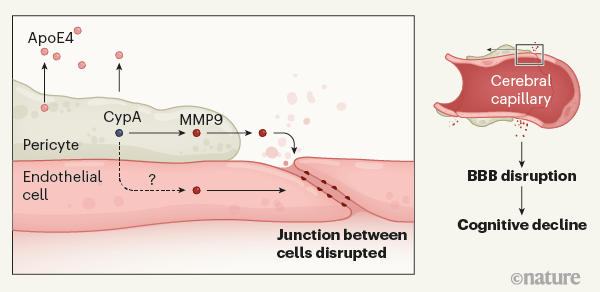
Finally, the researchers generated pericytes in vitro from human induced pluripotent stem cells that expressed APOE3 or APOE4. They found that APOE4-expressing pericytes secreted substantially more CypA and MMP9 than did APOE3
pericytes. ApoE4 (but not ApoE3) secreted by pericytes activates the
CypA–MMP9 pathway on nearby pericytes — the cells therefore cause their
own demise. ApoE4 could also activate the CypA–MMP9 pathway in
endothelial cells, which are susceptible to the harmful effects of APOE47. Therefore, injury to pericytes and endothelial cells might both cause BBB leakage (Fig. 1).
Figure 1 | The gene variantAPOE4and Alzheimer’s disease. People who carry APOE4 are at heightened risk of Alzheimer’s disease. Montagne et al.3
provide evidence that ApoE4 protein is secreted by cells called
pericytes, which abut endothelial cells that line cerebral capillaries
at the blood–brain barrier (BBB). Secreted ApoE4 activates the protein
cyclophilin A (CypA) in the pericytes. This triggers a downstream
signalling pathway involving activation of the inflammatory protein
matrix metalloproteinase-9 (MMP9) in pericytes, and possibly also in
endothelial cells. This causes disruption of junctions between adjoining
endothelial cells, opening the BBB in brain regions involved in
learning and memory. Disruption of the BBB is associated with impaired
cognition, although the mechanisms that link the two are unclear.
These observations cast new light on APOE4 that runs
contrary to the widely held idea that this gene variant contributes to
Alzheimer’s disease solely by promoting Aβ and tau accumulation4. Instead, it seems that BBB dysfunction might explain why APOE4 carriers are susceptible to Alzheimer’s disease. The authors’ findings might also explain why APOE4 carriers have worse outcomes following stroke or traumatic brain injury8 than do people who carry other APOE variants. However, as Alzheimer’s disease progresses, APOE4 could also slow Aβ and tau clearance, exacerbating declines in cognition.
Even more striking is the finding that early drivers of cognitive impairment differ between APOE4 and APOE3
carriers. Montagne and colleagues’ findings indicate that activation of
the CypA pathway and pericyte damage might not be involved in cognitive
impairment in people who carry the most common APOE variant, APOE3.
But whether a leaky BBB caused by factors that are independent of
pericytes (for example, damage to endothelial cells caused by Aβ1) contributes to cognitive impairment in APOE3 carriers remains unclear. The role of the BBB in APOE2 carriers, which was not assessed in the current study, also remains unknown. Although APOE2 is associated with a reduced risk of Alzheimer’s disease compared with other APOE variants, this is unlikely to result from a more resilient BBB, because APOE2 carriers have an increased risk of microhaemorrhages, suggesting vascular frailty4.
Whether
and how BBB breakdown leads to cognitive impairment also remains to be
determined. Is it a cause or a consequence of the disease process?
Evidence from mice indicates that some proteins in the blood, such as
fibrinogen, damage the synaptic connections between neurons9. But a pathogenic role for these proteins in the human brain has not yet been demonstrated.
Irrespective of these questions, Montagne et al. have broadened our understanding of how APOE4 promotes cognitive impairment. They have also demonstrated that different APOE
statuses can promote disease through different mechanisms. A deeper
appreciation of how gene variants shape Alzheimer’s disease might prove
crucial for more-personalized approaches to treating this prevalent and
incurable disease.







 Credit: Photo by veeterzy on Unsplash https://unsplash.com/@veeterzy