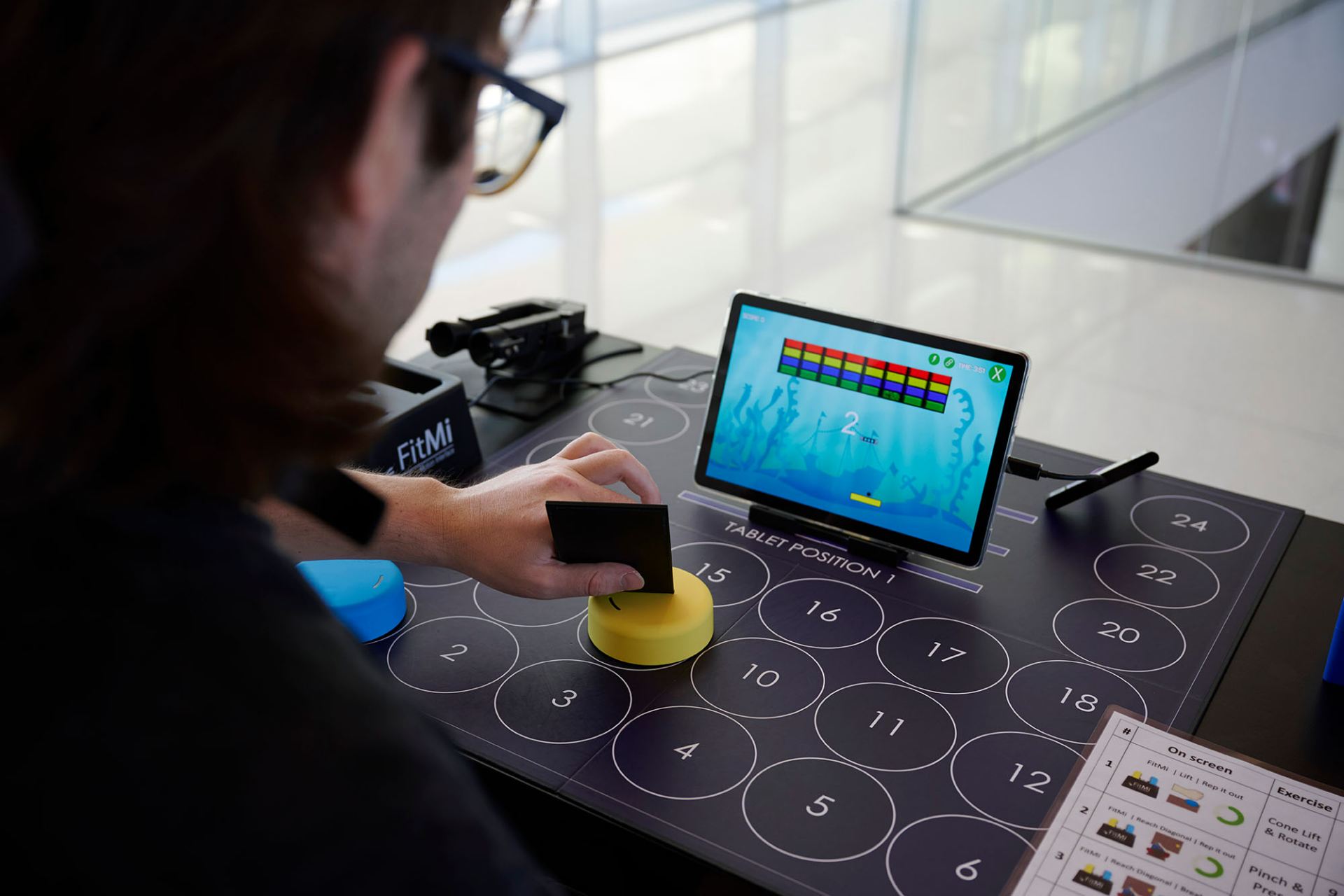
A stroke rehabilitation patient plays a
brick-breaking game as part of the RePlay system for motor skills
rehabilitation. The hand-held device uses an integrated accelerometer,
gyrometer and force sensor to measure the players’ movements, recording
statistics to track progress.
Researchers in The University of Texas at Dallas’ Texas Biomedical Device Center
(TxBDC) have developed an at-home physical rehabilitation system that
could give stroke patients an improved ability to recover upper-limb
function while removing transportation and other barriers.
In an article published online Oct. 31, 2022, and in the February print issue of Games for Health Journal,
the researchers describe a small feasibility study of RePlay, a
video-game-like system that patients can use independently to complete
the appropriate exercises to regain as much function as possible.
About 800,000 Americans experience strokes each year, and many of
them lose significant upper-limb function. They need rehabilitation,
which can be a long, expensive and arduous process. The availability of
unsupervised, at-home rehab could remove several barriers to optimal
recovery, said Dr. Michael Kilgard, interim executive director and chief science officer of TxBDC, and senior author of the study.

RePlay uses a variety of controllers to test
various abilities of stroke rehab patients, including grip strength.
Check out a short video demonstration on
YouTube.
“People don’t get enough physical therapy of any form,” said Kilgard, the Margaret Fonde Jonsson Professor of neuroscience in the School of Behavioral and Brain Sciences (BBS). “It costs too much. It takes too long. Not everyone is willing or able to go to as many sessions as are needed.”
RePlay creates a gameplay environment for rehab exercises in which
patients complete games on an Android tablet using a wireless hand-held
device or keyboard, or by swiping with their fingers. The equipment
measures force and movement of arms and fingers so that therapists can
customize instructions and quantify work and progress. Hand movements
are monitored as patients play seven different games.
“For neurorehabilitation after stroke or spinal cord injury, the goal
is to make new neural connections — you have to get people really
engaged,” Kilgard said. “In rehab, patients are asked to do a small
amount of targeted work every day, ramping up slowly. We wanted to find a
way to make it less tedious and something people actually finish.”
RePlay records exhaustive data on patient progress, providing
clinicians with a clear perspective on a patient’s recovery compared to
occasional rehab facility visits. The games become more challenging as
the patient improves.
Kilgard emphasized the importance of having measures of both physical progress and time spent on the device.
“Clinicians can see how many minutes were spent on each game, and
that matters a lot,” he said. “Physical therapy struggles with the
definition of a ‘dose’ of rehab — how much therapy does a patient need?
Are we counting in days or hours or sessions? This documents minutes of
active engagement. Bringing that data into physical and occupational
therapy is significant to us.”
“Our participants with stroke and spinal cord injury have
now played 19,000 of these games — hundreds upon hundreds of hours —
demonstrating that people can use RePlay effectively with only a short
learning period and little to no supervision.”
Dr. Michael Kilgard, interim executive director and chief science officer of the Texas Biomedical Device Center
Corresponding author David Pruitt MS’14, PhD’16, a former research
biomedical engineer at TxBDC and now a senior research engineer for
Vulintus, said the study demonstrated the potential benefits of RePlay
in both supervised and unsupervised settings. Sixteen patients used the
system during an initial one-hour office visit, and four of them took
the system home.
Participants produced on average 698 discrete movements during the
in-office visit, while those who used the system at home produced 1,593
discrete movements per day. The researchers’ baseline expectation was
100 repetitive movements per day.
VNS Therapy Clinical Trials
Researchers from the Texas Biomedical Device Center and Baylor Scott
& White Institute for Rehabilitation have teamed up to assess if
implanted vagus nerve stimulation coupled with rehabilitation is able to
improve arm function after a stroke or in people living with a spinal
cord injury. Therapy will take place over six weeks, and follow-ups will
occur at one, three and six months post-therapy. Participants will be
compensated for their time. Please visit these links for eligibility
requirements for the stroke and spinal cord injury trials.
“When we sent the RePlay system home with a subset of the
participants, we did not give them any extra help beyond an occasional
phone or Zoom call to see how things were going,” Pruitt said. “Every
day, each participant used the system consistently, following their plan
without supervision.”
Upon completion of the at-home phase, all of the participants
reported that they would be willing to use the system again in the
future.
“As you get stronger, the game raises the difficulty, or you can
adjust it yourself. If you can’t do the next level, it backs off next
time,” Kilgard said. “Our participants with stroke and spinal cord
injury have now played 19,000 of these games — hundreds upon hundreds of
hours — demonstrating that people can use RePlay effectively with only a
short learning period and little to no supervision.”
In future studies, the research team plans to test RePlay in tandem
with vagus nerve stimulation (VNS). The pairing of VNS with conventional
stroke rehab regimens was created at UT Dallas
to help rewire the circuitry of the brain and accelerate the recovery
of arm function. It was approved by the Food and Drug Administration in
August 2021.
“Adding the recovery-accelerating power of VNS to RePlay’s engaging,
convenient therapy could vastly improve the physical rehabilitation
experience for stroke and spinal cord injury patients,” Kilgard said.
“We hope RePlay makes rehabilitation much less cost-prohibitive. Along
with time and travel, we believe this system addresses the biggest
barriers to achieving the best possible results.”
Development of the RePlay platform was funded by two grants (R01NS094384, R01NS103803) from the National Institute of Neurological Disorders and Stroke.
Other UT Dallas faculty who are authors of the paper include neuroscience professor Dr. Robert Rennaker, associate director and chief technology officer of TxBDC and the Texas Instruments Distinguished Chair in Bioengineering; and Dr. Seth Hays, director of preclinical research for TxBDC, associate professor of bioengineering in the Erik Jonsson School of Engineering and Computer Science, and Fellow, Eugene McDermott Professor.
Current and former UT Dallas students who are among the authors
include Eric Meyers PhD’17, now a principal biomedical engineer at
Battelle; cognition and neuroscience doctoral student Rachael Affenit
Hudson; biomedical engineering doctoral student Joseph Epperson; and
TxBDC biomedical engineer Joel Wright BS’20. Dr. Jane Wigginton,
associate professor of emergency medicine at UT Southwestern Medical
Center, also was an author of the study.
To learn more about how UT Dallas is enhancing lives through transformative research, explore New Dimensions: The Campaign for UT Dallas.



 Open Access
 Access granted
 Subscription or Fee Access
