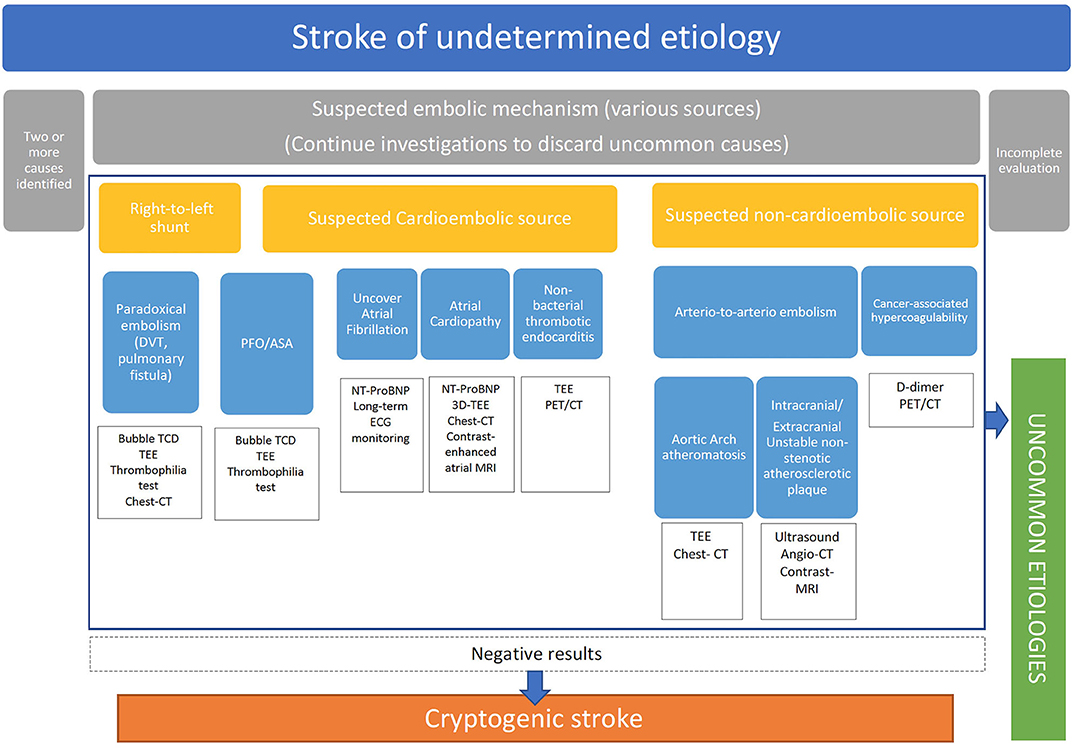
'Unknown' would never be allowed in the business world. Why is it allowed in the medical field? It would seem that the first thing you do is a CT or MRI scan to determine the exact location, determine if it is a bleed or clot and go from there. This is solveable. What is the protocol for diagnosing a stroke cause? If we don't have a protocol everyone in stroke leadership should be fired.
http://www.medpagetoday.com/Cardiology/Strokes/54102?xid=nl_mpt_DHE_2015-10-15&eun=g424561d0r
Physicians trying to figure out the cause of an unexplained stroke
need to take a lesson from former Secretary of Defense Donald Rumsfeld,
according to
Mitchell Elkind, MD.
In particular, Rumsfeld's reference to "unknown unknowns" -- things
we don't know that we don't know -- is a useful idea, said Elkind,
professor of neurology and epidemiology at Columbia University in New
York City, at a meeting here last week on cryptogenic stroke sponsored
by Medtronic, the American Heart Association, and the American Stroke
Association.
"In many cases, we just may not have looked for those things that could have caused the stroke," he said.
Cryptogenic stroke is defined as "a brain infarct not attributed to a
definite source of large-vessel atherosclerosis, cardioembolism, or
small vessel disease; it can be in the presence of an extensive work-up,
incomplete evaluation, or more than one cause," Elkind said.
A more recent evolution of the concept is ESUS, for "embolic stroke
of undetermined [or unknown] source." This definition, he continued,
implies that "the patient has had a full evaluation to show they don't
have [a] small-vessel stroke, no evidence of extracranial or
intracranial atherosclerosis, no major-risk cardioembolic source, and
they have no other specific cause" such as a dissection.
Cryptogenic stroke accounts for around 200,000 to 250,000 strokes per
year, and minorities such as African Americans and Hispanics are
disproportionately affected, Elkind said. Although common causes of
stroke, such as atrial fibrillation (Afib), are well-known, "more recent
evidence suggests there probably are a number of other atrial
abnormalities also associated with stroke, such as other arrhythmias,
blood markers like BMP, an enlarged left atrium, and abnormalities on
EKG," he added.
If the initial evaluation of a stroke patient -- which typically
includes a medical history, physical examination, blood tests, an EKG,
and imaging of the brain, blood vessels, and heart -- doesn't yield a
cause of a stroke, then more workups are called for. These tests for
"known unknowns" could include transesophageal echocardiography, more
prolonged cardiac monitoring, additional imaging of blood vessels, and
further lab testing.
And there is a huge list of possible additional causes
that might pop out at that evaluation, including migraine, genetic
disorders, non-stenosing plaques, infections, sleep apnea, cardiac
diseases, patent foramen ovale, and hypercoagulable states, Elkind
stated.
Negative Effects
Not knowing the cause of a stroke can have a negative effect on patients and physicians alike, said
Shyam Prabhakaran, MD,
director of stroke research at Northwestern University Feinberg School
of Medicine in Chicago. "We get lots of different things thrown at us,
like 'You don't know what caused my stroke?' That's damning; 'how come
you don't know something as simple as a cause of something as important
as a stroke'?" he said.
Or patients will ask, "Am I a ticking time bomb?" or "Should I go get
a second, third, or fourth opinion?," he continued. "Maybe you don't
know [the reason], but someone else does ... If you don't know what
caused it how can you tell [a patient] what to do?"
Sometimes patients will say, "'You looked for everything and I must
not have some of the bad causes of stroke. I guess that's a good
thing!'" Prabhakaran said. "I try to play up on that... It's the notion
of half empty or half full. If we didn't find [the cause], you perhaps
now have gotten yourself into a lower risk category -- you don't have
atrial fibrillation, you don't have a carotid lesion that needs to be
treated. I think that's the way we need to communicate."
He noted that part of the problem with cryptogenic stroke
is that "there really isn't a concise diagnostic evaluation that every
patient is supposed to get; there's so much variability based on where
you are."
"There's really an opportunity here for this group ... to help
standardize what is the expectation and what tests should be offered to
these patients," Prabhakaran said. "Are there determinants of that? Are
there access issues related to race, ethnicity, or income that play a
role in determining who gets what tests?"
Role of Afib
Eric Prystowsky, MD,
director of the cardiac arrhythmia service at St. Vincent Hospital in
Indianapolis, discussed the complicated role of atrial fibrillation.
"Just because you identify atrial fibrillation on the workup doesn't
mean it was the cause of the stroke," he pointed out. On the other hand,
if atrial fibrillation is the cause, it's sometimes difficult to detect
since patients don't always feel it.
Prystowsky suggested that patients hospitalized for cryptogenic
stroke who might have undiagnosed atrial fibrillation should be
discharged with a monitor. "I don't understand why [cryptogenic stroke]
patients don't go home with a monitor; why do you want to wait 3 months?
If you haven't figured it out in the hospital and you're suspicious,
you should get them on a monitor at the time of discharge."
There are also causes of stroke that no one really thinks about, said
Mark Alberts, MD,
professor of neurology at the University of Texas Southwestern Medical
Center in Dallas. "We do a whole-body scan with a person who has a
cryptogenic stroke and [often pick up] cancer," he said. "That's often
what causes a hypercoagulable state."
Drug abuse is also not tested for often, he said, adding that when he
worked at Northwestern University, "I had an edict ... Everybody who
walks in with a stroke or TIA [transient ischemic attack] gets a
[toxicology] screen." The oldest positive tox screen he saw was for an
"80-something" patient who was using cocaine.
Role of Stroke Centers
Due to the complexity of cryptogenic stroke, "most patient benefit
from a workup at a comprehensive stroke center" (CSC) such as at
Southwestern, Alberts said. "The thoroughness of the workup and accuracy
of diagnosis is going to vary greatly if the patient is not evaluated
properly."
David Baker, MD,
executive vice president for healthcare quality evaluation at the Joint
Commission, in Chicago, agreed. "One of goals should be to minimize
cryptogenic strokes by getting a proper workup. But if that not done,
[you] need referral to CSC."
But
Michael Brown, MD,
chair of the clinical policies committee at the American College of
Emergency Physicians, was concerned about the effects of such a
recommendation. "It seems like we must consider appropriate use of
resources," he said.
"A lot of what we talk about is endless workup. If you had a tiny stroke, a tiny
ditzel on an MRI, that's going to initiate a cascade of events; there is a cost to this. Where does cost-effectiveness come in?"
"We would hope some of these diagnostic pathways would have stops,"
Baker responded. "If you hit an extremely high level of confidence, you
may not need to go through a full workup for every patient." However, he
added, "All of this is probably going to get dramatically worse in the
next few years because of high-deductible health plans; we are going to
do expensive workups and people will leave and not be able to afford
their medications."
Terminology was another issue debated at the meeting. The term "cryptogenic stroke" should go away,
Clyde Yancy, MD, chief of cardiology at Northwestern University Feinberg School of Medicine, told
MedPage Today.
Instead, it should be "replaced with a specific cause for stroke or
ESUS, because at least it would implicate a treatment," he said.
Alberts, for his part, objected to the use of ESUS. "That's sort of a
misnomer because it implies we know it's an embolic stroke. How do you
know that?" he said. "When does ESUS become just SUS?"


 Blanca Fuentes
 Raquel Gutiérrez-Zúñiga
 Exuperio Díez-Tejedor