Changing stroke rehab and research worldwide now.Time is Brain! trillions and trillions of neurons that DIE each day because there are NO effective hyperacute therapies besides tPA(only 12% effective). I have 523 posts on hyperacute therapy, enough for researchers to spend decades proving them out. These are my personal ideas and blog on stroke rehabilitation and stroke research. Do not attempt any of these without checking with your medical provider. Unless you join me in agitating, when you need these therapies they won't be there.

What this blog is for:

My blog is not to help survivors recover, it is to have the 10 million yearly stroke survivors light fires underneath their doctors, stroke hospitals and stroke researchers to get stroke solved. 100% recovery. The stroke medical world is completely failing at that goal, they don't even have it as a goal. Shortly after getting out of the hospital and getting NO information on the process or protocols of stroke rehabilitation and recovery I started searching on the internet and found that no other survivor received useful information. This is an attempt to cover all stroke rehabilitation information that should be readily available to survivors so they can talk with informed knowledge to their medical staff. It lays out what needs to be done to get stroke survivors closer to 100% recovery. It's quite disgusting that this information is not available from every stroke association and doctors group.

Showing posts with label DNR. Show all posts

Thursday, September 30, 2021

End-of-Life Care Decision-Making in Stroke

You'll want to make sure your loved never hears the DNR, the nocebo effect might occur and your loved one completes the “self-fulfilling prophecy” by dying. You'll have to ask what is the objective reason the patient is expected to die. See how badly your stroke doctors know nothing factual about stroke:

All guesswork like this:

Mercury astronaut Scott Carpenter suffers stroke; full recovery expected

Oops! 

 Scott Carpenter - Obituary

End-of-Life Care Decision-Making in Stroke

  • 1Yale School of Medicine, New Haven, CT, United States
  • 2Division of Neurocritical Care and Emergency Neurology, Yale School of Medicine, New Haven, CT, United States

Stroke is one of the leading causes of death and long-term disability in the United States. Though advances in interventions have improved patient survival after stroke, prognostication of long-term functional outcomes remains challenging, thereby complicating discussions of treatment goals. Stroke patients who require intensive care unit care often do not have the capacity themselves to participate in decision making processes, a fact that further complicates potential end-of-life care discussions after the immediate post-stroke period. Establishing clear, consistent communication with surrogates through shared decision-making represents best practice, as these surrogates face decisions regarding artificial nutrition, tracheostomy, code status changes, and withdrawal or withholding of life-sustaining therapies. Throughout decision-making, clinicians must be aware of a myriad of factors affecting both provider recommendations and surrogate concerns, such as cognitive biases. While decision aids have the potential to better frame these conversations within intensive care units, aids specific to goals-of-care decisions for stroke patients are currently lacking. This mini review highlights the difficulties in decision-making for critically ill ischemic stroke and intracerebral hemorrhage patients, beginning with limitations in current validated clinical scales and clinician subjectivity in prognostication. We outline processes for identifying patient preferences when possible and make recommendations for collaborating closely with surrogate decision-makers on end-of-life care decisions.

Introduction: Epidemiology of Life-Sustaining Therapy for Severe Stroke Patients

Stroke is a leading cause of death and long-term disability in the United States (US) (1, 2). The term “stroke” for this review focuses on two subtypes: acute ischemic stroke (AIS) and intracerebral hemorrhage (ICH). Clinicians are often confronted with issues related to end-of-life (EOL) care for stroke patients, such as code status, dysphagia care, and airway management (3). In order to tailor these decisions to patients' wishes, goals-of-care (GOC) discussions regarding acceptable quality of life (QoL) that require collaboration with surrogate decision-makers of incapacitated patients are needed.

Code status changes are among the earliest decisions that may occur during hospitalization for severe stroke. In practice, do-not-resuscitate (DNR) orders are often placed as early as within 24 hours of emergency department admission for both ICH (4) and AIS (5) patients. Approximately 13–26% of stroke patients receive DNR orders within 24 hours of admission (4, 5), with higher proportions of DNR status among those who later die of stroke (6, 7). There is concern that the act of making a patient DNR by itself affects clinicians' impressions of prognosis and independently increases the likelihood of mortality in AIS (5) and ICH (8, 9). This possible “self-fulfilling prophecy” is a well-established concern in stroke care (10).

In the days to weeks after admission, issues of nutrition and airway management often come to the forefront of decision-making. Percutaneous endoscopic gastrostomy (PEG) placement is currently performed throughout the US in 8.8% of patients with AIS (11) and 10.4% for ICH (12), with variation amongst institutions (11, 12). Over half of PEG placements for AIS occur in the first week of admission (13). For stroke patients who have difficulty maintaining an open airway or who require prolonged mechanical ventilation, tracheostomy in the US is commonly performed 6–14 days after stroke onset (14, 15), with increasing numbers over the past two decades (14). Rates of life-sustaining interventions are higher in minority patients than white patients (16), including PEG (17, 18) and tracheostomy (18).

In conjunction with these decisions, surrogates and clinical teams often decide to forgo life-sustaining measures and instead pursue comfort measures only (CMO). Withdrawal of life-sustaining therapy (WLST) is more common in neuro-intensive care units (Neuro-ICUs) than medical intensive care units (MICUs) (19), with up to 26% of all ICH patients in one single-center series undergoing WLST (20). Almost half of all stroke deaths occur inpatient (21), and hospitalized stroke patients have extensive palliative care needs (22, 23) that may not always be met. In one single-center US study from 2009-2015, about 4% of AIS patients were discharged to hospice (22).

In this brief review, we discuss the issues that arise when making EOL care decisions regarding stroke patients. We discuss prognostication tools, their limitations, methods to determine an incapacitated patient's wishes including advance care planning documentation (ACP) and best practices for shared decision-making with surrogates.

Prognostication: Limitations of Clinical Scales

One factor in EOL decision-making involves prognostication of long-term outcome or natural disease history. Multiple clinical scales have been developed to predict mortality and functional outcome after stroke (2426), several of which have been externally validated (Table 1).
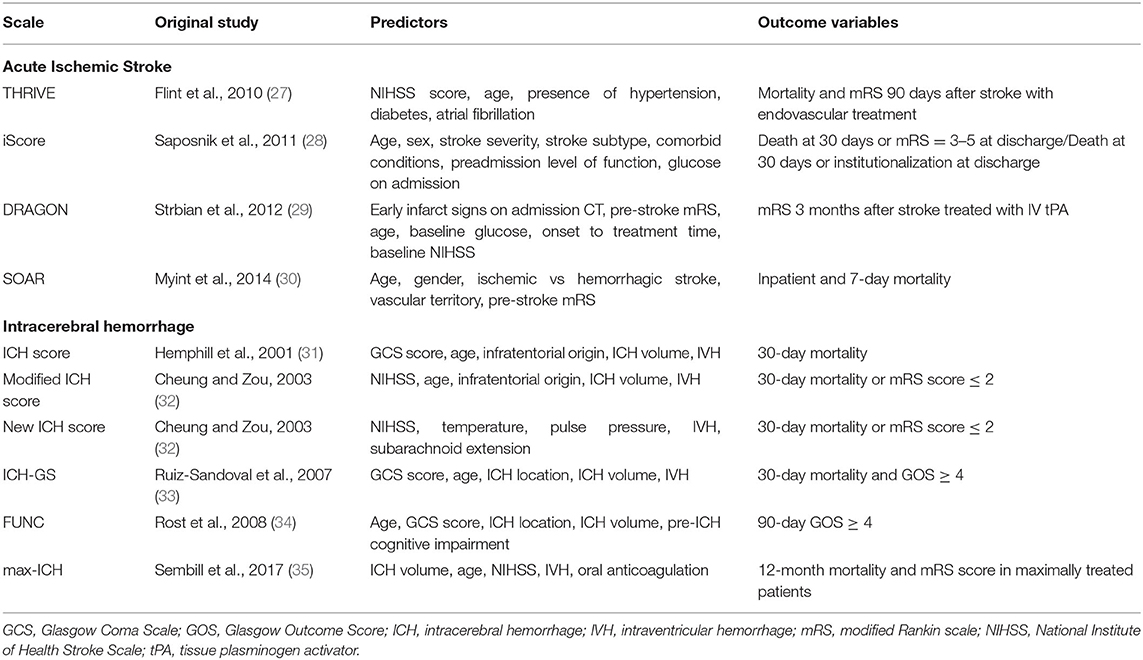
TABLE 1
www.frontiersin.org

Table 1. Selected clinical scales developed for acute ischemic stroke and intracerebral hemorrhage.

Common predictor variables in AIS scales include age, stroke severity, pre-stroke functional status, comorbidities, and stroke subtype (24), with some scales utilizing imaging characteristics (36).

For ICH, many prognostication scales are based on variations of the “original” ICH score (33, 3740), which was initially published with 30-day mortality data utilizing age, Glasgow Coma Scale at admission, ICH location, ICH volume, and presence of intraventricular hemorrhage (31).

Some published data suggest that scales largely outperform the “subjective” opinion of clinicians at predicting mortality and functional disability (4143). However, these studies generally involved asking clinicians to prognosticate expected outcomes from hypothetical patient vignettes, which simplify and distill information that would otherwise be available in real-world clinical practice. In a comparison of the predictions of clinicians against common prognostication scales for 3-month functional status in real-world ICH patients, clinicians outperformed scales with regards to predictive accuracy (44).

This finding points towards the first of several limitations of prognostication scales—scales generate predictions using cohort data, yet prediction for individual patients may depend on variables not captured by scales. Furthermore, few models have been assessed for calibration (45) and robust external validation (25, 46), limiting their generalizability. Most scales were developed retrospectively, and data used to generate them include local practice patterns with regards to WLST, potentially incorporating the self-fulfilling prophesy. Finally, scales may not predict outcomes that are most important to patients and families, as the same functional outcome may lead to different perceptions of QoL for different patients. Clinicians have been shown to be poor at predicting a patient's future QoL, an inherently subjective quality, after stroke (4749).

Despite these limitations, disclosing the results of a prognostication scale for a patient to a clinician impacts that clinician's clinical impression (50). Awareness of the limitations of scales can help ensure that the clinician utilizes these tools to complement clinical judgment rather than replace it. Recent studies suggest that making predictions based on clinical data from hospital day 5 rather than at admission may improve prognostication accuracy (51). Given the lack of objective tools for accurate prognostication and the potential for clinician bias to factor into decision-making, delaying prognostication may lead to improved prediction accuracy and clinical outcomes.

Goals-of-Care Conversations: Determining Patients' Wishes

Besides accurate neuro-prognostication, the ideal timing of GOC discussions regarding acceptable QoL for hospitalized stroke patients requires several considerations. GOC discussions, once initiated, are often iterative (1). Prognostic information should be tailored by amount and timing to the preferences of patients and families (52).

The aim of GOC discussions should be to ascertain the patient's wishes, or best estimates thereof, in order to provide goal-concordant care. As a means to this end, ACPs and surrogate decision-makers represent two sources of information for clinicians.


Friday, August 21, 2020

Treatment Restrictions and the Risk of Death in Patients With Ischemic Stroke or Intracerebral Hemorrhage

 If your doctor comes to you with this recommendation it means they have already given up.  SO YOUR ONLY SOLUTION IS TO HAVE A MILD STROKE.  This means your doctor has never come up with an objective damage diagnosis and protocols that fix that damage. Why the fuck are you going to such an incompetent hospital?

Treatment Restrictions and the Risk of Death in Patients With Ischemic Stroke or Intracerebral Hemorrhage

 
Originally publishedhttps://doi.org/10.1161/STROKEAHA.120.029788Stroke. ;0

Background and Purpose:

Do-not-resuscitate (DNR) orders in the first 24 hours after intracerebral hemorrhage have been associated with an increased risk of early death. This relationship is less certain for ischemic stroke. We assessed the relation between treatment restrictions and mortality in patients with ischemic stroke and in patients with intracerebral hemorrhage. We focused on the timing of treatment restrictions after admission and the type of treatment restriction (DNR order versus more restrictive care).

Methods:

We retrospectively assessed demographic and clinical data, timing and type of treatment restrictions, and vital status at 3 months for 622 consecutive stroke patients primarily admitted to a Dutch university hospital. We used a Cox regression model, with adjustment for age, sex, comorbidities, and stroke type and severity.

Results:

Treatment restrictions were installed in 226 (36%) patients, more frequently after intracerebral hemorrhage (51%) than after ischemic stroke (32%). In 187 patients (83%), these were installed in the first 24 hours. Treatment restrictions installed within the first 24 hours after hospital admission and those installed later were independently associated with death at 90 days (adjusted hazard ratios, 5.41 [95% CI, 3.17–9.22] and 5.36 [95% CI, 2.20–13.05], respectively). Statistically significant associations were also found in patients with ischemic stroke and in patients with just an early DNR order. In those who died, the median time between a DNR order and death was 520 hours (interquartile range, 53–737).

Conclusions:

The strong relation between treatment restrictions (including DNR orders) and death and the long median time between a DNR order and death suggest that this relation may, in part, be causal, possibly due to an overall lack of aggressive care.(Wrong, overall lack of protocols that deliver results. Survivors don't care about 'care'. Just maybe they want you to have effective protocols that deliver recovery results.)

Footnotes

For Sources of Funding and Disclosures, see page XXX.

The Data Supplement is available with this article at https://www.ahajournals.org/doi/suppl/10.1161/STROKEAHA.120.029788.

Correspondence to: H. Bart van der Worp, MD, PhD, Department of Neurology and Neurosurgery, University Medical Center Utrecht, Heidelberglaan 100, 3584 CX Utrecht, the Netherlands. Email

Sunday, July 19, 2020

Early Do-Not-Resuscitate Orders and Outcome After Intracerebral Hemorrhage


I see nothing here that suggests that an objective damage diagnosis was done before the DNR was written. You better hope like hell this doesn't happen to you, you better be awake and cognizant to dispute this. You better not be transported to one of these fast DNR hospitals, you won't make it out alive. Is the DNR because of co-morbidities or because of the extremely difficult work of stopping the bleed and the hospital doesn't have the staff to accomplish that? Is this before or after the bleed is stopped?

Early Do-Not-Resuscitate Orders and Outcome After Intracerebral Hemorrhage


Abstract

Background

Do-not-resuscitate (DNR) orders are commonly used after intracerebral hemorrhage (ICH) and have been shown to be a predictor of mortality independent of disease severity(So you don't know the severity? WHAT THE FUCK ARE YOU DOING?). We determined the frequency of early DNR orders in ICH patients and whether a previously reported association with increased mortality still exists.

Methods

We performed a retrospective analysis of patients discharged from non-federal California hospitals with a primary diagnosis of ICH from January 2013 through December 2014. Characteristics included hospital ICH volume and type and whether DNR order was placed within 24 h of admission (early DNR order). The risk of in-hospital mortality was evaluated both on the individual and hospital level using multivariable analyses. A case mix-adjusted hospital DNR index was calculated for each hospital by comparing the actual number of DNR cases with the expected number of DNR cases from a multivariate model.

Results

A total of 9,958 patients were treated in 180 hospitals. Early DNR orders were placed in 20.1% of patients and 54.2% of these patients died during their hospitalization compared to 16.0% of patients without an early DNR order. For every 10% increase in a hospital’s utilization of early DNR orders, there was a corresponding 26% increase in the likelihood of in-hospital mortality. Patients treated in hospitals within the highest quartile of adjusted DNR use had a higher relative risk of death compared to the lowest quartile (RR 3.9 vs 5.2) though the trend across quartiles was not statistically significant.

Conclusions

The use of early DNR orders for ICH continues to be a strong predictor of in-hospital mortality. However, patients treated at hospitals with an overall high or low use of early DNR had similar relative risks of death whether or not there was an early DNR order, suggesting that such orders may not be a proxy for less aggressive care as seen previously.

This is a preview of subscription content, log in to check access.

References

  1. 1.
    Feigin VL, Lawes CMM, Bennett DA, Barker-Collo SL, Parag V. Worldwide stroke incidence and early case fatality reported in 56 population-based studies: a systematic review. Lancet Neurol. 2009;8:355–69.
    Article  Google Scholar 
  2. 2.
    van Asch CJ, Luitse MJ, Rinkel GJ, van der Tweel I, Algra A, Klijn CJ. Incidence, case fatality, and functional outcome of intracerebral hemorrhage over time, according to age, sex, and ethnic origin: a systematic review and meta-analysis. Lancet Neurol. 2010;9:167–76.
    Article  Google Scholar 
  3. 3.
    Rincon F, Mayer SA. The epidemiology of intracerebral hemorrhage in the United States from 1979 to 2008. Neurocrit Care. 2013;19:95–102.
    Article  Google Scholar 
  4. 4.
    Davis SM, Broderick J, Hennerici M, Brun NC, Diringer MN, Mayer SA, et al. Hematoma growth is a determinant of mortality and poor outcome after intracerebral hemorrhage. Neurology. 2006;66:1175–81.
    CAS  Article  Google Scholar 
  5. 5.
    Hemphill JC, Bonovich DC, Besmertis L, Manley GT, Johnston SC. The ICH score: a simple, reliable grading scale for intracerebral hemorrhage. Stroke. 2001;32:891–7.
    Article  Google Scholar 
  6. 6.
    Morgenstern LB, Zahuranec DB, Sánchez BN, Becker KJ, Geraghty M, Hughes R, et al. Full medical support for intracerebral hemorrhage. Neurology. 2015;84:1739–44.
    Article  Google Scholar 
  7. 7.
    Becker KJ, Baxter AB, Cohen WA, Bybee HM, Tirschwell DL, Newell DW, et al. Withdrawal of support in intracerebral hemorrhage may lead to self-fulfilling prophecies. Neurology. 2001;56:766–72.
    CAS  Article  Google Scholar 
  8. 8.
    Hemphill JC, Newman J, Zhao S, Johnston SC. Hospital usage of early do-not-resuscitate orders and outcome after intracerebral hemorrhage. Stroke. 2004;35:1130–4.
    Article  Google Scholar 
  9. 9.
    Broderick J, Connolly S, Feldmann E, Hanley D, Kase C, Krieger D, et al. Guidelines for the management of spontaneous intracerebral hemorrhage in adults: 2007 update: a Guideline From the American Heart Association/American Stroke Association Stroke Council, High Blood Pressure Research Council, and the Quality of Care and Outcomes in Research Interdisciplinary Working Group. Circulation. 2007;116:e391–413.
    Article  Google Scholar 
  10. 10.
    Zahuranec DB, Brown DL, Lisabeth LD, Gonzales NR, Longwell PJ, Smith MA, et al. Early care limitations independently predict mortality after intracerebral hemorrhage. Neurology. 2007;68:1651–7.
    CAS  Article  Google Scholar 
  11. 11.
    Beach MC, Morrison RS. the effect of do-not-resuscitate orders on physician decision-making. J Am Geriatr Soc. 2002;50:2057–61.
    Article  Google Scholar 
  12. 12.
    Xian Y, Holloway RG, Smith EE, Schwamm LH, Reeves MJ, Bhatt DL, et al. Racial/ethnic differences in process of care and outcomes among patients hospitalized with intracerebral hemorrhage. Stroke. 2014;45:3243–50.
    Article  Google Scholar 
  13. 13.
    Silvennoinen K, Meretoja A, Strbian D, Putaala J, Kaste M, Tatlisumak T. Do-not-resuscitate (DNR) orders in patients with intracerebral hemorrhage. Int J Stroke. 2014;9:53–8.
    Article  Google Scholar 
  14. 14.
    Zurasky JA, Aiyagari V, Zazulia AR, Shackelford A, Diringer MN. Early mortality following spontaneous intracerebral hemorrhage. Neurology. 2005;64:725–7.
    CAS  Article  Google Scholar 
  15. 15.
    Sembill JA, Gerner ST, Volbers B, Bobinger T, Lücking H, Kloska SP, et al. Severity assessment in maximally treated ICH patients: the max-ICH score. Neurology. 2017;89:423–31.
    Article  Google Scholar 
  16. 16.
    Naidech AM, Bernstein RA, Bassin SL, Garg RK, Liebling S, Bendok BR, et al. How patients die after intracerebral hemorrhage. Neurocrit Care. 2009;11:45–9.
    Article  Google Scholar 
  17. 17.
    Suarez JI, Zaidat OO, Suri MF, Feen ES, Lynch G, Hickman J, et al. Length of stay and mortality in neurocritically ill patients: impact of a specialized neurocritical care team. Crit Care Med. 2004;32:2311–7.
    Article  Google Scholar 
  18. 18.
    Diringer MN, Edwards DF. Admission to a neurologic/neurosurgical intensive care unit is associated with reduced mortality rate after intracerebral hemorrhage. Crit Care Med. 2001;29:635–40.
    CAS  Article  Google Scholar 
  19. 19.
    González-Pérez A, Gaist D, Wallander M-A, McFeat G, García-Rodríguez LA. Mortality after hemorrhagic stroke: data from general practice (the health improvement network). Neurology. 2013;81:559–65.
    Article  Google Scholar 
  20. 20.
    Béjot Y, Grelat M, Delpont B, Durier J, Rouaud O, Osseby G-V, et al. Temporal trends in early case-fatality rates in patients with intracerebral hemorrhage. Neurology. 2017;88:985–90.
    Article  Google Scholar 
  21. 21.
    Poon MTC, Fonville AF, Al-Shahi SR. Long-term prognosis after intracerebral hemorrhage: systematic review and meta-analysis. J Neurol Neurosurg Psychiatry. 2014;85:660–7.
    Article  Google Scholar 
  22. 22.
    Mendelow AD, Gregson BA, Fernandes HM, Murray GD, Teasdale GM, Hope DT, et al. Early surgery versus initial conservative treatment in patients with spontaneous supratentorial intracerebral haematomas in the international surgical trial in intracerebral haemorrhage (STICH): a randomised trial. Lancet. 2005;365:387–97.
    PubMed  PubMed Central  Google Scholar 
  23. 23.
    Ziai WC, Siddiqui AA, Ullman N, Herrick DB, Yenokyan G, McBee N, et al. Early therapy intensity level (TIL) predicts mortality in spontaneous intracerebral hemorrhage. Neurocrit Care. 2015;23:188–97.
    CAS  Article  Google Scholar 
  24. 24.
    Qureshi AI, Majidi S, Chaudhry SA, Qureshi MH, Suri MFK. Validation of intracerebral hemorrhage-specific intensity of care quality metrics. J Stroke Cerebrovasc Dis. 2013;22:661–7.
    Article  Google Scholar 
  25. 25.
    Tomlinson T, Brody H. Ethics and communication in do-not-resuscitate orders. N Engl J Med. 1988;318:43–6.
    CAS  Article  Google Scholar 
  26. 26.
    Richardson DK, Zive D, Daya M, Newgard CD. The impact of early do not resuscitate (DNR) orders on patient care and outcomes following resuscitation from out of hospital cardiac arrest. Resuscitation. 2013;84:483–7.
    Article  Google Scholar 
  27. 27.
    Fuchs L, Anstey M, Feng M, Toledano R, Kogan S, Howell MD, et al. Quantifying the mortality impact of do-not-resuscitate orders in the ICU. Crit Care Med. 2017;45:1019–27.
    Article  Google Scholar 
  28. 28.
    Zahuranec DB, Morgenstern LB, Sánchez BN, Resnicow K, White DB, Hemphill JC. Do-not-resuscitate orders and predictive models after intracerebral hemorrhage. Neurology. 2010;75:626–33.
    CAS  Article  Google Scholar 
  29. 29.
    Creutzfeldt CJ, Becker KJ, Weinstein JR, Khot SP, McPharlin TO, Ton TG, et al. Do-not-attempt-resuscitation orders and prognostic models for intraparenchymal hemorrhage. Crit Care Med. 2011;39:158–62.
    Article  Google Scholar 
  30. 30.
    Zahuranec DB, Fagerlin A, Sánchez BN, Roney ME, Thompson BB, Fuhrel-Forbis A, et al. Variability in physician prognosis and recommendations after intracerebral hemorrhage. Neurology. 2016;86:1864–71.
    Article  Google Scholar 
  31. 31.
    Kelly PJ, Furie KL, Shafqat S, Rallis N, Chang Y, Stein J. Functional recovery following rehabilitation after hemorrhagic and ischemic stroke. Arch Phys Med Rehabil. 2003;84:968–72.
    Article  Google Scholar 
  32. 32.
    Katrak PH, Black D, Peeva V. Do stroke patients with intracerebral hemorrhage have a better functional outcome than patients with cerebral infarction? PM R. 2009;1:427–33.
    Article  Google Scholar 
  33. 33.
    Sreekrishnan A, Leasure AC, Shi F-D, Hwang DY, Schindler JL, Petersen NH, et al. Functional improvement among intracerebral hemorrhage (ICH) survivors up to 12 months post-injury. Neurocrit Care. 2017;27:326–33.
    Article  Google Scholar 

Thursday, April 2, 2015

Full medical support for intracerebral hemorrhage - DNR orders

You'll have to hope your medical team has read this or your relatives like you enough so they don't sign immediate Do Not Resuscitate orders.
http://www.neurology.org/content/early/2015/03/27/WNL.0000000000001525.short?rss=1
  1. J. Claude Hemphill III, MD, MAS
  1. Correspondence to Dr. Morgenstern: lmorgens@umich.edu
  1. Neurology 10.1212/WNL.0000000000001525
  1. Also available:
  2. Data Supplement

Abstract

Objective: This study tested the hypothesis that patients without placement of new do-not-resuscitate (DNR) orders during the first 5 days after intracerebral hemorrhage (ICH) have lower 30-day mortality than predicted by the ICH Score without an increase in severe disability at 90 days.
Methods: This was a prospective, multicenter, observational cohort study at 4 academic medical centers and one community hospital. Adults (18 years or older) with nontraumatic spontaneous ICH, Glasgow Coma Scale score of 12 or less, who did not have preexisting DNR orders were included.
Results: One hundred nine subjects were enrolled. Mean age was 62 years; median Glasgow Coma Scale score was 7, and mean hematoma volume was 39 cm3. Based on ICH Score prediction, the expected overall 30-day mortality rate was 50%. Observed mortality was substantially lower at 20.2%, absolute average difference 29.8% (95% confidence interval: 21.5%–37.7%). At 90 days, 27.1% had died, 21.5% had a modified Rankin Scale score = 5 (severe disability). A good outcome (modified Rankin Scale score 0–3) was achieved by 29.9% and an additional 21.5% fell into the moderately severe disability range (modified Rankin Scale score = 4).
Conclusions: Avoidance of early DNR orders along with guideline concordant ICH care results in substantially lower mortality than predicted. The observed functional outcomes in this study provide clinicians and families with data to determine the appropriate goals of treatment based on patients' wishes.